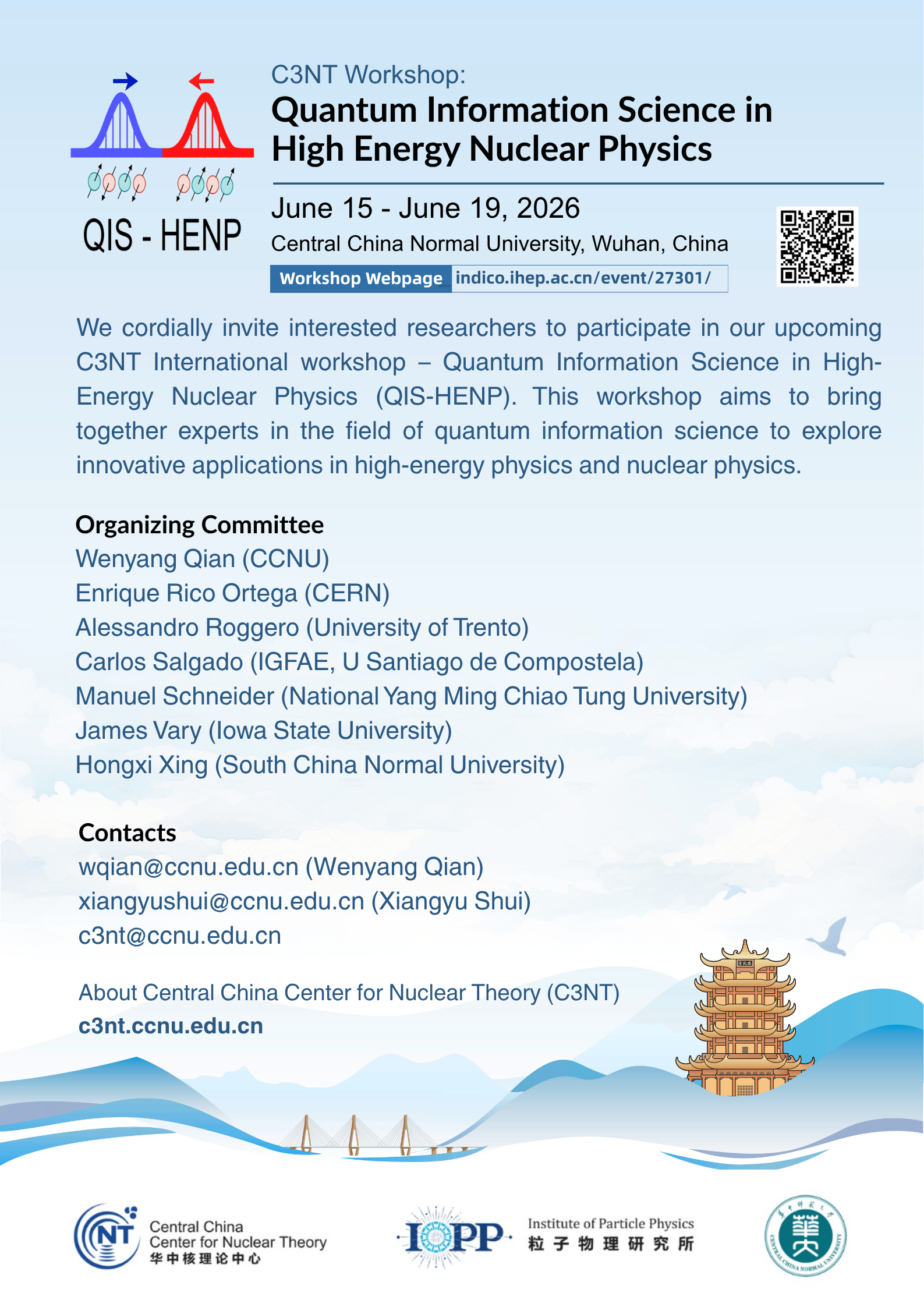
C3NT workshop: Quantum Information Science in High Energy Nuclear Physics (QIS-HENP)
9409
Building 9
Quantum simulation of high-energy physics (HEP) was one of the original motivations for the development of quantum computers and remains a source of ongoing proposals for achieving quantum advantage. As experimental platforms grow in size and fidelity and classical algorithms near their limits, novel quantum‑information tools are poised to revolutionize how we simulate fundamental interactions and dynamical processes in quantum field theories.
In this workshop, we bring together experts in different aspects of Quantum Information Science (QIS) to explore novel applications of cutting-edge methods, such as tensor networks and quantum simulation, in the context of HEP and nuclear physics. By fostering interdisciplinary dialogue through invited talks and discussions, our QIS‑HENP workshop will highlight new research directions at the interface of QIS and high‑energy/nuclear physics.
For invited participants & speakers:There will be no registration fee. Local support (meal and accommodation) will be provided if requested.
For non-invited participants:There will be a small registration fee (500 Yuan, or 73 dollars). Local support will be considered case by case, but not guaranteed (for registration after May 15, one will need to find their own hotel).
This event belongs to the workshop series organized by the Central China Center for Nuclear Theory (C3NT,c3nt.ccnu.edu.cn).

Group Photo on Monday:

Abolfazl Bayat
Ajaharul Islam
Alessandro Roggero
Alessio Celi
Andrea Bulgarelli
Ashutosh Tripathi
Baoyi Chen
Bin Wu
Carlos A. Salgado
Chengyi Li
Defu Hou
Dhruv Sood
Di Luo
Dong Bai
Enrique Rico Ortega
Francesco Pederiva
Germán Rodrigo
Hideki Okawa
Hongxi Xing
Hui Sun
Jad Halimeh
Jai Prakash
James Vary
jinghua fu
Jinlong Dang
Jinlong Dang
Kaiming Luo
Ke-Yang Liu
Li Tianyin
Linyuan Wei
Liqiang Zhu
Manuel Schneider
Matteo Wauters
Meijian Li
Sandip Maiti
Shuzhe Shi
Simone Montangero
Simran Singh
Srimoyee Sen
Weijie Du
Wenyang Qian
Xiaohui Liu
Xiaojian Du
Xiaoyang Wang
Xiaozhi Bai
Xingyu Guo
Xu-Guang Huang
Yahui Chai
Yang Li
Yifei Zhang
Ying-Ying Li
Yoshimasa Hidaka
Ziqi Zhang
子鑫 刘
甫鹏 李
-
- 12:00→18:00
Arrival 9409
9409
Building 9
Central China Normal University 152 Luoyu Road, Hongshan District Wuhan, Hubei, China
- 12:00→18:00
-
- 08:00→09:00
Registration 9409
9409
Building 9
Central China Normal University 152 Luoyu Road, Hongshan District Wuhan, Hubei, China - 09:00→09:10
Introduction 9409
9409
Building 9
Central China Normal University 152 Luoyu Road, Hongshan District Wuhan, Hubei, China- 09:00
Introduction and welcome 10mSpeaker: Wenyang Qian(Central China Normal University)
- 09:00
- 09:10→10:20
Talks 9409
9409
Building 9
Central China Normal University 152 Luoyu Road, Hongshan District Wuhan, Hubei, ChinaConvener: Hongxi Xing(South China Normal University)- 09:10
Quantum Algorithms for Event Generators at High-Energy Colliders 35mSpeaker: Germán Rodrigo
- 09:45
- 09:10
- 10:20→10:50
Coffee break 30m 9409
9409
Building 9
Central China Normal University 152 Luoyu Road, Hongshan District Wuhan, Hubei, China - 10:50→12:00
Talks 9409
9409
Building 9
Central China Normal University 152 Luoyu Road, Hongshan District Wuhan, Hubei, ChinaConvener: Alessandro Roggero- 10:50
Experimental applications of quantum algorithms in high-energy physics 35mSpeaker: Hideki Okawa
- 11:25
Defining quantum advantage in microscopic nuclear theory 35mSpeaker: James Vary
- 10:50
- 12:00→14:00
Lunch break 2h
- 14:00→15:45
Talks 9409
9409
Building 9
Central China Normal University 152 Luoyu Road, Hongshan District Wuhan, Hubei, ChinaConvener: Shuzhe Shi(Tsinghua University)- 14:00
Probing Confinement with Superconducting Circuits: From Z2 String Dynamics to Continuous U(1) Electrodynamics 35m
Understanding confinement and gauge-field dynamics beyond the reach of classical computation is one of the driving motivations for quantum simulation. I will present two complementary advances using superconducting circuits as a platform for lattice gauge theories (LGTs).
First, I will report on a digital quantum simulation of the Z2-Higgs model in (2+1) dimensions on a superconducting processor with up to 144 qubits and circuit depths reaching 192 two-qubit layers. Matter and gauge fields are mapped directly onto vertex and link qubits of a heavy-hex architecture. Combining error suppression, mitigation, and correction strategies, we observe in real time the string modes of motion of electric flux tubes connecting dynamical charges, providing a direct window into the stringy nature of confinement.
Second, I will introduce a superconducting-circuit architecture for analog quantum simulation of compact U(1) LGT that exploits the intrinsic infinite-dimensional Hilbert space of phase and charge variables. Gauss's law emerges exactly from local charge conservation, without auxiliary stabilizers, penalty terms, or Hilbert-space truncation, while the magnetic plaquette interaction is generated perturbatively through Josephson nonlinearities. Numerical diagonalization confirms the emergence of compact electrodynamics and coherent vortex excitations. Together, these results establish superconducting circuits as a scalable, versatile platform for probing non-perturbative gauge dynamics.
Speaker: Enrique Rico Ortega - 14:35
Real-time correlation functions on quantum computers and neural networks 35mSpeaker: Xiaoyang Wang
- 15:10
Discrete non-Abelian lattice gauge theories: a playground for high-energy, many-body and quantum information science. 35mSpeaker: Matteo Wauters
- 14:00
- 15:45→16:15
Coffee break 30m 9409
9409
Building 9
Central China Normal University 152 Luoyu Road, Hongshan District Wuhan, Hubei, China - 16:15→17:25
Talks 9409
9409
Building 9
Central China Normal University 152 Luoyu Road, Hongshan District Wuhan, Hubei, ChinaConvener: Francesco Pederiva- 16:15
Tensor network algorithms for high-dimensional HEP quantum simulations 35mSpeaker: Simone Montangero
- 16:50
Quantum entanglement of partons within strongly coupled QFTs 35mSpeaker: Yang Li
- 16:15
- 18:30→20:00
Welcome reception Guiyuan Hotel
Guiyuan Hotel
Guiyuan Hotel
- 08:00→09:00
-
- 09:00→10:10
Talks 9409
9409
Building 9
Central China Normal University 152 Luoyu Road, Hongshan District Wuhan, Hubei, ChinaConvener: Xu-Guang Huang(Fudan University)- 09:00
Quantum simulation of lattice gauge theory 35mSpeaker: Zhen-Sheng Yuan
- 09:35
Quantum simulation of simple nuclear reactions with realistic state dependent potentials 35mSpeaker: Francesco Pederiva
- 09:00
- 10:10→10:30
Coffee break 20m 9409
9409
Building 9
Central China Normal University 152 Luoyu Road, Hongshan District Wuhan, Hubei, China - 10:30→12:00
IOPP colloquium 9409
9409
Building 9
Central China Normal University 152 Luoyu Road, Hongshan District Wuhan, Hubei, China- 10:30
- 12:00→14:00
Lunch break 2h
- 14:00→15:10
Talks 9409
9409
Building 9
Central China Normal University 152 Luoyu Road, Hongshan District Wuhan, Hubei, ChinaConvener: Germán Rodrigo- 14:00
Observation of glueballs and string breaking in 2+1D lattice gauge theories on a quantum computer 35mSpeaker: Jad Halimeh
- 14:35
Approach to thermalization using quantum dynamics 35mSpeaker: Shuzhe Shi
- 14:00
- 15:10→15:40
Coffee break 30m 9409
9409
Building 9
Central China Normal University 152 Luoyu Road, Hongshan District Wuhan, Hubei, China - 15:40→16:50
Talks 9409
9409
Building 9
Central China Normal University 152 Luoyu Road, Hongshan District Wuhan, Hubei, ChinaConvener: Abolfazl Bayat- 15:40
Lattice QED$_3$ with staggered and Wilson fermions: finite density and topology 35mSpeaker: Simran Singh
- 16:15
Neural network wavefunctions for Hamiltonian lattice gauge theory simulations 35mSpeaker: Di Luo
- 15:40
- 17:00→18:00
Transportation to Banquet 9409
9409
Building 9
Central China Normal University 152 Luoyu Road, Hongshan District Wuhan, Hubei, China - 18:00→20:00
Workshop Banquet Hujin Restaurant (Yellow Crane Tower Branch)
Hujin Restaurant (Yellow Crane Tower Branch)
Hujin Restaurant (Yellow Crane Tower Branch) 湖锦黄鹤楼888 Linjiang Avenue No.55 Jinjiang International Chengpang (Jin Jiyuqiao), Wuchang, Wuhan
- 09:00→10:10
-
- 09:00→10:10
Talks 9409
9409
Building 9
Central China Normal University 152 Luoyu Road, Hongshan District Wuhan, Hubei, ChinaConvener: James Vary- 09:00
Nuclear dynamics on digital quantum computers 35mSpeaker: Alessandro Roggero
- 09:35
Quantum simulations of various topics in 1+1D gauge theory 35mSpeaker: Xingyu Guo
- 09:00
- 10:10→10:40
Coffee break 30m 9409
9409
Building 9
Central China Normal University 152 Luoyu Road, Hongshan District Wuhan, Hubei, China - 10:40→11:50
Talks 9409
9409
Building 9
Central China Normal University 152 Luoyu Road, Hongshan District Wuhan, Hubei, ChinaConvener: Enrique Rico Ortega(CERN-TH)- 10:40
- 11:15
Quantum Algorithms for Nuclear Many-Body Structure, Reactions, and Dynamics 35mSpeaker: Weijie Du
- 11:50→14:00
Lunch break 2h 10m
- 14:00→15:45
Talks 9409
9409
Building 9
Central China Normal University 152 Luoyu Road, Hongshan District Wuhan, Hubei, ChinaConvener: Ying-Ying Li(IHEP)- 14:00
Light-Front Hamiltonian Approach to QCD Jets in the Quantum Era 35mSpeaker: Meijian Li(University of Santiago de Compostela)
- 14:35
Toward quantum simulations of Maxwell-Chern-Simons theory: constant modes and gauge field truncation 35mSpeaker: Andrea Bulgarelli
- 15:10
Spin-State Teleportation at MeV Energies via Entanglement Generation and Manipulation Between Protons 35mSpeaker: Dong Bai
- 14:00
- 15:45→16:15
Coffee break 30m 9409
9409
Building 9
Central China Normal University 152 Luoyu Road, Hongshan District Wuhan, Hubei, China - 16:15→17:25
Talks 9409
9409
Building 9
Central China Normal University 152 Luoyu Road, Hongshan District Wuhan, Hubei, ChinaConvener: Manuel Schneider- 16:15
Simulating particle production from classical fields using quantum computation 35mSpeaker: Bin Wu
- 16:50
Quantum Simulation of Meson Scattering in Lattice Gauge Theory 35mSpeaker: Yahui Chai
- 16:15
- 09:00→10:10
-
- 09:00→10:10
Talks 9409
9409
Building 9
Central China Normal University 152 Luoyu Road, Hongshan District Wuhan, Hubei, ChinaConvener: Zhen-Sheng Yuan- 09:00
- 09:35
- 10:10→10:40
Coffee break 30m 9409
9409
Building 9
Central China Normal University 152 Luoyu Road, Hongshan District Wuhan, Hubei, China - 10:40→11:50
Talks 9409
9409
Building 9
Central China Normal University 152 Luoyu Road, Hongshan District Wuhan, Hubei, ChinaConvener: Meijian Li(University of Santiago de Compostela)- 10:40
Hadron structure functions in the Hamiltonian framework 35mSpeaker: Manuel Schneider
- 11:15
Hadron structure by quantum computing 35m
Parton distribution functions (PDFs), generalized parton distributions (GPDs), and hadronic tensors provide complementary information about the internal structure of hadrons. Quantum computing offers a Hamiltonian real-time simulation framework for these observables and may help overcome the sign problem that limits conventional Monte Carlo approaches.
In this talk, I will introduce recent progress along this direction. I will first discuss the direct quantum simulation of PDFs in the 1+1 dimensional Nambu–Jona-Lasinio model, where hadronic states are prepared by a quantum-number-resolving variational algorithm and light-front correlation functions are measured on quantum circuits. I will then extend the discussion to gauge theories, focusing on PDFs and GPDs in the Schwinger model, where gauge invariance and Wilson lines must be incorporated into the quantum algorithm.
Finally, I will discuss the non-Abelian case. Since the gauge links in PDF operators become significantly more complicated in QCD-like theories, an alternative strategy is to probe hadron structure through the hadronic tensor, computed from real-time current-current correlation functions. This provides a practical route to extract form factors and, in the future, to access deep-inelastic structure functions. Together, these studies outline a possible route toward quantum simulations of hadron structure, from PDFs and GPDs in the Schwinger model to hadronic tensors in 1+1 dimensional SU(2) gauge theory.
Speaker: Tianyin Li
- 10:40
- 11:50→14:00
Lunch break 2h 10m
- 14:00→15:45
Talks 9409
9409
Building 9
Central China Normal University 152 Luoyu Road, Hongshan District Wuhan, Hubei, ChinaConvener: Alessio Celi- 14:00
Gauge field flow for chiral gauge theories on a slab and a disk boundary 35mSpeaker: Jinlong Dang(Peking University)
- 14:35
Symmetric mass generation as a multicritical point with enhanced symmetry 35mSpeaker: Sandip Maiti
- 15:10
Hamiltonian lattice gauge theory: Application to nonequilibrium and dense QCD matter 35mSpeaker: Yoshimasa Hidaka
- 14:00
- 15:45→15:55
Closing 9409
9409
Building 9
Central China Normal University 152 Luoyu Road, Hongshan District Wuhan, Hubei, China - 15:55→16:25
Coffee break 30m 9409
9409
Building 9
Central China Normal University 152 Luoyu Road, Hongshan District Wuhan, Hubei, China
- 09:00→10:10
-
- 09:00→18:00
Departure 9409
9409
Building 9
Central China Normal University 152 Luoyu Road, Hongshan District Wuhan, Hubei, China
- 09:00→18:00
