


 Abstract
 HTML
HTML Reference
 Related
 PDF
PDF




-
The Drell–Yan processes [1], encompassing both neutral current
$ hh(q_i\bar{q_i})\rightarrow Z/\gamma^* \rightarrow \ell^+\ell^- $ , and charged current$ hh(q_i\bar{q_j})\rightarrow W^{\pm} \rightarrow \ell^{\pm} \nu $ production, constitute one of the most crucial inputs for proton parton distribution function (PDF) analyses. Within the framework of Quantum Chromodynamics (QCD), inclusive Drell–Yan process is rigorously factorized [2] into a short-distance hard-scattering part calculable in perturbation theory and a universal long-distance non-perturbative part incorporated in the PDFs. This established factorization enables the Drell–Yan processes to serve as model-independent probes for PDF determination. At hadron colliders, the productions of Drell–Yan processes are primarily initiated byu($ \bar{u} $ ) andd($ \bar{d} $ ) quarks, which play a fundamental role in the PDF studies. The colliding energy and kinematic features renders the Drell–Yan process sensitive to a wide range of the momentum fractionxof the initial-state quarks, especially the regionx~ 0.1, where the so-called "valence" quarks$ u_v $ and$ d_v $ are strongly dominant. Furthermore, the Drell–Yan processes exhibit exceptional precision in both theoretical predictions and experimental measurements. Theoretically, the inclusive Drell–Yan production allows the resummation and fixed-order perturbative QCD computations achieving percent-level accuracy; experimentally, the final-state leptons originating from$ W/Z $ boson decays are detected with very high efficiencies and small uncertainties. Together with very small background contaminations, this enables experimental uncertainties well controlled at also percent level. Under these conditions, once new Drell–Yan measurements with high precision become available, it's crucial to examine their impacts to light quark PDFs. When deviations are observed between data and predictions, it may imply potential limitations in current PDF models or QCD calculations. Such discrepancies offer unique opportunities to refine our understanding of proton structure.Some recent Drell–Yan measurements, including the proton structure parameterR(closely approximating
$ d_v/u_v $ ) [3] extracted from the forward–backward asymmetry ($ A_{FB} $ ) in$ Z/\gamma^* \to \ell^+\ell^- $ by the D0 [4] and CMS [5] collaborations, as well as theWcharge asymmetry measurement at high transverse mass ($ m_T $ ) region by ATLAS [6], collectively reveal significant deviations from current PDF predictions in the parton momentum fraction range$ x \sim 0.1 $ .These new datasets exhibit distinctive characteristics. First, they can provide flavor-sensitive information about the relative contributions ofuanddquarks. Although various Drell–Yan measurements [7−25] have been extensively incorporated into modern PDFs [26−28], direct experimental determination of the relativeuanddquark distributions, such as the light quark ratio
$ d/u $ , remains very rare. This difficulty arises because the Drell–Yan production occurs through both$ u\bar{u} $ and$ d\bar{d} $ initial states with comparable cross sections and identical final-state particles. Consequently, theu($ \bar{u} $ ) andd($ \bar{d} $ ) contributions are always mixed together and experimentally indistinguishable, which makes theuanddquarks determination heavily depend on the choice of non-perturbative formalism in the global analysis. Second, with higher collider energies, thes-,c-, andb-type quark contributions become more significant, thereby complicate the dependence on non-perturbative assumptions in the PDF global fits. Fortunately, observables from these new datasets are deliberately designed to contain no or insignificant contributions from these heavy quarks. Due to their significant deviations from PDF predictions, the distinctive features make the impact study of these new datasets on PDFs particular crucial.The study in this paper verifies that deviations from all the three datasets are mutually consistent, which may indicate a coherent tendency in theuanddquark behaviors with respect to the current PDFs. Details are organized as follows: Section II presents a short review of the three new Drell–Yan measurements; Section III studies the correlations between these new measurements and the PDFs using the cosine of the Pearson correlation angle; Section IV examines the impact of these new measurements by updating the PDFs with their results; Section V presents a summary.
-
For the neutral current Drell–Yan measurement, a recent method proposed in Reference [3] enables a refined flavor decomposition through the forward-backward asymmetry (
$ A_{FB} $ ) spectrum in the$ Z/\gamma^* \rightarrow \ell^+\ell^- $ Drell–Yan process. Theu($ \bar{u} $ ) andd($ \bar{d} $ ) quark information inside$ A_{FB} $ observable can be factorized into a well-defined structure parameter,R[5], which serves as a novel experimental observable and reflects unique information of the relative difference betweenuanddquarks.At a
$ p\bar{p} $ collider such as the Tevatron and appcollider such as the LHC, the observableRcan be approximately expressed as$ \begin{aligned}[b]& R_{p\bar{p}} \propto \frac{d(x_1)\,d(x_2) - \bar{d}(x_1)\bar{d}(x_2)}{u(x_1)\,u(x_2) - \bar{u}(x_1)\bar{u}(x_2)}\; , \\& R_{pp} \propto \frac{d(x_1)\,\bar{d}(x_2) - \bar{d}(x_1)d(x_2)}{u(x_1)\,\bar{u}(x_2) - \bar{u}(x_1)u(x_2)}\; . \end{aligned} $

(1) In the above definitions,
$ x_{1,2} $ are the momentum fractions of the two initial-state partons given by$ x_{1,2} = \frac{\sqrt{M^2 + Q_T^2}}{\sqrt{s}} e^{\pm Y} $ , whereM,Yand$ Q_T $ are the invariant mass, rapidity and transverse momentum of the dilepton system in Drell–Yan productions, and$ \sqrt{s} $ is the collision center-of-mass energy. The convention$ x_1 > x_2 $ is followed, reflecting the typical kinematic configuration at hadron colliders, where one parton carries a substantially larger momentum fraction than the other due to the boost of the dilepton system. The contributions froms-,c- andb-type quarks are nearly perfectly cancelled due to$ q(x,Q) = \bar{q}(x,Q) $ , for$ q = s $ ,c, andbup to the next-to-leading order (NLO) in QCD interactions, assuming initial equality at$ Q_0 $ around 1 GeV. Given the approximation that the light-quark distributions are approximately flavor-symmetric at lowx[26] (i.e.,$ u(x_2) \approx \bar{u}(x_2)\approx d(x_2) \approx \bar{d}(x_2) $ ) for$ x_2 \lesssim 5\times10^{-3} $ ), one can extract a ratio at bothppcollider and$ p\bar{p} $ collider:$ \begin{aligned} R \propto \frac{d(x_1) - \bar{d}(x_1)}{u(x_1) - \bar{u}(x_1)} = \frac{d_v(x_1)}{u_v(x_1)}, \end{aligned} $

(2) which provides a clean experimental probe of the valence quark ratio
$ d_v/u_v $ in the x ~ 0.1 region.These analyses have been performed: one with theRparameter extracted using 1.96 TeV
$ p\bar{p} $ collision data collected with the D0 detector at the Tevatron [4], and the other with theRparameter extracted using 8 TeVppcollision data collected with the CMS detector at the LHC [5]. Both results indicate an enhancement of the$ d_v/u_v $ ratio in thexregion around 0.1 relative to the predictions from current PDF sets. These measurements are expected to provide unique information in the PDF analysis: the D0 measurement extracted the structure parameterRdifferentially inZboson rapidity regions, focusing in particular on the interval$ 1 < |Y| < 1.5 $ , which corresponds to$ x_1 \sim 0.1 $ and$ x_2 \sim 0.01 $ . In this kinematic region, the measuredRvalues were found to be significantly higher than the predictions of the three modern PDFs (CTEQ [26], MSHT [27] and NNPDF [28]) by more than 3.5 standard deviations as illustrated inFigure 1(left panel). For the same observable extraction using CMS data in the forward rapidity intervals ($ 1.25 < |Y| < 2.4 $ ), corresponding to$ x_1 \sim 0.05 $ -0.1 and$ x_2 \sim 0.002 $ , the measuredRvalues were also found to be significantly larger than the predictions of the three PDFs, again implying an ehanced$ d_v/u_v $ ratio inx~ 0.1 region (seeFigure 1, middle panel). Given the absence of direct constraints on the relative composition of valence quarks in current global PDF fits, such deviations are acceptable.
Figure 1.(color online) Comparison between experimental measurements and theoretical predictions obtained using the modern PDF sets CT18NNLO [26], MSHT20 [27], and NNPDF4.0 [28], for observables sensitive to the flavor composition of the proton in hadron collider environments. The left panel shows the D0 measurement of the inverse
$ 1/R $ in the Drell–Yan process at$ \sqrt{s} = 1.96 $ TeV, while the middle panel presents the CMS measurement ofRat$ \sqrt{s} = 8 $ TeV in a similar process. The right panel shows the ATLAS measurement of theWboson charge asymmetry$ A^W_{\rm{ch}} $ at$ \sqrt{s} $ = 13 TeV. According to Equation 2,Ris defined as a function of$ x_1 $ , with$ x_1 \sim 0.1 $ being a valid approximation only in the rapidity ranges$ 1<|Y|<1.5 $ for the D0 data and$ 1.25<|Y|<2.4 $ for the CMS data. The complete set of rapidity bins in the left (middle) panel covers a wider range of$ 0.05 < x_1 < 0.4 $ ($ 0.005 < x_1 < 0.1 $ ) values.For the charged Drell–Yan process, ATLAS collaboration performed aWcharge asymmetry (
$ A^W_{\rm{ch}} $ ) measurement in the high transverse mass region ($ m_T $ up to 5 TeV) at$ \sqrt{s} = 13 $ TeV [6]. TheWcharge asymmetry is a classic experimental observable sensitive to PDF defined as$ A^W_{\rm{ch}} = (\sigma_{W^+} - \sigma_{W^-})/(\sigma_{W^+} + \sigma_{W^-}) $ , whereσis the measured cross sections. Compared with the traditionalWcharge asymmetry measurements, the high transverse mass requirement allows access to higher values ofx, such as$ x \sim 0.1 $ . In thisxregion, the initialuanddquarks lie very close to the valence peak distributions, whereass($ \bar{s} $ ),c($ \bar{c} $ ) andb($ \bar{b} $ ) quarks reside in their tail parts. Consequently, the processes are overwhelmingly dominated byuanddquarks. This configuration serves as an independent probe for studying the relative$ d/u $ quark composition. Notably, a deficit is observed in the ATLAS results relative to the PDF prediction around$ m^W_T \sim 1 $ TeV, suggesting that the relative structure ofuanddquarks may differ from current PDF expectations (seeFigure 1, right panel). The corresponding$ x_1 $ values probed in this high-$ m^W_T $ region lie between 0.02 and 0.3, overlapping with the$ x_1 $ range probed by theRmeasurements from both the D0 and CMS experiments.Given that both observables, the high transverse mass regionWcharge asymmetry and theRfrom
$ A_{FB} $ , can provide information on the relativeuanddquark contributions and show deviations from current PDF predictions, especially considering that these measurements are performed at different colliders with different center-of-mass energies, involving different processes and distinct production mechanisms for accessing thex~ 0.1 region, their mutual consistency is particularly interesting. As there are two quarks in the initial states,$ q(x_1)\bar{q}^{(\prime)}(x_2) $ and$ \bar{q}^{(\prime)}(x_1)q(x_2) $ are alway mixed together, it is necessary to quantitatively investigate the correlations among these datasets and their collective impact on theuanddquark PDFs of the proton. -
To examine the relative correlation and mutual compatibility of the experimental datasets, a commonly used approach is to compute the cosine of the Pearson correlation angle
$ C_H(X,Y) $ [29] between two quantitiesXandY. In the multidimensional parameter space of the Hessian PDF framework [30−32], this evaluation is performed by computing the variations ofXandYunder unit displacements along each eigenvector directionkof the PDF error set. Specifically,$ X_{\pm k} \equiv X(0, ..., \pm1, ..., 0) $ and$ Y_{\pm k} $ denote the values ofXandYevaluated at the$ \pm1\sigma $ positions along thek-th eigenvector direction. The uncertainties$ \delta_H X $ and$ \delta_H Y $ are defined as:$ \delta_H X = \frac{1}{2}\sqrt{\sum_{k=1}^{D}\left(X_{+k}-X_{-k}\right)^2} $ ,$ \delta_H Y = \frac{1}{2}\sqrt{\sum_{k=1}^{D}\left(Y_{+k}-Y_{-k}\right)^2} $ . The correlation angle is then computed as:$ \begin{aligned}[b] C_H(X, Y) =\;& \frac{1}{4\delta_H X \delta_H Y} \sum_{k=1}^{D} (X_{+k}-X_{-k})(Y_{+k}-Y_{-k}) \\=\;& \frac{\sum_{k=1}^{D} (X_{+k}-X_{-k})(Y_{+k}-Y_{-k})}{\sqrt{\sum_{k=1}^{D} (X_{+k}-X_{-k})^2} \sqrt{\sum_{k=1}^{D}(Y_{+k}-Y_{-k})^2}} \end{aligned} $

(3) Under this convention, the cosine of the correlation angle between the minimal fit
$ {\cal{X}}^2 $ for datasetEand the parton distribution functionfis defined as:$ \begin{aligned} C_H(E, f) = \frac{\sum_{k=1}^{D} ({ {\cal{X}}^2_E}_{(+k)}-{ {\cal{X}}^2_E}_{(-k)})(f_{+k}-f_{-k})}{\sqrt{\sum_{k=1}^{D} ({ {\cal{X}}^2_E}_{(+k)}-{ {\cal{X}}^2_E}_{(-k)})^2} \sqrt{\sum_{k=1}^{D}(f_{+k}-f_{-k})^2}} \end{aligned} $

(4) Thus, a positive
$ C_H(E,f) $ value generally implies that the direction minimizing$ {\cal{X}}^2_E $ simultaneously reduces the value of PDFf. Conversely, a negative$ C_H(E,f) $ indicates that datasetEpreferentially enhancesf.Since
$ {\cal{X}}^2_{E} $ depends on the theoretical predictions for the observables in datasetE, the ResBos generator [33] is employed for neutral Drell–Yan process predictions, and MCFM [34] is employed for charged Drell–Yan process predictions. ResBos provides approximate NNLO QCD + N3LL resummation and electroweak corrections via the effective Born approximation [35]. The MCFM program provides NNLO QCD predictions for W-boson production, incorporating NLO electroweak corrections.To identify which parton distribution functions are primarily responsible for the potential deviations observed among the three datasets, and to assess the consistency of theirx-dependent correlation patterns, the
$ C_H(E,f) $ between the new datasets and the$ u_v $ ,$ d_v $ ,$ d_v/u_v $ ,u,d,$ d/u $ ,$ \bar{u} $ ,$ \bar{d} $ and$ \bar{d}/\bar{u} $ PDFs are shown inFigure 2. The used quark PDFs are from CT18NNLO. The D0 1.96 TeVRmeasurement (the blue curve), the CMS 8 TeVRmeasurement (the green curve) and the ATLAS 13 TeV$ A^W_{\rm{ch}} $ measurement (the pink curve) are plotted together. It should be emphasized that the exact definition ofR, as given in Reference [5], is employed in this chapter and in Chapter IV, rather than the approximate expressions presented in Equations 1 and 2.
Figure 2.(color online)
$ C_H(E, f_{\rm{parton}}) $ (parton =$ u_v $ ,$ d_v $ ,$ d_v/u_v $ ,u,d,$ d/u $ ,$ \bar{u} $ ,$ \bar{d} $ and$ \bar{d}/\bar{u} $ , respectively) as a function ofx, showing the correlation between each dataset and the parton PDF$ f_{\rm{parton}} $ from CT18NNLO.Very similar patterns of behavior are observed among the different
$ C_H(E,f) $ distributions inFigure 2, reflecting the common physical sensitivity of the three new measurements. For the valenceuquark PDF ($ u_v $ , top-left panel), all three datasets yield positive$ C_H(E,f) $ values in thexregion around 0.1, corresponding to the larger-xparton in their kinematics. From the definition of$ C_H $ , a positive correlation generally indicates that minimizing$ {\cal{X}}^2_E $ for a given dataset is accompanied by a reduction in the value of$ f_{u_v} $ in this region. This consistent trend implies that all three measurements favor a lower$ u_v $ compared with the CT18NNLO prediction at$ x \sim 0.1 $ , in line with the observed excess ofRand the deficit in$ A^W_{\rm{ch}} $ discussed in Section II. A complementary pattern is seen for the valencedquark PDF ($ d_v $ , top-middle panel), where all datasets show negative$ C_H(E,f) $ values in the samexregion. This generally indicates that these datasets tend to enhance$ d_v $ in this region, together with a reduction in$ u_v $ , implying that the deviations inRand$ A^W_{{\rm{ch}}} $ can be jointly interpreted as a preference for a larger$ d_v/u_v $ ratio than modern PDF predictions, in agreement with the negative value of the valenced-to-uratio ($ d_v/u_v $ , top-right panel) at$ x \sim 0.1 $ .The middle-row panels show the correlations with theu,d, and
$ d/u $ PDFs. At$ x \sim 0.1 $ ,uexhibits a positive correlation for all datasets, again indicating a preference for a downward shift in this range, whiledexhibits the opposite sign, indicating an enhanceddquark density. These patterns persist for the antiquark PDFs ($ \bar{u} $ ,$ \bar{d} $ , and$ \bar{d}/\bar{u} $ , bottom panels), where$ \bar{d} $ follows the same trend asu, and$ \bar{u} $ follows the same trend asdat$ x \sim 0.1 $ . Consequently, these behaviors lead to a negative value of$ d/u $ and a positive value of$ \bar{d}/\bar{u} $ at$ x \sim 0.1 $ , thereby reinforcing the conclusion that the observed deviations inRand$ A^W_{{\rm{ch}}} $ can be simultaneously accounted for by a shift in the valence-quark ratio$ d_v/u_v $ , defined as$ (d - \bar{d})/(u - \bar{u}) $ .In summary, the strong correlation patterns for
$ u_v $ ,$ d_v $ , and$ d_v/u_v $ , together with the consistent behavior in theu,d,$ d/u $ ,$ \bar{u} $ ,$ \bar{d} $ , and$ \bar{d}/\bar{u} $ PDFs, provide quantitative evidence that the three new datasets are pulling the current PDFs in the same direction of increasing$ d_v/u_v $ ratio at$ x \sim 0.1 $ . This mutual agreement supports the conclusion that the observed deviations are unlikely to be independent statistical fluctuations, but rather reflect a coherent deviation with the central predictions of current PDFs. -
To further assess the compatibility between the three new hadron collider measurements and the datasets currently input to modern global PDF fits, as well as to investigate their impact on the PDF updating results, the error PDF updating method package (ᴇPᴜᴍᴘ) [30,36] is employed to update the CT18NNLO [26] PDFs. ᴇPᴜᴍᴘ facilitates efficient updating of the best-fit PDF set and Hessian eigenvector pairs of PDF sets (i.e., error PDFs) in light of new data by retaining all theoretical assumptions of the original global fit, such as the choice of parametrization and number of parameters. In Reference [36], the ᴇPᴜᴍᴘ framework is validated through detailed comparisons with full global analyses, and its potential is illustrated via selected phenomenological applications relevant to the LHC. In this work, the probedxregions and the related energy scaleQregions lie within the validated applicability range of Reference [36]. Therefore, despite the fixed assumptions, the qualitative conclusions regarding the impact of the new measurements remain valid.
The PDF updating is performed by systematically varying the statistical weights of the three newly input datasets (
$ R_{\rm{ D0}}\; $ ,$ R_{\rm{CMS}} $ , and$ A^W_{\rm{ch \;ATLAS}} $ ) from 0 to 15, thereby progressively enhancing their influences in the PDF updating process. This procedure enables an assessment of how the global fit responds, and whether these measurements are consistent or in tension with the existing inputs. Among the pre-existing datasets included in the modern PDFs, the NMC [22] and NuSea [24] data exhibit the most significant tensions with the three new hadron collider Drell–Yan measurements and are therefore highlighted. The NMC dataset provides values of the structure function ratio$ F_2^D/F_2^p $ extracted from deep inelastic muon scattering on hydrogen (p) and deuterium (D), which is sensitive to the relative flavor composition ofuanddquarks. The NuSea dataset is a Drell–Yan dimuon measurement with proton and deuteron targets, providing direct access to the$ \bar{d}/\bar{u} $ ratio through the comparison ofppandpDcross sections, and reporting a pronounced enhancement of the$ \bar{d}/\bar{u} $ distribution.As shown inFigure 3, the shifts in the updating are quantified by evaluating the changes in
$ {\cal{X}}^2 $ for selected datasets, expressed as$ \Delta {\cal{X}}^2 = {\cal{X}}^2_{\rm{original \;PDF}} - {\cal{X}}^2_{\rm{updated \;PDF}} $ . In this representation, an increasing$ \Delta {\cal{X}}^2 $ curve indicates that the selected dataset favors PDF modifications in the same direction as the three new data inputs, while a decreasing trend suggest a tension. The three new hadron collider Drell–Yan datasets exhibit monotonically increasing trends, indicating a consistent preference for the updated PDFs. In contrast, the NMC and NuSea datasets show generally decreasing curves with larger$ {\cal{X}}^2_{\rm{updated \;PDF}} $ values, highlighting a significant tension between these fixed-target measurements and the new hadron collider Drell–Yan data.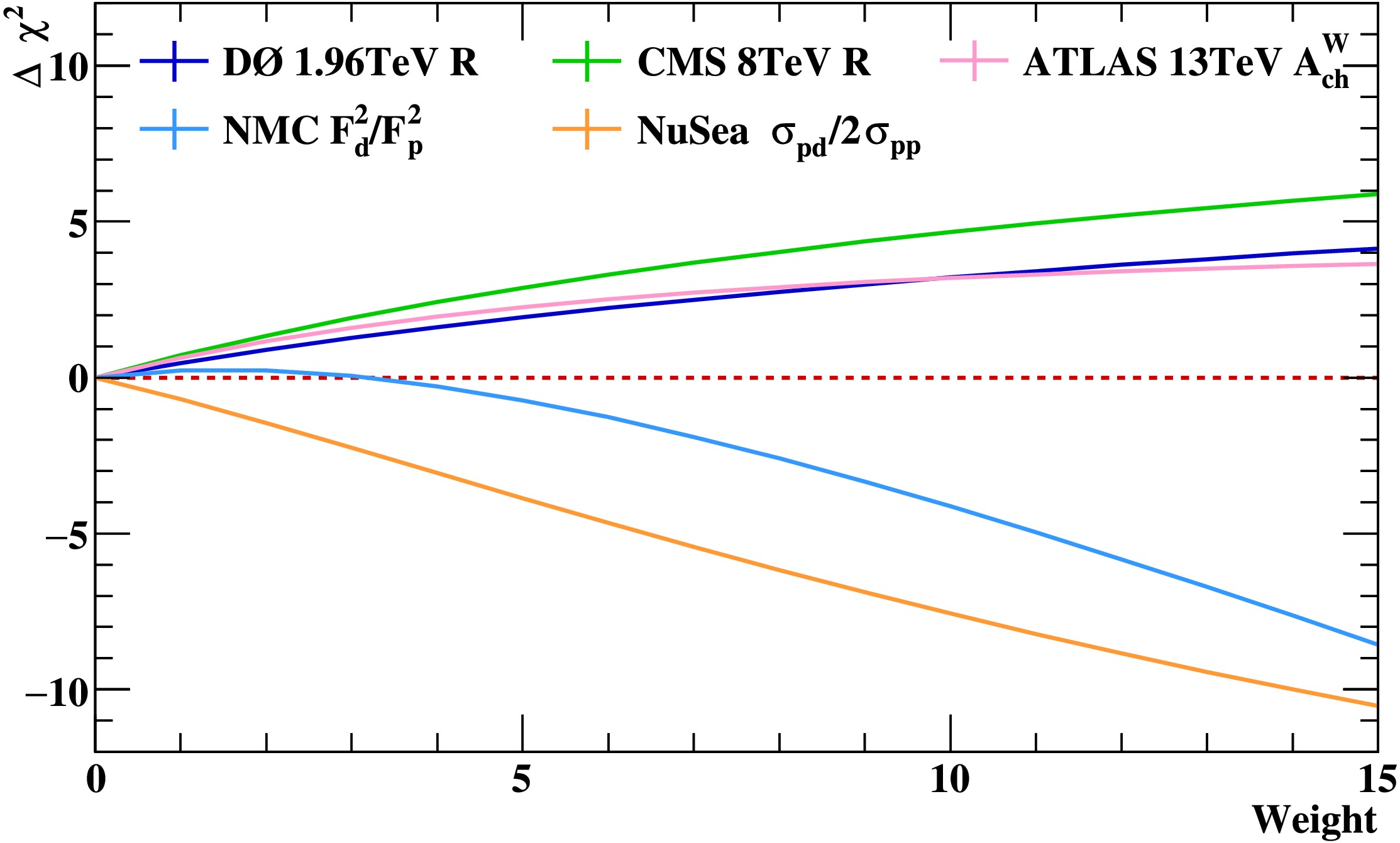
Figure 3.(color online) Impact on the global fit by increasing the weight (from 0 to 15) of the three new input datasets (
$ R_{\rm{ D0}}\; $ ,$ R_{\rm{CMS}} $ ,$ A^W_{\rm{ch \;ATLAS}} $ ). The effect is quantified by the changes in$ {\cal{X}}^2 $ for the five selected datasets. Each curve shows$ \Delta {\cal{X}}^2 = {\cal{X}}^2(E)_{\rm{original \;PDF}} - {\cal{X}}^2(E)_{\rm{updated \;PDF}} $ as a function of the updating weight applied to the corresponding dataset. An increasing slope reflects aligned PDF preferences, whereas a decreasing slope indicates opposite tendencies and potential tension.To further illustrate the impact of the three new datasets on individual parton densities, we compare the original CT18NNLO PDF set with the updated version generated through ᴇPᴜᴍᴘ tool, where each dataset was assigned a weight of 15.Figure 4shows the ratios of the updated PDFs to the original ones, together with their uncertainties, for nine selected parton flavors:
$ u_v $ ,$ d_v $ ,$ d_v/u_v $ ,u,d,$ d/u $ ,$ \bar{u} $ ,$ \bar{d} $ and$ \bar{d}/\bar{u} $ , all evaluated at$ Q = 100 $ GeV.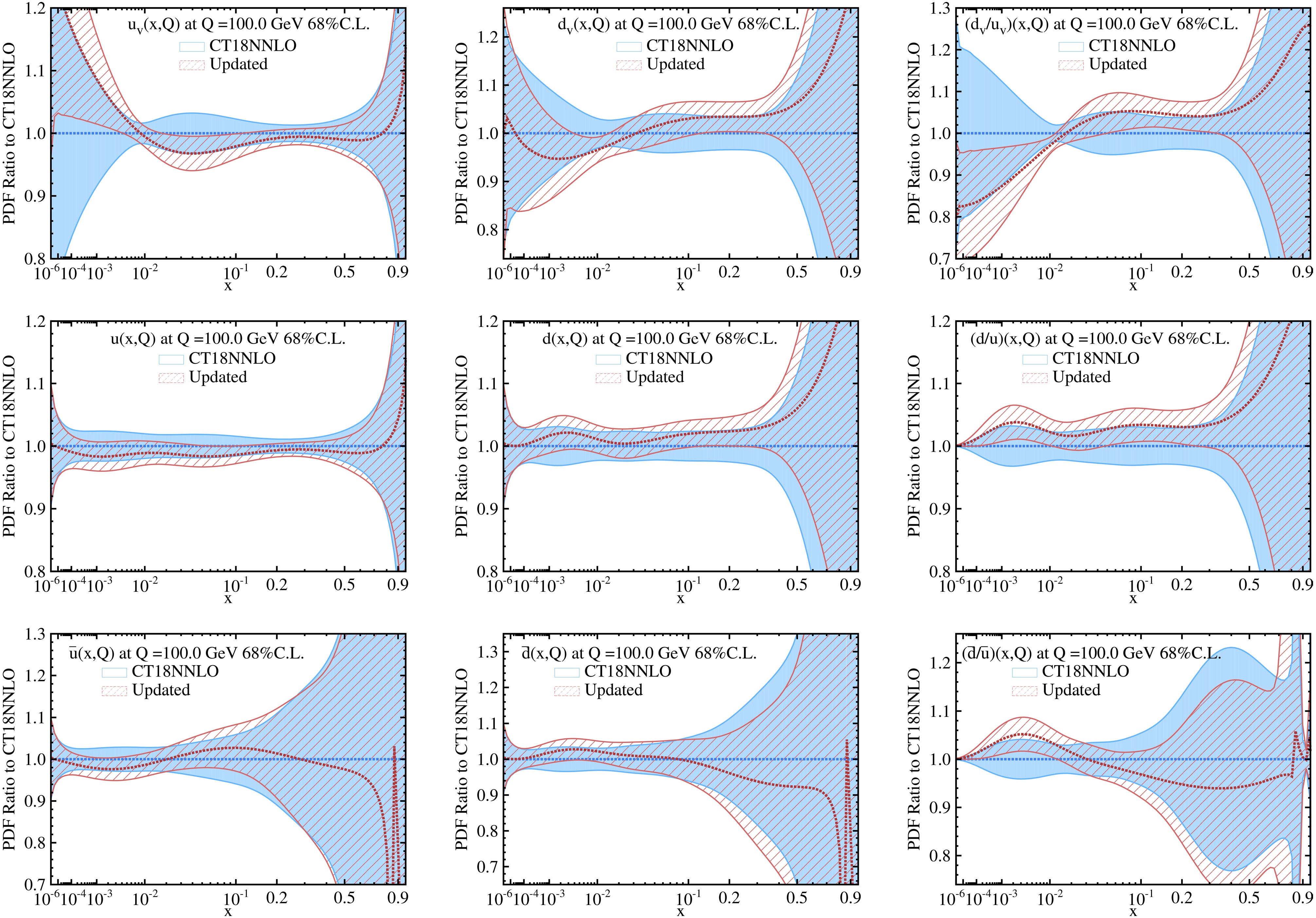
Figure 4.(color online) Comparison between updated PDFs, which are updated by the three new datasets with weight 15, and the original CT18NNLO central predictions. Each plot shows the ratio of the updated PDF to the original one, with associated uncertainty bands.
The most pronounced changes appear in the valence quark PDFs within thex~ 0.1 region, where all three datasets have their strongest sensitivity. Consistent with the
$ C_H(E,f) $ correlation patterns inFigure 2, the updated$ u_v $ distribution exhibits a downward shift in this range, while$ d_v $ shows a corresponding enhancement, jointly indicating a preference for a larger$ d_v/u_v $ ratio. The same flavor-dependent tendency is also visible in the other quark PDFs:u,$ \bar{d} $ , and$ \bar{d}/\bar{u} $ are reduced, whereasd,$ \bar{u} $ , and$ d/u $ are enhanced, in agreement with the correlation analysis discussed in Section III. Outside thex~ 0.1 region, the observed shifts are largely driven by the valence quark sum rules$ \int_0^1 u_v(x){\rm{d}}x = 2 $ and$ \int_0^1 d_v(x) {\rm{d}}x = 1 $ . -
In summary, recent hadron collider Drell–Yan measurements including theRratios from forward-backward asymmetry at D0 and CMS, and the high-
$ m_T $ Wcharge asymmetry$ A^W_{{\rm{ch}}} $ from ATLAS, exhibit a coherent preference for an enhanced$ d_v/u_v $ ratio in thex~ 0.1 region. Despite the differences in collider types, energies, and observables, these measurements demonstrate strong mutual consistency, especially in their correlation patterns within the global fit parameter space. A clear tension is observed between these collider measurements and fixed-target data such as NMC and NuSea, which have traditionally played a dominant role in constraining the relative light quark flavor structure. This result indicates a distinct trend in the preferred flavor composition ofuanddquarks. Future measurements with higher statistics will be crucial for placing more stringent constraints on the light-quark compositions. It should be noted that in this study, the results are derived from the ᴇPᴜᴍᴘ analysis tool, and the associated momentum fractionxrepresents only a Leading Order approximation, therefore a full PDF global analysis is required for more robust conclusions.
Impact of new measurements of light quarks at hadron colliders
- Received Date:2025-08-22
- Available Online:2026-03-01
Abstract:Recently a series of new measurements with both the neutral and charge current Drell–Yan processes have been performed at hadron colliders, showing deviations from the predictions of the current parton distribution functions (PDFs). In this article, the impact of these new measurements is studied by using their results to update the PDFs. Although these new measurements correspond to different boson propagators and colliding energies, they are found to have a similar impact to the light quark parton distributions with the momentum fractionxaround 0.1. It manifests that the deviations are consistent with each other and favor a larger valence


 DownLoad: