


 Abstract
 HTML
HTML Reference
 Related
 PDF
PDF


-
Superheavy nuclei have been one of the research frontiers and popular topics in nuclear physics since the prediction of the existence of a stable island of superheavy nuclei in the 1960s [1]. The study of superheavy nuclei is significant for extending the periodic table of elements, climbing the island of stability of superheavy nuclei, and exploring the stability of nuclei under extreme conditions. Over the past decades, experimentally, superheavy elements with
$ Z = 107-112 $ and$Z = 113-118$ have been synthesised in cold-fusion and hot-fusion reactions [2−7], respectively.αdecay, one of the main decay modes of superheavy nuclei, is extremely important in the study of superheavy nuclei. On the one hand, it is an important method of identifying newly synthesized superheavy nuclei by measuring the cascadeαdecay of newly synthesized superheavy nuclei to known nuclei [2−7]. On the other hand,αdecay, as an important probe for studying superheavy nuclei, provides abundant information about nuclear structures, such as magic numbers, islands of stability, and shell effects [6,7]. Currently, the major superheavy nuclei laboratories around the world are attempting to synthesize new elements with
$ Z = 119 $ and 120 to break through the eighth period of the periodic table of elements [8−16]. If reliable theoretical predictions can be made about the properties ofαdecay of superheavy nuclei, they will provide a useful reference for the experimental synthesis and identification of new elements with$ Z = 119 $ and 120 [17−22]. Becauseαdecay is dominated by quantum tunneling effects, theαdecay energy is very important in the study ofαdecay [23−30]. An uncertainty of 1 MeV inαdecay energy results in an uncertainty in theαdecay half-life of$ 10^3 $ to$ 10^5 $ times for nuclei [31]. Therefore, accurate predictions ofαdecay energies would be useful in predicting theαdecay half-lives of$ Z = 119 $ and 120 superheavy nuclei.The Finite-Range Droplet Model 2012 (FRDM) [32], a macroscopic-microscopic mass model, has been successfully and widely used to describe the fundamental properties of nuclei [33,34]. In this study, we investigate the root mean square deviation between theαdecay energies of nuclei given by the FRDM and those of 947 nuclei reported by the evaluated atomic mass table AME 2020 (AME) [35] with
$ 50\leqslant{Z}\leqslant 118 $ as 0.37 MeV. Although the FRDM can describe theαdecay energies of heavy and superheavy nuclei relatively well, room for improvement remains.Recently, machine learning techniques have demonstrated their ability to analyze large amounts of data to find hidden correlations and have had widespread success in nuclear physics research, such as predicting the mass [36−38], charge radius [39,40],αdecay [41−44], fission barrier [45], and nuclear reaction [46]. In this study, first, we determine the differences between theαdecay energies of the FRDM [32] and AME [35] using a neural network method and optimize theαdecay energies of the FRDM by combining these learned differences with the predictions of the FRDM. Second, theαdecay energies of unknown superheavy nuclei, in particular, those with
$ Z = 119 $ and 120, are predicted by combining the neural network approach and FRDM. Third, using the optimizedαdecay energy as input, we calculate theαdecay half-lives of the known superheavy nuclei using the Generalized Liquid Drop Model (GLDM) and Royer formula ofαdecay half-lives [47]. The calculations are compared with experimentalαdecay half-lives. Fourth, theαdecay half-lives of unknown superheavy nuclei, in particular those with$ Z = 119 $ and 120 are predicted using the GLDM and Royer formula with the optimizedαdecay energy as input. Finally, the relative errors of predictions and superposition are analyzed, and the average predictions are given to provide a theoretical reference for experiments synthesizing new elements.The remainder of this article is organized as follows. Sec. II presents the theoretical framework of the neural network details, GLDM, and Royer formula ofαdecay half-lives. Detailed calculations and discussion are given in Sec. III. Sec. IV provides a brief summary.
-
In this study, we design and implement a simple neural network model to predict the difference between the theoretical and experimentalαdecay energies. The model uses a three-layer fully connected network structure, with the input layer containing two features: the number of protons and mass number. It includes two hidden layers, each with 128 neurons, and uses the rectified linear unit (ReLU) activation function. The output layer consists of a single neuron to generate the predicted value. We divide the 947 nuclei dataset into three parts: 60% training set (569 nuclei), 20% validation set (189 nuclei), and 20% test set (189 nuclei). The training set is used to train the model. During this phase, the model learns the relationship between the input data and corresponding labels to adjust its parameters and minimize the loss function. The validation set is used to adjust the model's hyperparameters and select the best model architecture. During training, we regularly evaluate the model's performance on the validation set to assess its ability to generalize. If the model performs poorly on the validation set, this may indicate overfitting or underfitting. By monitoring the loss on the validation set, we can select the best training rounds and hyperparameters. The test set is used to evaluate the performance of the final model. The data in the test set are not used during training or validation; therefore, they provide a true assessment of the model.
We use the root mean square error
$ \sigma_{Q_{\alpha}} $ as a loss function to accurately assess the predictive accuracy of the model.$ \sigma_{Q_{\alpha}} = \sqrt{\frac{1}{n}\sum (Q_{\alpha,i}^{\text{FRDM-NN}}-Q_{\alpha,i}^{\text{AME}})^2} , $

(1) where
$ n = 947 $ represents the total number of data points,$ Q_{\alpha,i}^{\text{AME}} $ the desired output, and$ Q_{\alpha,i}^{\text{FRDM-NN}} $ the output from the neural network. We use the Adam optimizer to update the model parameters, which speeds up the training process. During training, the model undergoes 50000 iterations to reduce the loss for the training, validation, and test sets. Every 100 iterations, we output the loss value to monitor the training progress in real time. -
Theαdecay half-life can be obtained using the decay constantλas
$ \ T_{1/2} = \frac{\ln{2}}{\lambda} . $

(2) Within Gamow's picture [48,49], theαdecay constantλcan be calculated using the product ofα-particle preformation factor
$ P_{\alpha} $ , the assault frequencyν, and the barrier penetrating probabilityP:$ \ \lambda = P_{\alpha}{\nu}P . $

(3) Theα-particle preformation factor
$ P_{\alpha} $ can be estimated using the analytic formula proposed in our previous work [50,51]. It is expressed as$ \ \log_{10}P_{\alpha} = a+b(A_1^{1/6}+A_2^{1/6})+c\frac{N}{\sqrt{Q_{\alpha}}}+d\sqrt{l(l+1)}+h , $

(4) with
$ A_1 $ and$ A_2 $ being the mass numbers of theα-particle and daughter nucleus, respectively.Nand$ Q_{\alpha} $ denote the neutron number andαdecay energy of the parent nucleus, respectively.lis the angular momentum carried by theα-particle, which can be obtained using the conservation laws of angular momentum and parity [52]. Thehrepresents the blocking effect of unpaired nucleons. The adjustable parameters values are$ a = 37.421 $ ,$ b = -10.900 $ ,$ c = 0.040 $ , and$ d = -0.088 $ .$ h = 0 $ ,$ -0.323 $ , and$ -0.851 $ for even-even, odd-A, and doubly odd nuclei, respectively [50].The assault frequencyνcan be calculated as
$ \ \nu = \frac{1}{2R}\sqrt{\frac{2E_{\alpha}}{M_{\alpha}}} , $

(5) where
$ E_{\alpha} = \dfrac{A-4}{A}Q_{\alpha} $ is the kinetic energy of theα-particle, withAand$ Q_{\alpha} $ being the mass number andαdecay energy of the parent nucleus, respectively.$ M_{\alpha} $ denotes the mass of theα-particle.Ris the radius of theαdecay parent nucleus obtained by Refs. [53,54], and it is expressed as$ \ R = 1.28A^{1/3}-0.76+0.8A^{-1/3} , $

(6) withAbeing the mass number of the parent nucleus.
The barrier penetrating probabilityPcan be obtained using Wentzel-Kramers-Brillouin (WKB) approximation as
$ \ P = \exp\left[-\frac{2}{\hbar}{\int_{r_{\text{in}}}^{r_{\text{out}}} \sqrt{2B(r)(E_{r}-E(\text{sphere}))} {\rm d}r}\right] , $

(7) withrbeing the center of mass distance between the preformedα-particle and daughter nucleus. The classical turning points
$ r_{\text{in}} $ and$ r_{\text{out}} $ are obtained using$ r_{\text{in}} = R_1+R_2 $ and$ E(r_{\text{out}}) = Q_{\alpha} $ .$ B(r) = \mu $ represents the reduced mass between the preformedα-particle and daughter nucleus.The total interaction potentialEin the GLDM has been introduced in detail in previous works [54−58]. It consists of five parts: volume energy
$ E_V $ , surface energy$ E_S $ , Coulomb energy$ E_C $ , proximity energy$ E_{\text{Prox}} $ , and centrifugal potential$ E_l $ .$ \ E = E_V+E_S+E_C+E_{\text{Prox}}+E_l . $

(8) Although both theα-particle preformation factor
$ P_{\alpha} $ in Eq. (4) and centrifugal potential$ E_l $ in Eq. (8) consider the contribution of the angular momentum carried by theα-particle, this is not a double counting of the centrifugal effect.lreflects the difference in$ P_{\alpha} $ of the favored and unfavoredαdecays [50,51].Figs. 2–4of our previous work present our findings on the effect of$ P_{\alpha} $ onαdecay half-lives [59]. The previous study showed that the calculatedαdecay half-lives using Eq. (8), without considering$ P_{\alpha} $ , were smaller than the experimental data by more than an order of magnitude. When$ P_{\alpha} $ was considered, the experimental data were well reproduced [59]. This demonstrated that considering the contribution of the centrifugal potential only in the nuclear potential does not fully reflect the effect of angular momentum forαdecay and preformation ofα-particle. Therefore, the centrifugal effect is not double counted in Eqs. (4) and (8).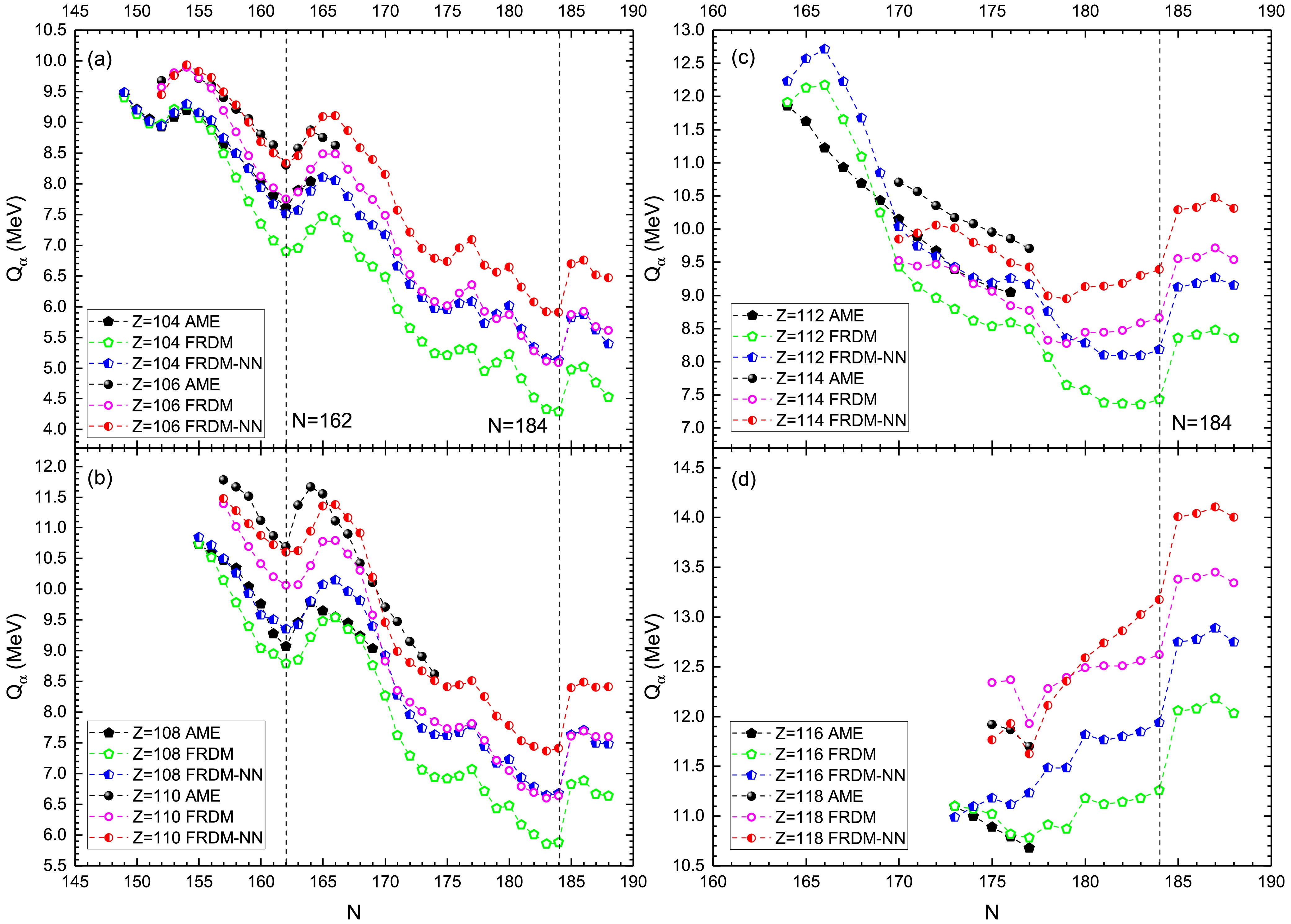
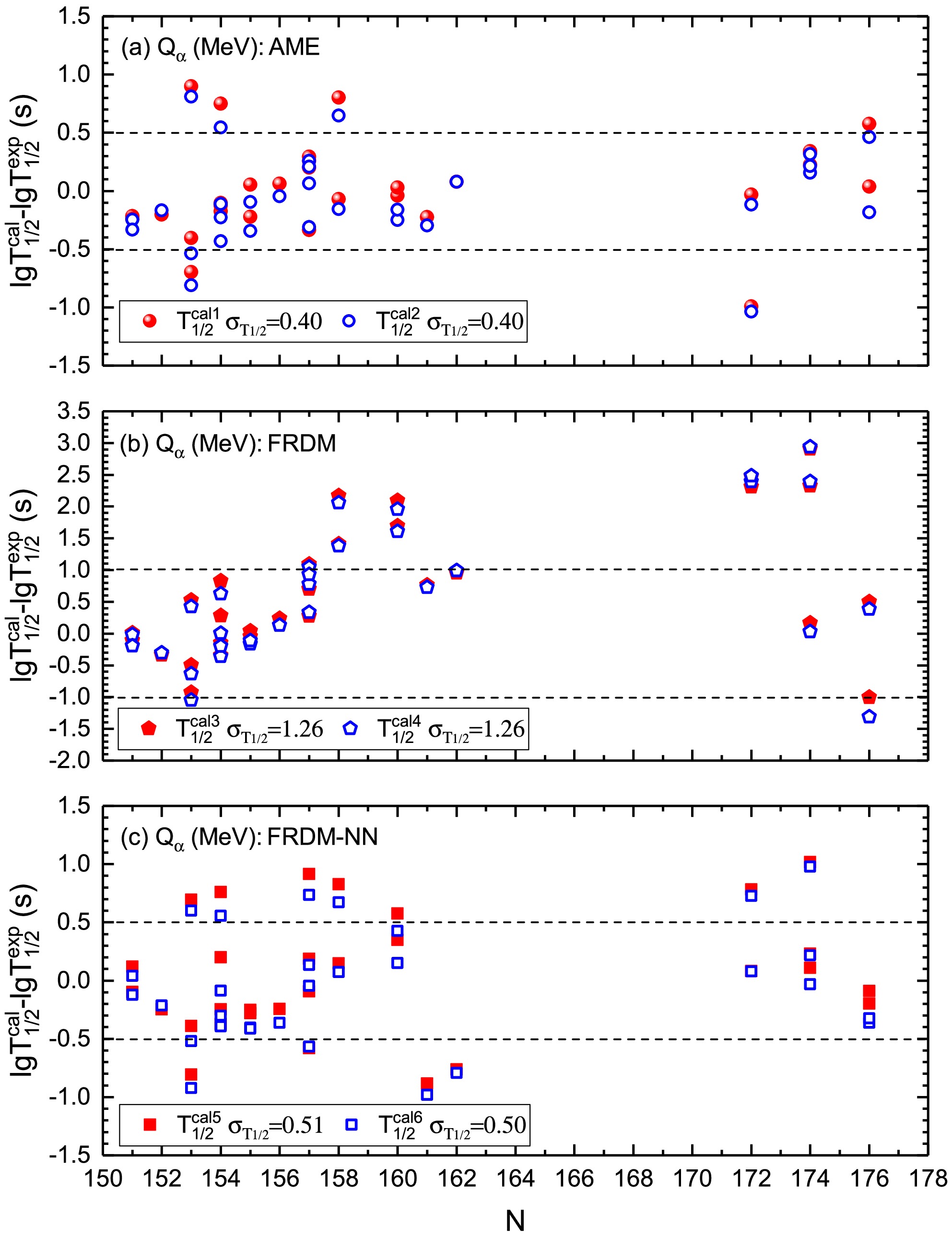
Figure 3.(color online) Logarithmic differences between the calculations ofαdecay half-lives using the GLDM and Royer formula [47] and the experimental data for 30 known superheavy nuclei, which are denoted by solid and open symbols, respectively.
${j^{\pi}_{p}}$ and${j^{\pi}_{d}}$ are available and obtained from NUBASE [61]. Subfigures (a), (b), and (c) denote the differences between the calculations when inputting theαdecay energies obtained using AME [35], FRDM [32], and FRDM-NN and the experimental data, respectively.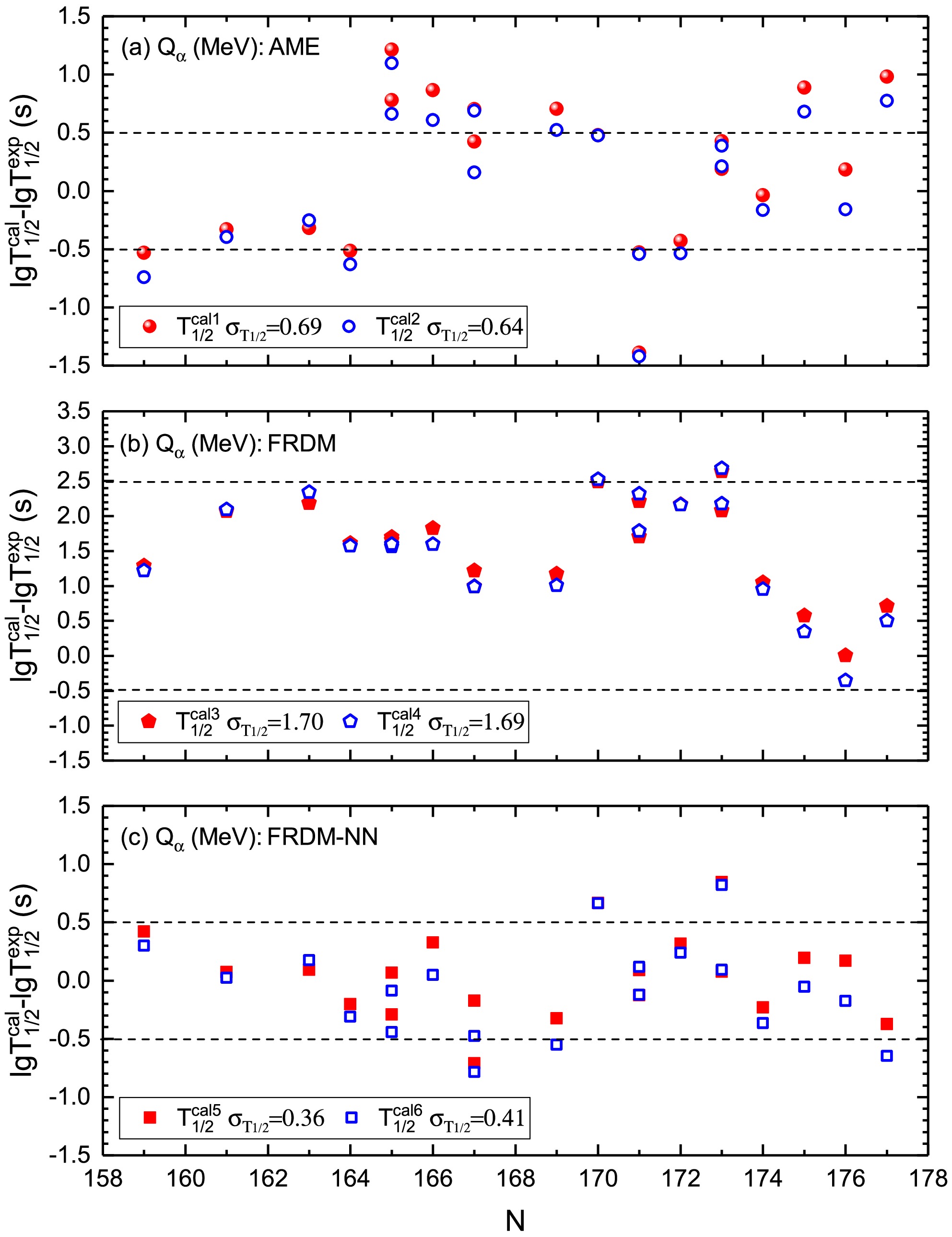
Figure 4.(color online) Same asFig. 3, but depicting the logarithmic differences between the calculations ofαdecay half-lives using the GLDM and Royer formula [47] and the experimental data for 20 known odd-Asuperheavy nuclei, where
${j^{\pi}_{p}}$ and/or${j^{\pi}_{d}}$ are not available in NUBASE [61] but obtained using the FRDM [32]. -
The Royer formula [54] is widely used to calculate and predictαdecay half-lives because it approximates the Universal Decay Law [27] when the reduced mass is approximately constant and the mass of the daughter is much larger than that of theα-particle [60]. This approximation is excellent for superheavy nuclei [60]. In a previous study [47], we further improved the Royer formula ofαdecay half-life by considering the contribution of centrifugal potential and the blocking effect of unpaired nucleons; it is expressed as
$ \log_{10}{T_{1/2}} = a+bA^{1/6}\sqrt{Z}+c\frac{Z}{\sqrt{Q_{\alpha}}}+{\rm d}l(l+1)+h , $

(9) whereA,Z, and
$ Q_{\alpha} $ are the mass number, proton number, andαdecay energy of parent nuclei, respectively.lis the angular momentum carried by theα-particle.hrepresents the blocking effect of unpaired nucleons. The values of adjustable parameters are$ a = -26.8125, b = -1.1255, c = 1.6057, d = 0.0513 $ . The values ofhfor differentαdecay cases are expressed as$ \ h = \left\{\begin{array}{llll} 0,&\text{for even-even nuclei},\\ 0.3625,&\text{for even } Z \;\text{-odd } N \text{ nuclei},\\ 0.2812,&\text{for odd } Z \;\text{-even } N \text{ nuclei},\\ 0.7486,&\text{for doubly odd nuclei}. \end{array}\right. $

(10) -
Accurateαdecay energies must be employed to achieve a theoretically accurate description ofαdecay half-lives. Herein, theαdecay energies given by the FRDM [32] are examined. The discrepancies between theαdecay energies calculated using the FRDM [32] and ones reported by AME [35] for 947 heavy and superheavy nuclei are denoted as red square and plotted inFig. 1. As shown in this figure, the discrepancy caused by the FRDM is typically in the range of
$ \pm 0.8 $ MeV for the majority of nuclei. However, for a significant number of nuclei, the discrepancy exceeds 1 MeV. Specifically, for$ 52 , the difference is greater than 0.5 MeV and even close to 2 MeV, indicating that theαdecay energies obtained using the FRDM are overestimated. In the region of$ 96 , the difference increased further toward the superheavy nuclei region, biased toward negative values. This suggests that the FRDM underestimates theαdecay energy in the region of superheavy nuclei. Consequently, the FRDM is likely to predict lowerαdecay energies for superheavy nuclei with$ Z = 119 $ and 120. Improving the accuracy ofαdecay energy calculations based on the FRDM alone is challenging. The introduction of neural networks can effectively compensate for these limitations within the FRDM [32]. Therefore, theαdecay energies must be optimized using the neural networks to improve the accuracy of predicting theαdecay energies of unknown superheavy nuclei, particularly with$ Z = 119 $ and 120. The deviations between the optimizedαdecay energies obtained using the neural network approach,i.e., FRDM-NN, and theαdecay energies reported by AME [35] are marked as blue circles inFig. 1. This figure shows that, after optimization using a neural network, theαdecay energy discrepancy caused by the FRDM-NN is significantly smaller than that caused by the FRDM. Furthermore, for the majority of nuclei, the deviations caused by the FRDM-NN are within a range of$ \pm 0.3 $ MeV. For superheavy nuclei, the deviations caused by the FRDM-NN are significantly lower than those caused by the FRDM, indicating that the FRDM-NN effectively improves the accuracy in describing theαdecay energy of superheavy nuclei. In addition,Fig. 1depicts the root mean square errors$ \sigma_{Q_{\alpha}} $ between theαdecay energies provided by the FRDM and FRDM-NN and those presented by AME. The$ \sigma_{Q_{\alpha}} $ values are reduced from 0.37 MeV in the FRDM to 0.21 MeV in the FRDM-NN, which means that the accuracy in describing theαdecay energy improves by$ \dfrac{0.37-0.21}{0.37} = 43.24 $ % when the neural network approach is applied.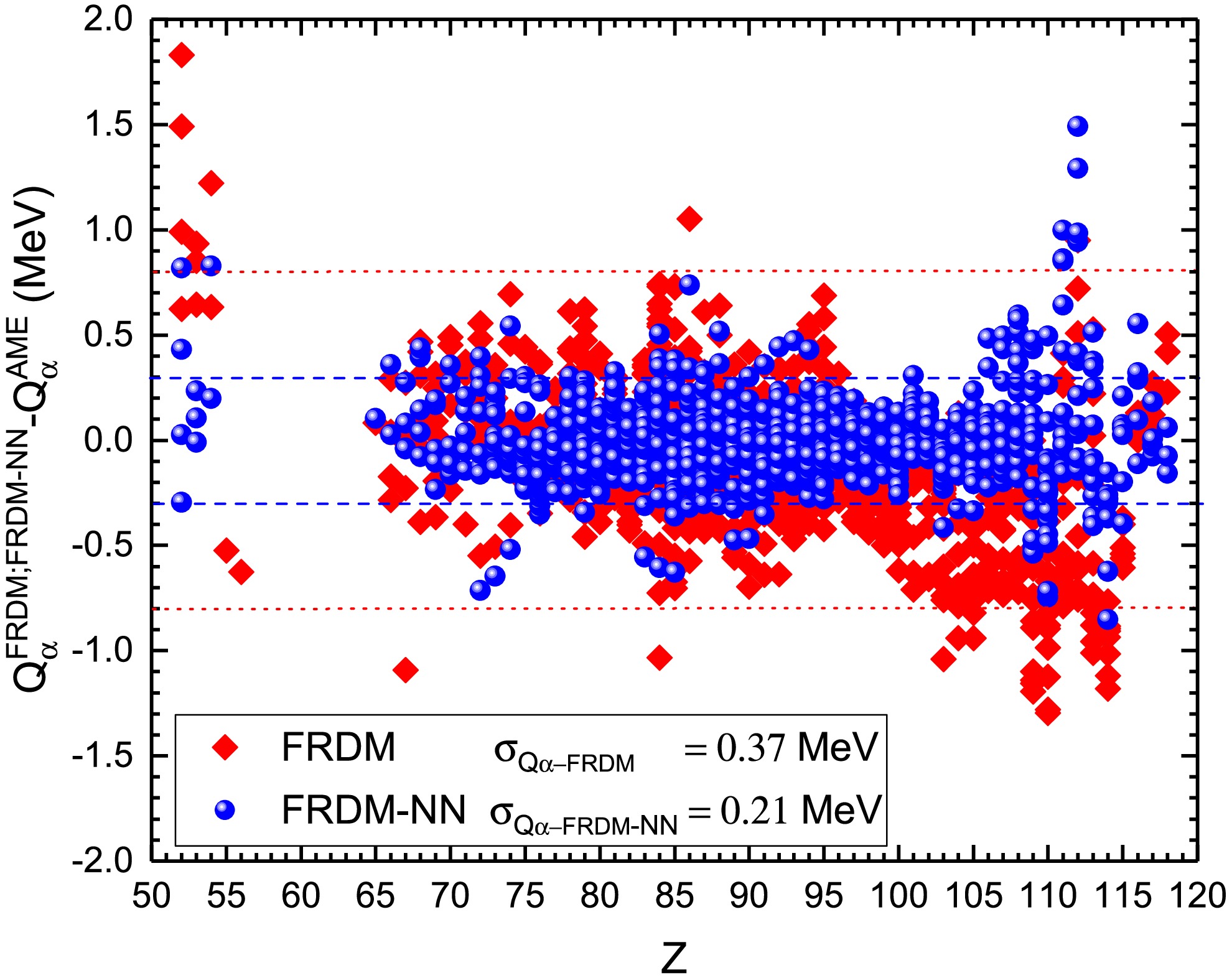
Figure 1.(color online) Differences between theαdecay energies obtained using the FRDM [32] and FRDM-NN and theαdecay energies reported by AME [35] for 947 known heavy and superheavy nuclei. The red square and blue circle denote the differences caused by
$Q_{\alpha}^{\text{FRDM}}$ and$Q_{\alpha}^{\text{FRDM-NN}}$ , respectively.The ability of the FRDM [32] and FRDM-NN to describe theαdecay energies of superheavy nuclei with
$ Z = 104 $ , 106, 108, 110, 112, 114, 116, and 118 is tested.Figure 2shows theαdecay energies of the superheavy nuclei given by AME [35], FRDM [32], and FRDM-NN, denoted by the solid, open, and semi-solid symbols, respectively. Theαdecay energies obtained with the FRDM are significantly different from those obtained with AME [35] (Fig. 2(a)−(d)). The optimizedαdecay energies obtained using the FRDM-NN are significantly improved in the reproduction of those given by AME [35]. In addition, consistent with the results shown inFig. 1, theαdecay energies of the superheavy isotope chains given by the FRDM [32] are mostly lower than the experimental values of AME [35]. The FRDM-NN method effectively solves this problem. Furthermore,Fig. 2(a) and (b) show that the three types ofαdecay energies all have a valley at$ N = 162 $ , and theαdecay energies of$ N = 164 $ increase dramatically. Evidence exists for a shell effect at$ N = 162 $ , based on theαdecay energies obtained by AME [35], in particular, for the FRDM and FRDM-NN. The shell effect at$ N = 162 $ has been demonstrated experimentally [6,7]. The FRDM-NN shows the shell effect at$ N = 162 $ , indicating that the neural network approach does not interfere with the revelation of the microscopic shell effect, which is important for exploring the island of stability for superheavy nuclei. In particular,Fig. 2(a)−(d) show that, when the neutron number exceeds$ N = 184 $ , theαdecay energies predicted by the FRDM and FRDM-NN change sharply, and at$ N = 186 $ , theαdecay energy increases by almost 1 MeV. This suggests that strong shell effect is reflected, implying that the next neutron magic number after$ N = 126 $ may be$ N = 184 $ .The experimentalαdecay half-lives and calculations based on theαdecay energies data from AME [35], FRDM [32], and FRDM-NN are presented inTables 1–3, respectively.Table 1shows the calculatedαdecay half-lives for the 30 known superheavy nuclei for which the spin and parity values of the parent and daughter nuclei,i.e.,
$ {j^{\pi}_{p}} $ and$ {j^{\pi}_{d}} $ , are available, obtained from the evaluated nuclear properties table NUBASE 2020 (NUBASE) [61].Table 2presents the calculations of 20 known odd-Asuperheavy nuclei, where$ {j^{\pi}_{p}} $ and/or$ {j^{\pi}_{d}} $ are not available in NUBASE [61] but obtained using the FRDM [32]. For the favored and unfavoredαdecay shown inTables 1and2, the angular momentumlis obtained using the conservation laws of angular momentum and parity [52]. In addition, the unfavoredαdecay with zero angular momentum transfer is also calculated to attest the possibility of favoredαdecay.Table 3lists the calculations of 17 known doubly odd superheavy nuclei, where$ {j^{\pi}_{p}} $ and/or$ {j^{\pi}_{d}} $ are not available in NUBASE [61].$ l = 0 $ is assumed to study the possibility of favoredαdecay. InTables 1–2, the first column shows theαdecay including the parent and daughter nuclei. The second column represents the spin and parity transition of the parent and daughter nuclei. The third column provides the minimum angular momentum taken away by theαparticle. The fourth column shows the experimentalαdecay half-lives and the error uncertainties given by NUBASE [61], except for the experimentalαdecay half-life and error uncertainties of the nucleus$ ^{264} {\rm{Hs}}$ listed inTable 1, which are obtained from the National Nuclear Data Center (NNDC) [62]. The fifth column is theαdecay energy reported by AME [35]. The sixth and seventh columns are the calculatedαdecay half-lives using the GLDM and Royer formula [47], respectively, where theαdecay energy given by AME [61] is inputted. The eighth column is theαdecay energy calculated using the FRDM [32]. The ninth and tenth columns are the calculatedαdecay half-lives by using the GLDM and Royer formula [47], respectively, where theαdecay energy given by the FRDM [32] is inputted. The eleventh column is theαdecay energy calculated using the FRDM-NN. The last two columns are theαdecay half-lives calculated using the GLDM and Royer formula [47], respectively, where theαdecay energy given by the FRDM-NN is inputted. Each column inTable 3is the same as those inTables 1and2, except for the column that does not list the$ {j^{\pi}_{p}} $ $ \to $ $ {j^{\pi}_{d}} $ changes.αtransition ${j^{\pi}_{p}}\to{j^{\pi}_{d}}$ 

l $\text{lg}T^{\text{exp}}_{1/2}$ 

$Q_{\alpha}^{\text{AME}}$ 

$\text{lg}T^{\text{cal1}}_{1/2}$ 

$\text{lg}T^{\text{cal2}}_{1/2}$ 

$Q_{\alpha}^{\text{FRDM}}$ 

$\text{lg}T^{\text{cal3}}_{1/2}$ 

$\text{lg}T^{\text{cal4}}_{1/2}$ 

$Q_{\alpha}^{\text{FRDM-NN}}$ 

$\text{lg}T^{\text{cal5}}_{1/2}$ 

$\text{lg}T^{\text{cal6}}_{1/2}$ 

$^{254}{\rm{Rf}} \to ^{250}{\rm{No}}$ 

${0^+\to0^+}$ 

0 $>-2.82^{}_{}$ 

$9.21\#$ 

$-0.70$ 

$-0.67$ 

$9.13$ 

$-0.47$ 

$-0.43$ 

$9.20$ 

$-0.67$ 

$-0.64$ 

$^{255}{\rm{Rf}} \to ^{251}{\rm{No}}$ 

${(9/2^-)}\to{(7/2^+)}$ 

0 $0.49^{+0.01}_{-0.01}$ 

$9.06$ 

$0.07$ 

$0.14$ 

$8.98$ 

$0.29$ 

$0.37$ 

$9.02$ 

$0.18$ 

$0.26$ 

$^{255}{\rm{Rf}} \to ^{251}{\rm{No}}$ 

${(9/2^-)}\to{(7/2^+)}$ 

1 $0.49^{+0.01}_{-0.01}$ 

$9.06$ 

$0.27$ 

$0.24$ 

$8.98$ 

$0.50$ 

$0.48$ 

$9.02$ 

$0.39$ 

$0.37$ 

$^{256}{\rm{Rf}} \to ^{252}{\rm{No}}$ 

${0^+\to0^+}$ 

0 $0.33^{+0.003}_{-0.003}$ 

$8.93$ 

$0.13$ 

$0.16$ 

$8.97$ 

$-0.01$ 

$0.02$ 

$8.94$ 

$0.08$ 

$0.12$ 

$^{257}{\rm{Rf}} \to ^{253}{\rm{No}}$ 

${(1/2^+)\to9/2^-}$ 

0 $0.75^{+0.02}_{-0.02}$ 

$9.08$ 

$-0.03$ 

$0.02$ 

$9.21$ 

$-0.40$ 

$-0.37$ 

$9.15$ 

$-0.24$ 

$-0.19$ 

$^{257}{\rm{Rf}} \to ^{253}{\rm{No}}$ 

${(1/2^+)\to9/2^-}$ 

5 $0.75^{+0.02}_{-0.02}$ 

$9.08$ 

$1.65$ 

$1.56$ 

$9.21$ 

$1.27$ 

$1.17$ 

$9.15$ 

$1.44$ 

$1.35$ 

$^{258}{\rm{Rf}} \to ^{254}{\rm{No}}$ 

${0^+\to0^+}$ 

0 $-0.59^{+0.02}_{-0.02}$ 

$9.20$ 

$-0.70$ 

$-0.70$ 

$9.28$ 

$-0.94$ 

$-0.95$ 

$9.29$ 

$-0.97$ 

$-0.99$ 

$^{259}{\rm{Rf}} \to ^{255}{\rm{No}}$ 

${3/2^+\#\to(1/2^+)}$ 

0 $0.49^{+0.04}_{-0.05}$ 

$9.13\#$ 

$-0.19$ 

$-0.16$ 

$9.07$ 

$-0.01$ 

$0.02$ 

$9.15$ 

$-0.25$ 

$-0.22$ 

$^{259}{\rm{Rf}} \to ^{255}{\rm{No}}$ 

${3/2^+\#\to(1/2^+)}$ 

2 $0.49^{+0.04}_{-0.05}$ 

$9.13\#$ 

$0.27$ 

$0.15$ 

$9.07$ 

$0.44$ 

$0.33$ 

$9.15$ 

$0.21$ 

$0.09$ 

$^{261}{\rm{Rf}} \to ^{257}{\rm{No}}$ 

${3/2^+\#\to(3/2^+)}$ 

0 $1.07^{+0.04}_{-0.04}$ 

$8.65$ 

$1.27$ 

$1.33$ 

$8.49$ 

$1.77$ 

$1.85$ 

$8.74$ 

$0.97$ 

$1.02$ 

$^{256}{\rm{Db}}$ 

$\to ^{252}{\rm{Lr}}$ 

${9^-\#\to7^-\#}$ 

0 $0.39^{+0.09}_{-0.12}$ 

$9.34$ 

$0.14$ 

$0.05$ 

$9.29$ 

$0.28$ 

$0.19$ 

$9.21$ 

$0.50$ 

$0.43$ 

$^{256}{\rm{Db}}$ 

$\to ^{252}{\rm{Lr}}$ 

${9^-\#\to7^-\#}$ 

2 $0.39^{+0.09}_{-0.12}$ 

$9.34$ 

$0.60$ 

$0.36$ 

$9.29$ 

$0.73$ 

$0.50$ 

$9.21$ 

$0.96$ 

$0.73$ 

$^{257}{\rm{Db}}$ 

$\to ^{253}{\rm{Lr}}$ 

${9/2^+\#\to(7/2^-)}$ 

0 $<0.39^{}_{}$ 

$9.21$ 

$-0.03$ 

$-0.04$ 

$9.26$ 

$-0.18$ 

$-0.21$ 

$9.15$ 

$0.13$ 

$0.12$ 

$^{257}{\rm{Db}}$ 

$\to ^{253}{\rm{Lr}}$ 

${9/2^+\#\to(7/2^-)}$ 

1 $<0.39^{}_{}$ 

$9.21$ 

$0.18$ 

$0.06$ 

$9.26$ 

$0.02$ 

$-0.10$ 

$9.15$ 

$0.33$ 

$0.22$ 

$^{258}{\rm{Db}}$ 

$\to ^{254}{\rm{Lr}}$ 

${0^-\#\to4^+\#}$ 

0 $0.53^{+0.07}_{-0.08}$ 

$9.44$ 

$-0.17$ 

$-0.28$ 

$9.52$ 

$-0.40$ 

$-0.52$ 

$9.48$ 

$-0.28$ 

$-0.39$ 

$^{258}{\rm{Db}}$ 

$\to ^{254}{\rm{Lr}}$ 

${0^-\#\to4^+\#}$ 

5 $0.53^{+0.07}_{-0.08}$ 

$9.44$ 

$1.50$ 

$1.26$ 

$9.52$ 

$1.27$ 

$1.02$ 

$9.48$ 

$1.39$ 

$1.15$ 

$^{259}{\rm{Db}}$ 

$\to ^{255}{\rm{Lr}}$ 

${9/2^+\#\to(1/2^-)}$ 

0 $-0.29^{+0.12}_{-0.16}$ 

$9.62$ 

$-1.21$ 

$-1.29$ 

$9.59$ 

$-1.13$ 

$-1.21$ 

$9.61$ 

$-1.20$ 

$-1.28$ 

$^{259}{\rm{Db}}$ 

$\to ^{255}{\rm{Lr}}$ 

${9/2^+\#\to(1/2^-)}$ 

5 $-0.29^{+0.12}_{-0.16}$ 

$9.62$ 

$0.46$ 

$0.25$ 

$9.59$ 

$0.54$ 

$0.33$ 

$9.61$ 

$0.47$ 

$0.26$ 

$^{263}{\rm{Db}}$ 

$\to ^{259}{\rm{Lr}}$ 

${9/2^+\#\to1/2^-\#}$ 

0 $1.89^{+0.12}_{-0.16}$ 

$8.83\#$ 

$1.01$ 

$1.00$ 

$8.41$ 

$2.37$ 

$2.41$ 

$8.83$ 

$1.03$ 

$1.03$ 

$^{263}{\rm{Db}}$ 

$\to ^{259}{\rm{Lr}}$ 

${9/2^+\#\to1/2^-\#}$ 

5 $1.89^{+0.12}_{-0.16}$ 

$8.83\#$ 

$2.70$ 

$2.54$ 

$8.41$ 

$4.06$ 

$3.95$ 

$8.83$ 

$2.72$ 

$2.57$ 

$^{259}{\rm{Sg}} \to ^{255}{\rm{Rf}}$ 

${(11/2^-)\to(9/2^-)}$ 

0 $-0.40^{+0.06}_{-0.07}$ 

$9.77$ 

$-1.25$ 

$-1.24$ 

$9.80$ 

$-1.35$ 

$-1.34$ 

$9.76$ 

$-1.24$ 

$-1.22$ 

$^{259}{\rm{Sg}} \to ^{255}{\rm{Rf}}$ 

${(11/2^-)\to(9/2^-)}$ 

2 $-0.40^{+0.06}_{-0.07}$ 

$9.77$ 

$-0.80$ 

$-0.93$ 

$9.80$ 

$-0.90$ 

$-1.03$ 

$9.76$ 

$-0.78$ 

$-0.92$ 

$^{260}{\rm{Sg}} \to ^{256}{\rm{Rf}}$ 

${0^+\to0^+}$ 

0 $-1.77^{+0.03}_{-0.03}$ 

$9.90$ 

$-1.94$ 

$-1.99$ 

$9.89$ 

$-1.92$ 

$-1.97$ 

$9.93$ 

$-2.02$ 

$-2.07$ 

$^{261}{\rm{Sg}} \to ^{257}{\rm{Rf}}$ 

${(3/2^+)\to(1/2^+)}$ 

0 $-0.73^{+0.01}_{-0.01}$ 

$9.71$ 

$-1.13$ 

$-1.13$ 

$9.72$ 

$-1.15$ 

$-1.15$ 

$9.83$ 

$-1.44$ 

$-1.45$ 

$^{261}{\rm{Sg}} \to ^{257}{\rm{Rf}}$ 

${(3/2^+)\to(1/2^+)}$ 

2 $-0.73^{+0.01}_{-0.01}$ 

$9.71$ 

$-0.68$ 

$-0.83$ 

$9.72$ 

$-0.69$ 

$-0.84$ 

$9.83$ 

$-0.98$ 

$-1.14$ 

$^{263}{\rm{Sg}} \to ^{259}{\rm{Rf}}$ 

${3/2^+\#\to3/2^+\#}$ 

0 $0.03^{+0.06}_{-0.07}$ 

$9.40$ 

$-0.30$ 

$-0.28$ 

$9.19$ 

$0.31$ 

$0.36$ 

$9.49$ 

$-0.55$ 

$-0.53$ 

$^{265}{\rm{Sg}} \to ^{261}{\rm{Rf}}$ 

${11/2^-\#\to3/2^+\#}$ 

0 $<1.26^{}_{}$ 

$9.05\#$ 

$0.70$ 

$0.76$ 

$8.45$ 

$2.60$ 

$2.73$ 

$9.00$ 

$0.85$ 

$0.92$ 

$^{265}{\rm{Sg}} \to ^{261}{\rm{Rf}}$ 

${11/2^-\#\to3/2^+\#}$ 

5 $<1.26^{}_{}$ 

$9.05\#$ 

$2.37$ 

$2.30$ 

$8.45$ 

$4.29$ 

$4.27$ 

$9.00$ 

$2.52$ 

$2.45$ 

$^{261}{\rm{Bh}} \to ^{257}{\rm{Db}}$ 

${(5/2^-)\to9/2^+\#}$ 

0 $-1.89^{+0.1}_{-0.12}$ 

$10.50$ 

$-2.79$ 

$-2.94$ 

$10.33$ 

$-2.38$ 

$-2.51$ 

$10.36$ 

$-2.46$ 

$-2.60$ 

$^{261}{\rm{Bh}} \to ^{257}{\rm{Db}}$ 

${(5/2^-)\to9/2^+\#}$ 

3 $-1.89^{+0.10}_{-0.12}$ 

$10.50$ 

$-2.02$ 

$-2.33$ 

$10.33$ 

$-1.61$ 

$-1.89$ 

$10.36$ 

$-1.69$ 

$-1.98$ 

$^{267}{\rm{Bh}} \to ^{263}{\rm{Db}}$ 

${5/2^-\#\to9/2^+\#}$ 

0 $1.34^{+0.16}_{-0.26}$ 

$9.23\#$ 

$0.52$ 

$0.48$ 

$8.55$ 

$2.65$ 

$2.68$ 

$9.10$ 

$0.91$ 

$0.88$ 

$^{267}{\rm{Bh}} \to ^{263}{\rm{Db}}$ 

${5/2^-\#\to9/2^+\#}$ 

3 $1.34^{+0.16}_{-0.26}$ 

$9.23\#$ 

$1.30$ 

$1.09$ 

$8.55$ 

$3.44$ 

$3.30$ 

$9.10$ 

$1.69$ 

$1.49$ 

$^{264}{\rm{Hs}} \to ^{260}{\rm{Sg}}$ 

${0^+\to0^+}$ 

0 $-3.10^{+0.19}_{-0.13}$ 

$10.59$ 

$-3.04$ 

$-3.15$ 

$10.52$ 

$-2.87$ 

$-2.97$ 

$10.72$ 

$-3.35$ 

$-3.47$ 

$^{265}{\rm{Hs}} \to ^{261}{\rm{Sg}}$ 

${3/2^+\#\to(3/2^+)}$ 

0 $-2.71^{+0.03}_{-0.04}$ 

$10.47$ 

$-2.45$ 

$-2.50$ 

$10.15$ 

$-1.65$ 

$-1.66$ 

$10.50$ 

$-2.52$ 

$-2.58$ 

$^{266}{\rm{Hs}} \to ^{262}{\rm{Sg}}$ 

${0^+\to0^+}$ 

0 $-2.40^{+0.08}_{-0.10}$ 

$10.35$ 

$-2.47$ 

$-2.56$ 

$9.78$ 

$-0.99$ 

$-1.02$ 

$10.26$ 

$-2.26$ 

$-2.33$ 

$^{269}{\rm{Hs}} \to ^{265}{\rm{Sg}}$ 

${9/2^+\#\to11/2^-\#}$ 

0 $1.18^{+0.17}_{-0.27}$ 

$9.27\#$ 

$0.75$ 

$0.78$ 

$8.95$ 

$1.73$ 

$1.80$ 

$9.50$ 

$0.09$ 

$0.09$ 

Continued on next page Table 1.Calculations of theαdecay half-lives of superheavy nuclei for which the spin and parity values of the parent and daughter nuclei are available, obtained from NUBASE 2020 (NUBASE) [61]. The experimentalαdecay half-lives and error uncertainties are obtained from the latest evaluated nuclear properties table NUBASE [61], except the experimentalαdecay half-life and error uncertainties of the nucleus
$^{264}{\rm{Hs}}$ , which are obtained from the NNDC [62]. Theαdecay energies are obtained from the evaluated atomic mass table AME 2020 (AME) [35], FRDM [32], and FRDM-NN. The symbol ''//www.macurncorp.com/hepnp/article/doi/10.1088/1674-1137/#'' of$Q_{\alpha}^{\text{AME}}$ indicates that theαdecay energy is not derived from experimental data but from systematics, which are obtained from AME [35]. Theαdecay energies and half-lives are in units of ''MeV'' and ''s'', respectively. ''()'' denotes uncertain spin and/or parity. ''//www.macurncorp.com/hepnp/article/doi/10.1088/1674-1137/#'' of the spin and/or parity indicates values estimated from trends in neighboring nuclides with the sameZandNparities, which are obtained from NUBASE [61].αtransition l $\text{lg}T^{\text{exp}}_{1/2}$ 

$Q_{\alpha}^{\text{AME}}$ 

$\text{lg}T^{\text{cal1}}_{1/2}$ 

$\text{lg}T^{\text{cal2}}_{1/2}$ 

$Q_{\alpha}^{\text{FRDM}}$ 

$\text{lg}T^{\text{cal3}}_{1/2}$ 

$\text{lg}T^{\text{cal4}}_{1/2}$ 

$Q_{\alpha}^{\text{FRDM-NN}}$ 

$\text{lg}T^{\text{cal5}}_{1/2}$ 

$\text{lg}T^{\text{cal6}}_{1/2}$ 

$^{260}{\rm{Db}} \to ^{256}{\rm{Lr}}$ 

0 $0.23^{+0.04}_{-0.04}$ 

$9.50\#$ 

$-0.36$ 

$-0.50$ 

$9.34$ 

$0.09$ 

$-0.03$ 

$9.43$ 

$-0.17$ 

$-0.31$ 

$^{260}{\rm{Bh}} \to ^{256}{\rm{Db}}$ 

0 $-1.39^{+0.13}_{-0.18}$ 

$10.40$ 

$-2.02$ 

$-2.20$ 

$10.25$ 

$-1.65$ 

$-1.81$ 

$10.20$ 

$-1.53$ 

$-1.69$ 

$^{262}{\rm{Bh}} \to ^{258}{\rm{Db}}$ 

0 $-1.08^{+0.05}_{-0.06}$ 

$10.32$ 

$-1.83$ 

$-2.03$ 

$10.11$ 

$-1.31$ 

$-1.48$ 

$10.23$ 

$-1.61$ 

$-1.79$ 

$^{264}{\rm{Bh}} \to ^{260}{\rm{Db}}$ 

0 $0.09^{+0.08}_{-0.09}$ 

$9.86\#$ 

$-0.68$ 

$-0.84$ 

$9.61$ 

$0.001$ 

$-0.13$ 

$9.94$ 

$-0.88$ 

$-1.05$ 

$^{266}{\rm{Bh}} \to ^{262}{\rm{Db}}$ 

0 $1.03^{+0.08}_{-0.10}$ 

$9.43\#$ 

$0.49$ 

$0.37$ 

$8.86$ 

$2.18$ 

$2.13$ 

$9.40$ 

$0.56$ 

$0.45$ 

$^{270}{\rm{Bh}} \to ^{266}{\rm{Db}}$ 

0 $2.36^{+0.25}_{-0.68}$ 

$9.06$ 

$1.53$ 

$1.40$ 

$8.33$ 

$3.90$ 

$3.87$ 

$8.91$ 

$2.00$ 

$1.89$ 

$^{266}{\rm{Mt}} \to ^{262}{\rm{Bh}}$ 

0 $-2.70^{+0.10}_{-0.12}$ 

$11.00$ 

$-2.83$ 

$-3.08$ 

$10.76$ 

$-2.29$ 

$-2.51$ 

$11.07$ 

$-3.01$ 

$-3.27$ 

$^{268}{\rm{Mt}} \to ^{264}{\rm{Bh}}$ 

0 $-1.64^{+0.12}_{-0.16}$ 

$10.77\#$ 

$-2.32$ 

$-2.56$ 

$10.03$ 

$-0.49$ 

$-0.64$ 

$10.55$ 

$-1.81$ 

$-2.00$ 

$^{270}{\rm{Mt}} \to ^{266}{\rm{Bh}}$ 

0 $-0.10^{+0.18}_{-0.30}$ 

$10.18\#$ 

$-0.89$ 

$-1.08$ 

$9.57$ 

$0.77$ 

$0.64$ 

$10.11$ 

$-0.71$ 

$-0.89$ 

$^{278}{\rm{Mt}} \to ^{274}{\rm{Bh}}$ 

0 $0.78^{+0.18}_{-0.30}$ 

$9.58$ 

$0.65$ 

$0.46$ 

$9.24$ 

$1.64$ 

$1.49$ 

$9.86$ 

$-0.14$ 

$-0.36$ 

$^{272}{\rm{Rg}} \to ^{268}{\rm{Mt}}$ 

0 $-2.38^{+0.10}_{-0.13}$ 

$11.20$ 

$-2.68$ 

$-2.98$ 

$11.00$ 

$-2.25$ 

$-2.51$ 

$11.29$ 

$-2.90$ 

$-3.21$ 

$^{282}{\rm{Rg}} \to ^{278}{\rm{Mt}}$ 

0 $2.11^{+0.14}_{-0.21}$ 

$9.55\#$ 

$1.41$ 

$1.25$ 

$8.79$ 

$3.77$ 

$3.69$ 

$9.42$ 

$1.81$ 

$1.66$ 

$^{282}{\rm{Nh}} \to ^{278}{\rm{Rg}}$ 

0 $-0.85^{+0.22}_{-0.45}$ 

$10.78$ 

$-1.21$ 

$-1.45$ 

$10.02$ 

$0.77$ 

$0.62$ 

$10.59$ 

$-0.75$ 

$-0.95$ 

$^{286}{\rm{Nh}} \to ^{282}{\rm{Rg}}$ 

0 $1.08^{+0.15}_{-0.23}$ 

$9.79$ 

$1.37$ 

$1.22$ 

$8.97$ 

$3.87$ 

$3.81$ 

$9.60$ 

$1.93$ 

$1.80$ 

$^{288}{\rm{Mc}} \to ^{284}{\rm{Nh}}$ 

0 $-0.75^{+0.05}_{-0.05}$ 

$10.65$ 

$-0.30$ 

$-0.50$ 

$10.14$ 

$1.06$ 

$0.91$ 

$10.45$ 

$0.21$ 

$0.04$ 

$^{290}{\rm{Mc}} \to ^{286}{\rm{Nh}}$ 

0 $-0.08^{+0.15}_{-0.24}$ 

$10.41$ 

$0.30$ 

$0.12$ 

$10.04$ 

$1.32$ 

$1.16$ 

$10.62$ 

$-0.24$ 

$-0.45$ 

$^{294}{\rm{Ts}} \to ^{290}{\rm{Mc}}$ 

0 $-1.15^{+0.15}_{-0.24}$ 

$11.18$ 

$-1.03$ 

$-1.27$ 

$11.30$ 

$-1.31$ 

$-1.57$ 

$11.36$ 

$-1.45$ 

$-1.72$ 

αtransition ${j^{\pi}_{p}}\to{j^{\pi}_{d}}$ 

l $\text{lg}T^{\text{exp}}_{1/2}$ 

$Q_{\alpha}^{\text{AME}}$ 

$\text{lg}T^{\text{cal1}}_{1/2}$ 

$\text{lg}T^{\text{cal2}}_{1/2}$ 

$Q_{\alpha}^{\text{FRDM}}$ 

$\text{lg}T^{\text{cal3}}_{1/2}$ 

$\text{lg}T^{\text{cal4}}_{1/2}$ 

$Q_{\alpha}^{\text{FRDM-NN}}$ 

$\text{lg}T^{\text{cal5}}_{1/2}$ 

$\text{lg}T^{\text{cal6}}_{1/2}$ 

$^{267}{\rm{Sg}} \to ^{263}{\rm{Rf}}$ 

${3/2^+\to1/2^+}$ 

0 $2.80^{+0.14}_{-0.21}$ 

$8.63\#$ 

$2.02$ 

$2.10$ 

$7.93$ 

$4.41$ 

$4.59$ 

$8.50$ 

$2.42$ 

$2.52$ 

$^{267}{\rm{Sg}} \to ^{263}{\rm{Rf}}$ 

${3/2^+\to1/2^+}$ 

2 $2.80^{+0.14}_{-0.21}$ 

$8.63\#$ 

$2.47$ 

$2.41$ 

$7.93$ 

$4.87$ 

$4.89$ 

$8.50$ 

$2.88$ 

$2.83$ 

$^{269}{\rm{Sg}} \to ^{265}{\rm{Rf}}$ 

${13/2^-\to3/2^+}$ 

0 $2.48^{+0.15}_{-0.22}$ 

$8.58$ 

$2.16$ 

$2.22$ 

$7.86$ 

$4.66$ 

$4.82$ 

$8.45$ 

$2.57$ 

$2.65$ 

$^{269}{\rm{Sg}} \to ^{265}{\rm{Rf}}$ 

${13/2^-\to3/2^+}$ 

5 $2.48^{+0.15}_{-0.22}$ 

$8.58$ 

$3.84$ 

$3.76$ 

$7.86$ 

$6.36$ 

$6.36$ 

$8.45$ 

$4.25$ 

$4.19$ 

$^{271}{\rm{Sg}} \to ^{267}{\rm{Rf}}$ 

${3/2^+\to13/2^-}$ 

0 $2.50^{+0.18}_{-0.30}$ 

$8.75\#$ 

$1.60$ 

$1.62$ 

$8.48$ 

$2.47$ 

$2.52$ 

$9.09$ 

$0.54$ 

$0.51$ 

$^{271}{\rm{Sg}} \to ^{267}{\rm{Rf}}$ 

${3/2^+\to13/2^-}$ 

5 $2.50^{+0.18}_{-0.30}$ 

$8.75\#$ 

$3.28$ 

$3.16$ 

$8.48$ 

$4.15$ 

$4.06$ 

$9.09$ 

$2.21$ 

$2.05$ 

$^{271}{\rm{Bh}} \to ^{267}{\rm{Db}}$ 

${1/2^-\to1/2^-}$ 

0 $0.46^{+0.22}_{-0.46}$ 

$9.42$ 

$-0.05$ 

$-0.17$ 

$8.72$ 

$2.07$ 

$2.03$ 

$9.31$ 

$0.26$ 

$0.15$ 

$^{267}{\rm{Hs}} \to ^{263}{\rm{Sg}}$ 

${1/2+\to9/2+}$ 

0 $<-1.16^{}_{}$ 

$10.04$ 

$-1.37$ 

$-1.39$ 

$9.40$ 

$0.39$ 

$0.43$ 

$9.93$ 

$-1.08$ 

$-1.10$ 

$^{267}{\rm{Hs}} \to ^{263}{\rm{Sg}}$ 

${1/2+\to9/2+}$ 

4 $<-1.16^{}_{}$ 

$10.04$ 

$-0.21$ 

$-0.37$ 

$9.40$ 

$1.57$ 

$1.46$ 

$9.93$ 

$0.08$ 

$-0.07$ 

$^{273}{\rm{Hs}} \to ^{269}{\rm{Sg}}$ 

${3/2^+\to13/2^-}$ 

0 $0.03^{+0.17}_{-0.28}$ 

$9.65$ 

$-0.40$ 

$-0.42$ 

$9.48$ 

$0.08$ 

$0.08$ 

$10.07$ 

$-1.53$ 

$-1.60$ 

$^{273}{\rm{Hs}} \to ^{269}{\rm{Sg}}$ 

${3/2^+\to13/2^-}$ 

5 $0.03^{+0.17}_{-0.28}$ 

$9.65$ 

$1.24$ 

$1.12$ 

$9.48$ 

$1.72$ 

$1.62$ 

$10.07$ 

$0.09$ 

$-0.06$ 

$^{275}{\rm{Hs}} \to ^{271}{\rm{Sg}}$ 

${3/2^+\to3/2^+}$ 

0 $-0.55^{+0.17}_{-0.27}$ 

$9.45$ 

$0.15$ 

$0.13$ 

$9.35$ 

$0.44$ 

$0.44$ 

$9.96$ 

$-1.26$ 

$-1.34$ 

$^{275}{\rm{Mt}} \to ^{271}{\rm{Bh}}$ 

${11/2^+\to1/2^-}$ 

0 $-1.51^{+0.19}_{-0.35}$ 

$10.48$ 

$-2.25$ 

$-2.44$ 

$10.11$ 

$-1.31$ 

$-1.45$ 

$10.70$ 

$-2.79$ 

$-3.00$ 

$^{275}{\rm{Mt}} \to ^{271}{\rm{Bh}}$ 

${11/2^+\to1/2^-}$ 

5 $-1.51^{+0.19}_{-0.35}$ 

$10.48$ 

$-0.64$ 

$-0.90$ 

$10.11$ 

$0.32$ 

$0.09$ 

$10.70$ 

$-1.18$ 

$-1.46$ 

$^{269}{\rm{Ds}} \to ^{265}{\rm{Hs}}$ 

${1/2^+\to9/2^+}$ 

0 $-3.64^{+0.17}_{-0.28}$ 

$11.51$ 

$-4.17$ 

$-4.38$ 

$10.69$ 

$-2.35$ 

$-2.42$ 

$11.06$ 

$-3.22$ 

$-3.34$ 

$^{269}{\rm{Ds}} \to ^{265}{\rm{Hs}}$ 

${1/2^+\to9/2^+}$ 

4 $-3.64^{+0.17}_{-0.28}$ 

$11.51$ 

$-3.03$ 

$-3.35$ 

$10.69$ 

$-1.20$ 

$-1.39$ 

$11.06$ 

$-2.07$ 

$-2.31$ 

$^{277}{\rm{Ds}} \to ^{273}{\rm{Hs}}$ 

${11/2^+\to3/2^+}$ 

0 $-2.22^{+0.18}_{-0.30}$ 

$10.90\#$ 

$-2.94$ 

$-3.09$ 

$10.57$ 

$-2.15$ 

$-2.26$ 

$11.16$ 

$-3.53$ 

$-3.72$ 

$^{277}{\rm{Ds}} \to ^{273}{\rm{Hs}}$ 

${11/2^+\to3/2^+}$ 

4 $-2.22^{+0.18}_{-0.30}$ 

$10.90\#$ 

$-1.80$ 

$-2.06$ 

$10.57$ 

$-1.00$ 

$-1.24$ 

$11.16$ 

$-2.40$ 

$-2.70$ 

$^{281}{\rm{Ds}} \to ^{277}{\rm{Hs}}$ 

${3/2^+\to3/2^+}$ 

0 $2.15^{+0.08}_{-0.10}$ 

$9.47\#$ 

$0.76$ 

$0.73$ 

$8.35$ 

$4.36$ 

$4.46$ 

$8.99$ 

$2.24$ 

$2.26$ 

$^{281}{\rm{Rg}} \to ^{277}{\rm{Mt}}$ 

${13/2^+\to1/2^-}$ 

0 $2.16^{+0.10}_{-0.13}$ 

$9.90\#$ 

$-0.10$ 

$-0.23$ 

$9.22$ 

$1.88$ 

$1.82$ 

$9.83$ 

$0.08$ 

$-0.04$ 

$^{281}{\rm{Rg}} \to ^{277}{\rm{Mt}}$ 

${13/2^+\to1/2^-}$ 

7 $2.16^{+0.10}_{-0.13}$ 

$9.90\#$ 

$2.64$ 

$2.64$ 

$9.22$ 

$4.66$ 

$4.69$ 

$9.83$ 

$2.83$ 

$2.83$ 

$^{281}{\rm{Cn}} \to ^{277}{\rm{Ds}}$ 

${3/2^+\to11/2^+}$ 

0 $-0.74^{+0.16}_{-0.26}$ 

$10.43$ 

$-1.18$ 

$-1.25$ 

$10.25$ 

$-0.71$ 

$-0.76$ 

$10.84$ 

$-2.20$ 

$-2.32$ 

$^{281}{\rm{Cn}} \to ^{277}{\rm{Ds}}$ 

${3/2^+\to11/2^+}$ 

4 $-0.74^{+0.16}_{-0.26}$ 

$10.43$ 

$-0.04$ 

$-0.22$ 

$10.25$ 

$0.43$ 

$0.26$ 

$10.84$ 

$-1.07$ 

$-1.29$ 

$^{283}{\rm{Cn}} \to ^{279}{\rm{Ds}}$ 

${3/2^+\to15/2^-}$ 

0 $0.76^{+0.07}_{-0.08}$ 

$9.89\#$ 

$0.24$ 

$0.22$ 

$9.13$ 

$2.47$ 

$2.55$ 

$9.74$ 

$0.64$ 

$0.64$ 

$^{283}{\rm{Cn}} \to ^{279}{\rm{Ds}}$ 

${3/2^+\to15/2^-}$ 

7 $0.76^{+0.07}_{-0.08}$ 

$9.89\#$ 

$2.98$ 

$3.09$ 

$9.13$ 

$5.25$ 

$5.42$ 

$9.74$ 

$3.39$ 

$3.51$ 

$^{285}{\rm{Cn}} \to ^{281}{\rm{Ds}}$ 

${5/2^+\to3/2^+}$ 

0 $1.48^{+0.10}_{-0.13}$ 

$9.39\#$ 

$1.67$ 

$1.69$ 

$8.79$ 

$3.56$ 

$3.65$ 

$9.43$ 

$1.55$ 

$1.57$ 

Continued on next page Tables 1–3show that the calculations of theαdecay half-lives using the GLDM and Royer formula [47], adopting theαdecay energy reported by AME [35], can reproduce the experimental data well, indicating that the models have been tested and are credible. However, the calculations of the GLDM and Royer formula using theαdecay energy given by the FRDM [32] are less accurate and have significant deviations between the calculations and experimental data. This indicates that the the accurateαdecay energy is important in studying theαdecay half-life, and theαdecay energy given by the FRDM should be optimized. The accuracy of the calculatedαdecay half-lives is improved in the reproduction of the experimental data by inputting theαdecay energy given by the FRDM-NN. Thus, theαdecay energy optimized using the neural network approach can be used to studyαdecay. In addition, for the nuclei
$ ^{269} {\rm{Hs}}$ ($ Z = 108 $ ,$ N = 161 $ ),$ ^{286} {\rm{Fl}}$ ($ Z = 114 $ ,$ N = 172 $ ), and$ ^{288} {\rm{Fl}}$ ($ Z = 114 $ ,$ N = 174 $ ) listed inTable 1, theαdecay half-lives calculated using the GLDM and Royer formula [47] and adopting theαdecay energy reported by AME [35] can reproduce the experimental data well. However, if theαdecay energy obtained using the FRDM-NN is used, the calculatedαdecay half-lives deviate from the experimental data by about one order of magnitude. This is because theαdecay energies obtained using the FRDM-NN for these three nuclei differ from the experimental data by about 0.3 MeV, possibly owing to the shell effects of proton number$ Z = 108 $ , neutron number$ N = 162 $ , and proton number$ Z = 114 $ . This suggests that theαdecay half-life is very sensitive to theαdecay energy.Furthermore, for the unfavoredαdecay listed inTables 1and2, the zero angular moment transfer is also calculated to investigate the possibility of favouredαdecay [60]. We observe that the calculatedαdecay half-life with non-zerolis longer than that with zerol. This is because for an unfavoredαdecay, the non-zerolcauses an extra centrifugal potential. The centrifugal potential causes the total barrier to be higher, the penetration probability to be lower, and theαdecay half-life to be longer. For some nuclei listed inTable 1, such as
$ ^{255} {\rm{Rf}}$ ,$ ^{257} {\rm{Rf}}$ ,$ ^{259} {\rm{Rf}}$ ,$ ^{257} {\rm{Db}}$ ,$ ^{259} {\rm{Db}}$ ,$ ^{263} {\rm{Db}}$ ,$ ^{259} {\rm{Sg}}$ ,$ ^{261} {\rm{Sg}}$ ,$ ^{261} {\rm{Bh}}$ ,$ ^{267} {\rm{Bh}}$ , and$ ^{269} {\rm{Hs}}$ , and nuclei listed inTable 2, such as$ ^{267} {\rm{Sg}}$ ,$ ^{271} {\rm{Sg}}$ ,$ ^{275} {\rm{Mt}}$ ,$ ^{277} {\rm{Ds}}$ ,$ ^{281} {\rm{Rg}}$ ,$ ^{281} {\rm{Cn}}$ , and$ ^{293} {\rm{Ts}}$ , calculations with a non-zerolinput can better reproduce the experimental data than those with a zerolinput. This indicates that these nuclei may undergo unfavoredαdecay. In addition, the calculations with a zerolinput match the experimental data better than those with a non-zerolinput for several nuclei listed inTable 1, such as$ ^{256} {\rm{Db}}$ ,$ ^{258} {\rm{Db}}$ , and$ ^{265} {\rm{Sg}}$ , and nuclei listed inTable 2,such as$ ^{269} {\rm{Sg}}$ ,$ ^{267} {\rm{Hs}}$ ,$ ^{273} {\rm{Hs}}$ ,$ ^{269} {\rm{Ds}}$ ,$ ^{283} {\rm{Cn}}$ ,$ ^{285} {\rm{Cn}}$ ,$ ^{285} {\rm{Nh}}$ ,$ ^{289} {\rm{Mc}}$ ,$ ^{291} {\rm{Lv}}$ , and$ ^{293} {\rm{Lv}}$ . This suggests that these nuclei tend to undergo favoredαdecay. Similarly, for the nuclei listed inTable 3, the calculatedαdecay half-lives with zerolcan reproduce the experimental data well, indicating that these nuclei may undergo favouredαdecay.The logarithmic differences between the calculatedαdecay half-lives and experimental data for 30 known superheavy nuclei with
$ {j^{\pi}_{p}} $ and$ {j^{\pi}_{d}} $ available in NUBASE [61], 20 known odd-Asuperheavy nuclei with$ {j^{\pi}_{p}} $ and/or$ {j^{\pi}_{d}} $ not available in NUBASE [61] but obtained using the FRDM [32], and 17 known doubly odd nuclei with$ {j^{\pi}_{p}} $ and/or$ {j^{\pi}_{d}} $ not available in NUBASE [61] withlassumed to be zero are shown inFigs. 3–5, respectively. Note that only the favoredαdecay and the unfavoredαdecay that have the minimum deviation with the corresponding angular momentum transfer are shown inFigs. 3–5. InFigs. 3–5, the subfigures (a), (b), and (c) represent the differences between the calculations of theαdecay half-lives using theαdecay energies obtained using AME [35], FRDM [32], and FRDM-NN and the experimental data, respectively. The solid (open) symbol represents the difference between the calculation by using the GLDM (Royer formula [47]) and the experimental data. To verify the precision of the calculatedαdecay half-lives, we determine the root mean square errors$ \sigma_{T_{1/2}} $ using Eq. (11) and show them inFigs. 3–5.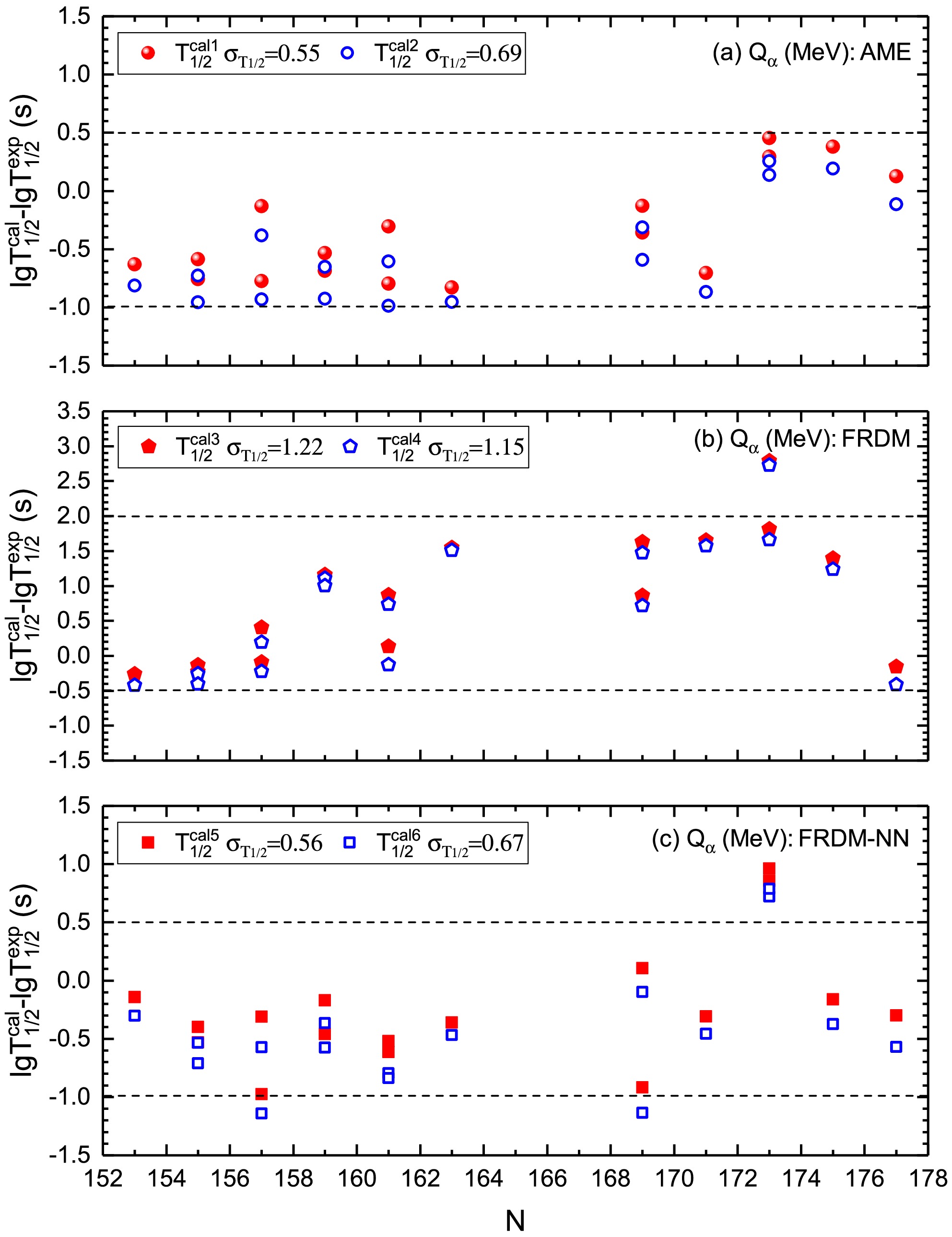
Figure 5.(color online) Same asFig. 3, but depicting the logarithmic differences between the calculations ofαdecay half-lives using the GLDM and Royer formula [47] and the experimental data for 17 known doubly odd superheavy nuclei, where
${j^{\pi}_{p}}$ and/or${j^{\pi}_{d}}$ are not available in NUBASE [61], and the favoredαdecay is assumed with$l = 0$ .$ \sigma_{T_{1/2}} = \sqrt{\frac{1}{n}\sum ({\log_{10}T_{1/2}^{\text{cal}}-\log_{10}T_{1/2}^{\text{exp}}})^2} , $

(11) where the number of nuclei shown inFigs. 3–5is
$ n = 30 $ for known superheavy nuclei with$ {j^{\pi}_{p}} $ and$ {j^{\pi}_{d}} $ available in NUBASE [61],$ n = 20 $ for known odd-Asuperheavy nuclei with$ {j^{\pi}_{p}} $ and/or$ {j^{\pi}_{d}} $ not available in NUBASE [61] but obtained using the FRDM [32], and$ n = 17 $ for known doubly odd nuclei with$ {j^{\pi}_{p}} $ and/or$ {j^{\pi}_{d}} $ not available in NUBASE [61] andlassumed to be zero, respectively.Fig. 3(a) shows that the logarithmic deviations between the calculations obtained using the GLDM and Royer formula [47] and experimental data are approximately 0.5 for most nuclei. The deviation symbols of the GLDM are higher than those of the Royer formula for most nuclei, indicating that the GLDM yields longerαdecay half-life results than those obtained using the Royer formula. This is because the GLDM considers theαpreformation factors, whereas the Royer formula does not. Consequently, theαdecay constants obtained using the GLDM are smaller than those calculated using the Royer formula, resulting in theαdecay half-lives calculated using the GLDM being longer than those calculated using the Royer formula. The$ \sigma_{T_{1/2}} $ values of two types of calculations and experimental data are 0.40 and 0.40, respectively. This indicates that the calculations using theαdecay energy of AME [35] can reproduce the experimental data well.Fig. 3(b) shows that, for a significant number of nuclei, the deviations between calculations and experimental data are approximately one order of magnitude, and for several nuclei, the deviations are over two orders of magnitude. This is caused by theαdecay energy given by the FRDM [32].Fig. 3(c) shows that the two types of calculatedαdecay half-lives can reproduce the experimental data well by using the optimizedαdecay energy obtained using the FRDM-NN. When adopting theαdecay energy given by the FRDM-NN, the$ \sigma_{T_{1/2}} $ values of the calculatedαdecay half-lives are reduced from 1.26 to 0.51 using the GLDM and from 1.26 to 0.50 using the Royer formula, indicatingimprovements of$ \dfrac{1.26-0.51}{1.26} = $ 59.52% and$ \dfrac{1.26-0.50}{1.26} = 60.32 $ %, respectively. A similar scenario is observed inFigs. 4and5.Encouraged by the excellent precision of the calculatedαdecay half-lives for known nuclei, theαdecay half-lives of superheavy nuclei, whoseαdecay mode is energetically allowed but not experimentally observed or whoseαdecay is observed but does not have an experimentally known intensity in NUBASE [61], are predicted using the GLDM and Royer formula [47] with theαdecay energy obtained using the FRDM-NN. The predictions are listed inTable 4. Theαdecay half-lives of superheavy nuclei with
$ Z = 119 $ and 120 are also predicted using the GLDM and Royer formula [47] with theαdecay energy obtained using the FRDM-NN and are listed inTable 5. InTables 4and5, the first column lists theαdecays including the parent and daughter nuclei. The second column represents the spin and parity transition of the parent and daughter nuclei obtained using the FRDM [32]. The third column denotes the minimum angular momentum taken away by theαparticle, obtained based on the conservation laws of angular momentum and parity [52]. The fourth column shows theαdecay energy given by the FRDM-NN. The fifth and sixth columns are the calculatedαdecay half-lives obtained using the GLDM and Royer formula [47] with theαdecay energy given by the FRDM-NN. The last two columns show the relative error calculated using Eq. (12) and the average results of the two types of predictions. For the unfavoredαdecay listed inTables 4and5, the zero angular moment transfer is also calculated for attesting the possibility of favoredαdecay. [60]αtransition ${j^{\pi}_{p}}\to{j^{\pi}_{d}}$ 

l $Q_{\alpha}^{\text{FRDM-NN}}$ 

$\text{lg}T^{\text{pre1}}_{1/2}$ 

$\text{lg}T^{\text{pre2}}_{1/2}$ 

ε $\text{lg}T^{\text{pre-ave}}_{1/2}$ 

Part A: ${j^{\pi}_{p}}$ and

${j^{\pi}_{d}}$ are available and taken from NUBASE [61]

$^{253}{\rm{Rf}} \to ^{249}{\rm{No}}$ 

${(7/2)(^+\#)\to5/2^+\#}$ 

0 $9.49$ 

$-1.13$ 

$-1.10$ 

$2.81$ %

$-1.12$ 

$^{253}{\rm{Rf}} \to ^{249}{\rm{No}}$ 

${(7/2)(^+\#)\to5/2^+\#}$ 

2 $9.49$ 

$-0.67$ 

$-0.79$ 

$14.93$ %

$-0.73$ 

$^{260}{\rm{Rf}} \to ^{256}{\rm{No}}$ 

${0^+\to0^+}$ 

0 $9.03$ 

$-0.22$ 

$-0.23$ 

$5.41$ %

$-0.23$ 

$^{264}{\rm{Rf}} \to ^{260}{\rm{No}}$ 

${0^+\to0^+}$ 

0 $7.93$ 

$3.29$ 

$3.41$ 

$3.55$ %

$3.35$ 

$^{266}{\rm{Rf}} \to ^{262}{\rm{No}}$ 

${0^+\to0^+}$ 

0 $7.50$ 

$4.88$ 

$5.05$ 

$3.26$ %

$4.96$ 

$^{268}{\rm{Rf}} \to ^{264}{\rm{No}}$ 

${0^+\to0^+}$ 

0 $7.87$ 

$3.47$ 

$3.56$ 

$2.53$ %

$3.51$ 

$^{265}{\rm{Db}} \to ^{261}{\rm{Lr}}$ 

${9/2^+\#\to1/2^-\#}$ 

0 $8.27$ 

$2.81$ 

$2.86$ 

$1.75$ %

$2.84$ 

$^{265}{\rm{Db}} \to ^{261}{\rm{Lr}}$ 

${9/2^+\#\to1/2^-\#}$ 

5 $8.27$ 

$4.50$ 

$4.40$ 

$2.30$ %

$4.45$ 

$^{269}{\rm{Db}} \to ^{265}{\rm{Lr}}$ 

${9/2^+\#\to1/2^-\#}$ 

0 $8.28$ 

$2.75$ 

$2.75$ 

$0.03$ %

$2.75$ 

$^{269}{\rm{Db}} \to ^{265}{\rm{Lr}}$ 

${9/2^+\#\to1/2^-\#}$ 

5 $8.28$ 

$4.44$ 

$4.29$ 

$3.44$ %

$4.36$ 

$^{258}{\rm{Sg}} \to ^{254}{\rm{Rf}}$ 

${0^+\to0^+}$ 

0 $9.45$ 

$-0.69$ 

$-0.68$ 

$1.95$ %

$-0.68$ 

$^{262}{\rm{Sg}} \to ^{258}{\rm{Rf}}$ 

${0^+\to0^+}$ 

0 $9.73$ 

$-1.49$ 

$-1.55$ 

$3.65$ %

$-1.52$ 

$^{264}{\rm{Sg}} \to ^{260}{\rm{Rf}}$ 

${0^+\to0^+}$ 

0 $9.28$ 

$-0.28$ 

$-0.30$ 

$4.51$ %

$-0.29$ 

$^{266}{\rm{Sg}} \to ^{262}{\rm{Rf}}$ 

${0^+\to0^+}$ 

0 $8.68$ 

$1.52$ 

$1.57$ 

$3.21$ %

$1.54$ 

$^{268}{\rm{Sg}} \to ^{264}{\rm{Rf}}$ 

${0^+\to0^+}$ 

0 $8.33$ 

$2.66$ 

$2.73$ 

$2.59$ %

$2.69$ 

$^{270}{\rm{Sg}} \to ^{266}{\rm{Rf}}$ 

${0^+\to0^+}$ 

0 $8.83$ 

$1.01$ 

$1.00$ 

$1.82$ %

$1.01$ 

$^{272}{\rm{Sg}} \to ^{268}{\rm{Rf}}$ 

${0^+\to0^+}$ 

0 $9.10$ 

$0.18$ 

$0.10$ 

$42.41$ %

$0.14$ 

$^{263}{\rm{Bh}} \to ^{259}{\rm{Db}}$ 

${5/2^-\#\to9/2^+\#}$ 

0 $10.19$ 

$-2.07$ 

$-2.18$ 

$5.23$ %

$-2.12$ 

$^{263}{\rm{Bh}} \to ^{259}{\rm{Db}}$ 

${5/2^-\#\to9/2^+\#}$ 

3 $10.19$ 

$-1.29$ 

$-1.56$ 

$17.37$ %

$-1.43$ 

$^{265}{\rm{Bh}} \to ^{261}{\rm{Db}}$ 

${5/2^-\#\to9/2^+\#}$ 

0 $9.71$ 

$-0.82$ 

$-0.89$ 

$8.80$ %

$-0.85$ 

$^{265}{\rm{Bh}} \to ^{261}{\rm{Db}}$ 

${5/2^-\#\to9/2^+\#}$ 

3 $9.71$ 

$-0.04$ 

$-0.28$ 

$85.20$ %

$-0.16$ 

$^{269}{\rm{Bh}} \to ^{265}{\rm{Db}}$ 

${5/2^-\#\to9/2^+\#}$ 

0 $8.81$ 

$1.79$ 

$1.77$ 

$1.21$ %

$1.78$ 

$^{269}{\rm{Bh}} \to ^{265}{\rm{Db}}$ 

${5/2^-\#\to9/2^+\#}$ 

3 $8.81$ 

$2.57$ 

$2.38$ 

$7.37$ %

$2.48$ 

$^{272}{\rm{Hs}} \to ^{268}{\rm{Sg}}$ 

${0^+\to0^+}$ 

0 $9.80$ 

$-1.10$ 

$-1.20$ 

$8.09$ %

$-1.15$ 

$^{274}{\rm{Hs}} \to ^{270}{\rm{Sg}}$ 

${0^+\to0^+}$ 

0 $10.14$ 

$-2.05$ 

$-2.17$ 

$5.74$ %

$-2.11$ 

$^{276}{\rm{Hs}} \to ^{272}{\rm{Sg}}$ 

${0^+\to0^+}$ 

0 $9.81$ 

$-1.19$ 

$-1.30$ 

$8.54$ %

$-1.25$ 

$^{268}{\rm{Ds}} \to ^{264}{\rm{Hs}}$ 

${0^+\to0^+}$ 

0 $11.28$ 

$-3.99$ 

$-4.18$ 

$4.61$ %

$-4.09$ 

$^{272}{\rm{Ds}} \to ^{268}{\rm{Hs}}$ 

${0^+\to0^+}$ 

0 $10.60$ 

$-2.48$ 

$-2.61$ 

$4.96$ %

$-2.55$ 

$^{274}{\rm{Ds}} \to ^{270}{\rm{Hs}}$ 

${0^+\to0^+}$ 

0 $10.94$ 

$-3.34$ 

$-3.50$ 

$4.53$ %

$-3.42$ 

$^{276}{\rm{Ds}} \to ^{272}{\rm{Hs}}$ 

${0^+\to0^+}$ 

0 $11.37$ 

$-4.31$ 

$-4.56$ 

$5.44$ %

$-4.43$ 

$^{278}{\rm{Ds}} \to ^{274}{\rm{Hs}}$ 

${0^+\to0^+}$ 

0 $10.91$ 

$-3.30$ 

$-3.50$ 

$5.87$ %

$-3.40$ 

$^{284}{\rm{Ds}} \to ^{280}{\rm{Hs}}$ 

${0^+\to0^+}$ 

0 $8.51$ 

$3.42$ 

$3.48$ 

$1.81$ %

$3.45$ 

$^{276}{\rm{Cn}} \to ^{272}{\rm{Ds}}$ 

${0^+\to0^+}$ 

0 $12.23$ 

$-5.41$ 

$-5.78$ 

$6.43$ %

$-5.59$ 

$^{278}{\rm{Cn}} \to ^{274}{\rm{Ds}}$ 

${0^+\to0^+}$ 

0 $12.71$ 

$-6.29$ 

$-6.80$ 

$7.54$ %

$-6.54$ 

$^{280}{\rm{Cn}} \to ^{276}{\rm{Ds}}$ 

${0^+\to0^+}$ 

0 $11.67$ 

$-4.35$ 

$-4.64$ 

$6.19$ %

$-4.50$ 

$^{282}{\rm{Cn}} \to ^{278}{\rm{Ds}}$ 

${0^+\to0^+}$ 

0 $10.03$ 

$-0.46$ 

$-0.54$ 

$14.93$ %

$-0.50$ 

$^{288}{\rm{Cn}} \to ^{284}{\rm{Ds}}$ 

${0^+\to0^+}$ 

0 $9.26$ 

$1.71$ 

$1.69$ 

$1.65$ %

$1.70$ 

$^{284}{\rm{Fl}} \to ^{280}{\rm{Cn}}$ 

${0^+\to0^+}$ 

0 $9.85$ 

$0.72$ 

$0.71$ 

$1.45$ %

$0.71$ 

Continued on next page Table 4.Predictions ofαdecay half-lives of superheavy nuclei, whoseαdecay mode is energetically allowed but not experimentally observed or whoseαdecay is observed but does not have an experimentally known intensity in NUBASE [61]. Theαdecay energies are obtained using the FRDM-NN. Theαdecay energies and half-lives are in units of "MeV" and "s", respectively.
αtransition ${j^{\pi}_{p}}\to{j^{\pi}_{d}}$ 

l $Q_{\alpha}^{\text{FRDM-NN}}$ 

$\text{lg}T^{\text{pre1}}_{1/2}$ 

$\text{lg}T^{\text{pre2}}_{1/2}$ 

ε $\text{lg}T^{\text{pre-ave}}_{1/2}$ 

$^{290}119 \to ^{286}{\rm{Ts}}$ 

0 $11.86$ 

$-1.88$ 

$-2.16$ 

$12.96$ %

$-2.02$ 

$^{291}119 \to ^{287}{\rm{Ts}}$ 

${1/2^-\to3/2^-}$ 

0 $11.90$ 

$-2.51$ 

$-2.76$ 

$8.85$ %

$-2.64$ 

$^{291}119 \to ^{287}{\rm{Ts}}$ 

${1/2^-\to3/2^-}$ 

2 $11.90$ 

$-2.09$ 

$-2.45$ 

$14.89$ %

$-2.27$ 

$^{292}119 \to ^{288}{\rm{Ts}}$ 

0 $11.87$ 

$-1.91$ 

$-2.22$ 

$13.98$ %

$-2.06$ 

$^{293}119 \to ^{289}{\rm{Ts}}$ 

${1/2^-\to3/2^-}$ 

0 $11.84$ 

$-2.38$ 

$-2.64$ 

$9.80$ %

$-2.51$ 

$^{293}119 \to ^{289}{\rm{Ts}}$ 

${1/2^-\to3/2^-}$ 

2 $11.84$ 

$-1.95$ 

$-2.33$ 

$16.26$ %

$-2.14$ 

$^{294}119 \to ^{290}{\rm{Ts}}$ 

0 $11.90$ 

$-2.04$ 

$-2.34$ 

$12.95$ %

$-2.19$ 

$^{295}119 \to ^{291}{\rm{Ts}}$ 

${1/2^-\to3/2^-}$ 

0 $12.13$ 

$-3.05$ 

$-3.34$ 

$8.90$ %

$-3.20$ 

$^{295}119 \to ^{291}{\rm{Ts}}$ 

${1/2^-\to3/2^-}$ 

2 $12.13$ 

$-2.62$ 

$-3.04$ 

$13.74$ %

$-2.83$ 

$^{296}119 \to ^{292}{\rm{Ts}}$ 

0 $12.31$ 

$-2.91$ 

$-3.29$ 

$11.59$ %

$-3.10$ 

$^{297}119 \to ^{293}{\rm{Ts}}$ 

${1/2^-\to3/2^-}$ 

0 $12.36$ 

$-3.55$ 

$-3.90$ 

$8.91$ %

$-3.72$ 

$^{297}119 \to ^{293}{\rm{Ts}}$ 

${1/2^-\to3/2^-}$ 

2 $12.36$ 

$-3.13$ 

$-3.59$ 

$12.91$ %

$-3.36$ 

$^{298}119 \to ^{294}{\rm{Ts}}$ 

0 $12.69$ 

$-3.66$ 

$-4.15$ 

$11.75$ %

$-3.91$ 

$^{299}119 \to ^{295}{\rm{Ts}}$ 

${1/2^-\to3/2^-}$ 

0 $12.81$ 

$-4.44$ 

$-4.90$ 

$9.42$ %

$-4.67$ 

$^{299}119 \to ^{295}{\rm{Ts}}$ 

${1/2^-\to3/2^-}$ 

2 $12.81$ 

$-4.01$ 

$-4.59$ 

$12.55$ %

$-4.30$ 

$^{300}119 \to ^{296}{\rm{Ts}}$ 

0 $12.90$ 

$-4.06$ 

$-4.63$ 

$12.19$ %

$-4.35$ 

$^{290}120 \to ^{286}{\rm{Og}}$ 

${0^+\to0^+}$ 

0 $11.92$ 

$-2.55$ 

$-2.71$ 

$6.03$ %

$-2.63$ 

$^{291}120 \to ^{287}{\rm{Og}}$ 

${3/2^+\to1/2^+}$ 

0 $12.13$ 

$-2.67$ 

$-2.86$ 

$6.53$ %

$-2.76$ 

$^{291}120 \to ^{287}{\rm{Og}}$ 

${3/2^+\to1/2^+}$ 

2 $12.13$ 

$-2.24$ 

$-2.55$ 

$11.98$ %

$-2.39$ 

$^{292}120 \to ^{288}{\rm{Og}}$ 

${0^+\to0^+}$ 

0 $12.14$ 

$-3.02$ 

$-3.26$ 

$7.38$ %

$-3.14$ 

$^{293}120 \to ^{289}{\rm{Og}}$ 

${5/2^+\to3/2^+}$ 

0 $12.11$ 

$-2.65$ 

$-2.86$ 

$7.33$ %

$-2.76$ 

$^{293}120 \to ^{289}{\rm{Og}}$ 

${5/2^+\to3/2^+}$ 

2 $12.11$ 

$-2.23$ 

$-2.56$ 

$12.86$ %

$-2.39$ 

$^{294}120 \to ^{290}{\rm{Og}}$ 

${0^+\to0^+}$ 

0 $12.07$ 

$-2.93$ 

$-3.13$ 

$6.53$ %

$-3.03$ 

$^{295}120 \to ^{291}{\rm{Og}}$ 

${1/2^+\to5/2^+}$ 

0 $12.16$ 

$-2.81$ 

$-3.00$ 

$6.43$ %

$-2.90$ 

$^{295}120 \to ^{291}{\rm{Og}}$ 

${1/2^+\to5/2^+}$ 

2 $12.16$ 

$-2.38$ 

$-2.69$ 

$11.58$ %

$-2.54$ 

$^{296}120 \to ^{292}{\rm{Og}}$ 

${0^+\to0^+}$ 

0 $12.41$ 

$-3.68$ 

$-3.96$ 

$7.03$ %

$-3.82$ 

$^{297}120 \to ^{293}{\rm{Og}}$ 

${1/2^+\to1/2^+}$ 

0 $12.61$ 

$-3.74$ 

$-4.03$ 

$7.22$ %

$-3.88$ 

$^{298}120 \to ^{294}{\rm{Og}}$ 

${0^+\to0^+}$ 

0 $12.33$ 

$-3.53$ 

$-3.81$ 

$7.41$ %

$-3.67$ 

$^{299}120 \to ^{295}{\rm{Og}}$ 

${1/2^+\to1/2^+}$ 

0 $12.96$ 

$-4.41$ 

$-4.81$ 

$8.16$ %

$-4.61$ 

$^{300}120 \to ^{296}{\rm{Og}}$ 

${0^+\to0^+}$ 

0 $13.06$ 

$-4.93$ 

$-5.40$ 

$8.75$ %

$-5.17$ 

Table 5.Predictions ofαdecay half-lives of superheavy nuclei with
$Z = 119$ and 120. Theαdecay energies are obtained using the FRDM-NN. The spin and parity values of the parent and daughter nuclei are obtained using the FRDM [32]. Theαdecay energies and half-lives are in units of "MeV" and "s", respectively.Tables 4and5show that the predictions ofαdecay half-lives obtained using the GLDM agree with those obtained using the Royer formula [47], and the trends in half-lives change are consistent. Moreover, the calculatedαdecay half-life for non-zerolis longer than that for zerolowing to the contribution of the centrifugal potential. In addition,Tables 4and5show that the predictedαdecay half-lives using the GLDM
$ \text{lg}T^{\text{pre}1}_{1/2} $ are longer than those using the Royer formula$ \text{lg}T^{\text{pre}2}_{1/2} $ for most nuclei. This is because the GLDM considers theαpreformation factors, whereas the Royer formula does not. Therefore, theαdecay constants calculated using the GLDM are smaller than those given by the Royer formula, resulting in theαdecay half-lives calculated using the GLDM being longer than those calculated using the Royer formula. Furthermore, to identify nuclei with reliableαdecay half-life predictions, the relative error of the two types of predictions is analyzed by introducing the following quantity [63]:$ \varepsilon = \frac{{\rm Max}(\lvert{\text{lg}T^{\text{pre}i}_{1/2}}\rvert)-{\rm Min}(\lvert{\text{lg}T^{\text{pre}i}_{1/2}}\rvert)}{{\rm Max}(\lvert{\text{lg}T^{\text{pre}i}_{1/2}}\rvert)}, $

(12) where
$ \text{lg}T^{\text{pre}i}_{1/2} $ presents the predictedαdecay half-life given by the GLDM and Royer formula. This relative error assesses the quality of the predictions for each nucleus by relating the spread of the two types of predictions to the maximum predicted results [63]. Theεvalues of the predictedαdecay half-lives for 138 superheavy nuclei presented inTable 4A, B, C, andTable 5are marked as red triangles, blue squares, purple pentagons, and green circles, respectively, and plotted inFig. 6. This graphical representation facilitates the selection of nuclei with maximally superposing predictions [63]. For most nuclei,$ \varepsilon<30 $ % except for the nuclei listed inTable 4such as$ ^{272} {\rm{Sg}}$ ($ l = 0 $ ,$ \varepsilon = 42.41 $ %),$ ^{265} {\rm{Bh}}$ ($ l = 3 $ ,$ \varepsilon = 85.20 $ %),$ ^{273} {\rm{Bh}}$ ($ l = 2 $ ,$ \varepsilon = 60.16 $ %),$ ^{271} {\rm{Mt}}$ ($ l = 3 $ ,$ \varepsilon = 91.18 $ %), and$ ^{291} {\rm{Mc}}$ ($ l = 2 $ ,$ \varepsilon = 74.27 $ %). However, when zerolis inputted in predicting theαdecay half-lives,$ \varepsilon = 8.80 $ % for$ ^{265} {\rm{Bh}}$ ,$ \varepsilon = 16.11 $ % for$ ^{273} {\rm{Bh}}$ , and$ \varepsilon = 12.69 $ % for$ ^{271} {\rm{Mt}}$ , indicating that these nuclei may undergo favoredαdecay. For nuclei$ ^{272} {\rm{Sg}}$ ($ Z = 106 $ ,$ N = 166 $ ) and$ ^{291} {\rm{Mc}}$ ($ Z = 115 $ ,$ N = 176 $ ), the largeεmay be caused by the shell effects of proton number$ Z = 108 $ , neutron number$ N = 162 $ , and proton number$ Z = 114 $ . Specifically,$ \varepsilon<20 $ % of the predicatedαdecay half-lives using the GLDM and Royer formula for superheavy nuclei with$ Z = 119 $ and 120. Theαdecay half-lives predicted using the GLDM model and Royer formula with theαdecay energies predicted using the FRDM-NN can provide a reference for experimental and theoretical research, in particular, for the synthesis of new superheavy elements with$ Z = 119 $ and 120. -
We have examined the accuracy of the FRDM in describing theαdecay energies of the 947 known heavy and superheavy nuclei. We observe important discrepancies between theαdecay energies obtained using the FRDM and those reported by AME. In particular, the FRDM underestimates the experimentalαdecay energies of superheavy nuclei. We optimize theαdecay energies of known nuclei obtained using FRDM using a neural network approach. The accuracy of the optimizedαdecay energies is significantly improved. Theαdecay energy systematics obtained using the FRDM and FRDM-NN reveal the evident shell effect at neutron number
$ N = 184 $ , implying that the next neutron magic number after$ N = 126 $ could be$ N = 184 $ . We study theαdecay half-lives of known superheavy nuclei using the GLDM and Royer formula with the input of the optimizedαdecay energies. The calculations of theαdecay half-lives reproduce the experimental data well. Theαdecay energies of superheavy nuclei, whoseαdecay mode is energetically allowed but not experimentally observed or whoseαdecay is observed but does not have an experimentally known intensity, are predicted using the FRDM-NN. Theαdecay half-lives of these superheavy nuclei are predicted using the GLDM and Royer formula. Theαdecay energies and half-lives of superheavy nuclei with$ Z = 119 $ and 120 are also predicted using the FRDM-NN, GLDM, and Royer formula. In addition, the relative error of predictedαdecay half-lives and superposition are analyzed, and the average predictions are given. We hope that our research will provide a reference for experiments to synthesize new superheavy elements.
αdecay properties of superheavy nuclei based on optimizedαdecay energies
- Received Date:2024-10-21
- Available Online:2025-05-15
Abstract:In this study, the accuracy of the Finite-Range Droplet Model 2012 (FRDM) in describing theαdecay energies of the 947 known heavy and superheavy nuclei is investigated. We find evident discrepancies between theαdecay energies obtained using the FRDM and those reported by the evaluated atomic mass table AME 2020 (AME). In particular, the FRDM underestimates the experimentalαdecay energies of superheavy nuclei. Theαdecay energies of known nuclei obtained using the FRDM are optimized using a neural network approach,i.e., FRDM-NN, and the accuracy improves significantly. Theαdecay energy systematics obtained using both the FRDM and FRDM-NN exhibit an evident shell effect at neutron number


 DownLoad: