


 Abstract
 HTML
HTML Reference
 Related
 PDF
PDF


-
The exploration ofα-decay, a fundamental decay mode of heavy and superheavy nuclei (SHN), serves as an effective tool for investigating different nuclear structural characteristics [1−10]. The most prevalent technique for detecting new superheavy elements (SHEs) in unexplored areas of the nuclear chart is through the observation ofα-decay chains [11,12]. These SHN exist owing to the stabilizing effects of nuclear shell structures [13]. The heaviest known synthesized element is
$ ^{294}_{118} \text{Og} $ , which has a half-life of$ 0.89^{+1.07}_{-0.31} $ ms and was produced through the hot fusion reaction$ ^{48}\text{Ca}+^{249}\text{Cf} $ [14]. While SHN such as$ ^{294}\text{Ts} $ ($ Z = 117 $ ) and$ ^{294}\text{Og} $ ($ Z = 118 $ ), containing 177 and 176 neutrons, respectively, have been successfully synthesized, these isotopes are still 7 and 8 neutrons less from the expected closed shell at$ N = 184 $ . Consequently, the central region of the long-sought island of stability remains uncharted. The competition to synthesize increasingly heavier elements beyond Og is ongoing.SHN primarily undergo decay viaα-decay [13,15−17]. The study ofα-decay chains, often followed by spontaneous fission, is the primary method for identifying SHN [13,18,19]. The analysis of the decay characteristics and quantum shell effects enables the deduction of the enhanced stability of recently produced SHN.
Various theoretical approaches have been proposed to effectively explainα-decay half-lives. These approaches include the generalized liquid drop model [20−24], transfer matrix method [25], density-dependent cluster model [26−29], unified fission model [30,31], Coulomb and proximity potential model [32], and two-potential approach [33−35]. A comprehensive microscopic treatment ofα-decay presents a complex quantum-mechanical challenge. Throughout the past century, many microscopic models have been developed to describe these decay processes. Qiet al.[8] reviewed recent developments in the process of radioactive particle decay, highlighting both experimental and theoretical advancements in the field. Mirea [36] conducted a microscopic study ofα-decay half-lives and the fine structure phenomenon using fission-like models by solving time-dependent pairing equations. Xuet al.[37] presented a microscopic calculation ofα-cluster formation in heavy nuclei through the quartetting wave function approach (QWFA), inspired by the successful application of the Tohsaki-Horiuchi-Schuck-Röpke (THSR) wave-function concept to light nuclei. Utilizing the QWFA, Yanget al.[4] performed a microscopic calculation ofα-cluster formation and decay in
$ ^{104} \text{Te} $ ,$ ^{212} \text{Po} $ , and their neighboring isotopes. More recently, Yanget al.[38] examined the effects of shell structure onα-cluster formation and decay using the QWFA.In addition to microscopic calculations, several empirical or semiempirical formulas have been proposed for calculatingα-decay half-lives, primarily based on theα-decay energy (Q-value) [20,39−42]. Many of these formulas are regularly refined over time. Royer [20] employed a fitting method on a dataset of 373αemitters to derive an analytical formula forα-decay based on the generalized liquid drop model. Brown [43] introduced a universal scaling rule based on the linear relationship between half-life and
$ Z_{d}^{0.6} $ $ Q_{\alpha}^{-1/2} $ . Renet al.[44] developed empirical formulas by examining the experimental variance of logarithmic half-lives, which were later modified by Niet al.[40] to include the reduced mass term using Wentzel-Kramer-Brillouin (WKB) approximations, resulting in the NRDX formula forα-decay half-lives. Utilizingα-like R-matrix theory and the microscopic mechanisms of charged-particle emission, Qiet al.[45] presented the universal decay law (UDL) applicable to bothα-decay and cluster decay modes. Additionally, a semi-empirical formula known as SemFIS [16], which incorporates the magic number of nucleons based on fission theory forα-decay, has been updated to SemFIS2 [41]. Poenaruet al.[46] derived a single universal curve (UNIV) forα-decay and cluster radioactivity based on fission theory. Horoiet al.presented a generalized scaling law [42], and Parkhomenko and Sobiczewski [47] developed a formula for$ Z > 82 $ that includes excitation energy considerations for odd-Aand odd-odd nuclei. Several of these formulas have been enhanced by incorporating an asymmetry term, including the modified scaling law Brown formula (MSLB) [48], modified universal decay law (MUDL) [49], modified Manjunatha formula (MMF) [50], modified Royer (Akrawy and Poenaru) formula [51], new Ren A formula [52], modified Horoi formula (MHF), and modified Sobiczewski formula (MSF) [53].The effect of angular momentum must be incorporated into empirical formulas as theα-decay half-life depends exponentially on the action, which is highly sensitive to theα-nucleus potential. An accurate consideration ofαtransitions requires accounting for the spins and parities of both the parent and daughter nuclei, as well as the angular momentum of the emittedα-particle. Empirical relationships that include terms for centrifugal potential enhance the accuracy ofα-decay half-life predictions, particularly for even-odd, odd-even, and odd-odd nuclei. This improved precision highlights the importance of including angular momentum effects into empirical models. Furthermore, the minimal orbital angular momentum (
$ \ell_\text{min} $ ) carried by theα-particle must be included to accurately describeα-decay half-lives, particularly for unfavored transitions ($ \ell_\text{min} \neq 0 $ ), where the parent state has different spin and parity assignments than the daughter state [54].Theα-decay half-lives are calculated within various macroscopicα-nucleus potential models [3,28,55−61] as well as fully microscopic models [62−64]. These models demonstrate thatα-decay half-lives are significantly reduced in deformed nuclei compared with spherical ones. The decrease is primarily owing to significant modifications in the interaction potential between theα-particle and the deformed daughter nucleus. The deformations of the daughter nuclei result in reduced barrier height and thickness in specific directions ofα-particle emission compared with the spherical daughter nucleus. Consequently, the transmission coefficient and, subsequently, the half-life ofα-decay, decrease significantly. The influence of deformations in daughter nuclei on the half-life ofα-decay is commonly ignored in empirical formulas [65]. Thus, the incorporation of a variable that accounts for the deformations of the daughter nucleus into the empirical expression forα-decay half-life is quite advantageous. The major objective of this study is to introduce improved empirical formulas forα-decay half-lives that include two factors dependent on deformation.
In this study, we incorporate the influence of angular momentum into recently revised empirical formulas to analyze both favored and unfavoredα-transitions. In addition, we improve the empirical formula by including a factor that accounts for nuclear isospin asymmetry. To consider the influence of deformations in daughter nuclei on the half-life ofα-decay, we incorporate an additional two terms into the empirical formulas that manipulateα-decay half-lives. These terms are determined by the values of the quadrupole and hexadecapole deformation parameters. By incorporating these recently introduced factors, which depend on the deformation values of the daughter nucleus, we enhance the empirical models forα-decay half-lives. We determine the coefficients for these improved formulas for even–even, even–odd, odd–even, and odd–odd atomic nuclei by fitting them with the latest experimental half-life measurements for 573 nuclei with atomic numbers in the range
$ 52 \leq Z \leq 118 $ [66]. Additionally, we conduct a comprehensive analysis of shell closures and their correlation with variations in the number of neutrons, as indicated by the logarithmic half-lives$ \log_{10} T $ . Our analysis predicts the half-lives forα-decay in the uncharted region of SHN utilizing the enhanced modified formulas.The remainder of this article is structured as: in Sec. II, we present an overview of the general theoretical framework for calculating theα-decay half-lives. Sec. III focuses on the analysis and discussion of the results. Finally, a summary and conclusion are provided in Sec. IV.
-
We analyze six empirical formulas to evaluate their effectiveness: the NRDX formula [40], UDL [45], Royer's formula [20], Viola-Seaborg formula (VSS1) [67−69], Taagepera-Nurmia formula (TN1) [70−72], and modified Brown formula (mB) [43]. To identify the most accurate, we compute their standard deviation (σ) and chi-squared (
$ \chi^2 $ ) values. The NRDX, UDL, and Royer formulas ranked as the top three performers. The original versions of these formulas are provided below:$ \begin{aligned} \log_{10}{T^{\rm NRDX}_{1/2}} = \,a\,\sqrt{\,\mu}\,\,Z_{\alpha}\,Z_{d}\dfrac{1}{\sqrt{Q_{\alpha}}}\,+\,b\,\sqrt{\mu}\,(Z_{\alpha}\,Z_{d})^{\,\frac{1}{2}}\,+\,\,c, \end{aligned} $

(1) $ \begin{aligned} \log_{10}{T^{\rm UDL}_{1/2}} = a\sqrt{\mu}Z_{\alpha}Z_{d}\dfrac{1}{\sqrt{Q_{\alpha}}}+b[\sqrt{\mu}Z_{\alpha}Z_{d}(A_{\alpha}^{\frac{1}{3}}+A_{d}^{\frac{1}{3}})]^{\frac{1}{2}}+c ,\end{aligned} $

(2) $ \begin{aligned} \log_{10}\,{T^{\rm Royer}_{1/2}}\,\, = \,\,(\,a\,+\,\,b\,\,A^{\,\frac{1}{6}}\,\sqrt{\,Z})\,\,+\,\,\dfrac{\,c\,Z}{\sqrt{\,Q_{\alpha}}},\,\,\,\,\,\,\,\,\,\,\,\,\,\,\,\,\,\,\,\,\,\, \end{aligned} $

(3) $ \begin{aligned} \log_{10}\,{T^{\rm VSS1}_{1/2}}\,\, = \,\,(a\,Z\,+\,b)\,\frac{1}{\sqrt{Q_{\alpha}}}\,+\,c\,Z\,+\,d,\,\,\,\,\,\,\,\,\,\,\,\,\,\,\,\,\,\, \end{aligned} $

(4) $ \begin{aligned} \log_{10}\,{T^{\rm TN1}_{\,1/2}}\,\, = \,\,a\, \sqrt{\,\mu}\,\frac{\,Z_{d}}{\sqrt{\,Q_{\alpha}}}\,-\,Z_{d}^{\,2/3}\,+\,b,\,\,\,\,\,\,\,\,\,\,\,\,\,\,\,\,\,\,\,\,\,\,\, \end{aligned} $

(5) $ \begin{aligned} \log_{10}\,{T^{\rm mB}_{\,1/2}}\,\, = \,\,a\,\,(\,Z_{d}\,)^{\,b}\,\frac{1}{\sqrt{\,Q_{\alpha}}}\,+\,c.\,\,\,\,\,\,\,\,\,\,\,\,\,\,\,\,\,\,\,\,\,\,\,\,\,\,\,\,\,\,\,\,\, \end{aligned} $

(6) In these formulas,μis equal to
$ A_\alpha A_d/(A_\alpha + A_d) $ , where$ A_\alpha $ and$ A_d $ are the mass numbers of theα-particle and daughter nucleus, respectively. Similarly,$ Z_\alpha $ and$ Z_d $ denote the atomic numbers of theα-particle and daughter nucleus, respectively, and$ Q_\alpha $ (in MeV) indicates the decay energy associated with theα-decay process. -
Niet al.[40] proposed the NRDX formula, which incorporates an approximate WKB barrier penetration probability. Derived fromR-matrix theory, Qiet al.[45] proposed a linear UDL based on the microscopic mechanism of charged-particle emission, applicable to bothα- and cluster decays. Additionally, Royer [20] developed an analytical formula within the generalized liquid drop model. These formulas, referred to as FA, are examined in detail, with the original expressions provided in Eqs. (1), (2) and (3).
InTable 1, we present updated parameters for Eqs. (1), (2) and (3), fitted to the latest available experimental data covering 573 nuclei within the range
$ 52 \leq Z \leq 118 $ . NuBASE2020 [66] provides the parity and spin assignments for the parent and daughter nuclei, along with experimentalα-decay half-lives. Experimental$ Q_{\alpha} $ values are taken from the latest AME2020 atomic mass evaluation [73].Formula Nuclei a b c NRDX e-e 0.4025 −1.4841 −12.4258 e-o 0.4087 −1.3802 −15.3409 o-e 0.4093 −1.4632 −13.4067 o-o 0.4199 −1.4132 −15.5589 All nuclei 0.4033 −1.4274 −13.5814 UDL e-e 0.4089 −0.5949 −21.7141 e-o 0.4149 −0.5545 −23.9417 o-e 0.4167 −0.5905 −22.4893 o-o 0.4272 −0.5709 −24.321 All nuclei 0.4098 −0.5737 −22.4698 Royer e-e −25.7207 −1.1385 1.5823 e-o −27.9119 −1.0524 1.6066 o-e −26.6051 −1.1229 1.6118 o-o −28.5625 −1.0722 1.6514 All nuclei −26.473 −1.0913 1.5854 Table 1.Parameters of the proposed FA for all sets ofαemitters.
-
Given the significance of angular momentum (
$ \ell $ ), we have incorporated an$ \ell $ term into these formulations in this study. The modified formulas, referred to as FB, are presented as follows:$ \begin{aligned}[b] \log_{10}{T^{\rm NRDX}_{1/2}} = \;&\,\,a\,\sqrt{\mu}\,Z_{\alpha}\,Z_{d}\,\dfrac{1}{\sqrt{\,Q_{\alpha}}}\,+\,b\sqrt{\,\mu}\,(Z_{\alpha}\,Z_{d})^{\frac{1}{2}} \\&+ c +\,d\,\ell(\ell+1), \end{aligned} $

(7) $ \begin{aligned}[b] \log_{10}{T^{\rm UDL}_{1/2}} =\;&a\sqrt{\mu}Z_{\alpha}Z_{d}\dfrac{1}{\sqrt{Q_{\alpha}}}+b[\sqrt{\mu}Z_{\alpha}Z_{d}(A_{\alpha}^{\frac{1}{3}}+A_{d}^{\frac{1}{3}})]^{\frac{1}{2}} \\& +c+d\,\ell(\ell+1), \end{aligned} $

(8) $ \begin{aligned} \log_{10}\,{T^{\rm Royer}_{1/2}}\, = \,(\,a\,+\,\,b\,\,A^{\frac{1}{6}}\,\sqrt{\,Z}\,)\,\,+\,\dfrac{\,c\,Z}{\sqrt{\,Q_{\alpha}}}\,+\,d\,\ell(\ell+1). \end{aligned} $

(9) Here,
$ \ell = \ell_{\text{min}} $ represents the minimum angular momentum value for theαtransition. This component significantly improves the description ofα-decay half-lives in odd-Aand odd-odd nuclei, where the parent and daughter nuclei have different spin-parity characteristics. Theα-particle emission from nuclei follows spin-parity selection rules; thus, the minimum angular momentum value$ \ell_{\text{min}} $ for theαtransition between states is defined as$ \begin{aligned} \ell_{\rm min} = \begin{cases} \Delta_{j} ,& \text{for even } \Delta_{j} \text{ and}\,\, \pi_{p} = \pi_{d},\\ \Delta_{j}+1,& \text{for even } \Delta_{j} \text{ and}\,\, \pi_{p}\neq\pi_{d},\\ \Delta_{j},& \text{for odd } \Delta_{j} \text{ and}\,\,\,\, \pi_{p}\neq\pi_{d},\\ \Delta_{j}+1,& \text{for odd } \Delta_{j} \text{ and}\,\,\,\, \pi_{p} = \pi_{d}.\\ \end{cases} \end{aligned} $

(10) Here,
$ \Delta_{j} = |j_{p} - j_{d}| $ , where$ j_{p} $ and$ \pi_{p} $ are the spin and parity of the parent nucleus, respectively, whereas$ j_{d} $ and$ \pi_{d} $ refer to those of the daughter nucleus. We include the angular momentum term for several reasons. Within the WKB approximation, the integral of the action, which encompasses the contribution from rotational energy, exponentially determines theα-decay half-life. At high rotational energy values, this contribution becomes significant in the action integral. The action integral is roughly proportional to$ \ell(\ell + 1) $ , given that the rotational energy is also proportional to$ \ell(\ell + 1) $ . However, this factor appears differently across various calculations of theα-decay half-life [65,74,75]. InTable 2, we present updated parameters for Eqs. (7), (8), and (9), fitted to the latest available experimental data covering a wide range of 573 nuclei (52$ \leq Z \leq 118 $ ).Formula Nuclei a b c d NRDX e-e 0.4025 −1.4841 −12.4258 0 e-o 0.4105 −1.4456 −14.0945 0.0439 o-e 0.4097 −1.4563 −13.7325 0.0173 o-o 0.4172 −1.4033 −15.6988 0.0377 All nuclei 0.4045 −1.4418 −13.5091 0.0398 UDL e-e 0.4089 −0.5949 −21.7141 0 e-o 0.4174 −0.5843 −23.0004 0.0479 o-e 0.4169 −0.5877 −22.7486 0.0153 o-o 0.4244 −0.5676 −24.378 0.0399 All nuclei 0.4111 −0.5799 −22.4812 0.0407 Royer e-e −25.7207 −1.1385 1.5823 0 e-o −27.0281 −1.1161 1.6167 0.0484 o-e −26.8576 −1.11688 1.6126 0.0149 o-o −28.5907 −1.0664 1.6407 0.0405 All nuclei −26.5033 −1.1041 1.5904 0.0408 Table 2.Parameters of the proposed FB for all sets ofαemitters.
-
We enhance the three empirical formulas by incorporating terms for nuclear isospin asymmetry, specificallyIand
$ I^2 $ ,$ (I = N-Z/A) $ for the parent nuclei [48,51]. The inclusion of the isospin-dependent termsIand$ I^2 $ in this framework builds upon prior advancements in modelingα-decay half-lives. The effectiveness of incorporating asymmetry-dependent terms, such asIand$ I^2 $ , into established formulas was demonstrated in earlier studies [48,51]. These modifications to empirical formulas, including the MSLB, modified Yibinet al.formula (MYQZR), and modified Viola-Seaborg formula (MVS), significantly improved the empirical predictions by establishing a linear relationship between these terms and the logarithm ofα-decay half-lives. Inspired by these findings, we employ a similar formalism in this study to account for the effects of isospin asymmetry, thereby enhancing the robustness of the theoretical model forα-decay. These modifications have been shown to play a crucial role in determining half-lives, as outlined in the following modified forms:$ \begin{aligned}[b] \log{T^{\rm NRDX}_{1/2}} = \;&a\sqrt{\mu}Z_{\alpha}Z_{d}\dfrac{1}{\sqrt{Q_{\alpha}}}+b\sqrt{\mu}(Z_{\alpha}Z_{d})^{{1}/{2}}+c \\&+d\ell(\ell+1)+eI+fI^{2} ,\end{aligned} $

(11) $ \begin{aligned}[b] \log{T^{\rm UDL}_{1/2}} = \;& a\sqrt{\mu}Z_{\alpha}Z_{d}\dfrac{1}{\sqrt{Q_{\alpha}}}+b[\sqrt{\mu}Z_{\alpha}Z_{d}(A_{\alpha}^{{1}/{3}}+A_{d}^{{1}/{3}})]^{{1}/{2}}\\&+c+d\ell(\ell+1)+eI+fI^{2} ,\\[-10pt]\end{aligned} $

(12) $ \begin{aligned} \log{T^{\rm Royer}_{1/2}} = (a+bA^{{1}/{6}}\sqrt{Z})+\dfrac{cZ}{\sqrt{Q_{\alpha}}}+d\ell(\ell+1)+eI+fI^{2} .\end{aligned} $

(13) InTable 3, we have updated the parameters of Eqs. (11), (12) and (13), which have been fitted to the latest available experimental data covering a wide range of 573 nuclei (52
$ \leq $ Z$ \leq $ 118).Formula Nuclei a b c d e f NRDX e-e 0.4110 −1.4135 −15.4356 0 9.8321 −54.0411 e-o 0.4154 −1.3989 −15.2438 0.0455 −6.5849 12.6399 o-e 0.4218 −1.3356 −16.916 0.0128 −10.0799 5.3699 o-o 0.4219 −1.3629 −17.1955 0.0399 2.0780 −17.773 All nuclei 0.4099 −1.3989 −15.2059 0.0406 3.4239 −23.8579 UDL e-e 0.4118 −0.5849 −22.8644 0 7.6698 −34.0419 e-o 0.4162 −0.5824 −22.4616 0.0458 −8.7192 33.1917 o-e 0.4228 −0.5562 −23.7951 0.0129 −12.2272 24.8499 o-o 0.4236 −0.5722 −24.1378 0.0395 0.5338 0.4496 All nuclei 0.4108 −0.5817 −22.4532 0.0407 1.2991 −3.7307 Royer e-e −26.5569 −1.1269 1.5885 0 7.7979 −31.5329 e-o −26.2112 −1.1212 1.6081 0.0457 −8.7121 35.671 o-e −27.674 −1.0537 1.6316 0.0129 −12.5284 27.7595 o-o −28.1175 −1.0884 1.6343 0.0398 1.6707 −1.0283 All nuclei −26.1995 −1.1178 1.5852 0.0407 1.4272 −1.6148 Table 3.Parameters of the proposed FC for all sets ofαemitters.
-
The new term accounts for the reduction inα-decay half-lives resulting from the deformation of the daughter nucleus. By incorporating the quadrupole deformation parameter,
$ \beta_2 $ , we can express the empirical formulations as follows:$ \begin{aligned}[b] \log_{10}{T^{\rm NRDX}_{1/2}}\, = \;&\,a\,\sqrt{\,\mu}\,Z_{\alpha}\,Z_{d}\dfrac{1}{\sqrt{Q_{\alpha}}}\,+\,b\sqrt{\mu}\,(Z_{\alpha}Z_{d})^{{1}/{2}}\,+c \\ &+\,g\sqrt{\kappa_2\beta_2}\frac{Z}{\sqrt{Q_{\alpha}}}, \end{aligned} $

(14) $ \begin{aligned}[b] \log_{10}{T^{\rm UDL}_{1/2}} =\;& a\sqrt{\mu}Z_{\alpha}Z_{d}\dfrac{1}{\sqrt{Q_{\alpha}}}+b[\sqrt{\mu}Z_{\alpha}Z_{d}(A_{\alpha}^{{1}/{3}}+A_{d}^{{1}/{3}})]^{{1}/{2}} \\ &+c+g\sqrt{\kappa_2\beta_2}\frac{Z}{\sqrt{Q_{\alpha}}},\\[-12pt] \end{aligned} $

(15) $ \begin{aligned}[b] \log_{10}\,{T^{\rm Royer}_{1/2}}\, =\; &\,(\,a\,+\,b\,A^{{1}/{6}}\,\sqrt{\,Z}\,)\,+\,\dfrac{c\,Z}{\sqrt{\,Q_{\alpha}}}\\&+\,g\sqrt{\kappa_2\beta_2}\frac{Z}{\sqrt{Q_{\alpha}}}. \end{aligned} $

(16) The deformation of the daughter nucleus results in significant changes in the nuclear and Coulomb parts of the potential. For a fixed separation distance between the spherical and deformed nuclei in the surface and tail regions, the varying orientation of the deformed nucleus has a large effect on the nuclear potential. This is because the change in orientation produces a change in the radial position of the half density overlap, which has maximum and minimum values of orientation of
$ \theta = 0^\circ $ and$ \theta = 90^\circ $ , respectively, when the values of deformations parameters are positive. A detailed discussion on the impact of nuclear deformation on the nuclear and Coulomb interaction potentials, as well as onα-decay half-lives and preformation probability, is provided in Ref. [76]. The study showed that deformation is manifested through an orientation angle-dependent nuclear radius, resulting in enhanced penetration for larger radii. Following Ref. [65], the surface radius of the deformed daughter nucleus is given by$ R(\theta) = R_{0}[1+\beta_2 Y_{20}(\theta)] $ , where$Y_{20}(\theta)$ represents the spherical harmonic function, and$R_{0}$ is the radius of a spherical nucleus. The reduction in theα-decay half-life owing to the deformation of the daughter nucleus is primarily attributed to the Coulomb contact between theα-particle and deformed daughter nucleus. The Coulomb interaction potential of theα-particle with the deformed daughter nucleus at the contact distance reaches a minimum value of$ V_{C}^ \text{min} = 2(Z_p - 2)e_{p}^{2}/(R_{L} + R_{\alpha}) $ , where$e_{p}$ is the proton charge,$R_{L}$ is the maximum radius of the deformed daughter nucleus, and$R_{\alpha}$ is the radius of theα-particle. At$\theta = 0$ , the maximum radius of a prolate nucleus$(\beta > 0)$ is given by$ R_{L} = R_{0}\left(1 + \sqrt{5/\pi}\beta/2\right) $ . At$ \theta = \pi/2 $ , the radius of an oblate nucleus$(\beta < 0)$ reaches its maximum value of$ R_{L} = R_{0}\left(1 + \sqrt{5/\pi}\beta/4\right) $ . The prolate nucleus has a maximum radius that is twice as large as that of the oblate nucleus. The difference in Coulomb interactions between spherical and deformed nuclei is expressed as$ \begin{aligned} \Delta = V_{C}^{S{\rm ph}} - V_{C}^{\rm min} \approx \frac{2(Z_p - 2)e_{p}^{2}}{(R_0 + R_{\alpha})^{2}}(R_L - R_0), \end{aligned} $

(17) where
$V_{C}^{S{\rm ph}} = 2(Z_p - 2)e_{p}^{2}/(R_{0} + R_{\alpha})$ represents the Coulomb interaction of theα-particle with the spherical daughter nucleus. The minimum Coulomb potential for theα-particle and deformed nucleus is given by$V^{\rm min}_C = 2(Z_p - 2)e_{p}^{2}/(R_L + R_d)$ . Thus, the reduction in theα-decay half-life resulting from the deformation of the daughter nucleus is linked to the quantity$ \Delta \propto (R_L - R_0) $ . The value of Δ for a prolate nucleus is twice that of an oblate nucleus. Consequently, to model this effect,$\kappa_2 = 2$ should be assigned for prolate nuclei and$\kappa_2 = -1$ for oblate nuclei, as indicated in Ref. [65]. We have updated the parameters of Eqs. (14), (15), and (16) inTable 4by fitting to the most recent experimental data available, covering a broad range of 573 nuclei (52$\leq$ Z$\leq$ 118).Formula Deform. Nuclei a b c g NRDX FRDM e-e 0.4039 −1.48 −12.6507 −0.0046 WS4 e-e 0.4065 −1.4785 −12.8695 −0.0145 FRDM e-o 0.4119 −1.3712 −15.8477 −0.0101 WS4 e-o 0.4119 −1.3687 −15.8595 −0.0120 FRDM o-e 0.4006 −1.4898 −11.9834 0.0256 WS4 o-e 0.4013 −1.4904 −12.0922 0.0271 FRDM o-o 0.4237 −1.4131 −15.8922 −0.0104 WS4 o-o 0.4211 −1.4109 −15.7065 0.0041 FRDM All nuclei 0.4028 −1.4286 −13.51 −0.0015 WS4 All nuclei 0.4044 −1.4246 −13.7357 0.0039 UDL FRDM e-e 0.4121 −0.5915 −22.1558 −0.0105 WS4 e-e 0.4151 −0.5918 −22.3266 0.0222 FRDM e-o 0.4203 −0.5491 −24.661 −0.0164 WS4 e-o 0.4201 −0.5473 −24.6655 0.0197 FRDM o-e 0.4106 −0.597 −21.6322 0.0177 WS4 o-e 0.4121 −0.5964 −21.8477 0.0154 FRDM o-o 0.4341 −0.5715 −24.9074 −0.0188 WS4 o-o 0.4319 −0.5678 −24.8446 −0.0165 FRDM All nuclei 0.4113 −0.5722 −22.6738 0.0049 WS4 All nuclei 0.4135 −0.5704 , -22.911 −0.0130 Royer FRDM e-e −26.1804 −1.1302 1.5948 −0.0106 WS4 e-e −26.4111 −1.1294 1.6076 −0.0236 FRDM e-o −28.7587 −1.0375 1.6303 −0.0186 WS4 e-o −28.7847 −1.0325 1.6301 −0.0230 FRDM o-e −25.8265 −1.1376 1.5914 0.0156 WS4 o-e −26.088 −1.1339 1.5981 0.0120 FRDM o-o −29.3181 −1.0710 1.6829 −0.0223 WS4 o-o −29.2608 −1.0619 1.6747 −0.0209 FRDM All nuclei −26.7448 −1.0866 1.5930 0.0063 WS4 All nuclei −27.0303 −1.0812 1.6025 −0.0157 Table 4.Parameters of the proposed FD for all sets ofαemitters.
-
The modification adds the deformation parameter term to FC to enable comparison, highlight any changes, and ultimately confirm its improvement. The modified forms are as follows:
$ \begin{aligned}[b] \log{T^{\rm NRDX}_{1/2}} =\;& a\sqrt{\mu}Z_{\alpha}Z_{d}\dfrac{1}{\sqrt{Q_{\alpha}}}+b\sqrt{\mu}(Z_{\alpha}Z_{d})^{{1}/{2}}+c \\&+d\ell(\ell+1)+eI+fI^{2}+g\sqrt{\kappa_2\beta_2}\frac{Z}{\sqrt{Q_{\alpha}}}, \end{aligned} $

(18) $ \begin{aligned}[b] \log{T^{UDL}_{1/2}} =\; &a\sqrt{\mu}Z_{\alpha}Z_{d}\dfrac{1}{\sqrt{Q_{\alpha}}}+b[\sqrt{\mu}Z_{\alpha}Z_{d}(A_{\alpha}^{{1}/{3}}+A_{d}^{{1}/{3}})]^{{1}/{2}}\\&+c+d\ell(\ell+1)+eI+fI^{2}+g\sqrt{\kappa_2\beta_2}\frac{Z}{\sqrt{Q_{\alpha}}}, \end{aligned} $

(19) $ \begin{aligned}[b] \log{T^{\rm Royer}_{1/2}} =\; &(a+bA^{{1}/{6}}\sqrt{Z})+\dfrac{cZ}{\sqrt{Q_{\alpha}}}+d\ell(\ell+1)\\&+eI+fI^{2}+g\sqrt{\kappa_2\beta_2}\frac{Z}{\sqrt{Q_{\alpha}}}. \end{aligned} $

(20) InTable 5, we have updated the parameters of Eqs. (18), (19), and (20) by fitting to the most recent experimental data that is available, spanning a large range of 573 nuclei (52
$ \leq $ Z$ \leq $ 118).Formula Deform. Nuclei a b c d e f g NRDX FRDM e-e 0.4212 −1.352 −17.503 0 4.8818 −47.425 −0.0172 WS4 e-e 0.4263 −1.3468 −17.9043 0 3.9586 −45.8513 −0.0345 FRDM e-o 0.4296 −1.315 −18.046 0.0455 −14.057 25.141 −0.0241 WS4 e-o 0.4309 −1.3001 −18.3189 0.0455 −15.6184 30.3708 −0.0346 FRDM o-e 0.4271 −1.299 −17.954 0.0134 −14.409 14.541 −0.0095 WS4 o-e 0.4376 −1.2354 −19.9843 0.0151 −19.6943 23.9168 −0.0347 FRDM o-o 0.4406 −1.264 −20.367 0.0409 −10.497 8.138 −0.0338 WS4 o-o 0.43464 −1.2779 −19.6939 0.0406 −6.6971 0.1239 −0.0283 FRDM All nuclei 0.4172 −1.3547 −16.6523 0.0417 −0.6479 −17.1009 −0.0129 WS4 All nuclei 0.4231 −1.3265 −17.614 0.0421 −3.0914 −12.7503 −0.0290 UDL FRDM e-e 0.4226 −0.5582 −24.716 0 2.5165 −27.929 −0.0183 WS4 e-e 0.4271 −0.5572 −24.9954 0 1.8638 −26.7521 −0.0347 FRDM e-o 0.4290 −0.5504 −24.616 0.04578 −15.408 43.457 −0.0218 WS4 e-o 0.4300 −0.5454 −24.7612 0.0458 −16.6869 47.786 −0.0308 FRDM o-e 0.4275 −0.5428 −24.555 0.0135 −16.031 32.542 −0.0085 WS4 o-e 0.4382 −0.5152 −26.2967 0.0152 −21.5001 41.5958 −0.0338 FRDM o-o 0.4399 −0.5350 −26.502 0.0404 −10.541 22.324 −0.0297 WS4 o-o 0.4341 −0.5424 −25.8589 0.0401 −6.7131 14.46 −0.0235 FRDM All nuclei 0.4177 −0.5643 −23.6042 0.0417 −2.4889 2.0562 −0.0122 WS4 All nuclei 0.4233 −0.5529 −24.3891 0.0421 −4.8025 5.8523 −0.0276 Royer FRDM e-e −28.248 1.0721 1.6257 0 3.227 −26.254 −0.0164 WS4 e-e −28.7077 −1.0636 1.6461 0 2.1765 −24.6488 −0.0339 FRDM e-o −28.550 −1.0436 1.6604 0.0456 −15.7533 46.246 −0.0231 WS4 e-o −28.7637 −1.0297 1.6659 0.0456 −17.2965 51.1313 −0.0333 FRDM o-e −28.673 −1.0145 1.655 0.01365 −17.384 37.474 −0.0108 WS4 o-e −30.5442 −0.9487 1.6980 0.0155 −22.8448 46.1014 −0.0378 FRDM o-o −30.798 −0.9940 1.703 0.0409 −10.360 22.418 −0.0324 WS4 o-o −30.1428 −1.0102 1.6805 0.0405 −6.5668 14.6467 −0.0269 FRDM All nuclei −27.3656 −1.0783 1.6115 0.0417 −2.2928 3.9548 −0.0121 WS4 All nuclei −28.2691 −1.0489 1.6354 0.0422 −4.8676 8.0698 −0.0286 Table 5.Parameters of the proposed FE for all sets ofαemitters.
-
The final modification to the empirical formulas incorporates a deformation parameter term specifically for
$ \beta_4 $ , expressed as$ j\sqrt{\kappa_4 \beta_4}\frac{Z}{\sqrt{Q_{\alpha}}} $ into FE to compare, identify any variations, and ultimately confirm its superiority.Here,
$ \beta_4 $ represents the hexadecapole deformation parameter of the surface of the daughter nucleus, given by$ R(\theta) = R_{0} \left[ 1 + \beta_4 Y_{40}(\theta) \right] $ , where$ Y_{40}(\theta) $ is the spherical harmonic function, and$ R_{0} $ is the radius of the spherical nucleus. Similar to the$ \beta_2 $ deformation term, the minimum Coulomb potential of the deformed nucleus deviates from that of the spherical nucleus by a deformation-independent factor multiplied by$ ( R_L - R_0 ) $ , where$ ( R_L - R_0 ) $ is associated with the change in half-life due to deformation.For
$ \beta_4 > 0 $ ,$ \kappa_4 = 2.35 $ , and for$ \beta_4 < 0 $ ,$ \kappa_4 = -1 $ . The modified forms are as follows:$ \begin{aligned}[b] \log{T^{\rm NRDX}_{1/2}} = a\sqrt{\mu}Z_{\alpha}Z_{d}\dfrac{1}{\sqrt{Q_{\alpha}}}+b\sqrt{\mu}(Z_{\alpha}Z_{d})^{{1}/{2}}+c +d\ell(\ell+1)+eI+fI^{2}+g\sqrt{\kappa_2\beta_2}\frac{Z}{\sqrt{Q_{\alpha}}}+ +j\sqrt{\kappa_4\beta_4}\frac{Z}{\sqrt{Q_{\alpha}}}, \end{aligned} $

(21) $ \begin{aligned}[b] \log{T^{\rm UDL}_{1/2}} = a\sqrt{\mu}Z_{\alpha}Z_{d}\dfrac{1}{\sqrt{Q_{\alpha}}}+b[\sqrt{\mu}Z_{\alpha}Z_{d}(A_{\alpha}^{{1}/{3}}+A_{d}^{{1}/{3}})]^{{1}/{2}}+c+{\rm d}\ell(\ell+1)+eI+fI^{2}+g\sqrt{\kappa_2\beta_2}\frac{Z}{\sqrt{Q_{\alpha}}} +j\sqrt{\kappa_4\beta_4}\frac{Z}{\sqrt{Q_{\alpha}}}, \end{aligned} $

(22) $ \begin{aligned}[b] \log{T^{\rm Royer}_{1/2}} = (a+bA^{{1}/{6}}\sqrt{Z})+\dfrac{cZ}{\sqrt{Q_{\alpha}}}+d\ell(\ell+1)+eI+fI^{2}+g\sqrt{\kappa_2\beta_2}\frac{Z}{\sqrt{Q_{\alpha}}} +j\sqrt{\kappa_4\beta_4}\frac{Z}{\sqrt{Q_{\alpha}}}. \end{aligned} $

(23) InTable 6, we have updated the parameters of Eqs. (21), (22), and (23) by fitting to the most recent experimental data that is available, spanning a large range of 573 nuclei (52
$ \leq $ Z$ \leq $ 118).Formula Deform. Nuclei a b c d e f g j NRDX FRDM e-e 0.4219 −1.3569 −17.4061 0 2.4836 −35.5215 −0.0048 −0.0281 WS4 e-e 0.4249 −1.3551 −17.5552 0 1.6964 −31.1562 −0.0203 −0.0373 FRDM e-o 0.4294 −1.3142 −18.0407 0.0456 −13.937 24.5934 −0.0247 0.0015 WS4 e-o 0.4314 −1.3005 −18.3458 0.04530 −15.9953 32.239 −0.0331 −0.0056 FRDM o-e 0.4294 −1.3050 −18.0225 0.0122 −15.9543 21.8921 −0.0029 −0.0179 WS4 o-e 0.4403 −1.2331 −20.1618 0.0131 −23.073 39.5545 −0.0256 −0.0387 FRDM o-o 0.4406 −1.2814 −19.953 0.0379 −12.556 21.4002 −0.0153 −0.0359 WS4 o-o 0.4359 −1.2903 −19.5435 0.0383 −8.3348 11.0491 −0.01509 −0.0374 FRDM All nuclei 0.4178 −1.3584 −16.6121 0.0410 −1.5145 −12.5516 −0.0079 −0.0117 WS4 All nuclei 0.4235 −1.3298 −17.5495 0.0410 −4.5510 −4.3006 −0.0213 −0.0239 UDL FRDM e-e 0.4233 −0.5603 −24.6358 0 0.0398 −15.5464 −0.0055 −0.0291 WS4 e-e 0.4256 −0.5613 −24.6413 0 −0.5872 −10.5229 −0.0190 −0.0409 FRDM e-o 0.4289 −0.5502 −24.6104 0.0458 −15.3233 43.0658 −0.0222 0.0011 WS4 e-o 0.4306 −0.5457 −24.7969 0.0455 −17.18 50.2737 −0.0289 −0.0074 FRDM o-e 0.4298 −0.5451 −24.6493 0.0123 −17.5826 39.9926 −0.0018 −0.0181 WS4 o-e 0.4409 −0.5145 −26.454 0.0131 −24.9353 57.6369 −0.0244 −0.0399 FRDM o-o 0.4399 −0.5416 −26.2109 0.0376 −12.5462 35.0548 −0.0126 −0.0335 WS4 o-o 0.4353 −0.5468 −25.7917 0.0379 −8.3231 24.9362 −0.0113 −0.0348 FRDM All nuclei 0.4183 −0.5659 −23.5825 0.0411 −3.3675 6.7005 −0.0071 −0.0119 WS4 All nuclei 0.4237 −0.5546 −24.3312 0.0409 −6.3400 14.8773 −0.0193 −0.0255 Royer FRDM e-e −28.1747 −1.0763 1.6281 0 0.9287 −14.6919 −0.0044 −0.0272 WS4 e-e −28.3836 −1.0720 1.6407 0 0.1177 −10.7827 −0.0203 −0.0350 FRDM e-o −28.5376 −1.04301 1.6594 0.0457 −15.6023 45.545 −0.0238 0.0019 WS4 e-o −28.786 −1.0300 1.6673 0.0455 −17.5845 52.6041 −0.0321 −0.0044 FRDM o-e −28.779 −1.0185 1.6633 0.0125 −18.8518 44.5545 −0.0045 −0.0172 WS4 o-e −30.6901 −0.9469 1.7073 0.0136 −25.9552 60.787 −0.0289 −0.0368 FRDM o-o −30.5173 −1.0082 1.7036 0.0379 −12.4288 35.4473 −0.0149 −0.0341 WS4 o-o −30.0987 −1.0194 1.6858 0.0383 −8.2595 25.5181 −0.0144 −0.0359 FRDM All nuclei −27.3505 −1.0812 1.6136 0.0411 −3.0899 8.1883 −0.0074 −0.0108 WS4 All nuclei −28.2154 −1.0521 1.6366 0.0412 −6.1737 15.8437 −0.0214 −0.0220 Table 6.Parameters of the proposed FF for all sets ofαemitters.
-
The accuracy of the updated formulas and the need for additional terms are assessed using the standard deviationσand
$ \chi^2 $ per degree of freedom. These statistical parameters, which are presented inTable 7, are calculated using the following relations:Formula NRDX UDL Royer VSS1 TN1 mB $ {\sigma} $ 

$ {\chi^2} $ 

$ {\sigma} $ 

$ {\chi^2} $ 

$ {\sigma} $ 

$ {\chi^2} $ 

$ {\sigma} $ 

$ {\chi^2} $ 

$ {\sigma} $ 

$ {\chi^2} $ 

$ {\sigma} $ 

$ {\chi^2} $ 

FA 0.635 0.404 0.629 0.398 0.629 0.398 0.636 0.407 0.685 0.469 0.706 0.501 FB 0.551 0.305 0.541 0.295 0.541 0.294 0.553 0.308 0.600 0.362 0.602 0.365 FC 0.539 0.294 0.541 0.296 0.540 0.295 0.542 0.297 0.579 0.339 0.605 0.369 FD(WS4) 0.634 0.404 0.627 0.395 0.625 0.393 0.636 0.408 0.669 0.449 0.706 0.502 FD(FRDM) 0.635 0.405 0.629 0.398 0.628 0.397 0.828 0.691 0.669 0.449 0.704 0.498 FE(WS4) 0.529 0.283 0.532 0.286 0.531 0.284 0.532 0.286 0.572 0.329 0.584 0.345 FE(FRDM) 0.535 0.289 0.537 0.292 0.537 0.291 0.538 0.293 0.569 0.328 0.559 0.317 FF (WS4) 0.524 0.278 0.5264 0.281 0.5263 0.280 0.528 0.283 0.566 0.324 0.584 0.345 FF(FRDM) 0.533 0.288 0.536 0.290 0.535 0.289 0.537 0.292 0.568 0.326 0.598 0.362 Table 7.Standard deviationσand
$ \chi^2 $ per degree of freedom for several empirical formulas forα-decay.$ \begin{aligned} \sigma = \sqrt{\frac{1}{N_{\rm nucl}-1}\sum\limits_{i = 1}^{N_{\rm nucl}}\left(\log_{10} T_{1/2,i}^{\, \text{calc.}}- \log_{10} T_{1/2,i}^{\, \text{expt.}}\right)^{2}}, \end{aligned} $

(24) $ \begin{aligned} \chi^{2} = \frac{1}{N_{\rm nucl}-N_{p}} \sum\limits_{i = 1}^{N_{\rm nucl}}\left(\log_{10} T_{1/2,i}^{\, \text{calc.}}- \log_{10} T_{1/2,i}^{\, \text{expt.}}\right)^{2}. \end{aligned} $

(25) Here,
$ T_{1/2,i}^{\, \text{calc.}} $ and$ T_{1/2,i}^{\, \text{expt.}} $ denote the calculated and experimental half-life values for thei-th data point, respectively.$ N_{\text{nucl}} $ represents the total number of nuclei (data points), and$ N_p $ is the number of degrees of freedom (or number of coefficients).We investigate the half-lives ofαemitters for nuclei with
$ 52 \leq Z \leq 118 $ . Six empirical formulas, designated as FA, FB, FC, FD, FE, and FF, are employed. The first formula, FA, is based on the original NRDX, UDL, and Royer formulas with adjusted parameters, FB includes an angular momentum term, and FC incorporates both angular momentum and isospin asymmetry effects. The remaining formulas (FD, FE, and FF) account for the deformation of the daughter nucleus. FD modifies FA by adding a term for quadrupole deformation of the daughter nucleus. FE builds on FC by including the quadrupole deformation term, and FF extends FE by incorporating a hexadecapole deformation term.Variation in
$\log_{10} \left(T_{1/2}^{\rm calc.}/T_{1/2}^{\rm expt.} \right)$ with the number of neutrons of the daughter nuclei,$ N_d $ is showed inFigs. 1and2,αemitters are categorized into four groups: even-even, even-odd, odd-even, and odd-odd nuclei.Figure 1specifically shows the variation in$\log_{10} \left(T_{1/2}^{\rm calc.}/T_{1/2}^{\rm expt.} \right)$ with$ N_d $ for the empirical formulas FA, FB, and FC, with the four categories of nuclei even-even, even-odd, odd-even and odd-odd, which are represented inFigs. 1(a), (b), (c), and (d), respectively.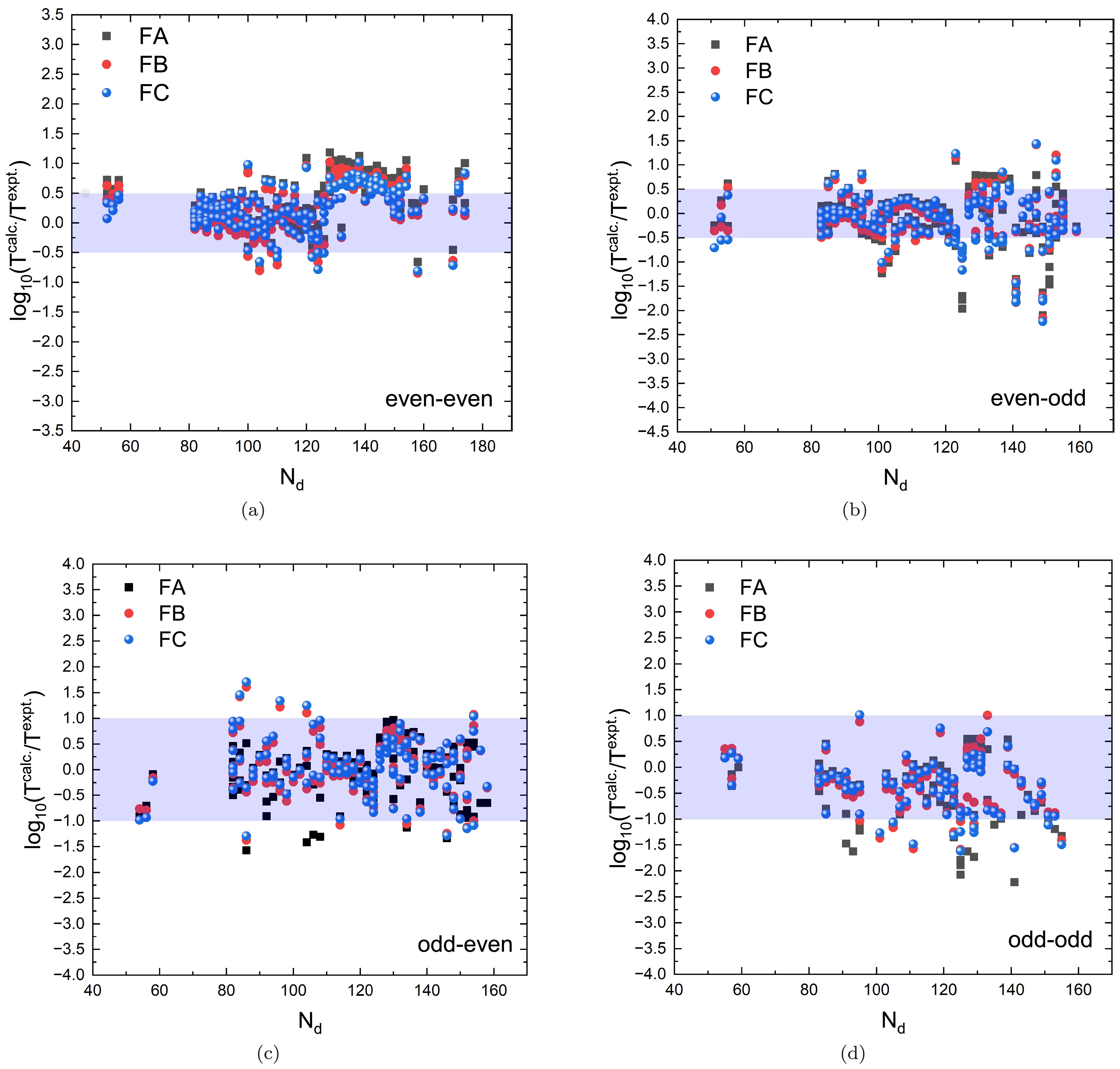
Figure 1.(color online) Deviation in the calculated and experimentalα-decay half-lives for the four categories of nuclei (e-e, e-o, o-e, o-o) using FA, FB, and FC against the neutron number,
$ N_d $ , of daughter nuclei.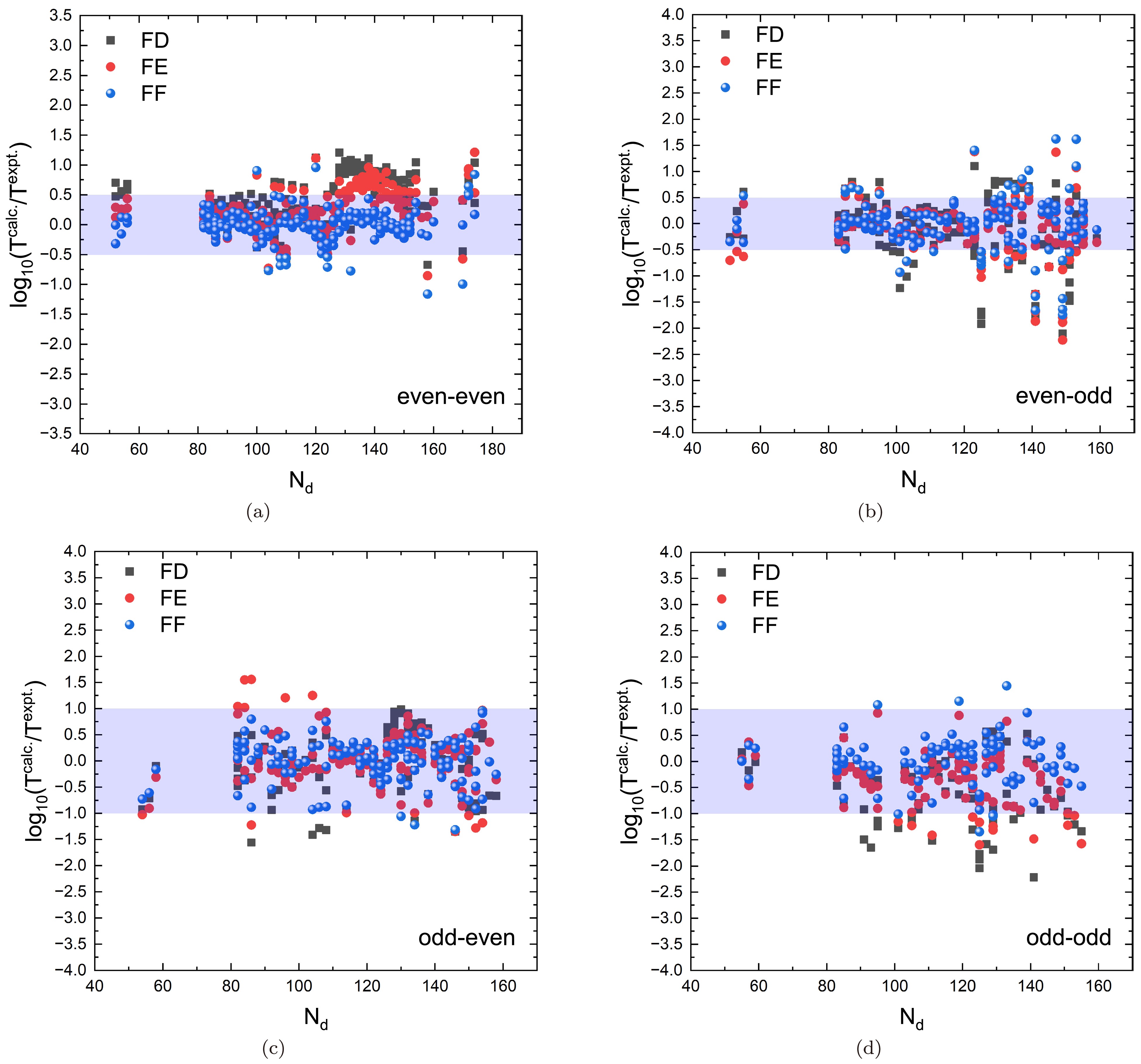
Figure 2.(color online) Same asFig. 1but for formulas FD, FE, and FF.
Figure 2is the same asFig. 1but for the formulas FD, FE, and FF which consider the deformation of daughter nuclei. A comparison ofFigs. 1and2shows that adding deformation terms to the empirical formulas FA, FB, and FC enhances the agreement of the theoretical calculated points with the experimental data. For even-even nuclei, most points representing the deviation between the calculated and experimentalα-decay half-lives inFig. 2(a) are located between the two lines
$\log{(T_{1/2}^{\rm calc.} / T_{1/2}^{\rm expt.})} = \pm 1/2$ . Moreover, the points from formula FF, which incorporates the hexadecapole deformation term, are located around$\log_{10}{(T_{1/2}^{\rm calc.} / T_{1/2}^{\rm expt.})} = 0$ . In contrast,Fig. 1(a) shows the three formulas FA, FB, and FC without deformation terms, where approximately 25% of the points fall above the horizontal line$\log_{10}{(T_{1/2}^{\rm calc.} / T_{1/2}^{\rm expt.})} = +1/2$ . This trend is also evident inFigs. 1(b), (c), and (d), where many points are locate far from$\log_{10}{(T_{1/2}^{\rm calc} / T_{1/2}^{\rm expt.})} = 0$ or outside the two horizontal lines$\log_{10}{(T_{1/2}^{\rm calc.} / T_{1/2}^{\rm expt.})} = \pm 1/2$ . The addition of deformation terms significantly improves the agreement between theoretical and experimental data, bringing points closer to$\log_{10}{(T_{1/2}^{\rm calc.} / T_{1/2}^{\rm expt.})} = 0$ and reducing the number of points outside the lines$\log_{10}{(T_{1/2}^{\rm calc.} / T_{1/2}^{\rm expt.})} = \pm 1/2$ , as demonstrated inFigs. 2(b), (c), and (d) compared with their counterparts inFigs. 1(b), (c), and (d).To examine the applicability of the various formulas and determine which one is the best to represent the experimental data, we calculate inTable 7the standard deviationsσand
$ \chi^2 $ given by Eqs. (24) and (25), respectively.σand$ \chi^2 $ for the six empirical formulas derived from NRDX, UDL, Royer, VSS1, TN1, and mB after modification using the angular momentum, isospin asymmetry, and deformation of the daughter nucleus. The deformation parameters are obtained from two mass models: WS4 [77] and FRDM [78]. For the NRDX formula using WS4 deformation parameters, the standard deviations for FE and FF are reduced by approximately 17% and 15%, whereas the$ \chi^2 $ values decrease by 30% and 31% compared with FD, respectively. The values of FA are nearly identical to those of FD. This indicates that the inclusion of angular momentum and isospin asymmetry enhances the impact of the deformation of the daughter nucleus on theα-decay half-lives. The percentage reductions inσand$ \chi^2 $ for the UDL formula are 15% and 16% forσ, and 28% and 29% for$ \chi^2 $ , respectively. When using deformation parameters derived from FRDM instead of WS4 for the NRDX formula, the standard deviation and$ \chi^2 $ for FE decrease by about 16% and 29%, respectively, compared with FD. For UDL,σand$ \chi^2 $ exhibit almost identical percentage reductions compared with FD. The maximum effect of hexadecapole deformation is 7.8% in$ \chi^2 $ and 4.2% inσ.To illustrate the effect of deformation on the variation inα-decay half-lives with the number of neutrons (
$ N_d $ ), we considerα-decay in nine heavy elements: At, Rn, Fr, Ra, Ac, Th, Pa, U, and Np. The calculated$ \log_{10}{T_{\alpha}} $ variations against the number of neutrons in the daughter nuclei for these elements are compared with experimental data inFigs. 3,4, and5. The$ \log_{10}{T} $ forα-decay is computed using six analytical formulas derived in this work, in addition to the double-folding model (DFM-def) that incorporates the deformation of daughter nuclei [6,59] for the elements At and Rn. The figures demonstrate that the behavior of the analytical formulas agrees well with the experimental variation in$ \log_{10}{T} $ with$ N_d $ . All formulas exhibit a minimum value of$ \log_{10}{T_{\alpha}} $ at$ N_d = 126 $ , which is a known magic neutron number. Furthermore, for mostα-decay$ \log_{10}{T_{\alpha}} $ curves, a dip appears at$ N_d = 120 $ and$ N_d = 122 $ , corresponding to semi-magic neutron numbers associated with neutron level closures. Owing to the simplicity of the empirical formulas forαand cluster decays, they can facilitate many calculations in a short time compared with microscopic models.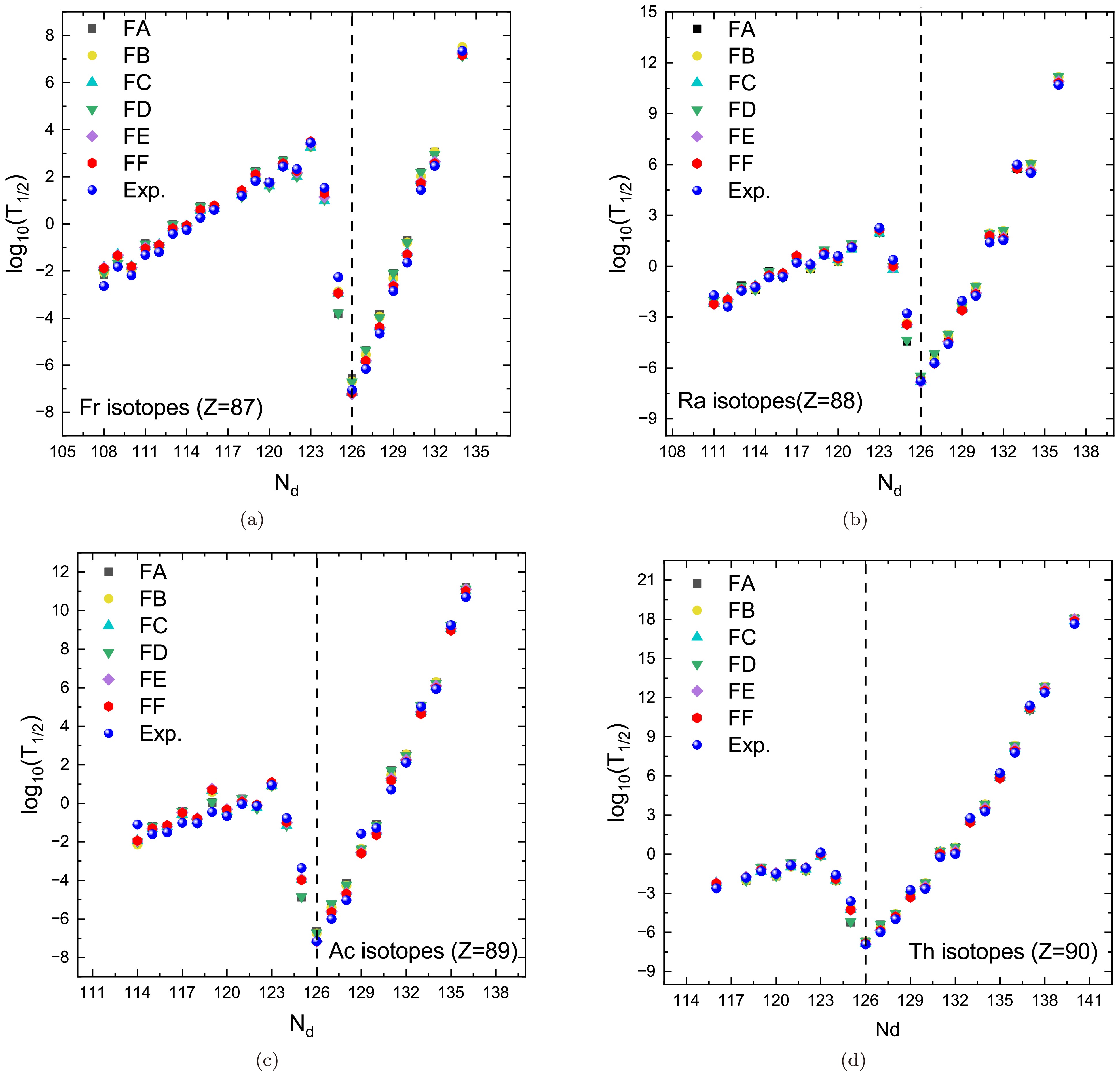
Figure 3.(color online) Comparison of the logarithmicα-decay half-lives with the neutron number,
$ N_d $ , of daughter nuclei for different isotopes of (a) Fr ($ Z = 87 $ ,) (b) Ra ($ Z = 88 $ ), (c) Ac ($ Z = 89 $ ), and (d) Th ($ Z = 90 $ ) nuclei.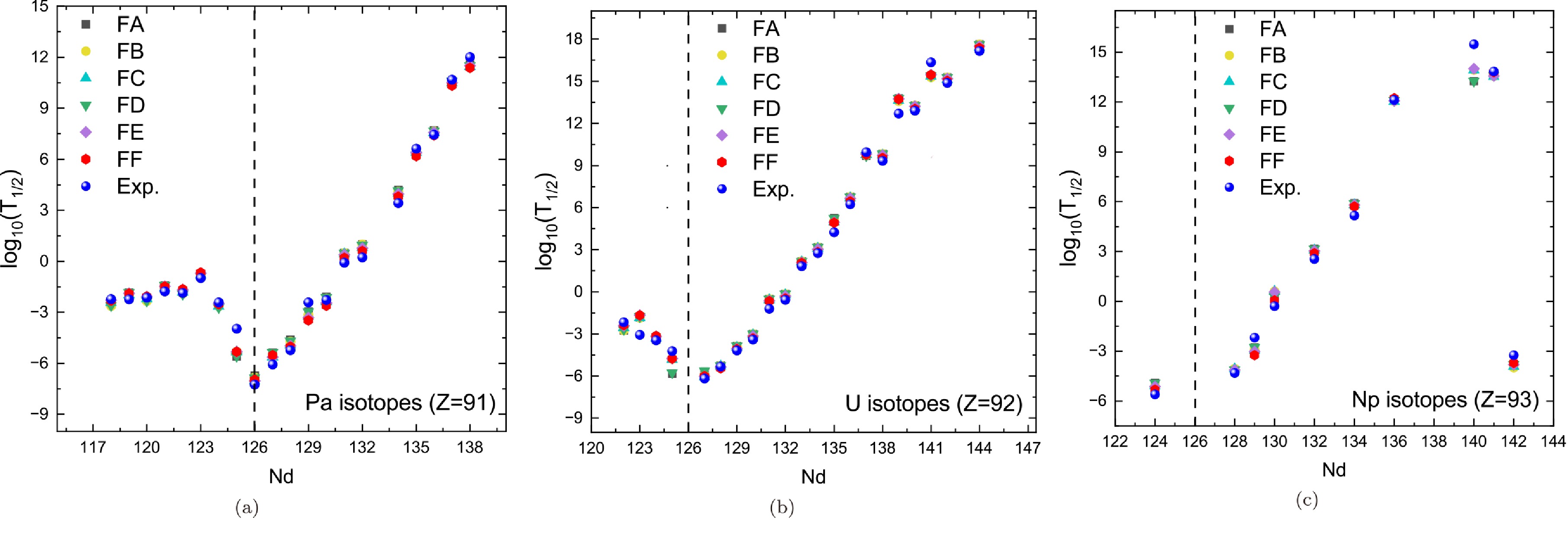
Figure 4.(color online) Same asFig. 3for different isotopes of (a) Pa (
$ Z = 91 $ ), (b) U ($ Z = 92 $ ), and (c) Np ($ Z = 93 $ ) nuclei.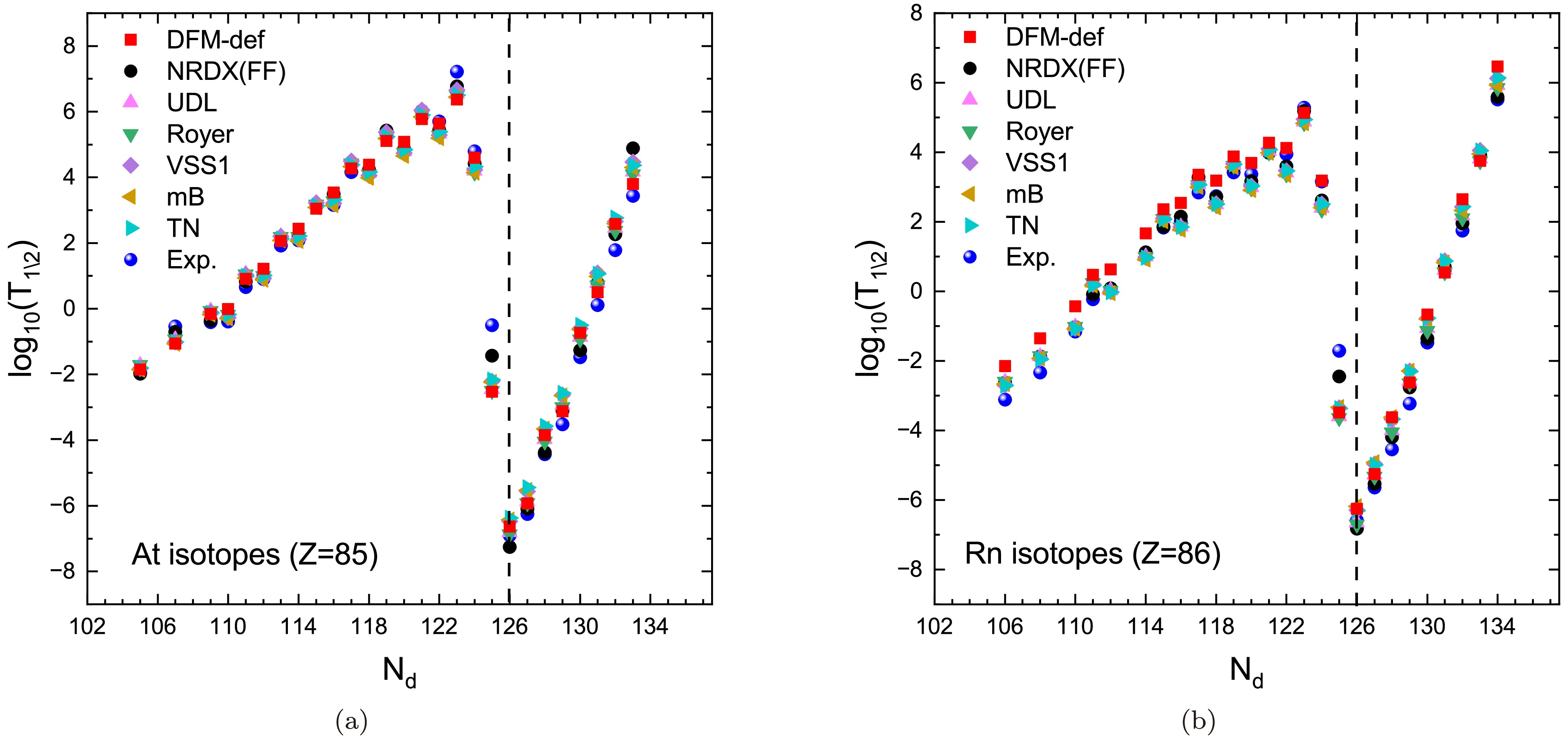
Figure 5.(color online) Comparison of the logarithmicα-decay half-lives with different theoretical approaches and with the recent available experimental data for different isotopes of (a) At (
$ Z = 85 $ ) and (b) Rn ($ Z = 86 $ ) nuclei. The$ \log_{10}T $ values are calculated using FF for NRDX and compared with the double folding model (DFM-def), UDL, Royer, VSS1, mB1, and TN methods.Theα-decay mode of SHN is essential to explore. We extend the application of the six empirical formulas to study theα-decay half-lives of SHN with
$ 119 \leq Z \leq 126 $ .Figures 6and7show the variation in$ \log_{10}{T_{\alpha}} $ against the neutron number of the daughter nuclei,$ N_d $ , for the eight SHN mentioned above. The logarithmicα-decay half-lives were calculated using the six empirical formulas: NRDX (FF), UDL, Royer, VSS1, mB, and TN, in addition to the double-folding model (DFM) for deformed nuclei. The eight figures indicate a clear minimum at$ N_d = 184 $ , a magic number identified by several studies [79−81]. Other dips, although less pronounced, are observed at$ N_d = 196 $ and$ 204 $ inFig. 6(a),$ 196 $ and$ 218 $ inFig. 6(b),$ 204 $ inFig. 6(c), and$ 196 $ ,$ 200 $ ,$ 204 $ , and$ 216 $ inFig. 6(d). InFig. 7(a), a dip is observed at$ N_d = 196 $ , with additional dips at$ 196 $ and$ 200 $ inFig. 7(b), and at$ 200 $ inFig. 7(c). All these neutron level closures identified in this paper have been reported previously in Refs. [79,82−86]. These numbers obtained from studies on calculating neutron energy levels within the framework of self-consistent mean field models, specifically using the Skyrme Hartree-Fock approach and relativistic mean-field models, for SHN with$ Z = 120 $ and$ 126 $ , employing twelve different effective nucleon-nucleon forces [82]. The three energy levels above the$ N = 184 $ neutron gap are$ j_{13/2} $ ,$ 2h_{11/2} $ , and$ k_{17/2} $ . For example, when the$ 2h_{11/2} $ level is filled with neutrons, it produces the semi-magic number$ 196 $ . Other semi-magic neutron numbers can be derived by filling levels with lower spin values above the$ 184 $ gap, such as the neutron level$ 4p_{3/2} $ when filled above$ 2h_{11/2} $ , resulting in the semi-magic neutron number$ N = 200 $ . The neutron level schemes are presented inFig. 8, wheras the neutron energy levels above the$ 184 $ gap for SHN within the range$ 120 \leq Z \leq 126 $ are detailed in Ref. [87].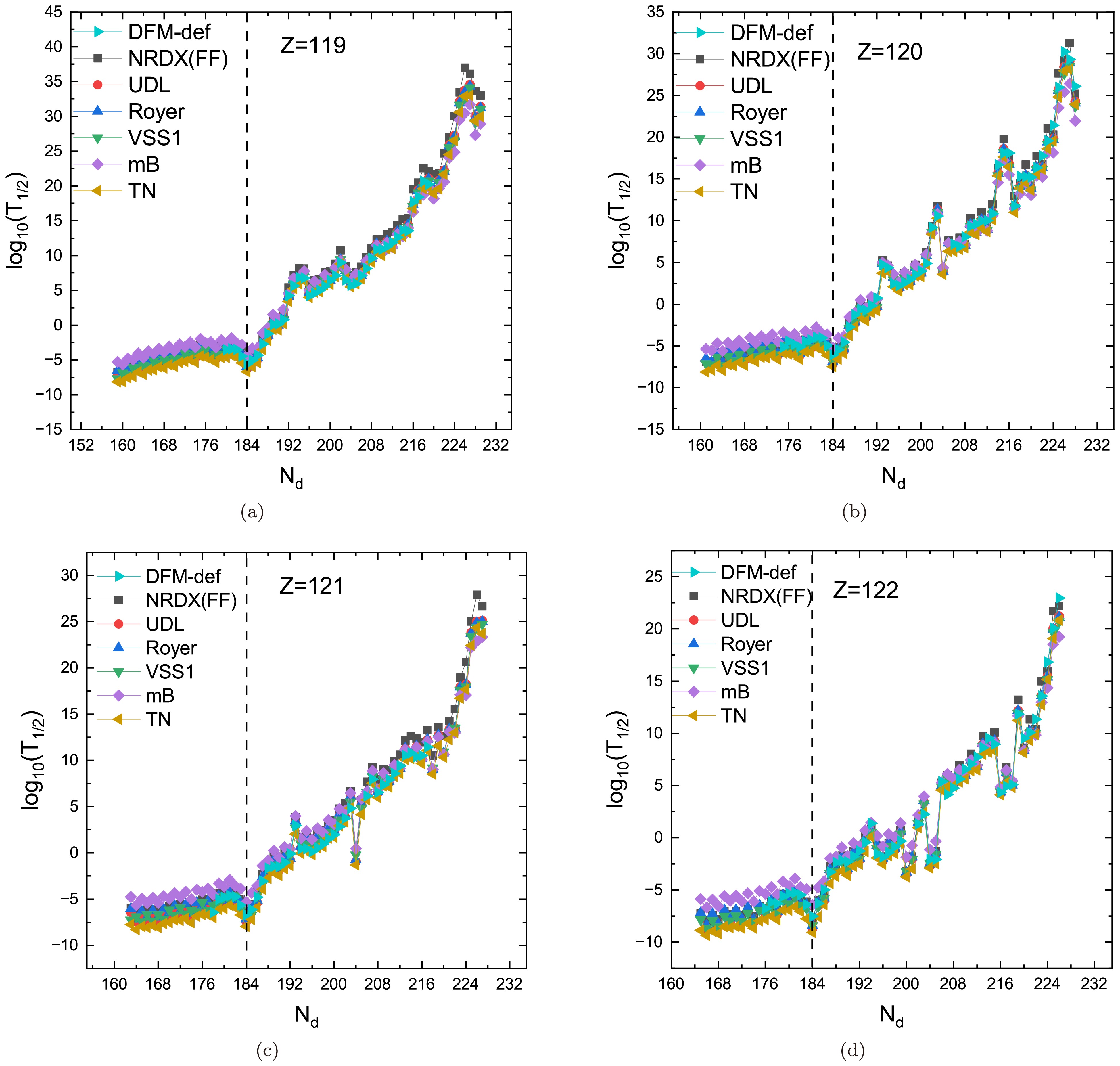
Figure 6.(color online) Predictions of the logarithmicα-decay half-lives with the neutron number,
$ N_d $ , of daughter nuclei for different isotopes of superheavy nuclei that have not yet been experimentally synthesized and a comparison with different theoretical approaches. (a) For$ Z = 119 $ isotopes, (b) for$ Z = 120 $ isotopes (c), for$ Z = 121 $ isotopes, and (d) for$ Z = 122 $ isotopes.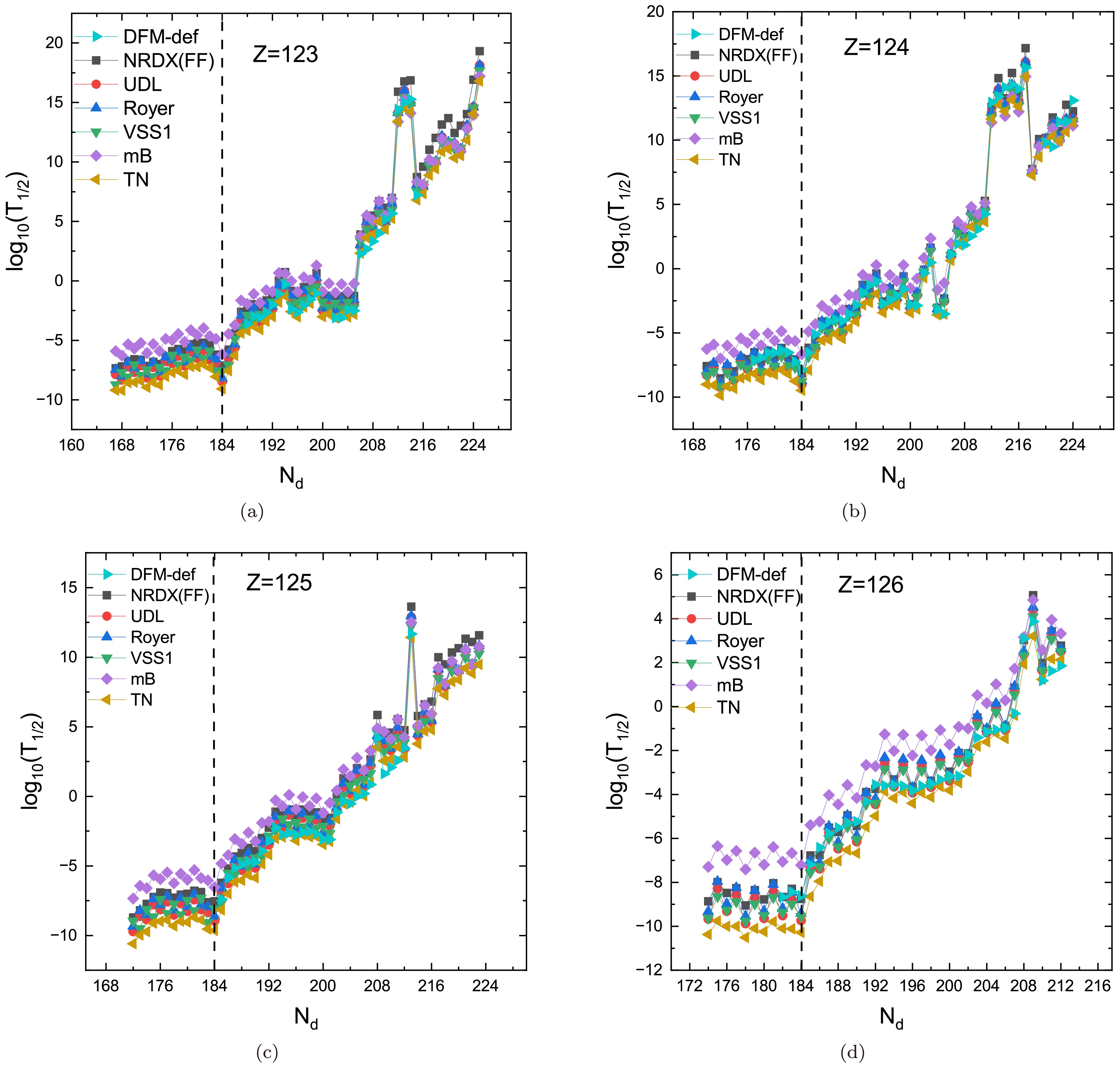
Figure 7.(color online) Same asFig. 6but for different isotopes of superheavy nuclei (a)
$ Z = 123 $ , (b)$ Z = 124 $ , (c)$ Z = 125 $ , and (d)$ Z = 126 $ .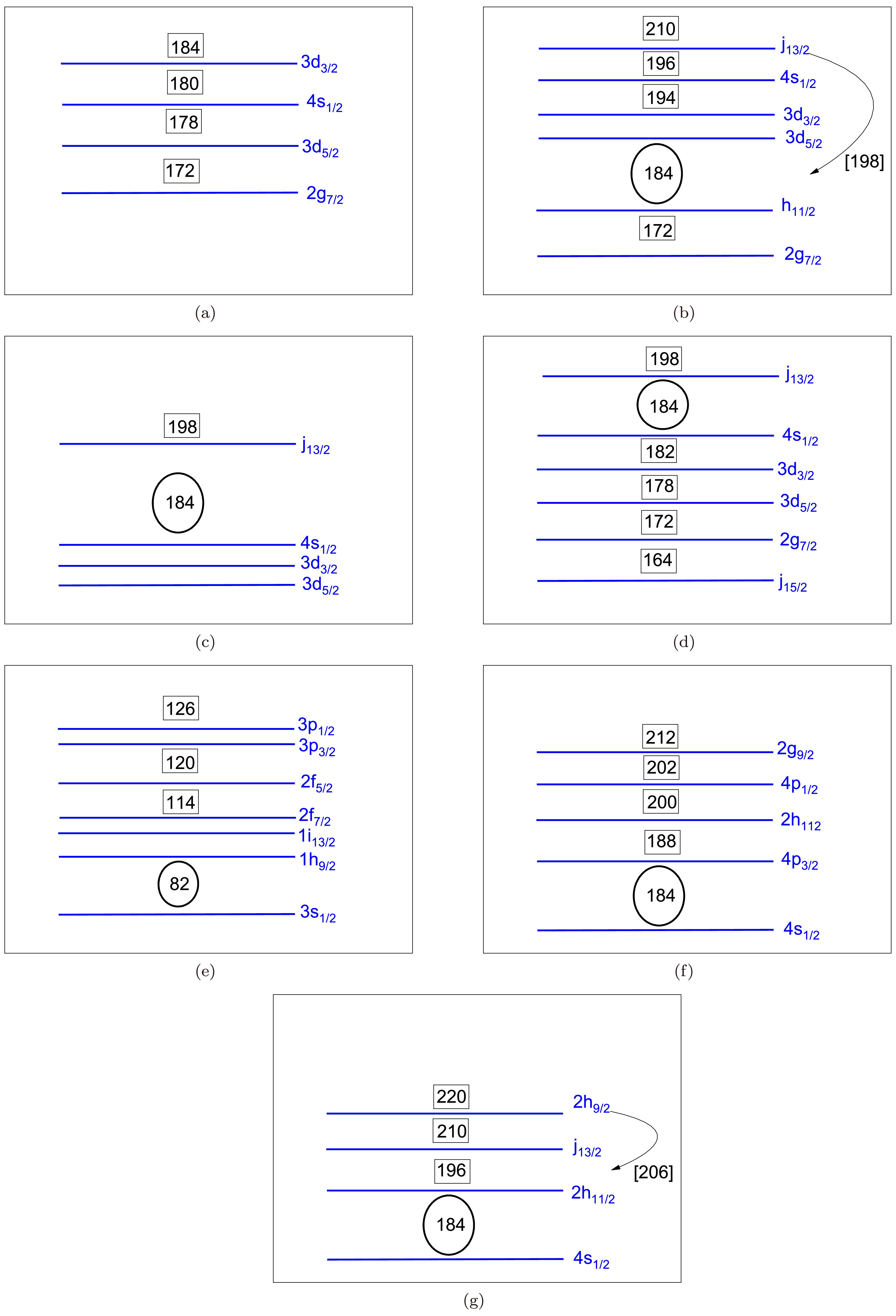
Figure 8.(color online) Level schemes for neutrons are represented by (a), (b), (c), (d), (f), and (g), and the level scheme for protons is denoted by (e).
-
Improved empirical formulas forα-decay half-lives are introduced by incorporating the effects of orbital angular momentum and isospin asymmetry. The coefficients of these enhanced formulas for even-even, even-odd, odd-even, and odd-odd nuclei are fitted using the most recent evaluated half-lives across a wide range of 573 nuclei, covering
$ 52 \leq Z \leq 118 $ . These formulas demonstrate good accuracy when compared with the latest experimental data for both heavy and recently synthesized superheavy nuclei. The improved formulas are both precise and simple. A new term that depends on the quadrupole and hexadecapole deformation of the daughter nucleus has been incorporated into the empirical relationship forα-decay half-lives. The inclusion of this term results in a reduction in the standard deviation of the decimal logarithm ofα-decay half-lives by up to 17%. Theα-decay half-lives of various isotopes of superheavy nuclei with$ Z = 119 - 126 $ , which have not yet been experimentally synthesized, are predicted using the improved formulas and compared with other theoretical approaches. The characteristics of the predictedα-decay half-lives indicate that$ N = 184 $ is the expected neutron magic number. We predict several neutron energy levels of the superheavy nuclei with$ Z = 119 - 126 $ . These predictions can serve as valuable guidance for future experimental research.
Enhanced empirical formulas forα-decay of heavy and superheavy nuclei: Incorporating deformation effects of daughter nuclei
- Received Date:2024-11-05
- Available Online:2025-03-15
Abstract:The latest experimental data ofα-decay half-lives for 573 nuclei within the range of


 DownLoad: