


 Abstract
 HTML
HTML Reference
 Related
 PDF
PDF


-
Alpha decay is a transformation that occurs when a nucleus spontaneously emits anαparticle. It is one of the main decay modes of heavy and superheavy nuclei (SHN). In the 1920s, Gamow [1] and Gurney and Condon [2] independently used quantum mechanics to describeα-decay, the process by which a preformedα-particle tunnels through a barrier created by theα-particle and residual nucleus. Since then, many theoretical models have been proposed to describe the nuclear interaction potential between theα-particle and daughter nucleus and to calculate the penetration probability (P) inα-decay [3−11]. The Wentzel-Kramers-Brillouin (WKB) approximation is a quasi-classical approximation for solving the one-dimensional Schrödinger equation proposed by Wenzel, Kramers, and Brillouin. It has been very widely used to calculate the penetration probability of a particle across potential barriers in quantum tunneling processes, such asα-decay and heavy-ion fusion reactions in nuclear physics. The transfer matrix (TM) approach uses multistep functions (multistep potential approximation) to approximate an arbitrary potential; subsequently, the wave function in each region can be calculated analytically, and the penetration probability is calculated by connecting momentum eigenfunctions [12]. The TM method can accurately calculate the penetration probability across arbitrary potential barriers when the number of segment is sufficiently large. For α-decay, the penetration penetrability obtained using the WKB approximation is about 30%−40% smaller than the accurate result obtained using the TM approach [13].
The synthesis of SHN has attracted much interest in the field of nuclear physics for a long time in the search for the possible existence of "island of superheavy nuclei". Theα-decay of SHN is of central interest in both experimental and theoretical studies, not only becauseα-decay is the main means of identifying SHN experimentally, but also because theα-decay reduced width
$ \delta^{2} $ , which is deduced from the measured half-life and the calculated penetration probability, is considered to encode rich information on the structure of nuclei.Uranium is the heaviest element in nature.
$ {\rm^{234}U} $ ,$ {\rm^{235}U} $ , and$ {\rm^{238}U} $ are the three isotopes of uranium that can be found in nature. Recently, the lightest uranium isotope$ {\rm^{214}U} $ has been produced at the Heavy Ion Research Facility in Lanzhou, China, which has attracted widespread interest in the nuclear physics community [14]. With the Rasmussen method, the$ \delta^{2} $ of$ {\rm^{214,216}U} $ is found to be significantly enhanced by a factor of 2 compared with other nuclei in the$ N_pN_n $ systematics [14]. As the extraction of$ \delta^{2} $ is model dependent, it relates to the choice of theα-core potential and the method of obtaining the penetration probability. Therefore, we must investigate whether these two factors affect the conclusion that the$ \delta^{2} $ of$ {\rm^{214,216}U} $ is significantly larger than those of the surrounding nuclei. Hence, four different phenomenologicalα-core potentials and two microscopic double-folding potentials, together with the WKB approximation and TM approach, are used to obtain the penetration probability. Theα-decay reduced width can be derived from theα-preformation probability. Various effects (e.g., nuclear deformation, isospin asymmetry, nuclear shells and pairing) on theα-preformation probability have been extensively studied, seee.g., Refs. [15−18]. In this work, we focus on the influences of nuclear deformation and theα-core potential on theα-decay reduced width in the$ N_{p}N_{n} $ systematics.The remainder of this paper is organized as follows: In Sect. II, the WKB approximation, TM approach, andα-core potentials are introduced. In Sect. III, the ratios of the
$ \delta^{2} $ of$ {\rm^{214}U} $ to those of the surrounding nuclei for different methods of calculatingPand differentα-core potentials are given and compared. The summary is given in Sect. IV -
Theα-decay reduced width
$ \delta^{2} $ is expressed as [19]$ \delta^{2}=\frac{h\mathrm{ln}2}{T_{1/2}P}, $

(1) where
$ T_{1/2} $ is the experimental half-life forα-decay, andPis the penetration probability. In this work, the half-life are obtained from Refs. [14,20]. -
Using the WKB approximation, the probability of penetration of a particle penetrating a barrierV(r) at an incident energy ofQcan be obtained:
$ P=\exp\left [ -\frac{2}{\hbar } \left | \int_{r_2}^{r_3} \sqrt{2\mu\left | V\left ( r \right ) -Q \right | } \right | \mathrm{d}r \right ], $

(2) whereμis the mass of the particle. The turning points
$ r_{2} $ and$ r_{3} $ are determined from the equation$ V(r_{2})= V(r_{3})=Q $ . This method of calculating the barrier penetration probability has certain limitations. The WKB approximation is considered to better calculate the penetration probability at energies significantly below the barrier peak and for the potentials that are slowly varying [21]. -
The TM approach assumes that an arbitrary potential barrier can be split into segments. When the number of segments is sufficiently large, this method can reasonably describe the arbitrary potential barrier. Assuming that the barrier is equally divided intoNsegments, the potential energy of each segment is expressed as
$ V_j=V\left ( \frac{r_{j-1} +r_j}{2} \right ) $

(3) with
$ r_{j-1} $ <r<$ r_{j}\ (j=0, 1, 2,... N, N+1) $ . The wave function of a particle with energyQin thejth region is given by$ \begin{array}{*{20}{l}} \Psi _{j} \left ( r \right ) = A_{j} \exp\left ( \mathrm{i}k_{j}r \right ) +B_{j} \exp\left ( -\mathrm{i}k_{j}r \right ). \end{array} $

(4) Here,
$ k_{j} $ =$ \sqrt{2\mu(Q-V_{j})}/{\hbar} $ is the wave number. The coefficients$ A_{j} $ and$ B_{j} $ can be obtained from the continuity ofψ(r) and its derivative at each boundary. By setting$ A_{0} $ = 1 and$ B_{N+1} $ = 0, we can calculate the penetration probability as follows:$ P=\frac{k_{n+1} }{k_{0} }{\left |A _{n+1} \right | }^2, $

(5) where
$ A_{n+1} $ =$ \dfrac{k_{0}}{k_{n+1}} $ $ \dfrac{1}{M_{22}} $ .$ {M_{22}} $ is given by$ \begin{array}{*{20}{l}} \begin{pmatrix} M_{11}&M_{12} \\ M_{21}&M_{22} \end{pmatrix}= \prod\limits_{l=0}^{n}M_{l}, \end{array} $

(6) where
$ \begin{array}{*{20}{l}} \begin{aligned} M_{l}=\frac{1}{2} \begin{pmatrix} \left ( 1+S_{l} \right )\mathrm{e}^{-\mathrm{i}\left ( k_{l+1}-k_{l} \right )r_{l} } & \left ( 1-S_{l} \right )\mathrm{e}^{-\mathrm{i}\left ( k_{l+1}+k_{l} \right )r_{l} } \\ \left ( 1-S_{l} \right )\mathrm{e}^{\mathrm{i}\left ( k_{l+1}+k_{l} \right )r_{l} } & \left ( 1+S_{l} \right )\mathrm{e}^{\mathrm{i}\left ( k_{l+1}-k_{l} \right )r_{l} } \end{pmatrix}, \end{aligned} \end{array} $

(7) $ S_{l}=\frac{k_{l}}{k_{l+1}} . $

(8) The accuracy of the TM approach can be validated with the
$ V(x) = V_{0}\cosh^{-2}(x/a) $ potential, for which the exact analytic transmission probability is known [22,23]. Thus, the penetration probability obtained using the TM approach is quoted as the exact value throughout the paper. -
Often, theα-core potential is composed of nuclear, Coulomb, and centrifugal terms:
$ \begin{array}{*{20}{l}} V(r) = V_{N}(r) + V_{C}(r)+V_{L}(r). \end{array} $

(9) In this paper, the following sixα-core potentials are considered.
(1) In a cluster model proposed by Bucket al. in Ref. [24], a cosh form of nuclear potential was used. It is given by
$ V_{N}\left ( r \right ) =-V_{0}\frac{1+\cosh \frac{R}{a} }{\cosh \frac{r}{a}+\cosh \frac{R}{a}}, $

(10) where
$ V_{0} $ is the depth,ais the diffuseness parameter, andRis the radius. A Langer modified centrifugal barrier$\dfrac{\hbar^{2} }{2\mu }\dfrac{(L+{1}/{2})^2}{r^2}$ is used instead of$ \dfrac{\hbar^{2} }{2\mu }\dfrac{L(L+1)}{r^2} $ . This modification is necessary when moving from the one-dimensional problem to three-dimensional problems [25,26]. The Coulomb potential$ V_{C}(r) $ is taken as a form appropriate to a pointα-particle interacting with a uniformly charged spherical core of radiusR:$ \begin{array}{*{20}{l}} V_{C}\left ( r \right ) =\left\{ \begin{array}{lcl} \dfrac{Z_{1}Z_{2}e^{2} }{ r}, & & {r > R} \\ \dfrac{Z_{1}Z_{2}e^{2} }{ 2R}\left [ 3-\left ( \frac{r}{R} \right ) ^{2} \right ], & &{r \leq R} \end{array} \right. \end{array} $

(11) Rin the above two equations is determined by the Bohr-Sommerfeld quantization condition
$ \int_{r_{1}}^{r_{2}}\sqrt{\frac{2\mu }{\hbar ^2}\left | Q_{\alpha}-V(r) \right |\mathrm{d}r } =(G+L-1)\frac{\pi }{2} . $

(12) Here,Gis the global quantum number, and
$ Q_{\alpha} $ is theα-decay energy. The classic turning points ($ {r_{1}} $ ,$ {r_{2}} $ , and$ {r_{3}} $ in order of increasing distance from the origin) are solved using$ V(r)=Q_{\alpha} $ . The three free parameters are set to$ V_{0}=162.3 $ MeV,a= 0.40 fm,$ G=20 $ (forN$ \le126 $ ),G= 22 (forN$ \ge126 $ ). They are determined using a best fit to the available data [24]. This potential is termed Pot1.(2) In our recent work, an isospin-dependent depth parameter
$ V_{0} $ =152.5(1+0.2$ \dfrac{N-Z}{N+Z} $ ) and an adjusted diffuseness parameter$ a=0.39 $ fm in Eq.(10) are obtained by fitting the experimental half-lives of uranium isotopes [27]. This potential is termed Pot2.(3) In Ref. [13], a mass and charge number dependentα-core potential was obtained using the following expression:
$ V_{N}(r)=-\frac{A_{1}U_{0}}{1+\exp\left(\dfrac{r-R_{0}}{{a}} \right)} $

(13) with
$ U_{0} =[53-33(N-Z)/A] $ MeV,$ R_{0}=1.27A^{1/3} $ fm,$ a= 0.67 $ fm.$ A_{1} $ is the mass number of the emitted particle.N,Z, andAare the neutron, proton, and mass numbers of the parent nucleus, respectively. The Coulomb potential is given by Eq. (11) with radius$R=1.28A^{1/3}- 0.76+0.8A^{-1/3}$ fm. This potential is termed Pot3.(4) In the Rasmussen method, theα-core potential is obtained from the real part of a potential deduced by Igo to fit alpha elastic-scattering data [28,29]. It is expressed as
$ V_{N}(r)=-1100\exp\left [ -\left ( \frac{r-1.17A^{1/3}}{0.574} \right ) \right ] \rm MeV, $

(14) whereAis the mass number of the parent nucleus. This potential is termed Pot4.
(5) Unlike the previous phenomenologicalα-core potentials, the double-folding potential uses the microscopic nuclear and realistic Coulomb potentials [30]:
$ \begin{array}{*{20}{l}}V_{N}(\boldsymbol{r })=\lambda\int \mathrm{d}\boldsymbol{r_{1} } \mathrm{d}\boldsymbol{r_{2} }\rho _{1}(\boldsymbol{r_{1} })\rho _{2}(\boldsymbol{r_{2} })g(E,\left | \boldsymbol{s } \right | ), \end{array} $

(15) $ V_{C}(\boldsymbol{r })=\int \mathrm{d}\boldsymbol{r_{1} }\mathrm{d}\boldsymbol{r_{2} }\rho' _{1}(\boldsymbol{r_{1} })\rho' _{2}(\boldsymbol{r_{2} })\frac{e^{2}}{\left | \boldsymbol{s } \right | }, $

(16) whereλis the renormalized factor. In this work,λ=0.6 is used according to the values in Ref. [30]. In some studies, the value ofλis determined using the Bohr-Sommerfeld quantization condition, seee.g., [15,31], whereas others use a constant value ofλ,e.g.,Refs. [6,30,32]. As discussed in Ref. [32], the variation inλis small in both spherical and deformed cases for different nuclei. We have checked that the extracted
$ \delta^{2} $ is influenced when varyingλ; however, its effect on theα-decay reduced width ratio is weak. Therefore, a constant value ofλis used in this paper for simplicity.$ \boldsymbol{r } $ is the distance between the mass centers of theα-particle and core.$\boldsymbol{r_{1} }$ and$ \boldsymbol{r_{2} } $ are the nucleon coordinates belonging to the α -particle and daughter nucleus, respectively. The quantity$ \left | \boldsymbol{s } \right | $ is the distance between a nucleon in the core and a nucleon in theα-particle.$ \rho_{1} $ and$ \rho_{2} $ are the mass density distributions of theα-particle and core.$ \begin{array}{*{20}{l}} \rho_{1}(r_{1})=0.4299\exp(-0.7024r_{1}^2), \end{array} $

(17) $ \rho_{2}(r_{2})=\frac{\rho_{0}}{1+\exp(\dfrac{r_{2}-c}{{a}})}, $

(18) where
$ \rho_{0} $ is fixed by the mass numbers of the daughter nucleus ($ A_{d} $ ),$ c=1.07A_{d}^{1/3} $ , and$ a=0.54 $ fm.$ \begin{array}{*{20}{l}} \int \rho_{i}(\boldsymbol{r})\mathrm{d}\boldsymbol{r}=A_{i}. \end{array} $

(19) $ \rho'_{1} $ and$ \rho'_{2} $ in Eq. (16) are the charge density distributions of theα-particle and daughter nucleus, respectively.$ \begin{array}{*{20}{l}} \rho'_{1}=\rho'_{0}\exp(-0.7024r_{1}^2), \end{array} $

(20) $ \rho'_{2}=\frac{\rho'_{0}}{1+\exp(\dfrac{r_{2}-c}{{a}})}. $

(21) The value of
$ \rho'_{0} $ is fixed by the charge numbers of theα-particle and daughter nucleus.$ \begin{array}{*{20}{l}} \int \rho'_{i}(\boldsymbol{r})\mathrm{d}\boldsymbol{r}=Z_{i}. \end{array} $

(22) $ g(E,\left | \boldsymbol{s } \right |) $ in Eq. (15) is the microscopic M3Y nucleon-nucleon interaction potential:$ \begin{aligned}[b] g(E,\left | \boldsymbol{s } \right | )=\;&7999\frac{\exp(-4s)}{4s}\\&-2134\frac{\exp(-2.5s)}{2.5s} +J_{00}\delta(\boldsymbol{s }), \end{aligned} $

(23) $ \begin{array}{*{20}{l}} J_{00}=-276(1-0.005E_{\alpha}/A_{\alpha}). \end{array} $

(24) $ E_{\alpha} $ and$ A_{\alpha} $ denote the energy and mass number of the cluster, respectively. This potential is termed Pot5.(6) The majority of all known atomic nuclei have varying degrees of deformation. The deformed double-folding potential considers the axial deformation of the daughter nuclei [32]. Theα-core potential is
$ \begin{array}{*{20}{l}} V(\boldsymbol{r },\beta ) =\lambda V_{N}(\boldsymbol{r },\beta ) + V_{C}(\boldsymbol{r },\beta ), \end{array} $

(25) whereβis the orientation angle of theα-particle relative to the symmetry axis of the daughter nucleus.
For the deformed residual nucleus, its density distribution is related to the deformation parameters:
$ \rho _{2} (r_{2},\theta )=\frac{\rho_{0}}{1+\exp(\dfrac{r_{2}-R(\theta )}{{a}} )}, $

(26) where the half-density radius
$ R(\theta) $ is given by$ \begin{array}{*{20}{l}} R(\theta )=R_{0}(1+\beta _{2}Y_{20}(\theta )+\beta _{4}Y_{40}(\theta )). \end{array} $

(27) Here,
$ R_{0} = 1.07A_{d}^{1/3} $ fm and$ a = 0.54 $ fm. In this work, only the contribution of$ \beta_2 $ is considered for simplicity. This potential is termed Pot6.In Pot6, thePofα-decay is
$ P_{\beta }=\exp\left[ -2\int_{r_{2}(\beta )}^{r_{3}(\beta )}\sqrt{\frac{2\mu }{\hbar ^2} \left | Q_{\alpha }-V(r,\beta ) \right | \mathrm{d}r} \right ], $

(28) where the values of
$ r_{2}(\beta) $ and$ r_{3}(\beta) $ can be calculated using$ Q_{\alpha} = V(r,\beta) $ . The total penetration factorPis obtained by$ P=\frac{1}{2}\int_{0}^{\pi}P_{\beta}\sin(\beta)\mathrm{d}\beta. $

(29) -
The six potential barriers for theα-decay of
$ {\rm^{214}U} $ are shown inFig. 1. The potentials for two different orientationsβ=0° and 90° in Pot6 are shown as red solid lines with triangles and blue solid lines with circles, respectively. These potentials are significantly different, which can lead to a large difference in the penetration probabilityPof theα-particle through each potential becausePdepends strongly on the height and width of the potential barrier. Consequently, theα-decay reduced width$ \delta^{2} $ can be considerably different correspondingly.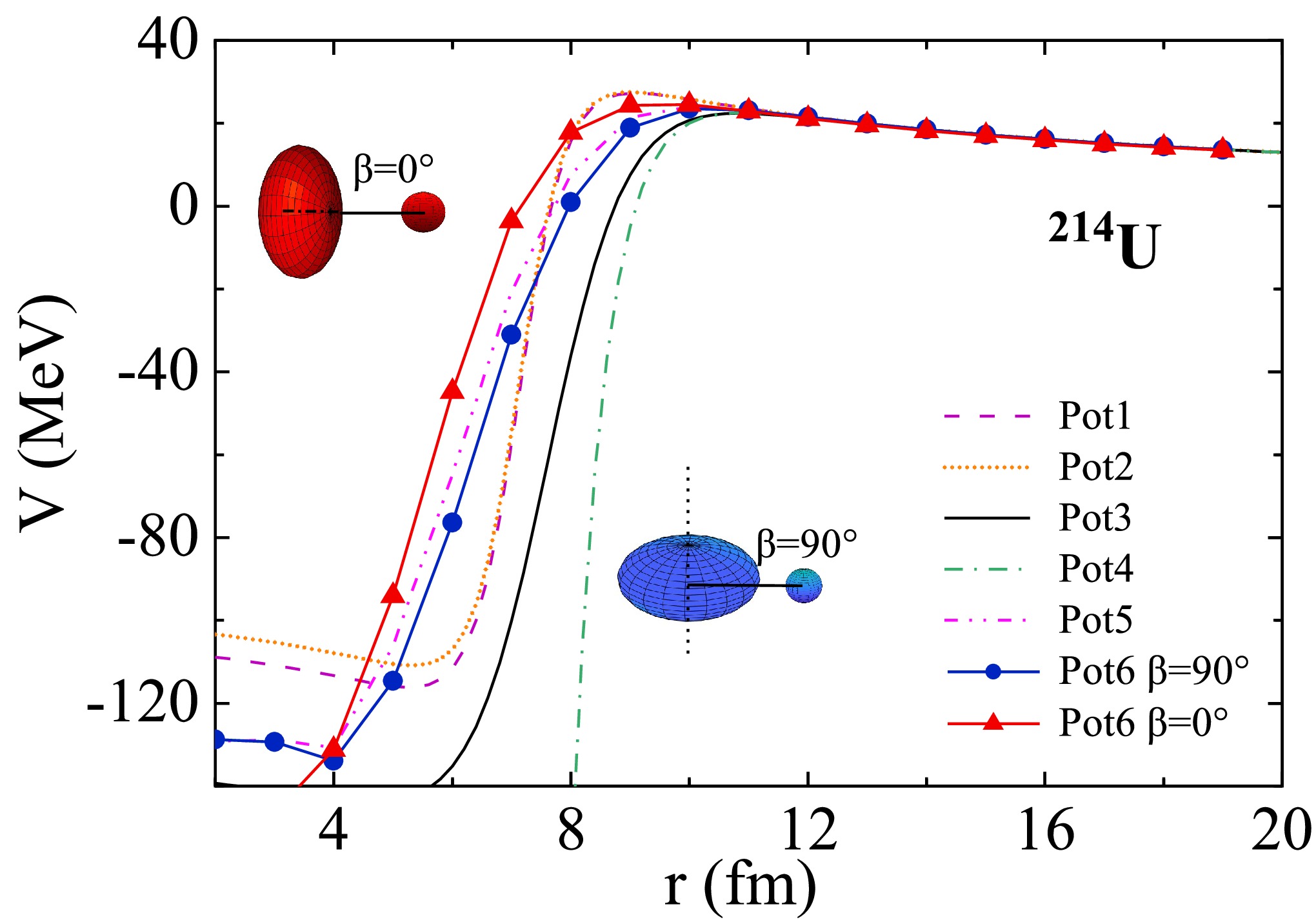
Figure 1.(color online) Sixα-core potentials of
$ {\rm^{214}U} $ .$ \beta = 0^{\circ} $ and$ \beta = 90^{\circ} $ are two different orientations of the$ \alpha+{\rm^{210}Th} $ system under Pot6. -
The WKB approximation is more reliable with a gentle variation in potential,i.e., only slightly change over the de Broglie wavelength. Its computational accuracy in studies on heavy-ion fusion, alpha decay, and proton and cluster radioactivity has been discussed [13,33,34]. Ref. [13], for Pot3, found thatPof theα-decay obtained using the WKB approximation is about 30%−40% smaller than the exact one obtained with the TM approach. In this work, the accuracy of the WKB approximation to calculatePis examined using differentα-core potentials. The relative deviation of the WKB approximation can be examined using
$RD=(P_{\mathrm{WKB}}-P_{\rm TM})/ P_{\rm TM}\times$ 100%.$P_{\rm WKB}$ and$P_{\rm TM}$ denote the penetration probabilities obtained using the WKB approximation and TM approach, respectively. In this work, theα-decay of nuclei around$ {\rm^{214}U} $ is considered. The experimental$ Q_{\alpha} $ values are obtained from Refs. [14,35]. The RD values obtained with differentα-core potentials are plotted as a function the mass number of parent nuclei inFig. 2. For Pot1 and Pot2, the RD values are almost constant (about –40%), whereas for Pot3 and Pot4, the RD values vary from about –20% to –40%. This is because both Pot3 and Pot4 are dependent on the mass number, whereas Pot1 and Pot2 are not.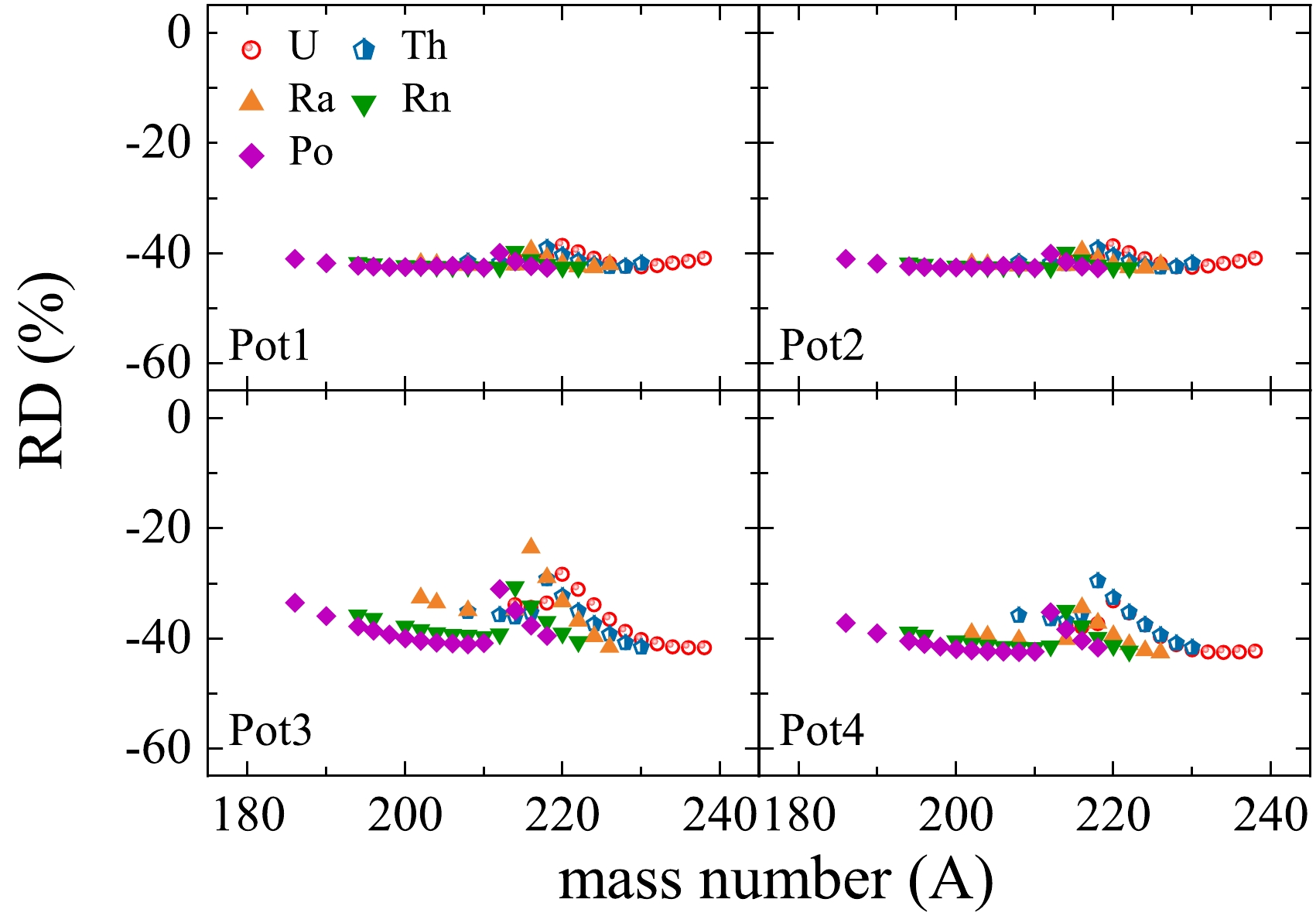
Figure 2.(color online) Relative deviation in the penetration probability caused by the WKB approximation ofα-decay for Pot1-Pot4.
Using the WKB approximation and TM approach, we extract
$ \delta^{2} $ of the ground state to ground state decays of$ {\rm^{214}U} $ and the surrounding nuclei for Pot1-Pot4, which is shown inFig. 3as function of$ N_{p}N_{n} $ . Here,$ N_{p} $ and$ N_{n} $ are the proton and neutron numbers relative to the nearest closed shellZ= 82 andN= 126, respectively. In this work, the error in$ \delta^{2} $ is caused only by the uncertainty of the experimental half-life [14].Figure 3clearly shows that$ \delta^{2} $ is model-dependent. Nevertheless, as discussed in Ref. [36], rich information about the structural properties of nuclei can be gained from the trend in$ \delta^{2} $ of different isotopes, rather than from$ \delta^{2} $ itself. Comparing the results in the left column ofFig. 3, we observe that the values of$ \delta^2 $ for differentα-core potentials vary by almost three orders of magnitude, from$ 10^{2} $ to$ 10^{5} $ . According to Eq. (1), for the same nucleus, the only factor that affects the value of the$ \delta^2 $ isP. InFig. 1, Pot1 has the largest barrier width, resulting in a lower probability of theα-particle crossing this barrier. Therefore, the value of$ \delta^2 $ obtained with Pot1 is the largest. If we compare the results in the left and right panels, for the sameα-core potential, we find that the values of$ \delta^2 $ obtained with the TM approach are smaller than those obtained with the WKB approximation. This is owing to the underestimation ofPin the WKB approximation. In addition, in all cases, the$ \delta^2 $ of$ {\rm^{214,216}U} $ is larger than those of surrounding nuclei. This is consistent with the results presented in the experimental paper Ref. [14] in which Pot4 and the WKB approximation were used.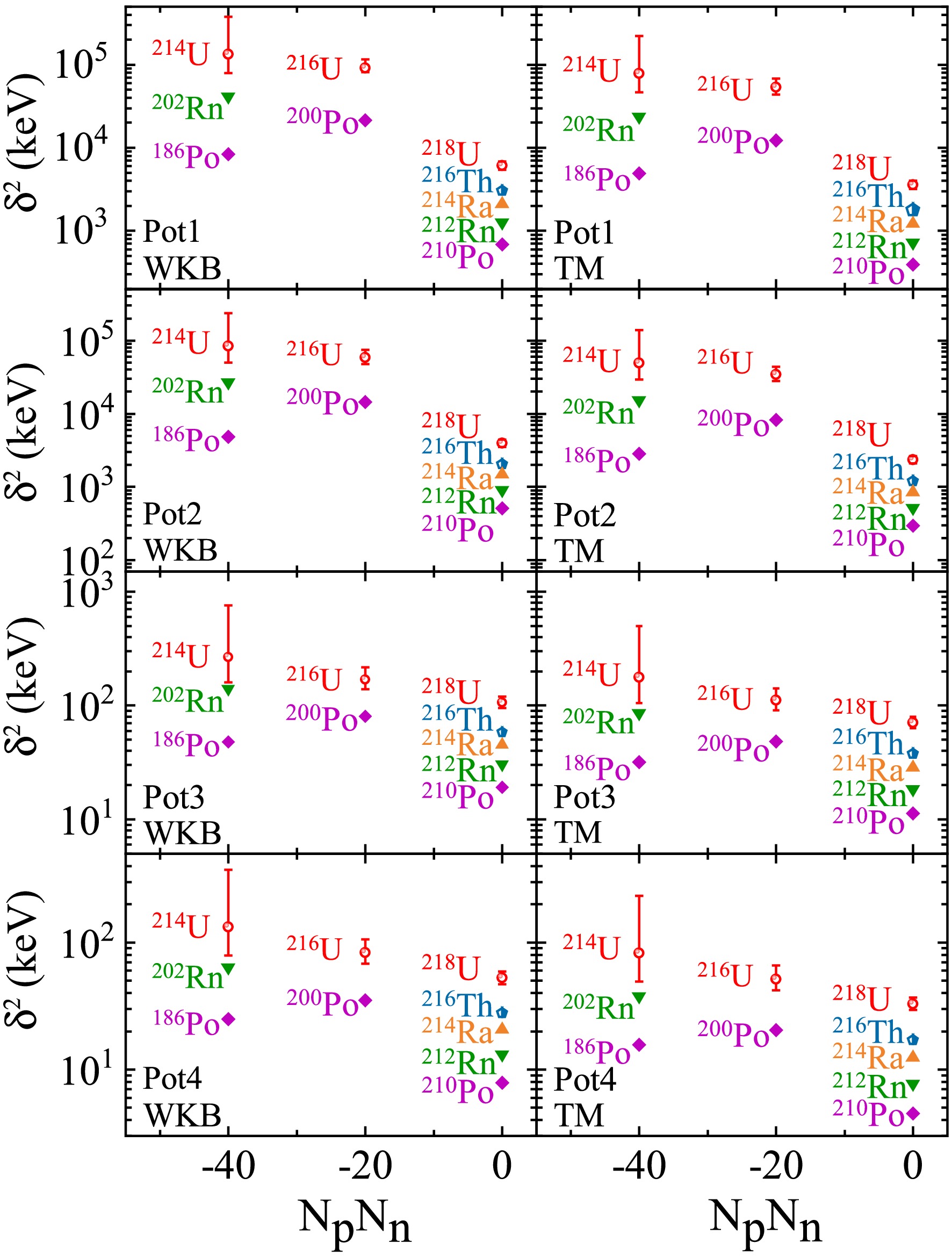
Figure 3.(color online)α-decay reduced width
$ \delta^{2} $ of$ {\rm^{214}U} $ and the surrounding nuclei obtained using the WKB approximation (left panels) and the TM method (right panels) with differentα-core potentials. The$ N_{p} $ and$ N_{n} $ values are proton and neutron number relative to$ Z = 82 $ and$ N = 126 $ closed shells, respectively.To quantitatively study whether
$ \delta^2 $ of$ {\rm^{214,216}U} $ is significantly enhanced by a factor of 2 compared with those of the surrounding nuclei in the$ N_{p}N_{n} $ systematics, we list the ratios of$ \delta^2 $ of$ {\rm^{214,216,218}U} $ to those of surrounding nuclei with the same$ N_{p}N_{n} $ inTable 1. First, the$ \delta^2 $ ratio between$ {\rm^{214}U} $ ($ {\rm^{216}U} $ ) and$ {\rm^{202}Rn} $ ($ {\rm^{200}Po} $ ) is larger than 2 for Pot1-Pot4. In Pot1, the$ \delta^2 $ ratio of$ {\rm^{214}U} $ to$ {\rm^{202}Rn} $ and$ {\rm^{216}U} $ to$ {\rm^{200}Po} $ are the largest (3.29 and 4.33, respectively). The conclusion that$ \delta^2 $ of$ {\rm^{214,216}U} $ is enhanced appears to hold even if the value of$ \delta^2 $ may vary several orders of magnitude for differentα-core potentials. Second, we find that the values of the$ \delta^2 $ ratio obtained using the WKB approximation are considerably close to those obtained with the TM approach, which means that both the WKB approximation and TM approach can be used to study theα-decay reduced width. By considering the fact that the TM approach is much more time consuming than the WKB approximation, in the following discussions, we focus on the results obtained using the WKB approximation.α−core potential $ N_{p}N_{n} $ 

$ \delta^2 $ ratio

WKB method TM approach Pot1 −40 $ {\rm^{214}U} $ /

$ {\rm^{202}Rn} $ 

$ 3.22_{-1.30}^{+5.89} $ 

$ 3.29_{-1.33}^{+6.01} $ 

$ {\rm^{214}U} $ /

$ {\rm^{190}Po} $ 

$ 5.97_{-2.41}^{+10.91} $ 

$ 6.04_{-2.44}^{+11.04} $ 

$ {\rm^{214}U} $ /

$ {\rm^{186}Po} $ 

$ 15.96_{-6.44}^{+29.15} $ 

$ 15.92_{-2.44}^{+29.09} $ 

−20 $ {\rm^{216}U} $ /

$ {\rm^{200}Po} $ 

$ 4.24_{-0.44}^{+1.19} $ 

$ 4.33_{-0.77}^{+1.21} $ 

0 $ {\rm^{218}U} $ /

$ {\rm^{216}Th} $ 

$ 2.00_{-0.22}^{+0.24} $ 

$ 2.02_{-0.21}^{+0.25} $ 

$ {\rm^{218}U} $ /

$ {\rm^{214}Ra} $ 

$ 2.87_{-0.31}^{+0.35} $ 

$ 2.94_{-0.32}^{+0.36} $ 

$ {\rm^{218}U} $ /

$ {\rm^{212}Rn} $ 

$ 4.83_{-0.52}^{+0.59} $ 

$ 4.98_{-0.54}^{+0.61} $ 

$ {\rm^{218}U} $ /

$ {\rm^{210}Po} $ 

$ 8.82_{-0.95}^{+1.09} $ 

$9.10_{ - 0.98}^{ + 1.12}$ 

Pot2 −40 $ {\rm^{214}U} $ /

$ {\rm^{202}Rn} $ 

$ 3.13_{-1.26}^{+5.71} $ 

$ 3.19_{-1.29}^{+5.84} $ 

$ {\rm^{214}U} $ /

$ {\rm^{190}Po} $ 

$ 6.25_{-2.52}^{+11.41} $ 

$ 6.32_{-2.55}^{+11.55} $ 

$ {\rm^{214}U} $ /

$ {\rm^{186}Po} $ 

$ 17.41_{-7.03}^{+31.82} $ 

$ 17.37_{-7.01}^{+31.73} $ 

−20 $ {\rm^{216}U} $ /

$ {\rm^{200}Po} $ 

$ 4.07_{-0.72}^{+1.14} $ 

$ 4.15_{-0.74}^{+1.16} $ 

0 $ {\rm^{218}U} $ /

$ {\rm^{216}Th} $ 

$ 1.94_{-0.21}^{+0.24} $ 

$ 1.96_{-0.21}^{+0.24} $ 

$ {\rm^{218}U} $ /

$ {\rm^{214}Ra} $ 

$ 2.69_{-0.29}^{+0.33} $ 

$ 2.75_{-0.30}^{+0.34} $ 

$ {\rm^{218}U} $ /

$ {\rm^{212}Rn} $ 

$ 4.37_{-0.47}^{+0.54} $ 

$ 4.51_{-0.49}^{+0.55} $ 

$ {\rm^{218}U} $ /

$ {\rm^{210}Po} $ 

$ 7.72_{-0.83}^{+0.95} $ 

$ 7.96_{-0.86}^{+0.98} $ 

Pot3 −40 $ {\rm^{214}U} $ /

$ {\rm^{202}Rn} $ 

$ 1.90_{-0.77}^{+3.46} $ 

$ 2.04_{-0.83}^{+3.73} $ 

$ {\rm^{214}U} $ /

$ {\rm^{190}Po} $ 

$ 2.33_{-0.94}^{+4.26} $ 

$ 2.40_{-0.97}^{+4.39} $ 

$ {\rm^{214}U} $ /

$ {\rm^{186}Po} $ 

$ 5.55_{-2.24}^{+10.13} $ 

$ 5.51_{-2.23}^{+10.07} $ 

−20 $ {\rm^{216}U} $ /

$ {\rm^{200}Po} $ 

$ 2.10_{-0.37}^{+0.59} $ 

$ 2.29_{-0.41}^{+0.64} $ 

0 $ {\rm^{218}U} $ /

$ {\rm^{216}Th} $ 

$ 1.82_{-0.20}^{+0.22} $ 

$ 1.87_{-0.20}^{+0.23} $ 

$ {\rm^{218}U} $ /

$ {\rm^{214}Ra} $ 

$ 2.35_{-0.25}^{+0.29} $ 

$ 2.49_{-0.27}^{+0.31} $ 

$ {\rm^{218}U} $ /

$ {\rm^{212}Rn} $ 

$ 3.50_{-0.38}^{+0.43} $ 

$ 3.82_{-0.41}^{+0.47} $ 

$ {\rm^{218}U} $ /

$ {\rm^{210}Po} $ 

$ 5.58_{-0.60}^{+0.69} $ 

$ 6.27_{-0.67}^{+0.77} $ 

Pot4 −40 $ {\rm^{214}U} $ /

$ {\rm^{202}Rn} $ 

$ 2.08_{-0.83}^{+3.79} $ 

$ 2.17_{-0.89}^{+4.00} $ 

$ {\rm^{214}U} $ /

$ {\rm^{190}Po} $ 

$ 2.35_{-0.95}^{+4.30} $ 

$ 2.41_{-0.97}^{+4.40} $ 

$ {\rm^{214}U} $ /

$ {\rm^{186}Po} $ 

$ 5.30_{-2.14}^{+9.68} $ 

$ 5.26_{-2.12}^{+9.61} $ 

−20 $ {\rm^{216}U} $ /

$ {\rm^{200}Po} $ 

$ 2.36_{-0.42}^{+0.66} $ 

$ 2.52_{-0.45}^{+0.70} $ 

0 $ {\rm^{218}U} $ /

$ {\rm^{216}Th} $ 

$ 1.89_{-0.20}^{+0.23} $ 

$ 1.93_{-0.21}^{+0.24} $ 

$ {\rm^{218}U} $ /

$ {\rm^{214}Ra} $ 

$ 2.54_{-0.27}^{+0.31} $ 

$ 2.66_{-0.29}^{+0.33} $ 

$ {\rm^{218}U} $ /

$ {\rm^{212}Rn} $ 

$ 3.98_{-0.43}^{+0.49} $ 

$ 4.26_{-0.46}^{+0.52} $ 

$ {\rm^{218}U} $ /

$ {\rm^{210}Po} $ 

$ 6.71_{-0.72}^{+0.83} $ 

$ 7.30_{-0.79}^{+0.90} $ 

Table 1.Ratios of
$ \delta^2 $ of$ {\rm^{214,216,218}U} $ to those of surrounding nuclei with the same$ N_{p}N_{n} $ systematics under different α-core potentials and different theoretical methods of obtaining the penetration probability. -
The values of the quadrupole deformation
$ \beta_2 $ of the daughter nuclei of$ {\rm^{214}U} $ and surrounding nuclei are listed inTable 2. These values are obtained from Ref. [37]. Clearly, the value of$ \beta_2 $ varies from positive to negative for different nuclei. We may expect that the$ \delta^{2} $ ratio between them can be influenced by the nuclear deformation, particularly for$ {\rm^{214}U} $ and$ {\rm^{202}Rn} $ . The nuclear deformation effect can be considered within the double-folding potential. Moreover, the effects of nuclear deformation on α-decay also have been studied based on the nuclear proximity potential [38] and deformed Woods-Saxon type potential [39−41]. In this work, double-folding potentials without (Pot5) and with (Pot6) the deformation effect are considered. The$ \delta^{2} $ ratios calculated using the WKB approximation under Pot5 and Pot6 are listed inTable 3. Comparing the results obtained under Pot5 and Pot6, we observe that the ratio is reduced when the nuclear deformation effect is considered. The$ \delta^2 $ ratio between$ {\rm^{214}U} $ and$ {\rm^{202}Rn} $ is slightly below 2, implying that the nuclear deformation effect should be considered when studying the trend in theα-decay reduced width.Parent nuclei $ Q_{\alpha} $ /MeV

Daughter nuclei $ \beta_{2} $ [37]

$ {\rm^{186}Po} $ 

8.501 $ {\rm^{182}Pb} $ 

0.011 $ {\rm^{200}Po} $ 

5.9816 $ {\rm^{196}Pb} $ 

0 $ {\rm^{202}Rn} $ 

6.7738 $ {\rm^{198}Po} $ 

0.075 $ {\rm^{216}Th} $ 

8.072 $ {\rm^{212}Ra} $ 

−0.053 $ {\rm^{214}U} $ 

8.696 $ {\rm^{210}Th} $ 

−0.135 $ {\rm^{216}U} $ 

8.531 $ {\rm^{212}Th} $ 

−0.094 $ {\rm^{218}U} $ 

8.775 $ {\rm^{214}Th} $ 

−0.063 α−core potential $ N_{p}N_{n} $ 

$ \delta^2 $ ratio

WKB method Pot5 −40 $ {\rm^{214}U} $ /

$ {\rm^{202}Rn} $ 

$ 2.22_{-0.90}^{+4.05} $ 

$ {\rm^{214}U} $ /

$ {\rm^{186}Po} $ 

$ 6.92_{-2.79}^{+12.64} $ 

−20 $ {\rm^{216}U} $ /

$ {\rm^{200}Po} $ 

$ 2.59_{-0.46}^{+0.73} $ 

0 $ {\rm^{218}U} $ /

$ {\rm^{216}Th} $ 

$ 1.92_{-0.21}^{+0.24} $ 

Pot6 −40 $ {\rm^{214}U} $ /

$ {\rm^{202}Rn} $ 

$1.78_{-0.72}^{+3.25}$ 

$ {\rm^{214}U} $ /

$ {\rm^{186}Po} $ 

$ 5.35_{-2.16}^{+9.78} $ 

−20 $ {\rm^{216}U} $ /

$ {\rm^{200}Po} $ 

$ 2.30_{-0.41}^{+0.64} $ 

0 $ {\rm^{218}U} $ /

$ {\rm^{216}Th} $ 

$ 1.86_{-0.20}^{+0.23} $ 

Table 3.Same asTable 1but under Pot5 and Pot6.
We note that in Ref. [42], within the generalized liquid drop model, the
$ \delta^2 $ ratio between$ {\rm^{214}U} $ and$ {\rm^{202}Rn} $ is smaller than 2. In Ref. [36], by considering a shell-dependentα-core potential, the$ \delta^2 $ ratio between$ {\rm^{214}U} $ and$ {\rm^{202}Rn} $ is found to be larger than 10. With other phenomenologicalα-core potentials, this ratio is typically smaller than 3, as listed inTable 1. The present analysis demonstrates that the influences of theα-core potential and nuclear deformation should be discussed when studying theα-decay reduced width. Studies (e.g., Refs. [15,16]) on theα-preformation probability have shown that shell closures in both parent and daughter nuclei are very important; consequently, the reduced width is also closely related to shell closures. More detailed studies on the effects of shell closures are required to fully understand theα-decay reduced width in the$ N_{p}N_{n} $ systematics. -
Using the WKB approximation and TM approach to obtain the penetration probability, we revisit theα-decay reduced width
$ \delta^{2} $ of$ {\rm^{214,216}U} $ and their surrounding nuclei under four different phenomenologicalα-core potentials, as well as spherical and deformed double-folding potentials. We observe that$ \delta^{2} $ is very sensitive to theα-core potential; its value can vary by almost three orders of magnitude when differentα-core potential is considered. The values of$ \delta^{2} $ obtained using the WKB approximation are about 20%−40% larger than those obtained with the TM approach because of the underestimation of penetration probability in the WKB approximation. This underestimation is found to be related to the choice ofα-core potential, as well as the mass and charge number of parent nuclei. However, this underestimation only have a small effect on the ratio of the$ \delta^{2} $ of uranium isotopes to the surrounding nuclei under$ N_{p}N_{n} $ systematics. With spherical form for theα-core potentials, the$ \delta^{2} $ ratio is about twice as large as those of the surrounding nuclei. With the deformed double-folding potential, the ratio between$ \delta^{2} $ of$ {\rm^{214}U} $ and those of the surrounding nuclei is found slightly below 2. This present work indicates that the influences of theα-core potential and nuclear deformation should be discussed when studying theα-decay reduced width in the$ N_{p}N_{n} $ systematics. -
The authors are grateful to the C3S2 computing center in Huzhou University for numerical calculation support. We acknowledge the fruitful discussions with Drs Qian Yibin, Wan Niu, Deng Jungang, and Zhang Zhiyuan.
Revisiting the alpha-decay reduced width of the lightest uranium isotope214U
- Received Date:2024-08-27
- Available Online:2025-03-15
Abstract:The lightest uranium isotope


 DownLoad: