


 Abstract
 HTML
HTML Reference
 Related
 PDF
PDF




-
The possibility of a deformed shell gap at
$ N=152 $ was suggested by the systematics of the alpha-particle energies around the$ A=250 $ mass region [1]. This large gap enhances the stability of isotopes at$ N=152 $ and results in large values of the moment of inertia (MOI) compared to those of the neighboring isotopes [2]. Over the past decade, many in-beam spectroscopy studies have been performed on the$ N=152 $ even-even (e.g.,248Cm,250Cf,252Fm,254No, and256Rf) and odd-A(e.g.,249Bk,251Es, and255Lr) isotones [3−5]. These observed rotational bands, associated with MOIs and alignment properties, can reveal detailed information on the single-particle level structure in light superheavy nuclei.Ground-state bands (GSBs) with identical transition energies (within 2 keV) in theA~ 250 actinide nuclei were reported in Ref. [6]. To the best of our knowledge, the identical transition energies of the recently observed GSBs in the heavier
$ N=152 $ isotones254No [7] and256Rf [2] have not previously been reported. A comparison of the experimental kinematic MOI$ J^{(1)} $ of the GSBs in the$ N=152 $ isotones254No,255Lr, and256Rf is shown inFig. 1. The experimental data are taken from Refs. [2,5,7]. The kinematic MOI$ J^{(1)} $ values are nearly identical for the GSBs in the even-even nuclei254No and256Rf, whereas for their odd-Aneighbor nucleus255Lr, there is an remarkable increase in$ J^{(1)} $ for the GSB. Furthermore, the odd-even difference in MOI gradually decreases with increasing rotational frequencyω. These issues require further investigation.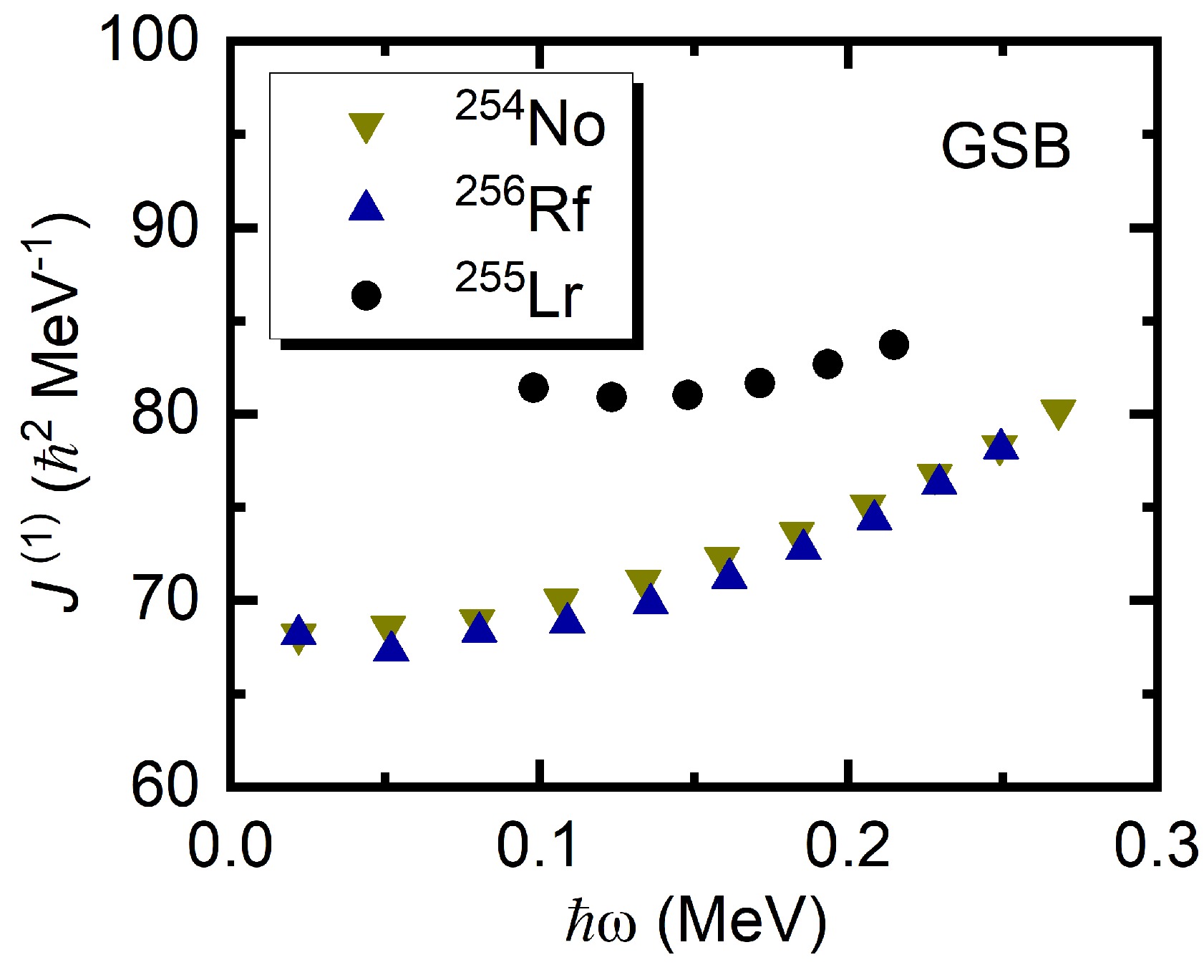
In this study, the rotational properties and blocking effects of the
$ N=152 $ isotones254No,255Lr, and256Rf are investigated using the cranked shell model (CSM), with the pairing correlations treated via the particle-number-conserving (PNC) method. It is well known that the MOIs of normally deformed bands are sensitive to nuclear pairing correlations and Pauli blocking effects. In the PNC-CSM method, the CSM Hamiltonian, including monopole and quadrupole pairing correlations, is diagonalized directly in a truncated Fock space. Thus, the particle number is conserved and the Pauli blocking effects are exactly considered. -
For an axially symmetric nucleus in the rotating frame, the CSM Hamiltonian with pairing is
$ H_\mathrm{CSM}=H_{\rm Nil} - \omega J_{x} +H_\mathrm{P} $ .$ H_{\rm Nil}=\sum h_{\rm Nil} $ is the Nilsson Hamiltonian,$ \xi (\eta) $ is the eigenstate of the single-particle Hamiltonian$ h_{\xi (\eta)} $ , and$ \overline{\xi} (\overline{\eta}) $ is the corresponding time-reversed state.$ -\omega J_{x} $ is the Coriolis interaction with cranking frequencyωabout thexaxis (perpendicular to the nuclear symmetryzaxis). The pairing$ H_\mathrm{P} $ includes monopole$ H_\mathrm{P}(0)= -G_{0} \sum_{\xi\eta}a_{\xi}^{\dagger}a_{\overline{\xi}}^{\dagger}a_{\overline{\eta}}a_{\eta} $ and quadrupole$ H_\mathrm{P}(2)= -G_{2} \sum_{\xi\eta}q_{2}(\xi)q_{2}(\eta)a_{\xi}^{\dagger}a_{\overline{\xi}}^{\dagger}a_{\overline{\eta}}a_{\eta} $ pairing correlations, where$ q_{2}(\xi) = \sqrt{{16\pi}/{5}}\langle \xi |r^{2}Y_{20}|\xi\rangle $ is the diagonal element of the stretched quadrupole operator, and$ G_{0} $ and$ G_{2} $ are the average monopole and quadrupole pairing strengths, respectively.In the PNC method for the pairing correlations, the CSM Hamiltonian
$ H_{\rm CSM} $ is diagonalized in a sufficiently large cranked many-particle configuration (CMPC) space without particle-quasiparticle transformation; thus, the Pauli blocking effects on pairing are treated consistently and exactly. The eigenstate of$ H_{\rm CSM} $ can be expressed as$ |\psi\rangle = \sum_{i}C_{i}|i\rangle $ , where$ C_i $ is real, and$ |i\rangle=|\mu_1 \mu_2 \cdots \mu_n\rangle $ is a CMPC defined as then-particle occupation on the cranked Nilsson orbitals. The particle occupation probability of the cranked Nilsson orbitalμin the state$ |\psi\rangle $ is$ n_{\mu} = \sum_{i}|C_{i}|^{2}P_{i \mu} $ , where$ P_{i \mu} = 1 $ ifμis occupied in$ |i\rangle $ , otherwise,$ P_{i \mu} = 0 $ . The kinematic MOI of the eigenstate$ |\psi\rangle $ is$ J^{(1)}=\langle\psi|J_x|\psi\rangle/{\omega}=\sum_{\mu} j^{(1)}(\mu)+ $ $ \sum_{\mu<\nu} j^{(1)}(\mu\nu) $ , where$ j^{(1)}(\mu)=[\langle \mu |j_x| \mu \rangle n_{\mu}]/\omega $ is the direct contribution, and$ j^{(1)}(\mu\nu)=2[\langle \mu |j_x|\nu\rangle\sum_{i is the interference term. The details of PNC calculations are given in Refs. [8,9]. -
The Nilsson parametersκandμare taken from Ref. [10]. The values of proton
$ \kappa_5 $ ,$ \mu_5 $ and neutron$ \kappa_6 $ ,$ \mu_6 $ are modified slightly to fit the single-particle level sequence when the high-order deformation$ \varepsilon_6 $ is considered [11−13]. The deformations are used as input parameters in the PNC-CSM calculations. For the neighboring isotones254No,255Lr, and256Rf, the deformation parameter$ \varepsilon_2=0.260 $ is chosen to be close to the experimental value [14], and$ \varepsilon_4=0.020 $ and$ \varepsilon_6=0.045 $ are chosen, referring to the deformations predicted by the finite range droplet model [15].In principle, the effective pairing strengths
$ G_{0} $ and$ G_{2} $ can be determined by the experimental odd-even differences in nuclear binding energies. They are also connected with the dimensions of the truncated CMPC space. In these calculations for254No,255Lr, and256Rf, the CMPC space is entirely constructed in the proton$ N=5 $ , 6 and neutron$ N=6 $ , 7 major shells, and the dimensions of the CMPC space are approximately 1000. For the even-even nuclei254No and256Rf, the corresponding effective pairing strengths are$ G_{0} = 0.25 $ MeV and$ G_{2} = 0.02 $ MeV for both protons and neutrons. For the odd-even nucleus255Lr, the pairing strengths are slightly smaller for protons, that is,$ G_{0p} = 0.15 $ MeV and$ G_{2p} = 0.02 $ MeV, and those for neutrons are the same with even-even nuclei. The stability of the PNC-CSM calculations against the change in the dimensions of the CMPC space has been investigated in Refs. [9,16].The cranked Nilsson levels near the Fermi surface of254No for protons and neutrons are shown inFig. 2. The signature
$ \alpha=+1/2 $ and$ \alpha=-1/2 $ levels are denoted by solid and dotted lines, respectively. The$ Z = 100 $ gap for protons and$ N=152 $ gap for neutrons are consistent with the experiment and the results predicted by the Woods-Saxon potential [17]. Based on such a sequence of single-particle levels, the experimental ground state with the configuration$ \pi [521]1/2 $ and the first excited state with the configuration$ \pi [514]7/2 $ in255Lr ($ Z=103 $ ) can be reproduced well.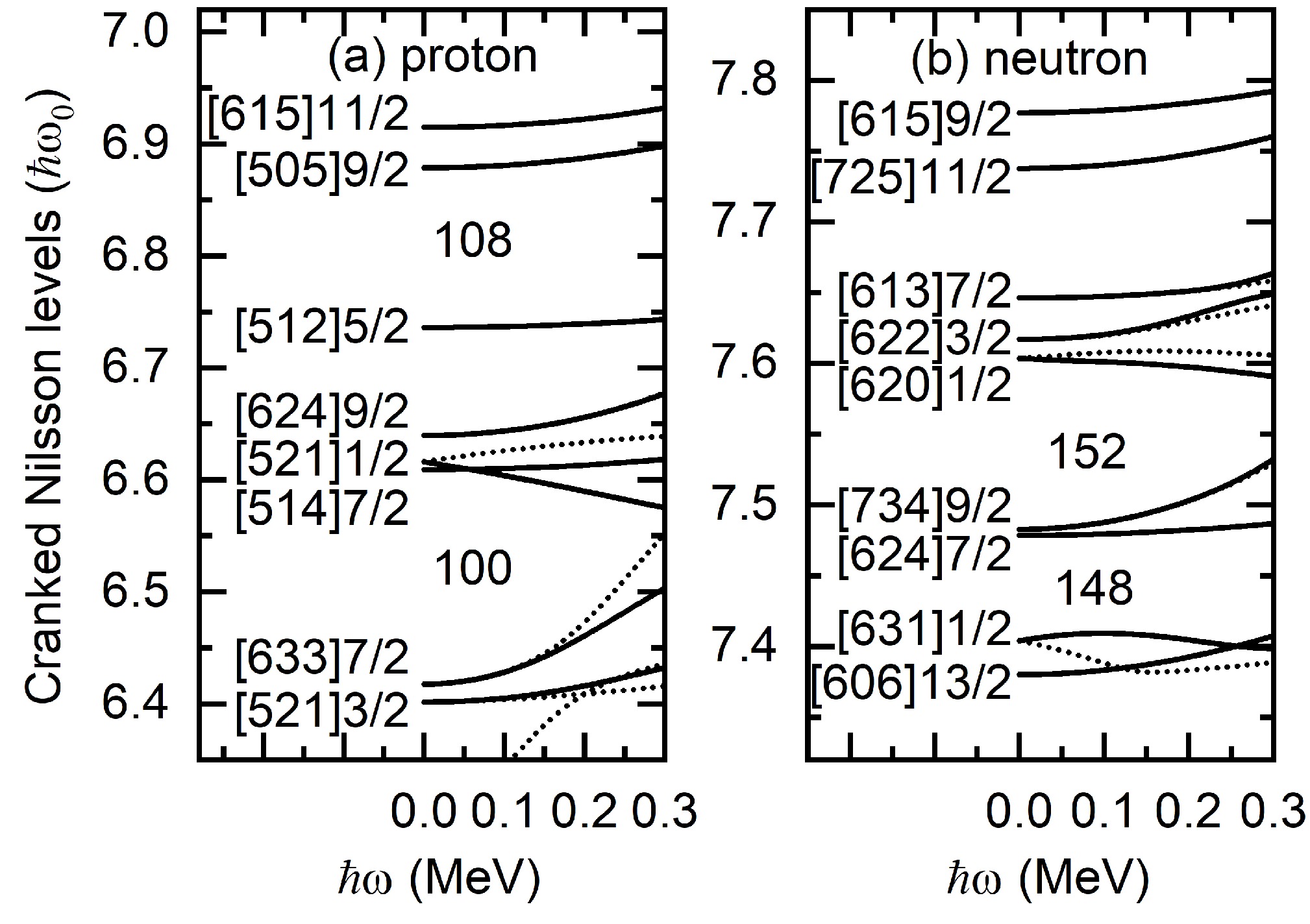
Figure 2.Cranked Nilsson levels near the Fermi surface of254No for protons and neutrons. The signature
$\alpha = +1/2 $ and$\alpha = -1/2 $ levels are denoted by solid and dotted lines, respectively.Figure 3shows the experimental and calculated kinematic MOIs of the GSBs in254No,255Lr, and256Rf, which are denoted by solid squares and lines, respectively. The experimental kinematic MOI can be extracted using
$ J^{(1)}(I)=(2I+1)\hbar^{2}/E_{\gamma}(I+1 \rightarrow I-1) $ . For255Lr, the signature$ \alpha=-1/2 $ band has not been observed, and only the experimental and calculated MOIs of the signature$ \alpha=+1/2 $ band in255Lr are shown.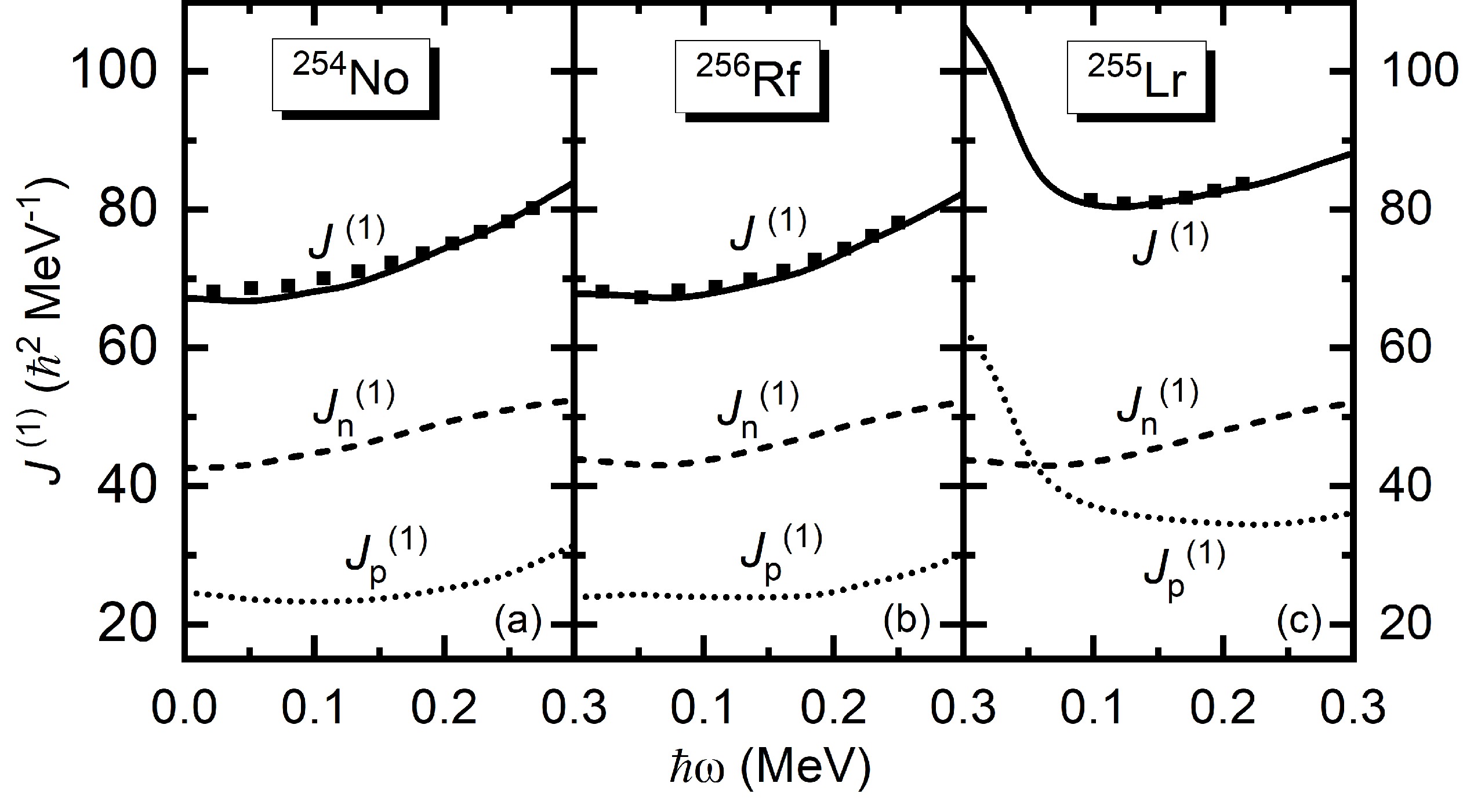
Figure 3.Experimental and calculated kinematic moments of inertia
$ J^{(1)} $ for the GSBs in the$ N=152 $ isotones254No,255Lr, and256Rf. The experimental data are denoted by squares, which are taken from Refs. [2,5,7]. The PNC-CSM calculations are denoted by lines.$ J_n^{(1)} $ and$ J_p^{(1)} $ represent the separate contributions to$ J^{(1)} $ from neutrons and protons, respectively.As shown inFigs. 3(a) and3(b), the observed near identity of
$ J^{(1)} $ for the GSBs in254No and256Rf is reproduced satisfactorily by the PNC-CSM calculations. InFig. 3(c), the experimental$ J^{(1)} $ of the odd-Anucleus255Lr is larger than those of the neighboring even-even nuclei254No and256Rf by approximately 15$ \hbar^{2} $ to 5$ \hbar^{2} $ MeV, with the observed frequency$ \hbar\omega $ increasing from approximately$ \hbar\omega=0.10 $ to 0.20 MeV, which is also reproduced well by the PNC-CSM calculation. In addition, the calculation shows that$ J^{(1)} $ for the GSB in255Lr is larger than those in neighboring nuclei by approximately 40$ \hbar^{2} $ MeV at$ \hbar\omega=0 $ MeV. As shown inFigs. 3(a)−3(c), the contributions to$ J^{(1)} $ from neutrons ($ J_n^{(1)} $ ) are nearly the same for the GSBs in these three isotones. The observed identity of$ J^{(1)} $ in the neighboring even-even nuclei254No and256Rf, as well as the large difference in$ J^{(1)} $ in the odd-Anucleus255Lr, primarily stem from contributions to$ J^{(1)} $ from protons ($ J_p^{(1)} $ ).Figure 4shows the occupation probability
$ n_{\mu} $ of each proton orbitalμ(including both$ \alpha = \pm 1/2 $ ) near the Fermi surface for the GSBs in254No,255Lr, and256Rf. As shown inFig. 4(a), both the proton$ \pi [514]7/2 $ and$ \pi [521]1/2 $ orbitals are nearly half occupied ($ n_\mu \approx 1 $ ) for254No. This can be understood as the$ \pi [514]7/2 $ and$ \pi [521]1/2 $ orbitals being close to each other [seeFig. 2], and relatively strong pairing correlations are expected between these two orbitals. Compared to the case of254No, two additional protons in256Rf partially occupy the proton$ \pi [514]7/2 $ ,$ \pi [521]1/2 $ , and$ \pi[624]9/2 $ orbitals. Owing to the proton$ Z=100 $ subshell, the orbitals under this subshell are almost completely occupied ($ n_\mu \approx 2 $ ).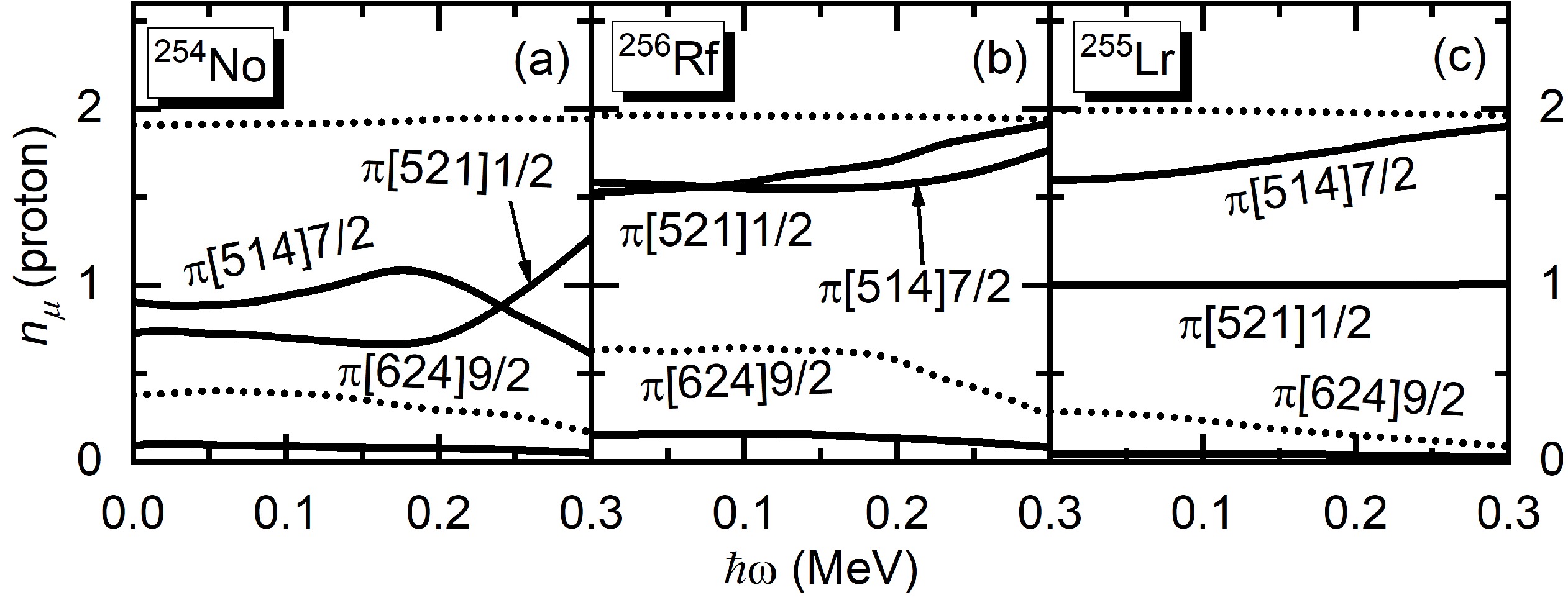
Figure 4.Occupation probabilities
$ n_{\mu} $ of each cranked proton orbitalμ(including both$ \alpha=\pm 1/2 $ ) near the Fermi surface for the GSBs in the$ N=152 $ isotones254No,255Lr, and256Rf. The Nilsson orbitals far above ($ n_{\mu} \approx 0 $ ) and far below the Fermi surface ($ n_{\mu} \approx 2 $ ) are not shown.Unlike the case of254No and256Rf, as shown inFig. 4(c), the
$ \pi [521]1/2 $ orbital is half occupied ($ n_{\mu} $ $ \approx $ 1) over the entire frequency. Except for the$ \pi [521]1/2 $ orbital, the other cranked Nilsson orbitals are either fully occupied ($ n_{\mu} $ $ \approx $ 2) or empty ($ n_{\mu} $ $ \approx $ 0). This is understandable fromFig. 2, which shows that the Fermi surface of255Lr ($ Z=103 $ ) is just located at the proton$ \pi [521]1/2 $ orbital at$ \hbar\omega=0 $ MeV. The cranked Nilsson orbitals$ \pi [514]7/2 $ and$ \pi [521]1/2 $ ($ \alpha=+1/2 $ ) are close to each other over the entire rotational frequency; thus, the$ \pi [514]7/2 $ orbital is nearly fully occupied and the$ \pi [521]1/2 $ orbital is half occupied.The PNC-CSM calculations can provide detailed information on the contributions to the MOIs
$ J^{(1)} $ from each cranked orbital, including the direct contribution$ j^{(1)}(\mu) $ and interference term$ j^{(1)}(\mu\nu) $ . The calculated$ j^{(1)}(\mu) $ and$ j^{(1)}(\mu\nu) $ from the proton major$ N=5 $ and$ N=6 $ shells for the GSBs in254No,255Lr, and256Rf are shown inFig. 5. The sum of the contributions from the proton orbitals below the$ Z=100 $ subshell (blue dashed lines) is almost the same for all the isotones. Compared to254No, the contributions to$ J^{(1)} $ from two additional protons, partially occupying the proton orbitals$ \pi [514]7/2 $ ,$ \pi [521]1/2 $ , and$ \pi [624]9/2 $ , are almost negligible for GSBs in256Rf. These lead to the near identity of the total$ J^{(1)} $ for the neighboring even-even GSBs in254No and256Rf. In contrast, the blocking of the nucleon on the proton orbital$ \pi [521]1/2 $ leads to a significant increase in proton$ j^{(1)}([521]1/2) $ for the GSB in the low frequency region of the odd-Anucleus255Lr [seeFig. 5(c)]. However, owing to the Coriolis antipairing effect, the blocking effects become weakened with increasing frequency. As shown inFigs. 5(a)−5(c), the differences in$ j^{(1)}([521]1/2) $ of the GSBs of the odd-Anucleus and neighboring even-even nuclei decrease with increasing rotational frequency$ \hbar\omega $ . Therefore, as shown inFig. 3,$ J^{(1)}_p $ of the GSB in the odd-Anucleus255Lr exhibits significant deviations from those in the neighboring even-even nuclei.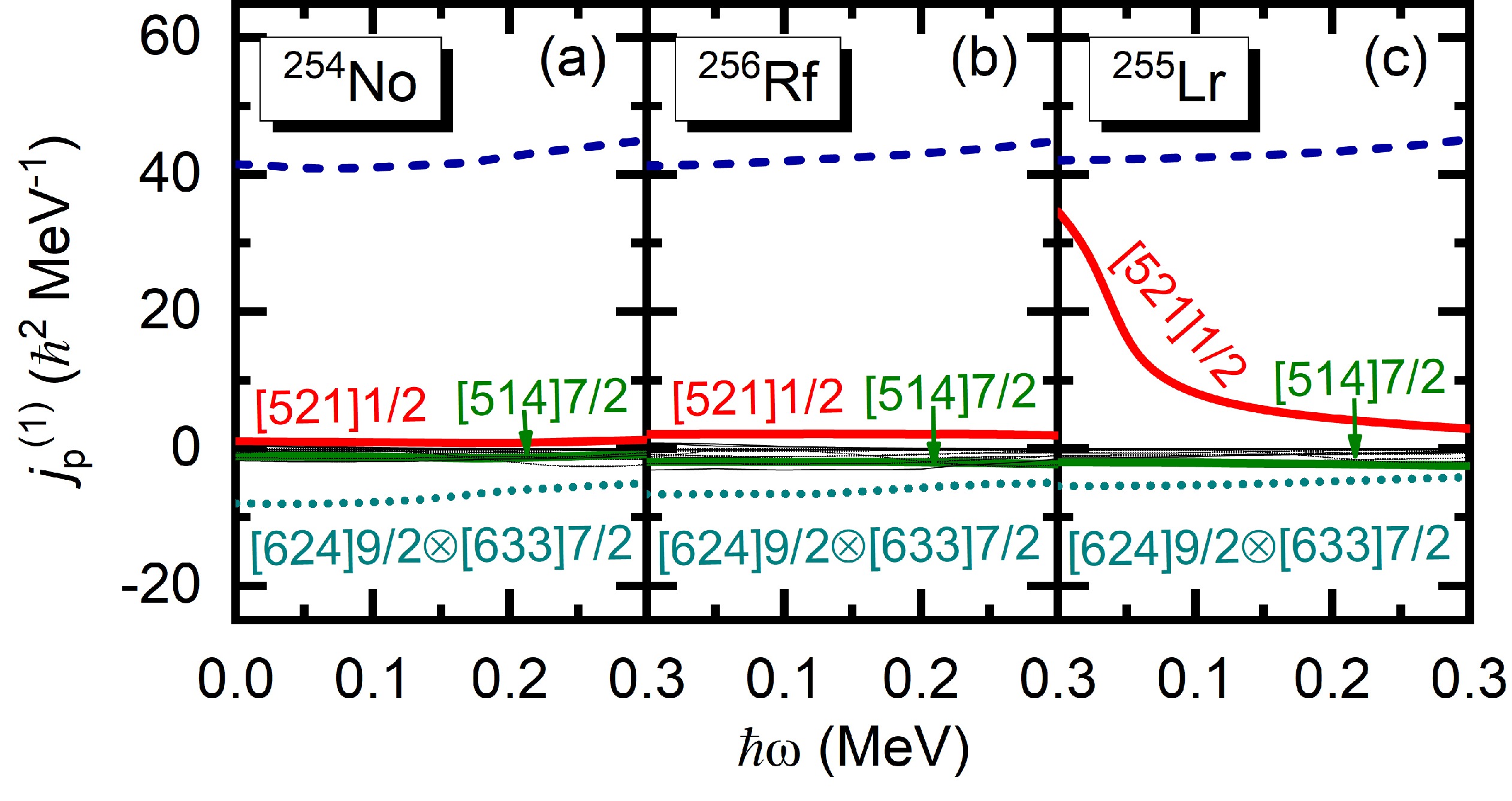
Figure 5.(color online) Calculated contributions to
$ J_p^{(1)} $ from each cranked proton orbital, including the direct contribution$ j^{(1)}(\mu) $ (solid lines) and interference term$ j^{(1)}(\mu\nu) $ (dotted lines), for the GSBs in the$ N=152 $ isotones254No,255Lr, and256Rf. The sum of the contributions from orbitals under the$ Z=100 $ subshell is denoted by blue dashed lines.$ j^{(1)}(\mu) $ and$ j^{(1)}(\mu\nu) $ are denoted simply byμand$ \mu\otimes\nu $ , respectively.The electronic quadrupole transition probabilities
$ B(E2) $ are important quantities for testing the nuclear wavefunctions and deducing the quadrupole collectivities. In the semiclassical approximation, the transition probabilities$ B(E2) $ can be obtained as$B(E2)= {3} \langle \psi|Q_{20}^{p}|\psi\rangle/ {8}$ , where$ |\psi\rangle $ is the eigenstate of the CSM Hamiltonian, and$ Q_{20}^{p} $ corresponds to the laboratory quadrupole moment of protons,$ Q_{20}^{p}=r^{2}Y_{20}=\sqrt{{5}/{16 \pi}}(3 z^{2}-r^{2}) $ . Note that the valence single-particle space is constructed in the major shells from$ N=0 $ to$ N=6 $ for protons, and there is no effective charge involved in the calculation of the$ B(E2) $ values. Because the same deformation parameters are used to calculate the$ B(E2) $ values for all$ N=152 $ isotones, the different behaviors of$ B(E2) $ values along an isotonic chain are purely a microscopic effect of the nuclear many-body wavefunctions.Figure 6demonstrates the calculated
$ B(E2) $ values as a function of rotational frequency$ \hbar\omega $ for the GSBs of254No,255Lr, and256Rf. Because more valence nucleons participate in the collective behavior, the$ B(E2) $ value of255Lr (256Rf) is larger than that of254No by approximately 0.30$ e^{2}b^{2} $ (0.27$ e^{2}b^{2} $ ) at low frequency. The$ B(E2) $ values remain almost constant at$ \hbar\omega<0.20 $ MeV, which indicates that these isotones have stable rotor characteristics with large collectivities in the low frequency region. At high rotational frequency, the behaviors of the$ B(E2) $ values for the GSBs of255Lr,256Rf, and254No are different. The$ B(E2) $ values in255Lr and256Rf decrease at$ \hbar\omega>0.20 $ MeV, whereas that in254No increases in this frequency region. This difference is easy to understand because the level$ \pi [514]7/2 $ crosses$ \pi [521]1/2 $ [seeFig. 2(a)], which leads to a structural change in the many-body wave functions.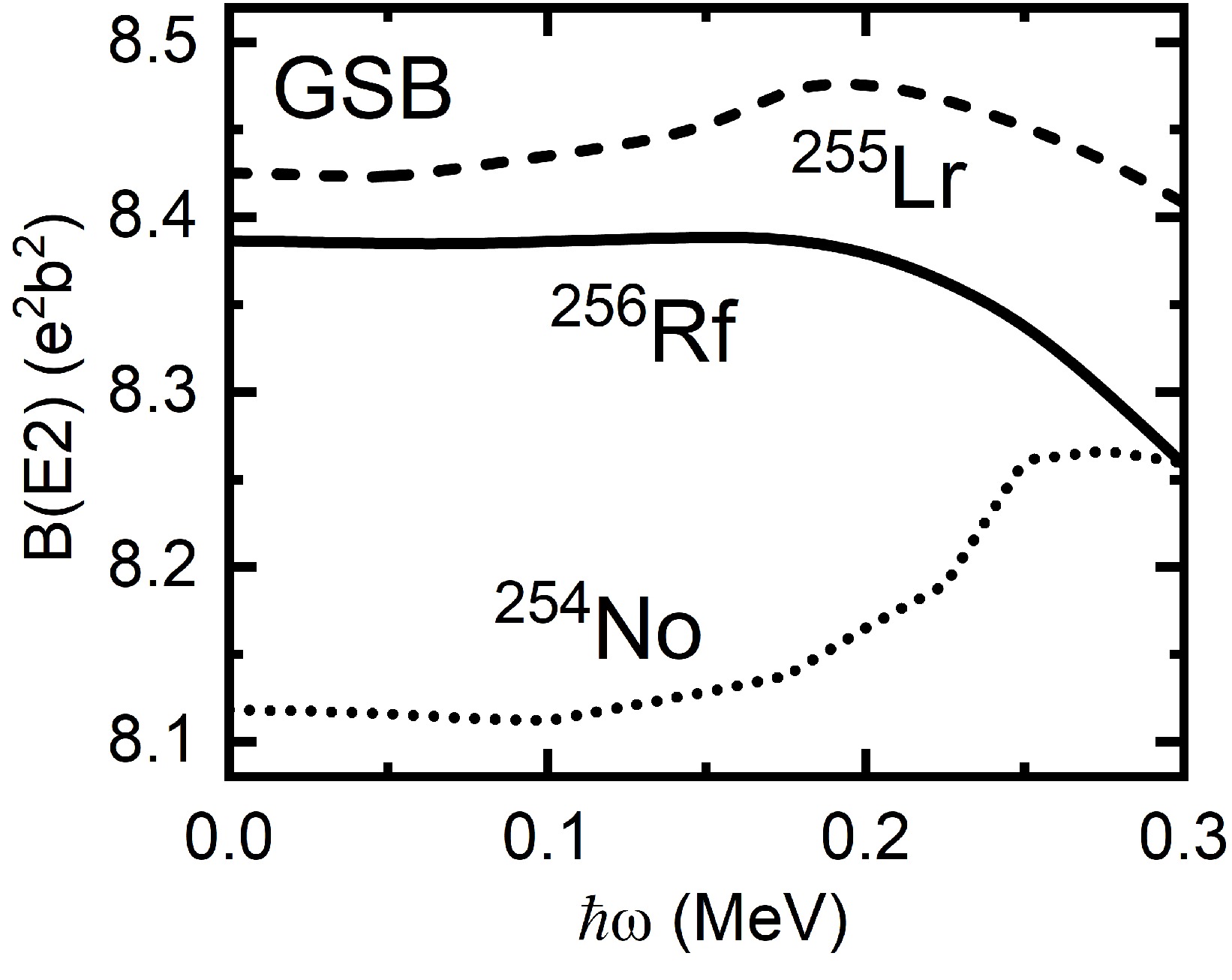
Figure 6.Calculated
$ B(E2)$ values as a function of rotation frequency$\hbar\omega $ for the GSBs of254No,255Lr, and256Rf. -
In summary, the GSBs in the
$ N = 152 $ isotones254No,255Lr, and256Rf are investigated using the CSM, with the pairing correlations treated via a PNC method. The Pauli blocking effects are considered exactly in the PNC method. The experimentally kinematic MOIs$ J^{(1)} $ are reproduced well by the PNC-CSM calculations, and the contributions to$ J^{(1)} $ from neutrons are nearly the same for these isotones.The variation in
$ J^{(1)} $ versus frequency exhibits a remarkable identity for the neighboring even-even isotones254No and256Rf. This is because the two additional protons in256Rf are partially occupied by the proton$ \pi [514]7/2 $ ,$ \pi [521]1/2 $ , and$ \pi [624]9/2 $ orbitals, but the contributions to$ J^{(1)} $ are negligible compared to254No.Compared to the case of the neighboring nuclei254No and256Rf, there is a nearly 50% increase in
$ J^{(1)} $ for the odd-Anucleus255Lr. Detailed theoretical investigations show that the increase in$ J^{(1)} $ is mainly caused by the contribution of proton$ j^{(1)}([521]1/2) $ owing to the blocking of the nucleon on the proton$ \pi [521]1/2 $ orbital in255Lr.The electronic quadrupole transition probabilities
$ B(E2) $ among254No,255Lr, and256Rf are investigated using the semiclassical approximation, with the microscopic wave function obtained via the PNC-CSM method. Compared to the$ B(E2) $ values of255Lr and256Rf, the different behavior of the$ B(E2) $ value of254No at$ \hbar\omega>0.20 $ MeV is predicted to be due to the level$ \pi [514]7/2 $ crossing$ \pi [521]1/2 $ .
Rotational properties and blocking effects inN= 152 isotones254No,255Lr, and256Rf
- Received Date:2024-08-21
- Available Online:2025-02-15
Abstract:The ground-state bands in the


 DownLoad: