


 Abstract
 HTML
HTML Reference
 Related
 PDF
PDF


-
In 1964, Gell-Mann [1] and Zweig [2] proposed the conventional quark model, suggesting that mesons and baryons are composed of
$ q\bar{q} $ andqqq, respectively. At that time, most hadrons were properly explained by this model. However, over the past two decades, there has been an influx of new experimental data unveiling properties of hadronic states that challenge the predictions of the conventional quark model, such asX(3872) [3],Y(4626) [4], and$ Z_{c}(3900) $ [5]. These exotic hadronic states provide a valuable platform for a deeper understanding of the properties of low-lying Quantum Chromodynamics (QCD).In 2021, the LHCb Collaboration reported a new state
$ T_{cc}^{+} $ (3875) in the$ D^{0}D^{0}\pi $ mass distribution with a mass$ M=3875.1+\delta m_{\exp} $ , where$ \delta m_{\exp}=-273\pm61\pm5^{+11}_{-14} $ keV, and a width$ \Gamma=410\pm165\pm43^{+18}_{-38} $ keV [6,7]. This notably narrow width indicates that it is a long-living exotic state. Its spin-parity quantum number is$ J^{P}=1^{+} $ . The minimal quark content of$ T_{cc}^{+} $ (3875) is$ cc\bar{u}\bar{d} $ , which means that, unlike the three hidden-charm tetraquark states mentioned above, there can be no annihilation for such a component. These interesting properties have attracted theoretical attention and motivated research globally [8−48]. It is generally assumed that$ T_{cc}^{+} $ is a molecular state, a compact tetraquark, or a triangle singularity. For example, in Ref. [8], by using a coupled-channel approach, the authors suggested that$ T_{cc}^{+} $ is a hadronic molecule generated by the interactions in the$ D^{*+}D^{0} $ and$ D^{*0}D^{+} $ channels. In Ref. [9], they also argued that$ T_{cc}^{+} $ is a molecule state in the framework of chiral unitary theory. Moreover, S. S. Agaevet al.[10] proposed that$ T_{cc}^{+} $ is a compact structure by employing the QCD three-point sum rule method. In Refs. [11,12], the authors proposed that this state may be a triangle logarithmic singularity.In addition to theTccstate, double-bottom (
$ T_{bb} $ ) tetraquark states have also been investigated in various theoretical frameworks. In Ref. [13], also using a coupled-channel approach, the authors proposed that$ \bar{B}^{*}\bar{B}^{*} $ states with$ IJ^{P}=01^{+},11^{+} $ might be good molecular candidates. In Ref. [14], J. Chenget al.employed a heavy diquark-antidiquark symmetry (HDAS) and the chromomagnetic interaction (CMI) model to study$ bb\bar{n}\bar{n} $ ($ n=u,\; d $ ) tetraquark states. The results show that the lowest energy of$ bb\bar{n}\bar{n} $ with$ IJ^{P}=01^{+} $ is approximately 116 MeV below the$ \bar{B}\bar{B}^{*} $ threshold. In Ref. [15], Linet al.investigated theP-wave$ T_{bb}^{-} $ states in the diquark-antidiquark framework by employing the quark model. In the$ \rho $ -mode with$ 1^{1}P_{1} $ $ [bb]_{\bar{3}}^{0}[\bar{u}\bar{d}]_{3}^{0} $ configuration, its energy is approximately 18 MeV lower than the$ \bar{B}\bar{B} $ threshold, which means it can establish a compact bound state.Furthermore, theoretical investigations have explored other partners (
$ T_{bc} $ ,$ T_{bc\bar{s}} $ ,$ T_{cc\bar{s}} $ ,$ T_{bb\bar{s}} $ ) ofTcc. In the case of$ T_{bc} $ ,$ T_{bc\bar{s}} $ states, in Ref. [18] the authors employed a nonrelativistic quark model and found that$ T_{bc} $ with$ IJ^{P}=00^{+} $ and 01+,$ T_{bcs} $ with$\frac{1}{2}0^{+}$ ,$\frac{1}{2}1^{+}$ can form a bound state. The high-spin states$ T_{bc} $ with$ 02^{+} $ and$ T_{bc\bar{s}} $ with$\frac{1}{2}2^{+}$ can decay intoD-wave$ \bar{B}D $ and$ \bar{B}_{s}D $ , although they are below the$ \bar{B}^{*}D^{*} $ and$ \bar{B}_{s}^{*}D^{*} $ thresholds, respectively. The QCD sum rule has also been used to calculate$ T_{bc} $ and$ T_{bc} $ [16,17]. In Ref. [16], the authors suggested that for the$ T_{bc\bar{s}} $ states with$ J^{P}=0^{+} $ and$ 1^{+} $ , both masses are below the corresponding thresholds ($ D^{(*)}\bar{B}^{(*)} $ ). In Ref. [17], the results show that the masses of$ T_{bc\bar{s}} $ tetraquark states are below the thresholds of$ \bar{B}_{s}D $ and$ \bar{B}^{*}_{s}D $ final states for the scalar and axial-vector channels, respectively. Regarding$ T_{cc\bar{s}} $ and$ T_{bb\bar{s}} $ tetraquark states, in Ref. [18], the authors argued that$ T_{cc\bar{s}} $ is not a bound state, but they obtained a shallow bound state for the$ T_{bb\bar{s}} $ tetraquark state with$IJ^{P}= {\frac{1}{2}}1^{+}$ . Applying the color-Coulomb potential in the diquark-antidiquark framework at the heavy quark limit [19], the$ T_{bb\bar{s}} $ state becomes bound into compact structures. However, in Ref. [20], the authors reported that$ T_{cc\bar{s}} $ can establish a stable state against the strong interaction. Further results and discussions on the partners ofTcccan be found in Refs. [49−59].WhileTccpartners involving heavy quarks have been extensively studied, limited attention has been given to double strangeness partner (Tss) tetraquark states. Thus, the investigation of bound and resonant states in theTsssystem is both interesting and necessary.
The structure of the paper is as follows. Section II provides a brief description of the quark model and wave functions. Section III introduces the real-scaling method. Section IV details the3P0method. Section V presents our results and discussion.
-
In this study, we primarily investigated the dynamics of the
$ s\bar{q}s\bar{q} $ system using the chiral quark model. This model is an excellent potential framework because it effectively explains hadron interactions, including mass, kinetic, and potential terms, which can be expressed as$ H = 2 (m_s + m_q) + 2 \left(\frac{\vec{p}_{s\bar{q}}^2}{2\mu_{s\bar{q}}}\right) +\frac{\vec{p}_{s\bar{q}s\bar{q}}^2}{2\mu_{s\bar{q}s\bar{q}}} + V(r_{ij}), $

(1) wheremdenotes the quark mass,
$ \mu $ represents the reduced mass, and$ \vec{p} $ is the relative momentum between quarks. The form of$ \mu $ is$ \mu_{s\bar{q}}=\frac{m_{s} m_{\bar{q}}}{m_{s} + m_{\bar{q}}},~~\mu_{s\bar{q}s\bar{q}}=\frac{(m_{s}+m_{\bar{q}})}{2}. $

(2) In the
$ s\bar{q}s\bar{q} $ system,sandqcan be approximately regarded as identical quarks. Consequently, the exchange of Goldstone bosons betweensandqplays a significant role. Therefore, our potential includes the confinement potential, one-gluon exchange potential, and Goldstone boson exchange potential, expressed as follows:$ \begin{aligned}[b] V(r_{ij}) = \sum\limits_{i

(3) Goldstone boson exchange mainly stems from the spontaneous chiral symmetry breaking, a fundamental characteristic of QCD. This results in a long-range attractive force between quarks. In our chiral quark model, the chiral part of the Hamiltonian, (
$ V_{\pi}(r_{ij}) $ +$ V_{\eta}(r_{ij}) + $ $ V_{K}(r_{ij}) $ +$ V_{\sigma}(r_{ij}) $ ), can be expressed as$ \begin{aligned}[b] V_{\pi}(r_{ij}) =\;& \frac{g_{ch}^2}{4\pi}\frac{m_{\pi}^2}{12m_im_j}\frac{\Lambda_{\pi}^2}{\Lambda_{\pi}^2-m_{\pi}^2}m_\pi [ Y(m_\pi r_{ij}) \\ &- \frac{\Lambda_{\pi}^3}{m_{\pi}^3}Y(\Lambda_{\pi} r_{ij}) ] {\boldsymbol{\sigma}}_i \cdot{\boldsymbol{\sigma}}_j \sum\limits_{a=1}^3 \lambda_i^a \lambda_j^a, \\ V_{K}(r_{ij})=\;& \frac{g_{ch}^2}{4\pi}\frac{m_{K}^2}{12m_im_j} \frac{\Lambda_K^2}{\Lambda_K^2-m_{K}^2}m_K [ Y(m_K r_{ij}) \\ &- \frac{\Lambda_{K}^3}{m_{K}^3}Y(\Lambda_{K} r_{ij}) ] {\boldsymbol{\sigma}}_i \cdot{\boldsymbol{\sigma}}_j \sum\limits_{a=1}^3 \lambda_i^a \lambda_j^a, \\ V_{\eta}(r_{ij}) =\; & \frac{g_{ch}^2}{4\pi}\frac{m_{\eta}^2}{12m_im_j}\frac{\Lambda_{\eta}^2}{\Lambda_{\eta}^2-m_{\eta}^2}m_{\eta} [ Y(m_\eta r_{ij}) \\ &- \frac{\Lambda_{\eta}^3}{m_{\eta}^3}Y(\Lambda_{\eta} r_{ij}) ] {\boldsymbol{\sigma}}_i \cdot{\boldsymbol{\sigma}}_j [\lambda_i^8 \lambda_j^8 \cos\theta_P - \sin \theta_P], \\ V_{\sigma}(r_{ij})=\;& -\frac{g_{ch}^2}{4\pi}\frac{\Lambda_{\sigma}^2}{\Lambda_{\sigma}^2-m_{\sigma}^2}m_\sigma [ Y(m_\sigma r_{ij})-\frac{\Lambda_{\sigma}}{m_\sigma}Y(\Lambda_{\sigma} r_{ij}) ], \end{aligned} $

(4) where
$ {\boldsymbol{\sigma}} $ represents the Pauli matrices acting on the spin wave functions of theTsssystem, and$ {\boldsymbol{\lambda}}^{a} $ denotes the Gell-Mann matrices acting on the flavor wave functions of theTsssystem.$ Y(x) $ is the Yukawa function, explicitly given by$Y(x)={e^{-x}}/{x}$ .$ \Lambda_{\chi} $ serves as the cut-off parameter, and$ g^2_{ch}/4\pi $ denotes the Goldstone-quark coupling constant. The masses of Goldstone bosons are denoted by$ m_{\pi} $ ,$ m_{\eta} $ , and$ m_{K} $ , while$ m_{\sigma} $ is determined by the relation$ m_{\sigma}^2 \approx m_{\pi}^2+4 m_{u,d}^2. $

(5) One of the characteristics of QCD is quark confinement, which suggests that quarks cannot be separated. This corresponds to the confinement potential in the Hamiltonian. Unlike other potential forms in the quark model, the confinement potential is not directly derived from the field theory. Consequently, it typically appears in three common forms: linear [60], quadratic [61], and screened[62] confinement potentials. These potentials share the common feature of exhibiting strong attraction at short distances. The distinction lies in the fact that, owing to screening effects, screened confinement potential can describe well the spectra of light mesons including excited states. Given that the
$ s\bar{q}s\bar{q} $ system involves light mesons (K/K*), we employed the screened confinement potential in this study. Its specific form is expressed as$ V_{\rm con} (r_{ij}) = [-a_{c}(1- {\rm e}^{-\mu_c r_{ij}}) + \Delta ] {\boldsymbol{\lambda}}_i^c \cdot {\boldsymbol{\lambda}}_j^c, $

(6) where
$ {\boldsymbol{\lambda}}^{c} $ denotes$S U(3)$ color Gell-Mann matrices, and$ a_{c} $ and$ \mu_c $ are model parameters.The one-gluon exchange potential
$V_{\rm oge}(r_{ij})$ reflects the QCD characteristic of asymptotic freedom. It plays a crucial role in the quark model by offering intermediate-range attractive forces. This potential generally consists of a Coulomb term and a color-magnetic term. It reads$ V_{\rm oge} (r_{ij})= \frac{\alpha_s}{4} {\boldsymbol{\lambda}}_i^c \cdot {\boldsymbol{\lambda}}_{j}^c \left[\frac{1}{r_{ij}}-\frac{1}{6m_im_j}{\boldsymbol{\sigma}}_i\cdot {\boldsymbol{\sigma}}_j \frac{{\rm e}^{-r_{ij}/r_0(\mu_{ij})}}{ r_{ij}r_0^2(\mu_{ij})} \right], $

(7) where
$ \alpha_s $ is the QCD-inspired strong coupling constant, which is determined by fitting experimental meson data. Generally, the heavier the quark, the smaller the coupling constant between quarks. All the parameters are determined by fitting the meson spectrum, from light to heavy, taking into account only a quark-antiquark component. They are listed inTable 1.Quark masses $ m_u=m_d $ (MeV)

313 $ m_{s} $ (MeV)

555 Goldstone bosons $\Lambda_{\pi}=\Lambda_{\sigma}(\rm fm^{-1})$ 

4.2 $\Lambda_{\eta}=\Lambda_{K}(\rm fm^{-1})$ 

5.2 $ g_{ch}^2/(4\pi) $ 

0.54 $ \theta_p(^\circ) $ 

–15 Confinement $ a_{c} $ (MeV)

430 $ \mu_{c} $ (

$ fm^{-1} $ )

0.7 $ \Delta $ (MeV)

181.1 OGE $ \alpha_{qq} $ 

0.54 $ \alpha_{qs} $ 

0.48 $ \alpha_{ss} $ 

0.42 $ \hat{r}_0 $ (MeV)

28.17 Table 1.Quark model parameters (
$ m_{\pi}=0.7 $ $\rm fm^{-1} $ ,$ m_{\sigma}=3.42 $ $\rm fm^{-1} $ ,$ m_{\eta}=2.77 $ $\rm fm^{-1} $ ,$ m_{K}=2.51 $ $\rm fm^{-1} $ ). -
TheTsssystem has two important structures: the molecular (
$ s\bar{q} $ -$ s\bar{q} $ ) and diquark ($ ss $ -$ \bar{q}\bar{q} $ ) configurations. At the quark level, these are expressed as the product of four components: color, spin, flavor, and orbital parts. According to QCD, any quark system, including multi-quark states, must be colorless. Therefore, the color wave function of a four-quark system can be obtained by two coupled color-singlet clusters,$ {\bf{1}} \otimes {\bf{1}} $ ,$ C_{1} = \sqrt{\frac{1}{3}}(\bar{r}r+\bar{g}g+\bar{b}b) \times \sqrt{\frac{1}{3}}(\bar{r}r+\bar{g}g+\bar{b}b). $

(8) Additionally, the color wave function of a colorless four-quark system can also be obtained by coupling two color-octet wave functions,
$ {\bf{8}} \otimes {\bf{8}} $ ,$ \begin{aligned}[b] C_{2} =\;& \sqrt{\frac{1}{72}}(3\bar{b}r\bar{r}b+3\bar{g}r\bar{r}g+3\bar{b}g\bar{g}b+3\bar{g}b\bar{b}g+3\bar{r}g\bar{g}r \\ & +3\bar{r}b\bar{b}r+2\bar{r}r\bar{r}r+2\bar{g}g\bar{g}g+2\bar{b}b\bar{b}b-\bar{r}r\bar{g}g \\ & -\bar{g}g\bar{r}r-\bar{b}b\bar{g}g-\bar{b}b\bar{r}r-\bar{g}g\bar{b}b-\bar{r}r\bar{b}b). \end{aligned} $

(9) These two color wave functions correspond to the molecular configurations. Regarding the diquark structure, the color wave functions are constructed in a similar manner to the coupling of two color-octet states into a color-singlet four-quark wave function. Specifically, it involves coupling
$ {\bf{3}} \otimes \bar{{\bf{3}}} $ and$ {\bf{6}} \otimes \bar{{\bf{6}}} $ to form a colorless four-quark system. The wave function can be expressed as$ \begin{aligned} C_{3} =\;& \sqrt{\frac{1}{12}}(rg\bar{r}\bar{g}-rg\bar{g}\bar{r}+gr\bar{g}\bar{r}-gr\bar{r}\bar{g}+rb\bar{r}\bar{b} \\ &-rb\bar{b}\bar{r}+br\bar{b}\bar{r}-br\bar{r}\bar{b}+gb\bar{g}\bar{b}-gb\bar{b}\bar{g} +bg\bar{b}\bar{g}-bg\bar{g}\bar{b}), \end{aligned} $

$ \begin{aligned}[b] C_{4} =\;&\sqrt{\frac{1}{24}}(2rr\bar{r}\bar{r}+2gg\bar{g}\bar{g}+2bb\bar{b}\bar{b} +rg\bar{r}\bar{g}+rg\bar{g}\bar{r} \\ &+gr\bar{g}\bar{r}+gr\bar{r}\bar{g}+rb\bar{r}\bar{b}+rb\bar{b}\bar{r}+br\bar{b}\bar{r} \\ &+br\bar{r}\bar{b}+gb\bar{g}\bar{b}+gb\bar{b}\bar{g}+bg\bar{b}\bar{g}+bg\bar{g}\bar{b}). \end{aligned} $

(10) In contrast to color wave functions, the spin of antiquarks and quarks is indistinguishable. Therefore, diquark and molecular structures share the same spin wave function. Given that we are studying theTsssystem with total spin 1, its wave function exists in three possible configurations, namely
$ {\bf{0}} \otimes {\bf{1}} $ ($ S_1 $ ),$ {\bf{1}} \otimes {\bf{0}} $ ($ S_2 $ ), and$ {\bf{1}} \otimes {\bf{1}} $ ($ S_3 $ ),$ \begin{aligned} &S_{1} =\chi_{00}^{\sigma}\chi_{11}^{\sigma},\quad \quad S_{2} =\chi_{11}^{\sigma}\chi_{00}^{\sigma},\\ &S_{3} =\frac{1}{\sqrt{2}}(\chi_{11}^{\sigma}\chi_{10}^{\sigma}-\chi_{10}^{\sigma}\chi_{11}^{\sigma}).\end{aligned} $

The flavor wave functions of the sub-clusters for the two structures are
$ \chi_{\frac{1}{2},\frac{1}{2}}^{fm}=s\bar{d},\chi_{\frac{1}{2},-\frac{1}{2}}^{fm}=-s\bar{u}, $

(11) $ \chi_{0,0}^{fd_{1}}=ss,\chi_{0,0}^{fd_{2}}= \frac{1}{\sqrt{2}}(\bar{u}\bar{d} - \bar{d}\bar{u}). $

(12) In this case, the subscripts of
$ \chi_{I,I_z}^{fm(d)i} $ denote the isospin and its third component, while the superscripts specify the structure (fmfor the molecular configuration and$ fd $ for the diquark configuration) and the index. Considering the isospin ofTcc, the isospin ofTssis set to zero. Thus, the total flavor wave function can be coupled in two possible ways:$ {\bf{\frac{1}{2}}} \otimes {\bf{\frac{1}{2}}} $ (molecular configuration,$ F_1 $ ) and$ {\bf{0}} \otimes {\bf{0}} $ (diquark configuration,$ F_2 $ ). The total flavor wave functions can be written as$ \begin{aligned}[b] F_{1} =\; & \frac{1}{\sqrt{2}}\left( \chi_{\frac{1}{2}\frac{1}{2}}^{fm} \chi_{\frac{1}{2}-\frac{1}{2}}^{fm}-\chi_{\frac{1}{2}-\frac{1}{2}}^{fm} \chi_{\frac{1}{2}\frac{1}{2}}^{fm} \right), \\ F_{2} =\; & \chi_{\frac{1}{2}\frac{1}{2}}^{fm} \chi_{\frac{1}{2}\frac{1}{2}}^{fm}. \end{aligned} $

(13) Given that theTsssystem has positive parity, we set all orbital quantum numbers to zero. Consequently, its spatial wave function can be represented as
$ \psi(r) = \Psi_{l_1=0}({\bf r}_{12})\Psi_{l_2=0}({\bf r}_{34}) \Psi_{L_r=0}({\bf r}_{1234}). $

The spatial wave functions for the three relative motions involved here are expanded using the Gaussian Expansion Method (GEM):
$ \Psi_{l_1=0}(r_{12}) = \sum\limits_{n1=1}^{n1_{\max}} c_{n1} N_{n1} {\rm e}^{-\nu_{n1}r^2}Y_{00}(\hat{r_{12}}), $

(14) $ \Psi_{l_2=0}(r_{34}) = \sum\limits_{n2=1}^{n2_{\max}} c_{n2} N_{n2} {\rm e}^{-\nu_{n2}r^2}Y_{00}(\hat{r_{34}}), $

(15) $ \Psi_{L_r=0}(r_{1234}) = \sum\limits_{n3=1}^{n3_{\max}} c_{n3} N_{n3} {\rm e}^{-\nu_{n3}r^2}Y_{00}(\hat{r_{1234}}), $

(16) with normalization constant
$ N_{n} = \left[\frac{4(2\nu_{n})^{{3}/{2}}}{\sqrt{\pi}} \right]^{{1}/{2}} . $

(17) The coefficients
$ c_n $ are variational parameters determined through dynamic optimization. The Gaussian size parameters follow a geometric progression,$ \nu_{n}=\frac{1}{r^2_n}, \quad r_n=r_1a^{n-1}, \quad a=\left(\frac{r_{n_{\max}}}{r_1}\right)^{\frac{1}{n_{\max}-1}}. $

(18) Here,
$ r_n $ denotes the Gaussian size parameter for then-th term, with$ r_1 $ and$r_{n_{\max}}$ as the initial parameters.The total wave function is constructed as the direct product of the orbital, spin, color, and flavor wave functions. Thus, the complete wave function of the system is expressed as
$ \Psi^{i,j,k}={{\cal{A}}} \psi(r) S_i F_j C_k. $

(19) Here,
$ {\cal{A}} $ denotes the antisymmetrization operator. For the$ s\bar{q}s\bar{q} $ system, where the two subsystems are identical,$ {\cal{A}} $ is defined as 1-(13)-(24)+(13)(24). Subsequently, to determine the eigen-energies of the system utilizing the Rayleigh-Ritz variational principle, we solve the Schrödinger equation:$ H\Psi^{i,j,k}=E\Psi^{i,j,k}. $

(20) -
The real-scaling method was first proposed by Taylor [63] to study resonance states in electron-molecule systems. Owing to its success in explaining a substantial amount of experimental data, Hiyamaet al.[64] applied this method at the quark level to search for the
$ P_c $ states in the$ qqqc\bar{c} $ system. Subsequently, we introduced this method to the tetraquark system for the first time and successfully explained particles [65−69] such asY(4626),X(2900), and$ \Upsilon $ (10753).The real-scaling method involves systematically scaling the width of Gaussian functions between two groups using a scaling factor denoted as
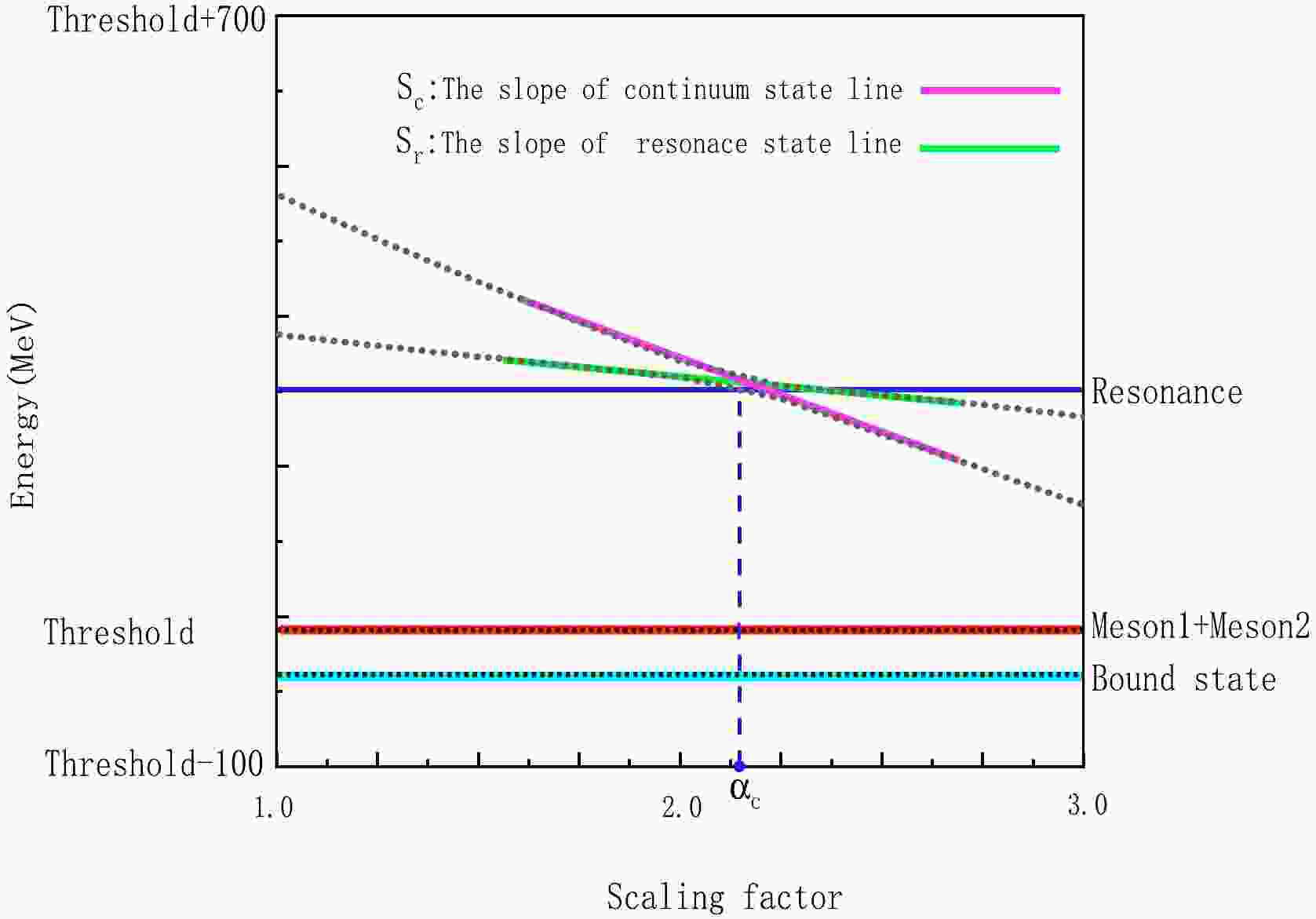
$ \alpha $ ,$ R \rightarrow \alpha R $ . As$ \alpha $ increases, the width of the Gaussian functions expands, leading to variations in the system energy. If a stable structure is present, it remains unaffected by the changes in Gaussian function widths. Within the framework of this method, bound states do not exhibit decay behavior owing to the absence of corresponding decay channels, and thus manifest as horizontal lines, as shown inFig. 1(a). Conversely, resonance states, which have several decay channels, strongly couple with scattering channels and decay to the relevant threshold channels. This is depicted inFig. 1(b) by two downward-sloping lines that demonstrate avoid-crossing behavior. Given that resonance states are stable structures, the avoid-crossing structure may reappear as the scaling factor$ \alpha $ increases. However, a larger$ \alpha $ results in a more complex calculation process. Therefore, for computational efficiency, we set$ \alpha $ to range from 1.0 to 3.0. Within this range, most resonance states exhibit repeated avoid-crossing structures. The real-scaling method allows for the calculation of the decay width of stable states. The calculation equation is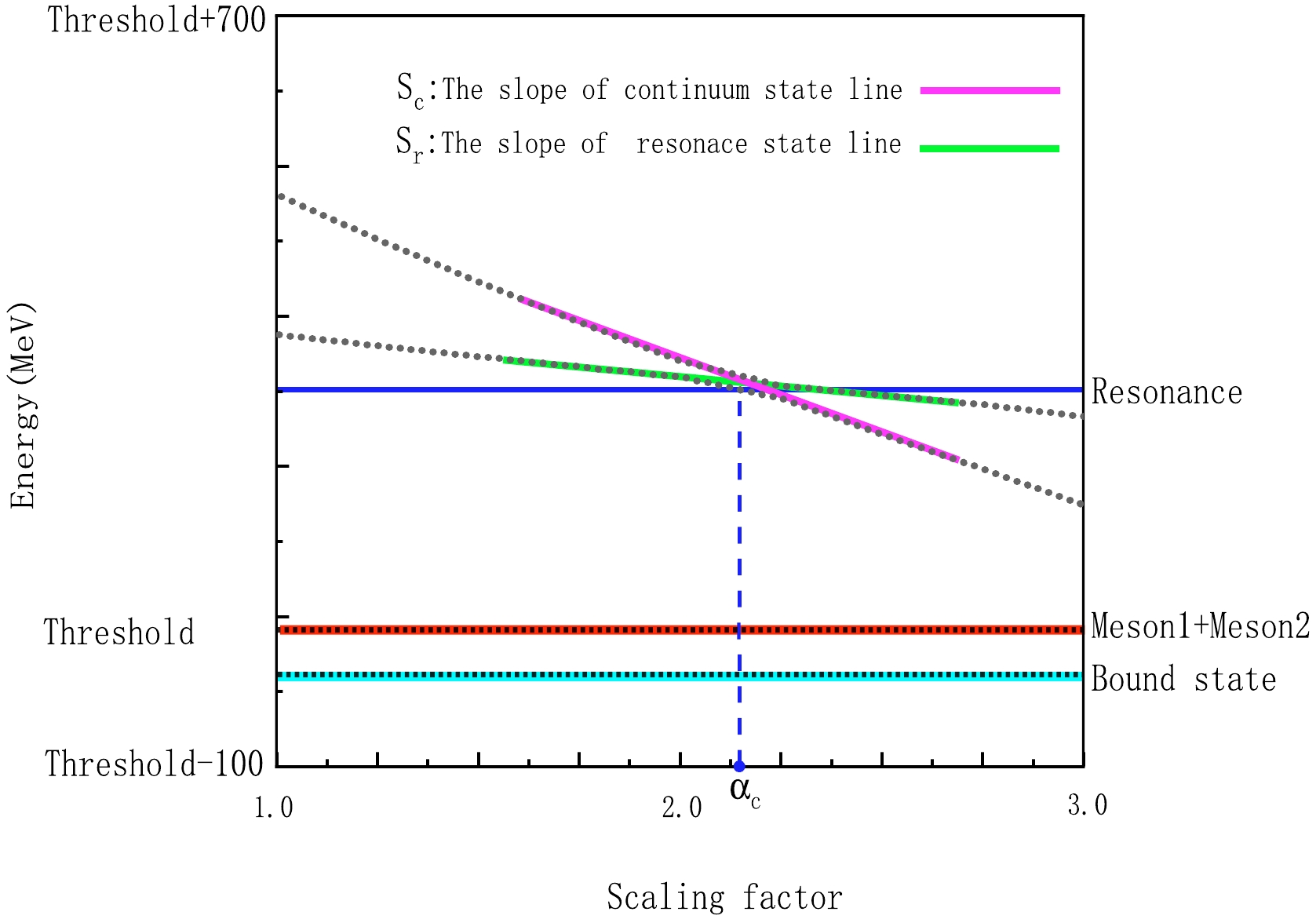
Figure 1.(color online) Two forms of stable states, namely bound state (horizontal line) and resonance state (avoid-crossing structure), for the real-scaling method. The red line represents the threshold, while the light blue line indicates the bound state. The avoid-crossing structure formed by the red line represents the scattering state, whereas the green line represents a genuine resonance.
$ \Gamma =4 |V(\alpha_c)|\frac{\sqrt{|Slope_r||Slope_s|}}{|Slope_r-Slope_s|}. $

(21) Based on the discussion above, in the framework of the real-scaling method, the avoid-crossing structure represents a resonant state, while the horizontal line indicates a bound state. Therefore, the decay width calculation given by Eq. (21) is applicable only to the decay width of resonant states. Here,
$ \alpha_c $ denotes the$ \alpha $ coordinate corresponding to the avoid-crossing structure, while$ V(\alpha_c) $ represents the energy difference at the avoid-crossing point between the two lines; "$ slope_r $ " and "$ slope_s $ " indicate the slopes of these two lines. -
The3P0model is extensively employed in the calculation of meson decay widths [70,71]. It posits that a meson in the vacuum excites a pair of quark-antiquark with momenta
$ {\bf{p}}_3 $ and$ {\bf{p}}_4 $ , respectively. The probability of their production is determined by a parameter$ \gamma $ , which is generally determined by an overall fitting of the strong decay width of hadrons. Thus, one obtains$ \gamma=6.95 $ for$ u\bar{u} $ and$ d\bar{d} $ pair creation, and$ \gamma=6.95/\sqrt{3} $ for$ s\bar{s} $ pair creation [72]. The flavor wave function of the quark-antiquark pair is given by$\phi_{0} =(u\bar{u} + d\bar{d} + s\bar{s})/ {\sqrt{3}}$ , and the color wave function is$\omega_{0} = (r\bar{r} + g\bar{g} + b\bar{b})/{\sqrt{3}}$ . The operator in the model is$ \begin{aligned}[b] T=\;&-3\; \gamma\sum\limits_m\langle 1m1-m|00\rangle\int {\rm d}{\bf{p}}_3{\rm d}{\bf{p}}_4\delta^3({\bf{p}}_3+{\bf{p}}_4)\\ &\times{\cal{Y}}^m_1\left(\frac{{\bf{p}}_3-{\bf{p}}_4}{2}\right) \chi^{34}_{1-m}\phi^{34}_0\omega^{34}_0b^\dagger_3({\bf{p}}_3)d^\dagger_4({\bf{p}}_4), \end{aligned} $

(22) TheS-matrix element for the process
$ A \rightarrow B + C $ is expressed as$ \langle BC|T|A\rangle=\delta^3({\bf{P}}_A-{\bf{P}}_B-{\bf{P}}_C){\cal{M}}^{M_{J_A}M_{J_B}M_{J_C}}, $

(23) where
$ {\bf{P}}_B $ and$ {\bf{P}}_C $ are the momenta ofBandCmesons in the final state; they satisfy$ {\bf{P}}_A = {\bf{P}}_B + {\bf{P}}_C = 0 $ in the center-of-mass frame of mesonA.$ {\cal{M}}^{M_{J_A}M_{J_B}M_{J_C}} $ is the helicity amplitude of the process$ A \rightarrow B + C $ , which can be obtained as$ \begin{aligned}[b] {\cal{M}}^{M_{J_A}M_{J_B}M_{J_C}}({\bf{P}})=\;&\gamma\sqrt{8E_AE_BE_C} \sum\limits_{ M_{L_A},M_{S_A}, M_{L_B},M_{S_B}, M_{L_C},M_{S_C},m } \langle L_AM_{L_A}S_AM_{S_A}|J_AM_{J_A}\rangle \langle L_BM_{L_B}S_BM_{S_B}|J_BM_{J_B}\rangle\\ &\times\langle L_CM_{L_C}S_CM_{S_C}|J_CM_{J_C}\rangle\langle 1m1-m|00\rangle \langle\chi^{14}_{S_BM_{S_B}}\chi^{32}_{S_CM_{S_C}}|\chi^{12}_{S_AM_{S_A}}\chi^{34}_{1-m}\rangle [\langle \phi^{14}_B\phi^{32}_C|\phi^{12}_A\phi^{34}_0\rangle {\cal{I}}^{M_{L_A},m}_{M_{L_B},M_{L_C}}({\bf{P}},m_1,m_2,m_3)\\ &+(-1)^{1+S_A+S_B+S_C}\langle\phi^{32}_B\phi^{14}_C|\phi^{12}_A\phi^{34}_0\rangle {\cal{I}}^{M_{L_A},m}_{M_{L_B},M_{L_C}}(-{\bf{P}},m_2,m_1,m_3)], \end{aligned} $ 
(24) with the momentum space integral
$ \begin{aligned} {\cal{I}}^{M_{L_A},m}_{M_{L_B},M_{L_C}}({\bf{P}},m_1,m_2,m_3)=\int {\rm d} {\bf{p}}\, \psi^\ast_{n_BL_BM_{L_B}} \left({ \frac{m_3}{m_1+m_3}}{\bf{P}}+{\bf{p}}\right)\psi^\ast_{n_CL_CM_{L_C}} \left({ \frac{m_3}{m_2+m_3}}{\bf{P}}+{\bf{p}}\right) \psi_{n_AL_AM_{L_A}} ({\bf{P}}+{\bf{p}}){\cal{Y}}^m_1({\bf{p}}), \end{aligned} $

(25) where
$ {\bf{P}}={\bf{P}}_B=-{\bf{P}}_C $ ,$ {\bf{p}}={\bf{p}}_3 $ , and$ m_3 $ is the mass of the created quark$ q_3 $ . To analyze the results and compare the theoretical results with experimental data, the partial wave amplitude$ {{\cal{M}}}^{JL}(A\rightarrow BC) $ is often employed. It is related with the helicity amplitude by the Jacob-Wick formula [73]:$ \begin{aligned}[b] &{{\cal{M}}}^{J L}(A\rightarrow BC) = \frac{\sqrt{2 L+1}}{2 J_A +1} \sum\limits_{M_{J_B},M_{J_C}} \langle L 0 J M_{J_A}|J_A M_{J_A}\rangle \\&\quad\times\langle J_B M_{J_B} J_C M_{J_C} | J M_{J_A} \rangle {\cal{M}}^{M_{J_A} M_{J_B} M_{J_C}}({{\bf{P}}}). \end{aligned} $

(26) Finally, the decay width is calculated as
$ \Gamma = \pi^2 \frac{{|{\bf{P}}|}}{M_A^2}\sum\limits_{JL}\Big |{\cal{M}}^{J L}\Big|^2, $

(27) where a nonrelativistic phase-space is assumed,
$ |{\bf{P}}| =\frac{\sqrt{[M^2_A-(M_B+M_C)^2][M^2_A-(M_B-M_C)^2]}}{2M_A}, $

(28) with
$ M_A $ ,$ M_B $ ,$ M_C $ being the masses of the mesons involved. In this study, for computational convenience, we transformed the transition operatorTfrom the momentum space to the coordinate space. The specific form is$ \begin{aligned}[b] T_2=\;&-3\gamma\sum\limits_{m}\langle 1m1-m|00\rangle\int {\rm d}{\bf{r}}_{\bf{3}}{\rm d} {\bf{r}}_{\bf{4}}(\frac{1}{2\pi})^{{3}/{2}}{\rm i} r2^{-{5}/{2}}f^{-5} \\ &\times Y_{1m}(\hat{{\bf{r}}}){\rm e}^{-\frac{r^2}{4f^2}} {\rm e}^{-\frac{R_{AV}^2}{f_0^2}}\chi_{1-m}^{34}\phi_{0}^{34} \omega_{0}^{34}b_3^{\dagger}({\bf{r}}_{\bf{3}})d_4^{\dagger}({\bf{r}}_{\bf{4}}). \end{aligned} $

(29) Here,
$ {\bf{R}}_{AV}={\bf{R}}_A-{\bf{R}}_V $ is the relative coordinate between the source particle "A" and the created quark-antiquark pair in the vacuum, with$ \begin{aligned} &{\bf{R}}_A = \frac{m_1{\bf{r}}_{\bf{1}}+m_2{\bf{r}}_{\bf{2}}}{m_1+m_2}; \\ &{\bf{R}}_V = \frac{m_3{\bf{r}}_{\bf{3}}+m_4{\bf{r}}_{\bf{4}}}{m_3+m_4}=\frac{{\bf{r}}_{\bf{3}}+{\bf{r}}_{\bf{4}}}{2}. \end{aligned} $

The convergence factor
${\rm e}^{-r^2/(4f^2)}$ in the modified operator$ T_2 $ accounts primarily for energy considerations of the quark-antiquark pairs created in the vacuum, confirming the difficulty of creating high-energy quark-antiquark pairs. The damping factor${\rm e}^{-R_{AV}^2/{R_0}^2}$ reflects that the created quark-antiquark pair should not be too far from the originating particle. Finally, the parameter$ \gamma = 6.95 $ was initially obtained by fitting the heavy-flavor meson$ c\bar{c} $ . However, a previous study of ours demonstrated that this parameter cannot be directly applied to the calculation of mass shifts in the light meson spectrum [74]. In this context, we need to calculate the decay of the light mesonK*. Therefore, we first obtained a new value for$ \gamma $ by fitting the experimental data for$ \rho \rightarrow \pi\pi $ . The values of the parameters$ R_0 $ andfwere ultimately determined by fitting the masses of light mesons,$ \gamma = 32.2, \quad f = 0.5\; {\rm{fm}}, \quad R_0 = 1.0\; {\rm{fm}}. $

-
We systematically studied the bound and resonant states inTss. We coupled the diquark and molecular structures to explore potential bound states, denoted asKK*. Within the framework of the four-quark model, theKK*states cannot decay via strong interactions into other two-meson channels. Therefore, the decay width of bound statesKK*can only originate from the process of
$K^{*} \rightarrow K \pi$ . Using the3P0model, we first calculated the decay width ofK*in vacuum based on previously fitted parameters of light mesons. Then, we calculated the decay width ofK*when bound in theKK*state, taking into account the effects of binding energy. By comparing these two results, we estimated the decay width of the bound stateKK*. Finally, we employed the real-scaling method to systematically identify resonant states in the energy range from 1.4 to 2.8 GeV and calculated their decay widths. -
Table 2summarizes the results of the bound-state calculations. Owing to symmetry restrictions, the molecular structure of theTsssystem with 01+involves four physical channels: two color singlets,KK*andK*K*, and their corresponding color octets. Meanwhile, the diquark structure of theTsssystem contains only two physical channels:
$ [ss]_6^0[\bar{q}\bar{q}]_{\bar{6}}^1 $ and$ [ss]_3^1[\bar{q}\bar{q}]_{\bar{3}}^0 $ .Channel $ |S_i F_j C_k\rangle(\Psi^{i,j,k}) $ 

E Mixed KK* $ |111\rangle $ 

1393 $ [K]_8[K^{*}]_8 $ 

$ |112\rangle $ 

1959 K*K* $ |311\rangle $ 

1816 [K*]8[K*]8 $ |312\rangle $ 

1797 coupled-molecular-channels: 1392 $ [ss]_6^0[\bar{q}\bar{q}]_{\bar{6}}^1 $ 

$ |124\rangle $ 

1974 $ [ss]_3^1[\bar{q}\bar{q}]_{\bar{3}}^0 $ 

$ |223\rangle $ 

1543 coupled-diquark-channels: 1484 complete coupled-channels: 1328 Threshold (K+K*): 1392 Table 2.Results of the bound state calculations in the
$ s\bar{q}s\bar{q} $ system (unit: MeV).The energy ofKK*is 1393 MeV, which is 1 MeV above the threshold (1392 MeV). Its color octet state,
$ [K]_8[K^{*}]_8 $ , has an energy of 1959 MeV, which is significantly higher than the threshold energy, indicating that neither of these channels form bound states. By contrast,K*K*has an energy of 1816 MeV, whereas its color octet state, [K*]8[K*]8, has an energy of 1797 MeV. This energy is not only lower than that of$ [K]_8[K^{*}]_8 $ but also lower than the energy ofK*K*. This can be attributed to the fact that, within the quark model, strong attractive forces are more likely to occur between double vector mesons [75]. We performed channel coupling for these four molecular states. The results indicate that, althoughK*K*and [K*]8[K*]8exhibit strong attractive interactions, the coupling effect still do not lower the energy of the lowest energy channelKK*below the threshold. Similarly, owing to symmetry constraints, the diquark structure contains only two physical channels,$ [ss]_6^0[\bar{q}\bar{q}]_{\bar{6}}^1 $ and$ [ss]_3^1[\bar{q}\bar{q}]_{\bar{3}}^0 $ . Among these, the$ 3 \times \bar{3} $ configuration has a relatively low energy of 1543 MeV, approximately 100 MeV above the threshold energy, whereas the$ 6 \times \bar{6} $ configuration has a much higher energy and is heavier than all the molecular structures. This suggests that the diquark structure with$ 3 \times \bar{3} $ exhibits stronger attraction. Subsequently, we performed structural mixing of the two physical channels in the diquark structure and the four physical channels in the molecular structure. The calculation results indicate that a bound state,B(1320), with a binding energy of 60 MeV was obtained. The composition analysis reveals that the molecular stateKK*contributes 82% toB(1320), while the$ [ss]_3^1[\bar{q}\bar{q}]_{\bar{3}}^0 $ state contributes 13%, as shown inTable 3. The root-mean-square distance ofB(1320) shows that the distance between internal quarks is approximately 1 fm, directly confirming thatB(1320) is predominantly a molecular state.State KK* $ [ss]_3^1[\bar{q}\bar{q}]_{\bar{3}}^0 $ 

K*K* [K*]8[K*]8 $ r_{s\bar{s}} $ 

$ r_{s\bar{q}} $ 

$ r_{\bar{q}\bar{q}} $ 

B(1320) 82% 13% 3% 2% 1.0 1.1 1.3 Table 3.Main components of the bound state and root-mean-square distance among the internal quarks (unit: fm).
Similar to the decay width ofTcc, which mainly comes from
$ DD^{*} \rightarrow DD + \pi $ , the decay width of the predicted bound stateB(1320) should mainly result from$ KK^{*} \rightarrow KK + \pi $ .Tcchas a binding energy of 1 MeV and hence only minimally affects the phase space for$ DD^{*} \rightarrow DD + \pi $ , resulting in a decay width almost equal to that of$ D^{*} $ . In contrast toTcc,B(1320) has a binding energy of 60 MeV, which substantially reduces the phase space for$ KK^{*} \rightarrow KK + \pi $ . As a result, the decay width ofB(1320) is expected to be less than that ofK*. To estimate the decay width of the bound state in theTsssystem (KK*), we distributed the binding energy of 60 MeV equally between the two particlesKandK*. Consequently, the energy ofK*inKK*had to be corrected by reducing it by approximately 30 MeV. The decay width ofK*, after this mass correction, provides the decay width of the bound state in theTsssystem (KK*). Employing the3P0model, we calculated the decay widths ofK*andK*within the bound stateKK*separately. The results are listed inTable 4. We observed, that owing to the influence of the binding energy, the decay width ofK*decreased from 20 to 17 MeV. Therefore, we hypothesize that the width of the bound stateB(1320) we obtained should be approximately 3 MeV smaller than the experimentally observed width ofK*.State $ K\pi $ 

State $ K\pi $ 

K* 20 MeV K*in theKK* 17 MeV Table 4.Comparison of the calculated decay widths ofK*in vacuum and in theKK*bound state.
-
In the quark model, resonances can form through two types of mechanism: the first involves strong attraction between mesons, resulting in resonance states, and the second involves resonance formation due to attractive interactions between colorful structures. Given that, in theTssbound state calculations, every single channel is a scattering state, the first mechanism does not apply. Thus, we focused on identifying resonances under the second mechanism framework.
In theTsssystem, there are four colorful structures: two diquark configurations,
$ [ss]_6^0[\bar{q}\bar{q}]_{\bar{6}}^1 $ and$ [ss]_3^1[\bar{q}\bar{q}]_{\bar{3}}^0 $ , and two color-octet states,$ [K]_8[K^{*}]_8 $ and [K*]8[K*]8. We first performed channel coupling of these four colorful structures. According to our calculations, within the energy range of 1.4−2.8 GeV, we identified 13 possible candidates of resonance in theTsssystem. These resonances, denoted asE(energy), are listed inTable 5along with their corresponding color structure compositions. The majority of the candidates are located around 2.6 GeV, indicating several genuine resonances at this energy level. Subsequently, we employed the real-scaling method to evaluate the stability of these resonances and obtained the results presented inFig. 2. As shown inFig. 2, most of the resonance candidates decayed into their corresponding threshold channels. Only four resonances,R(2290),R(2610),R(2690), andR(2740), survived the coupling process with the scattering channels. The resonanceR(2290) primarily originated from the previous resonance candidateE(2313). As the scaling factor$ \alpha $ increased, the calculational space changed, causing the energy ofE(2313) to drop to 2290 MeV, where it stabilized and formed an avoid-crossing structure at$ \alpha=1.2 $ . The energies of most resonance candidates are concentrated around 2.6 GeV. Note that the other three genuine resonances that survive after coupling with the scattering channels also have energies near 2.6 GeV. By comparing the energy levels, we can infer that resonanceR(2620) likely originated from candidateE(2618), resonanceR(2680) from candidateE(2682), and resonanceR(2740) from candidateE(2751). We also calculated the percentage contributions of each channel and the root-mean-square distance between quarks for these resonances, as listed inTable 6. This table shows that each resonance has a significant [K*]8[K*]8component. From our previous bound state calculations, we already observed that the energy of [K*]8[K*]8is lower than that ofK*K*, indicating a strong attraction between [K*]8[K*]8. Given that these four resonances contain substantial colorful structure components, their internal quark distances are small, within 1 fm. Additionally, their decay widths are all less than 10 MeV.Resonances $ [ss]_6^0[\bar{q}\bar{q}]_{\bar{6}}^1 $ 

$ [ss]_3^1[\bar{q}\bar{q}]_{\bar{3}}^0 $ 

$ [K]_8[K^{*}]_8 $ 

[K*]8[K*]8 E(1484) 8.7% 83.3% 1.1% 6.9% E(1875) 68.2% 1.0% 12.8% 18.0% E(2099) 12.0% 63.4% 5.6% 18.9% E(2229) 1.3% 69.0% 18.6% 11.1% E(2313) 68.3% 9.2% 8.4% 14.1% E(2345) 0.9% 59.6% 21.1% 18.4% E(2541) 17.0% 56.0% 15.3% 11.7% E(2618) 34.9% 9.9% 31.5% 23.6% E(2631) 2.9% 59.3% 25.5% 12.1% E(2669) 18.4% 33.0% 8.2% 40.4% E(2681) 4.3% 49.1% 42.2% 6.3% E(2726) 45.5% 19.2% 11.4% 23.9% E(2751) 1.4% 60.7% 18.3% 19.5% Table 5.Candidates for resonant states in the
$ s\bar{q}s\bar{q} $ system (unit: MeV).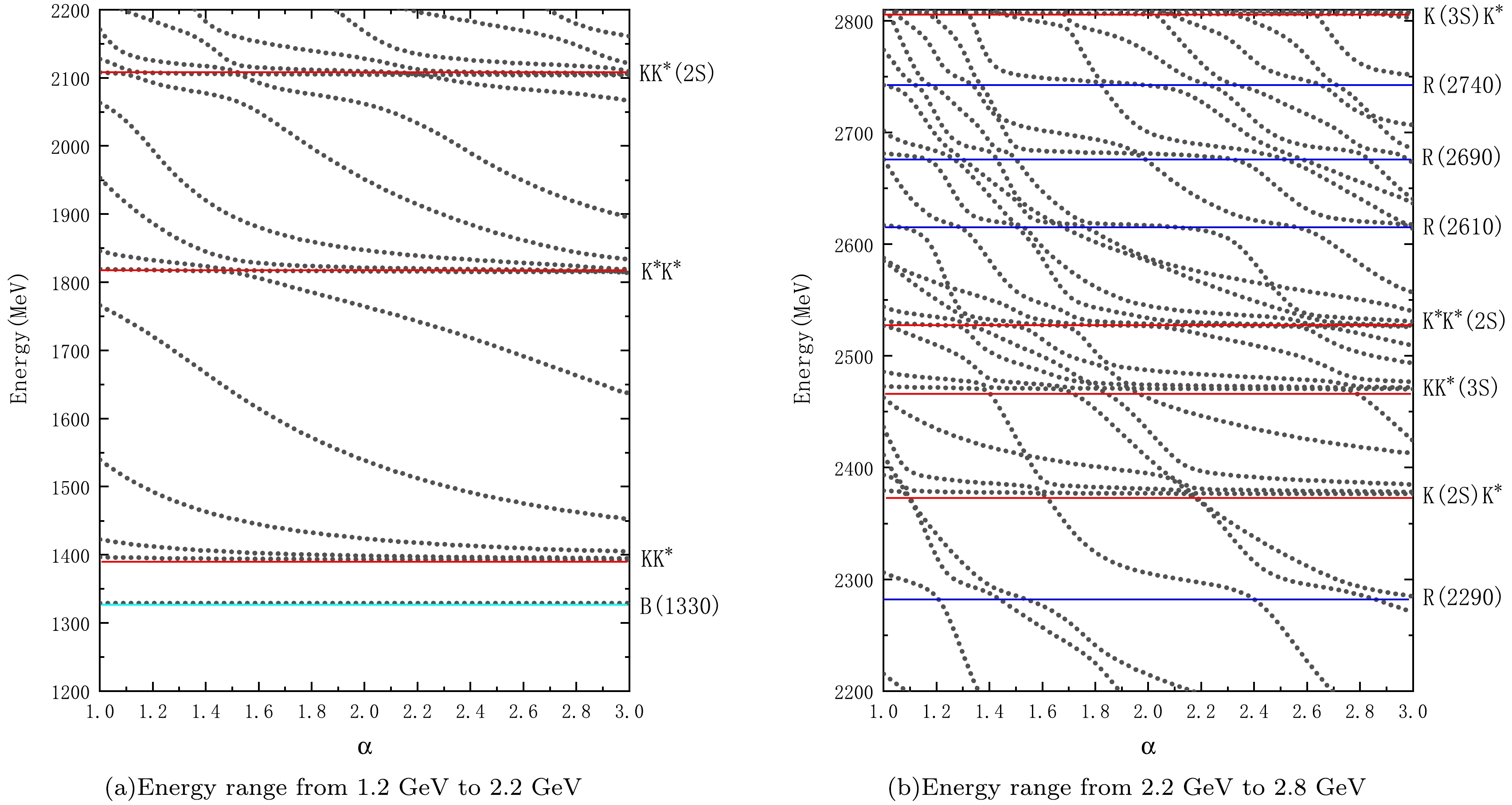
Figure 2.(color online) Energy spectrum of theTsssystem obtained from the real-scaling method.
state width KK* $ [K]_8[K^{*}]_8 $ 

K*K* [K*]8[K*]8 $ [ss]_3^1[\bar{q}\bar{q}]_{\bar{3}}^0 $ 

$ [ss]_6^0[\bar{q}\bar{q}]_{\bar{6}}^1 $ 

$ r_{s\bar{s}} $ 

$ r_{s\bar{q}} $ 

$ r_{\bar{q}\bar{q}} $ 

R(2290) 10.2 17.2% 8.0% 9.8% 36.4% 5.8% 22.4% 1.1 1.2 1.4 R(2620) 5.3 19.6% 24.8% 0.9% 36.3% 15.0% 3.2% 1.2 1.4 1.5 R(2680) 5.8 5.4% 25.5% 15.1% 28.9% 7.3% 17.6% 1.2 1.3 1.4 R(2740) 1.9 7.4% 14.5% 1.6% 35.1% 0.3% 40.1% 0.9 1.0 1.2 Table 6.Decay widths of the resonance states, main components of the resonance states (unit: MeV), and root-mean-square distances (unit: fm) in the
$ ss\bar{q}\bar{q} $ system. -
In the framework of the chiral quark model, we systematically investigated the bound states and resonances of theTss(
$ s\bar{q}s\bar{q} $ with 01+) system. Using the method of Gaussian expansion, we considered four physical channels,KK*andK*K*, and their corresponding color octets,$ [K]_8[K^{*}]_8 $ and [K*]8[K*]8, in the molecular structure, as well as two physical channels,$ [ss]_6^0[\bar{q}\bar{q}]_{\bar{6}}^1 $ and$ [ss]_3^1[\bar{q}\bar{q}]_{\bar{3}}^0 $ , in the diquark structure, and performed coupled-channel calculations for these two structures.The bound state calculations reveal a deeply bound state,B(1330), withKK*as its primary component. We hypothesize that the main decay width of this bound state arises from the decay process
$ K^{*} \rightarrow K + \pi $ . Thus, using the3P0model, we calculated the decay width ofK*to be 20 MeV. However, the binding energy ofB(1330), approximately 60 MeV, directly affects the decay phase space ofK*. By distributing this binding energy equally betweenK*andK, we estimated that the energy ofK*should be reduced by approximately 30 MeV during the decay process. Consequently, the decay width of the bound stateB(1330) in theTsssystem is estimated to be 17 MeV. Subsequently, we employed the real-scaling method to calculate the resonances. These results indicate that we obtained four resonances,R(2290),R(2610),R(2690), andR(2740), primarily composed of colorful structure components. Their decay widths are all within 10 MeV, and the internal quark distances are around 1 fm.Given the current interest inTcc, with much attention focused on its heavy-flavor partner, there is limited research on the light-flavor partner ofTcc. Therefore, we suggest that related experiments must be conducted to search for the predicted bound states and resonances in theTsssystem.
Dynamical study ofTsssystems using the chiral quark model
- Received Date:2024-06-14
- Available Online:2025-01-15
Abstract:Since the discovery ofTccby LHCb, there has been considerable interest inTccand its heavy-flavor partners. However, the study of its strange partnerTsshas been largely overlooked. Within the framework of the chiral quark model, we conducted a systematic study of the bound states ofTssbased on the Gaussian Expansion Method. We considered all physical channels with 01+, including molecular and diquark structures. Moreover, by considering the coupling between diquarks and molecular states, our calculations allowed us to identify a deep bound state with a bounding energy of 60 MeV primarily composed ofKK*. Using the3P0model, we calculated the decay width ofK*within theKK*bound state, which is approximated as the decay width of the bound state in theTsssystem. These results indicate that, owing to the effect of binding energy, the decay width ofK*inKK*is approximately 3 MeV smaller than that ofK*in vacuum. Additionally, resonance state calculations were performed. We used the real-scaling method to search for possible resonance states in theTsssysytem. Because of the strong attraction in the [K*]8[K*]8configuration, four resonance states were found in the vicinity of 2.2−2.8 GeV, predominantly featuring hidden-color structures. The decay widths of these states are less than 10 MeV. We strongly recommend experimental efforts to search for the resonance states in theTsssystem predicted by our calculations.


 DownLoad: