


 Abstract
 HTML
HTML Reference
 Related
 PDF
PDF


-
The study of one-step and two-step transfer of nucleons and clusters in nuclear reactions may answer the question of the existence of multi-neutron systems, which is an important problem in nuclear physics. The problem of the existence of light neutron clusters (dineutron, tetraneutron,etc.) is over 60 years old, but it is still of interest for both theoretical and experimental studies [1−5]. A recent paper [6] reported that the observation of a resonance structure near the threshold for the formation of a four-neutron system corresponds to a quasi-bound tetraneutron cluster that manifests itself in the8He+p→4He+p+4nreaction and lives for a very short time.
Concerning the problem of studying light neutron clusters, a dineutron is of great interest. The dineutron can be formed near the surface of neutron-rich nuclei [7]. The first attempt to observe an unstable dineutron,i.e., a system of two neutrons in the singlet state, was made by V. K. Voitovetskiiet al. in reaction2H(n,p)2natEn= 14 MeV from the spectrum of the protons [8]. In Ref. [9], the authors studied the decay of the16Ве nucleus and obtained results that show the dineutron nature of the decay with a small angle of emission between two neutrons. The measured two-neutron separation energy for16Ве was 1.35 MeV, which is consistent with calculations in the shell model. However, in these calculations, the authors did not take into account the interaction between the emitted neutrons, which can also explain the observed correlations of the emission angles of the two neutrons [10].
Two-neutron transfer reactions are a unique tool for studying the interaction between neutrons and confirming the existence of the dineutron clusters that manifest themselves during the interaction of two nuclei [11−15]. The difficulty in interpreting experimental data is that such reactions can proceed as both one-step and two-step neutron transfer processes, which cannot be separated experimentally [16]. In Ref. [17], the authors showed that the product nuclei are formed as a result of one-step transfer of two neutrons and that the contribution of this process is especially significant when low-lying excited states are populated in the formed nuclei. Thus, to describe experimental data, it is extremely important to take into account the probabilities of both one-step and two-step neutron transfer [18].
In the elastic scattering of6He nuclei on4He [19−22] and4He on6Li [23], an increase in the cross-section at backward angles was observed. The authors interpreted this increase as the existence of the dineutron cluster in the6Не nucleus and the deuteron cluster in the6Li nucleus. However, the optical model of elastic scattering could not describe this effect, while the calculation of the corresponding transfer cross-sections for dineutron and deuteron clusters within the framework of the distorted wave Born approximation (DWBA) method fully explained this behavior as the contribution of the channel of the transfer of a two-nucleon cluster.
Another interesting experimental result was obtained in Ref. [24] for the6He+65Cu reaction at a beam energy of 22.6 MeV: the cross-section for the two-neutron transfer was found to be larger than that for one-neutron transfer. Thus, the authors concluded that “the dineutron configuration of6He plays a dominant role in the reaction mechanism.”
Concerning the9Be nucleus, it was revealed that the dineutron cluster manifests itself in the reaction channel9Be(3He,7Be)5He [25,26]. The9Be(3He,6He)6Be reaction channel observed at forward angles corresponds to the transfer of three neutrons. The calculations reported in [25] within the framework of the coupled reaction channels (CRC) method showed that the two-step transfer mechanisms (n-2nand2n-n) make a significant contribution to the cross-section, which is also an indirect evidence of the transfer of the dineutron cluster.
The present study is a part of our systematic studies of nucleon and cluster transfer in reactions with various projectiles on9Be:d+9Be [27] and3He+9Be [25,26]. Here, we studied reaction channels with the weakly bound projectile nucleus6Li. The aim was to elucidate the manifestation of the cluster structure of9Be in the studied reaction channels. In particular, we focused on the reaction channel9Be(6Li,8Li)7Be to estimate whether a one-step or two-step transfer is the most probable mechanism of the transfer of two neutrons.
Section II provides a detailed description of the conducted experiment. Section III presents experimental cross-sections and their comparative analysis. Sections IV and V are devoted to the theoretical method employed to analyze the experimental data. Sections VI and VII present the results of the theoretical analysis of the experimental data.
-
The experiment was performed at the Flerov Laboratory of Nuclear Reactions, Joint Institute for Nuclear Research, Dubna. An intense6Li beam with an energy of 68 MeV was accelerated by the U-400 cyclotron and transported to the reaction chamber (Fig. 1) of the high-resolution magnetic analyzer MAVR [28].
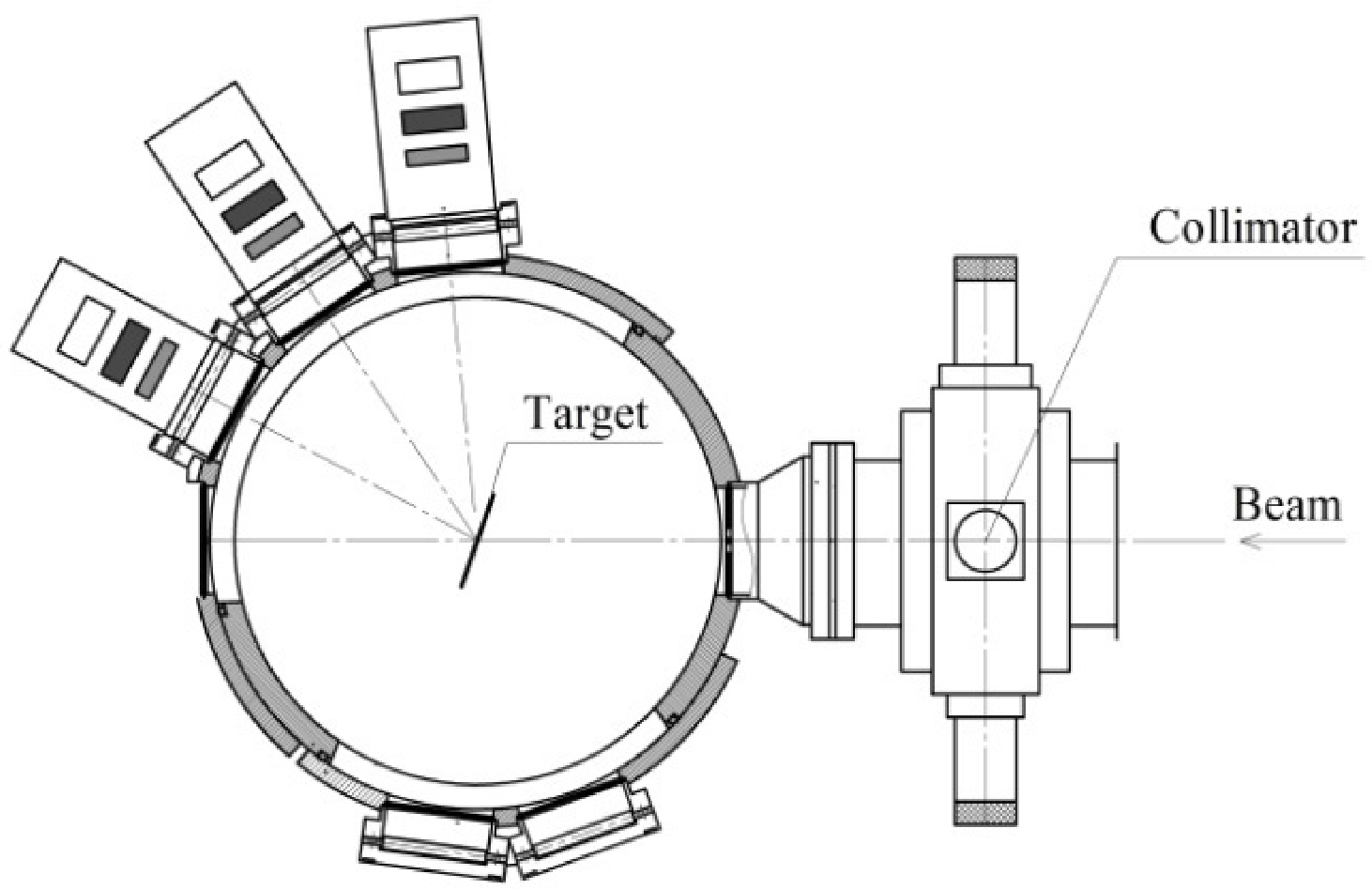
Figure 1.Reaction chamber with the9Be foil target and three three-layer semiconductor telescopes (∆E1, ∆Е2,ER).
The beam profile was formed by the magnetic optics of the U-400 cyclotron supplemented by a system of diaphragms. The beam size was controlled by the profilometer installed in front of the reaction chamber; on a target, it was 5 mm × 5 mm at an intensity of 30 nA. The total number of particles passing through the target was determined by a Faraday cup and also monitored by elastic scattering.
The beam was focused onto the self-supporting 5-µm thick9Be foil. The target purity was higher than 99%; a possible admixture of carbon and oxygen isotopes in the target material was not observed in the measured energy spectra.
Particle identification was done by measuring energy losses and residual energy in detectors (∆E-Emethod). For this purpose, three three-layer semiconductor telescopes were used, the first two thin detectors of which measured specific energy losses ∆E1, ∆Е2(Fig. 1). Their thickness was 50 and 300 µm, respectively. The third detectorERwas 3.2-mm thick and measured the residual energy of the reaction products after they passed through the first two detectors. The configuration of such telescopes made it possible to reliably identify reaction products from helium to boron isotopes in a wide energy range. Examples of identification matrices obtained by one of the telescopes used in the experiments are shown inFig. 2. It can be seen that the reaction products were unambiguously identified.
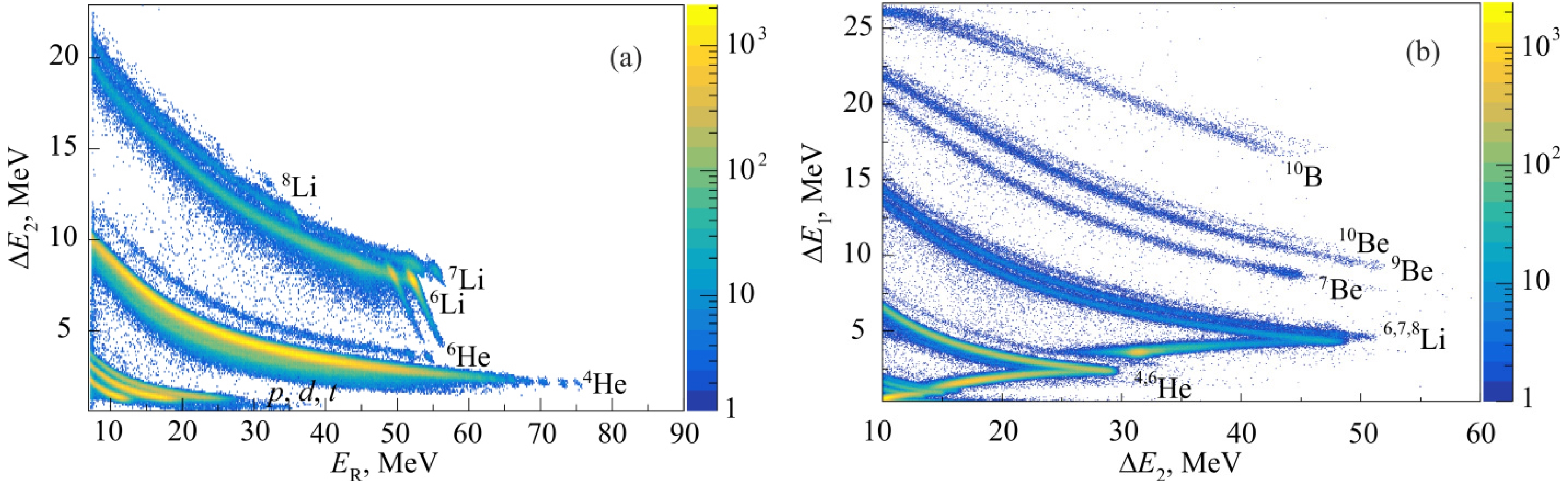
Figure 2.(color online) Examples of identification matrices obtained by one of the telescopes: (a) ∆E2- ∆ERat an angle ofθlab= 16° and (b) ∆E1-∆E2atθlab= 12°.
To measure the energy spectra and angular distributions of the nuclei emitted in the reaction, we used an inclusive method. The energy resolution of the detecting system was determined by the energy resolution of the6Li beam and errors in measuring the energy losses of particles in the target material. In the case of registration of particles withZ= 1‒3, the energy resolution was ≈ 500 keV; for particles withZ= 4‒5, it was ≈ 1 MeV.
The excitation energy spectra corresponding to the energy of the states of the9Be,8Be,7Be, and8Li nuclei are shown inFigs. 3and4. The populated ground and first excited states are indicated. Note that the width of each peak of a state in the spectra was determined by three factors: natural width, instrument resolution of the spectrometer, and energy spread. Events corresponding to multibody exit channels make insignificant contributions to these peaks. The excited states of the complementary products corresponding to the two-body exit channels can be observed in the resulting energy spectra. The complementary products are as follows:
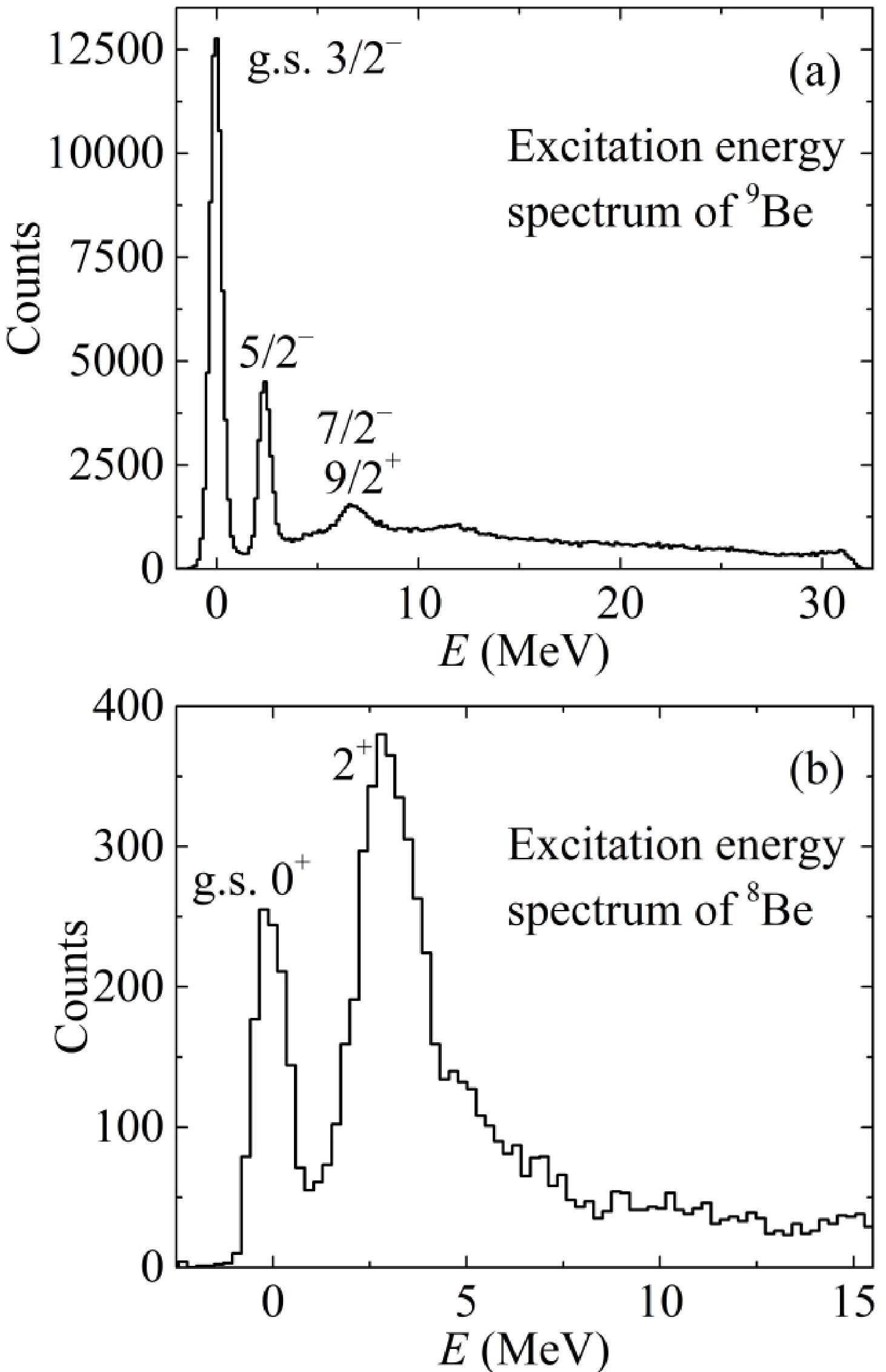
Figure 3.Excitation energy spectra for (a)9Be in the case of detection of6Li at an angle ofθlab= 16° and (b)8Be in the case of detection of7Li atθlab= 14°.
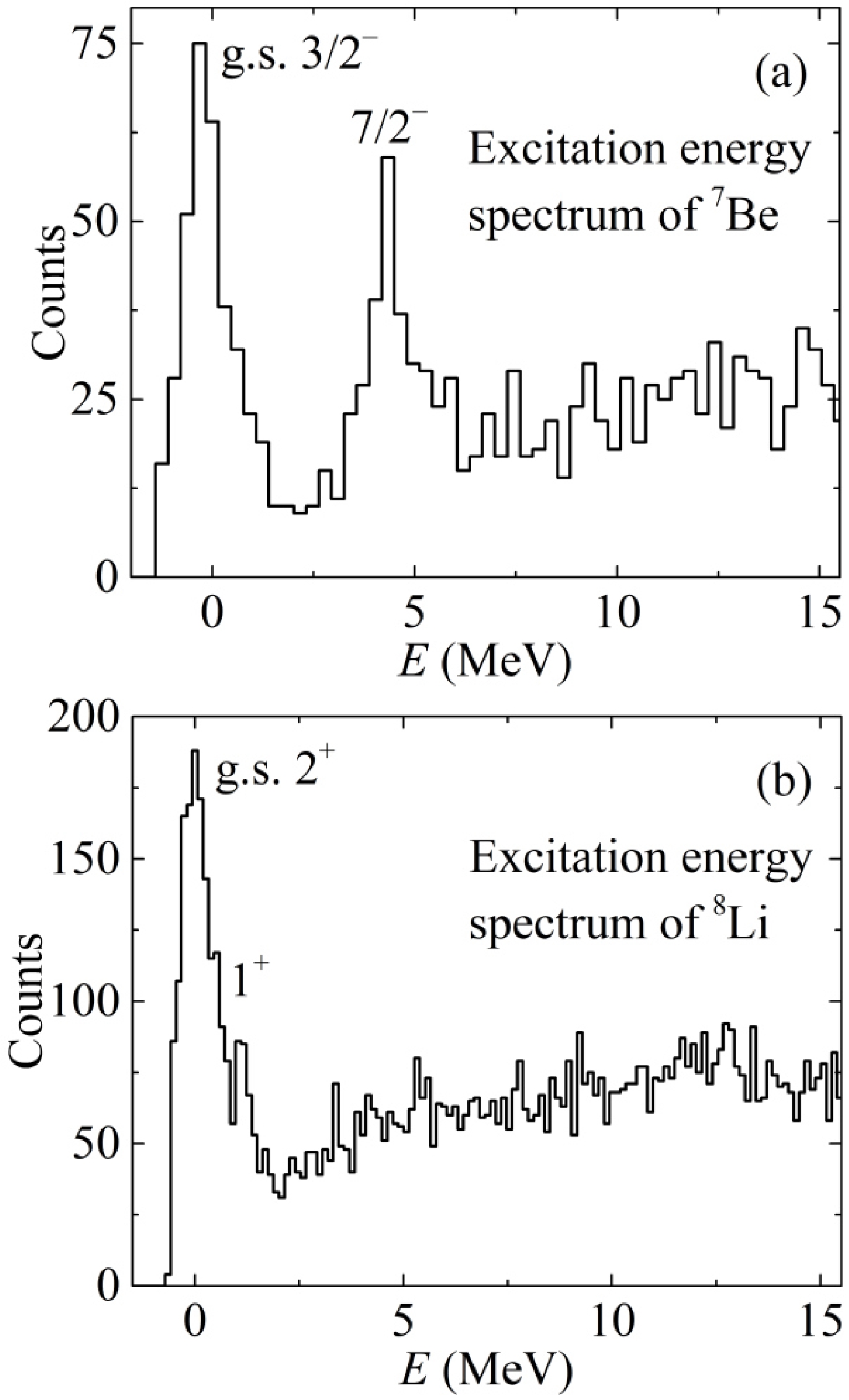
Figure 4.Excitation energy spectra for (a)7Be in the case of detection of8Li at an angle ofθlab= 12° and (b)8Li in the case of detection of7Be atθlab= 16°.
–9Ве in the reaction channel9Be(6Li,6Li)9Be (in the case of detection of6Li [Fig. 3(a)]);
–8Ве in the reaction channel9Be(6Li,7Li)8Be (in the case of detection of7Li [Fig. 3(b)]);
–7Ве in the reaction channel9Be(6Li,8Li)7Be (in the case of detection of8Li) [Fig. 4(a)];
–8Li in the reaction channel9Be(6Li,7Be)8Li (in the case of detection of7Be [Fig. 4(b)]).
The narrow peak at 2.43 MeV inFig. 3(a) is the first excited rotational level 5/2–of the9Be nucleus. The next wide peak corresponds to overlapping of two excited levels (7/2–, 6.38 MeV) and (9/2+, 6.76 MeV) of9Be. The narrow peak at 3.03 MeV inFig. 3(b) is the first excited rotational level 2+of the8Be nucleus. For the9Be and8Be nuclei, the first rotational levels 5/2–and 2+are populated with large probabilities. The single-particle excited levels of the9Be nucleus are not observed because of the small neutron separation threshold (Table 1). For the7Be nucleus [Fig. 4(a)], the first low-lying single-particle excited level (1/2–, 0.43 MeV) is not separated from the ground state peak, and the second single-particle excited level (7/2–, 4.57 MeV) is observed. Other single-particle excited levels of the7Be nucleus are not observed because they are above the proton separation threshold (Table 1) and are populated with low probability. For the8Li nucleus [Fig. 4(b)], the first low-lying single-particle excited level (1+, 0.98 MeV) is situated near the ground state peak. Other single-particle excited levels of the8Li nucleus are not observed because they are above the neutron separation threshold (Table 1) and are populated with low probability.
Nucleus Alpha particle α /MeV Protonp/MeV Neutronn/MeV 8Li 6.1 12.4 2.03 7Be 1.59 5.6 10.7 8Be –0.092 17.3 18.9 9Be 2.46 16.9 1.66 Table 1.Particle separation energies for the8Li and7,8,9Be nuclei.
-
Differential cross-sections for each angle were obtained by considering solid angles of the telescopes, the thickness of the target, and the number of particles incident on the target. The experimental setup made it possible to measure the energy spectra of the reaction products in the range of angles 10°–83° in the laboratory system; the error in measuring the angle was ±1°. Angles greater than 83° could not be measured because of the design features of the scattering chamber. The measured angular distributions of the products of the reaction6Li+9Be at an energy of 68 MeV are presented inFigs. 5,6. The relative error in cross-section measurements is not larger than 20%. This error is predominantly due to the following factors: statistical errors in counting events, errors in target thickness determination, inaccuracies in solid angle values, and errors in beam intensity measurements.
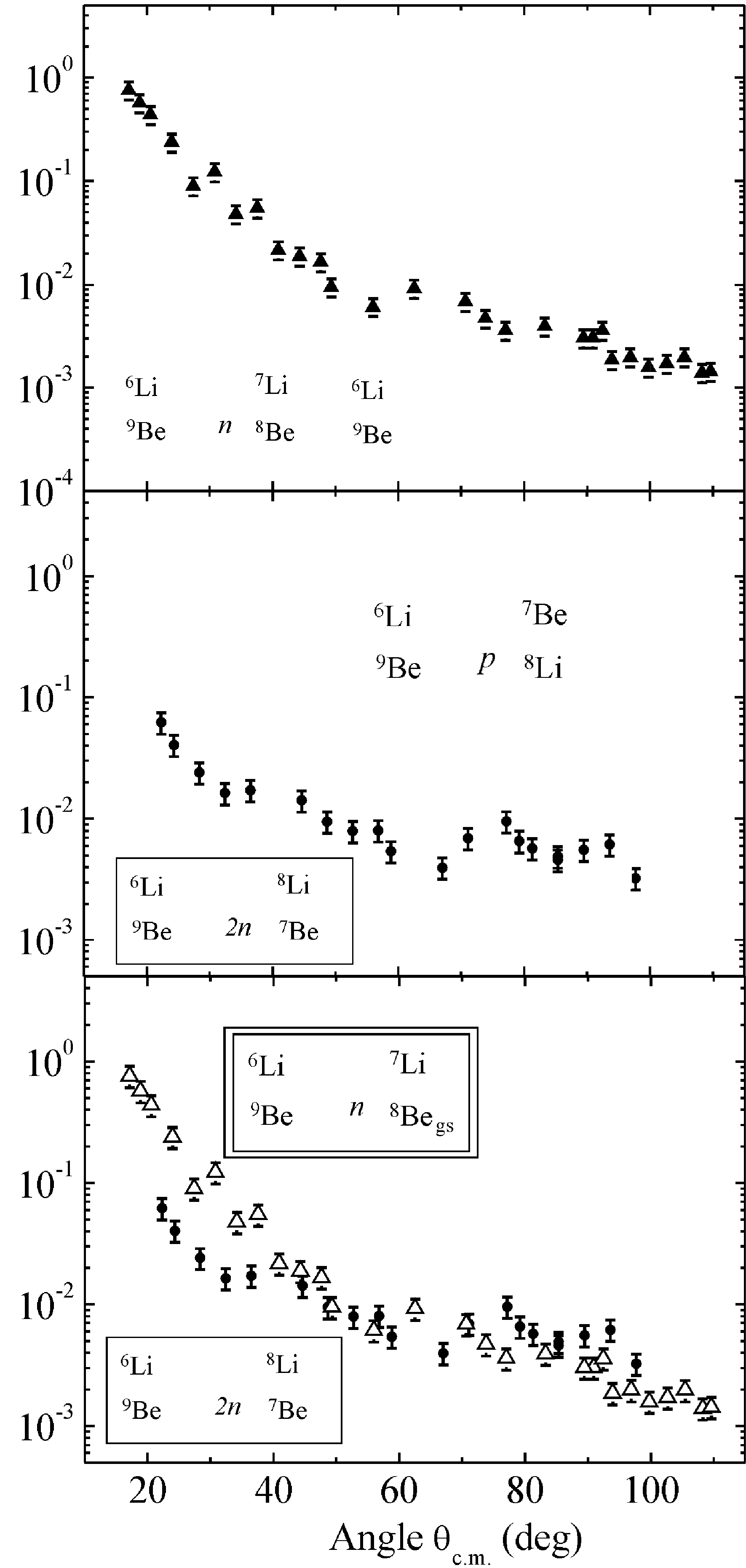
Figure 5.Experimental angular distributions for the products of the6Li+9Be reaction at 68 MeV: (a)7Li in exit channels7Li+8Begs(triangles) and7Li+8Be2+(circles); (b)8Li (circles) and7Be (triangles) in exit channels8Ligs+7Begs,1/2–and7Begs+8Ligs,1+, respectively; (c)7Li in exit channel7Li+8Begs(empty triangles) and8Li (circles) in exit channel8Ligs+7Begs,1/2–.The transfer mechanisms are shown in insets.
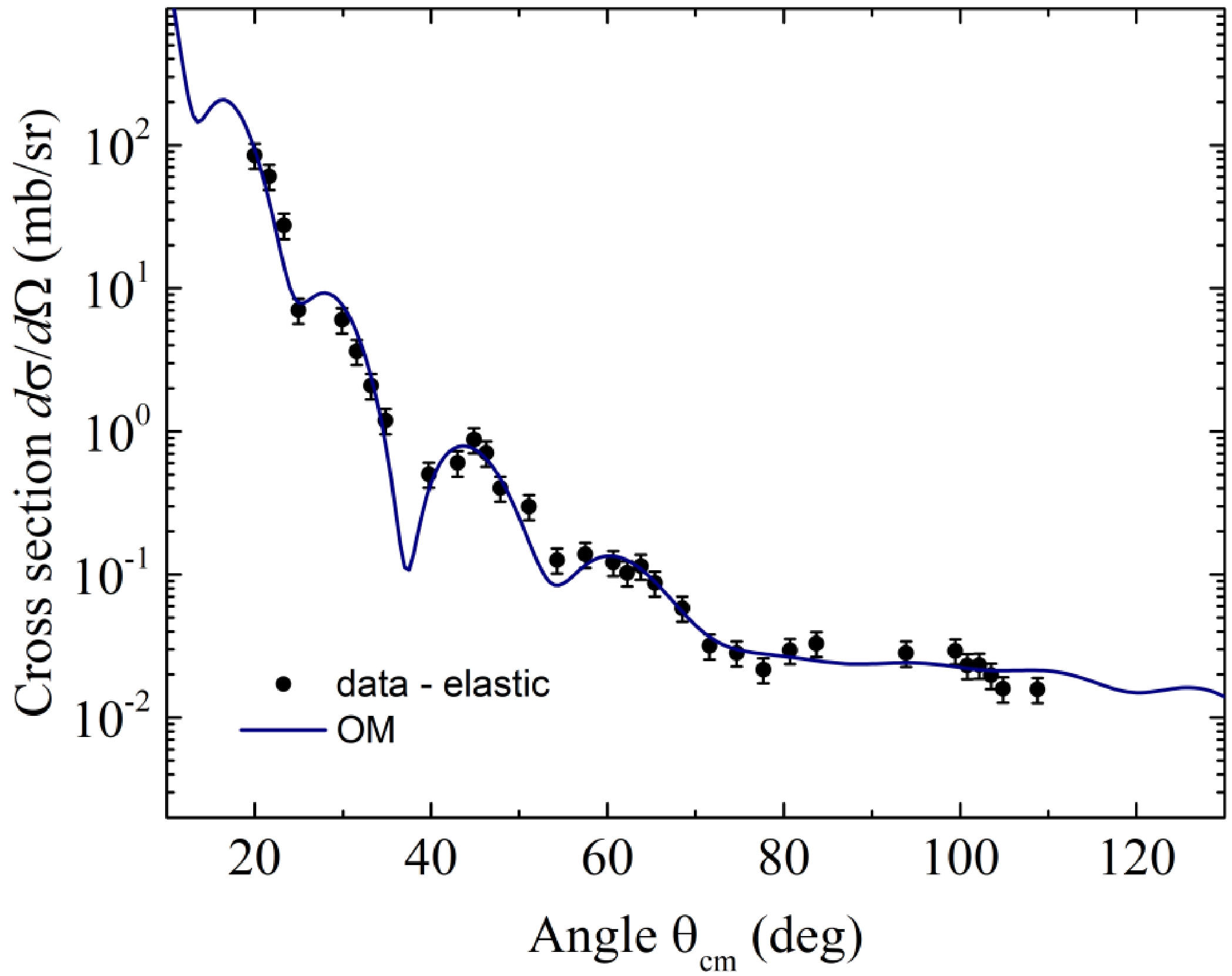
Figure 6.(color online) Angular distributions for the elastic scattering channel9Be(6Li,6Li)9Be: experimental data (circles) and results of calculations (curves).
The relatively high cross-sections for the transfer of one neutronnfrom the weakly bound target nucleus9Be [Fig. 5(a)] can be explained by the manifestation of its cluster structure (α+n+α) [27]. The differential cross-sections for the transfer of two neutrons in the reaction channel9Be(6Li,8Li)7Be have comparable values with those for the reaction channels of the transfer of one neutron,9Be(6Li,7Li)8Begsand9Be(6Li,7Li)8Be2+. As can be seen fromFig. 5(c), the ratio σ1n/σ2nfor the reaction channels9Be(6Li,7Li)8Begsand9Be(6Li,8Li)7Be at forward angles is approximately equal to 10 and smoothly decreases with increasing angle to ~ 1.
-
Experimental differential cross-sections for elastic scattering of6Li on the9Be nucleus are presented inFig. 6. The experimental data were analyzed within the optical model using the Fresco code [29,30]. The optical potential used in the calculations is expressed as
$ U\left( r \right) = - {V_{\text{V}}}f(r;{R_{\text{V}}},{a_{\text{V}}}) - {\rm i}{V_{\text{W}}}f(r;{R_{\text{W}}},{a_{\text{W}}}) + {V_{\text{C}}}\left( r \right) , $

(1) with the Woods-Saxon form-factors for both the real and imaginary parts expressed as
$ f(r;{R_{{\text{V,W}}}},{a_{{\text{V,W}}}}) = {\left\{ {1 + \exp \left[ {{{\left( {r - {R_{{\text{V,W}}}}} \right)} \mathord{\left/ {\vphantom {{\left( {r - {R_{{\text{V,W}}}}} \right)} {{a_{{\text{V,W}}}}}}} \right. } {{a_{{\text{V,W}}}}}}} \right]} \right\}^{ - 1}} , $

(2) where
$ {R_{{\text{V,W}}}} = {r_{{\text{V,W}}}}\left( {A_{\text{p}}^{1/3} + A_{\text{t}}^{1/3}} \right) , $

(3) VVandVWare the depth parameters for the real and imaginary parts of the optical potential, respectively;rV,WandaV,Ware geometric parameters;ApandAtare the mass numbers of the projectile and target nuclei, respectively;VC(r) is the Coulomb potential of a uniformly charged sphere with radius
$ {R}_{\text{С}}={r}_{\text{С}}\left({A}_{\text{p}}^{1/3}+{A}_{\text{t}}^{1/3}\right) . $

(4) In our calculations, we setrC= 0.717 fm.
The theoretical elastic scattering cross-section was fitted to the measured experimental data within the optical model using the SFresco code [30]. As a starting point for seeking the optical potential in our calculations, we used the parameters for the elastic scattering of6Li+9Be at an energy of 50 MeV [31]. All six parameters, namely, depthsVV,Wand geometric parametersrV,W,aV,W, were varied. It can be seen that we achieved an excellent fit (χ2/N=1.418) of the experimental data (Fig. 6). The parameters of the potential expressed by Eq. (1) are listed inTable 2.
VV/MeV rV/fm aV/fm VW/MeV rW/fm aW/fm 152.20 0.698 0.624 12.36 1.388 0.930 Table 2.Parameters of the optical potential (1) for elastic scattering.
-
Theoretical analysis of the cross-sections for the transfer channels was performed using the DWBA method [32,33] and the Fresco code [29,30]. We calculated the one-step transfer using the prior formalism of the DWBA amplitude. For the two-step transfer of two neutrons, we used the second-order DWBA; a prior-post combination was chosen to avoid non-orthogonality terms [30,32,33]. According the DWBA formalism, the main ingredients required for calculations are the internal wave functions
$ \left( {{\phi _A},{\phi _b}} \right) $ ,$ \left( {{\phi _a},{\phi _B}} \right) $ for the nuclei in the transfer reactionA+b→a+B(A=a+x, B=b+x). The wave function for nucleusBwith total spinJand spin projectionMcan be expressed as [30,32,33]$ \phi _B^{JM}\left( {\xi ,r} \right) = {\sum\limits_{Ilj} {A_{lsj}^{IJ}\left[ {\phi _b^I\left( \xi \right) \otimes {\varphi _{lsj}}\left( r \right)} \right]} _{JM}} , $

(5) where coefficients
$ A_{lsj}^{IJ} $ are the so-called coefficients of fractional parentage (CFP) or spectroscopic amplitudes, and their square moduli$ S_{lsj}^{IJ} = {\left| {A_{lsj}^{IJ}} \right|^2} $ are the spectroscopic factors [30,32,33]. These factors can be interpreted as a probability of finding the nucleon or clusterxin a single-particle state with quantum numbersl,s,jbound to coreaorbwith spinI[32]. Below, we denote the spectroscopic amplitude asAx, wherexis the nucleon or cluster with all its quantum numbers. All spectroscopic amplitudesAxused in our calculations (Table 3) were taken from the shell model calculations reported in [13,25,34−37].AorB aorb x nlj Ax 7Li 6Li n 1p3/2 –0.735 7Li0.477 6Li n 1p3/2 0.329 8Li 6Li 2n 1d2 –0.667 8Li 7Li n 1p3/2 –0.478 7Be 6Li p 1p3/2 –0.735 7Be0.429 6Li p 1p3/2 –1.740 8Be 7Be n 1p3/2 –1.234 8Be3.03 7Be n 1p3/2 0.771 8Be3.03 7Be0.429 n 1p3/2 −0.655 9Be 8Li p 1p1/2 –0.375 9Be 8Be n 1p3/2 0.866 9Be 7Be 2n 2s0 0.247 The wave functions of the bound states of the nucleons and dineutron clustersxin the target and projectile nuclei were obtained using the Woods-Saxon potential. The potential depths were adjusted to reproduce the experimental binding energies of the nucleons and clusters [38], while the parametersaandr0were fixed:a= 0.65 fm andr0= 1.25A1/3fm [13,25,39].
We adjusted only the potential parameters for the exit channels [40] while keeping the parameters for the entrance and intermediate channels as well as the spectroscopic amplitudes.
-
Experimental differential cross-sections for the9Be(6Li,7Li)8Вegsand9Be(6Li,7Li)8Вe3.03channels in comparison with the DWBA calculations are shown inFig. 7. For these reaction channels, we detected the7Li nucleus, and the8Be product was considered complementary to the detected one.
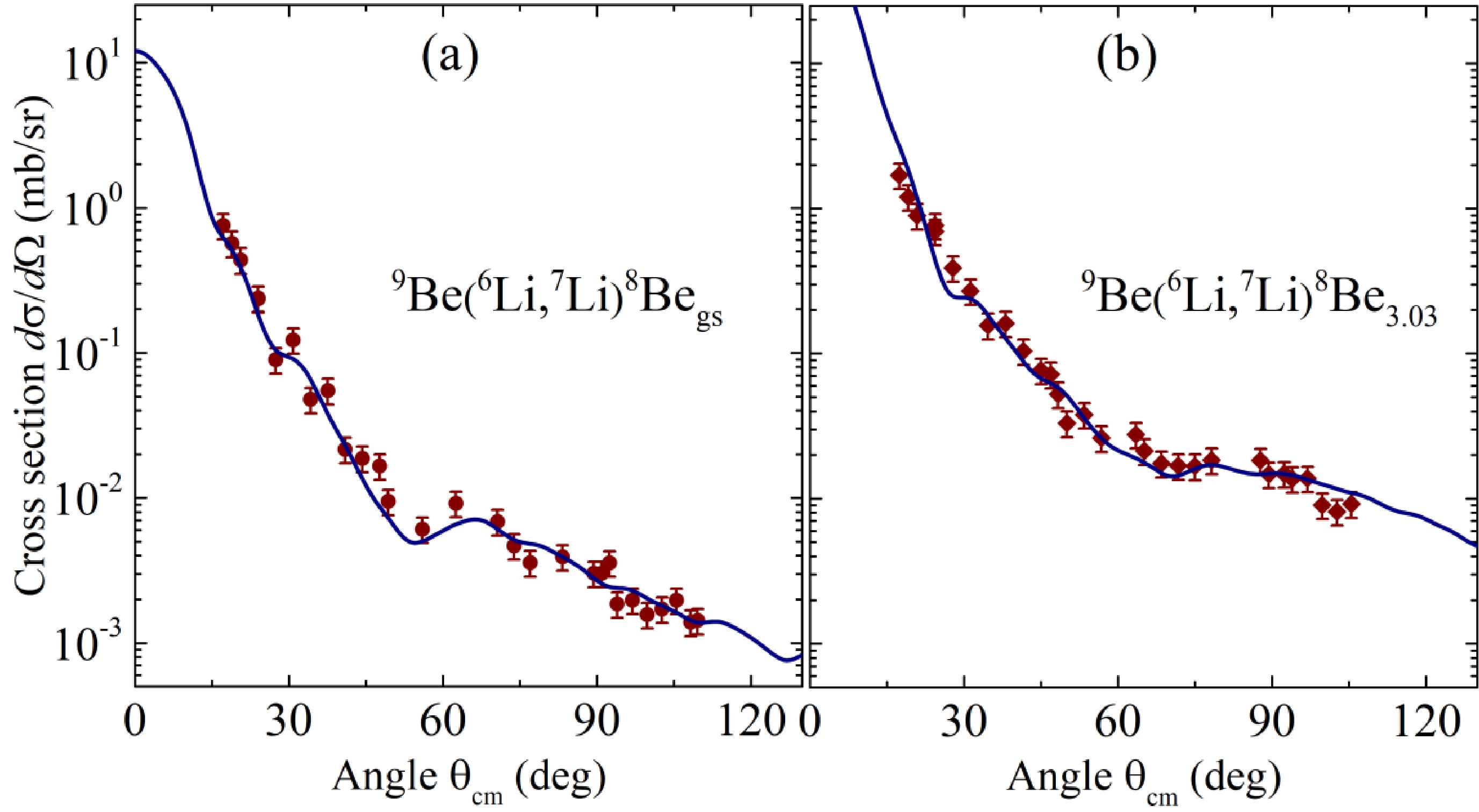
Figure 7.(color online) Experimental angular distributions for the neutron transfer channels (a)9Be(6Li,7Li)8Вegsand (b)9Be(6Li,7Li)8Вe3.03(symbols) in comparison with the calculation results (curves).
The potential parameters describing the elastic scattering of6Li+9Be (Table 2) were used for the entrance channel. For the7Li+8Begsexit channel, we also used a potential in the Woods-Saxon form with the parameters obtained by fitting the calculation results to the experimental data on the angular distributions. The parameters recommended in [41] were used as initial parameters in the fitting procedure.
The parameters of the real part of the potential for the7Li+8Begsexit channel were the same as those for the7Li+8Be3.03exit channel. However, owing to the fact that the values of the cross-sections for the9Be(6Li,7Li)8Вe3.03reaction channel are higher, we reduced the depth parameterVWof the imaginary part for the7Li+8Be3.03exit channel. To better reproduce the shape of the experimental angular distributions, we fitted the radius parameterrWof the imaginary part. As a result, an increased value of the radius parameterrWwas obtained for the7Li+8Be3.03exit channel. Note that our DWBA calculations reproduce the experimental data well (Fig. 7). The obtained parameters of the optical potential are listed inTable 4.
Reaction channel VV/MeV rV/fm aV/fm VW/MeV rW/fm aW/fm rC/fm 7Li+8Be 152.20 0.669 0.853 30.50 1.008 0.809 0.677 7Li+8Be3.03 152.20 0.669 0.853 12.36 1.388 0.809 0.677 Table 4.Parameters of the optical potential (1) obtained for the specified exit channels.
-
Similar to the9Be(6Li,7Li)8Be reaction channel, calculations were carried out for the9Be(6Li,7Be)8Li reaction channel, in which the proton transfer occurs from the target nucleus to the projectile nucleus, leading to the exit channel7Be+8Li. The spectroscopic amplitudes of the transferred proton used for the configurations6Li+pand8Li+pare listed inTable 3. The wave functions of the protons in the nuclei7Be =6Li+pand9Be =8Li+pwere calculated by varying the depth of the Woods–Saxon potential to reproduce the binding energy exactly in the same manner as described in the previous section. It is worth mentioning that the binding energy of the protonpin the9Ве nucleus is 16.9 MeV, which is comparable to the binding energy of two neutrons2nin the9Ве nucleus, 20.6 MeV.
The parameters of the Woods-Saxon potential for the7Be+8Ligsand7Be+8Li0.98exit channels (Table 5) were obtained by fitting the calculation results to the experimental angular distribution at fixed potential parameters for the entrance channel (6Li+9Be,Table 2). The parameters reported in [42] were used as initial parameters in the fitting process.
Reaction channel VV/MeV rV/fm aV/fm VW/MeV rW/fm aW/fm rC/fm 7Be+8Ligs 125.50 0.657 0.853 12.25 0.888 0.809 0.664 7Be+8Li0.98 115.04 0.657 0.853 12.36 0.888 0.809 0.664 Table 5.Parameters of the optical potential (1) obtained for the specified exit channels.
The measured energy spectrum of7Вe for the9Be(6Li,7Вe)8Li reaction channel is shown inFig. 4(b). Because of the relatively low energy resolution, the low-lying excited state of8Li (1+, 0.98 MeV) is practically not resolved from the ground state. The results of the DWBA calculations for the transfer of a proton in the reaction channels9Be(6Li,7Вe)8Ligs,0.98are shown inFig. 8. They are fairly close to the experimental angular distribution of the7Вe nucleus. The solid blue curve inFig. 8represents an incoherent sum of the cross-sections for the ground state and the first excited state 0.98 of8Li. The significant contribution of the reaction channel9Be(6Li,7Вe)8Li0.98in the incoherent sum of the cross-sections is consistent with the measured energy spectrum of7Be shown inFig. 4(b).
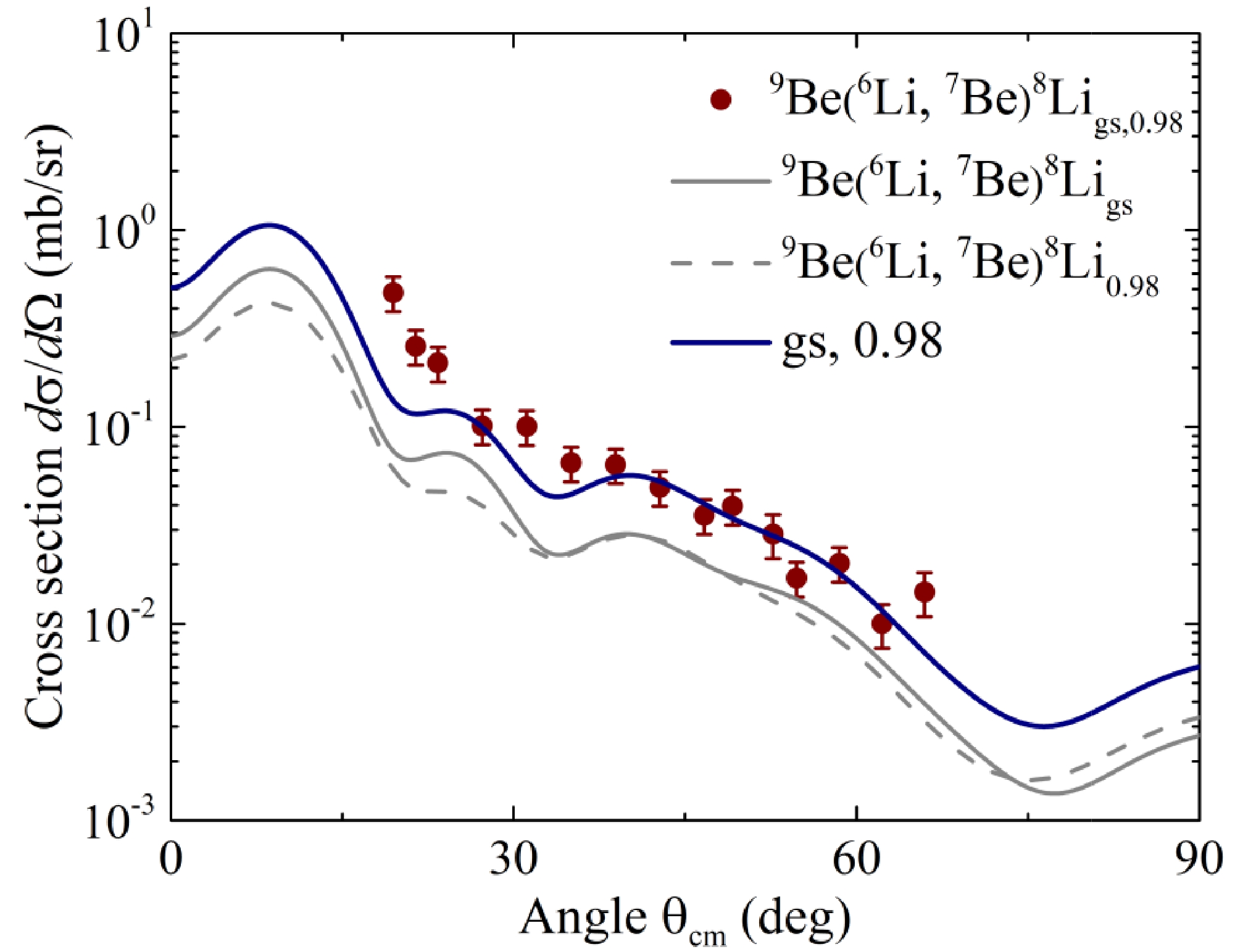
Figure 8.(color online) Experimental angular distribution of the reaction channels9Be(6Li,7Вe)8Ligs,0.98(circles) in comparison with the calculation results (curves).
The values of the experimental differential cross-sections at forward angles (three points atθcm=19.5°−23.4°) could not be described by the theoretical curve; this may be due to the presence of a contribution from the inelastic excitation of the6Li projectile [43]. Nevertheless, the shape of the theoretical curve in this angular range is close to that of the experimental data.
A similar discrepancy between DWBA calculations and experimental data was observed in [43,44]. This can be solved by adjusting the values of the spectroscopic amplitudes or reducing the imaginary part of the exit channel potential. However, in such a case, we would lose the overall agreement of the DWBA calculations with the experimental points. This fact indicates the need for more complex calculations that take into account inelastic excitations of the nuclei in the studied channels; this will be addressed in a future theoretical study.
The proton transfer, inverted with respect to the scattering angle, serves as an alternative to the two-neutron transfer mechanisms in the9Be(6Li,8Li)7Be reaction channel [45]. Therefore, we included it in the calculations shown inFig. 9. The one-step mechanism corresponds to the transfer of a di-neutron cluster2nor a protonp, while the two-step mechanism corresponds to the two-step transfer of two neutronsn-n.

Figure 9.(color online) Reaction mechanisms considered in the calculations.
We used the same potential parameters fromTable 5for the7Be+8Ligsand8Ligs+7Be exit channels. The potential parameters obtained in Sections IV and V were used for the entrance channel (6Li+9Be,Table 2) and for the intermediate channels (7Li+8Begsand7Li+8Be3.03in the calculations for then-ntransfer,Table 4). The potential parameters for the exit channel8Li+7Be0.429were obtained by fitting the cross-section to reproduce the experimental data. As a starting point for seeking the potential, we used the parameters for the exit channel7Li+8Begs(Table 4). The resulting parameters were as follows:VV= 155 MeV,rV= 0.669 fm,aV=0.853 fm,VW= 19.25 MeV,rW= 1.388 fm, andaW= 0.780 fm.
The spectroscopic amplitudesAxfor the nucleons and dineutron clusters included in the calculations are listed inTable 3. The higher value ofAx= 0.667 for the configuration8Li=6Li+2ncompared toAx= 0.478 for the configuration8Li=7Li+nmay favor dineutron in the cluster transfer mechanism (i.e., one-step transfer of two neutrons) compared to the two-step mechanism of neutron transfer.
The differential cross-section for the9Be(6Li,8Li)7Be reaction channel has the form of a coherent sum of two amplitudes,
$ \frac{{{d}\sigma }}{{{d}\Omega }}\left( {{\theta _{{\text{cm}}}}} \right) = {\left| {{f_{\text{I}}}\left( {{\theta _{{\text{cm}}}}} \right) + {f_{{\text{II}}}}\left( {{\theta _{{\text{cm}}}}} \right)} \right|^2} , $

(6) where
${f_{\text{I}}}\left( {{\theta_{{\text{cm}}}}} \right)$ and${f_{{\text{II}}}}\left( {{\theta_{{\text{cm}}}}} \right)$ are the amplitudes of the one-step and two-step transfer mechanisms, respectively [29,30]:$ {f_{\text{I}}}\left( {{\theta_{{\text{cm}}}}} \right) = {f_{2n}}\left( {{\theta_{{\text{cm}}}}} \right) + {f_p}\left( {{\text{π }} - {\theta_{{\text{cm}}}}} \right),{f_{{\text{II}}}}\left( {{\theta_{{\text{cm}}}}} \right) = {f_{n - n}}\left( {{\theta_{{\text{cm}}}}} \right), $

(7) ${f_{2n}}\left( {{\theta_{{\text{cm}}}}} \right)$ and${f_p}\left( {\pi - {\theta_{{\text{cm}}}}} \right)$ are the amplitudes of the one-step transfer of two neutrons and proton, respectively;${f_{n - n}}\left( {{\theta_{{\text{cm}}}}} \right)$ is the amplitude of the two-step transfer of two neutrons. The experimental angular distribution of the8Li nucleus for the reaction channel9Be(6Li,8Li)7Вe in comparison with the calculation results is shown inFig. 10(a). InFig. 10(b), the DWBA calculations for each mechanism considered in the coherent sum [Eq. (6)] are presented separately: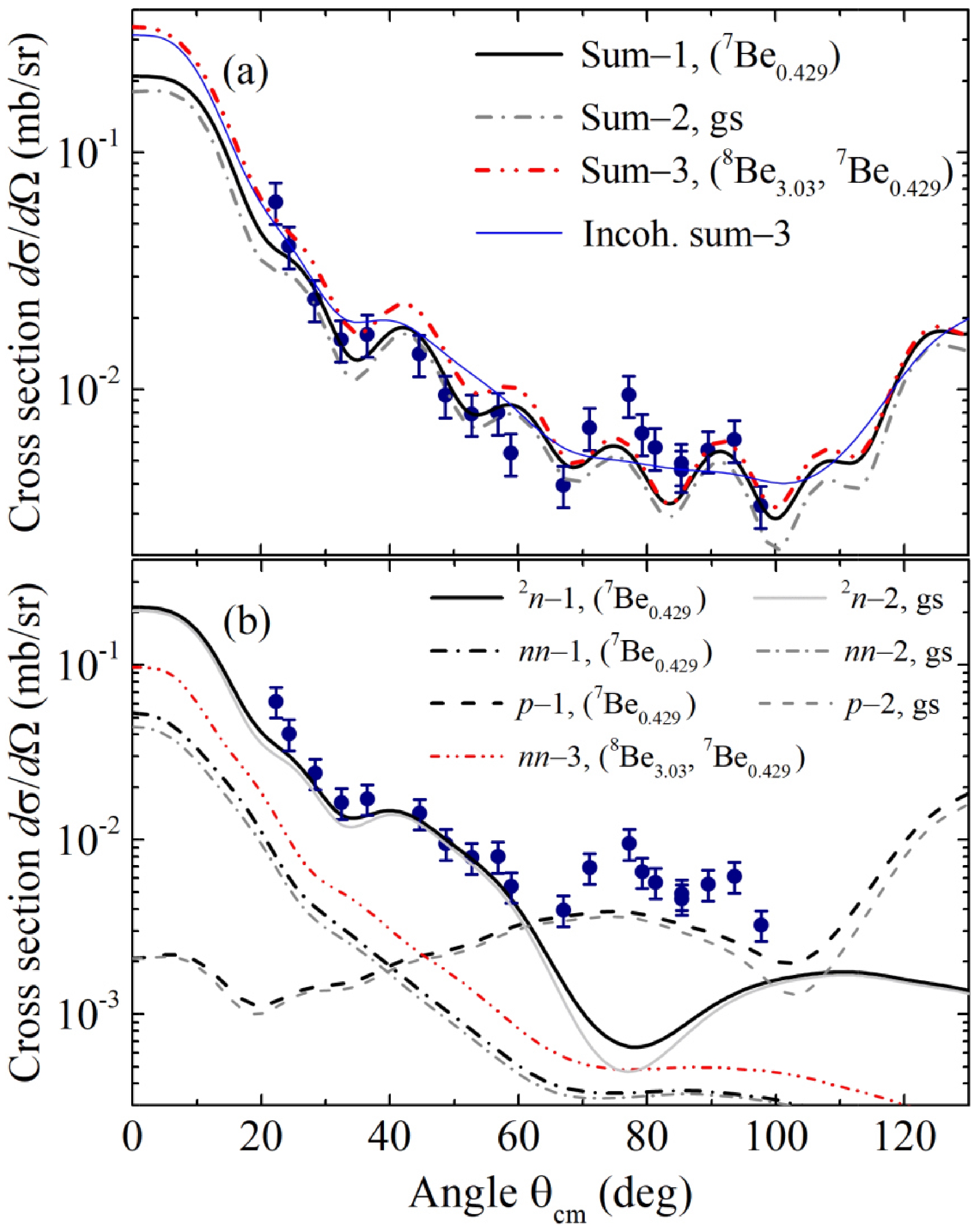
Figure 10.(color online) Experimental angular distribution of the8Li nucleus for the nucleon transfer channels9Be(6Li,8Li)7Вegs,0.429(circles) in comparison with the calculation results. The curves are the results of calculations including the excited states given in parentheses. (a) Sums of reaction mechanisms. (b) Contributions of nucleon and cluster transfer mechanisms taken into account in the calculations.
– for one-step transfer:
●6Li+9Be →8Ligs+7Begs,0.429(2n–1 curve) – dineutrosn transfer included in the Sum-1 curve;
●6Li+9Be →8Ligs+7Begs(2n–2 curve) – dineutron transfer included in the Sum-2 curve;
●6Li+9Be →7Begs,0.429+8Ligs(p–1 curve) – proton transfer included in the Sum-1 curve;
●6Li+9Be →7Begs+8Ligs(p–2 curve) – proton transfer included in the Sum-2 curve;
– for two-stepn-ntransfer:
●6Li+9Be →7Ligs+8Begs→7Begs,0.429+8Ligs(nn–1 curve) included in the Sum-1 curve;
●6Li+9Be →7Ligs+8Begs→7Begs+8Ligs(nn–2 curve) included in the Sum-2 curve;
●6Li+9Be →7Ligs+8Begs,3.03→7Begs,0.429+8Ligs(nn–3 curve) included in the Sum-3 curve.
The angular distributions of the9Be(6Li,8Li)7Вegs,0.429reaction channels inFig. 10(a) have oscillations. These oscillations indicate the interference of the transfer mechanisms presented inFig. 9. The dineutron transfer makes a relatively large contribution at forward angles, while in the range of angles 60°–130°, the proton transfer dominates [Fig. 10(b)]. The contribution of two-step neutron transfer is negligible in the entire range of angles, which is consistent with the results of [13,18,46,47].
Similar oscillations due to the interference of two-neutron and α-transfer mechanisms in the reaction14C(16O,18O)12C were obtained in [45]. The incoherent sum yields a smoother angular distribution [45,47], as shown by the thin solid curve inFig. 10(a). It can be assumed that the characteristic features of two-neutron transfer reactions are the domination of the one-step transfer of two neutrons and the interference of the transfer mechanisms [18,46,48,49].
Note that the8Be3.03state in the intermediate channel of the two-step neutron transfer provides a better description of the experimental points in the region ofθcm=20°−30°; simultaneously, the calculated cross-sections in the region ofθcm=45°−70° are slightly overestimated [Fig. 10(a)]. The excitation of the8Be3.03state in the intermediate channel does not have a strong effect on the calculation results for the9Be(6Li,8Li)7Вe reaction channel. The same results were obtained in [13] for9Be(7Be,9Be)7Be.
The contribution of the9Be(6Li,8Li)7Be0.429channel is insignificant, which is consistent with the excitation energy spectrum of the7Be nucleus [Fig. 4(a)]. However, taking into account the excitation of7Be0.429in the exit channel improves the theoretical description of the cross-sections [Fig. 10(a)]. Note that if we exclude all excitations from the calculations, the experimental differential-cross sections will be underestimated, for example, in the regions of anglesθcm=0−25° andθcm=70°−85°, which indicates the importance of considering excitations of nuclei in the reaction.
Typically, the structure of the8Li nucleus is considered in the two-body7Li+nor three-body α+n+ttheoretical models [50,51]. The9Be nucleus is usually represented as a system of two α-clusters and a neutron located with a high probability between them, i.e., α+n+α [52-54]. However, the large contribution of the dineutron transfer to the cross-sections [Fig. 10(b)] suggests that the8Li and9Be nuclei can manifest configurations corresponding to the two-body structures6Li+2nand7Be+2n, respectively. The contribution of the dineutron transfer mechanism in the range of angles 0–60° is approximately five times higher than the contribution of the mechanism of two-step transfer of two neutrons [46].
-
The energy and angular distributions for the9Be(6Li,6Li)9Be,9Be(6Li,7Li)8Be,9Be(6Li,8Li)7Be, and9Be(6Li,7Be)8Li channels in the6Li+9Be reaction at an energy of 68 MeV were measured. The energy distributions of the detected nuclei reproduce the population scheme of the ground and low-lying excited states of complementary nuclei, which confirms the two-body nature of the reaction exit channels considered in this study.
The parameters of the Woods-Saxon optical potential were determined from the analysis of the experimental data on elastic scattering of6Li+9Be. The consideration of elastic scattering as well as the one- and two-step transfer reaction mechanisms led to good agreement with the experimental data on the9Be(6Li,8Li)7Be reaction channel. It was also shown that the dineutron transfer2nmakes a larger contribution to the cross-sections of the9Be(6Li,8Li)7Be reaction channel at forward angles compared to proton transfer and two-step transfer of two neutrons. The proton transfer makes a contribution comparable to the dineutron transfer in the range of anglesθcm=60°−130°. The contribution of two-step transfer of two neutrons is negligible in the entire range of angles. The oscillations in the angular distribution for the9Be(6Li,8Li)7Вe reaction channel indicate the interference of the transfer mechanisms. The large contribution of the dineutron transfer to the cross-sections suggests that the8Li and9Be nuclei can manifest configurations corresponding to the two-body structures6Li+2nand7Be+2n, respectively.
Study of one-step and two-step neutron transfer in the reaction6Li +9Be
- Received Date:2024-05-07
- Available Online:2024-11-15
Abstract:This paper presents the results of experiments conducted to measure the cross-sections for elastic scattering and nucleon transfer channels in the6Li+9Be reaction at an incident energy of 68 MeV:9Be(6Li,6Li)9Be,9Be(6Li,7Li)8Be,9Be(6Li,7Li)8Be2+,9Be(6Li,8Li)7Be, and9Be(6Li,7Be)8Li. The objective of the study is to elucidate the manifestation of the cluster structure of9Be. Theoretical analysis of the contributions of the one-step and two-step neutron transfer mechanisms is performed using the distorted wave Born approximation method with the Fresco code. Good agreement between the calculations and the experimental data is obtained for the channels of elastic scattering9Be(6Li,6Li)9Be, neutron9Be(6Li,7Li)8Be, and proton transfer9Be(6Li,7Be)8Li, as well as for the transfer of two neutrons9Be(6Li,8Li)7Be. The dineutron cluster transfer mechanism makes a dominant contribution to the9Be(6Li,8Li)7Be reaction channel at forward angles.


 DownLoad: