


 Abstract
 HTML
HTML Reference
 Related
 PDF
PDF




-
Theρ-meson leading-twist longitudinal distribution amplitude (DA) is a key input parameter when investigating related exclusive processes including theρmeson. Charmed semileptonic decay processes can provide a clear platform for researching theρ-meson DA. In charmed factories, the BESIII collaboration reported new results for the semileptonic decay
$ D^0\to \rho^-\mu^+\nu_\mu $ in 2021 [1]. In 2019, the BESIII collaboration provided improved measurements of$ D\to\rho e^+\nu_e $ [2]. The CLEO collaboration provided measurements of the form factors in the decays$ D^{0/+}\to \rho^{-/0}e^+\nu_e $ in 2013 [3], and their previous measurements can be found in [4,5]. It is known that transition form factors (TFFs) are key components of semileptonic$ D \to \rho \ell^+ \nu_\ell $ decays in the standard model. Therefore, accurate TFFs are very important for theoretical groups and experimental collaborations. Theoretically, the$ D\to\rho $ TFFs can be treated using different approaches, such as the 3-point sum rule (3PSR) [6], heavy quark effective field theory (HQEFT) [7,8], relativistic harmonic oscillator potential model (RHOPM) [9], quark model (QM) [10,11], light-front quark model (LFQM) [12,13], light-cone sum rule (LCSR) [14−16], covariant confined quark model (CCQM) [17], heavy meson and chiral symmetry theory (HMχT) [18], and lattice QCD (LQCD) [19,20]. The LCSR approach is based on operator production expansion near the light-cone, and all the non-perturbative dynamics are parameterized into light-cone DAs (LCDAs), which is suitable for calculating the heavy to light transition. In this study, we take the LCSR approach to calculate the$ D\to\rho $ TFFs with a left-handed current1 . Thus, the key task is obtaining an accurateρ-meson longitudinal twist-2 DA.Theoretically, theρ-meson longitudinal leading-twist DA can be studied using various methods, such as QCD sum rules (SRs) [21−26], LQCD [27−30], the AdS/QCD holographic method [31−34], extraction from experimental data [35−38], the light-front quark model (LFQM) [39,40], Dyson-Schwinger equations (DSEs) [41], large momentum effective theory (LMET) [42], instanton vacuum [43,44], and other models [45,46]. The QCDSR in the framework of background field theory (BFT) is an effective approach in calculating light and heavy meson DAs [47]. In early 2016, we preliminarily studied theρ-meson longitudinal leading-twist DA [48], in which the first two order nonzeroξ-moments and Gegenbauer moments were obtained, and the behavior of
$ \phi_{2;\rho}^\|(x,\mu) $ described by the light-cone harmonic oscillator (LCHO) model was determined [49].In 2021, we proposed a new research scheme for the QCDSR study on pionic leading-twist DAs, in which a new SR formula forξ-moments was proposed after considering that the SR for the zerothξ-moment cannot be normalized in the entire Borel region [50]. It enabled us to calculate more higher-orderξ-moments. Furthermore, the behavior of the pion DA
$ \phi_{2;\pi}(x,\mu) $ could be determined by fitting sufficientξ-moments with the least squares method. Subsequently, this scheme was used to study pseudoscalar$ \eta^{(\prime)} $ -meson and kaon leading-twist DAs [51,52] andD-meson twist-2,3 DAs [53], axial vector$ a_1(1260) $ -meson twist-2 longitudinal DAs [54], and scalar$ a_0(980) $ and$ K_0^\ast(1430) $ -meson leading-twist DAs [55,56]. Inspired by this, we restudy theρ-meson leading-twist longitudinal DA$ \phi_{2;\rho}^\|(x,\mu) $ by adopting the research scheme proposed in Ref. [50].The remainder of this paper are organized as follows. In Sec. II, we present the calculations for theξ-moments of theρ-meson leading-twist DA, the
$ D\to \rho $ TFFs, and the semileptonic decays$ D\to\rho\ell^+\nu_\ell $ . In Sec. III, we present the numerical results and discussions on theξ-moments,$ D\to \rho $ TFFs, and$ D\to \rho\ell^+\nu_\ell $ decay widths and branching ratios. Section IV is contains a summary. -
To derive the sum rules ofρ-meson leading-twist longitudinal DAξ-moments, we adopt the following correlation function (also known as the correlator):
$ \begin{aligned}[b] \Pi(z,q) &= {\rm i}\int {\rm d}^4x {\rm e}^{{\rm i}q\cdot x} \langle 0 | T\{J_n(x) J_0^\dagger(0) \} |0\rangle \\ &= (z\cdot q)^{n+2} I(q^2), \end{aligned} $

(1) where the current
$J_n(x) = \bar{d} {\not {z}} ({\rm i}z\cdot {\mathop D\limits^ \leftrightarrow})^n u(x) $ with$ z^2 = 0 $ . After taking the standard QCDSR calculation procedure within the framework of BFT [50], we obtain an expression for$ \langle\xi^n\rangle_{2;\rho}^\| \times \langle\xi^0\rangle_{2;\rho}^\| $ ,$ \begin{aligned}[b] & \frac{\langle\xi^n\rangle_{2;\rho}^\| \langle\xi^0\rangle_{2;\rho}^\| f_\rho^2}{M^2 {\rm e}^{m_\rho^2/M^2}} \\ =\;& \frac{3}{4\pi^2} \frac{1}{(n+1)(n+3)} (1 - {\rm e}^{-s_\rho/M^2}) + \frac{(m_d + m_u) \langle\bar{q}q\rangle}{(M^2)^2} \\ &+ \frac{\langle\alpha_s G^2\rangle}{(M^2)^2} \frac{1 + n\theta(n-2)}{12\pi(n+1)} - \frac{(m_d + m_u) \langle g_s\bar{q}\sigma TGq\rangle}{(M^2)^3} \frac{8n+1}{18} \\ &+ \frac{\langle g_s\bar{q}q \rangle^2}{(M^2)^3} \frac{4(2n+1)}{81} - \frac{\langle g_s^3fG^3\rangle}{(M^2)^3} \frac{n\theta(n-2)}{48\pi^2} + \frac{\langle g_s^2\bar{q}q\rangle^2}{(M^2)^2} \frac{2+\kappa^2}{486\pi^2} \\ &\times \Big\{ -2(51n+25) \Big( -\ln \frac{M^2}{\mu^2} \Big) + 3(17n+35) + \theta(n-2) \\ &\times \Big[ 2n\Big( -\ln \frac{M^2}{\mu^2} \Big) + \frac{49n^2 + 100n + 56}{n} - 25(2n+1) \\ &\times \Big[ \psi \Big( \frac{n+1}{2} \Big) - \psi \Big( \frac{n}{2} \Big) + \ln 4 \Big] \Big] \Big\}, \end{aligned} $

(2) where
$ m_\rho $ and$ f_\rho $ are theρ-meson mass and decay constant, respectively,$ s_\rho $ is the continuum threshold,$ m_u $ and$ m_d $ are the current quark masses of theuanddquarks, respectively,Mis the Borel parameter,$ \langle\bar{q}q\rangle $ with$ q = u (d) $ is the double-quark condensate,$ \langle\alpha_sG^2\rangle $ is the double-gluon condensate,$ \langle g_s\bar{q}\sigma TGq\rangle $ is the quark-gluon mix condensate,$ \langle g_s^3fG^3\rangle $ is the triple-gluon condensate, and$ \langle g_s\bar{q}q \rangle^2 $ and$ \langle g_s^2\bar{q}q \rangle^2 $ are the four-quark condensates, respectively. In addition,$ \kappa = \langle\bar{s}s\rangle / \langle\bar{q}q\rangle $ with the doublesquark condensate$ \langle\bar{s}s\rangle $ . By taking$ n = 0 $ for Eq. (2), the SR of the zeroth-orderξ-moment$ \langle\xi^0\rangle_{2;\rho}^\| $ can be obtained as$ \begin{aligned}[b] \frac{(\langle\xi^0\rangle_{2;\rho}^\|)^2 f_\rho^2}{M^2 {\rm e}^{m_\rho^2/M^2}} =\;& \frac{1}{4\pi^2} (1 - {\rm e}^{-s_\rho/M^2}) + (m_d + m_u) \frac{\langle\bar{q}q\rangle}{(M^2)^2} \\ &+ \frac{\langle\alpha_s G^2\rangle}{(M^2)^2} \frac{1}{12\pi} - \frac{1}{18} (m_d + m_u) \frac{\langle g_s\bar{q}\sigma TGq\rangle}{(M^2)^3} \\ &+ \frac{4}{81} \frac{\langle g_s\bar{q}q \rangle^2}{(M^2)^3} + \frac{\langle g_s^2\bar{q}q\rangle^2}{(M^2)^2} \frac{2+\kappa^2}{486\pi^2} \\ &\times \Big[ -50 \Big( -\ln \frac{M^2}{\mu^2} \Big) + 105 \Big]. \end{aligned} $

(3) Eq. (3) indicates that the zeroth-orderξ-moment
$ \langle\xi^0\rangle_{2;\rho}^{\|} $ in Eq. (2) cannot be normalized in the entire Borel parameter region. The main reason for this is because the contributions from vacuum condensates larger than dimension-six are truncated normally. As discussed in Ref. [50], a more accurate and reasonable SR for thenth-orderξ-moment$ \langle\xi^n\rangle_{2;\rho}^\| $ should be$ \langle\xi^n\rangle_{2;\rho}^\| = \frac{\langle\xi^n\rangle_{2;\rho}^\| \times \langle\xi^0\rangle_{2;\rho}^\| |_{\rm From\ Eq.\; (2)}}{\sqrt{(\langle\xi^0\rangle_{2;\rho}^\|)^2} |_{\rm From\ Eq.\; (3)}} . $

(4) However, to describe the behavior of theρ-meson leading-twist longitudinal DA, we take the following DSE model for
$ \phi_{2;\rho}^\parallel(x,\mu) $ [57,58]:$ \begin{array}{*{20}{l}} \phi_{2;\rho}^\parallel(x,\mu) = \mathcal{N} [x(1-x)]^{\alpha_-} \Big[ 1 + \hat{a}_2 C_2^\alpha(2x-1) \Big], \end{array} $

(5) where
$ \alpha_- = \alpha - 1/2 $ , and$ \mathcal{N} = 4^\alpha \Gamma(\alpha + 1) / [\sqrt{\pi} \Gamma(\alpha + 1/2)] $ is the normalization constant. In this notation, the Gegenbauer polynomial series is considered the most accurate form for describing the meson DA. Unfortunately, one cannot obtain all Gegenbauer moments in principle. Therefore, a truncated form of the Gegenbauer polynomial series (TF model) is typically used to approximately describe the behavior of the meson DA in the literature. However, the TF model is not an ideal model for describing the behavior of meson DAs, because it truncates at the lowest Gegenbauer coefficient. In fact, the DSE model is still a truncated form of the Gegenbauer polynomial series. The difference between these two models is that the DSE model is based on the$ {C_n^\alpha} $ -basis, whereas the TF model is based on the$ {C_n^{3/2}} $ -basis. In addition, the factor$ [x(1-x)]^{\alpha_-} $ in the DSE model can adjust and compensate for the impact caused by truncation to a certain extent. Another advantage of the DSE model is that, as mentioned in Ref. [58], it can reduce the introduced spurious oscillations.Next, to obtain the
$ D\to\rho $ TFFs, we can take the following correlation function:$ \begin{aligned}[b] \Pi_\mu(p,q) =\;& {\rm i}\int {\rm d}^4x {\rm e}^{{\rm i}q\cdot x} \\ & \times \langle\rho (\tilde p,\tilde\epsilon)|{\rm T} \big\{\bar q_1(x)\gamma_\mu(1-\gamma_5)c(x), j_D^{L\dagger} (0)\big\} |0\rangle, \end{aligned} $

(6) where
$j_D^{L} (x)= {\rm i} \bar q_2(x)(1 - \gamma_5)c(x)$ is the left-handed current. As we know, there are fifteen DAs for a vector meson up to twist-4 accuracy, and the left-handed chiral current can reduce the uncertainties from chiral-odd vector meson DAs with$ \delta^{0,2} $ -order and leave the chiral-even with a$ \delta^{1,3} $ -order meson. The relationships are listed inTable 1. In this table, except$ j_D^{L} (x) $ , the current$ j_D^{R} (x) $ respects the right-handed current with the expression$j_D^{R} (x)= {\rm i} \bar q_2(x) \times (1 + \gamma_5)c(x)$ , as researched in our previous study [15]. The parameter$ \delta \simeq m_\rho/m_c\sim 52\ $ % [59,60]. Meanwhile, the chiral current approach has been considered in other studies [61−66], which improves the predictions of the LCSR approach.twist-2 twist-3 twist-4 $ \delta^0 $ 

$ \phi_{2;\rho}^\bot $ 

$ j_D^{L} (x) $ 

$ \delta^2 $ 

$ \phi_{3;\rho}^\|, \psi_{3;\rho}^\|, \Phi_{3;\rho}^\bot $ 

$ \phi_{4;\rho}^\bot,\psi_{4;\rho}^\bot,\Psi_{4;\rho}^\bot, \widetilde{\Psi} _{4;\rho}^\bot $ 

$ \delta^1 $ 

$ \phi_{2;\rho}^\| $ 

$ \phi_{3;\rho}^\bot, \psi_{3;\rho}^\bot, \Phi_{3;\rho}^\|,\tilde\Phi_{3;\rho }^\bot $ 

$ j_D^{R} (x) $ 

$ \delta^3 $ 

$ \phi_{4;\rho}^\|,\psi_{4;\rho}^\| $ 

Table 1.ρ-meson DAs with different twist-structures up to
$ \delta^3 $ , where$ \delta \simeq m_\rho/m_c $ .Based on the procedures of the LCSR approach, we obtain the expressions of the
$ D\to \rho $ TFFs$ A_{1,2}(q^2) $ and$ V(q^2) $ LCSRs with the left-handed current in the correlator. The analytic formulas are similar to the$ B\to\rho $ TFFs of our previous study [45], which replace the input parameter of theB-meson with aD-meson, such as$ m_B\to m_D $ ,$ f_B \to f_D $ ,$ m_b \to m_c $ . The detailed expressions can be written as follows:$ \begin{aligned}[b] A_1(q^2) =\;&\frac{2m_c^2 m_\rho f_\rho ^\|}{m_D^2 f_D (m_D + m_\rho)} {\rm e}^{m_D^2/M^2} \bigg\{ \int_0^1\frac{{\rm d}u}{u}{\rm e}^{-s(u)/M^2} \\ &\times \left[ \Theta(c(u,s_0))\phi_{3;\rho}^\bot(u) - \frac{m_\rho^2}{u M^2}\widetilde\Theta(c(u,s_0)) C_\rho^\|(u) \right] \\ & - m_\rho^2\int {\mathcal D} \underline\alpha\int {\rm d}v\, {\rm e}^{-s(X) /M^2} \frac{1}{X^2 M^2} \,\Theta(c(X,s_0)) \\ &\times \left[\Phi_{3;\rho}^\|(\underline \alpha ) + {\widetilde \Phi}_{3;\rho}^\|(\underline \alpha )\right] \bigg\},\\[-15pt] \end{aligned} $

(7) $ \begin{aligned}[b] A_2(q^2) =\;& \frac{m_c^2 \, m_\rho \, (m_D \,+\, m_\rho )\,f_\rho^\| }{m_D^2 f_D }\; {\rm e}^{m_D^2/M^2}\; \bigg\{\,2\, \int_0^1\, \frac{{\rm d} u}{u} \\ &\times {\rm e}^{- s(u)/M^2}\; \,\bigg[\,\frac{1}{uM^2}\; \widetilde\Theta(c(u,s_0))\, A_\rho^\|(u) \,+\; \frac{m_\rho^2}{u M^4} \\ &\times\widetilde{\widetilde\Theta}(c(u,s_0)) C_\rho^\|(u)+ \frac{m_b^2 m_\rho^2}{4u^4M^6} \widetilde{\widetilde{\widetilde\Theta}}(c(u,s_0)) B_\rho^\|(u) \bigg] \\ & + m_\rho^2\int {\cal D} \underline\alpha \int{{\rm d}v} {\rm e}^{ - s(X)/M^2} \, \frac{1}{X^3 M^4}\,\Theta(c(X,s_0)) \\ & \times [\Phi_{3;\rho}(\widetilde {\underline \alpha }) + \widetilde \Phi_{3;\rho}^\|(\widetilde {\underline \alpha })] \bigg\}, \\[-15pt]\end{aligned} $

(8) $ \begin{aligned}[b] V(q^2) =\;& \frac{m_c^2 m_\rho (m_D+m_\rho) f_\rho^\| }{2 m_D^2 f_D } {\rm e}^{m_D^2/M^2} \int_0^1 {\rm d} u {\rm e}^{- s(u)/M^2} \\ & \times \frac{1}{u^2 M^2}\widetilde\Theta(c(u,s_0))\psi_{3;\rho}^ \bot(u), \end{aligned} $

(9) where
$ s(\varrho)=[m_b^2-\bar \varrho(q^2-\varrho m_\rho^2)]/\varrho $ with$ \bar \varrho = 1 - \varrho $ ($ \varrho $ representsuorX), and$ X=a_1 + v a_3 $ .$ f_\rho^\| $ represents theρ-meson decay constant, and$ c(u,s_0)=u s_0 - m_b^2 + \bar u q^2 - u \bar u m_\rho^2 $ .$ \Theta(c(\varrho,s_0)) $ is the usual step function, and the definitions for$ \widetilde\Theta (c(u,s_0)) $ ,$ \widetilde{\widetilde\Theta}(c(u,s_0)) $ , and$ \widetilde{\widetilde{\widetilde\Theta}}(c(u,s_0)) $ can be found in our previous study [45]. The combinedρ-meson DA$ A_\rho^\| (x), B_\rho^\| (x) $ , and$ C_\rho^\| (x) $ have the expressions$ \begin{aligned}[b] &A_\rho^\| (x) = \int_0^x {\rm d}v [\phi _{2;\rho }^\| (v) - \phi _{3;\rho }^ \bot (v)]\\ &B_\rho^\| (x) = \int_0^x {\rm d}v \phi_{4;\rho}^\|(v) \\ &C_\rho^\| (x) = \int_0^x {\rm d} v \int_0^v {\rm d} w [\psi_{4;\rho}^\|(w) + \phi _{2;\rho }^\|(w) - 2\phi_{3;\rho}^\bot(w)] \end{aligned} $

(10) which originate from the definition of the chiral-even two-particle DAs [60]. From Eqs. (7), (8), and (9), we can see that only
$ \delta^{1,3} $ -order DAs have contributions to TFFs with a left-chiral correlation function. Conversely,$ \delta^{0,2} $ -order DAs do not have contributions, which also indicates that transverse twist-2 DAs have no contribution to$ A_{1,2}(q^2) $ and$ V(q^2) $ . Furthermore, the twist-3 DAs$ \psi_{3;\rho}^\bot(x,\mu) $ ,$ \phi_{3;\rho}^\bot(x,\mu) $ , and$ A_\rho^\| (x,\mu) $ can be related to$ \phi_{2;\rho}^\| $ directly using the Wandzura-Wilczek approximation [67,68],$ \begin{aligned}[b] &\phi_{3;\rho}^\bot(x,\mu ) = \frac12 \left[\int_0^x {{\rm d}v} \frac{\phi _{2;\rho }^\| (v,\mu )}{\bar v} + \int_x^1 {\rm d} v \frac{\phi _{2;\rho }^\| (v,\mu)}{v} \right], \\ &\psi_{3;\rho}^\bot(x,\mu ) = 2\left[ \bar x \int_0^x {{\rm d}v} \frac{\phi _{2;\rho }^\| (v,\mu )}{\bar v} + x \int_x^1 {\rm d}v \frac{\phi _{2;\rho }^\| (v,\mu)}{v}\right], \\ & A_\rho^\|(x,\mu) = \frac12 \left[ \bar x \int_0^x {{\rm d}v} \frac{\phi _{2;\rho }^\| (v,\mu )}{\bar v} + x \int_x^1 {\rm d}v \frac{\phi _{2;\rho }^\| (v,\mu)}{v} \right], \end{aligned} $

(11) Moreover, there have two ratio
$ r_V = {V(0)}/{A_1(0)} $ and$ r_2={A_2(0)}/{A_1(0)} $ based on the TFFs$ A_{1,2}(q^2) $ and$ V(q^2) $ , which have less uncertainties between the different approaches.Next, we turn to the physical observables for the semileptonic decay
$ D\to\rho \ell^+\nu_\ell $ . Therefore, we introduce the longitudinal and transverse helicity decay widths, which are composed in terms of three helicity form factors$ H_{0,\pm} (q^2) $ $ \begin{aligned}[b] \Gamma =\;&\frac{G_F^2 C_k|V_{cd}|^2 }{192\pi^3 m_D^3}\int_{m_\ell^2}^{q^2_{\rm max}}q^2\sqrt{\lambda(q^2)} \\ &\times \Big\{ |H_+(q^2)|^2+|H_-(q^2)|^2+|H_0(q^2)|^2\Big\}, \end{aligned} $

(12) where the constant
$ C_k = 1 $ for$ D^0\to\rho^-\ell^+\nu_\ell $ and$ C_k = 1/\sqrt{2} $ for$ D^+\to\rho^0\ell^+\nu_\ell $ . Other parameters and expressions have the following definitions:$ G_F=1.166\times10^{-5}\; {\rm GeV}^{-2} $ is the Fermi constant,$ \lambda(q^2) = (m_D^2 + m_\rho^2 - q^2)^2-4 m_D^2 m_\rho^2 $ is the phase-space factor, and$ q^2_{\rm max} = (m_D-m_\rho)^2 $ is the small recoil point of the$ D\to\rho $ transition. The three helicity form factors$ H_{\pm}(q^2) $ and$ H_0(q^2) $ are mainly separated by the transition amplitude with a definite spin-parity quantum number, which can be found in our previous study [15]. Meanwhile, the longitudinal and transverse helicity amplitudes are expressed as$ \Gamma^{\rm T} = \Gamma^+ + \Gamma^- $ ,$ \Gamma^{\rm L}=\Gamma^0 $ , and$ \Gamma=\Gamma^{\rm L} + \Gamma^{\rm T} $ . The helicity form factors$ H_{0,\pm}(q^2) $ can be calculated by relating them to the Lorentz orthogonal form factors$ A_{1,2}(q^2) $ and$ V(q^2) $ via the following definition:$ H_{\pm}(q^2) =(m_D+m_\rho) A_1(q^2) \mp \frac{\sqrt{\lambda(q^2)}}{m_D+m_{\rho}}V(q^2), $

(13) and
$ \begin{aligned}[b] H_0(q^2) =\;&\frac{1}{2m_{\rho}\sqrt{q^2}}\Big[(m_D^2-m_\rho^2-q^2) ( m_D+m_\rho) A_1(q^2) \\ &-\frac{\lambda(q^2)}{m_D+m_{\rho}}A_2(q^2) \Big]. \end{aligned} $

(14) -
To perform the numerical calculation, we take
$ f_\rho = 210 \pm 4\; {\rm MeV} $ [40,69],$ m_\rho = 775.26 \pm 0.23\; {\rm MeV} $ , the current quark masses$ m_u = 2.16^{+0.49}_{-0.26}\; {\rm MeV} $ and$ m_d = 4.67^{+0.48}_{-0.17}\; {\rm MeV} $ [70], the vacuum condensates$ \langle\bar{q}q\rangle = (-2.417^{+0.227}_{-0.114}) \times 10^{-2}\; {\rm GeV}^2 $ ,$\langle g_s\bar{q}\sigma TGq\rangle = (-1.934^{+0.188}_{-0.103}) \times 10^{-2} {\rm GeV}^5$ ,$ \langle g_s\bar{q}q\rangle^2 = (2.082^{+0.734}_{-0.697}) \times 10^{-3}\; {\rm GeV}^6 $ ,$ \langle g_s^2\bar{q}q\rangle^2 = (7.420^{+2.614}_{-2.483}) \times 10^{-3}\; {\rm GeV}^6 $ ,$ \langle\alpha_s G^2\rangle = 0.038 \pm 0.11\; {\rm GeV}^4 $ , and$\langle g_s^3fG\rangle \simeq 0.045\; {\rm GeV}^6$ , and$ \kappa = 0.74 \pm 0.03 $ [50,71,72]. Among these, the current quark masses and vacuum condensates except the gluon condensates are scale dependent and have above values at$ \mu = 2\; {\rm GeV} $ . For the scale evolution of these inputs, refer to Ref. [50]. For the detailed calculation in this study, we take the scale$ \mu = M $ as usual. By requiring that there be a reasonable Borel window to normalize$ \langle\xi^0\rangle_{2;\rho}^\parallel $ with Eq. (3), we obtain the continuum threshold as$ s_\rho \simeq 2.1\; {\rm GeV}^2 $ .Now, we can obtain theξ-moment versus the Borel parameter. Furthermore, we can determine the Borel window and then the value of thenthξ-moment
$ \langle\xi^n\rangle_{2;\rho}^\parallel $ based on the well-known criteria that the contributions of the continuum state and dimension-six condensate are as small as possible and the value of$ \langle\xi^n\rangle_{2;\rho}^\parallel $ is stable in the Borel window. Specifically, the continuum contribution is not more than$30$ % for all of thenth-order, and the dimension-six contribution of$ \langle\xi^n\rangle_{2;\rho}^\parallel $ is less than$ 2 $ % for$ n = (2,4) $ and$5$ % for$ n = (6,8,10) $ . Note that only the even orderξ-moments are nonzero owing to isospin symmetry. Theξ-moments versus the Borel parameter and the obtained Borel windows are shown inFig. 1, where the shaded areas are the Borel windows for$ n= $ (2, 4, 6, 8, 10).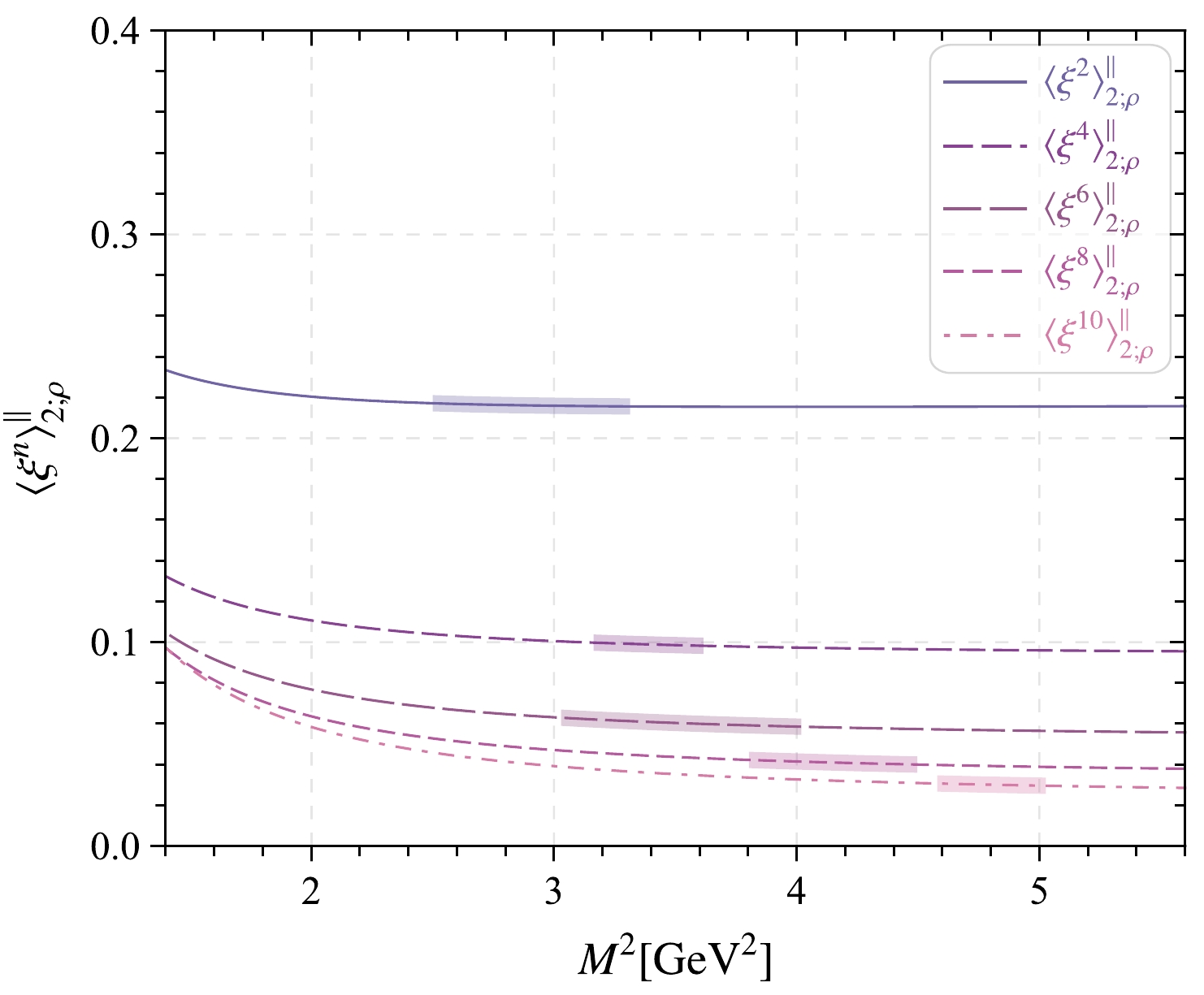
Figure 1.(color online)ρ-meson leading-twist longitudinal DA moments
$ \langle \xi^n\rangle_{2;\rho}^\parallel $ with$ n=(2,4,6,8,10) $ versus the Borel parameter$ M^2 $ and the corresponding Borel windows, where all input parameters are set as their central values.Then, the values of
$ {\langle\xi^n\rangle_{2;\rho}^\parallel}|_\mu $ up to the 10th-order with four different scales$ \mu = $ (1.0, 1.4, 2.0, 3.0) GeV and the second Gegenbauer moment$ a_{2;\rho}^\parallel $ can be obtained, which are shown inTable 2. Here, we only calculate the values of the first five non-zeroξ-moments because, as shown in Ref. [57], these moments are sufficient to determine the behavior of the DA$ \phi_{2;\rho}^\parallel(x,\mu) $ . As a comparison, the other theoretical predictions obtained using QCD SRs [21−26], LQCD [27−30], AdS/QCD [31,32], data fitting [35,36], LFQM [39], and DSE [41] are also shown inTable 2. Our second moment is less than the QCD SR predictions in Ref. [21,23,26], the LQCD calculations [27−30], and DSE result [41] and larger than the QCD SR predictions in Refs. [24,25] but very consistent with the value from QCD SRs in Ref. [22], the AdS/QCD prediction [31,32], and the value extracted from the HERA data on diffractiveρphotoproduction [35,36].$\mu {\rm /GeV }$ 

$ \langle\xi^2\rangle_{2;\rho}^\parallel $ 

$ \langle\xi^4\rangle_{2;\rho}^\parallel $ 

$ \langle\xi^6\rangle_{2;\rho}^\parallel $ 

$ \langle\xi^8\rangle_{2;\rho}^\parallel $ 

$ \langle\xi^{10}\rangle_{2;\rho}^\parallel $ 

$ a_{2 \parallel}^{2;\rho} $ 

This study 1.0 $ 0.220(6) $ 

$ 0.103(4) $ 

$ 0.0656(50) $ 

$ 0.0457(35) $ 

$ 0.0346(28) $ 

$ 0.059(18) $ 

This study 1.4 $ 0.217(5) $ 

$ 0.100(3) $ 

$ 0.0623(40) $ 

$ 0.0428(29) $ 

$ 0.0320(23) $ 

$ 0.051(16) $ 

This study 2.0 $ 0.215(5) $ 

$ 0.0986(31) $ 

$ 0.0603(35) $ 

$ 0.0411(25) $ 

$ 0.0304(20) $ 

$ 0.045(14) $ 

This study 3.0 $ 0.214(4) $ 

$ 0.0972(28) $ 

$ 0.0587(30) $ 

$ 0.0397(22) $ 

$ 0.0292(18) $ 

$ 0.041(13) $ 

QCD SRs [21] 1.0 − − − − − $ 0.18(10) $ 

QCD SRs [22] 1.0 $ 0.227(7) $ 

$ 0.095(5) $ 

$ 0.051(4) $ 

$ 0.030(2) $ 

$ 0.020(5) $ 

− QCD SRs [23,26] 1.0 − − − − − $ 0.15(7) $ 

QCD SRs [23,26] 2.0 − − − − − $ 0.10(5) $ 

QCD SRs [24] 1.0 $ 0.216(21) $ 

$ 0.089(9) $ 

$ 0.048(5) $ 

$ 0.030(3) $ 

$ 0.022(2) $ 

$ 0.047(58) $ 

QCD SRs [25] 2.0 $ 0.206(8) $ 

$ 0.087(6) $ 

− − − $ 0.017(24) $ 

LQCD [27] 2.0 $ 0.237(36)(12) $ 

− − − − − LQCD [28,29] 2.0 $ 0.27(1)(2) $ 

− − − − − LQCD [30] 2.0 − − − − − $ 0.132(27) $ 

AdS/QCD [31,32] 1.0 $ 0.228 $ 

− − − − − Data fitting [35,36] 1.0 $ 0.227 $ 

$ 0.105 $ 

$ 0.062 $ 

$ 0.041 $ 

$ 0.029 $ 

− LFQM [39] 1.0 $ 0.21,0.19 $ 

$ 0.09,0.08 $ 

$ 0.05,0.04 $ 

− − $ 0.02,-0.02 $ 

DSE [41] 2.0 $ 0.23 $ 

$ 0.11 $ 

$ 0.066 $ 

$ 0.045 $ 

$ 0.033 $ 

− Table 2.Our predictions for the first five nonzero-orderξ-moments
$ \langle \xi^n\rangle _{2;\rho}^\parallel $ with$ n=(2,4,6,8,10) $ and the second-order Gegenbauer moment$ a_{2 \parallel}^{2;\rho} $ of theρ-meson leading-twist longitudinal DA, compared with other theoretical predictions.By fitting our values of
$ \langle\xi^n\rangle_{2;\rho}^\parallel $ with$ n = (2,4,6,8,10) $ shown inTable 2using the least squares method (where the model parametersαand$ \hat{a}_2 $ are taken to be the fitting parameters, and for a specific fitting procedure, refer to Ref. [50]), the behavior of theρ-meson leading-twist longitudinal DA can be obtained. The model parametersαand$ \hat{a}_2 $ of our DA and the corresponding$ \chi^2_{\rm min}/n_d $ and goodness of fit$ P_{\chi^2_{\rm min}} $ at several typical scales, such as$ \mu = (1.0, 1.4, 2.0, 3.0)\; {\rm GeV} $ , are exhibited inTable 3. The curve of theρ-meson leading-twist longitudinal DA is shown inFig. 2. Other predictions in Refs. [25,41,46] are also shown for comparison. Our curve is closer to the asymptotic form. In addition, we use the TF model$ \phi_{2;\rho}^{\parallel({\rm TF})}(x,\mu) = 6x(1-x) \Big[1 + a_{2\parallel}^{2;\rho} C_2^{3/2}(2x-1) + a_{4\parallel}^{2;\rho} C_4^{3/2}(2x-1) \Big] $ to fit our values of theξ-moments of theρ-meson leading-twist longitudinal DA shown inTable 2. The results indicate that the goodness of fits for the DSE model exhibited inTable 3are close to those of the TF model at$ \mu = 1\; {\rm GeV} $ but better than those of the TF model at$ \mu = (1.4, 2.0, 3.0)\; {\rm GeV} $ . For example,$ a_{2\parallel}^{2;\rho} = 0.040 $ ,$a_{4\parallel}^{2;\rho} = 0.054$ ,$ \chi^2_{\rm min}/n_d = 0.657635/3 $ , and$ P_{\chi^2_{\rm min}} = 0.88312 $ at$ \mu = 2\; {\rm GeV} $ . The curve of the TF model$ \mu = 2\; {\rm GeV} $ is also shown inFig. 2. We find that the curve of the DSE model is smoother than that of the TF model. Thus, we use the DSE model instead of the TF model in this study.μ α $ \hat{a}_2 $ 

$ \chi^2_{\rm min}/n_d $ 

$ P_{\chi^2_{\rm min}} $ 

$ 1.0 $ 

$ 0.625 $ 

$ -0.516 $ 

$ 0.957/3 $ 

$ 0.812 $ 

$ 1.4 $ 

$ 0.678 $ 

$ -0.448 $ 

$ 0.488/3 $ 

$ 0.922 $ 

$ 2.0 $ 

$ 0.721 $ 

$ -0.398 $ 

$ 0.259/3 $ 

$ 0.968 $ 

$ 3.0 $ 

$ 0.709 $ 

$ -0.427 $ 

$ 0.141/3 $ 

$ 0.987 $ 

Table 3.Model parametersαand
$ \hat{a}_2 $ of our DA obtained by fitting using the least squares method and the corresponding$ \chi^2_{\rm min}/n_d $ and goodness of fit$ P_{\chi^2_{\rm min}} $ at several typical scales, such as$\mu = (1.0,~ 1.4,~ 2.0,~ 3.0)~ {\rm GeV}$ .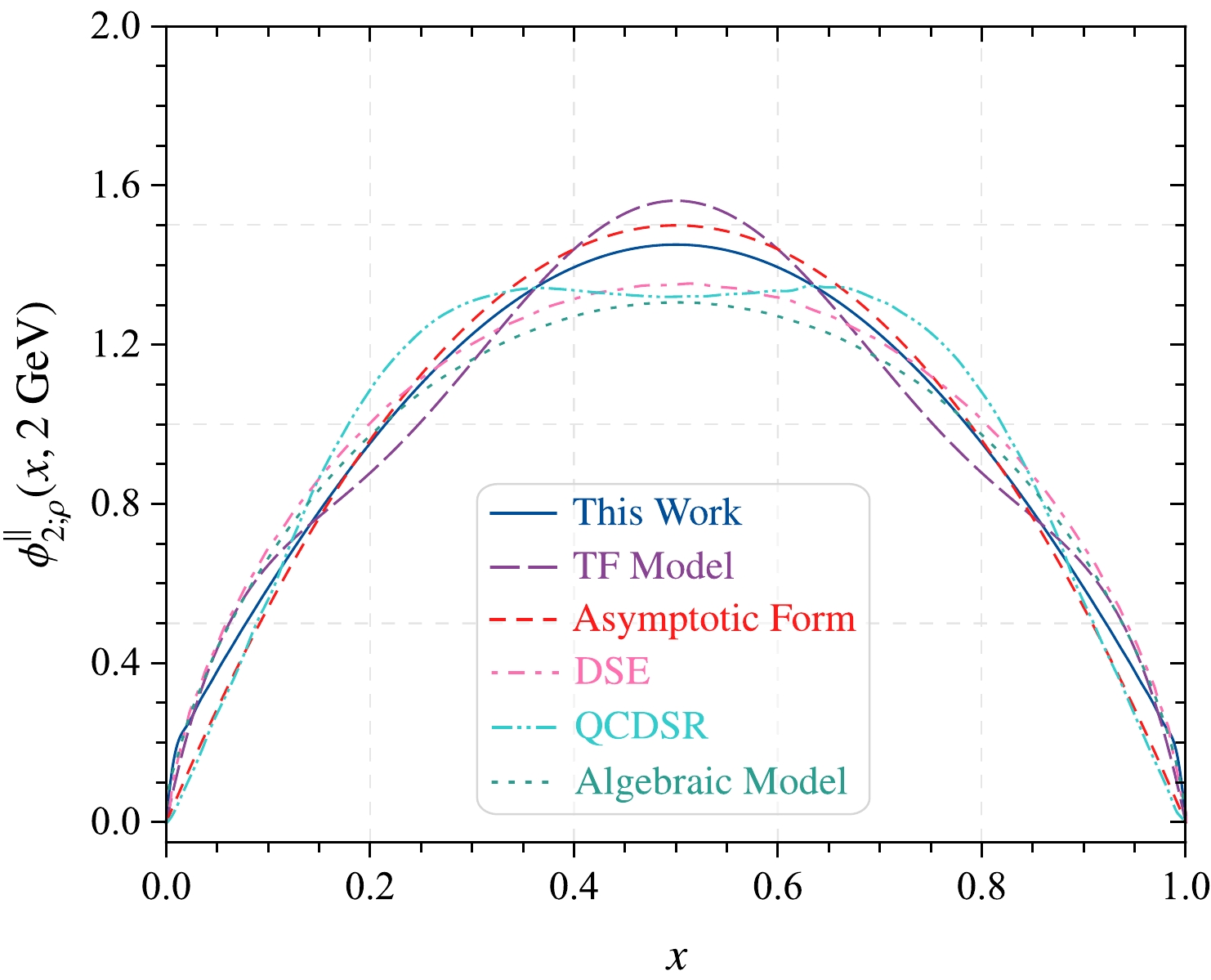
Furthermore, to calculate the
$ D\to \rho $ TFFs, the input parameters should be clarified. The current charm-quark mass is$ m_c = 1.27\pm0.02\; {\rm GeV} $ , and theD-meson mass is$ m_D = 1.869\; {\rm GeV} $ [70]. Based on the three criteria for determining$ s_0 $ and$ M^2 $ in the LCSR approach, which can be found in our previous study [51], we have$ s_0^{A_1} = 7.0\pm 0.1\; {\rm GeV}^2 $ ,$ s_0^{A_2}= 6.0\pm0.1\; {\rm GeV}^2 $ ,$s_0^{V} = 7.0\pm 0.1 {\rm GeV}^2$ ,$M^2_{A_1} = 1.45\pm 0.05\; {\rm GeV}^2$ ,$M^2_{A_2} = 1.20\pm 0.05 \;{\rm GeV}^2$ , and$M^2_{V} = 2.15\pm 0.05\; {\rm GeV}^2$ . Then, the TFFs at the large recoil region,i.e.,$ A_{1,2}(0) $ and$ V(0) $ , are present inTable 4. The uncertainties originate from the squared average for all the input parameters. InTable 4, the predictions from theoretical group and experimental collaborations,i.e., the CLEO collaboration [3], 3PSR [6], HQEFT [7,8], RHOPM [9], QM [10,11], LFQM [12], and HMχT [18], and lattice QCD predictions [19,20] are presented. A comparison of all the results inTable 4indicates that the TFFs of our prediction are consistent with those of many approaches within errors.$ A_1(0) $ 

$ A_2(0) $ 

$ V(0) $ 

This study $ 0.498^{+0.014}_{-0.012} $ 

$ 0.460^{+0.055}_{-0.047} $ 

$ 0.800^{+0.015}_{-0.014} $ 

CLEO2013 [3] $ 0.56(1)^{+0.02}_{-0.03} $ 

$ 0.47(6)(4) $ 

$ 0.84(9)^{+0.05}_{-0.06} $ 

3PSR [6] $ 0.5(2) $ 

$ 0.4(1) $ 

$ 1.0(2) $ 

HQETF [7] $ 0.57(8) $ 

$ 0.52(7) $ 

$ 0.72(10) $ 

LCSR [8] $ 0.599^{+0.035}_{-0.030} $ 

$ 0.372^{+0.026}_{-0.031} $ 

$ 0.801^{+0.044}_{-0.036} $ 

RHOPM [9] 0.78 0.92 1.23 QM-I [10] 0.59 0.23 1.34 QM-II [11] 0.59 0.49 0.90 LFQM [12] $ 0.60(1) $ 

$ 0.47(0) $ 

$ 0.88(3) $ 

HMχT [18] 0.61 0.31 1.05 LQCD [19] $ 0.45(4) $ 

$ 0.02(26) $ 

$ 0.78(12) $ 

LQCD [20] $ 0.65(15){^{+0.24}_{-0.23}} $ 

$ 0.59(31){^{+0.28}_{-0.25}} $ 

$ 1.07(49)(35) $ 

Table 4.
$ D\to \rho $ TFFs$ A_{1,2}(q^2) $ and$ V(q^2) $ at the large recoil region$ q^2\simeq 0 $ . The errors are squared averages of all the mentioned error sources. As a comparison, we also present predictions from various other methods.The ratios between different
$ D\to\rho $ TFFs,i.e.,$ r_2 $ and$ r_V $ , are shown inFig. 3. Here, the results from the CLEO collaboration [3], HMχT [18], LFQM [12], HQEFT [7], 3PSR [6], QM [10,11], and CCQM [17] are presented for comparison. From the figure, we can reach the following conclusions: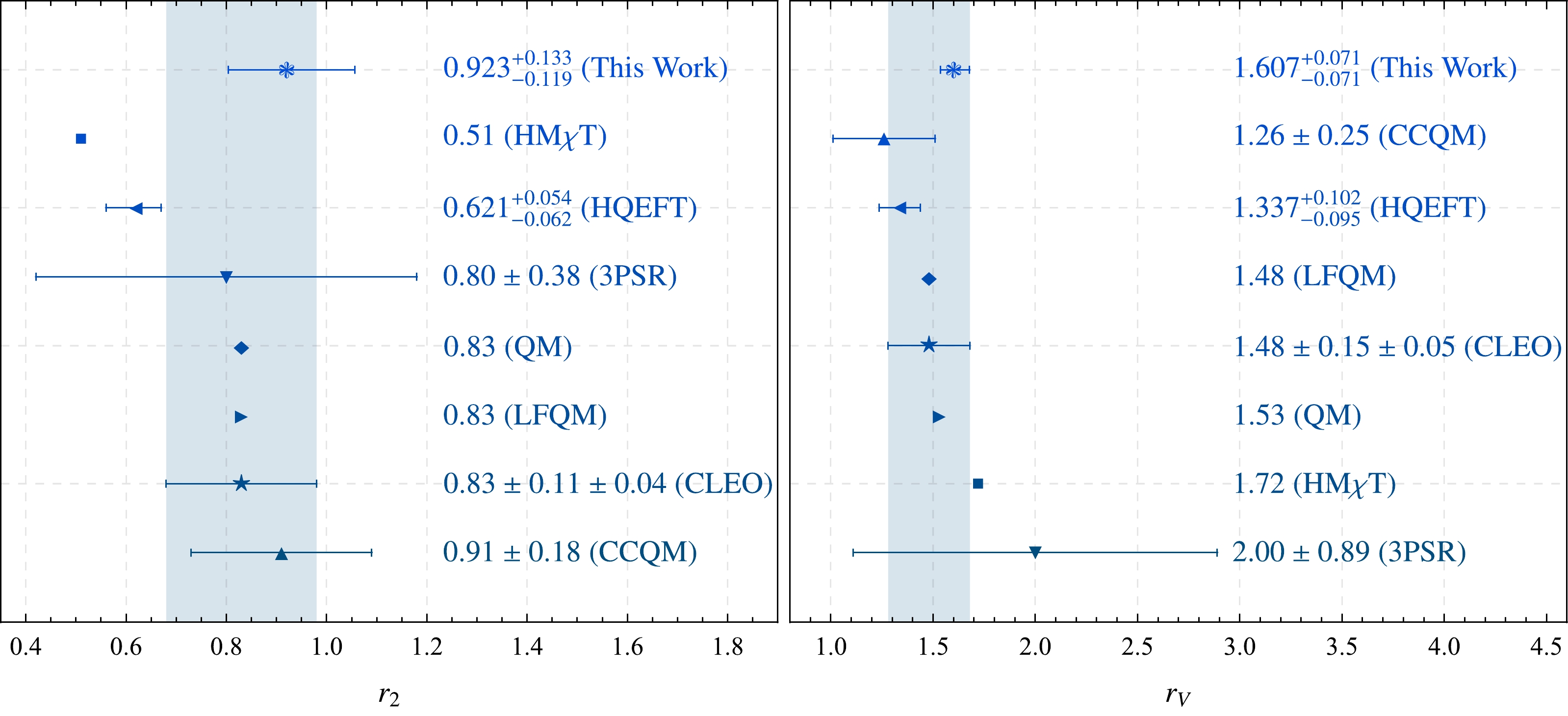
● Our predictions within uncertainties are in the region of the CLEO collaboration results.
● In terms of the central value with respect to uncertainties, our results for
$ r_2 $ agree with the QM, LFQM, 3PSR, and CCQM for theoretical predictions.$ r_V $ agrees with the QM and 3PSR predictions.● The uncertainties of our predictions are (12.9% ~ 14.4%) for
$ r_2 $ and 4.4% for$ r_V $ , which indicates that this method can obtain applicable results in the confidence level. Because the predictions from the left-handed chiral current LCSR approach are mainly obtained at leading order for a strong coupling, we will consider the possible uncertainty/pollution from the axial-vector current in subsequent studies.Using the resultant TFFs in the large recoil region, their behavior in the entire physical region,i.e.,
$ q^2_{\rm phys.} \in [0, 1.18]\; \text{GeV}^2 $ should be obtained. It is known that the LCSR predictions are suitable in low and intermediate momentum transfer. Therefore, a rapidly converging series based on$ z(t) $ -expansion is used to extrapolate in this study [73,74],$ \begin{eqnarray} F_i(q^2) = \frac1{1-q^2/m_{R,i}^2} \sum_{k=0,1,2}a_k^i [z(q^2)-z(0)]^k. \end{eqnarray} $

(15) The formula for
$ z(t) $ can be found in Ref. [73].$ F_i $ respects three TFFs,$ A_{1,2} $ andV. The appropriate resonance masses are$ m_{R,i}= 2.007\; {\rm GeV} $ for the TFF$ V(q^2) $ with$ J^P = 1^- $ and$ m_{R,i}= 2.427\; {\rm GeV} $ for the TFFs$ A_{1,2}(q^2) $ with$ J^P = 1^+ $ . The parameters$ a_k^i $ can be fixed by requiring$ \Delta < $ 0.1%, where the parameter Δ is introduced to measure the quality of extrapolation,$ \Delta={\sum_t|F_i(t)-F_i^{\rm fit}(t)|} / {\sum_t|F_i(t)|}\times 100 $ , where$t\in[0,1/40,\cdots,40/40]\times 0.8\; {\rm GeV}^2$ . The$ D\to \rho $ TFFs obtained in this study using LCSRs and the simplez-series expansion parameterization are shown inFig. 4. The maximal momentum transfers of the LCSR calculation of the$ D \to \rho $ TFFs are$ A_1(q_{\rm max}) = 0.883^{+0.022}_{-0.019} $ ,$A_2(q_{\rm max}) = 0.611^{+0.102}_{-0.103}$ , and$ V(q_{\rm max}) = 2.082^{+0.060}_{-0.059} $ .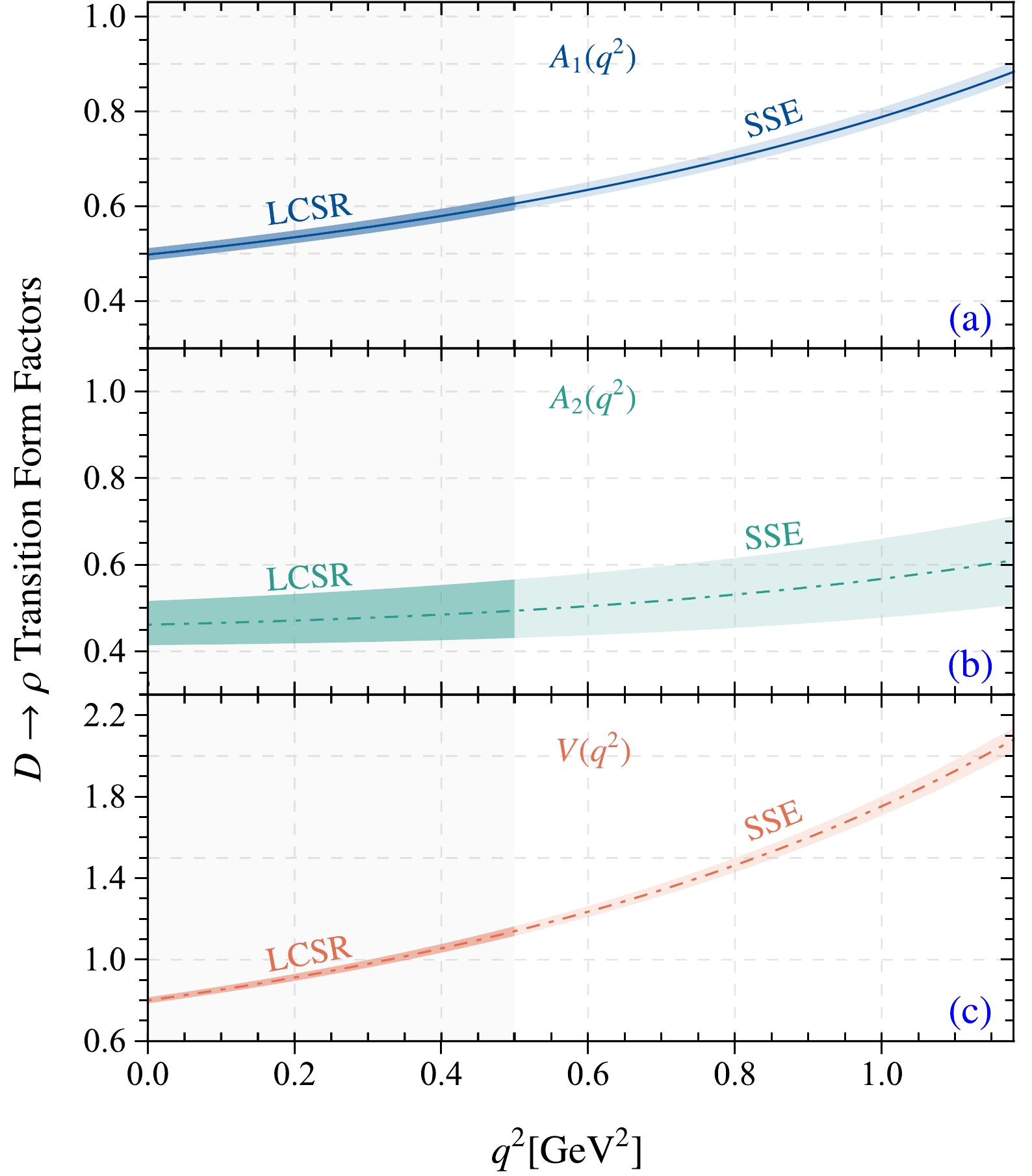
Figure 4.(color online) Predictions for the
$ D\to \rho $ TFFs, where the darker bands are the results of this study using the LCSR approach, and the lighter bands are the predictions from simplez-series expansion parameterizations.After obtaining the extrapolated TFFs of the transition
$ D\to\rho $ , we find the CKM-independent total decay width$ 1/|V_{\rm cd}|^2 \times \Gamma $ . Combining the ratio of the longitudinal/transverse and positive/negative helicity decay widths, we present the predictions inTable 5. The 3PSR [6], HQEFT [7], RHOPM [9], QM [10], LQCD [19], and LQCD [20] results are given for comparison. As shown inTable 5, there are large differences between the total decay widths from the different theoretical groups, and our results agree with the lattice results within uncertainties. Our predicted longitudinal/transverse helicity decay width agrees with those of HQEFT and LQCD within uncertainties, which is larger than 1. Our positive/negative helicity decay width agrees with that of the QM and LQCD within uncertainties.$ 1/|V_{\rm cd}|^2 \times \Gamma $ 

$ \Gamma^{\rm L}/ \Gamma^{\rm T} $ 

$ \Gamma^+/ \Gamma^- $ 

This study $ 57.87^{+5.40}_{-5.13} $ 

$ 1.00^{+0.10}_{-0.11} $ 

$ 0.15^{+0.02}_{-0.01} $ 

3PSR [6] $ 15.80\pm4.61 $ 

$ 1.31\pm0.11 $ 

$ 0.24\pm0.03 $ 

HQEFT [7] $ 71\pm14 $ 

$ 1.17\pm0.09 $ 

$ 0.29\pm0.13 $ 

RHOPM [9] $ 90.83 $ 

0.91 0.19 QM [10] $ 88.86 $ 

1.33 0.11 LQCD [19] $ 54.63\pm12.51 $ 

$ 1.86\pm0.56 $ 

0.16 LQCD [20] 71.75 1.10 0.18 Table 5.
$|V_{cd}| $ -independent total decay width$1/|V_{cd}|^2 \times \Gamma $ , ratio for longitudinal/transverse and positive/negative helicity decay widths. For comparsion, other theoretical group predictions are also given.Lastly, the branching fractions for the two types of
$ D\to\rho\ell^+\nu_\ell $ semileptonic decays are calculated. The first is the$ D^0 $ -type, including the$ D^0 \to \rho^- e^+\nu_e $ and$ D^0 \to \rho^- \mu^+\nu_\mu $ decays, for which the lifetime$\tau(D^0)= 0.410\pm 0.001$ ps should be used. The second is the$ D^+ $ -type, including$ D^+ \to \rho^0 e^+\nu_e $ and$ D^+ \to \rho^0 \mu^+\nu_\mu $ , associated with$ \tau(D^+)= 1.033\pm 0.005 $ ps [70]. The CKM matrix element$ |V_{cd}| = 0.225\pm0.001 $ [69]. We present the predictions inTable 6, where the two uncertainties mainly arise from the squared average of the theoretical input parameters and the experimental uncertainties from theD-meson lifetime. For comparison, the theoretical results from the 3PSR [6], HQEFT [7], narrow width approximation (NWA) [75] with the HQEFT [8] and LFQM [12] approaches, LCSR [8,14], LFQM [13], CCQM [17], chiral unitarity approach (χUA) [76], RQM [77], HMχT [18], ISGW2 [78] and experimental results from the BESIII collaboration [1,2] and CLEO collaboration prediction in 2013 [3] and 2005 [4] are also given. The results show that:Decay Mode $ D^0\to \rho^- e^+ \nu_e $ 

$ D^+ \to \rho^0 e^+ \nu_e $ 

$ D^0\to \rho^- \mu^+ \nu_\mu $ 

$ D^+ \to \rho^0 \mu^+ \nu_\mu $ 

This study $ 1.825^{+0.170}_{-0.162}\pm 0.004 $ 

$ 2.299^{+0.214}_{-0.204}\pm 0.011 $ 

$ 1.816^{+0.168}_{-0.160}\pm 0.004 $ 

$ 2.288^{+0.212}_{-0.201}\pm 0.011 $ 

BESIII [1] − − $ 1.35\pm0.09\pm0.09 $ 

− BESIII [2] $ 1.445\pm0.058\pm0.039 $ 

$ 1.860\pm0.070\pm0.061 $ 

− − CLEO2013 [3] $ 1.77\pm0.12\pm0.10 $ 

$ 2.17\pm0.12^{+0.12}_{-0.22} $ 

− − CLEO2005 [4] $ 1.94\pm0.39\pm0.13 $ 

$ 2.1\pm0.4\pm0.1 $ 

− − 3PSR [6] $ 0.5\pm0.1 $ 

− − − HQEFT [7] $ 1.4\pm0.3 $ 

− − − LCSR [8] $ 1.81^{+0.18}_{-0.13} $ 

$ 2.29^{+0.23}_{-0.16} $ 

$ 1.73^{+0.17}_{-0.13} $ 

$ 2.20^{+0.21}_{-0.16} $ 

NWA [75]+HQEFT [8] $ 1.67\pm0.27 $ 

$ 2.16\pm0.36 $ 

− − NWA [75]+LFQM [12] $ 1.73\pm0.07 $ 

$ 2.24\pm0.09 $ 

− − LFQM [13] − − $ 1.7\pm0.2 $ 

− LCSR [14] $ 1.74\pm0.25 $ 

$ 2.25\pm0.32 $ 

$ 1.65\pm0.23 $ 

$ 2.14\pm0.30 $ 

CCQM [17] 1.62 2.09 1.55 2.01 HMχT [18] 2.0 2.5 − − χUA [76] 1.97 2.54 1.84 2.37 RQM [77] 1.96 2.49 1.88 2.39 ISGW2 [78] 1.0 1.3 − − Table 6.Branching ratios of the semileptonic decays
$ D^0\to \rho^- \ell^+ \nu_\ell $ and$ D^+ \to \rho^0 \ell^+ \nu_\ell $ (in units of$ 10^{-3} $ ). For comparison, we also present the results from experimental collaborations and theoretical groups.● The results obtained using our left-handed chiral LCSR approach are consistent with those obtained using other LCSRs within uncertainties.
● Our current results are consistent with those of the CLEO collaboration but are larger than the BESIII collaboration predictions.
● Our results are consistent with those of other theoretical groups, such as the NWA, LFQM, HQEFT,χUA, RQM, and HMχT, but have a smaller gap when compared with the 3PSR, HQEFT,χUA, and ISGW2 results.
-
In the framework of BFT with the QCD SR approach, we calculate theξ-moments of theρ-meson leading twist longitudinal DA. Because the zerothξ-moment cannot be normalized in the entire Borel region, a new SR formula for theξ-moment is given in Eq. (2). The results up to the tenth order with the scale
$ \mu = (1.0,1.4,2.0.3.0)\; {\rm GeV}^2 $ are presented inTable 2, where the results from other theoretical group are also given. Next, we present the$ D\to \rho $ TFFs in the large recoil region,i.e.,$A_1(0),~ A_2(0)$ , and$ V(0) $ , inTable 4and the ratio$ r_{2,V} $ inFig. 3, which indicate that our results are reasonable and consistent with those of many approaches within errors. Subsequently, we calculate the$ |V_{cd}| $ -independent total decay width and the ratio for the longitudinal/transverse and positive/negative helicity decay width results and present them inTable 5. A detail discussion comparing our results with other predictions is presented. Finally, we show the branching fraction of the two types of$ D\to\rho\ell^+\nu_\ell $ semileptonic decays inTable 6. In the near further, we hope that more accurate data will be reported and more theoretical results will be given to explain the gaps between different approaches. -
We are grateful for the referee's valuable comments and suggestions.
ρ-meson longitudinal leading-twist distribution amplitude revisited and theD→ρsemileptonic decay
- Received Date:2023-12-04
- Available Online:2024-06-15
Abstract:Motivated by our previous study [Phys. Rev. D 104(1), 016021 (2021)] on the pionic leading-twist distribution amplitude (DA), we revisit theρ-meson leading-twist longitudinal DA


 DownLoad: