


 Abstract
 HTML
HTML Reference
 Related
 PDF
PDF


-
In recent years, nuclear processes involving weakly bound (WB) projectiles, such as6Li and7Li nuclei, have been extensively investigated [1–5]. The primary reason for this interest is the opportunity to investigate how distinct reaction mechanisms affect each other when the binding energy of the projectile is relatively low. The6,7Li WB projectiles are characterized by a high clusterization probability that emerges at a relatively low excitation energy (Ex),6Li→α+datEx~ 1.474 MeV and7Li→α+tatEx~ 2.468 MeV, making them good candidates for this.
The scattering processes between heavy nuclei at energies approaching the Coulomb barrier (VB) are characterized by a peculiar behavior of the optical potential (OP), which is referred to as the threshold anomaly (TA) [6]. The term TA was introduced to define the manner in which the real and imaginary potentials vary with energy aroundVB. For systems with tightly bound projectiles, the TA can be identified as a bell-shaped peak in the real potential and a significant reduction in the strength of the imaginary potential as the energy reduces belowVB. However, for systems induced by WB projectiles, this is considerably different. As the WB projectiles are characterized by their weak nature and high dissociation probability that is not suppressed below and close toVB, the coupling to the continuum creates a dynamic polarization potential (DPP) that causes the typical TA to disappear [7]. Owing to the high breakup probability that is present strongly below and close toVB, the imaginary potential is expected to increase instead of falling to zero to account for the non-vanishing breakup cross sections belowVB. These characteristics have been proposed to explain why the usual TA does not exist in systems including the WB6,7Li projectiles. The absence of TA at energies aroundVBwas observed in many systems induced by the WB6,7Li projectiles, and this was introduced as a new anomaly called the breakup threshold anomaly (BTA) [8]. Although the BTA is well presented in various systems induced by7Li projectiles, among them7Li +27Al [9],28Si [10],138Ba [11], and other systems such as7Li +59Co [12],80Se [13],134Ba [7], and208Pb [14], revealed the occurrence of the usual TA. These controversial results related to the occurrence of the BTA in systems induced by7Li make it an active research area [15,16].
In addition to the available experimental measurements for the7Li +144Sm system [17−21], many theoretical studies have focused on investigating this system [22−26]. In Ref. [17], the6,7Li +144Sm elastic scattering angular distributions (ADs) were measured experimentally at energies aroundVBfor the two systems. The ADs were investigated using the optical model (OM) with a nuclear potential of the usual Woods-Saxon (WS) shape. None of the weakly bound systems studied (6,7Li +144Sm) exhibited the TA, which is well presented in systems with tightly bound projectiles such as (12C,16O +144Sm). In addition to the various studies that determined a systematic global potential for7Li [22−24], the7Li +144Sm system was investigated microscopically using the continuum discretized coupled channel (CDCC) method [25,27−30]. In Ref. [25], the ADs for7Li projectiles scattered by59Co,144Sm, and208Pb targets at energies aroundVBwere investigated using the CDCC method to determine the significance of the Coulomb-nuclear interference. The differences and similarities between the results for the6Li and7Li were also explored. The analysis showed that the6Li total breakup cross sections are greater than those for7Li.
The current study complements our ongoing research plan that investigates the peculiarities and interaction mechanisms of different nuclear systems induced by the WB projectiles [31−42]. In the current study, we examine the ADs and reaction cross sections (σR) for the7Li +144Sm system within various interaction potentials and calculation approaches. Finally, information on the absence of the typical TA is presented. In Section II, the potentials that were implemented in the theoretical calculations are discussed. The obtained results are presented in Section III, along with their discussion. The findings and interpretations of this work are discussed in Section IV.
-
The elastic scattering7Li +144Sm ADs at energies between 21.6 and 52 MeV [17,18] are investigated within various potentials and approaches, starting with the fundamental phenomenological OM and the semi-microscopic São Paulo potential (SPP). The cluster folding model (CFM) was used to account for the7Li→α+tcluster structure. The CFM computations with and without the inclusion of a surface DPP were performed to reproduce the considered data. Finally, the CDCC computations were carried out by considering the coupling to resonant states only, as well as that to resonant and non-resonant continuum. As a result, we believe that the analyses using different potentials could aid in clarifying the various characterizations of the7Li +144Sm system and in determining the optimal potentials that accurately reproduce the data.
-
The applicability of the OM model is predicated on the existence of a smooth-varying average potential and the premise that the influence of the various reaction channels can be reflected by an imaginary potential. As a result, the OM is applied primarily to the data that varied smoothly with the energy. If one of these premises does not hold and the behavior of cross sections deviates from being reasonably smooth, the OM will be a non-useful concept. The considered7Li +144Sm elastic scattering ADs are analyzed within the OM, which has the following central potential:
$\begin{aligned}[b] U(r) =& {V_C}(r) - {V_0}{\left[ {1 + \exp \left( {\frac{{r - {R_V}}}{{{a_V}}}} \right)} \right]^{ - 1}}\\& - {\rm i} {W_0}{\left[ {1 + \exp \left( {\frac{{r - {R_W}}}{{{a_W}}}} \right)} \right]^{ - 1}} , \end{aligned} $

(1) Here,
$ {V_C}(r) $ is the Coulomb potential, characterized by the radius$ {R_C} = {r_C}{\text{ }}A_t^{1/3},{\text{ }}{r_C} = 1.3{\text{ fm}} $ . The real and imaginary parts of the nuclear potential appear as the second and third terms in Eq. (1), have the standard volume WS shape, and are identified by the parameters:V0andW0(potential depth),rVandrW(reduced radius parameter),aVandaW(diffuseness), respectively. -
The7Li +144Sm interaction potential was constructed microscopically to address the various ambiguities inherited from the OM potentials. The SPP is conceptually comparable to the conventional double folding potential since it is derived by folding the densities of the projectile and target nuclei with an effective interaction potential
$ v_{NN}^{{\text{SPP2}}} $ [43–47], and it is expressed as:$ {V_F}(R) = \iint \rho_{P} (\overrightarrow{r_{P}}) \rho_{T} (\overrightarrow{r_{T}}) v_{NN}^{\rm SPP2} (\overrightarrow{R} - \overrightarrow{r_{P}} + \overrightarrow{r_{T}}) {\rm d} \overrightarrow{r_{P}} {\rm d} \overrightarrow{r_{T}}. $

(2) The density distribution
$\rho_{P}(r_{P})$ of7Li was taken from Ref. [48] and has the following form:$ \rho (r) = (\xi + \gamma {r^2})\exp {\text{ }}( - \beta {r^2}){\text{f}}{{\text{m}}^{-3}} $

(3) where
$ \xi $ =0.1387,$ \gamma $ =0.0232, and$ \beta $ =0.3341. The density distribution$\rho_{T}(r_{T})$ of144Sm nucleus was calculated within the Dirac-Hartree-Bogoliubov model [49] using theREGINAcode. The new version SPP2 [47] was employed, and the effective interaction$ v_{NN}^{{\text{SPP2}}} $ , which is energy- dependent, is expressed as$ v_{NN}^{{\text{SPP2}}}(\overrightarrow r ) = - {U_0}{\text{ }}{{\rm e}^{ - {{(r/a)}^2}}}{\text{ }}{{{\rm e}}^{ - {\text{4}}{{\text{V}}^{\text{2}}}{\text{/}}{C^{\text{2}}}}} $

(4) where
$ {U_0} $ = 735.813 MeV,a= 0.5 fm,Vis the relative velocity between the colliding nuclei, andCis the speed of light. -
The CFM was implemented to describe the7Li +144Sm elastic scattering ADs by considering the7Li→α+tcluster nature that emerges at a low excitation energy ~ 2.468 MeV. The real (
$ {V^{CF}} $ ) and imaginary ($ {W^{CF}} $ ) cluster folding potentials (CFPs) for the7Li +144Sm system were prepared as follows:$\begin{aligned}[b] {V}^{CF}(R)=&{\displaystyle \int }\left[{V}_{\text{ }\alpha -{\text{ }}^{144}\text{ Sm}}\left(R-\frac{\text{3}}{\text{7}}r\right)+{V}_{t-^{144}\text{ Sm}}\left(R+\frac{\text{4}}{\text{7}}r\right)\right]\\&\times\text{ }{\left|{\text{χ}}_{\alpha -t}(r)\right|}^{2} {\rm d} r\text{,} \end{aligned}$

(5) $ \begin{aligned}[b]{W}^{CF}(R)=&{\displaystyle \int }\left[{W}_{\text{ }\alpha -{\text{ }}^{144}\text{ Sm}}\left(R-\frac{\text{3}}{\text{7}}r\right)+{W}_{t-^{144}\text{ Sm}}\left(R+\frac{\text{4}}{\text{7}}r\right)\right]\\&\times\text{ }{\left|{\text{χ}}_{\alpha -t}(r)\right|}^{2} {\rm d}\text{ }r\text{,}\end{aligned} $

(6) where
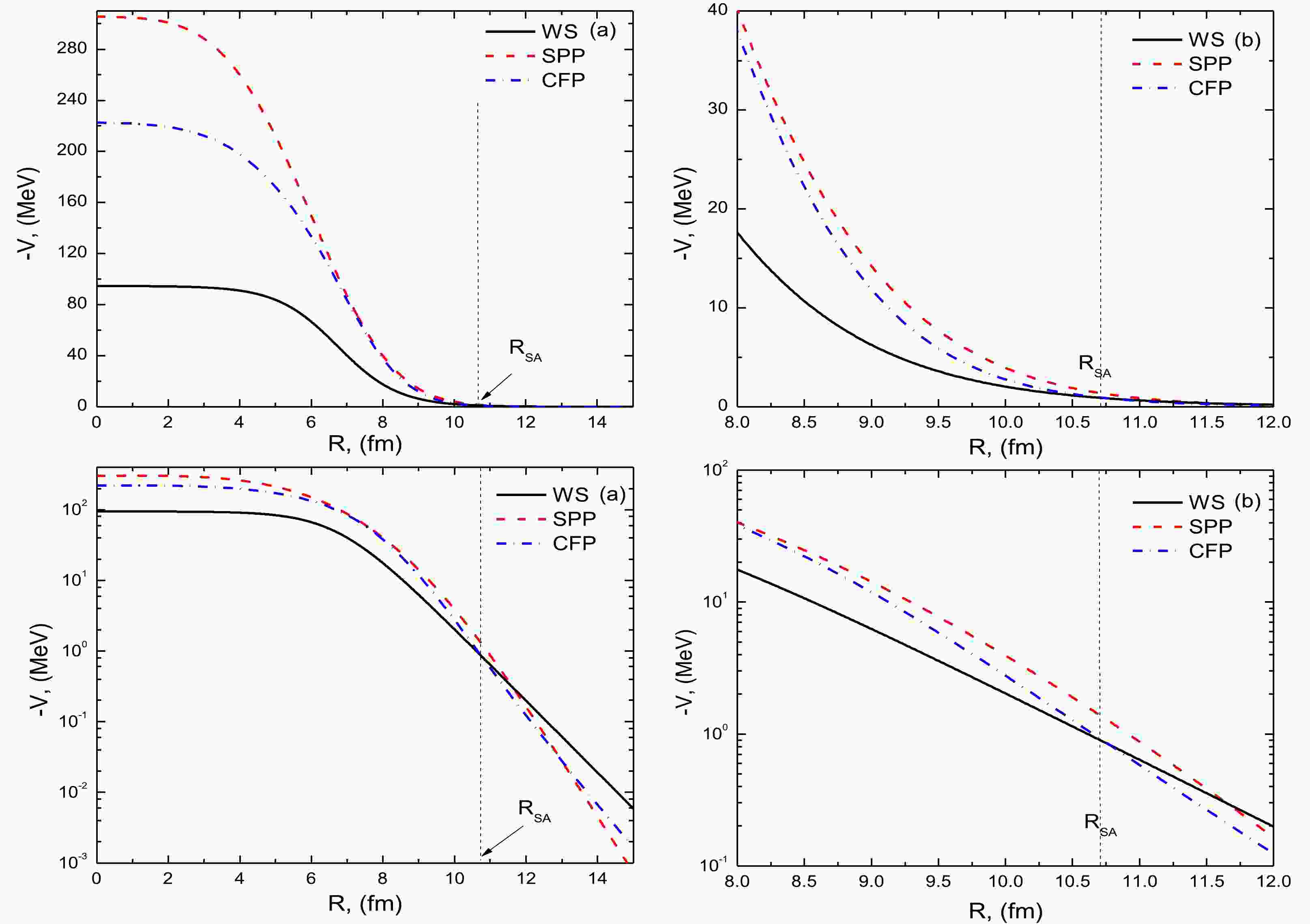
$ {V_{{\text{ }}\alpha - {{\text{ }}^{144}}{\text{ Sm}}}} $ ,$ {W_{{\text{ }}\alpha - {{\text{ }}^{144}}{\text{ Sm}}}} $ ,$ {V_{t{ - ^{144}}{\text{ Sm}}}} $ , and$ {W_{t{ - ^{144}}{\text{ Sm}}}} $ are the real and imaginary potentials for thet+144Sm andα+144Sm channels at appropriate energiesEt≈ 3/7ELiandEα≈ 4/7ELi[50,51]. The intercluster wave function$ {{{\chi }}_{\alpha - t}}(r) $ represents a 2P3/2state in a real WS potential, and it is characterized by the parametersRV= 1.83 fm,aV= 0.65 fm, and the depth (V0) was varied till the binding energy for the cluster was reproduced. As the maximum considered energy was 52 MeV, the suitablet+144Sm andα+144Sm potentials for constructing the7Li +144Sm CFPs wereUt+144SmatElab=3/7 × 52 = 22.29 MeV andUα+144SmatElab= 4/7 × 52 = 29.71 MeV, (U=V+W). The potentialsUt+144SmatElab= 22.29 MeV “taken from the global potential for tritons” [50] andUα+144SmatElab= 50 MeV [51] were adopted to generate the CFPs for the7Li +144Sm. The three potentials used − WS, SPP, and CFP − to study the7Li +144Sm system atE= 52 MeV close to the strong absorption radius (RSA) are shown inFig. 1. Despite the observed differences between the considered potentials in the low radial region, all fairly reproduced the data. This is consistent with the fact that most of the available heavy ion scattering data is sensitive only to the tail of the nucleus-nucleus potential, in the vicinity of the strong absorption radius (RSA), which is typically ~$ 1.5{\text{ }}(A_P^{1/3} + A_T^{1/3}) $ . The employed OM and SPP are energy-dependent, while the employed CFP is energy-independent.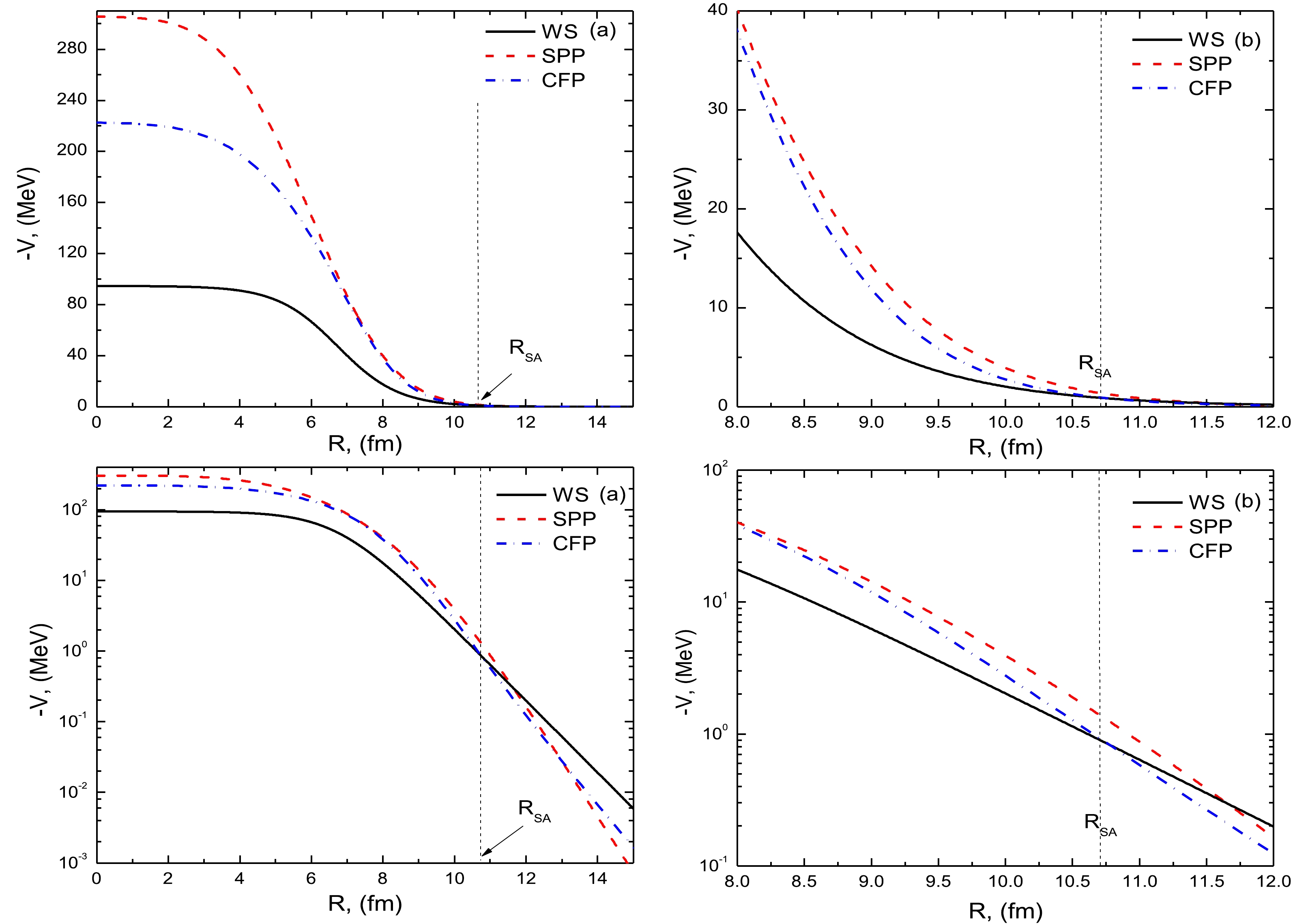
Figure 1.(color online) Implemented real WS, SPP, and CFP potentials utilized to reproduce the7Li +144Sm AD atElab= 52 MeV in (a) whole radial range and (b) in the range 8–12 fm with a linear and logarithmic scale.
-
The7Li +144Sm elastic scattering ADs were reanalyzed phenomenologically at energies between 21.6 and 52 MeV [17,18] using OMP with a Coulomb and nuclear part, as shown in Eq. (1). The OM calculations were performed using the geometrical parametersrV,rW,aV, andaWfixed to 1.286, 1.739, 0.853, and 0.809 fm, respectively, in accordance with Cook’s study [22]. This allowed us to explore how the potential depths evolve with energy. The OM computations employed two varying parameters,V0andW0, which were adjusted to describe the experimental data. TheFRESCOcode [52] upgraded with theχ2minimizationSFRESCOcode was implemented to describe the data and obtain the optimal potential parameters by minimizing theχ2value, which gives the deviation between the experimental data and the calculations.
The experimental7Li +144Sm ADs at all the considered energies below and above the barrier are fairly reproduced utilizing the OM approach as depicted inFig. 2, and the extracted optimal parameters are listed in Table I. To examine the applicability of the dispersion relation on the real (JV) and imaginary (JW) volume integrals, these quantities were calculated, and their values are displayed inTable 1. TheJVandJWvalues do not follow the typical dispersion relation, where the imaginary potential depth does not drop to zero as the energy decreases below the barrier. The OM analysis revealed that the TA, which is well presented in systems with tightly bound projectiles [53,54], is not present in the7Li +144Sm system under consideration.
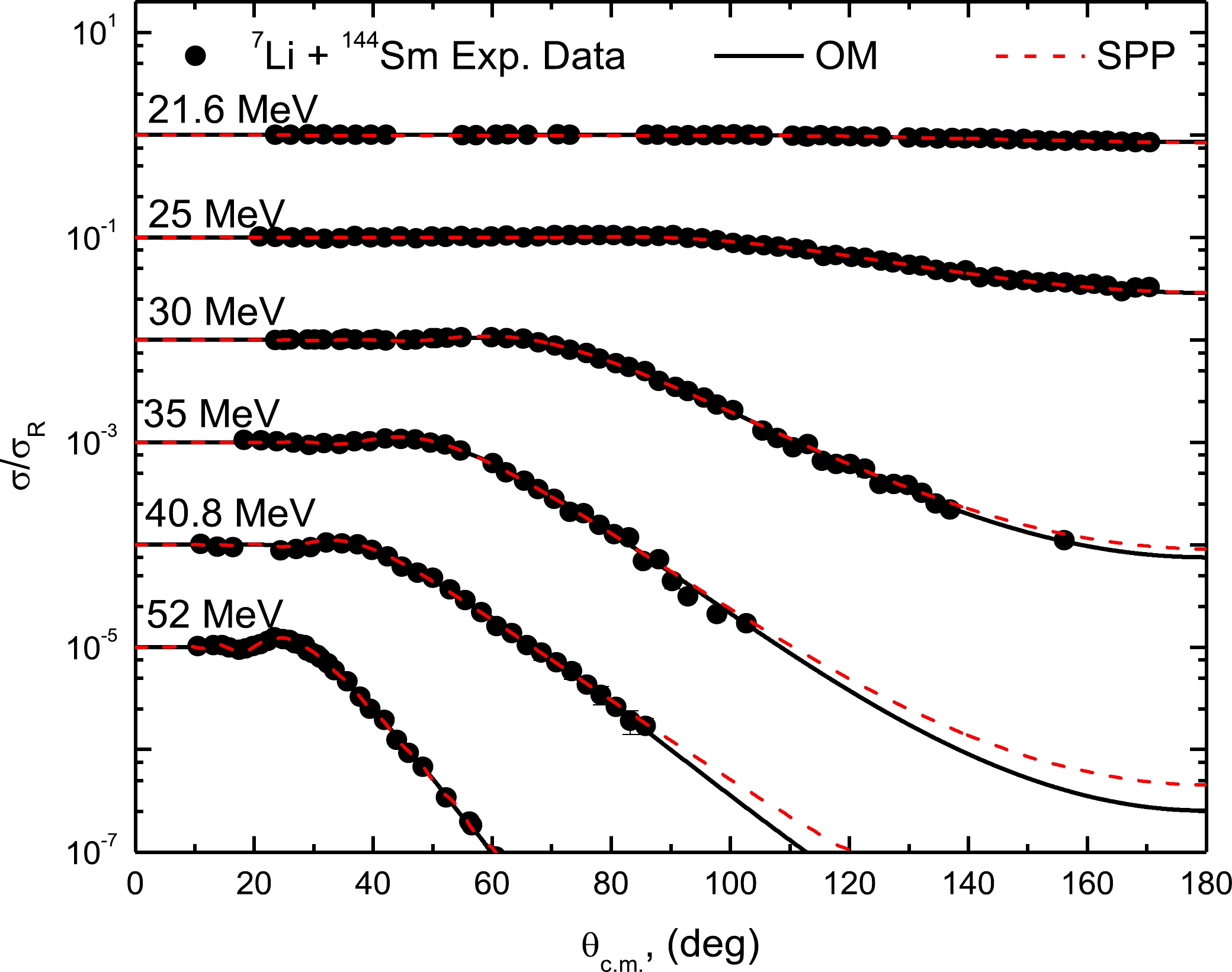
Figure 2.(color online)144Sm(7Li,7Li)144Sm experimental ADs versus theoretical calculations within WS potential (solid curves) and SPP (dashed curves) atElab= 21.6, 25, 30, 35, 40.8, and 52 MeV. Data is displaced by 0.1.
The extractedV0andW0values from the present OMP analysis are far from those reported in Ref. [17] owing to the different geometrical parameters considered. Hence, we compared the behavior of the obtained OM-WS potential from this work with that potential in Ref. [17]. It was found that the two potential families at the sensitive radius (~ 10.7 fm) have a minimum uncertainty and are nearly independent of the geometrical shape.
E/MeV Pot. V0(MeV)/NRSPP W0(MeV)/NISPP χ2/N $ {\mathit{\sigma }}_{\mathit{R}} $ /mb

JV/(MeV·fm3) JW/(MeV·fm3) 21.6 WS 163.15±17.28 6.48±0.49 1.22 39.9±3.6 240.45±25.47 21.98±1.66 SPP 1.881±0.125 1.120±0.080 1.61 252.7±18.2 769.08±51.11 457.93±32.71 22.1 WS 165.51±10.26 4.63±0.31 1.43 40.9±3.2 243.93±15.12 15.70±1.05 SPP 1.421±0.096 0.877±0.068 1.82 209.9±16.4 580.41±39.21 358.21±27.77 22.6 WS 161.5±7.26 5.42±0.28 0.87 65.2±3.9 238.02±10.67 18.38±0.95 SPP 1.301±0.070 0.999±0.063 1.13 256.6±16.1 531.15±28.58 407.85±25.72 23 WS 167.82±10.87 5.01±0.47 0.59 79.7±8.3 247.34±16.02 16.99±1.59 SPP 1.318±0.089 0.865±0.089 0.63 245.4±24.4 537.89±36.32 353.02±36.32 25 WS 133.77±4.14 6.28±0.34 1.24 251.7±11.0 197.15±6.10 21.29±1.15 SPP 1.089±0.029 0.839±0.059 1.16 402.7±19.8 443.60±11.81 341.77±24.03 27 WS 111.96±2.39 7.65±0.26 1.91 501.1±9.6 165.01±3.52 25.95±0.88 SPP 1.026±0.015 0.879±0.038 1.40 646.4±13.5 417.18±6.10 357.41±15.45 29 WS 103.71±1.46 7.82±0.30 2.6 723.7±10.7 152.85±2.15 26.52±1.02 SPP 1.015±0.016 0.696±0.036 1.78 814.1±14.2 411.94±6.49 282.47±14.61 30 WS 103.34±1.63 7.43±0.22 0.82 813.7±9.0 152.30±2.40 25.20±0.75 SPP 0.967±0.014 0.617±0.028 1.44 882.9±12.0 392.10±5.68 250.18±11.35 32 WS 101.08±2.37 8.63±0.43 1.3 1037±13.0 148.97±3.49 29.27±1.46 SPP 1.028±0.025 0.728±0.051 1.75 1117±21.0 416.06±10.12 294.64±20.64 35 WS 82.82±1.91 8.96±0.36 2.4 1266±14.0 122.06±2.81 30.39±1.22 SPP 0.899±0.020 0.675±0.035 3.1 1314±16.0 362.85±8.07 272.44±14.13 40.8 WS 38.15±4.77 15.61±0.98 0.93 1791±29.0 56.23±7.03 52.94±3.32 SPP 0.859±0.040 1.268±0.108 0.94 1862±38.0 344.85±16.06 509.05±43.36 52 WS 94.59±3.76 8.93±0.94 0.18 2063±42.0 139.41±5.54 30.29±3.19 SPP 0.863±0.122 0.373±0.123 0.14 1925±85.0 342.90±48.47 148.20±48.87 Table 1.Optimal parameters extracted from the analysis of the7Li +144Sm system within both WS and SPP. TheJV,JWand reaction cross sections (σR) values are given.
-
It is always desirable to derive the interaction potential within microscopic approaches, such as the SPP, for minimizing the various parameter ambiguities that may arise during the phenomenological OM analysis. Therefore, the new SPP2 [47] version was implemented to investigate the7Li +144Sm ADs. The real portion of SPP was computed using Eq. (2), and the imaginary portion was determined by multiplying the real portion by a factor. The shape of the central potential is as follows:
$ U(R) = {V_C}(R) - {N_{\rm RSPP}}{\text{ }}{V^{\rm SPP}}(R) - {\rm i} {N_{\rm ISPP}}{\text{ }}{V^{\rm SPP}}(R). $

(7) The second and third terms denote the real and imaginary SPP, with their corresponding normalization factors,NRSPPandNISPP, respectively. Consequently, two changeable parameters (NRSPPandNISPP) were used to fit the data. The small number of fitting parameters and the non-biased search (NRSPPandNISPPwere permitted to freely vary between 0.1 and 2.0), and they result in an obvious energy dependence on the potentials. The computations within the SPP, as shown inFig. 2, reasonably agree with the experimental7Li +144Sm ADs using theNRSPPandNISPPvalues displayed inTable 1. With an average value of 0.69 ± 0.09, the extractedNRSPPvalues in the energy range of 21.6–52 MeV (close to and above the barrierVB) are close. TheNRSPPvalues moderately change as the energy falls below the barrierVB, whereas theNISPPvalues demonstrate an increasing trend. This observed behavior deviates strongly from the typical TA, in which the imaginary potential vanishes as the energy falls below the barrier. In other words, the analysis performed within the SPP confirms the existence of the BTA, which agrees with the findings of Ref. [17]. The analysis reveals the necessity of decreasing the real SPP strength by ~ 31% in order to fairly fit the7Li +144Sm ADs. This decrease is primarily owing to the7Li breakup effects.
-
Motivated by the appreciable clusterization probability of7Li intot+αcluters, we investigate the considered7Li +144Sm ADs using CFPs defined in Eqs. (5) and (6). The form of the central potential is as follows:
$ U(R) = {V_C}(R) - {N_{\rm RCF}}{\text{ }}{V^{CF}}(R) - {\rm i} {\text{ }}{N_{\rm ICF}}{\text{ }}{W^{CF}}(R). $

(8) The second and third terms denote the real and imaginary CFP, with their corresponding normalization factors,NRCFandNICF, respectively. Consequently, two changeable parameters (NRCFandNICF) were used to fit the data. The obvious advantage of the analysis performed within the CFP is that both the real and imaginary potentials are prepared semi-microscopically. Second, the limited number of fitting parameters (NRCFandNICF) can indicate a clear energy dependence on the real and imaginary potential strengths, which provides a better understanding of the presence or absence of the BTA in the studied system. Some systems induced by the WB7Li projectile [9–11,17] showed the presence of BTA at energies aroundVB, where the imaginary potential strength increaed instead of dropping to zero. Other systems induced by the7Li projectiles [12–14] showed the absence of the BTA.
The theoretical analysis within the CFP successfully reproduced the7Li +144Sm ADs at all considered energies and throughout the whole angular range, as depicted inFig. 3. The extractedNRCFvalues in the energy range of 25–52 MeV (above the barrierVB) are quite consistent, with an average value of 0.62 ± 0.20. Furthermore, by reducing the energy belowVB, the extractedNRCFexhibits an increasing trend, as listed inTable 2. The non-vanishing trend observed for the imaginary CFP part when the energy decreases below the barrier indicates the presence of the BTA. In addition, the analysis revealed that the strength of the real CFP must be decreased by ~ 38% to adequately describe the7Li +144Sm ADs in the energy range 25–52 MeV (aboveVB).
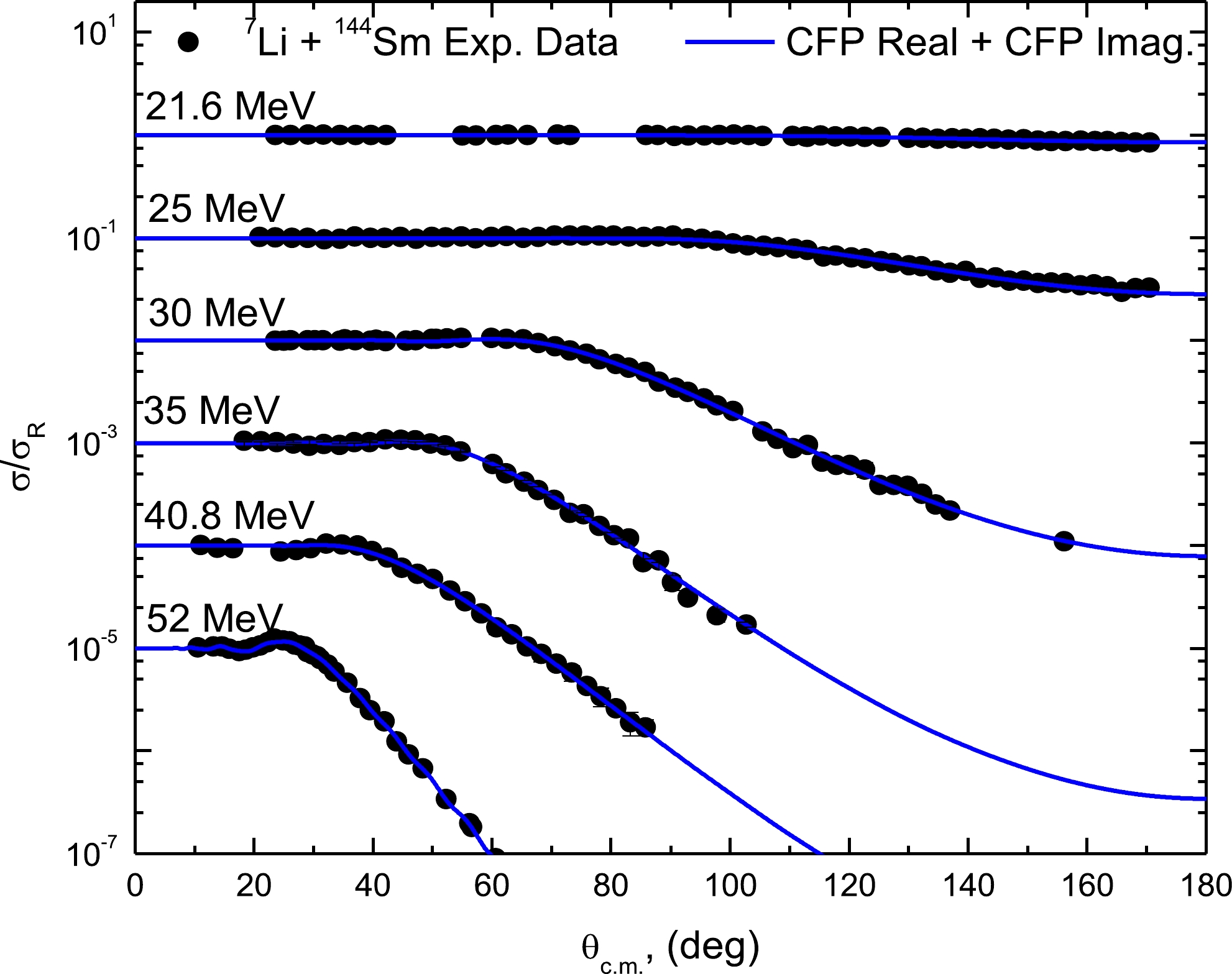
Figure 3.(color online)144Sm(7Li,7Li)144Sm experimental ADs versus the calculations within CFP atElab= 21.6, 25, 30, 35, 40.8, and 52 MeV. Data is displaced by 0.1.
E/MeV NRCF NICF χ2/N $ {\mathit{\sigma }}_{\mathit{R}} $ /mb

JV/(MeV·fm3) JW/(MeV·fm3) 21.6 1.663±0.066 0.308±0.013 1.08 47.87±2.2 826.11±32.79 26.66±1.13 22.1 1.479±0.015 0.236±0.007 1.6 48.98±1.3 734.70±7.45 20.43±0.61 22.6 1.358±0.036 0.297±0.012 0.99 76.84±3.3 674.59±17.88 25.71±1.04 23 1.338±0.048 0.281±0.019 0.63 92.09±6.1 664.66±23.84 24.32±1.64 25 0.945±0.021 0.403±0.020 1.08 272.7±9.7 469.43±10.43 34.88±1.73 27 0.754±0.014 0.517±0.017 2.72 527.2±9.5 374.55±6.95 44.75±1.47 29 0.669±0.016 0.528±0.029 3.7 742.8±16.4 332.33±7.95 45.70±2.51 30 0.649±0.014 0.547±0.021 1.24 850.4±12.7 322.39±6.95 47.35±1.82 32 0.626±0.022 0.634±0.038 1.42 1073±22.0 310.97±10.93 54.88±3.29 35 0.468±0.016 0.720±0.032 2.8 1319±19.0 232.48±7.95 62.33±2.77 40.8 0.251±0.015 0.950±0.005 2.1 1880±4.0 124.18±7.42 82.24±0.43 52 0.581±0.038 0.563±0.122 0.1 2024±81.0 288.61±18.88 48.73±10.56 Table 2.OptimalNRCFandNICFvalues extracted from the calculations within CFP.
-
The considerable coupling impact on the breakup channel is the main source for the evident reduction in the strength of the SPP and CFP. This impact can be modelled by including an additional DPP to simulate the effects that result from coupling to all the other states (continuum) or by carrying out the microscopic CDCC computations. Both methods were considered to reproduce the7Li +144Sm ADs. In the present work, we have suggested a simple approach to simulate the DPP. The following form (Eq. 9) was employed to calculate the DPP based on the previously generated CFPs.
$ {U_{\rm DPP}}(R) = {N_{\rm RDPP}}\frac{\rm d}{{{\rm d}R}}{V^{\rm CFP}}(R) + {\rm i} {N_{\rm IDPP}}\frac{\rm d}{{{\rm d}R}}{W^{\rm CFP}}(R). $

(9) As previously demonstrated, the7Li +144Sm ADs in the energy range of 25–52 MeV were reasonably described within the CFPs when the real and imaginary CFP strengths were decreased by ~ 38% and 39%, respectively. We describe the considered ADs using non-normalized CFPs such that “bothNRCFandNICFare fixed to unity” by incorporating an additional DPP. As a simple approach, the DPP was taken as a factor multiplied by the derivative of the real and imaginary CFPs. Thus, two parameters,NRDPPandNIDPP, which denote the normalization factors for the DPP, were employed to fit the data. The same methodology was followed in our previous works [5,55,56]. As shown inFig. 4, the experimental7Li +144Sm ADs agree well with the (non-normalized CFPs + DPP) calculations, and the optimally obtainedNRDPPandNIDPPvalues are listed inTable 3. The nature of the implemented DPP changed from an attractive one (for the data above theVB) to a repulsive one (for the data below theVB), as shown from the extracted values listed inTable 3. Consequently, the nature of the DPP highly depends on the interaction energy.
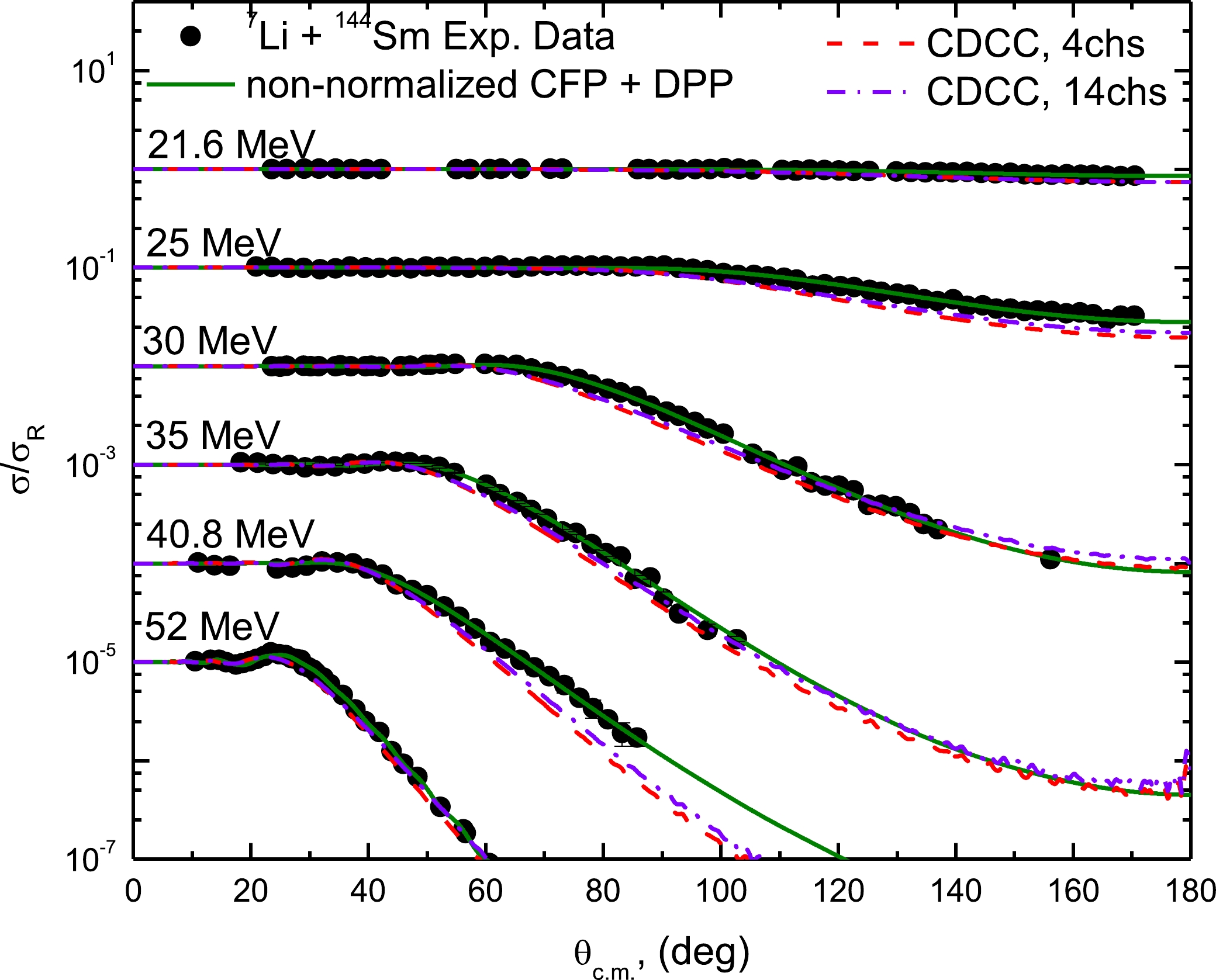
Figure 4.(color online)144Sm(7Li,7Li)144Sm experimental ADs atElab= 21.6, 25, 30, 35, 40.8, and 52 MeV versus the (non-normalized CFPs + DPP) calculations (curves), 4-channels CDCC computations (dashed curves), and 14-channels CDCC computations (dashed dot curves).
E/MeV NRDPP NIDPPP χ2/N $ {\mathit{\sigma }}_{\mathit{R}} $ /mb

JV/(MeV·fm3) JW/(MeV·fm3) 21.6 −0.473±0.070 0.778±0.023 1.09 47.17±3.6 594.19±87.94 61.67±1.82 22.1 −0.319±0.044 0.846±0.017 1.64 49.35±3.4 562.47±77.58 59.49±1.20 22.6 −0.240±0.029 0.778±0.016 1.02 77.14±3.9 546.19±66.00 61.67±1.27 23 −0.231±0.045 0.798±0.029 0.64 91.93±8.6 544.34±106.04 61.03±2.22 25 0.027±0.020 0.661±0.029 1.85 272.1±13.6 491.19±127.35 65.41±2.87 27 0.155±0.011 0.526±0.021 2.72 528.4±11.2 464.82±32.99 69.73±2.78 29 0.204±0.008 0.517±0.028 3.6 743.9±14.7 454.73±17.83 70.02±3.79 30 0.214±0.008 0.504±0.022 1.24 848.8±12.2 452.67±16.92 70.44±3.07 32 0.230±0.013 0.406±0.041 1.4 1072±22.0 449.37±25.40 73.57±7.43 35 0.317±0.009 0.337±0.034 2.8 1311±19.0 431.45±12.25 75.78±7.65 40.8 0.513±0.017 −0.234±0.073 0.89 1856±34.0 391.08±12.96 94.05±29.34 52 0.250±0.020 0.521±0.121 0.09 2005±83.0 445.25±35.62 69.89±16.23 Table 3.OptimalNRDPPandNIDPPvalues extracted from the (non-normalized CFPs + DPP) calculations.JV,JW,andσRvalues are displayed.
Then, we employed the microscopic CDCC approach [57–59] to investigate the considered7Li +144Sm ADs. The inclusion of couplings to the continuum states, which makes it possible to analyze the impacts of projectile breakup, is an obvious advantage of the CDCC approach. The CDCC computations were carried out using theFRESCOcode, considering the coupling to resonant (7/2–and 5/2–) states of widths 0.2 and 2.0 MeV, the bound non-resonant (1/2–) state, and the non-resonant continuum (discretized into 10 bins). These computations were referred to as the "14-channels CDCC". In addition, the CDCC computations, named "4-channels CDCC", were performed by ignoring the coupling to the non-resonant continuum; these computations are illustrated inFig. 4. Our test computations revealed that the coupling to resonant states has the most important contributions, while the contributions from other continuum states are minimal. By using Eqs. (5) and (6), the diagonal and coupling potentials were determined. The continuum above theα+tbreakup threshold energy was divided into momentum bins of widthΔk= 0.25 fm-1,kis extended from 0.0 to 0.75 fm-1. The implemented model space for truncation and discretization of7Li was taken from Ref. [60].
It is important to clarify that the calculations performed within the CFP approach could be considered a particular case of the CDCC calculations with only a single channel. Within the CFP approach, we reproduced the7Li +144Sm ADs using normalized real and imaginary CFP parts, as illustrated inTable 2. However, in the CDCC calculations (4 and 14 channels), the calculations are free of any adjusting parameters; therefore, we could study the effects arising from the couplings to resonant and non-resonant continuums on the elastic scattering channel. Therefore, it is not surprising that the CFP calculations (1-channel CDCC) using normalized CFPs work very well (Fig. 3), whereas the more physical CDCC calculations (4 and 14 channels,Fig. 4) failed to reproduce the data.
Additionally, the elastic scattering ADs for the7Li +144Sm system were analyzed using an effective potentialUeffextracted from the CDCC computations. TheUeffwas taken as the sum of the cluster folding potential (UCF) and the dynamic polarization potential (UTELP). The latter arises from the coupling to the continuum states and is generated from the CDCC computations utilizing the so-called trivially equivalent local potential (TELP) approach [61]. The implementedUeffin the theoretical calculations is expressed in Eq. (10). The generatedUCF,UTELP, andUefffor the7Li +144Sm system atElab=40.8 and 52 MeV in the radial region 8–12 fm, near theRSA, are shown inFig. 5.
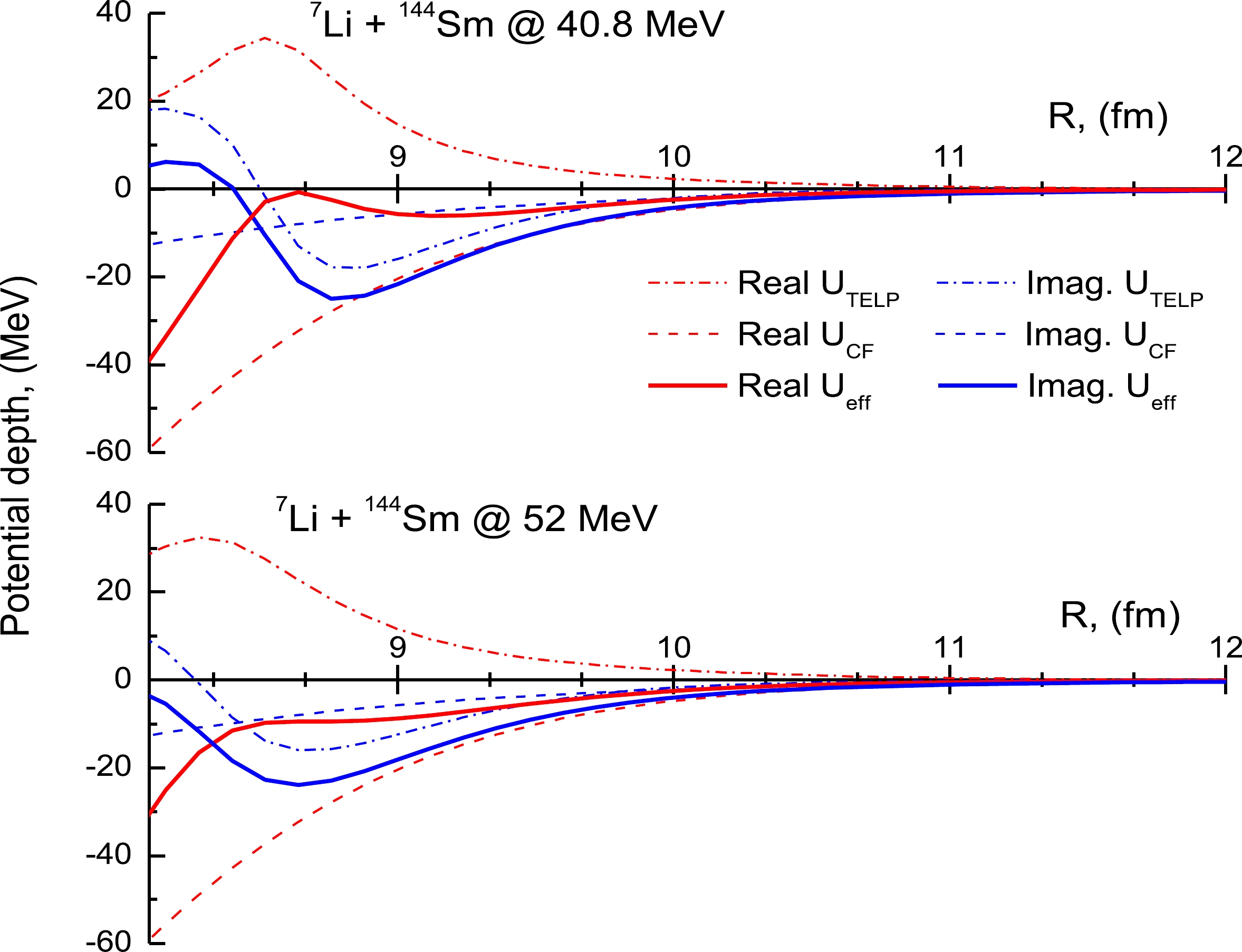
Figure 5.(color online)UCF,UTELP, andUeffpotentials generated from the CDCC computations for the7Li +144Sm system atE= 40.8 and 52 MeV.
$ {U_{\rm eff}}(r) = {U_{\rm CF}}(r) + {U_{\rm TELP}}(r), U = V + {\rm i} W. $

(10) The considered ADs are reproduced utilizing normalizedUeff, which is characterized by two normalization factors,NReffandNIeff, for the real and imaginary parts of theUeff, respectively. The7Li +144Sm elastic ADs and the calculations within the normalizedUeffagreed well, as shown inFig. 6using theNReffandNIeffvalues listed inTable 4.
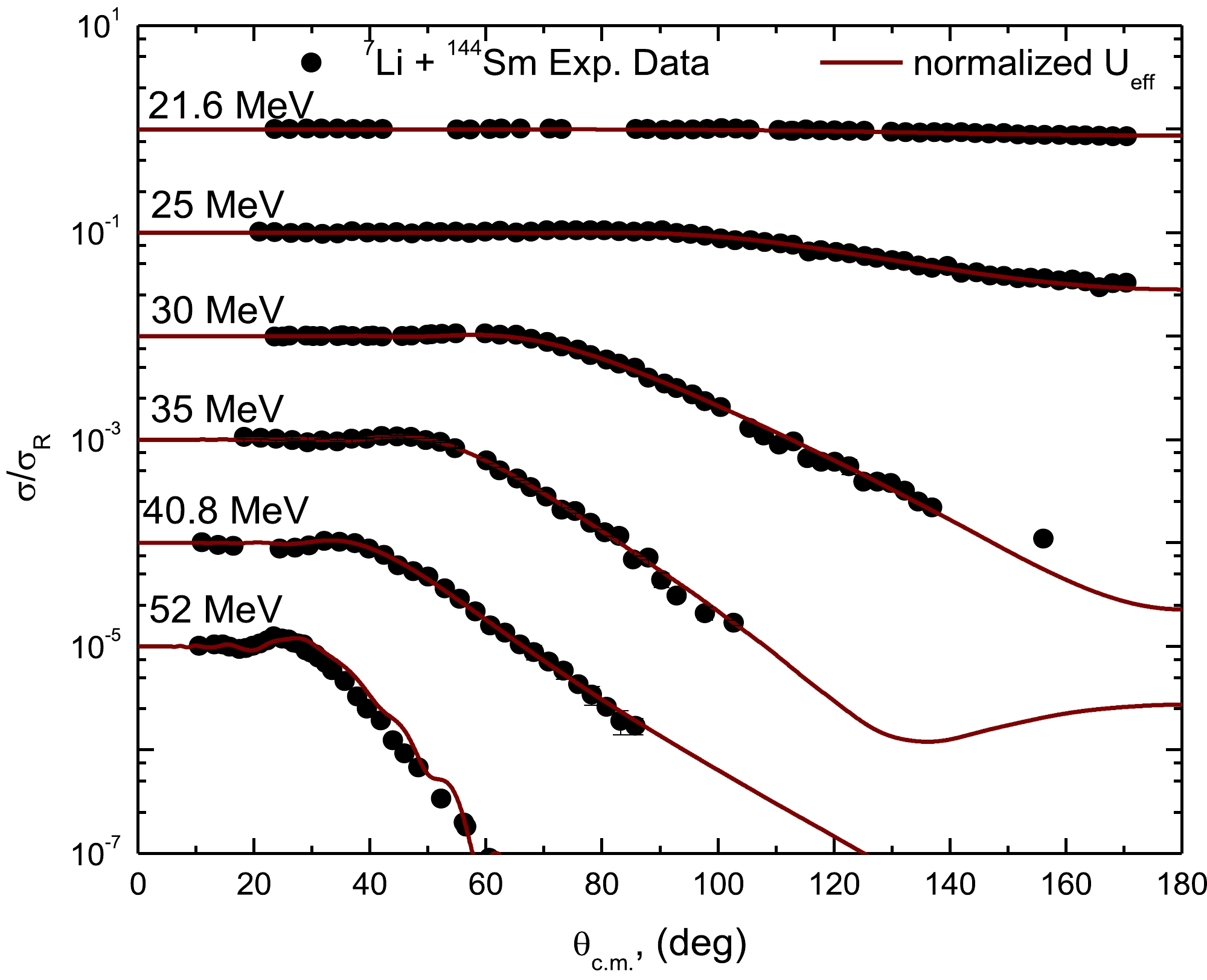
Figure 6.(color online)144Sm(7Li,7Li)144Sm experimental ADs versus the calculations within the normalizedUeffatElab= 21.6, 25, 30, 35, 40.8, and 52 MeV.
E/MeV NReff NIeff χ2/N 21.6 1.711±0.047 0.292±0.008 2.3 22.1 1.664±0.008 0.208±0.007 2.4 22.6 1.803±0.009 0.253±0.006 2.2 23 1.953±0.006 0.204±0.016 0.8 25 1.634±0.009 0.277±0.017 1.6 27 1.483±0.018 0.438±0.011 2.7 29 1.449±0.018 0.568±0.011 4.9 30 1.495±0.012 0.486±0.011 2.1 32 1.586±0.017 0.489±0.017 1.4 35 1.308±0.021 0.489±0.013 2.5 40.8 1.029±0.034 0.794±0.053 0.9 52 0.658±0.001 0.189±0.006 7.1 Table 4.OptimalNReffandNIeffvalues extracted from the theoretical computations within the normalizedUeff.
The energy dependence on theJVandJWvalues extracted from the various implemented potentials showed a nearly consistent pattern despite the different numerical values, as shown inFigs. 7and8. The studied dependence could be useful for identifying the presence or absence of the usual TA, which is identified as a bell-shaped peak in the real potential and a dramatic reduction in the strength of the imaginary potential as the energy reduces below the barrier. As shown inFig. 8, there was no dramatic reduction in theJWvalues as the energy decreased below the barrier; theJWvalues demonstrated an increasing trend rather than dropping to zero as it approached the barrier, especially for those extracted from the calculations within SPP. This analysis demonstrates the absence of the typical TA, and that the BTA is well presented in the7Li +144Sm system.
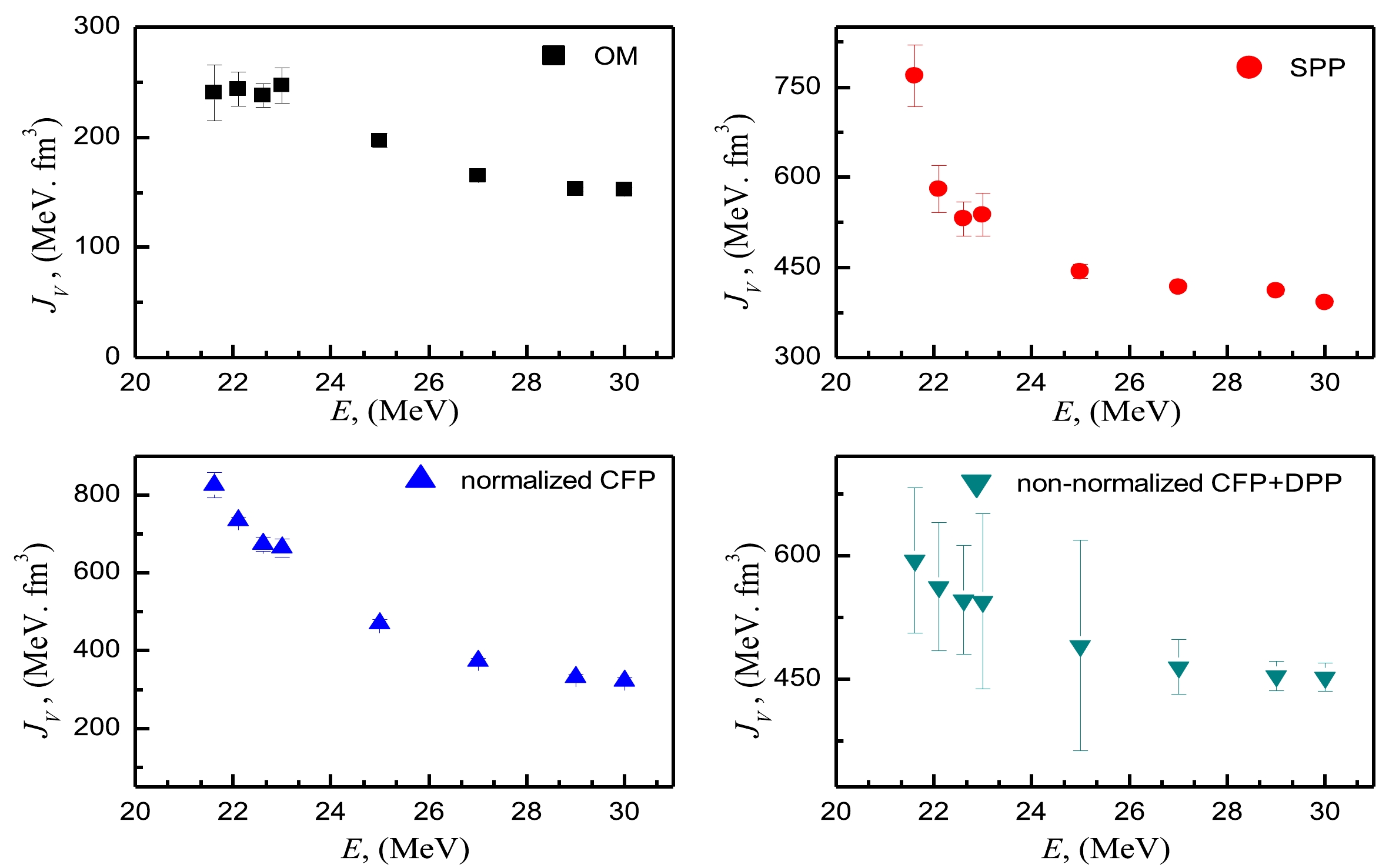
Figure 7.(color online) Energy dependence on theJVvalues extracted from the various applied potentials.
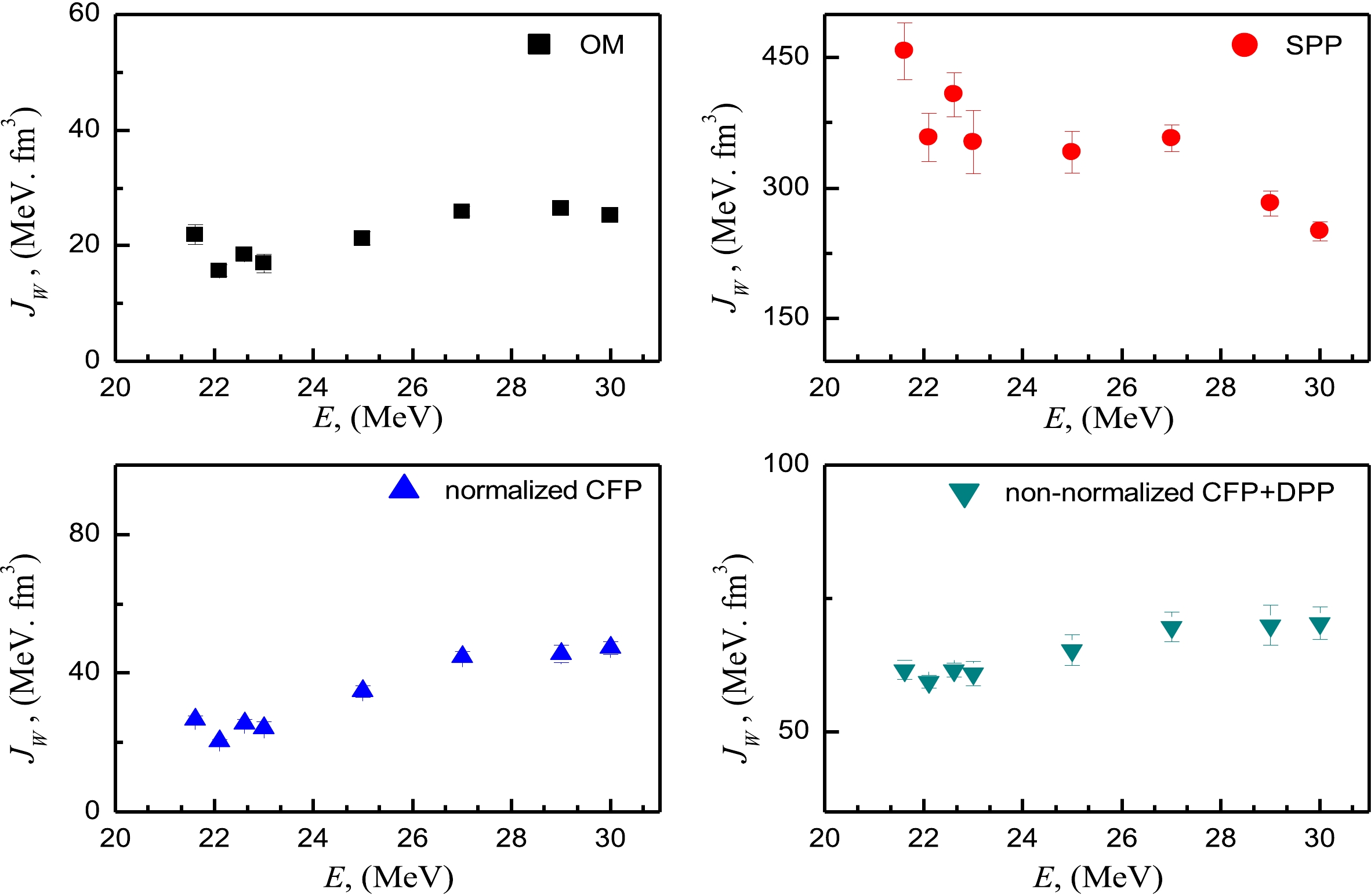
Figure 8.(color online) Same as Fig. 7, but for the energy dependence on theJWvalues.
Within the framework of the various employed approaches, we investigated the energy dependence on the extracted σRvalues, as shown inFig. 9. A commonly utilized reduction approach [62–64] was employed to clarify the comparison of the total reaction cross sections for the system under consideration. The reduced cross section is scaled as
${\sigma _{\rm red}} = \dfrac{{{\sigma _R}}}{{\left( {A_P^{1/3} + A_T^{1/3}} \right)}}$ and the reduced energy is scaled as${E_{\rm red}} = {E_{\rm c.m.}}\dfrac{{A_P^{1/3} + A_T^{1/3}}}{{{Z_P}{Z_T}}}$ . The symbolsPandTdenote the projectile and target, respectively;σRdenotes the total reaction cross section;Zdenotes the charge; andAdenotes the masses of the involved nuclei.Figure 9illustrates the reduced energy dependence on the extracted reduced reaction cross sections for the7Li +144Sm system as well as for the7Li +28Si [56] and7Li +58Ni [42] systems. The black dashed curve in the figure represents the energy dependency based on the Wong formula [64], which has the following form: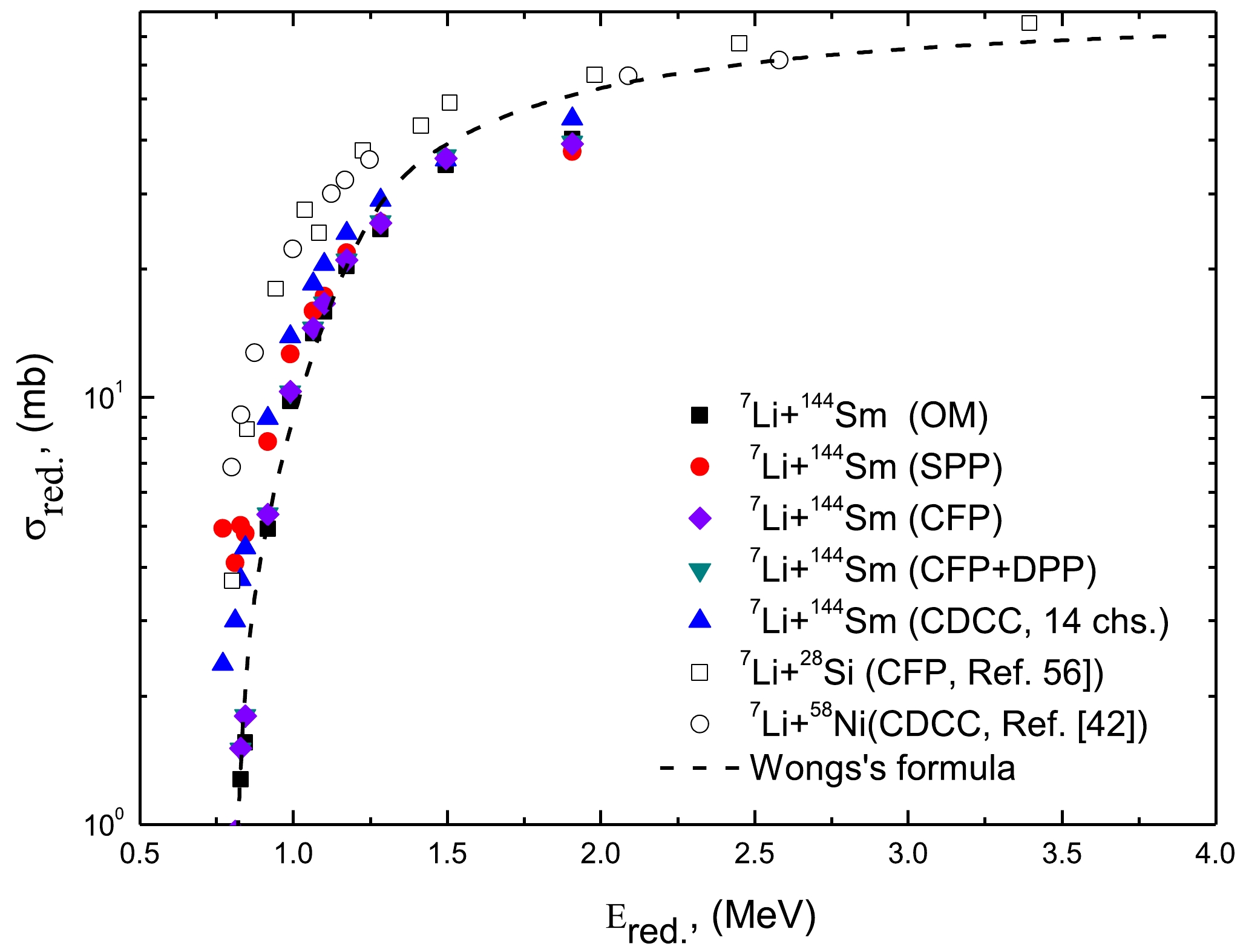
$ {\sigma _{\rm red}} = \frac{{{\varepsilon _0}r_0^2}}{{2{E_{\rm red}}}}\ln \left[ {1 + \exp \left( {\frac{{2\pi \left( {{E_{\rm red}} - {V_{\rm red}}} \right)}}{{{\varepsilon _0}}}} \right)} \right], $

(11) where
$ {\varepsilon _0} = \hbar {\omega _0}\dfrac{{A_P^{1/3} + A_T^{1/3}}}{{{Z_P}{Z_T}}} $ ,${V_{\rm red}} = {V_0}\dfrac{{A_P^{1/3} + A_T^{1/3}}}{{{Z_P}{Z_T}}}$ , and${E_{\rm red}} = {E_{\rm c.m.}}\dfrac{{A_P^{1/3} + A_T^{1/3}}}{{{Z_P}{Z_T}}}$ . The parameters of the Wong model were used with the fitting parameters$ {\varepsilon _0} $ = 0.178,r0= 0.13 fm, and${V_{\rm red}}$ = 0.83 MeV. However, the reliability of these fit parameters may be limited owing to the scarcity of data. It is clearly shown that the extractedσRvalues exhibit an increasing trend as the energy increased, and they are nearly consistent except for the extractedσRvalues from the CDCC computations, which showed a remarked increase, especially at the low energies studied, mainly owing to the breakup effects of7Li.To observe the effect of channel coupling on the7Li +144Sm AD atElab= 40.8 MeV, we compared the 1 channel (1 Ch) CDCC calculation to those of the 4 and 14 channels, as shown inFig. 10. As expected, the more channels were coupled, the better fitting the achieved. Further, one of the unsettled issues observed in nuclear reactions induced by the weakly bound clusterized nuclei such as7Li projectiles is the origin of the incomplete fusion and large α particle production. A few years ago, the most accepted explanation for the aforementioned behavior was the breakup intoα+tstructure followed by the capture of triton (t). In recent studies [65,66], this issue was investigated through pioneering experimental measurements for the7Li +93Nb and7Li +209Bi systems, respectively, allowing, for the first time, a significant population of the region to be accessible only to the direct triton stripping process and not to breakup followed by the capture of triton. The main conclusion drawn from these studies was the dominance of the direct cluster-stripping mechanism in the large alpha production. To further study this effect on the considered7Li +144Sm AD atElab= 40.8 MeV, we studied the breakup effect and the combined effects of breakup and triton transfer on the elastic scattering channel, as depicted inFig. 10.
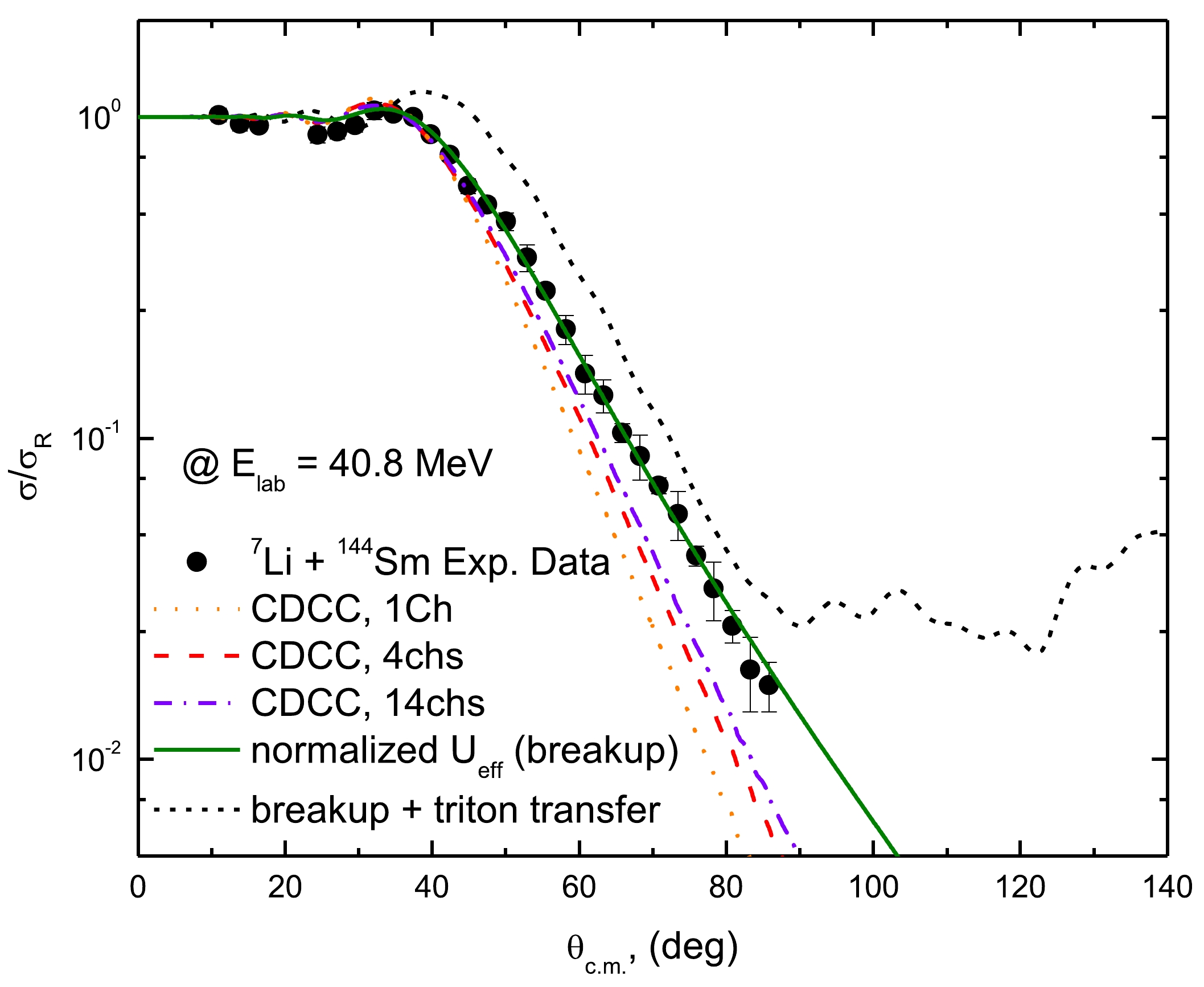
Figure 10.(color online)144Sm(7Li,7Li)144Sm experimental AD atElab= 40.8 MeV versus the 1-channel (dotted curve), 4-channels (dashed curve), and 14-channels (dashed dotted curve) CDCC computations. The figure also demonstrates the effect of breakup (solid curve) in comparison with the combined effects of breakup and triton transfer (short dashed curve).
The triton was assumed to be transferred as a single entity from the7Li ground state to at+144Sm state f147Eu. The potential for the entrance channel (7Li +144Sm) is the normalizedUeffatElab= 40.8 MeV (with normalizations,NReff= 1.029 andNReff= 0.794), which considers the7Li breakup effect. For the exit channel (t+147Eu), the SPP was employed with the standard form (NRSPP= 1.0 andNISPP= 0.78). The bound state potential for the configurations7Li→α+tand147Eu→144Sm +twere taken in the standard WS form withRV= 1.25,aV= 0.65 fm and the depth was adjusted to reproduce the binding energies for the considered clusters, 2.467 and 10.529 MeV, respectively. The spectroscopic amplitudes for the
$ \left\langle {{{}^{\text{7}}{\text{Li}}}} \mathrel{\left | {\vphantom {{{}^{\text{7}}{\text{Li}}} {\alpha + t}}} \right. } {{\alpha + t}} \right\rangle $ and$ \left\langle {{{}^{{\text{147}}}{\text{Eu}}}} \mathrel{\left | {\vphantom {{{}^{{\text{147}}}{\text{Eu}}} {^{144}{\text{Sm}} + t}}} \right. } {{^{144}{\text{Sm}} + t}} \right\rangle $ overlaps were taken as unity. The calculation, considering the combined effects of breakup and triton transfer, demonstrated a substantial increase in the cross-section values, indicating that there is a significant impact from the triton transfer mechanism. -
The study provides a thorough analysis of the existing7Li +144Sm ADs at energies comparable to the barrier energyVB, utilizing various potentials and approaches starting from the simplest WS volume-shaped phenomenological potential of two changeable parameters (V0andW0) and fixed geometrical parameters. As a result, either the presence or absence of TA may be indicated by the energy dependence on both theV0andW0values. The analysis highlighted the presence of the BTA behavior; the imaginary potential depth exhibits a non-vanishing trend as the energy reduces below theVB, which agrees with the findings of Refs. [9−11,17] and contradicts those of Refs. [12-14].
The analysis within the SPP revealed the following features. The imaginary SPP strength showed a remarked increase as the energy reduced belowVB. Therefore, the analysis using the SPP approach confirmed the presence of the BTA. In addition, the analysis revealed the need to reduce the real SPP strength by ~ 31% in order to fairly reproduce the7Li +144Sm ADs.
The considered data were reanalyzed later within the CFM by considering the7Li →t+αcluster nature. The CFM analysis revealed the need to reduce the real CFP strength by ~ 38% to adequately reproduce the7Li +144Sm ADs, while confirming the presence of the BTA phenomenon. The real CFP strength showed an increasing trend as the energy decreased below the barrier. This rise in the real CFP strength was accompanied by a non-vanishing trend in the imaginary CFP strength.
Generally, the analyses conducted within the SPP and CFP revealed the necessity of reducing the real potential strength to accurately reproduce the data under consideration. This observed behavior originates from the strong coupling to the7Li breakup continuum states, which generates a repulsive DPP. Two different strategies were followed for modeling the coupling effects: by introducing an additional DPP and by carrying out the full microscopic CDCC method. The CDCC computations revealed that the coupling to the resonant states has the most significant contribution. The analyses also showed that both the7Li breakup and the triton transfer mechanism have significant impacts on the elastic channel data.
Dynamics of7Li breakup and its influence on elastic scattering: a study of7Li +144Sm system
- Received Date:2023-09-07
- Available Online:2024-02-15
Abstract:The angular distributions of7Li +144Sm elastic scattering over the energy range of 21.6–52 MeV are reanalyzed utilizing various interaction potentials. The analysis aims to study the consistency of the implemented potentials in representing the considered data and investigate the cluster nature of the weakly bound7Li projectile. This will aid in the better understanding the impacts of7Li breakup on the elastic scattering channel. Strong coupling to the breakup channel has a substantial impact on the elastic data and reproduces a repulsive dynamical polarization potential, which drastically diminishes the real potential strength. This reported impact was simulated by introducing a semi-microscopic repulsive DPP and by implementing the method of continuum discretized coupled channels. The analysis was also extended to understand the impact of triton transfer on the elastic scattering data.


 DownLoad: