


 Abstract
 HTML
HTML Reference
 Related
 PDF
PDF


-
Exploring the properties of strongly interacting matter is a fundamental topic in high energy nuclear physics. In particular, from a theoretical perspective, it is crucial to study the breaking and restoration of chiral symmetry to understand such matter. As we know, the (approximate) chiral symmetry is believed to be good in the light quark sector. Unfortunately, the perturbative method becomes unavailable for quantum chromodynamics (QCD) in low energy regimes since the strong coupling constant is no longer small enough. In addition, the lattice QCD cannot handle the numerical calculations at finite chemical potential because of the famous sign problem. Hence, effective theories and models are needed to investigate the QCD matter. Especially based on the chiral symmetry and chiral symmetry breaking of QCD, the Nambu-Jona-Lasinio (NJL) model [1,2] is one of the most useful tools to study the properties of strongly interacting matter, such as the dynamical breaking/restoration of the chiral symmetry and the masses of light mesons.
One of the uncertainties of the NJL model is the way of dealing with the mean field approximation, and this issue has been well emphasized for a few decades [3]. Mathematically, the Fierz transform of the NJL model Lagrangian should be of equal importance as compared with the original NJL model Lagrangian, but they are treated unequally when applying the mean field approximation. Therefore, we rewrite the Lagrangian as
$ \mathcal{L}_{R} = (1-\alpha)\mathcal{L}+\alpha \mathcal{L}_F $ by introducing an arbitrary weighting parameterα, where$ \mathcal{L} $ is the original NJL Lagrangian, and$ \mathcal{L}_F $ is the Fierz transform of$ \mathcal{L} $ . It has been discussed that there are no physical requirements for the choice ofαvalue, and the value ofαcould be determined by astronomy observations, i.e., the properties of compact stars [4−7], which impose constraints on the QCD equations of state.In this paper, we discuss a possible alternative way of predicting the value ofαusing the properties of light mesons. As we know, the mass spectra of pseudoscalar mesonπand scalar mesonσhave been studied in the NJL type model for the last few dozen years [8]. Sinceπandσmesons are chiral partners, the mass difference between them carries the information of the chiral symmetry breaking and restoration. Therefore, apart from the indirect measurement on the equation of states of compact stars, the measurement of the meson masses in the heavy ion collision experiments is an alternative method to extract the information of the weighting parameterα, as well as that of the chiral phase transition in dense QCD matter.
This paper is organized as follows. We begin with the general formalism in Sec. II, and then, the corresponding numerical results are presented in Sec. III. Finally, the conclusions are given in Sec. IV.
-
The redefined Lagrangian---the combination of the original Lagrangian
$ \mathcal{L} $ in the two-flavor NJL model and the corresponding Fierz transformed Lagrangian$ \mathcal{L}_F $ is given by [4]$ \begin{array}{*{20}{l}} \mathcal{L}_{R} = (1-\alpha)\mathcal{L}+\alpha \mathcal{L}_F, \end{array} $

(1) where
$ \begin{array}{*{20}{l}} \mathcal{L}= \bar{\psi}({\rm i} \partial /-m) \psi+ G\left[(\bar{\psi} \psi)^{2}+\left(\bar{\psi} {\rm i} \gamma^{5} \cdot \tau \psi\right)^{2}\right] \end{array} $

(2) and
$ \begin{aligned}[b] \mathcal{L}_F=& \bar{\psi}({\rm i} \partial /-m) \psi+ \frac{G}{8 N_{c}}\left[2(\bar{\psi} \psi)^{2}+2\left(\bar{\psi} {\rm i} \gamma^{5} \tau \psi\right)^{2}-2(\psi \tau \psi)^{2}\right.\\& -2\left(\bar{\psi} {\rm i} \gamma^{5} \psi\right)^{2}-4\left(\bar{\psi} \gamma^{\mu} \psi\right)^{2}-4\left(\bar{\psi} {\rm i} \gamma^{\mu} \gamma^{5} \psi\right)^{2}\\&+\left.\left(\bar{\psi} \sigma^{2 m} \psi\right)^{2}-\left(\bar{\psi} \sigma^{\mu \nu} \tau \psi\right)^{2}\right], \end{aligned} $

(3) along with the current quark masses
$m = {\rm diag}(m_u,m_d)$ .By applying the mean field approximation to the Lagrangian and dropping the irrelevant part, we get the effective Lagrangian
$ \left<\mathcal{L}_R\right>_{\rm eff}=\bar{\psi}({\rm i} \partial /-M)\psi+G\left(1-\alpha+\frac{\alpha}{4N_c}\right)\sigma^2+\frac{\alpha G}{2 N_c}n^2, $

(4) where
$ \sigma = \left<\bar{\psi}\psi\right> $ is the quark condensation, and the quark number density is$ n = \left<\psi^{\dagger}\psi\right> $ . In addition, we introduce the constituent quark mass$ M = m - 2G\left(1-\alpha+\dfrac{\alpha}{4N_c}\right)\sigma $ and the renormalized chemical potential$ \mu_r = \mu -\dfrac{\alpha G}{N_c}n $ .Thus, the corresponding thermodynamic potential density takes the form
$ \begin{aligned}[b] \Omega =& -\frac{T}{V}\ln Z = G\left(1-\alpha+\frac{\alpha}{4N_c}\right)\sigma^2 - \frac{\alpha G}{2 N_c} n^2 \\ & -\frac{N_c N_f}{\pi^2}\int_{0}^{\Lambda}{\rm d}p p^2\Bigg\{E(M,p)\\&+T \ln\left[1+\exp\left(-\frac{E(M,p)+\mu_r}{T}\right)\right] \\&+T \ln\left[1+\exp\left(-\frac{E(M,p)-\mu_r}{T}\right)\right] \Bigg\}. \end{aligned} $

(5) Here, the energy dispersion relation
$E(M,p)= \sqrt{M^2+p^2}$ and the Fermi-Dirac distribution functions$ n(p,\mu)=\frac{1}{1+\exp\left(\frac{E(M,p)-\mu}{T}\right)}, \quad \bar{n}(p,\mu)=\frac{1}{1+\exp\left(\frac{E(M,p)+\mu}{T}\right)}. $

(6) Then, the gap equations are determined by
$ \dfrac{\partial \Omega}{\partial M} = \dfrac{\partial \Omega}{\partial \mu_r} = 0 $ , which can be written into the exact forms$ \sigma + \frac{N_c N_f M}{\pi^2}\int_{0}^{\Lambda}\frac{{\rm d}p p^2}{E(M,p)} \left[1- n(p,\mu_r)-\bar{n}(p,\mu_r)\right]=0 \tag{7a}$

and
$ n- \frac{N_c N_f M}{\pi^2}\int_{0}^{\Lambda}\frac{{\rm d}p p^2}{E(M,p)} \left[ n(p,\mu_r)-\bar{n}(p,\mu_r)\right]=0. \tag{7b}$

In contrast, to calculate the meson masses, we obtain the dispersion relations forπandσmesons in the random-phase approximation (RPA),
$ \begin{aligned}[b] &1 - 2\left(1-\alpha+\frac{\alpha}{4N_c}\right)G\frac{N_c N_f}{\pi^2}P\\& \times \int_{0}^{\Lambda}\frac{p^2}{E(M,p)}\left(1-\frac{M_{\pi}^2}{M_{\pi}^2-4E(M,p)^2}\right)\\& \times \left(1- n(p,\mu_r)- \bar{n}(p,\mu_r)\right){\rm d}p = 0, \end{aligned}\tag{8a} $

and
$ \begin{aligned}[b]& 1 - 2\left(1-\alpha+\frac{\alpha}{4N_c}\right)G\frac{N_c N_f}{\pi^2}P\\&\times\int_{0}^{\Lambda}\frac{p^2}{E(M,p)}\left(1-\frac{M_{\sigma}^2-4M^2}{M_{\sigma}^2-4E(M,p)^2}\right)\\&\times\left(1- n(p,\mu_r)-\bar{n}(p,\mu_r)\right){\rm d}p = 0. \end{aligned}\tag{8b} $

-
In this section, we calculate the numerical results for the pole masses of theπandσmesons. Firstly, by fitting the physical pion mass
$ M_{\pi} = 137 $ MeV, decay constant$ f_{\pi} = 93 $ MeV, and quark condensate$\langle \bar{u}u\rangle =-(247)^3 \,\, \rm{MeV}^3$ , we obtain the current mass of light quarks$ m = 5.5 $ MeV, the three momentum hard cutoff$ \Lambda = 631 $ MeV, and the coupling constant$ g = 5.074^{-6} $ MeV$ ^{-1} $ in the conventional NJL model [8]. Then, the new coupling constant G in the modified NJL model is given by$ G = \frac{1+\dfrac{1}{N_c}}{1-\alpha+\dfrac{\alpha}{4N_c}}g. $

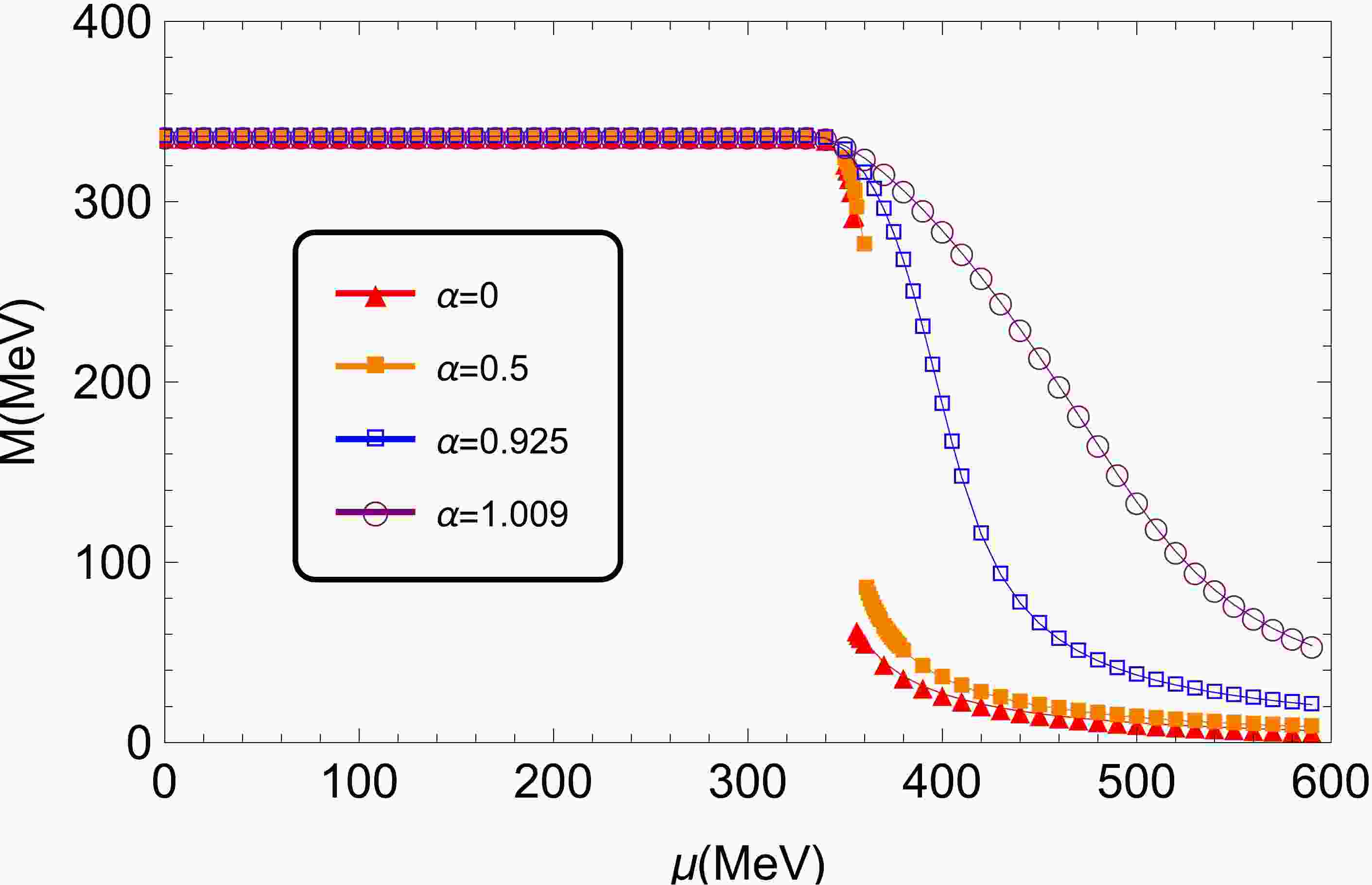
(9) The constituent quark massesMas a function of quark chemical potentialμat zero temperature but with some different weighting constantsαare plotted inFig. 1. Evidently, within our model parameters, the order of chiral phase transition changes from first order to crossover asαincreases from zero: explicitly, the transitions are first-order phase transitions at
$ \alpha = 0, 0.5 $ , while they are crossover transitions at$ \alpha = 0.925,~ 1.009 $ . Hence, there must be a threshold value$ \alpha_c $ between 0.5 and 0.925 where the termination of the first-order transition happens. This has also been discussed in Ref. [4] by using different NJL parameters and is further investigated in Ref. [9] with the same parameters. Moreover, the (pseudo) critical chemical potential$ \mu_c $ at zero temperature is found to be located at approximately 354, 360, 397, and 474 MeV, respectively, by analyzing the data inFig. 1numerically for these four different values ofαfrom 0 to 1.009. Notably, when$ \mu \lesssim340 $ MeV, the constituent quark massMremains constant for all different values ofαat zero temperature. As for$ \mu \gtrsim340 $ MeV, we can see that the smaller the value ofα, the faster the decrease in constituent quark mass. Therefore, the (approximate) chiral symmetry will be fully restored at a larger chemical potential whenαincreases.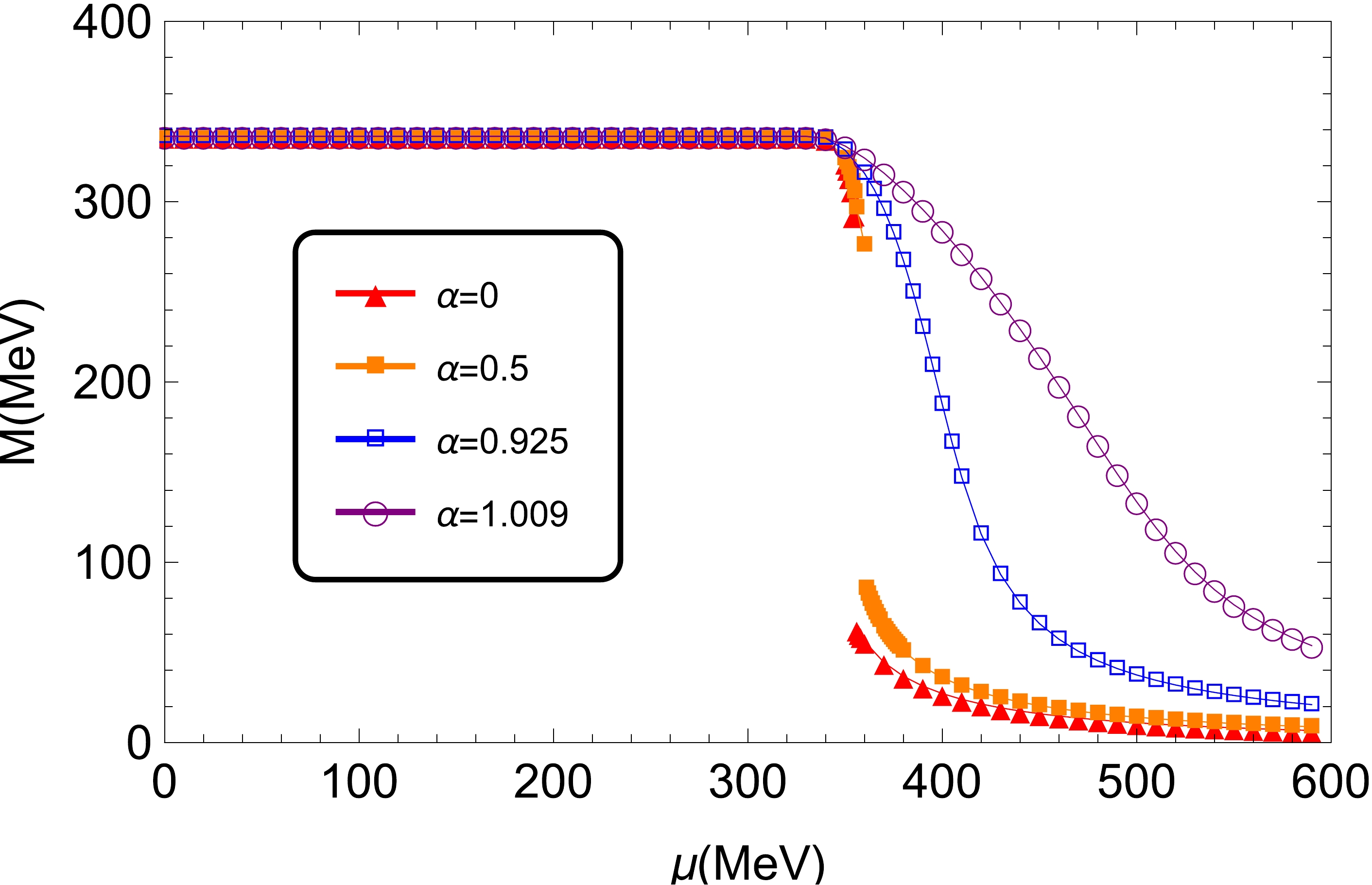
Figure 1.(color online) Constituent quark massMas a function of the chemical potentialμat
$ T = 0 $ and$ \alpha = $ 0, 0.5, 0.925 and 1.009, respectively.The pole masses ofπandσmesons as functions of quark chemical potential at zero temperature are given inFig. 2, obtained by Eqs. (8a) and (8b) with different weighting constantsα. Note that, when
$ \alpha = 0 $ , our results coincide with the previous results in the conventional mean field approximation [8]. Similar to the constituent quark mass, the meson masses keep constant as long as the chemical potential is smaller than$ 340 $ MeV. When the chemical potential reaches$ 340 $ MeV, the pion mass begins to increase withμ, while theσmeson mass decreases first and then increases. Moreover, in the region of$ \mu \gtrsim340 $ MeV, the smaller the value ofα, the faster the change in meson masses. In addition, there is a jump at$ \mu_c $ for smallαvalues where a first-order chiral phase transition happens.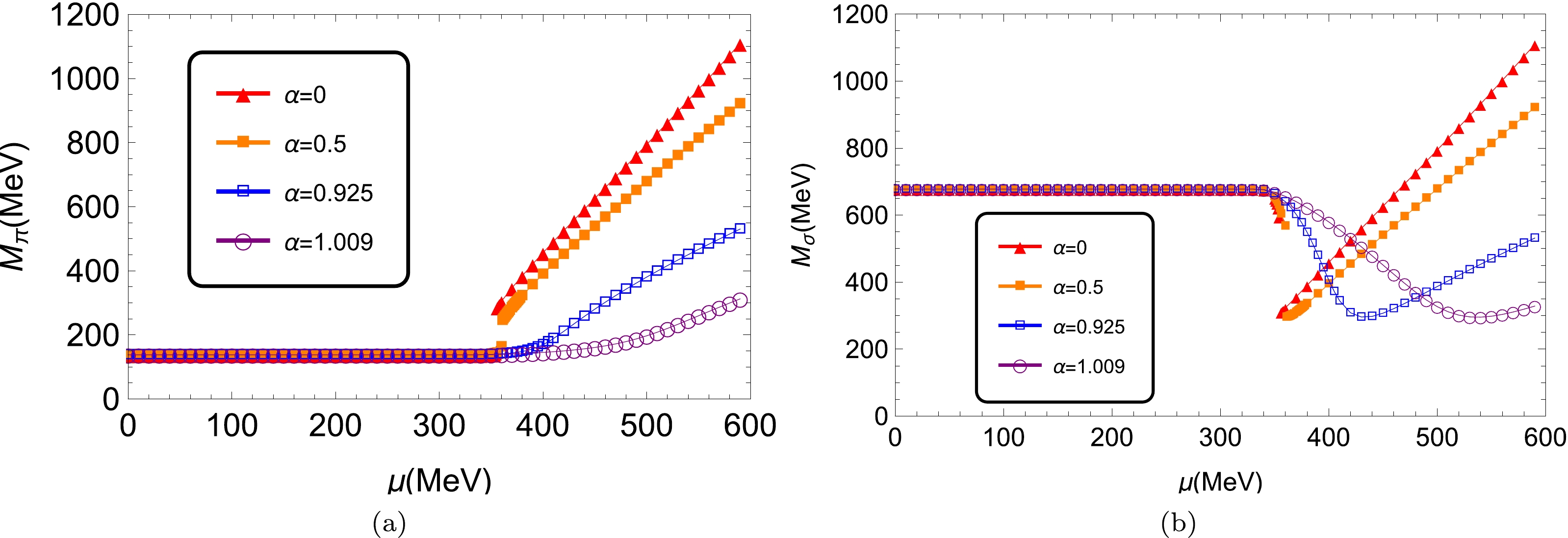
Figure 2.(color online) Pole masses of pion (left panel) andσmeson (right panel) as functions of chemical potential at
$ T = 0 $ and$ \alpha = $ 0, 0.5, 0.925 and 1.009.The pole masses ofπandσmesons, as well as twice the constituent quark mass for some selectedα,are plotted inFig. 3. Note that the Mott chemical potential is defined by
$ M_{\pi}(\mu_{\rm Mott}) = 2M(\mu_{\rm Mott}) $ . The Mott transition is the signification where pions dissociate to the unbound resonance state. As discussed in Ref. [10], when the chiral phase transition is a smooth crossover, instead of the definition of the pseudo critical point, the Mott transition point is a better way to characterize the chiral crossover. In our case, whenαis small,$\mu_{\rm Mott}$ and$ \mu_c $ are almost identical. Whenαis large,$\mu_{\rm Mott} > \mu_c$ , and the differences are larger whenαis larger ($\mu_{\rm Mott} = 354,\; 360,\; 420\; \text{and}\; 519$ MeV for$ \alpha = 0,\; 0.5,\; 0.925\; \text{and}\; 1.009 $ , respectively). The smoother the phase transition (αis larger in our model), the larger the difference between$\mu_{\rm Mott}$ and$ \mu_c $ . For theσmeson, the dissociation chemical potential is defined as$ m_{\sigma}(\mu_d) = 2m_{\pi}(\mu_d) $ . From our data,$ \mu_d =354,\; 360,\; 402,\; 483 $ MeV for$ \alpha = 0,\; 0.5,\; 0.925\; \text{and}\; 1.009 $ , respectively. The difference between$ \mu_d $ and$ \mu_c $ is also enhanced whenαincreases, but the difference is small even whenαis larger than 1. At a very large chemical potential, the pole mass of theσmeson and pion are almost identical (they are the same in the chiral limit, while for the current massive light quark mass,$ M_{\pi}^2 = M_{\sigma}^2 - 4 m^2 $ ). Evidently, the larger the value ofα, the larger the chemical potential needed to attain such a feature.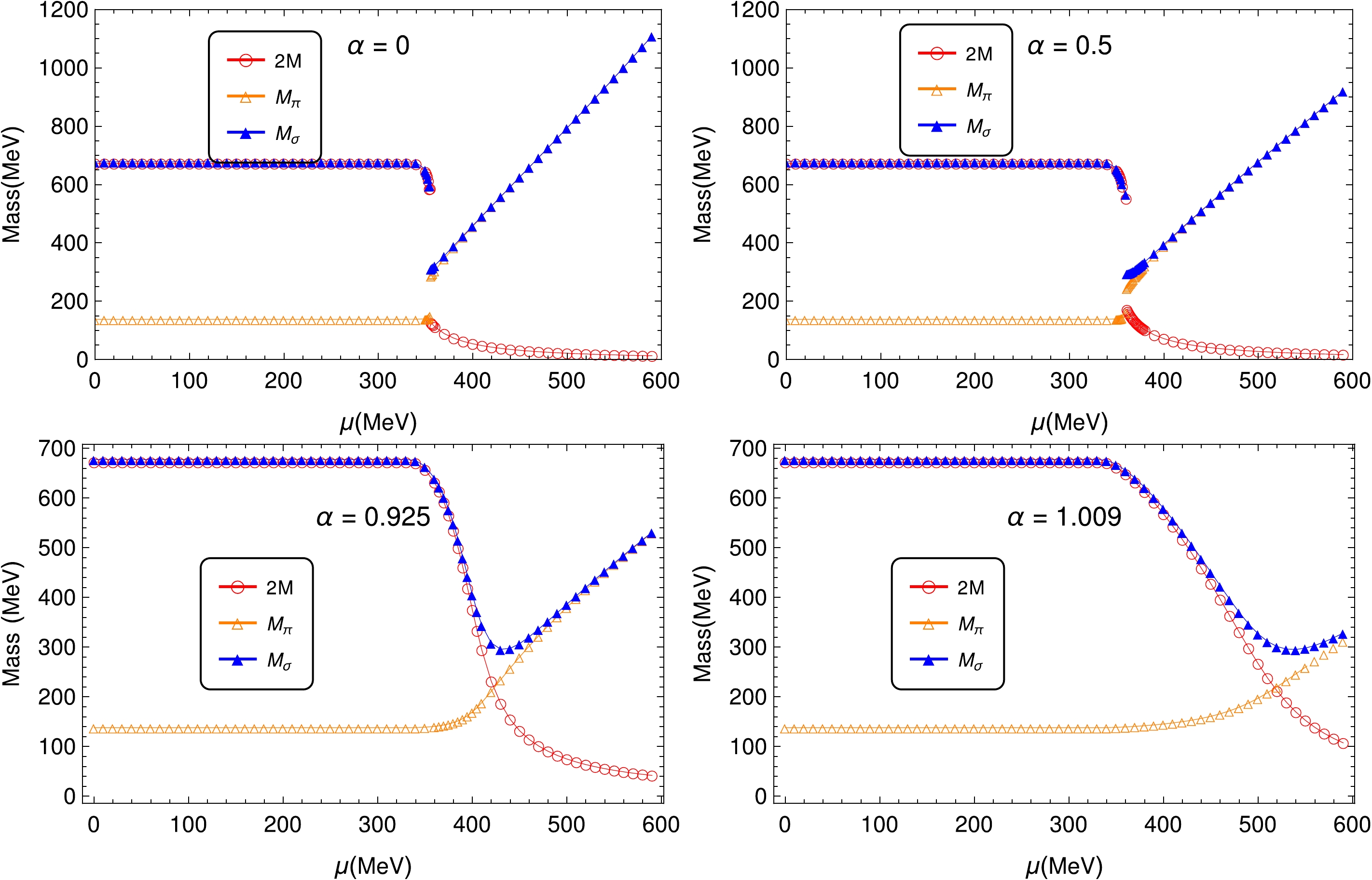
Figure 3.(color online) Pole masses ofσmeson and pion and twice the constituent quark mass as functions of chemical potential at
$ T = 0 $ and$ \alpha\; =\; 0,\; 0.5,\; 0.925\; \text{and}\; 1.009 $ .To further clarify the impact ofαon the Mott chemical potential and dissociation chemical potential, we plot them as functions ofαinFig. 4. The Mott chemical potential and the dissociation chemical potential are shown in the left and right panels, respectively. Both functions display an exponential increase withα. Additionally, the Mott chemical potential is higher than the dissociation chemical potential for large values ofα. These results support the discussion presented in the previous paragraph.
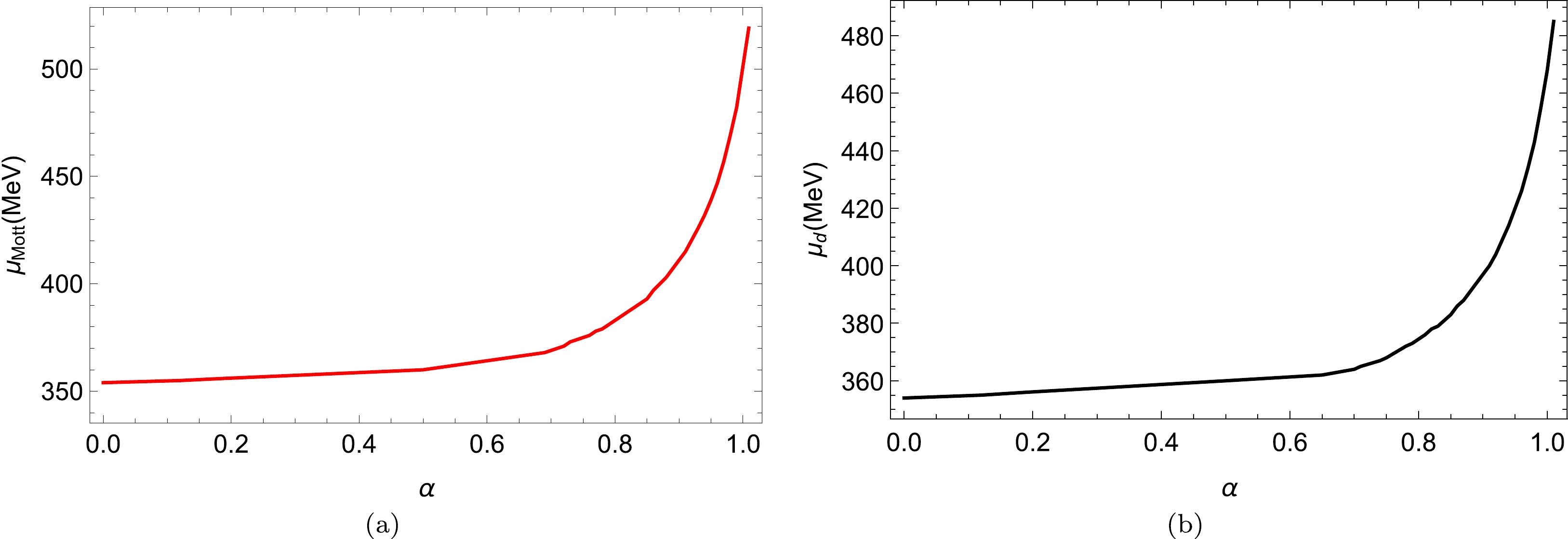
Figure 4.(color online) Mott chemical potential (left panel) and dissociation chemical potential (right panel) as functions ofα.
Additionally, for the finite temperature case, the only difference from the zero temperature case is that the first-order phase transition regime becomes smaller as the temperature increases. The discontinuity in the meson masses disappears for all values ofαabove a certain temperature. We demonstrate this by plotting the pion andσmeson masses at a temperature of
$ T = 100 $ MeV inFig. 5. Our model predicts that, at this temperature, the phase transition is a crossover for all values ofα. The meson masses do not exhibit a "jump" as a function of the chemical potential, and the rest of the physical behaviors coincide with our zero-temperature results.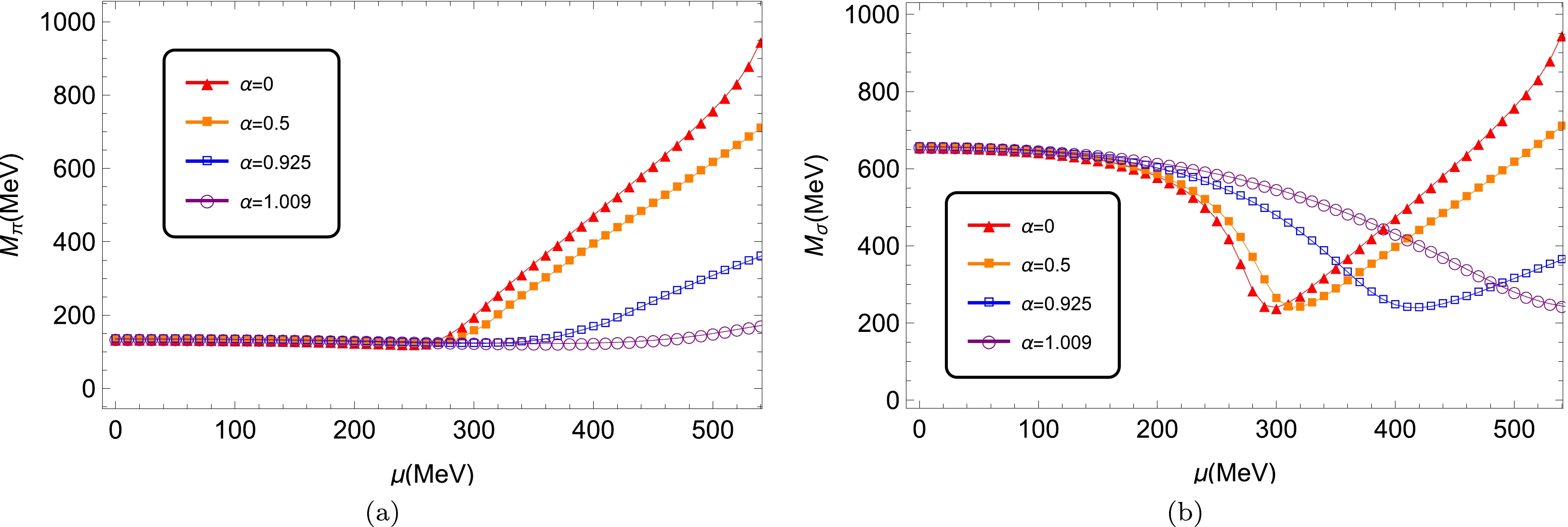
Figure 5.(color online) Pole masses of pion (left panel) andσmeson (right panel) as functions of chemical potential at
$ T = 100 $ MeV and$ \alpha\; =\; 0,\; 0.5,\; 0.925\; \text{and}\; 1.009 $ . -
In this study, we investigate the pole masses of pions andσmesons as functions of the chemical potentialμin the context of the Nambu-Jona-Lasinio (NJL) model using a new self-consistent mean field approximation method. We find that the mass spectrum of mesons can provide insight into the chiral phase transition of QCD matter. In particular, we observe that, at
$ T = 0 $ , the chiral phase transition can be either first order or a crossover depending on the value ofα. Additionally, the difference between the Mott transition and chiral phase transition becomes more significant asαincreases, and we find that the temperature can help restore chiral symmetry, leading to a continuous mass spectrum for any value ofα. In a high density environment such as in the core of compact stars, the chemical potential of quark matter should reach several hundreds of MeV. The weighting constantαis an important feature in studying the dense matter, in addition to the indirect measurements that constrain the equation of state (EOS) of neutron stars. Our results of theπandσmesons show significant differences in meson properties with differentαvalues.We suggest that the meson properties in collisions with a large chemical potential or in compact stars can be useful for studying the chiral phase transition of QCD matter. Furthermore, the meson mass differences for different values ofαcan be measured by studying the decay channels of the
$ \pi^0 $ andσmesons. Electromagnetic probes (photons and dileptons) have a long mean-free-path and minimal interactions with the medium in collision experiments, making them excellent choices to study the meson properties,e.g.,$ \pi^{0} \rightarrow \gamma+ \gamma $ and$ \pi^0\rightarrow \gamma + \gamma\rightarrow e^{+}+e^{-}+\gamma $ . In the future, electromagnetic probes may be used in high chemical potential collision experiments to study the meson properties. Additionally, if the "sign problem" can be solved, lattice calculations can provide a more straightforward way to determine the value ofαin the NJL model.
(Pseudo) Scalar mesons in a self-consistent NJL model
- Received Date:2023-06-08
- Available Online:2023-12-15
Abstract:In this study, we investigate the mass spectra ofπandσmesons at finite chemical potential using the self-consistent NJL model and the Fierz-transformed interaction Lagrangian. The model introduces an arbitrary parameterαto reflect the weights of the Fierz-transformed interaction channels. We show that, whenαexceeds a certain threshold value, the chiral phase transition transforms from a first-order one to a smooth crossover, which is evident from the behaviors of the chiral condensates and meson masses. Additionally, at a high chemical potential, the smaller the value ofα, the higher the masses of theπandσmesons. Moreover, the Mott and dissociation chemical potentials increase with the increase inα. Thus, the meson mass emerges as a valuable experimental observable for determining the value ofαand investigating the properties of the chiral phase transition in dense QCD matter.


 DownLoad: