


 Abstract
 HTML
HTML Reference
 Related
 PDF
PDF



-
Conventional studies onr-processes focus on producing heavy unstable nuclei. Among the thousands of publications, one may be impressed by the recent reviews [1–3].
The interesting aspects of the current study lie in the area ofr-processes that occur with light 1p-shell nuclei and are motivated by the concepts suggested in Refs. [4–6]. Kajinoet al.suggested networks for primordial nucleosynthesis in inhomogeneous Big Bang models in Ref. [4] and their further extension to the evolution of light elements in cosmic rays [5].
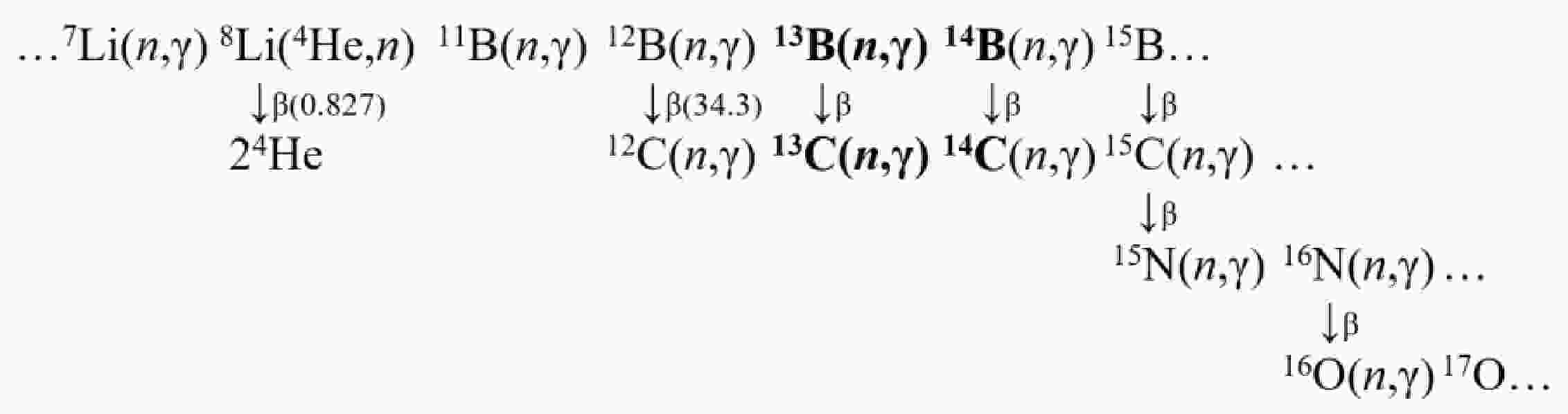
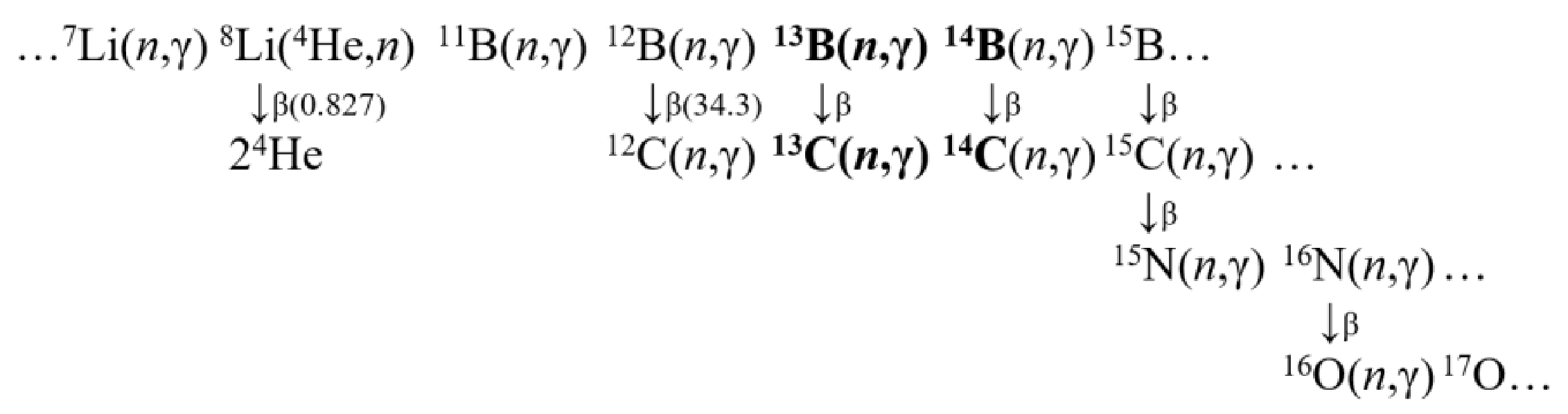
More than 20 years ago, Terasawaet al. raised the problem of the role of light neutron-rich nuclei (Z< 10) inr-process nucleosynthesis in supernovae [6]. In particular, we are interested in the possible branching of boron and carbon chains leading to the formation of heavier isotopes up to oxygen for the development of a primordial chain starting from7Li (see Fig. 6 in Ref. [7] and our illustration inFig. 1).
Further development of sensitivity studies on the (n,γ) reactions running through the neutron-rich boron11–14B and12–19C carbon isotopes was achieved by Sasaquiet al. [7], and these reactions have been included in heavy nuclei network production. Almost all reaction rates for the boron chains used in these model calculations were taken from [8], and their uncertainties were estimated to be at least a factor of two [7]. It turned out that only the13B(n,γ)14B process on boron isotopes exhibited zero impact on heavy element production.
We suggest a new estimation of the13B(n,γ)14B reaction rate within the modified potential cluster model (MPCM) approach, which significantly differs from the results of Ref. [8]. Therefore, we can provide reasons for revising the conclusions of [7] on the negligible role of the13B(n,γ)14B reaction in heavy nuclei network production.
A comparative analysis of the reaction rates of the processes inFig. 1is a way of defining the contribution of the13B(n,γ)14B reaction in the boron-carbon-nitrogen network. Our early MPCM research on neutron radiative capture reactions relevant to those inFig. 1is provided in the following references: the10B(n,γ)11B reaction is examined in Ref. [9], the reaction chain11B(n,γ)12B(n,γ)13B is considered in Refs. [10,11,12], we investigated12C(n,γ)13С in Ref. [13] and13С(n,γ)14С in Ref. [14],14С(n,γ)15С is not yet published, and research on the15N(n,γ)16N process is presented in Ref. [15].
For the reaction16O(n,γ)17O, the measured cross-section and its rate, calculated in the direct reaction capture model, are presented in the recent Ref. [16]. There are no data on the14B(n,γ)15B and16N(n,γ)17N reaction rates to date.
Experimental study of the13B(n,γ)14B reaction is presented using the only measurement of the neutron breakup of the15B isotope via Coulomb dissociation performed in inverse kinematics [17]. The total cross-section of13B(n,γ)14B is derived from the Coulomb breakup of15B and is very tentative. Therefore, theoretical model calculations are in high demand to fill the information gap on the13B(n,γ)14B reaction in boron chains as inFig. 1.
Another problem concerns the lack of well-defined information on the spectral structure of14B required to apply the MPCM. We use current data on the14B spectrum [18], as opposed to previous data from an earlier review [19], to classify the possible multipole structure of the corresponding cross-sections of present and future interest.
Interestingly, the reactions13B(n,γ)14B and13C(n,γ)14C are isobar-analogous, and the latter is examined in detail in Ref. [14]. Although14B and14C are not mirror nuclei, the Young diagrams reveal several common features of orbital symmetry. We exploit this fact while classifying the allowed and forbidden states (FS) in the discrete and continuum spectra ofn+13B channels.
Within the MPCM, the total cross-sections of13B(n,γ)14B radiative capture onto the ground state (GS) and first excited state (ES) of14B are calculated, as well as the reaction rates in the interval 0.01T9– 10T9. Based on the reaction rate interval, we evaluate the balance between14B synthesis via the radiative neutron capture reaction13B(n,γ)14B and13B decay inhibiting this synthesis.
This paper is organized as follows. Sec. II contains the MPCM presentation of14B in then +13B channel. In Sec. III, the total cross-sections of the13B(n,γ0+1)14B reaction are considered. In Sec. IV, we present then13B radiative capture reaction rate and compare the neutron radiative capture rates on10-13B and12-14C isotopes. We outline the conclusions in Sec. V. Appendix A includes the numerical values of then13B reaction rate, and Appendix B illustrates the computational procedure accuracy of the reaction rate calculations.
-
We preface the calculations of the reaction cross-sections with an analysis of the14B spectrum data, following Ref. [18]. The spectrum of selected levels of the14B nucleus is shown inFig. 2. The structure of the bound ground stateJπ, T= 2–, 2 is assigned as a combination of two main orbital components:
${\psi _{GS}} = {\alpha _S}\left| S \right\rangle + {\alpha _D}\left| D \right\rangle + ...$ , where the corresponding weights are${\alpha _S} = 0.71(5)$ and${\alpha _D} = 0.17(5)$ . In the present calculations, we consider theS-component only. As for the excitedJπ= 1–state, it is found to be the dominantS-component with a weight${\alpha _S} = 0.94(20)$ .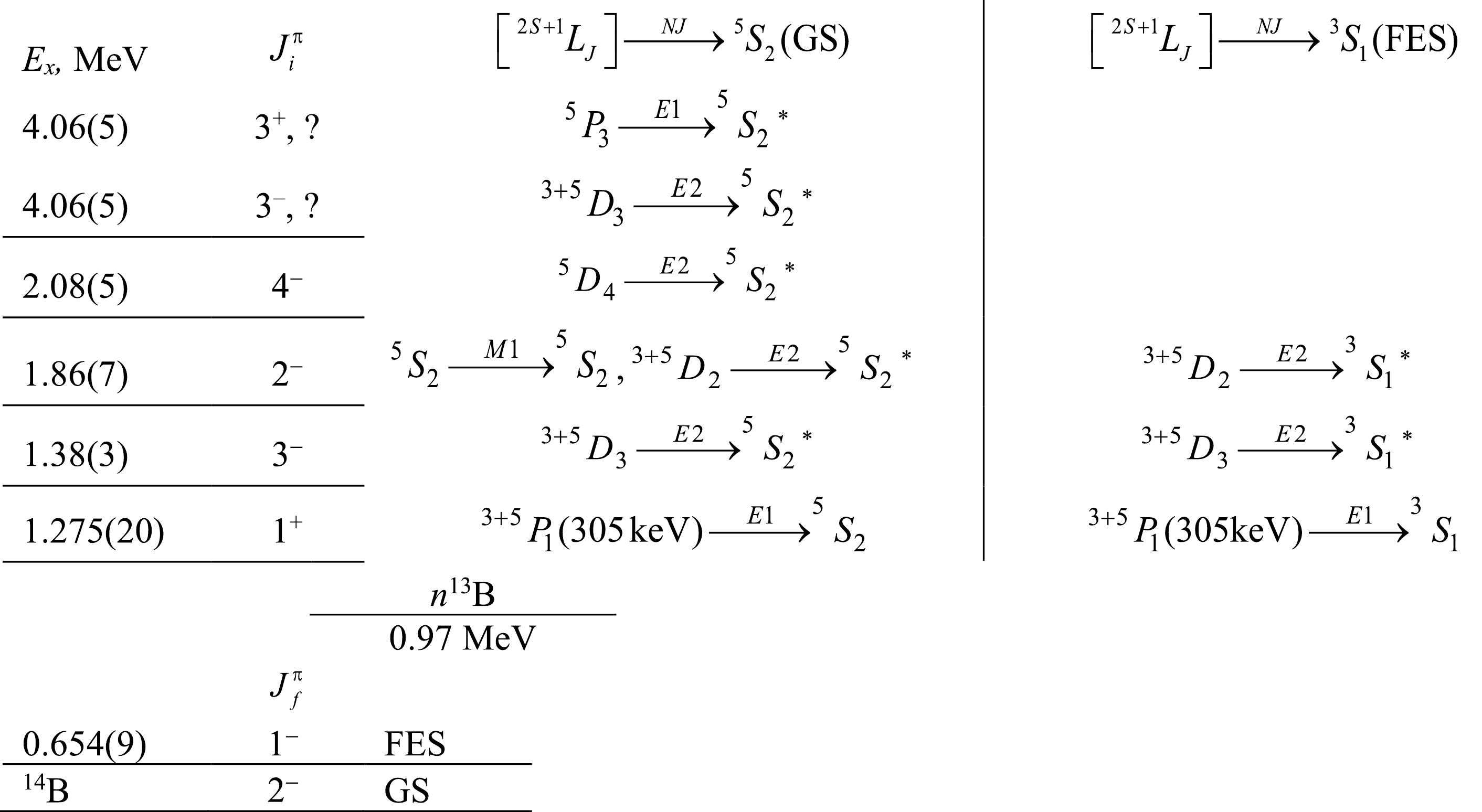
Figure 2.Spectrum of the14B nucleus in MeV [18]. * indicates the transitions we do not consider.
Now, let us comment on the resonance states in the spectrum of14B. The 1stresonance can be associated with the spin-mixed3+5P1wave at the energyEc.m.= 0.305(20) MeV becauseJπ= 3/2–for13B andJπ= 2–for14B. Radiative neutron capture from this state proceeds via theE1 transition to the ground5S2and excited3S1states.
The 2ndresonance hasJπ= 3–and may be excited at 0.41 MeV as a3+5D2state so that only theE2 transition may occur. Because we are operating within the long-wave approximation for the electromagnetic interaction Hamiltonian here and henceforth, we do not consider theE2 orM2 transitions if selection rules do not forbid the more strongE1 andM1 processes.
The 3rdresonance withJπ= 2–may be excited at 0.89(7) MeV in the5S2or3+5D2scattering waves. From the5S2scattering wave, theM1 transition to the GS is allowed, but we assume that owing to the large width Γc.m.=1.0(5) MeV, this resonance does not practically affect the total capture cross-section if this resonance is considered a spin-mixed3+5D2wave.
The 4thresonance at an excitation energy of 2.08(5) MeV is defined as theJπ= 4–state, but its width is unknown. It may be matched to a5D3scattering wave, leading to theE2 transition, and is not considered in present calculations.
The position of the 5thresonance in the spectrum is defined at 4.06(5) MeV, with a width of 1.2(5) MeV and a total spinJ= 3, but the parity is unknown [18]. We assume a positive parity for this level and construct a resonance potential for the5P3scattering wave. The5P3state leads to theE1 transition to the5S2ground state of14B. Its effect on the total cross-section is weak owing to its large width. If a negative parity is assumed, this state is the analog of the 2ndresonance state mentioned above.
We do not denote two other levels in the spectrum at energies of 2.32(4) MeV and 2.97(4) MeV because only their energies are known [18]. Transitions labeled asnot consideredinFig. 2may be assumed as perspectives for future study of the13B(n,γ)14B reaction when new experimental data on the14B spectrum are available.
-
The cross-sections ofE1 andM1 capture to the GS are provided by the following transition amplitudes:
$\begin{aligned}[b]& ^{3 + 5}{P_1}(305\;{\text{keV}}){\xrightarrow{{E1}}^5}{S_2}, \quad ^5{P_3}{\xrightarrow{{E1}}^5}{S_2}, \quad ^{3 + 5}{P_2}{\xrightarrow{{E1}}^5}{S_2},\\& ^3{P_0}{\xrightarrow{{E1}}^5}{S_2},\quad ^5{S_2}{\xrightarrow{{M1}}^5}{S_2}.\end{aligned} $

(1) For the cross-sections ofE1 andM1 capture to the ES of14B, these transition amplitudes are
$ ^3{P_1}(305\;{\text{keV}}){\xrightarrow{{E1}}^3}{S_1} , ^3{P_0}{\xrightarrow{{E1}}^3}{S_1} , ^3{P_2}{\xrightarrow{{E1}}^3}{S_1} , ^3{S_1}{\xrightarrow{{M1}}^3}{S_1} . $

(2) The calculation of the corresponding cross-sections is performed using the following formalism [20–23] adapted to the selectedE1 andM1 transitions:
$ \sigma (N1,{J_f}) = \frac{{2\pi {{\rm e}^2}}}{{3{\hbar ^2}}}{\left( {\frac{{\mu K}}{{k }}} \right)^3}\sum\limits_{{L_i},{J_i}} {(2{J_i} + 1) \cdot {B^2}(N1) \cdot I_{NJ}^2(k,{J_f},{J_i})} , $

(3) $ {B^2}(E1) = \frac{{25}}{{m_{{}^{13}{\text{B}}}^2}}, {I_{EJ}}(k,{J_f},{J_i}) = \left\langle {{\chi _f}\left| {{r^J}} \right|{\chi _i}} \right\rangle ,$

(4) $\begin{aligned}[b]& {B^2}(M1) = 3{\left( {\frac{\hbar }{{{m_0}c}}} \right)^2}{\left[ {\frac{{{\mu _n}}}{{{m_n}}} - \frac{{{\mu _{{}^{13}{\text{B}}}}}}{{{m_{{}^{13}{\text{B}}}}}}} \right]^2}, \\&{I_{MJ}}(k,{J_f},{J_i}) = \left\langle {{\chi _f}\left| {{r^{J - 1}}} \right|{\chi _i}} \right\rangle, \end{aligned}$

(5) whereN1 =E1 orM1,μis the reduced mass in then+13B channel,Kis theγ-quantum wave number,
$K = {E_\gamma }/\hbar c$ ,kis the relative motion wave number related to the non-relativistic kinetic energy as${E_{\rm c.m.}} = {\hbar ^2}{k^2}/2\mu $ ,JiandJfare the total angular momenta, the multipolarity is fixed as the dipoleJ= 1, and${I_{NJ}}(k,{J_f},{J_i})$ are the radial matrix elements over the relative distancer. We use masses ofmn= 1.00866491597 amu [24] and$m_{{}^{13}{\text{B}}}^{}$ = 13.0177802 amu [25], and the constant$ {\hbar ^2}/{m_0} $ = 41.4686 MeV·fm2, wherem0is the atomic mass unit (amu). The magnetic moments in (5) are given in nuclear magnetonμN:μn= −1.9130μN, and${\mu _{{}^{13}{\text{B}}}}$ = 3.1778μN[18,19,24,25].The radial functionsχiandχfare the numerical solutions of the Schrodinger equation, with the central interaction potential of Gaussian type for a fixed combination of angular momentaJLS,
$ V\left({}^{2S+1}{L}_{J},r\right) = -{V}_{0}\left({}^{2S+1}{L}_{J}\right)\text{exp}\left\{-\alpha \left({}^{2S+1}{L}_{J}\right){r}^{2}\right\}, $

(6) where the potential parametersV0and α depend on the momenta [2S+1LJ]i, fof the partial wave.
Following (1) and (2), theSandPwaves provide the transition amplitudes in the initial continuum channel. The classification of orbital states using Young diagrams for the 14-nucleon system in the channelA= 13 + 1 proves that onlySwaves are allowed, andPwaves also have a forbidden state [14]. Because there are no complete tables of the products of Young diagrams for a system withA> 8, we complement the symmetry analysis with the formalism of the translationally invariant shell model (TISM) [26,27]. Therefore, we treat the option of the interaction potential with FS forSwaves.
The classification of orbital states using Young diagrams defines the optimization range of the potential depthV0,i.e., if FS exists in the given channel, the potential should be sufficiently deep to include this state. Otherwise, it may be shallow. Shallow potentials are appropriate for the description of scattering states without resonances and should give phase shifts close to zero [22,23]. Deep non-resonance potentials should also provide the moderate energy dependence of phase shifts, which may be normalized according to the Levinson theorem (see details in [28]). In the case of resonance scattering states, the potential (6) should fit additional conditions – the reproduction of the resonance positionEc.m.and its width Γc.m.within the experimental uncertainties [11,20].
We provide the potential parameters of the neutron scattering on13B inTable 1.
No. {2S+1LJ}i V0/ MeV α/ fm−2 1 3+ 5P1– resonance at 305 keV 618.035 0.8 2 3+5P2,5P3,3P0– non-resonance 1220.0 1.0 3 5S2,3S1– non-resonance 0.0 0.0 4 5S2– non-resonance 315.0 1.0 Table 1.Parameters of the interaction potentials of then +13B continuum.
Parameters of the3+5P1wave potential are matched with the experimental values of the resonance positionEc.m.= 305(20) keV and width Γc.m.= 100(20) keV [18]. Calculations with potential No. 1 inTable 1lead toEc.m.= 305(1) keV and Γc.m.= 106(1) keV. The corresponding3+5P1phase shift shown inFig. 3(red solid curve) reveals the resonant behavior and equals 270(1)° at 305 keV.
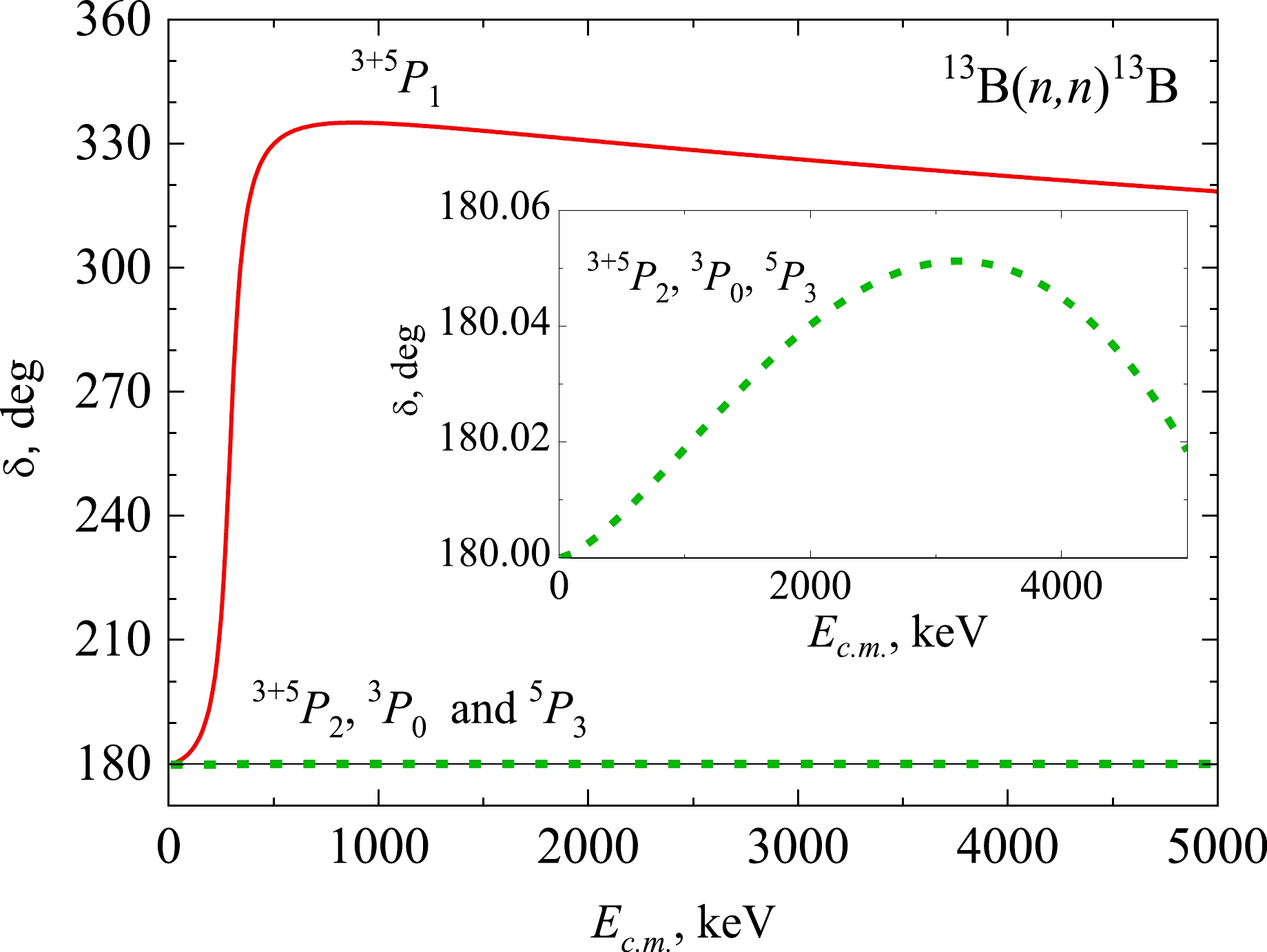
Figure 3.(color online)Pwave phase shifts calculated in the MPCM with the parameters inTable 1: red solid curve – resonance3+5P1wave, green dashed curve – non-resonance3+5P2,3P0, and5P3waves.
Non-resonance3+5P2,5P3, and3P0waves are provided by potential No. 2 with FS fromTable 1. Their phase shifts are normalized to 180(1)° according to the generalized Levinson theorem [28] (green dashed curve inFig. 3).
For the non-resonanceS-waves, we consider two variants of the interaction potentials. No. 3 fromTable 1refers to the case without FS and leads to a zero scatteringS-phase shift. The inclusion of FS leads to a 180(1)° phase shift with the No. 4 parameters fromTable 1. The construction of BS potentials is based on the demand to reproduce the channel binding energyEband match the corresponding asymptotic constant.
We use the well-known relation for the asymptotic normalizing coefficientANCand dimensionless asymptotic constantCW[22,23],
$ {C_W} = \,\frac{{{A_{\rm NC}}}}{{\sqrt {2{k_0}} }} \cdot \frac{1}{{\sqrt {{S_{{f}}}} }} , $

(7) where the relative wave numberk0is related to the binding energy
$ {E_b} = {\hbar ^2}k_0^2/2\mu $ , andSfis the spectroscopic factor. Note that experimental data onANCusually found from the peripherical reactions alone with the spectroscopic factorSfare the input information for calculations of the theoretical valuesCW. Ref. [29] reported the valuesANC= 0.73(10) fm−1/2, obtained from measurements of the breakup cross-sections for the reaction9Be(14B,13B+γ)X at the National Superconducting Cyclotron Laboratory (NSCL), Michigan State University. Data on the spectroscopic factorsSf= 0.71(19) [30] andSf= 0.66 [31] lead to the interval 0.52 ≤Sf≤ 0.9. Consequently, the range for the dimensionless constant isCW= 1.40(38).There are a number of phase shift equivalent potentials, which reproduce the channel binding energy exactly but lead to different radial wave functions. We exploit theCWconstant to constrain the choice of the corresponding potential parameters. The asymptotic constantCWis not single-defined but has a range arising from experimentalANCandSfvalues. There is also a variety ofV0and α parameters, which provide the binding energyEbin then+13B channel within theCWrange. This is shown in the band for the corresponding cross-sections. For example, the details of the computing methods we use may be found in Ref. [20].
The parameters of the GS potentials of14B in then13B channel given inTable 2reproduce a binding energy ofEb= −0.9700 MeV. The potentials of the GS Nos. 1, 2 and 3, 4 have nearly the sameCWin pairs and allow us to present the effects of the FS.
No. {2S+1LJ}i V0/ MeV α/ fm−2 CW Rch/ fm Rm/ fm 1 5S2without FS 19.0756 0.2 1.40(1) 2.50 2.62 2 5S2with FS 217.486 0.5 1.42(1) 2.50 2.63 3 5S2without FS 6.1237 0.04 2.10(1) 2.52 2.81 4 5S2with FS 49.262 0.1 2.15(1) 2.52 2.84 Table 2.Parameters of the GS potentials of14B in then13B channel and calculated asymptotic constantCW,Rch, andRmradii.
The chargeRchand matterRmradii are calculated with these parameter sets according to the procedure in Ref. [32]. To calculate the14B radii, we use the following input information: for13B, the known values areRch(13B) = 2.48(3) fm andRm(13B) = 2.41(5) fm [33]; the neutron matter radius is equal to the proton one,Rm(n) =Rm(p) = 0.8414(19) fm [24], and the neutron charge radiusRch(n) = 0. The obtained results for14B listed inTable 2are in good agreement with the experimental valuesRch(14B) = 2.50(2) fm andRm(14B) = 2.52(9) fm of Ref. [33].
The ES potentials of14B in then13B channel with the parameters given inTable 3reproduce the binding energyEb= 0.3160 MeV [32]. There is no data onANCof the excited 1-state; therefore, the correspondingCWconstants inTable 3as well as theRchandRmradii may be recommended for future measurements. Along withTable 2, the potentials of the ES Nos. 1, 2 and 3, 4 are grouped in pairs for the same purpose to monitor the FS effects.
No. {2S+1LJ}i V0/MeV α/ fm−2 Cw Rch/fm Rm/fm 1 3S1without FS 15.75681 0.2 1.21(1) 2.53 2.97 2 3S1with FS 208.3937 0.5 1.22(1) 2.53 2.98 3 3S1without FS 4.27985 0.04 1.53(1) 2.56 3.23 4 3S1with FS 44.71865 0.1 1.56(1) 2.56 3.27 Table 3.Parameters of the ES potentials of14B in then13B channel and calculated asymptotic constantCW,Rch, andRmradii.
Note that the interaction potentials may depend on different diagrams for the same orbitalL-waves of continuous and discrete spectra [34]. TheS-wave potentials inTable 1for the continuum andTables 2and3for the bound states are different. This is an important observation in the case ofM1 transitions. Otherwise, the radial matrix elements in (5) atJ= 1 are equal to zero owing to the orthogonality of the bound and scattering radial functions calculated in the same potential.
-
The effect of the asymptoticCWconstant on the total cross-sections for13B(n,γ0)14B capture to the GS of14B is illustrated inFig. 4(a). The results of the calculations of theE1 andM1 partial cross-sections for potentials Nos. 1 (CW= 1.40) and 3 (CW= 2.10) fromTable 2and the scattering potentials fromTable 1are shown in comparison with the experimental data of [17].Figure 4(a) shows the total cross-sections in the linear energy scale up to 2.5 MeV to display the
$ ^{3 + 5}{P_1} $ resonance at 305 keV.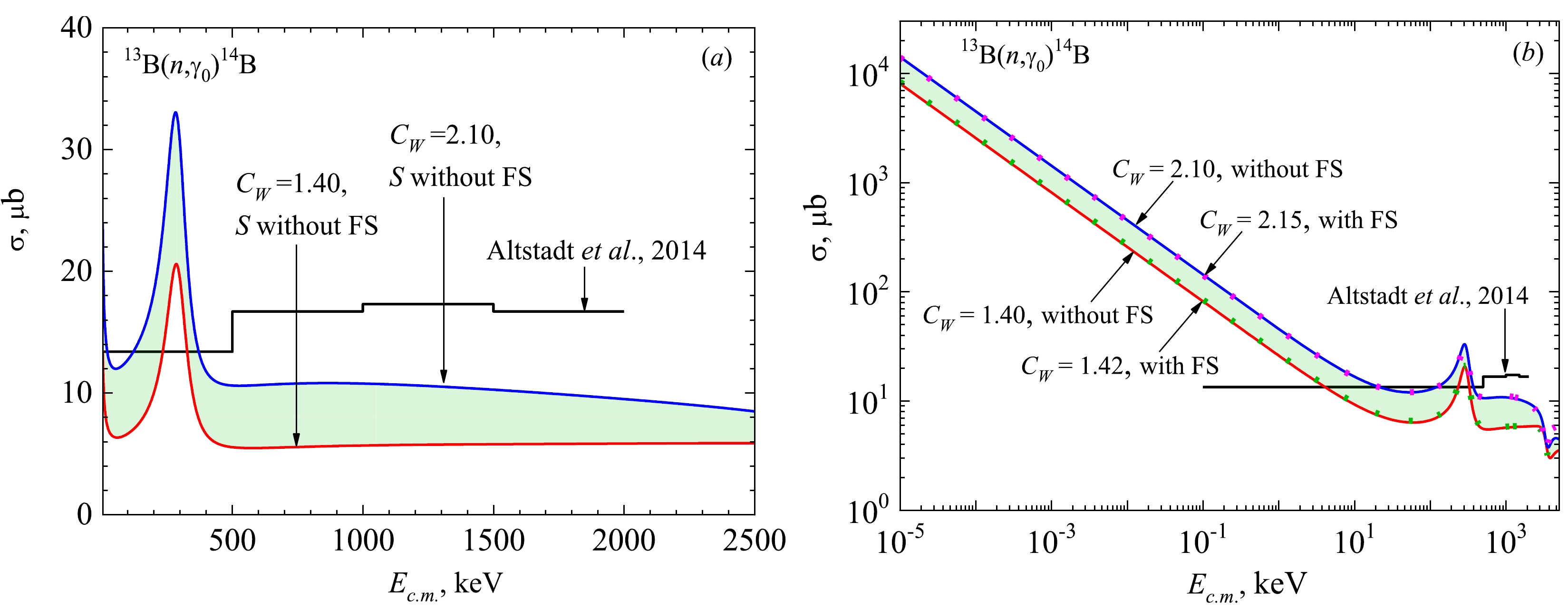
Figure 4.(color online) Total cross-sections of13B(n,γ0)14B radiative capture to the GS of14B with potentials fromTables 1and2. The histogram represents the experiment [17]. (a) Total cross-sections calculated without FS: red solid curve – potential No. 1 inTable 2(CW= 1.40), blue solid curve – potential No. 3 inTable 2(CW= 2.10). (b) Comparison of the total cross-sections calculated without and with FS: solid curves are the same as inFig. 4(a), green dotted curve – potential No. 2 inTable 2(CW= 1.42), magenta dotted curve – potential No. 4 inTable 2(CW= 2.15).
Figure 4(b) shows a wider range from 10-5keV to 5 MeV relevant to the reaction rate calculation (see Sec. IV). The purpose of the results presented inFig. 4(b) is to answer the question of the role of the FS in the GS potentials fromTable 2arranged in pairs,i.e., with or without FS at closeCW. The calculation results of the total cross-sections for the GS potentials with FS Nos. 2 (CW= 1.42) and 4 (CW= 2.15) are shown inFig. 4(b) by the green and magenta dotted curves, respectively.
We find good pairwise agreement with the results for potentials without FS. The slight variation is associated with a small difference in the values ofCWand the scattering phase shifts of theSpotential with FS (No. 4 inTable 1) from exactly zero within 1 degree. At an energy of 10-5keV, the cross-section value for the GS potential without FS No. 1 is equal to 8.05 mb, and for the GS with FS No. 2, it is equal to 8.36 mb. Similar results are obtained for the second potential with an FS. Therefore, we conclude that the presence or absence of FS does not affect the calculated total cross-section. The same consistent pattern is revealed in the (n,γ1) capture calculations to the ES of14B. Further results are presented only for potentials without FS.
To evaluate the thermal cross-sections, we use the standard approximation at energies from 10 meV to 1 keV,
$ {\sigma _{\rm ap}}({\text{μb}}) = \frac{A}{{\sqrt {{E_{\rm c.m.}}({\text{keV}})} }}. $

(8) The value of the calculated cross-section
${\sigma _{\rm theor}}(E)$ atEmin= 10 meV provides the constantA= 25.46 μb·keV1/2for the red solid curve inFig. 4(b) (CW=1.40). Consequently, at a thermal energy of 25.3 meV, the cross-section${\sigma _{\rm therm}}$ = 5.1 mb. For the blue solid curve inFig. 4(b) (CW= 2.10),A= 44.70 μb·keV1/2and${\sigma _{\rm therm}}$ = 8.9 mb.The accuracy of the approximation (8) is defined by the relative difference between the cross-sections
${\sigma _{\rm theor}}(E)$ andσap(E),$ M(E) = \left| {[{\sigma _{\rm ap}}(E) - {\sigma _{\rm theor}}(E)]} \right|/{\sigma _{\rm theor}}(E). $

(9) M(1 keV) ≈ 0.2% for both cases ofCWdecreases with decreasing energy.
Figure 5illustrates the input of the partialE1 andM1 cross-sections related to the set of amplitudes (1) of the (n,γ0) process. TheM1 transition from theSwave determines the low-energy and thermal cross-sections. TheE1 transition amplitudes define the higher energy region. The (n,γ1) capture process reveals nearly the same partial structure (2).
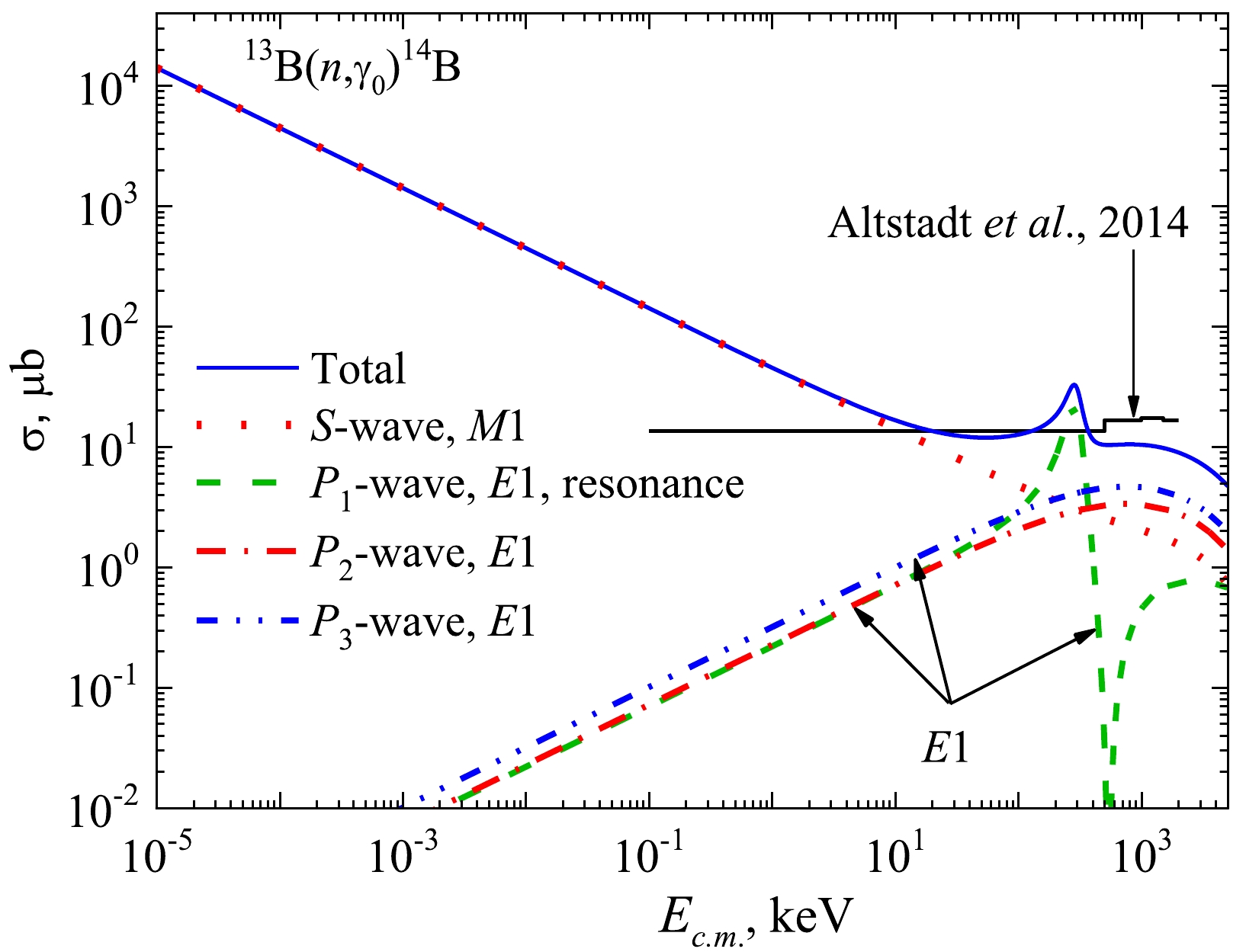
Figure 5.(color online) PartialE1 andM1 and total cross-sections of13B(n,γ0)14B radiative capture to the GS of14B (CW= 2.10 without FS). The histogram represents the experiment [17].
Figure 6illustrates the relative input of the (n,γ0) and (n,γ1) capture processes into the total cross-section. The dominance of the (n,γ0) cross-section compared with (n,γ1) is within a factor of ~ 1/30. Note that the example inFig. 6refers to the lowerCWvalues. The tendency is as follows: an increase inCWleads to the increase of any cross-section, but the (n,γ0) dominance remains within the above factor.
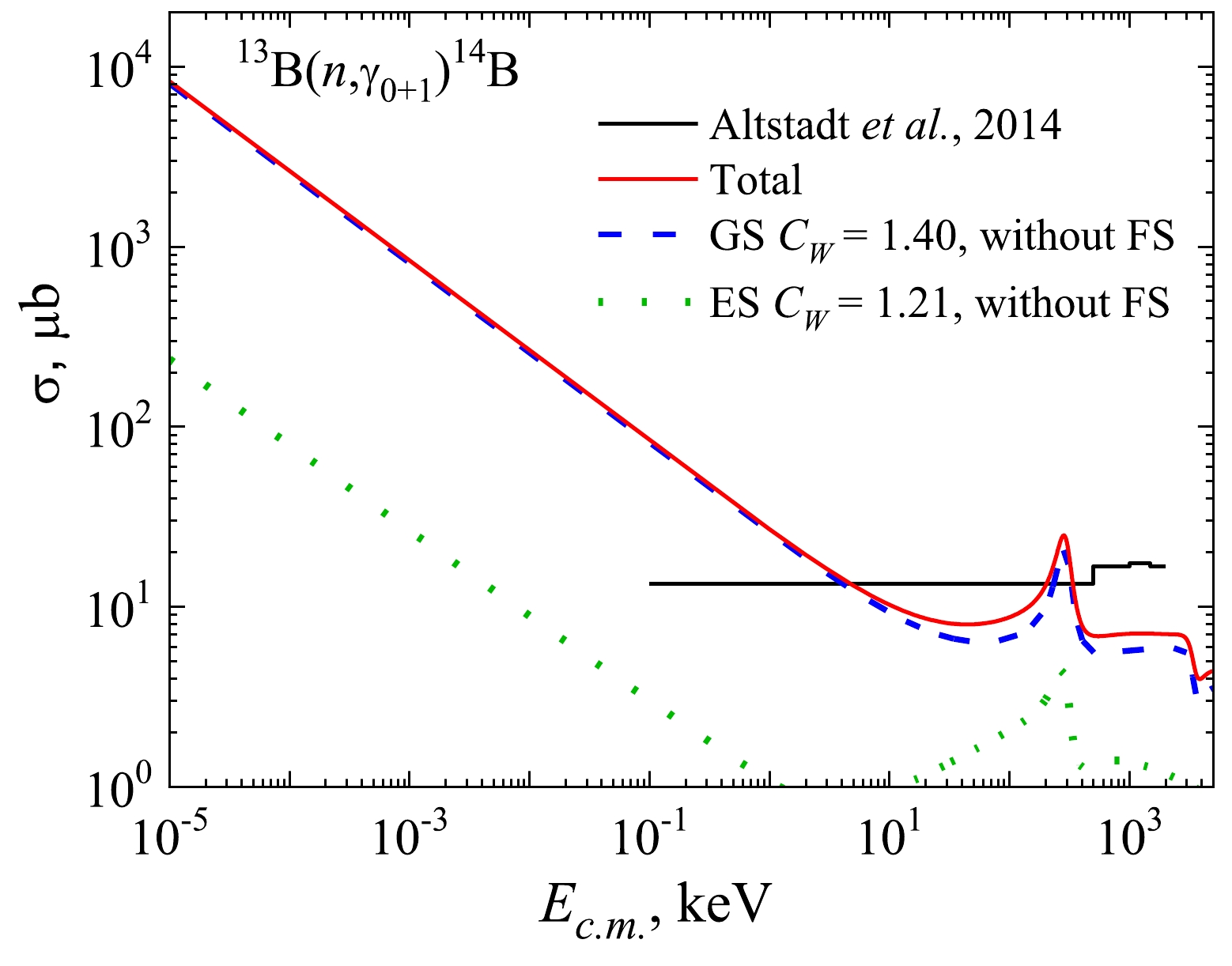
Figure 6.(color online) PartialE1 andM1 and total cross-sections of13B(n,γ0+1)14B radiative capture to the ground 2–and excited 1–states of14B (CW= 1.40 for the GS andCW= 1.21 for the ES). The histogram represents the experiment [17].
Summarizing our results for the total cross-sections inFigs. 4−6, we find that starting fromEc.m.≈ 10 keV and down to thermal energies, the cross-section increases by 103times from ~ 10 μb to ~ 5–10 mb. We assume this result is a prospective one for future experiments. At the same time, because the data of [17] are preliminary and not sufficiently informative, our discussions on the agreement between the experiment and MPCM calculations inFigs. 4,5, and6are slightly premature.
-
We follow [35] when calculating the reaction rate of radiative neutron capture. For the rate in units of cm3mol-1sec-1, the following expression is used:
$\begin{aligned}[b] {N_A}\left\langle {\sigma v} \right\rangle =& 3.7313 \cdot {10^4}{\mu ^{ - 1/2}}T_9^{ - 3/2}\int\limits_0^\infty {\sigma (E)} E\\&\times\exp ( - 11.605E/{T_9}){\rm d}E, \end{aligned}$

(10) whereNAis Avogadro's number,Eis given in MeV, the total cross-section σ(E) is in μb,μis the reduced mass in amu, andT9is the temperature in 109K [35]. Appendix B illustrates the computational procedure accuracy of the reaction rate calculations.
-
InFig. 7(a), the red and blue solid curves show the (n,γ0) capture reaction rates to the GS, which correspond to the results for the total cross-sections presented for the potentials without FS inFig. 4(b). The band inFig. 7(a) corresponds to the band inFig. 4and confines the possible reaction rate values for the range ofCWdiscussed in Sec. II.B.
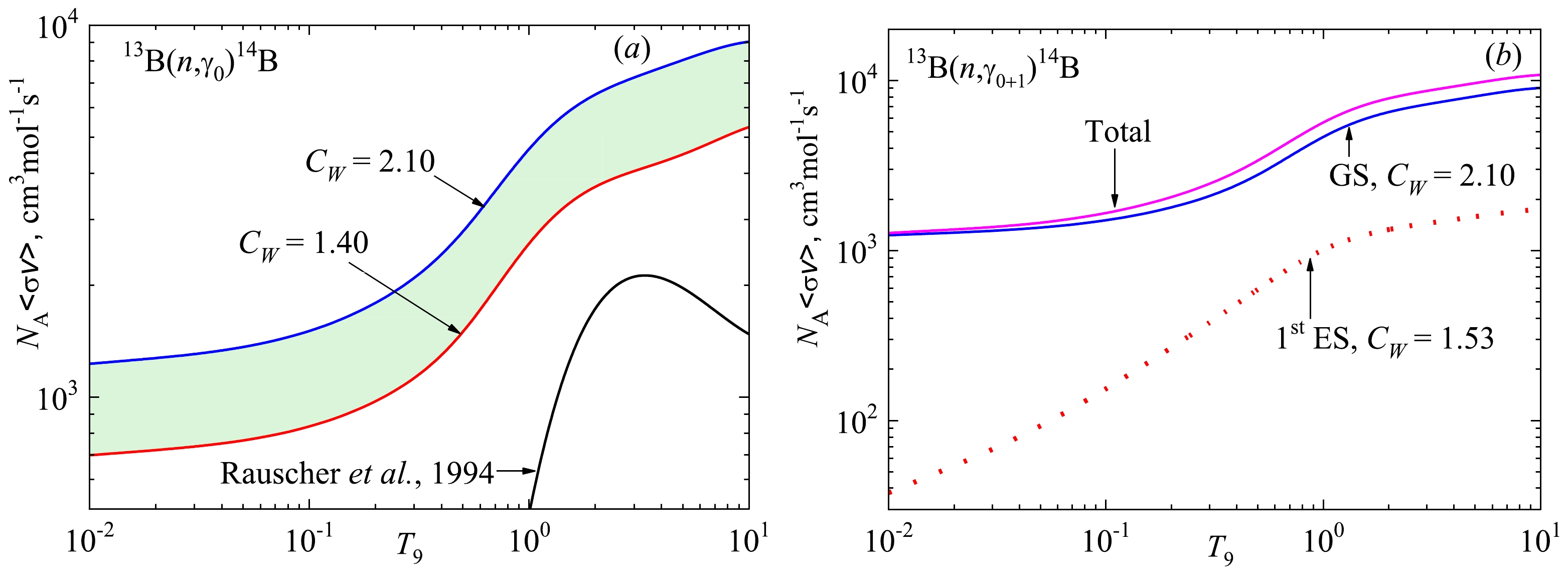
Figure 7.(color online) Reaction rate of radiative neutron capture on13B calculated with potentials without FS. (a) Transitions to the GS: potential No. 1 fromTable 2(CW= 1.40) – red solid curve, potential No. 3 fromTable 2(CW= 2.10) – blue solid curve. The black solid curve shows the reaction rate obtained by Rauscheret al. in Ref. [8]. (b) Transitions to the ground and excited states: GS potential No. 3 fromTable 2(CW= 2.10) – blue solid curve; ES potential No. 3 fromTable 3(CW= 1.53) – red dotted curve. The magenta solid curve is the total capture reaction rate.
The black solid curve inFig. 7(a) shows the reaction rate from [8] obtained by Rauscheret al.Figure 7(a) indicates that these results completely disregard the non-resonance part of the reaction, which leads to an increase in the cross-sections at low energies owing to theM1 transition, as shown inFig. 4(b) andFig. 6.
An important remark concerns the structure of bound states. In [8], theDcomponent is assumed for both the GS and ES of14B in then+13B channel, in contrast with our treating these states asS-waves. Consequently, there are noM1 transitions in the calculations of Rauscheret al. [8], which provide the low-temperature reaction rate. The resonance structure of the black curve inFig. 7is due to the 3-(Ex= 1.38 MeV) resonance, and the 1+resonance (Ex= 1.275 MeV) is not considered. The signature of the 1+(305 keV) resonance in the cross-sections inFigs. 4–6incorporated in the current calculations is observed in reaction rates as an increase at temperatures ofT9≥ 0.2 inFig. 7.
Figure 7(b) shows the input of the (n,γ1) capture to the reaction rate through the example of oneCWset. As shown inFig. 6, the (n,γ1) capture contribution of the excited 1-state is relatively small, resulting in the values of the reaction rate inFig. 7(b) (red dotted curve). The same tendency is preserved for any otherCWset.
The signature of the 300 keV resonance in the cross-sections inFigs. 4–6is observed in the reaction rates as an increase at temperatures ofT9≥ 0.2 inFig. 7.
The reaction rates inFig. 7are parameterized by an expression of the form [36]
$ \begin{aligned}[b]{N_A}\left\langle {\sigma v} \right\rangle =& {a_1}/T_9^{2/3}\exp ( - {a_2}/T_9^{1/3})(1.0 + {a_3}T_9^{1/3} \\&+ {a_4}T_9^{2/3} + {a_5}T_9^{} + {a_6}T_9^{4/3} + {a_7}T_9^{5/3}) + \frac{{{a_8}}}{{{T_9}}}.\end{aligned} $

(11) The parametersaigiven inTable 4correspond to the reaction rates presented inFig. 7: the first column refers to the red solid curve inFig. 7(a); the second column – the blue solid curve inFig. 7(a); the third column – the red dotted curve inFig. 7(b); the last column – the magenta solid curve inFig. 7(b).
i (n,γ0),CW= 1.40 (n,γ0),CW= 2.10 (n,γ1),CW= 1.53 (n,γ0+1),CW= 2.10 andCW= 1.53 ai ai ai ai 1 14381.77 17240.08 2413.837 19795.34 2 1.41717 1.2962 1.46568 1.31492 3 −2.61253 −2.52512 −3.81023 −2.64425 4 1.16178 0.93077 4.53362 1.25477 5 3.19007 3.74616 2.12766 3.6103 6 −2.58617 −2.76411 −2.80537 −2.77072 7 0.57029 0.57636 0.69249 0.58652 8 4.74344 7.39244 0.13587 7.62151 χ2= 0.13 χ2= 0.09 χ2= 0.12 χ2= 0.09 Table 4.Parameters in (11) for the reaction rates inFig. 7.
The reaction rates are presented inTable A1of Appendix A.
T9 (n,γ0),CW= 1.40 ${N_A}\left\langle {\sigma v} \right\rangle $ 

(n,γ0),CW= 2.10
${N_A}\left\langle {\sigma v} \right\rangle $ 

(n,γ1),CW= 1.53
${N_A}\left\langle {\sigma v} \right\rangle $ 

(n,γ0+1),CW= 2.10 andCW= 1.53
${N_A}\left\langle {\sigma v} \right\rangle $ 

0.01 696.895 1227.53 37.5176 1265.0476 0.02 718.923 1270.56 53.8965 1324.4565 0.03 734.56 1302.34 67.2893 1369.6293 0.04 749.033 1332.05 80.0969 1412.1469 0.05 763.127 1361.07 92.6427 1453.7127 0.06 777.063 1389.77 105.014 1494.784 0.07 790.928 1418.33 117.244 1535.574 0.08 804.764 1446.79 129.351 1576.141 0.09 818.593 1475.22 141.346 1616.566 0.1 832.43 1503.63 153.236 1656.866 0.2 972.988 1789.64 267.522 2057.162 0.3 1123.68 2088.81 376.527 2465.337 0.4 1296.14 2417.88 483.691 2901.571 0.5 1496.05 2783.22 589.108 3372.328 0.6 1717.03 3173.33 690.019 3863.349 0.7 1946.46 3568.69 783.394 4352.084 0.8 2172.32 3951.72 867.368 4819.088 0.9 2386.04 4310.64 941.37 5252.01 1 2582.75 4639.3 1005.75 5645.05 1.5 3291.73 5830.41 1217.32 7047.73 2 3672.32 6500.93 1325.54 7826.47 2.5 3894.09 6920.42 1392.2 8312.62 3 4046.34 7223.52 1441.32 8664.84 3.5 4169.1 7469.1 1481.95 8951.05 4 4279.75 7682.51 1517.62 9200.13 4.5 4385.5 7874.58 1549.74 9424.32 5 4488.98 8049.78 1578.96 9628.74 6 4690.21 8355.32 1629.74 9985.06 7 4879.33 8603.13 1671.11 10274.24 8 5049.62 8794.33 1703.62 10497.95 9 5196.07 8931.47 1727.77 10659.24 10 5316.06 9018.76 1744.08 10762.84 χ2= 0.13 χ2= 0.09 χ2= 0.12 χ2= 0.09 Table A1.13B(n,γ)14B radiative capture reaction rates.
-
To define the role of the13B(n,γ)14B reaction in the boron chain of sequence inFig. 1, we must consider whether the calculated reaction rates prove the formation of14B or13B decays before neutron capture may start. Short-lived isotopes may provider-processes in an explosive environment and neutron-rich matter at high densities [37]. The conventional density–temperature conditions for ther-process are assumed as
$ {\bar n_n} $ ~ 1022– 1023cm−3andT9~ 1 [2,38]. We examine these conditions for the13B(n,γ)14B reaction based on the calculated reaction rates.We can identify the r-process according to the following relation:
$ {\tau _\beta } \approx {N_n}\tau (n,\gamma ), $

(12) where the mean lifetime ofβ-decayτβand neutron capture time
$ \tau (n,\gamma ) $ are interrelated by the number of neutronsNnthat must be captured beforeβ-decay occurs [37,39]. The neutron capture time$ \tau (n,\gamma ) $ depends on the reaction rate and neutron number density$ {\bar n_n} $ [40],$ \tau (n,\gamma ) = \frac{1}{{{{\bar n}_n}\left\langle {{\sigma _{n,\gamma }}v} \right\rangle }} . $

(13) Note that the recommended half-life values t1/2[18,41,42] span the range 17.10 – 17.52 ms, and following the Sargent formula t1/2=τβln(2), the mean lifetime range is 0.0243 s <τβ<0.0253 s. Further calculations reveal minor variations within theτβinterval.
The
$ \tau (n,\gamma ) $ calculation results for the13B(n,γ0)14B reaction are shown inFig. 8(a) as an insert. The dashed line corresponds to the13B mean lifetimeτβ= 0.0248 s and$ {\bar n_n} $ = 1023cm-3.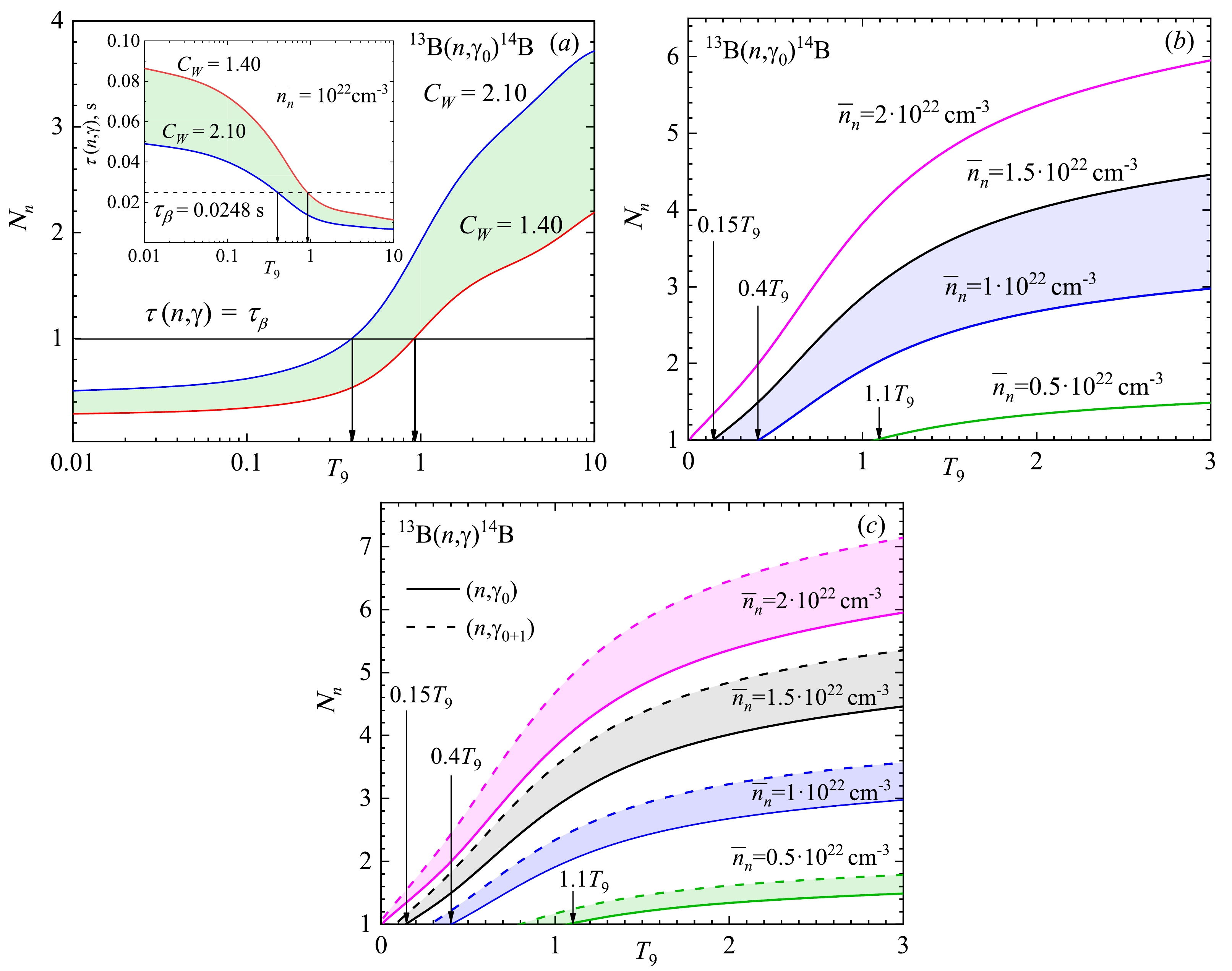
Figure 8.(color online) Number of captured neutronsNndependence onT9conditioned by the neutron number density
$ {\bar n_n} $ . (a)$ {\bar n_n} $ = 1022cm-3. The band corresponds to the reaction rates inFig. 7. The insert shows the neutron capture time$ \tau (n,\gamma ). $ (b) Illustration of the ignitionT9values depending on the neutron number density$ {\bar n_n} $ . (c) Effect of the excited state: solid curves correspond to (n,γ0) capture to the GS; dashed curves correspond to the (n,γ0+1) total capture.The arrows indicate the equality
$ {\tau _\beta } = \tau (n,\gamma ) $ and reflect the equilibrium of the decay and capture processes,Nn= 1. The area under the dashed line holds$ \tau (n,\gamma ) < {\tau _\beta } $ , which means that the number of neutrons that interact with13B isNn> 1, as shown in the main field ofFig. 8(a). We may conclude that at temperatures ofT9on the right of the arrows, the process (n,γ) is faster compared withβ-decay. Therefore, the ignition of the13B(n,γ0)14B reaction occurs atT9≥ 0.4 in the case of the reaction rate shown by the upper curve (CW= 2.10) inFig. 7(a) and atT9≥ 0.9 in the case of the low red curve (CW= 1.40).Figure 8(b) shows the correlation between the variation in the neutron density and ignition temperatureT9,i.e., for higher
$ {\bar n_n} $ , a lowerT9is needed to provide the number of (n,γ0) capture actsNn> 1.Figure 8(c) illustrates the same regularities, but we find a very specific feature.Fig. 7(b) shows no essential input of the (n,γ1) process, playing the role of reaction rate correction, but its inclusion when considering neutron capture time
$\tau (n,{\gamma _{0 + 1}})$ leads to the noticeable shift in ignition points to the lower edge of theT9scale:$ 0.15{T_9} \to 0.1{T_9}\, $ $ ({\bar n_n} = 1.5 \cdot {10^{22}} $ cm–3);$ 0.4{T_9} \to 0.3{T_9} $ ($ {\bar n_n} = 1 \cdot {10^{22}} $ cm–3);$ 1.1{T_9} \to 0.8{T_9} $ ($ {\bar n_n} = 0.5 \cdot {10^{22}} $ cm–3). Therefore, even a slight increase in reaction rate gives feedback to the occurrence of the13B(n,γ0+1)14B reaction. There are no temperature constraints at high neutron density$ {\bar n_n} > 2 \cdot {10^{22}} $ .TheT9interval relevant to the start of ther-production of14B may be defined at the present stage as 0.1 <T9< 0.8 under neuron density matter conditions of 0.5·1022cm−3<
$ {\bar n_n} $ < 1.5·1022cm−3. Based on these results, we compare the reaction rates of radiative neutron capture on10-13B and12-14C isotopes calculated within the same MPCM model formalism, as presented inFig. 9.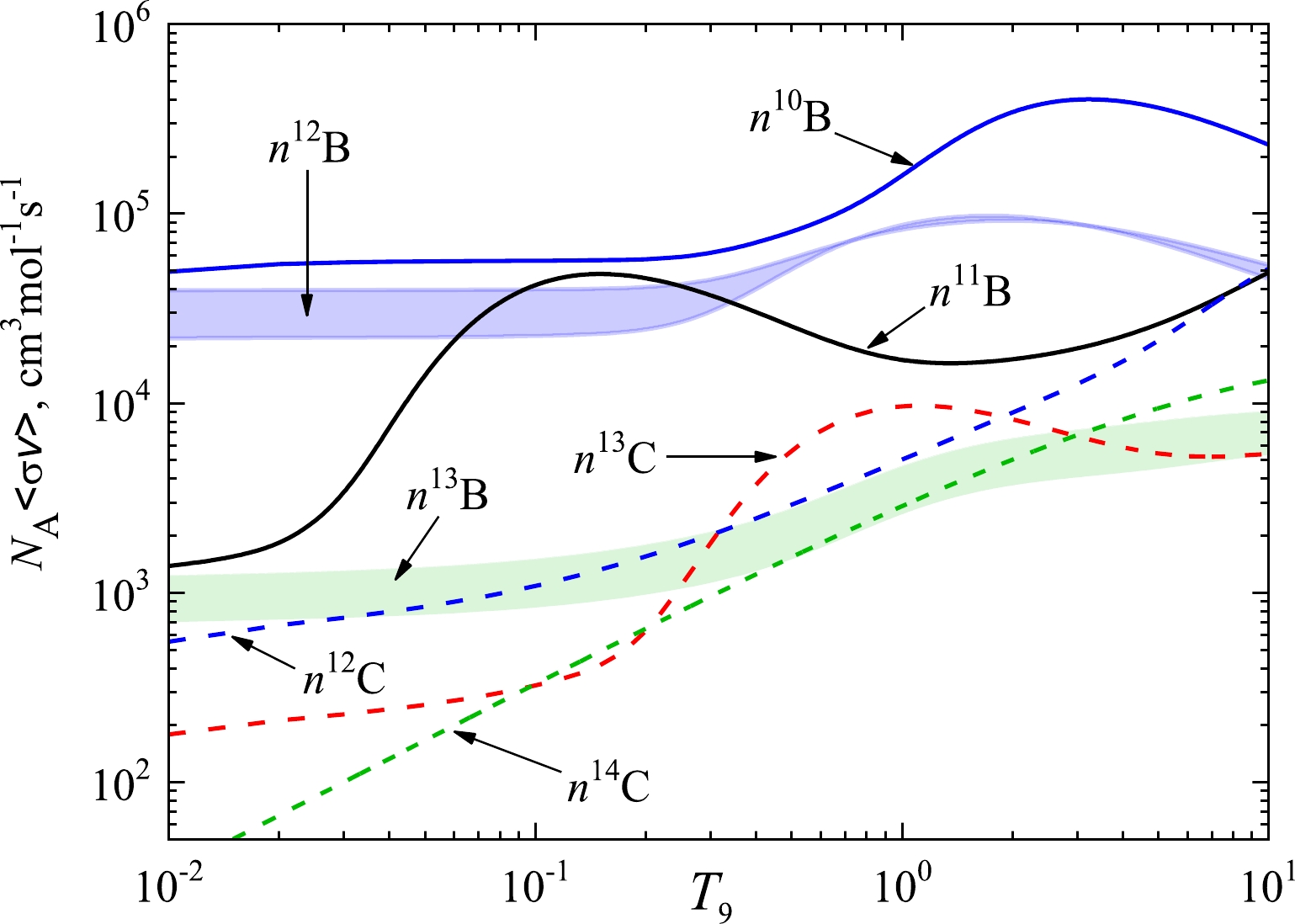
Figure 9.(color online) Comparison of the neutron capture reaction rates on10–13B and12–14C isotopes calculated in the MPCM.10B(n,γ)11B – blue solid curve [9],11B(n,γ)12B – black solid curve [10,11],12B(n,γ)13B – pale blue band [12],13B(n,γ)14B – pale green band (present calculations),12C(n,γ)13C – blue dashed curve [13],13C(n,γ)14C – red dashed curve [14],14C(n,γ)15C – green dashed curve (unpublished). Additional details are provided inTable 5.
It is natural that the production of isotopes with mass numberAfollowingA-1 provides the continuation of the neutron-induced sequence if the previous reaction rate is comparable to or prevailed over by the next one. This regularity for the10–13B isotopes is observed directly at temperatures of ~ 0.05 – 0.3T9, which overlaps with the window for14B production. The gaps at low and highT9in the case of the11B(n,γ)12B reaction rate are not worrying because the isotope11B is stable and may be accumulated.
We now complement the comparative analysis of the boron chain with information fromTable 5. A correlation between the threshold energiesEthin the boron channels and the reaction rates at ultra-lowT9is observed,i.e., a higherEthresults in a higher reaction rate. The thermal cross-sections for odd-odd10,12B isotopes are nearly an order larger than
${\sigma _{\rm therm}}$ of the odd-even11,13B. We can observe these relationships for the reaction rates inFig. 9, except at the temperature interval ~ 0.02 – 1T9for the11B(n,γ0+1+2+3+4)12B reaction, where the rate essentially increases owing to the large number of resonances in this channel. Moreover, the calculated${\sigma _{\rm therm}}$ for11B(n,γ)12B shows excellent agreement with the measured value (see details in Refs. [10,11]), and we interpret this result as the substantiation of the obtained${\sigma _{\rm therm}}$ for13B(n,γ)14B in this study.Reaction Threshold energyEth/MeV Included bound states Included resonances ${\sigma _{\rm therm} }$ /mb

Ref. 10B(n,γ)11B 11.4541 (n,γ0+2+3+4+9) 6+8P5/2,6+8D5/2,6+8D7/2 405 [9] 11B(n,γ)12B 3.3700 (n,γ0+1+2+3+4) 3+5P2,3+5D1(I),3+5D2,3+5D3,3+5D1(II),5F1(I),3+5F3(I),5F1(II) 10.6 [10,11] 12B(n,γ)13B 4.8780 (n,γ0) 4D1/2,4D5/2,4P5/2 176 and 285 [12] 13B(n,γ)14B 0.9700 (n,γ0+1) 3+5P1 5.1 – 8.9 present 12C(n,γ)13C 4.9464 (n,γ0+1+2+3) 2D3/2 3.4 – 3.9 [13] 13C(n,γ)14C 8.1765 (n,γ0+1+2) 2P1/2 1.50 [14] 14C(n,γ)15C 1.2181 (n,γ0+1) 2P3/2 5·10-6 − Table 5.Overview of radiative neutron capture reactions on10–13B and12–14C isotopes calculated in the MPCM.
The isobar-analog channels13B(n,γ)14B and13C(n,γ)14C lead to the formation of14C either via14Bβ-decay or direct radiative neutron capture on13C.Fig. 9shows that at temperatures below 0.3T9, the boron channel rate exceeds the carbon one and decreases in the range ~ 0.3 – 3T9, and atT9> 3, the reaction rates in both channels become close. Consequently, we may conclude that both14C production processes exhibit comparable efficiency.
-
The total cross sections of the13B(n,γ0+1)14B reaction are calculated in the MPCM based on theE1 andM1 transitions from 10-2eV to 5 MeV. We prove that the strong sensitivity of the cross sections to the asymptotic constantCWprovides an appropriate long-range dependence of the radial boundSwave functions; thus, a largerCWresults in larger absolute values of cross-sections. The role of the FS in the calculated spectrum turned out to be insignificant.
TheE1 transitions provides the background of the cross-section owing to the capture from the non-resonance3+5P2,5P3, and3P0waves, and the resonant3+5P1wave in the initial channel reveals the resonance structure of the cross-section at ~ 300 keV.
TheM1 transition occurs via theSscattering wave and contributes predominantly to the thermal cross-sections. The variation inCW= 1.4 – 2.4 gives the range of
${\sigma _{\rm therm}}$ = 5.1 – 8.9 mb. These${\sigma _{\rm therm}}$ values have not ever been estimated in theory, which may be important for researchers.The reaction rates of the13B(n,γ0+1)14B process exhibit the same dependence on the asymptotic constantCWand the relative contributions of the (n,γ0) and (n,γ1) channels. The results of MPCM calculations differ cardinally from those of Rauscheret al. [8] across the entireT9range. Therefore, we conclude that the present data on the reaction rates substantiate the role of the13B(n,γ0+1)14B reaction in boron-carbon-nitrogen chains,i.e., this is not the break-point of the boron sequence.
To support our conclusion, we estimate the relationship between the mean lifetime of13Bβdecay τβand neutron capture time
$ \tau (n,\gamma ) $ . The temperature window for the ignition of14Br-production, 0.1 – 0.8T9, related to the neutron densities$ {\bar n_n} $ = 5 1021– 1.5 1022cm−3is determined, whereas at$ {\bar n_n} $ > 1.5 1022cm−3, there are no temperature limits. We demonstrate that the preferences for the13B(n,γ0+1)14B reaction directly depend on the reaction rate values; the larger the$ \left\langle {{\sigma _{n,\gamma }}v} \right\rangle $ values, the shorter the neutron capture time$ \tau (n,\gamma ). $ We foresee the following factors increasing the reaction rate. The inclusion of theD-component into the bound GS (its weight is estimated today at ~ 17%) may enhance the input of the 1+resonance to theE1 capture cross-section at 305 keV. The role of the transitions shown inFig. 2but not considered in the present study may be evaluated; as an example, the inclusion of a rather weak (n,γ1) process leads to the narrowing of the ignition temperature interval. Another problem concerns the determination of 3πlevel parity atEx= 4.06 MeV. If π = +1, the additionalE1 transition may occur. In the case of π = −1, theE2 transition may reveal interference effects with the 3-state atEx= 1.38 MeV.
The unique experimental results on the Coulomb dissociation of14B [17], converted into the cross-section of the13B(n,γ)14B reaction, remain preliminary and are not complete with estimated uncertainties.
We assume that our results on the reaction rate of13B(n,γ)14B may change the perspective expressed in Ref. [7] on its minor impact on heavy element production. The present calculations are predictive and estimative to substantiate the performance of new experiments on the neutron capture on13B and give a model estimation of the reaction rate of the synthesis of the14B isotope in then13B channel for the first time.
-
To assess reaction rate calculation accuracy, we evaluate the impact of the integration parameters on the calculated reaction rate (10). In addition, we study the influence of the integration method. The integration options we consider are the Simpson method (second order,m= 2) [43] and Milne method (fourth order,m= 4) [44].
Figure B1shows the effect of changingEmaxfrom 1 to 7 MeV at a constant stepEstep= 0.25 keV using the Simpson method (panela), and the dependence of the reaction rate onEstepvaries from 0.1 keV to 1 keV at a constantEmax= 5 MeV (panelb).
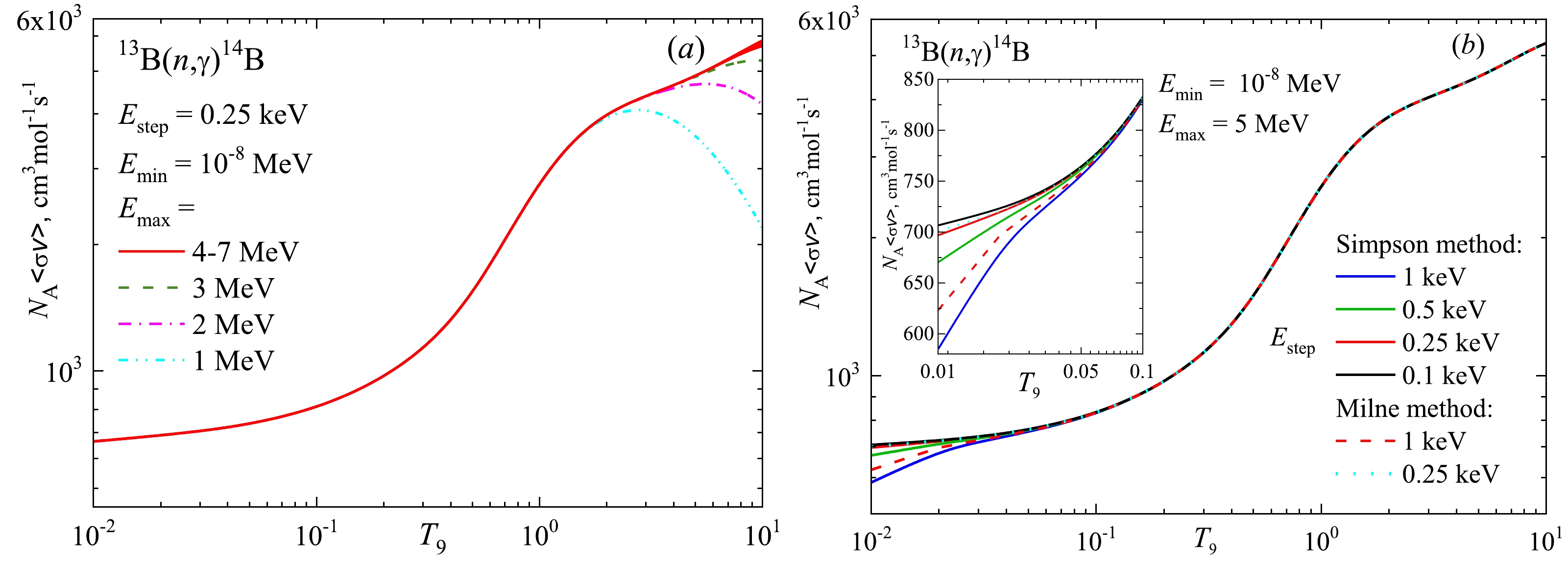
Figure B1.(color online) Dependence of the shape of the reaction rate on the integration procedure in expression (10). The lower integration limitEmin= 10–8MeV. (a) Variation inEmaxin the range of 1 MeV to 7 MeV at a constantEstep= 0.25 keV calculated using the Simpson method. (b) Variation inEstepin the range of 0.1 keV to 1 keV at a constantEmaxof 5 MeV calculated using the Simpson and Milne methods.
When changingEmax, the shape of the reaction rate at high temperatures does not practically change atEmax≥ 4 MeV. In the region of low temperature atEstep≤ 0.25 keV, the shape of the reaction rate is virtually unchanged. In this study, we assumeEmax= 5 MeV and an integration stepEstepof 0.25 keV.
We also test the Milne method [44] with a uniform grid, assumingEmin= 0, the next point is at the first step of energy integration, andEmax= 4 MeV.Figure B1(b) shows the results atEstep= 1 keV (red dashed curve) andEstep= 0.25 keV (blue dotted curve). AtEstep= 0.25 keV, the calculation result does not depend on the method for calculating the integral of the reaction rate, but Milne's method works faster.
Estimation of radiative capture13B(n,γ0+1)14B reaction rate in the modified potential cluster model
- Received Date:2023-06-21
- Available Online:2023-10-15
Abstract:We discuss current attempts to employ the modified potential cluster model to describe the available experimental data on the13B(n,γ0+1)14B total cross-sections. The estimated results of theM1 andE1 transitions from then13B scattering states to the ground and first excited states of14B are presented. The 1stresonance atEx= 1. 275 MeV (1+) is revealed in both the cross-section and reaction rate. Within the variation in the asymptotic constant, a thermal cross-section interval of 5.1 – 8.9 mb is proposed. Based on the theoretical total cross-sections at energies of 0.01 eV to 5 MeV, we calculate the reaction rate in the temperature range of 0.01 to 10T9. The ignitionT9values of the13B(n,γ0+1)14B reaction depending on a neutron number density


 DownLoad: