


 Abstract
 HTML
HTML Reference
 Related
 PDF
PDF


-
Synthesis of9Be involves overcoming the well-known gap withA= 8. Therefore, the9Be as theseed nucleusmay be incorporated in branching chains leading to carbon isotope production. More than 30 years have passed since Malaney and Fowler raised the issue of9Be production and suggested additions to the standard nuclear reaction network for developing the inhomogeneous model of Big Bang nucleosynthesis (BBN) [1]. While discussing the role of the radioactive isotopes in the formation of stable elements at the early stage of the evolution of the Universe, a set of chains has been proposed (see the network in Fig. 1 of Ref. [2]). Later, two chains essential for the production of neutron-rich isotopes were suggested in [3]:
$ \begin{aligned}[b]\\[-8pt]{}^{4}{\rm{He}}(^{3}{\rm H},\gamma)^{7}{\rm{Li}}(n,\gamma)^{8}{\rm{Li}}(\alpha,n)^{11}{\rm B}(n,\gamma)^{12}{\rm B}({\rm e}^-{\rm ν})^{12}{\rm C}(n,\gamma)^{13}{\rm C}(n,\gamma)^{14}{\rm C}(n,\gamma)^{15}{\rm C}({\rm e}^-{\rm ν})^{15}{\rm N}…, \end{aligned}\tag{1a}$ 
$ ^{7}{\rm{Li}}(n,\gamma)^{8}{\rm{Li}}(n,\gamma)^{9}{\rm{Li}}({\rm e}^-{\rm ν})^{9}{\rm{Be}}(n,\gamma)^{10}{\rm{Be}}({\rm e}^-{\rm ν})^{10}{\rm B}(n,\gamma)^{11}{\rm B}(n,\gamma)^{12}{\rm B}({\rm e}^-{\rm ν})^{12}{\rm C}…. \tag{1b}$

Path (1a) is the Lithium-Boron-Carbon (Li-B-C) chain, and (1b) is the Lithium-Berillium-Boron-Carbon (Li-Be-B-C) chain. Reaction9Be(n,γ)10Be in (1b) plays the role of trigger for ignition of the B-C path. That is reasonable as10Be is a long-lived isotope (1.387×10⁶years) and, therefore, may play the role of seed nucleus. One may find the balance between the (1a) and (1b) scenarios while all corresponding reaction rates are well-defined.
There is one more matter of concern for the9Be(n,γ)10Be process: Terasawa and coworkers raised the issue of the critical reaction flows leading to the production of carbon isotopes (Fig. 6 in Ref. [4]). It was pointed out in [4] that the switch-off of the10Be(α,γ)14C reaction in the Be-isotope chain leads to the ignition of the Li-Be-C reaction flow:
$ ^{7}{\rm{Li}}(n,\gamma)^{8}{\rm{Li}}(n,\gamma)^{9}{\rm{Li}}({\rm e}^-{\rm ν})^{9}{\rm{Be}}(n,\gamma)^{10}{\rm{Be}}(n,\gamma)^{11}{\rm{Be}} (n,\gamma)^{12}{\rm{Be}}({\rm e}^-{\rm ν})^{12}{\rm B}({\rm e}^-{\rm ν})^{12}{\rm C}…. \tag{1c} $ 
We will pay special attention to the9Be(n,γ)10Be reaction in the beryllium paths (1b) and (1c). Our motivation concerns the disputed point of view on the origin of10Be: The current position is that10Becannot be produced by thermonuclear reactionsin stars [5] but is processed via cosmic-ray spallation [6]. Meanwhile, the rate of the9Be(n,γ)10Be reaction is included in the network for calculation of the abundance of the beryllium isotopes in the context of BB nucleosynthesis up to CNO [7,8].
The role of the9Be(n,γ)10Be reaction in chains (1b) and (1c) is still unclear today. The reason is that only one modeless result on the reaction rate published by Rauscher in 1994 [9] was included in the network calculations [7]. Nowadays, there are two more reports on the reaction rate based on model calculations [10,11]. Below we show that these results do not confirm those of Ref. [9]. The present paper, along with [10,11], is intendedto attract attention to the9Be(n,γ)10Be reaction and reconsider its astrophysical status in the evolution of the elements according to (1b) and (1c) branching.
We propose the practical goal of reproducing the cross-sections of nucleon-induced radiative capture reactions on the 1p-shell nuclei (A≤16) within the same model approach, an ad hoc modified potential cluster model (MPCM), and finally to calculate the corresponding reaction rates [12,13] in order to complete the sequences like (1). Recently we presented calculations on the reactions7Li(n,γ)8Li [14],10B(n,γ)11B [15],11B(n,γ0)12B [16], and11B(n,γ0+1+2+3+4)12B [17].
The preliminary research on the9Be(n,γ)10Be reaction that we conducted nearly ten years ago [18] should be recognized as estimative for the following reasons:
(a) The cross-sections for the capture to the ground state (GS) and four excited states (ESs) have been calculated in the energy range of 10 meV (1 meV = 10−3eV) up to 1 MeV. Only two experimental points at 25 meV [19] and 25 keV [20,21] were available as benchmarks.
(b) Only one
${}^3{D_3}$ resonance at 622 keV in l.s. was considered in [18]. Extension of the energy interval from 1 MeV to 5 MeV allows the inclusion of four more resonances in the present treatment. Their effect on the cross-sections and the reaction rates is demonstrated.(c) The calculation procedure of the overlapping integrals is re-examined compared to [18] (see for details Sec. VI).
(d) The reaction rate is not calculated in [18].
In the present work within the MPCM, we consider the9Be(n,γ0+1+2+3+4+5)10Be reaction in the region of thermal and astrophysical energies of 10 meV up to 5 MeV, considering the formation of10Be in both the GS and five ESs belown9Be threshold and the five lowest resonances. Present research on9Be(n,γ)10Be also covers new experimental data on the thermal neutron capture cross-section [22−24]. Theoretical calculations are now relevant, while the experimental study of the9Be(n,γ)10Be reaction is insufficient. Recent measurements of the total cross-section
$\sigma (E)$ for this reaction added two points [10]; therefore, six points are available now above 1 MeV [10,20,21].We also compare the MPCM reaction rate with model calculations [9] and direct radiative capture model results [10,11].
The present work is organized as follows: Section I presents the Introduction. Section II covers calculation methods. A classification of orbital states and interaction potentials are given in Sec. III and Sec. IV, respectively. Section V presents the total cross-sections, and Sec. VI provides the reaction rates. The conclusions follow in Sec. VII.
-
We provided a detailed presentation of MPCM in [17,25] (see references therein). Generally, the nuclear wave function (WF) is constructed as the antisymmetrized product of the internal cluster functions, consisting ofA1andA2nucleons and a relative motion function [26]. These WFs are characterized by specific quantum numbers, includingJLSand Young's diagrams {f}, and they determine the orbital part of WF permutation symmetry of the relative motion of the clusters.
The MPCM is easy to use since it comes down to solving the two-body problem, equivalent to the one-body problem in a central field. For the scattering states, the potentials are constructed based on the description of the scattering phase shifts or the spectra of the final nucleus, with consideration of the main low-lying resonances. For a bound state (BS) of two clusters in a nucleus, the interaction potentials are primarily constructed based on the requirement to describe the main characteristics of the nucleus. In this case, the potential parameters from the known characteristics of the BS of nuclei are fixed.
The obtained continuum and discrete WFs are the constituents for the calculation of the integral cross-section
$\sigma (NJ,{J_f})$ of the A(a,γ)B reactions. The calculation formalism forEJandMJtransitions in the potential cluster model is described in [12,13]. The partial total cross-sections of radiative capture from the initialJistate in the continuous spectrum to the final boundJfstate are of the form$ \sigma (NJ,{J_f}) = \frac{{8\pi K{{\rm e}^2}}}{{{\hbar ^2}{k^3}}}\frac{{\text{μ }}}{{(2{S_1} + 1)(2{S_2} + 1)}}\frac{{J + 1}}{{J{{[(2J + 1)!!]}^2}}}A_J^2(NJ,K) \times \sum\limits_{{L_i}\,,{J_{i\,}}} {P_J^2(NJ,{J_f},{J_i})I_J^2(k,{J_f},{J_i}).} $

(2) Here,
$\mu $ is the reduced mass of particles in the initial channel, andkis the wave number of particles in the initial channel.${S_1}$ and${S_2}$ are the spins of particles in the initial channel.KandJare the wave number and total momentum of the$\gamma $ quantum, respectively.NJdenotes the electricEJor magneticMJtransitions of theJmultipolarity from the initial${J_i}$ state in the continuous spectrum to the final bound${J_f}$ state of the nucleus.For electric orbitalЕJ(L) transitions, the values of
${P_J}$ ,${A_J}$ , and${I_J}$ are defined as [12,13]:$\begin{aligned}[b] P_J^2(EJ,{J_f},{J_i}) =& {\delta _{{S_i}{S_f}}}\left[ {(2J + 1)(2{L_i} + 1)(2{J_i} + 1)(2{J_f} + 1)} \right]\\&\times{({L_i}0J0|{L_f}0)^2}\left\{ {\begin{array}{*{20}{c}} {{L_i}} \\ {{J_f}} \end{array}\begin{array}{*{20}{c}} S \\ J \end{array}\begin{array}{*{20}{c}} {{J_i}} \\ {{L_f}} \end{array}} \right\}{,^2}\end{aligned} $

(3) $ {A_J}(EJ,K) = {K^J}{\mu ^J}\left( {\frac{{{Z_1}}}{{{m^J}_1}} + {{( - 1)}^J}\frac{{{Z_2}}}{{{m^J}_2}}} \right), $

(4) $ {I_J}(k,{J_f},{J_i}) = \left\langle {{\chi _f}\left| {{r^J}} \right|{\chi _i}} \right\rangle . $

(5) Here,
${L_f},{L_i},{J_f},{J_i}$ are the orbital and total angular momentums of the particles in the initial (i) and final (f) channels;${m_1},~{m_2},~{Z_1},~{Z_2}$ are the masses and charges of the particles in the initial channel; and${I_J}(k,{J_f},{J_i})$ is the integral over the initial${\chi _i}$ and final${\chi _f}$ relative motion radial functions and part of theЕJ(L) operator.To consider the magneticМJ(S) transitions, we use the following expressions:
$ \begin{aligned}[b] P_J^2(MJ,{J_f},{J_i}) =& {\delta _{{S_i}{S_f}}} [ S(S + 1)(2S + 1)(2{J_i} + 1)\\&\times(2{L_i} + 1)(2J - 1) {(2J + 1)(2{J_f} + 1)} ] \\& \times {({L_i}0J - 10|{L_f}0)^2}{\left\{ {\begin{array}{*{20}{c}} {{L_i}}&{J - 1}&{{L_f}} \\ S&1&S \\ {{J_i}}&J&{{J_f}} \end{array}} \right\}^2}, \\ \end{aligned} $

(6) $\begin{aligned}[b] {A_J}(MJ,K) =& \frac{{\hbar K}}{{{m_0}c}}{K^{J - 1}}\sqrt {J(2J + 1)}\\&\times \left[ {\mu _1^{}{{\left( {\frac{{m_2^\,}}{{m_1^\, + {m_2}}}} \right)}^J} + {{( - 1)}^J}\mu _2^{}{{\left( {\frac{{m_1^\,}}{{m_1^\, + {m_2}}}} \right)}^J}} \right], \end{aligned}$

(7) $ {I_J}(k,{J_f},{J_i}) = \left\langle {{\chi _f}} \right|{r^{J - 1}}\left| {{\chi _i}} \right\rangle . $

(8) We use the following input data: particle masses in the atomic mass unit (amu)
${m_n}$ = 1.00866491597 [27],$m({}^9{\rm{Be}})$ = 9.0121829 [28], and the constant$ {\hbar ^2}/{m_0} = $ 41.4686 MeV·fm2, where${m_0}$ − amu. Magnetic moments are${\mu _1} \equiv {\mu _n} = - 1.91304272{\mu _0}$ and${\mu _2} \equiv \mu ({}^9{\rm{Be}}) = - 1.778{\mu _0}$ .Selection rules for the corresponding angular momentums are provided by the Clebsch-Gordan coefficients, 6j− and 9j− symbols in (3) and (6) according to [29]. All numerical calculations in the present study have been performed based on our authorial software using Simply Fortran. Most of these programs are included in the books in their updated form [12,13].
-
Consider the classification of orbital states of clusters based on Young's diagrams for the9Be nucleus. Assuming that this system consists of 8 + 1 particles, we can use diagrams {44} and {1} for them. In this case, for9Be, we obtain two possible orbital symmetries, {54} + {441}. The first is forbidden since it contains five cells in one row, and the second is allowed. The diagram {441} corresponds to the allowed states (AS) in then8Be system.
Therefore, for then9Be system, we have {441} + {1} = {541} + {442} + {4411}. This set contains forbidden states (FS) with the diagram {541} for the orbital angular momentumsL= 1, 2, 3,… and AS with configuration {4411} andL= 1, 3. Orbital angular momentumsLare determined by Elliott's rule [30,31]. Diagram {442} is apparently an allowed one withL= 0, 2,… and is relevant to allowed BSs inSandDwaves. We limited our treatment to the minimum values of the orbital angular momentumL =0, 1, 2.
The quantum numbers of9Be are
${J^{\text{π }}} = 3/{2^ - }$ , and for10Be, they are${J^\pi },T = {0^ + },1$ [32,33]. Then9Be potential refers to the${}^3{P_0}$ wave corresponding to Young's diagrams {541} and {4411}. The first diagram is forbidden, and the second is allowed. The diagram {4411} matches the GS of the10Be nucleus in then9Be channel. The other${}^3{P_J}$ waves correspond to the allowed bound excited states. Similar potentials are used for the continuous partial waves.We assume that there is a bound AS for the {442} diagram in the
${}^3S$ wave without FS. It may correspond to the third excited state (3rdES) with${J^\pi } = {1^ - }$ and excitation energy of 5.9599 MeV.In the
${}^3D$ wave containing a bound FS for the {541} diagram, there is also a bound AS for {442}. It may correspond to the fifth excited state (5thES). The same classification is done for all other partial waves. Therefore, we unambiguously fix the structure of the forbidden and allowed states in each partial potential forL= 0, 1, 2. Note that the number of BSs, forbidden or allowed in any partial potential, determines the number of WF nodes at short distances [26]. Recall that the radial bound state function corresponding to the minimum energy has no node, and the BS next highest in energy has one node,etc. [34]. -
Figure 1illustrates the spectrum of the10Be nucleus and guides our further calculations. It shows six BSs,ad hocone GS, and five ESs. Five resonances above the thresholdEb= 6.8122 MeV are included in the consideration.
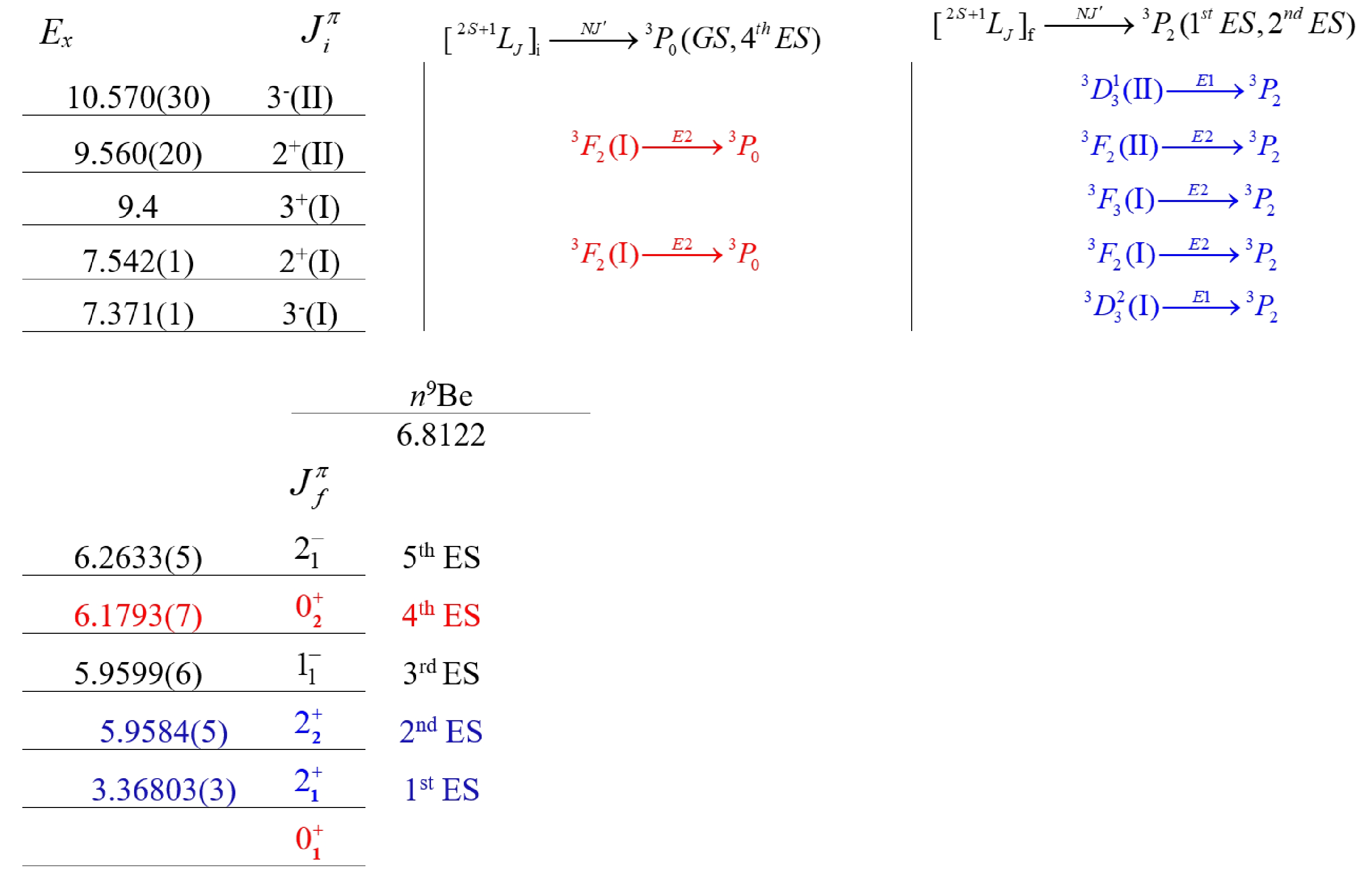
Figure 1.(color online) Spectrum levels in MeV (c.m.) of the10Вe nucleus with the indication of quantum numbers
${J^\pi },T$ [32,33] (arbitrary energy scale).$J_{\mathbf{N}}^\pi $ – low indexN= 1 or 2 indicates the order of appearance of the state with the same momentum$J$ in the spectrum of9Be. In the case of a continuous spectrum, the corresponding indication is given as a Roman numeral.To calculate the cross-sections (2), one needs to construct the discrete and scattering radial functions in overlapping integrals
$ {I_J}({J_f},{J_i}) $ (5) and (8). Functions$ {\chi _i} $ and$ {\chi _f} $ are the numerical solutions of the radial Schrödinger equation with the inter-cluster potentials of the Gaussian form:$ V(r,JLS) = - {V_0}(JLS)\exp \{ - \gamma (JLS){r^2}\}, $

(9) Here,
${V_0}$ is potential depth, andγis related to the potential width. The procedure of fitting${V_0}$ andγfor the discrete and continuous states is presented in the following sub-sections. -
The BS parameters
${V_0}$ andγare found unambiguously by matching the binding energy, charge radius, and AC. While the binding energy and charge radius can be calculated with high accuracy, the most significant uncertainties are due to AC. Let us start with the definition of AC. The dimensionless constant$ {C_w} $ is found from the following relation:$ {{{\chi }}_L}(r) = \sqrt {2{k_0}} {C_w}{W_{ - \eta L + 1/2}}(2{k_0}r). $

(10) Here,
$ {W_{ - \eta L + 1/2}} $ is the Whittaker function and$ {k_0} $ is a wave number related to the binding energy${E_b} = {k_0}^2/2\mu $ . In case$\eta = 0$ , the analytical form of the Whittaker function is:$ {W_{0,l}}(z) = {{\rm e}^{ - z/2}}\sum\limits_{n = 0}^l {{z^{ - n}}} \frac{{(l + n)!}}{{(l - n)!n!}}. $

(11) Let us present all variants for the ACs, which include the asymptotic normalization coefficient (ANC), dimensionless asymptotic constant
${C_w}$ , and spectroscopic factor$ {S_F} $ .The dimensional asymptotic constantC(in fm-1/2) is related toANCvia the spectroscopic factor$ {S_F} $ :$ A_{\rm NC}^2 = {S_F} \times {C^2} . $

(12) Along with relation (10), the asymptotics of WF may be written via the dimensional constantC
$ {{{\chi }}_L}(r) = C{W_ - }_{\eta L + {\text{1}}/{\text{2}}}\left( {{\text{2}}{k_0}r} \right) . $

(13) Comparison of relations (10) and (13) shows the following interrelation of the asymptotic constants:
$ C = \sqrt {2{k_0}} {C_w}. $

(14) The available information on the spectroscopic factors
$ {S_F} $ and ACs$A_{\rm NC}^2$ for the GS of10Be is given inTable 1[11,35−46]. The relation$C_w^2 = A_{\rm NC}^2/({S_F}2{k_0})$ is used for the calculation of values${C_w}$ . InTable 2, we present the data on the spectroscopic factors${S_F}$ for the virtual decay of10Be*in ESs: the experimental values are from [35–39,45,46] and the calculated ones from [11,40−44].Reference $ {S_F} $ 

$ {C_w} $ 

Experiment Bockelmanet al.,1951 [36], Variational method 2.357 2.231 Dardenet al.,1976 [37], DWBA 2.1 2.07 Harakehet al.,1980 [38], DWBA 1.58 1.81 Lukyanovet al.,2014 [39], Optical model 1.65 1.85 Average,present calculations ${ {\bar{\boldsymbol S} }_{\boldsymbol{F} } } \bf{=1.922}$ 

${ {\bar{\boldsymbol C}}_{\boldsymbol{w} } } {\bf = 1.990}$ 

Theory Schmidt-Rohret al.,1964 [40], Born Approximation 1.67 1.89 Cohen & Kurath, 1967 [41], 1p shell model 2.3565 2.231 Andersonet al.,1974 [42], DWBA 1.21 1.54 Mughabghab, 1985 [43], Spin-spin interaction 2.1 2.07 Ogawaet al.,2000 [44], Stochastic variational method 2.24 2.14 Leeet al.,2007 [45], Shell model 2.44 2.30 Grinyeret al.,2011 [46], Shell model 2.62 2.41 Grinyeret al.,2011 [46],ab initio 2.36 2.23 Grinyeret al.,2011 [46], Variational Monte Carlo 1.93 2.01 Timofeyuk, 2013 [35], 0-pshell model 1.515 1.77 Mohr, 2019 [11], Direct capture model ~1.06 1.36 Mohr, 2019 [11], Direct capture model 1.58 1.81 Average,present calculations ${ {\bar{\boldsymbol S}}_{\boldsymbol{F} } } {\bf =1.923}$ 

${ {\bar{\boldsymbol C}}_{\boldsymbol{w} } } {\bf =1.980}$ 

Table 1.Data on the spectroscopic factors
${S_F}$ and calculated constants$ {C_w} $ for the GS of10Be ($J_{\mathbf{N}}^\pi $ =$0_1^ + $ ) corresponding to$A_{\rm NC}^2$ =9.12 fm−1[35].Reference 1stES, $2_1^ + $ 

2ndES, $2_2^ + $ 

3rdES, $1_1^ - $ 

4thES, $0_1^ + $ 

5thES, $2_1^ - $ 

Experiment Bockelmanet al.,1951 [36], Variational method 0.274 0.421 ‒ ‒ ‒ Dardenet al.,1976 [37], DWBA 0.23 ≤1.0 ‒ ‒ 0.065 Harakehet al.,1980 [38], DWBA 0.38 ≤0.73 ≤0.14 ‒ 0.08 Lukyanovet al.,2014 [39], Optical model 1.00 1.40 0.43 ‒ 0.26 Average 0.471 0.888 0.285 ‒ 0.135 Theory Schmidt-Rohret al.,1964 [40], Born Approximation 0.24 ‒ ‒ ‒ ‒ Cohen & Kurath, 1967 [41], Shell model 0.1261 0.1899 ‒ ‒ ‒ Andersonet al.,1974 [42], DWBA 0.17 0.54 0.36 ‒ 0.20 Mughabghab, 1985 [43], Spin interaction 0.23 ‒ ‒ 0.031 ‒ Ogawaet al.,2000 [44], Variational method 0.23 0.40 0.79 0.10 ‒ Mohr, 2019 [11], Direct capture model 0.38 <0.73 <0.14 ‒ 0.08 Mohr 2019 [11], Direct capture model 0.17 0.54 ‒ ‒ ‒ Average 0.2209 0.4800 0.43 0.0655 0.14 Table 2.Data on the spectroscopic factors
${S_F}$ for the ESs of10Be*.The calculated results on the binding energyEb, chargeRch, and matter radiiRmwithin the MPCM are presented inTable 3.
No. ${E_x}$ /MeV

${J^\pi }$ 

${\left[ {{}^{2S + 1}{L_J}} \right]_f}$ 

${V_0}$ /MeV

${E_b}$ /MeV

Rch/fm Rm/fm ${C_w}$ 

1 0 $0_1^ + $ 

${}^3P_0^1$ 

363.351572 −6.81220 2.53 2.54 1.72(1) 2 3.36803(3) $2_1^ + $ 

${}^3P_2^1$ 

345.676475 −3.44417 2.54 2.57 1.14(1) 3 5.9584(5) $2_2^ + $ 

${}^3P_2^2$ 

328.584340 −0.85380 2.55 2.69 0.60(1) 4 5.9599(6) $1_1^ - $ 

${}^3{S_1}$ 

33.768513 −0.85230 2.56 2.76 1.24(1) 5 6.1793(7) $0_2^ + $ 

${}^3P_0^2$ 

326.799005 −0.63290 2.56 2.72 0.53(1) 6 6.2633(50) $2_1^ - $ 

${}^3{D_2}$ 

248.148914 −0.54890 2.53 2.52 0.057(1) For the potential of the GS binding energy, the value 6.812200 MeV is obtained with an accuracy of 10–6MeV, the mean square charge radius equals 2.53 fm, and the matter radius is 2.54 fm. The AC error is determined by averaging over the interval 4 – 16 fm, where the AC remains practically stable.
The potential of the first excited state (1stES)
$^3P_2^1$ at an excitation energy of 3.36803(3) MeV10Be [–3.44417] is obtained with${J^\pi } = {2^ + }$ . Here and further in brackets, the energy relative to the thresholdn9Be is pointed in MeV. Such potential has one bound FS at {541}. Since data on the AC of this and other ESs are absent, the parameter γ is the same as for the GS potential.For the potential of the second excited state (2ndES)
$^3P_2^2$ at an excitation energy of 5.9584(5) MeV,10Be [–0.85381] with${J^\pi } = {2^ + }$ is obtained. It also has one FS.At an excitation energy of 5.9599(6) MeV [–0.8523], the third excited state (3rdES) with quantum numbers
${J^\pi } = {1^ - }$ is reported in Ref. [32]. Such an excited state we consider as a bound AS in the${}^3{S_1}$ wave related to the {422} Young's diagram.The fourth excited state (4thES) at an energy of 6.1793(7) MeV [–0.6329] coincides in its quantum numbers
${J^\pi },$ $T = {0^ + },1$ with the GS [32].The fifth excited state (5thES) at an energy of 6.2633(50) MeV relative to the GS [–0.54890] with quantum numbers
$2_1^ - $ refers to the${}^3{D_2}$ state [32]. We did not consider the 5thES earlier [18], and here, we estimate the value of its contribution to the totaln9Be capture cross-sections.While calculating the charge and matter radii of10Be, a9Be nucleus radius equal to the 2.518(12) fm from Ref. [47] was used. The neutron charge radius equals zero, and its matter radius is the same as the proton radius 0.8775(51) fm given in the database [27]. To demonstrate the quality of present calculations of theRchcharge andRmmatter radii, we suggest compiling the experimental data on these values and available model calculations inTable 4.
Reference States Rm/fm Rch/fm Experiment Ozawaet al. 2001 [48], Glauber Model 2.30±0.02 2.30±0.02 Nörtershäuseret al. 2009 [49], Isotopic shift GS, $0_1^ + $ 

2.357(18) 2.357(18) Descouvemont & Itagaki 2020 [50], Stochastic variational method 2.44±0.02 2.44±0.02 Average values 2.3657±0.02 2.3657±0.02 Theory Liatardet al. 1990 [51], Microscopic model 2.479±0.028 ‒ Ogawaet al. 2000 [44], Stochastic variational method 2.28 2.35 Wanget al. 2001 [52], Relativistic Mean Field GS, $0_1^ + $ 

2.40 ‒ Timofeyuk, 2013 [35], 0-p shell model ‒ 3.042 Ahmadet al. 2017 [53], Glauber Model 2.36±0.04 ‒ Average values 2.3798±0.034 2.696 Ogawaet al. 2000 [44], Stochastic variational method 1stES, $2_1^ + $ 

2.41 3.47 Table 4.Data on theRchcharge andRmmatter radii.
The summary of the spectroscopic factorSFandCwfor the GS of10Be shows very close average values for the experimental (
${\bar S}^{\text{exp.}}_F = 1.922$ ,${\bar C}^{\text{exp.}}_w = 1.99$ ) and theoretical (${\bar S}^{\rm theor.}_F = 1.923$ ,${\bar C}^{\rm theor.}_w = 1.98$ ) ones. At the same time, the corresponding intervals differ. In the case of experiment one has:$1.58 \leqslant {\bar S}^{\text{exp.}}_F \leqslant 2.357$ and$1.85 \leqslant {\bar C}^{\text{exp.}}_w \leqslant 2.23$ , and the theoretical intervals are$1.06 \leqslant {\bar S}^{\rm theor.}_F \leqslant 2.62$ and$1.36 \leqslant {\bar C}^{\rm theor.}_w \leqslant 2.41$ . The value for the asymptotic constantCwfor the GS of9Be obtained in present calculations equals 1.72(1), which is within the indicated intervals.There are no data on the ANC for the excited states of10Be. The obtainedCwinTable 3may be assumed as the proposed ones for the 1st– 5thESs.
Based on the interaction potentials with parameters fromTable 3, the radial wave functions of the BSs have been calculated as the numerical solutions of the radial Schrödinger equation. The description of the developed algorithm may be found in Refs. [25,54].
The BS radial WFs are shown inFig. 2. Their node or nodeless behavior is the signature of the Young's diagram classification relative to the number of ASs and FSs in a given partial wave. These functions are the constituents of the overlapping integrals (5) and (8).
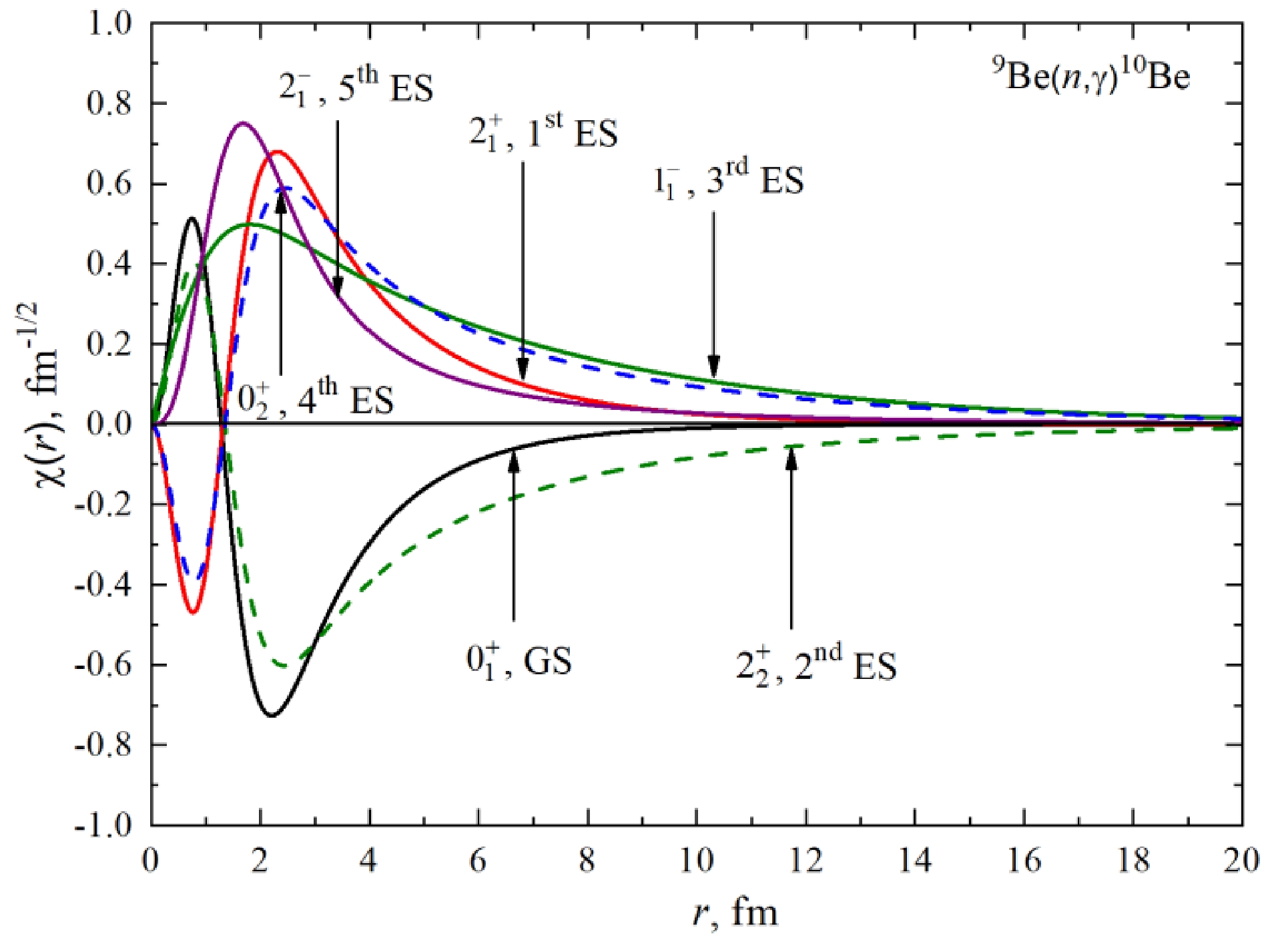
Figure 2.(color online) Radial wave functions of the bound states in then9Be channel calculated with the potentials from Table 3.
-
FollowingFig. 1, we consider five resonance states ofn9Be at energies less than 5.0 MeV. We use the characteristics of the energy levels to construct the scattering potentials: By fitting the excitation energy
${E_x}$ and level width${\Gamma _{\rm c.m.}}$ , the parameters${V_0}$ and γ are determined. The results for the matched parameters of the scattering potentials are given inTable 5. The calculated values of the${E_{\rm res}}$ and${\Gamma _{\rm c.m.}}$ are in good agreement with the experimental data [32,33].No. ${E_x}$ , expt.

${\Gamma _{\rm c.m.} }$ , expt.

Jπ ${}^{2S + 1}{L_J}$ 

${V_0}$ /MeV

γ/ fm-2 ${E_{\rm res} }$ , theory

${\Gamma _{\rm c.m.} }$ , theory

1 7.371(1) 15.7(5) 3- $^3D_3^1$ 

457.879 0.35 0.559(1) 15(1) 2 7.542(1) 6.3(8) 2+(I) $^3F_2^1$ 

211.667 0.11 0.730(1) 6(1) 3 9.4 291(20) 3+ $^3{F_3}$ 

220.685 0.12 2.588(1) 283(1) 4 9.560(20) 141(10) 2+(II) $^3F_2^2$ 

337.83 0.18 2.748(1) 146(1) 5 10.570(30) 200(100) 3- $^3D_3^2$ 

1953.33 1.5 3.758(1) 187(1) 6 No res. – 1– $^3{D_1}$ 

300.0 0.35 – – 7 No res. – 1+ $^3{P_1}$ 

206.0 0.4 – – Table 5.Parameters of the potentials of the resonant and nonresonant scattering states in then9Be channel. The excitation energy of
${E_x}$ (MeV) levels and their width${\Gamma _{\rm c.m.}}$ (keV) are taken from experimental data [32,33]. Resonance energies${E_{\rm res}}$ (MeV) and widths${\Gamma _{\rm c.m.}}$ (keV) are calculated with the parameters${V_0}$ and γ.Let us comment onTable 5and its illustration inFig. 3. In the spectrum of the10Be nucleus in then9Be channel, there is an above-threshold
${J^\pi } = {3^ - }$ level at the energy of 0.622(1) MeV in l.s. or 0.559(1) keV in c.m. and width of${\Gamma _{\rm c.m.}} = 15.7$ keV [32]. We compare it to the resonance$^3D_3^{\,1}$ in the elasticn9Be scattering channel.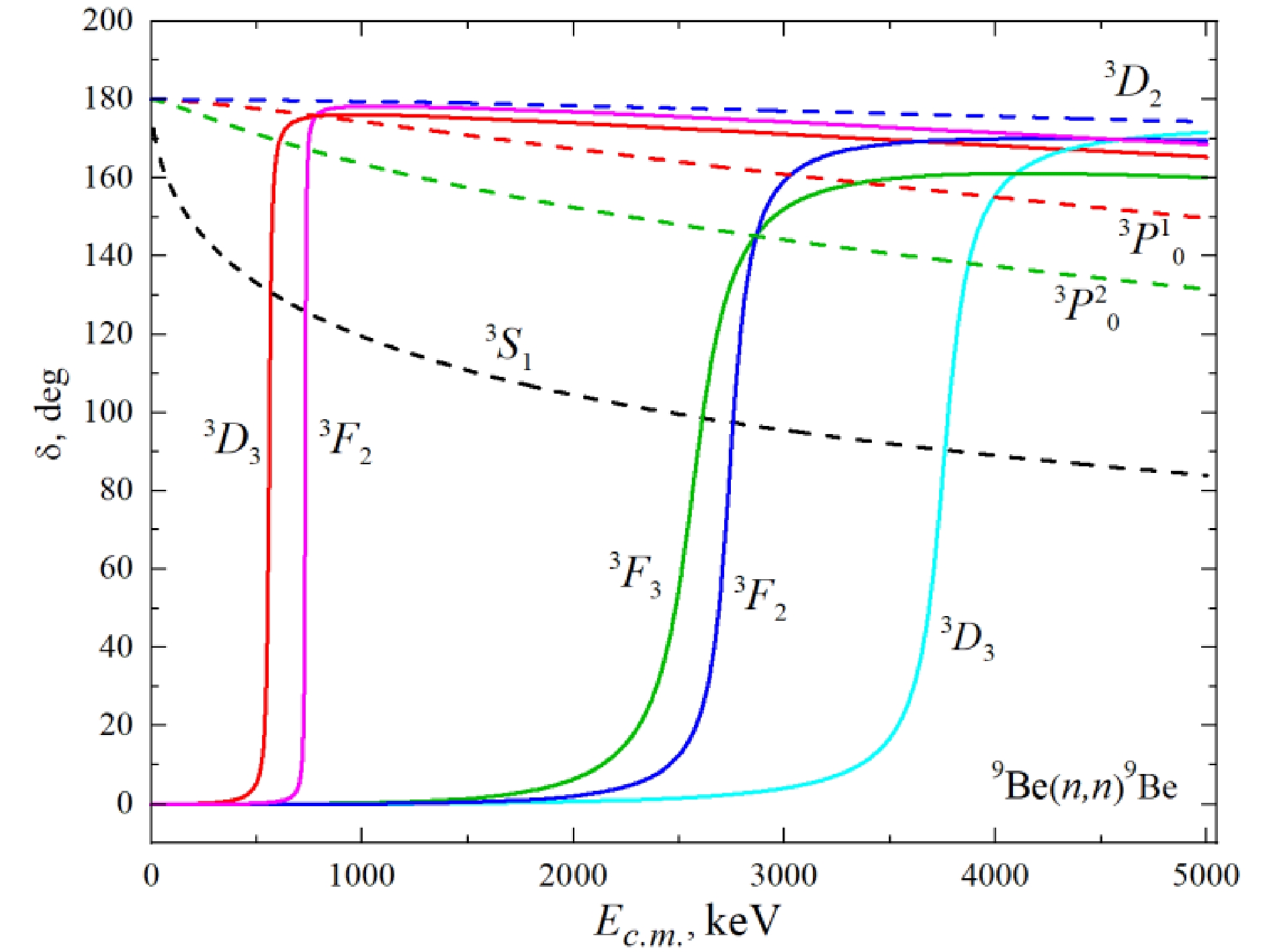
For the potential of the resonance
$^3D_3^{\,1}$ scattering wave at 559(1), the corresponding keV parameters are the same as in [18]. The elastic scattering phase shift for this potential is shown inFig. 3by a solid red curve and has a resonance character, reaching 90(1)° at 559(1) keV. The potential contains the bound FS related to the diagram {541} following the above classification, and the state for {422} is considered unbound. The width of such a resonance is equal to 15(1) keV, which is in good agreement with the results of Ref. [32].The next
${J^\pi } = {2^ + }$ resonance at an excitation energy of 7.542(1) MeV relates to the resonance at 0.730 MeV c.m. and width of${\Gamma _{\rm c.m.}} = 6.3(8)$ keV. We failed to find potential parameters correctly conveying the characteristics of such a resonance in thePwave. We found the potential with FS for the${}^3{F_2}$ wave, which allows us to reproduce the${J^\pi } = {2^ + }$ resonance characteristics. The elastic scattering${}^3{F_2}$ phase shift is shown inFig. 3by a solid magenta curve and illuminates a resonance behavior, reaching 90(1)° at 730(1) keV.Consider a resonance at an excitation energy of 9.4 MeV
${J^\pi } = {3^ + }$ . It relates to the resonance at 2.588 MeV c.m. and a width of 291(20) keV. We consider this state a3F3wave. The corresponding potential contains one FS that leads to the resonance at 2.588(1) MeV c.m. and a width of 283(1) keV. The scattering phase shift$\delta_F $ (2.588 MeV) = 90(1)° (solid green curve inFig. 3).The next resonance is located at an excitation energy of 9.560 (20) MeV
${J^\pi } = {2^ + }$ . It relates to the$^3F_2^{}$ wave with a resonance at 2.748(20) MeV c.m. and a width of 141(10) keV. The corresponding potential contains one FS and givesEres= 2.748(1) MeV and Γc.m.= 146(1). The scattering phase shift$\delta_F$ (2.748 MeV) = 90(1)° (solid blue curve inFig. 3).We associate the last
${J^\pi } = {3^ - }$ resonance at an excitation energy of 10.570(30) MeV with the${}^3D_3^2$ wave with a resonance at 3.758(30) MeV c.m. and width of 200(100) keV. It leads to resonance at 3.758 (1) MeV c.m. and a width Γc.m.= 187 (1) keV. The scattering phase shift$\delta_D $ (3.758 MeV) = 90(1)° (the solid cyan curve inFig. 3).The potential of the
${}^3{D_1}$ scattering wave leads to zero scattering phase shifts since no resonances are observed in this state. This potential contains a bound FS corresponding to the {541} diagram, and the state for {422} is not bound.The parameters of the potentials for the nonresonant
${}^3{P_{0,2}}$ waves are the same as for the BSs fromTable 3, and for the${}^3{P_1}$ wave, the values are indicated inTable 5.For the
${}^3{S_1}$ scattering wave, the parameters of interaction potential fromTable 3are used.We do not consider here the resonances at 9.27 MeV with
${J^\pi } = {4^ - }$ [32], 10.150 MeV, and 11.800(50) MeV with${J^\pi } = {4^ + }$ [33]. They only lead to theE2 transitions, which give a noticeably smaller contribution to the cross-sections, unlikeE1 transitions.For the resonant waves, the relation between the scattering phase shift
$\delta $ and the resonance width value${\Gamma _{\rm c.m.}}$ is as follows:$ {\Gamma _{\rm c.m.}} = 2{({\rm d}\delta /{\rm d}{E_{\rm c.m.}})^{ - 1}}. $

(15) Figure 3illustrates the corresponding phase shifts calculated with the potentials fromTables 3and5.
-
The partial cross-sections are calculated from (2) – (8) and presented inFig. 4(a). The selection rules for the allowed transitions are provided by the vector addition of angular momentums in Clebsch-Gordan coefficients, the 6jand 9j-symbols in expressions (3) and (6). The summary of the multipleNJtransitions is presented inTable 6. The factor
$P_J^2(NJ,{J_f},{J_i})$ in the final column shows the algebraic weight of the corresponding amplitude in a partial cross-section.Fig. 4(b) compares the present MPCM calculations with those from [11] discussed below.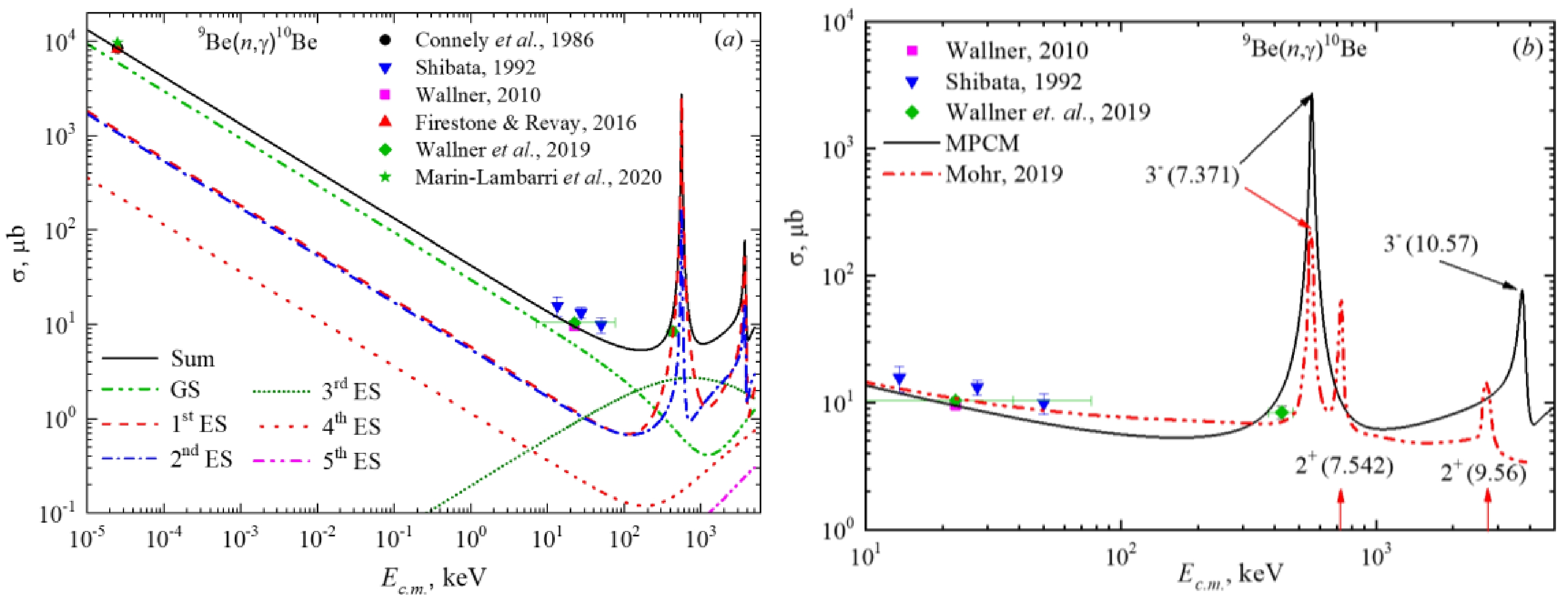
Figure 4.(color online) Total cross-sections for the reaction of radiativen9Be capture. Experimental data:
No. [2S+1LJ]i NJtransitions [2S+1LJ]f $P_J^2(NJ,J_f^{},{J_i})$ 

GS (green dot-dotted curve inFig. 4(a)) 1 $^3{S_1}$ (No. 4Table 3)

E1 $ { }^{t} \mathbb{P}_{\mathrm{t}}^{\mathrm{d}} $ 

1 2 $^3{D_1}$ (No. 6Table 5)

E1 $ { }^{t} \mathbb{P}_{\mathrm{t}}^{\mathrm{d}} $ 

2 3 3P1(No. 7Table 5) M1 $ { }^{t} \mathbb{P}_{\mathrm{t}}^{\mathrm{d}} $ 

2 4 $^{\mathbf{3}}{{\mathbf{F}}_{\mathbf{2}}}$ (No. 2, No. 4Table 5)

E2 $ { }^{t} \mathbb{P}_{\mathrm{t}}^{\mathrm{d}} $ 

3 1stES (red dashed curve inFig. 4(a)) 5 3S1(No. 4Table 3) E1 $ { }^{2} P_{2} $ 

5 6 3D1(No. 6Table 5) E1 $ { }^{2} P_{2} $ 

1/10 7 3D2(No. 6Table 3) E1 $ { }^{2} P_{2} $ 

3/2 8 ${}^{\mathbf{3}}{\mathbf{D}}_{\mathbf{3}}^{\mathbf{1}}$ (No. 1Table 5)

E1 $ { }^{2} P_{2} $ 

42/5 9 ${}^{\mathbf{3}}{\mathbf{D}}_{\mathbf{3}}^{\mathbf{2}}$ (No. 5Table 5)

E1 $ { }^{2} F_{2} $ 

42/5 10 3P1(No. 7Table 5) M1 $ { }^{2} F_{2} $ 

5/2 11 3P2(No. 2Table 3) M1 $ { }^{2} F_{2} $ 

15/2 12 $^{\mathbf{3}}{{\mathbf{F}}_{\mathbf{2}}}$ (No. 2, No. 4Table 5)

E2 $ { }^{2} F_{2} $ 

3/7 13 $^{\mathbf{3}}{{\mathbf{F}}_{\mathbf{3}}}$ (No. 3Table 5)

E2 $ { }^{2} F_{2} $ 

3 2ndES (blue dash-dotted curve fromFig. 4(a)) 14 $^3{S_1}$ (No. 4Table 3)

E1 $ { }^{2} \mathbb{R}_{2}^{2} $ 

5 15 $^3{D_1}$ (No. 6Table 5)

E1 $ { }^{2} \mathbb{R}_{2}^{2} $ 

1/10 16 $^3{D_2}$ (No. 6Table 3)

E1 $ { }^{2} \mathbb{R}_{2}^{2} $ 

3/2 17 ${}^{\mathbf{3}}{\mathbf{D}}_{\mathbf{3}}^{\mathbf{1}}$ (No. 1Table 5)

E1 $ { }^{2} \mathbb{R}_{2}^{2} $ 

42/5 18 ${}^{\mathbf{3}}{\mathbf{D}}_{\mathbf{3}}^{\mathbf{2}}$ (No. 5Table 5)

E1 $ { }^{2} \mathbb{R}_{2}^{2} $ 

42/5 19 3P1(No. 7Table 5) M1 $ { }^{2} \mathbb{R}_{2}^{2} $ 

5/2 20 3P2(No. 3Table 3) M1 $ { }^{2} \mathbb{R}_{2}^{2} $ 

15/2 21 $^{\mathbf{3}}{{\mathbf{F}}_{\mathbf{2}}}$ (No. 2, No. 4Table 5)

E2 $ { }^{2} \mathbb{R}_{2}^{2} $ 

3/7 22 $^{\mathbf{3}}{{\mathbf{F}}_{\mathbf{3}}}$ (No. 3Table 5)

E2 $ { }^{2} \mathbb{R}_{2}^{2} $ 

3 3rdES (dark cyan short dotted curve inFig. 4(a)) 23 3P0(No. 1Table 3) E1 $ { }^{2} F_{1} $ 

1 24 3P1(No. 7Table 5) E1 $ { }^{2} F_{1} $ 

3 25 3P2(No. 2Table 3) E1 $ { }^{2} F_{1} $ 

5 4thES (red dotted curve inFig 4(a)) 26 $^3{S_1}$ (No. 4Table 3)

E1 $ { }^{2} P_{6}^{2} $ 

1 27 3D1(No. 6Table 5) E1 $ { }^{2} P_{6}^{2} $ 

2 28 3P1(No. 7Table 5) M1 $ { }^{2} P_{6}^{2} $ 

2 29 $^{\mathbf{3}}{{\mathbf{F}}_{\mathbf{2}}}$ (No. 2, No. 4Table 5)

E2 $ { }^{2} P_{6}^{2} $ 

3 5thES (magenta dash-dot-dotted curve inFig. 4(a)) 30 3P1(No. 7Table 5) E1 3D2 9/2 31 3P2(No. 2Table 3) E1 3D2 3/2 Table 6.Classification of partial transitions for the9Be(n,γ0+1+2+3+4+5)10Be reaction. In column 2, the indicated initial scattering state [2S+1LJ]iis supplied with the number of the corresponding potential with parameters given in the indicated table. Resonance transitions are indicated with bold. The final state is noted as [2S+1LJ]f.
$P_J^2$ are the algebraic factors (3) and (6).Within the constructed partial cross-section, we mark the transitions leading to the resonances in bold. These resonances occur via the strongE1 transition to the 1stand 2ndESs, and they are observed in partial
$(n,{\gamma _1})$ and$(n,{\gamma _2})$ cross-sections inFig. 4(a). The strength of theE2 transitions is much less than that ofE1. The value of theE2 cross-sections does not exceed 0.1 μb, so the resonance structure does not appear within the treated energy range.The partial capture
$(n,{\gamma _0})$ to the GS of10Be provides the major background for all other partial cross-sections due to theE1 transition from the non-resonance${}^3{S_1}$ scattering wave not damped by the centrifugal barrier. Similar transitions can be seen for the capture to the 1stand 2ndESs (No. 5 and 14 inTable 6). The partial cross-sections$(n,{\gamma _0})$ and$(n,{\gamma _4})$ are of the same structure.In our previous work [18], the radial matrix elements
${I_J}(k,{J_f},{J_i})$ defined in (5) and (8) were integrated only up to 20 fm, which is insufficient when the radial functions refer to the bound states with${E_{b}} < \,\,1\,{\text{MeV}}$ . These are 2nd– 5thESs. Therefore, only GS and 1stES integrals${I_J}(k,{J_f},{J_i})$ are calculated correctly, and all the others (2nd– 5thESs) led to marked underestimates of the total cross-sections. Here, we have eliminated this inaccuracy and calculated the overlapping integrals (5) and (8) up to 100 fm.Note the results for the
$(n,{\gamma _0})$ and$(n,{\gamma _1})$ cross-sections do not practically differ from those obtained in [18]. Corrections inserted in the calculations of the$(n,{\gamma _2})$ ,$(n,{\gamma _3})$ , and$(n,{\gamma _4})$ cross-sections sometimes exceed the results of [18] by an order of magnitude.One more remark concerns the input of the
$(n,{\gamma _5})$ capture to the 5thES into the total cross-section. It follows fromTable 6(No. 30 and 31 that despite thestrongE1 transition, there are no resonances; therefore, the role of this partial cross-section is negligible.The experimental data for the totaln9Be capture cross-sections are presented in [10,19−23]. In Ref. [22], the experimental data for the cross-section at a thermal energy
${\sigma _{\rm th}}$ = 8.27(13) mb are reported. This value differs a little from the results of [19], where${\sigma _{\rm th}}$ = 8.49(34) mb, or [10] where${\sigma _{\rm th}}$ = 8.31(52) mb. The most recent measurements of the thermal cross-section give a value of${\sigma _{\rm th}}$ = 9.70(57) mb [23] and${\sigma _{\rm th}}$ = 9.70(53) mb [24]; they exceed the previous results by ~15%.Given certain general assumptions about the interaction potentials of then9Be channel in the continuous and discrete spectrums, we describe the available experimental data on the total neutron capture cross-section at energies from 25 meV [19,22] to the lower measured point at 426 keV [10,20,21] quite well. However, the early data from [55] at theEc.m.energies ~12–45 keV (see comments in [10]) are higher than the latest results [10,19−23].
Figure 4(a) illustrates the smooth increase of the total cross-section with the energy decrease. Low-energy approximation of the neutron radiative capture cross-sections without resonances may be found in [56]. At energies of 10-5to 1 keV, the calculated cross-section shown inFig. 4(a) by a solid curve may be approximated as follows:
$ \sigma (\mu{\rm b}) = \frac{A}{{\sqrt {{E_{\rm c.m.}}({\text{keV}})} }}. $

(16) Expression (16) refers to theSwave capture cross-section. The value of the constantA= 42.01 μb·keV1/2is determined from one point in the total cross-sections at minimum energy, equal to 10−5keV (c.m.). The corrected calculation of
${I_J}(k,{J_f},{J_i})$ integrals for the transitions to the 2ndand 4thESs led to an increase in the coefficientAin expression (16) from 40.2 μb·keV1/2[18] to 42.01 μb·keV1/2by 4%.We consider the modulus of the relative deviation between the theoretical cross-section and its approximation by (16):
$ M(E) = \left| {[{\sigma _{\rm ap}}(E) - {\sigma _{\rm theor}}(E)]/{\sigma _{\rm theor}}(E)} \right| $

(17) in the energy range from 10−5to 1 keV. Below 1 keV, the deviationM(E) does not exceed 0.9%. For example, the application of approximation (16) at 25.3 meV gives the value
${\sigma _{\rm th}}$ = 8.35 mb, which is within the error limits of the results of [19,22].Let us comment on the only theoretical calculations of the total cross-sections of9Be(n,γ0+1+2+3+4+5)10Be reaction performed in the folding cluster model [10,11] (see Refs. therein for the model formalism). InFig. 4(b) we compare our total cross-section with calculations by Mohr [11], as they are in nearly the same energy interval. The results from Ref. [10] are very close to those of Mohr [11] and were obtained using the same approach.
In [11] four low-lying resonances corresponding to the states in10Be atEx= 7.371 MeV (
${J^\pi }$ ,LJ= 3−,D3), 7.542 MeV (2+,P2), 9.27 MeV (4−,D4), and 9.56 MeV (2+,P2) are included. The 1st, 3rd, and 4thprovide the resonance structure of the total cross section inFig. 4(b) (red double-dotted curve). In our classification, 2+resonances are associated withF-waves but notP-waves. This identification issue may be regarded as open. However, these 2+states lead to theE2 capture cross-sections in both cases. As mentioned above, in our calculations, theE2 resonance capture cross-section does not exceed 0.1 μb; therefore, the results of Mohr [11] are unclear to us. We did not consider the 4−resonance due to its minor role. -
The corresponding reaction rates have been calculated based on the partial and summed cross-sections illustrated inFig. 4(a). The present results are compared with the data on the reaction rate of Refs. [9−11].
The reaction rate for radiative neutron capture is calculated according to [57] in units of cm3mol−1s−1:
$\begin{aligned}[b] {N_A}\left\langle {\sigma v} \right\rangle =& 3.7313 \cdot {10^4}{\mu ^{ - 1/2}}T_9^{ - 3/2}\int\limits_0^\infty {\sigma (E)E}\\& \times\exp ( - 11.605E/{T_9}){\rm d}E . \end{aligned}$

(18) Here, the reduced massμis in amu, the temperatureT9in 109K, the total cross sectionσ(E) in μb, andEin MeV. The integration was implemented over 100,000 points in the energy range 10-5to 5·103keV.
Figure 5shows the calculated rate of the9Be(n,γ0+1+2+3+4+5)10Be reaction with capture to the GS and all ESs. The partial contributions of transitions to different ESs are denoted in the figure field, and the black solid curve shows the total rate.
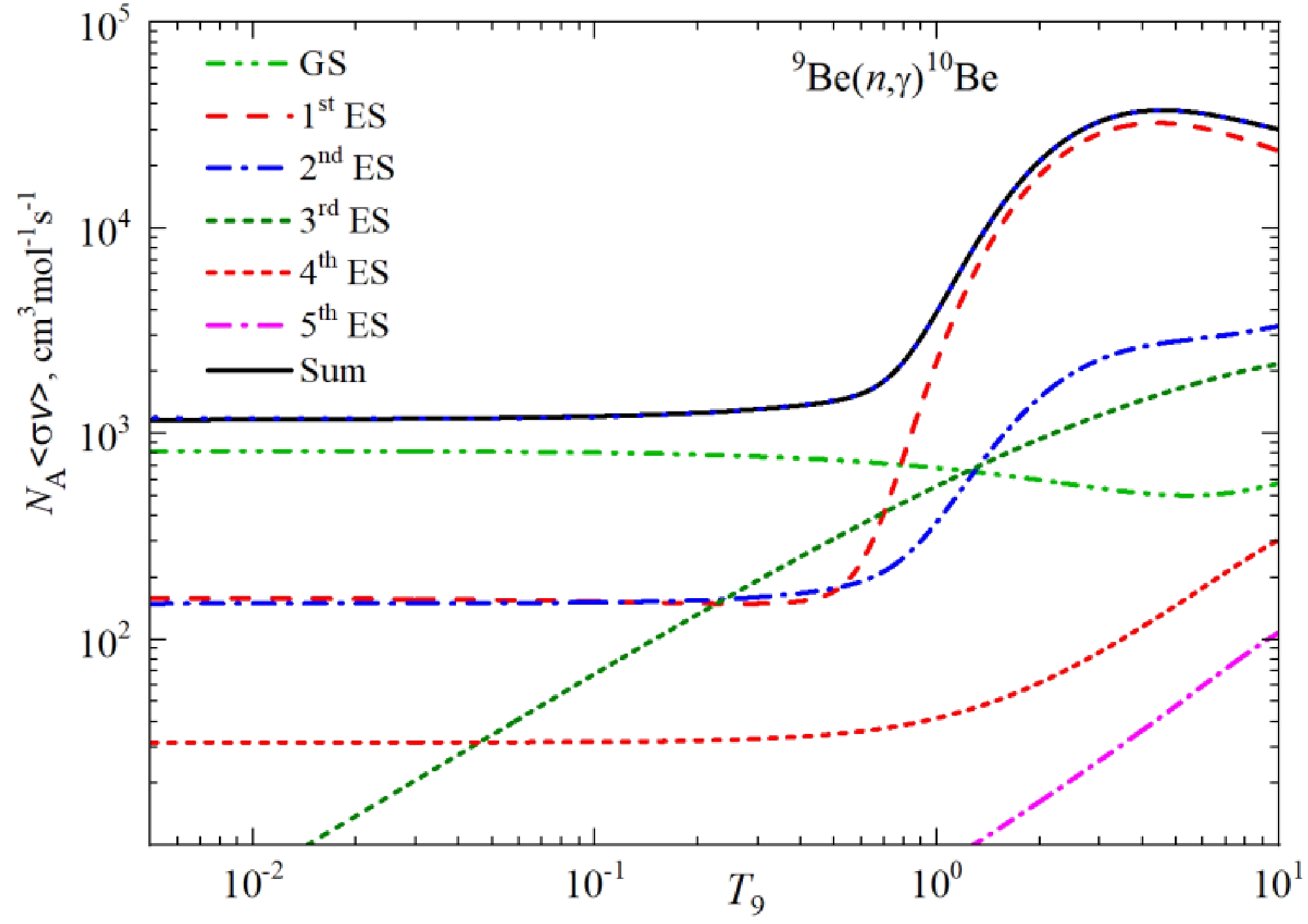
Figure 5.(color online) Total and partial reaction rates of neutron capture of the9Be nucleus.
The total reaction rate is approximated by the analytical expression from [10]:
$\begin{aligned}[b] {N_A}\left\langle {\sigma v} \right\rangle =& {a_1}(1.0 + {a_2}T_9^{1/2} + {a_3}T_9^{} + {a_4}T_9^{3/2} + {a_5}T_9^2 + {a_6}T_9^{5/2})\\& + {a_7}/T_9^{3/2}\exp ( - {a_8}/T_9^{}). \end{aligned}$

(19) We provide the approximation parametersχ2= 0.001 inTable 7. The accuracy of the calculated curve is 5%.
i ai i ai i ai i ai 1 1190.438 3 0.6435 5 0.00178 7 1.31549·106 2 –0.15943 4 –0.00344 6 –1.2853·10-4 8 6.4213 Table 7.Reaction rate approximation parameters.
We demonstrate inFig. 6the contributions of the resonance cross-sections to the total reaction rate. Comparison of
$ {\left\langle {\sigma v} \right\rangle _{{\text{res}}}} $ (black solid) and$ {\left\langle {\sigma v} \right\rangle _{{\text{non - res}}}} $ (red dashed) shows the rising of the total reaction rate from the ~ 0.4T9. Their difference reaches an order of magnitude at the maximum at ~ 4T9. Note that the non-resonance$ {\left\langle {\sigma v} \right\rangle _{{\text{non - res}}}} $ is calculated with the switched-off resonance amplitudes Nos. 4, 8, 9, 12, 13, 17, 18, 21, 22, and 29 ofTable 5.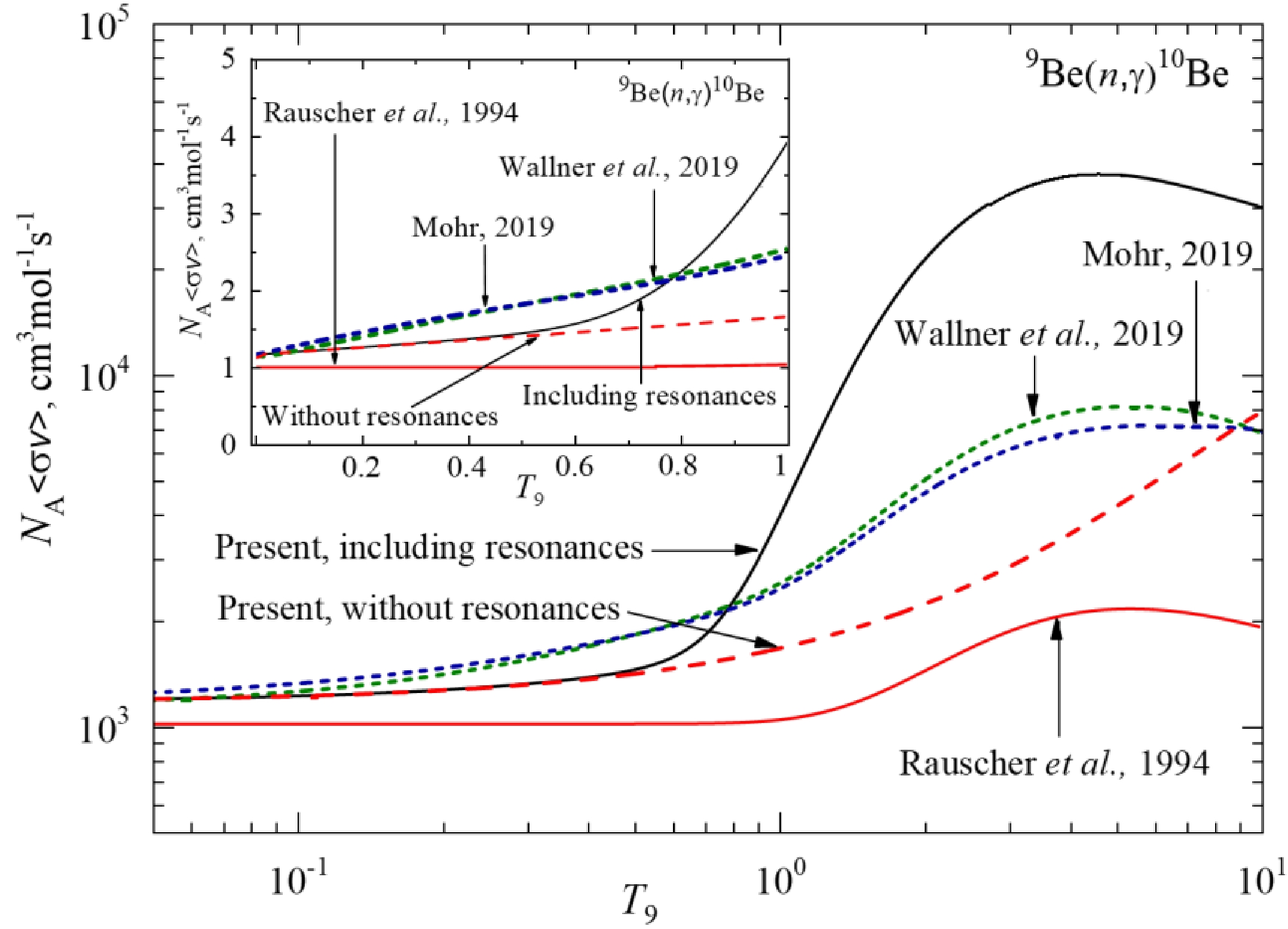
Figure 6.(color online) Comparison of the total reaction rates of radiative neutron capture of9Be: the dark green short dashed curve is the result of Ref. [10], the blue short dashed curve is the result of Ref. [11], and the red solid curve is the result of Ref. [9]; the black solid curve is the total reaction rate including resonances (same as in Figure 5); and the red dashed curve is the result of present calculations without resonance amplitudes.
Another comment concerns the present calculations of the9Be(n,γ0+1+2+3+4+5)10Be reaction rate and those from Refs. [10,11] as well as [9]:
(i) Calculations of the total cross-sections in [10,11] are performed in a folding cluster model but with subdivision into the direct capture partσDCand resonance partσR,ad hocσ=σDC+σR± 2(σDC·σR)1/2cos(δR) [58,59]. Contrariwise, in the MPCM approach, there is no such subdivision, and consequently there are no problems with uncertainties coming from the interference term. Both types of energy dependence are best viewed ascontinuousbehavior of the scattering phase shifts3D3,3F2, and3F3inFig. 3. Within this calculating scheme, the corresponding scattering functionsχiare obtained and incorporated into the overlapping integrals (5) and (8). The calculations in [9] are modeless ones.
(ii) The most significant input into the cross-section at energies higher than ~ 500 keV comes from the first 3-(0.559) resonance. In [10,11], to calculate the σRaccording to the Breit-Wigner formula, the experimental data on the first 3+resonance state is exploited (see, for example, Table 2 in [11]). MPCM reproduces the parameters of this resonance also. In Refs. [10,11], the value ofσ(0.559 MeV) ≈ 200 μb is reported. In the present calculations, we obtained the value ofσ(0.559 MeV) ≈ 1200 μb. This difference is illustrated in the corresponding reaction rates in nearly the same proportion: The present calculations exceed the reaction rates of [10,11] starting from ~ 0.8T9and are higher by a factor of nearly 5 at ~ 5T9.
(iii) We confirm the conclusion of Mohr [11] on the temperature dependence of the reaction rate at the low-rangeT9contrary to the constant
$ < \sigma v > $ behavior proposed in [9] (see insert inFig. 6). -
The partial and total cross-sections of the9Be(n,γ0+1+2+3+4+5)10Be reaction are calculated in the energy range from 10-5to 5 MeV in the MPCM. The expansion of the energy range to 5 MeV allows us to consider five
$^3D_{\,3}^{\,1}$ ,$^3F_{\,2}^{\,1}$ ,$^3F_{\,3}^{}$ ,$^3F_{\,2}^{\,2}$ , and$^3D_{\,\,3}^{\,2}$ resonances and estimate their signature in the total cross-section. A narrow resonance ofEx= 0.730 MeV is proposed as an$^3F_2^1$ state, not aPone as in Ref. [11]. Comparing the GS partial cross-section, the transitions to the 1stand 2ndESs contribute significantly to the total cross-section. The role of the (n,γ3) process increases with energy. The minor role of the (n,γ4) and (n,γ5) processes is demonstrated numerically.The calculated thermal cross-section
${\sigma _{\rm th}} = 8.35$ mb is in good agreement with experimental data of [10,19−21], which are ~ 10% lower than the early measurements [23,24]. That is cause for discussions with the experimentalists.The total and partial rates of the9Be(n,γ0+1+2+3+4+5)10Be reaction are calculated in the temperature range of 0.001 to 10T9and are approximated by an analytical expression. The inclusion of resonances shows their impact on the corresponding reaction rate of a value higher by a factor of 4-5 atT9>1 compared to the results of [10,11].
The lack of experimental data on the cross-sections higher than 500 keV illustrates the problem of quantitatively reproducing the first 0.559 MeV resonance, as it makes the most significant contribution to the rate of the9Be(n,γ)10Be reaction. New experimental measurements are strongly needed.
Finally, it is worth mentioning that our theoretical rstudy of the9Be(n,γ)10Be reaction can be applied to the isobar-analog process9Be(p,γ)10B. A comparative analysis of these processes within the same theoretical approach can illuminate the beryllium–boron branching under discussion.
Radiative9Be(n,γ0+1+2+3+4+5)10Be reaction rate in the potential cluster model
- Received Date:2023-04-21
- Available Online:2023-08-15
Abstract:Within the framework of the modified potential cluster model with forbidden states, the total cross-sections of radiativen9Be capture to the ground and five low-lying excited states are calculated at energies from 10−2eV up to 5 MeV. The thermal cross-section


 DownLoad: