


 Abstract
 HTML
HTML Reference
 Related
 PDF
PDF



-
The12C+12C fusion reaction plays an important role in stellar evolution, explosion, and associated nucleosynthesis in the Universe [1,2]. It governs carbon burning of massive stars, carbon deflagration in Type Ia supernovae (SNe Ia; [3,4]), and the carbon flash condition of superbursts [5,6]. The energy region of astrophysical interest extends from a few tens of keV to 3 MeV. All direct measurements are limited to energies above the center-of-mass energy
$ E_{\rm c.m.}= $ 2.1 MeV. Thus, extrapolation is inevitable to obtain the nuclear reaction rate at astrophysically relevant energies. However, owing to the strong narrow resonance structure in the12C+12C reaction, theoretical predictions are difficult and not consistent with each other [7].In the past decades, many experiments and theoretical models have been developed to reduce the uncertainties introduced by extrapolation [8–12].
The so-called standard rate of the12C+12C reaction was established by Caughlan and Fowler [13] (CF88) with experimental data of
$ E_{\rm c.m.}= $ 2.5 – 6.5 MeV and extrapolated using constant$ S^* $ based on the square well penetration factor [14]. They predicted a slowly rising trend of$ S^* $ (E) toward lower energies, which agrees well with various phenomenological and microscopic models [8,11,12,15,16] subsequently proposed. However, these reaction models are based on the average of the upper limits of cross section data taken at energies far higher than the energy region of astrophysical interest. Their extrapolations are far higher than the astrophysical energy region of interest and ignore the effects of possible low-lying resonances.Contrary to the rising trend of CF88, a significant suppression at lower energies owing to the hindrance effect was suggested by Gasqueset al. [11]. Jianget al. [7] predicted that the hindrance effect leads to a maximum of the modifiedS-factors (
$ S^* $ (E)$ =S $ (E)exp(0.46E)) of the12C+12C reaction, which appears around$ E_{\rm c.m.}= $ 3.68 MeV. After the maximum, the$ S^* $ factors decrease rapidly at lower energies. However, the existence of such a maximum of the$S^* $ factors is clearly ruled out by the more precise measurement of the12C+13C reaction at the deep sub-barrier owing to the strong correlation of$ S^* $ factors between the12C+12C and12C+13C fusion reactions [17].In contrast, a dramatic increase in
$ S^* $ factors in the12C+12C reaction was predicted by Tuminoet al. [18], for which an indirect measurement technique known as the Trojan Horse Method (THM) was applied. They obtained$ S^* $ factors from 2.8 to 0.7 MeV, overlapping the entire region of astrophysically relevant energies. This indirect measurement successfully overcomes the experimental limits of direct measurements and avoids the uncertainties introduced by extrapolation. However, it also leads to more complex results. The reaction rates of12C+12C obtained by different studies exhibit trends in different directions and deviate from each other by 1 – 7 orders of magnitude below 3 MeV.Recently, several new measurements [19–22] and theoretical models [23,24,25] were reported. An overall comparison of these measurements has been summarized by Aliottaet al. [26]. They indicated that these measurements generally agree down to 2 MeV within experimental errors. A clear discrepancy exists between the
$ S^* $ factor from Tanet al. [19] and those from Fruetet al. [20] and Spillaneet al. [9] in the region$ E_{\rm c.m.}= $ 2.7 – 3.0 MeV. The12C+12C reaction rate was reported by Adsleyet al. [21] by considering the potential resonance contribution, which is$ \sim $ 10 times larger than that of CF88 around$ E_{\rm c.m.}= $ 1.5 MeV. For theoretical models, Mukhamedzha-novet al. [23] (Muk19) re-evaluated the$ S^* $ factors from the THM and predicted a decreasing trend at lower energies. Based on their own independent theoretical approach, Bonasera and Natowitz [24] also evaluated the$ S^* $ factors at lower energies and showed an agreement with the trend predicted by THM measurements. The full microscopic calculation of Taniguchi and Kimura [25] presented a moderate trend.Owing to the lingering controversy among the reaction rates available in literature, devoted sensitivity studies could be performed by taking advantage of these available reaction rates. To evaluate the impact of the12C+12C reaction rate on astrophysical models, we choose the THM and Muk19 because these two rates currently present the upper and lower limit of12C+12C reaction rates.
This paper is organized as follows: In Section II, we compare the reaction rates of12C+12C used in this study. Section III describes the code and input parameters. We compare the chemical evolution from C burning for two rates in Section IV and their yields for all the isotopes used in this study in Section V. In Section VI, the theoretical abundance is compared with the observed abundance. In Section VII, we summarize our results and present the main conclusions.
-
There are three main channels for the12C+12C reaction in C burning:
$ \begin{array}{*{20}{l}} ^{12}{\rm C}+^{12}{\rm C}\, \rightarrow \, ^{20}{\rm Ne}+\alpha \, (Q=+4.616\; {\rm MeV}), \\ ^{12}{\rm C}+^{12}{\rm C}\, \rightarrow \, ^{23}{\rm Na}+{p} \, (Q=+2.238\; {\rm MeV}), \\ ^{12}{\rm C}+^{12}{\rm C}\, \rightarrow \, ^{23}{\rm Mg}+{n} \, (Q=-2.605\; {\rm MeV}). \end{array} $

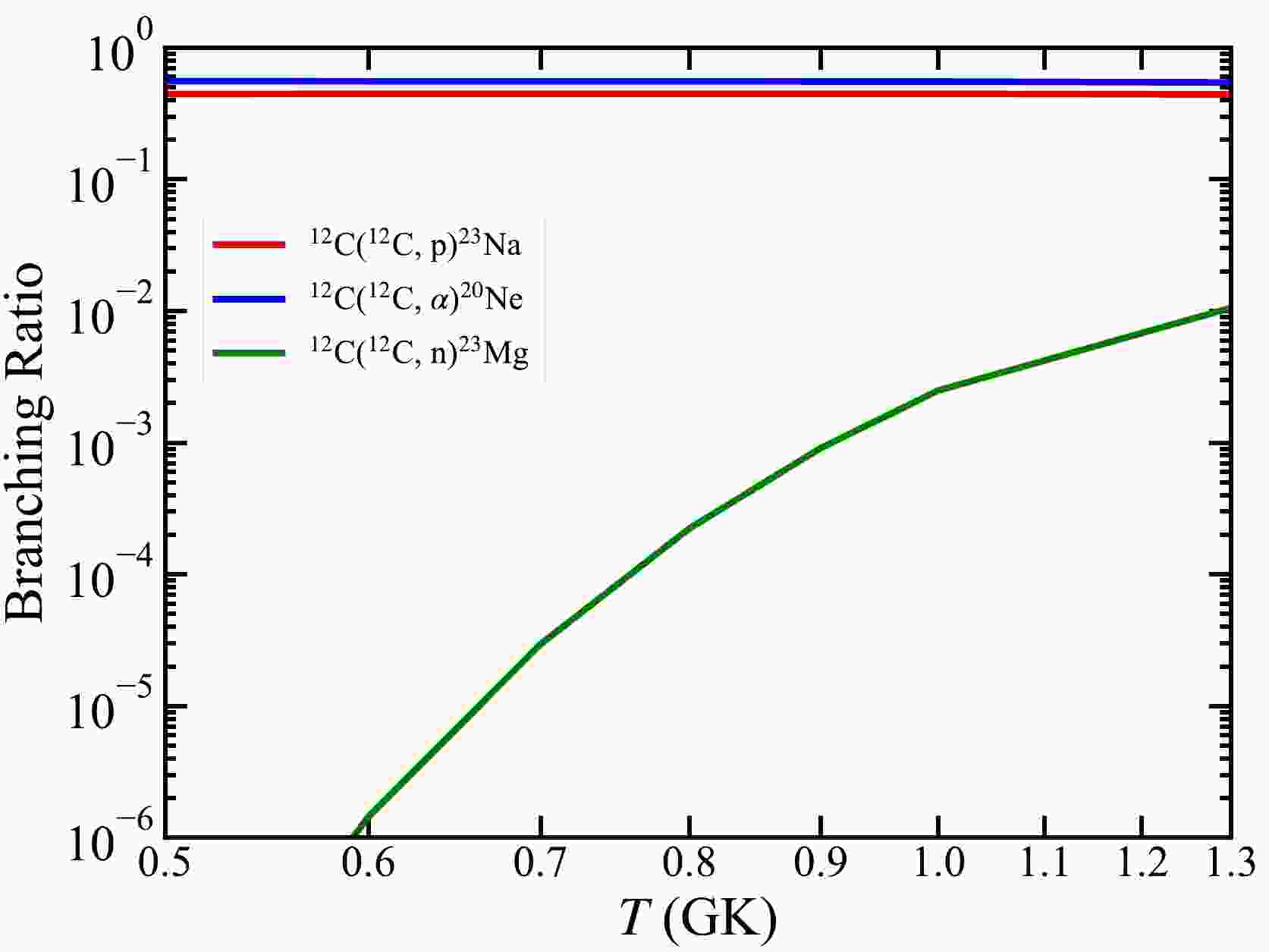
As shown inFig. 1, in the temperature range of hydrostatic C burning, the branching ratios of12C(12C,α)20Ne and12C(12C,p)23Na are 55.4% (blue) and 44.6% (red), respectively, whereas the probability of12C(12C,n)23Mg is two orders of magnitude lower owing to the negativeQvalue. With such a low branching ratio,12C(12C,n)23Mg contributes little to the energy generation rate of the12C+12C reaction; however, it is important for the production of23Na, as discussed in Section IV.
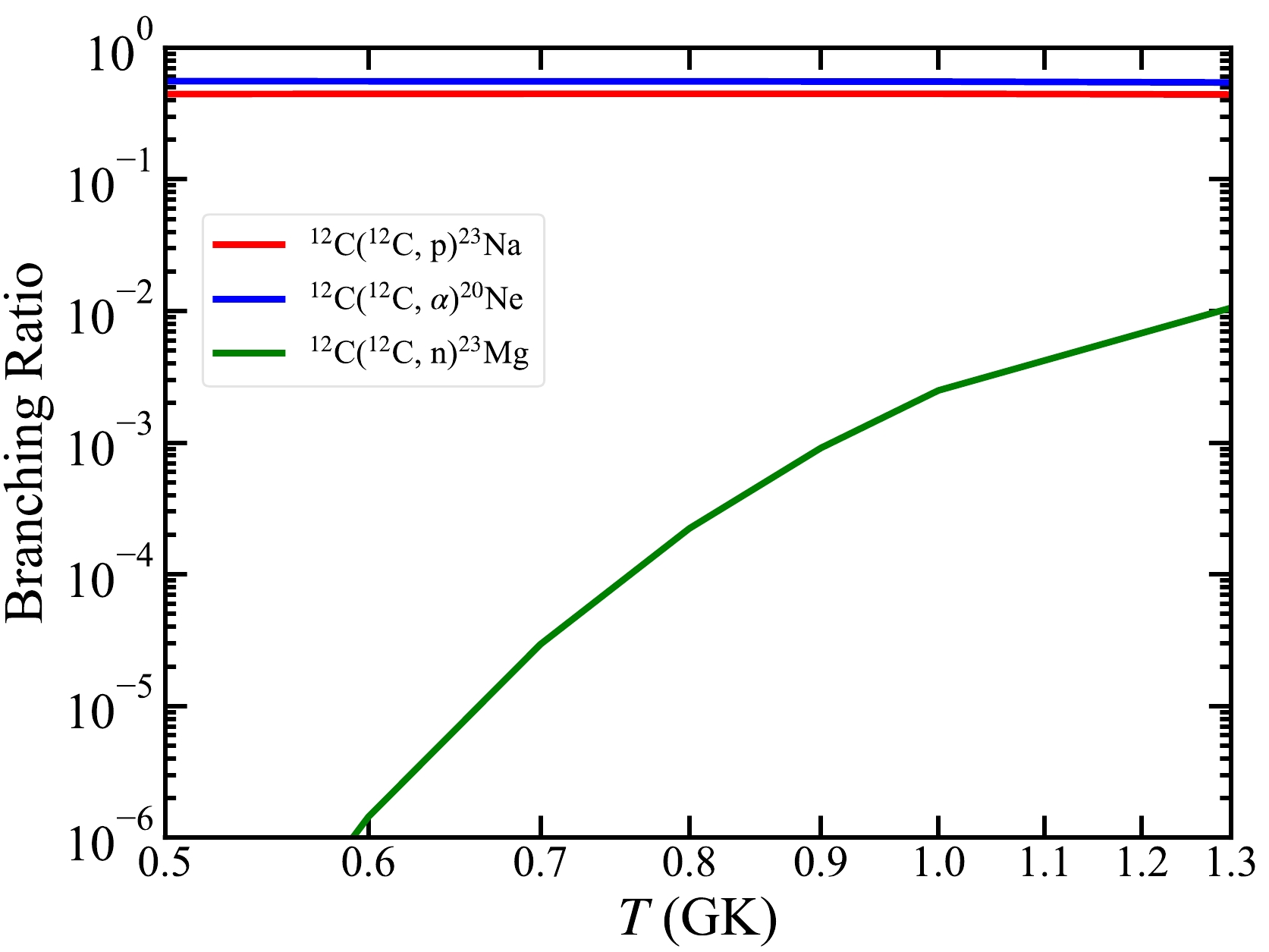
Figure 1.(color online) Branching ratios of three main channels for the12C+12C reaction as a function of temperature. The branching ratios of12C(12C,α)20Ne and12C(12C,p)23Na are 55.4% (blue) and 44.6% (red), respectively, whereas that of12C(12C,n)23Mg ranges from
$ \sim 10 $ $ ^{-6} $ to$ \sim 10 $ $ ^{-2} $ (green) in the temperature region of hydrostatic C burning. These branching ratios are from$\mathrm{ReaclibV2.2}$ [27].At
$ T= $ 0.7 GK, for example, the THM reaction rate of Tuminoet al. [18] is$ \sim 10$ times higher than that of CF88, whereas the rate derived by considering the factor proposed by Mukhamedzhanovet al. [23] is$ \sim 3$ times lower than that of CF88, as shown inFig. 2.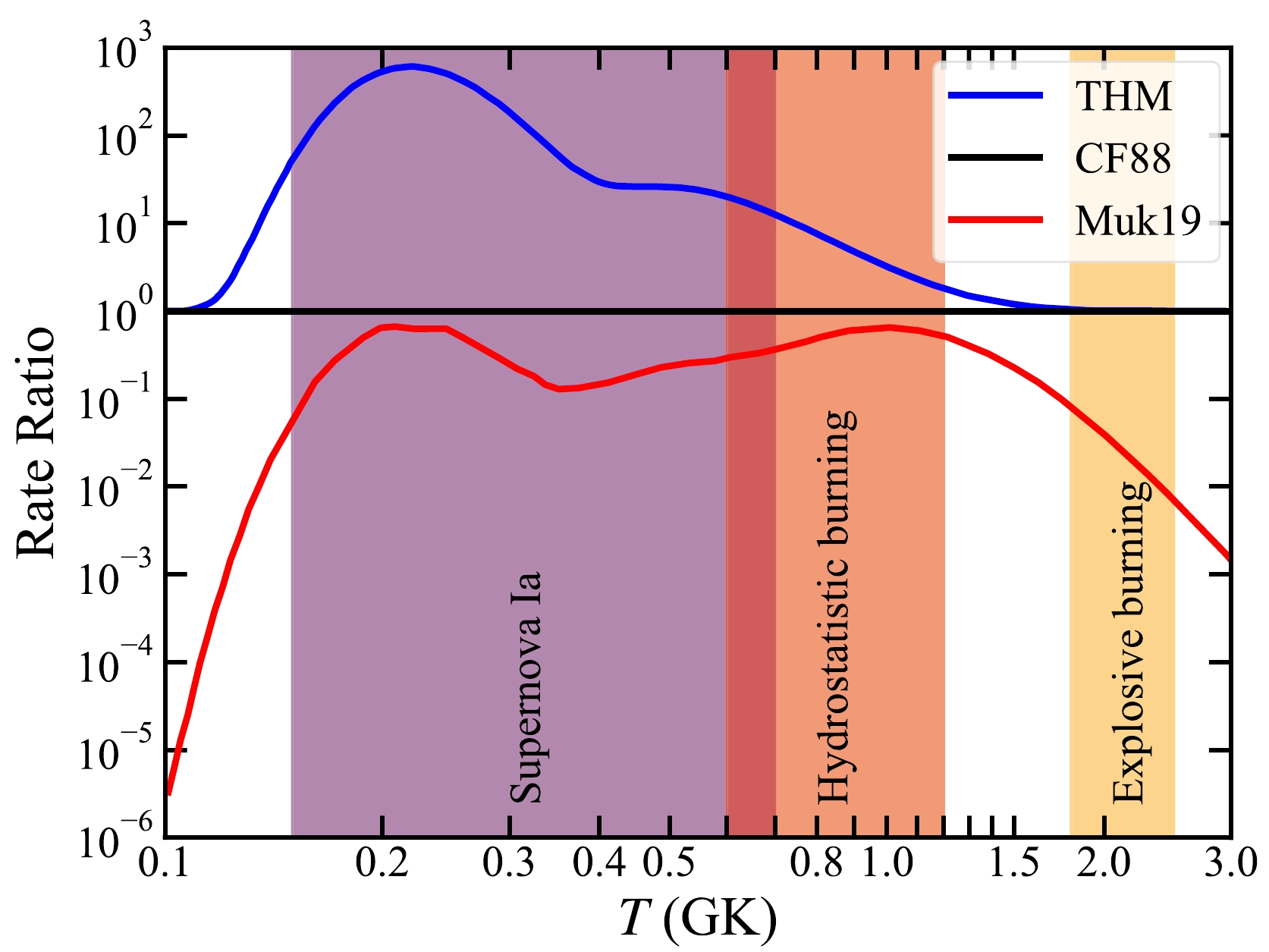
Figure 2.(color online)12C+12C reaction rates as a function of temperature. The THM rate (blue) is from Tuminoet al. [18]. The Muk19 rate (red) is obtained from the
$ S^* $ factors reported by Mukhamedzhanovet al. [23]. Both of these reaction rates are normalized by the CF88 rate (black) from Caughlan and Fowler [13]. The temperatures for C ignition in Type Ia supernovae ($ T = $ 0.15 – 0.7 GK), hydrostatic C burning ($ T= $ 0.6 – 1.2 GK), and explosive C burning ($ T = $ 1.8 – 2.5 GK) are marked by colored bands.Therefore, besides the more precise direct measurements of nuclear physics, studies on the effect of the12C+12C reaction rate on stellar evolution are important. Furthermore, it is also necessary to make comparisons between stellar models with different12C+12C reaction rates and astronomical observations. Gasqueset al. [11] first discussed the differences in stellar C burning and nucleosynthesis between the12C+12C reaction rates obtained from the hindrance effect and CF88. They concluded that the hindrance rate changes the abundances of many isotopes, especially enhancing the abundances of long-lived radioactive isotopes such as26Al and60Fe. Bennettet al. [28] and Pignatariet al. [29] discussed the effect of increasing and decreasing CF88 on the evolution of massive stars and the nucleosynthesis of s-process isotopes. Recently, two studies explored the effect of the THM rate, compared with the CF88 rate, on the ignition of Type Ia supernovae [30] and compactness and presupernova evolution [31].
Motivated by the above studies, it is necessary to compare the THM and Muk19 rates and discover how large differences in nucleosynthesis are introduced by these two rates. Then, a comparison between our theoretical presupernova yields and observational data of stellar abundances is conducted.
-
We employ the Modules for Experiments in Stellar Astrophysics (MESA, version 12778; Paxtonet al. [32–36]) to follow various nuclear burnings and structure evolutions in stars from Zero-Age Main-Sequence (ZAMS) until an Fe core is formed. Three groups of models with the12C+12C reaction rates from the THM, CF88, and Muk19 are calculated. The mass grids of the models are
$ M{\rm (ZAMS)}= $ 20, 23, 25, 28, 30, 32, 35, 38, and 40M$ _\odot $ .In the convection zone, we use mixing-length theory with the ratio between the mixing-length and a pressure scale height of
$ \alpha_{\rm mlt}= $ 3.0 when the mass fraction of H exceeds 0.5 and$ \alpha_{\rm mlt}= $ 1.5 for other stages. We adopt the exponential scheme with$ f_{0}= $ 0.004 and$ f= $ 0.01 for the overshooting. The Dutch scheme factor$\mathrm{Dutch_scaling_factor = 0.5}$ is adopted in this study. The "Dutch" scheme in MESA is a combination of three main mass loss prescriptions from de Jageret al. [37] for cool stars, Vinket al. [38] for hot H-rich stars, and Nugiset al. [39] for Wolf-Rayet stars.For the initial elemental abundances, we assume a He mass fraction of
$ Y=2Z+0.24 $ and a H mass fraction of$ X=1-Y-Z $ . Here,$ Z= $ 0.02 denotes the sum of the initial mass fractions of heavy elements, that is, C and heavier elements. For isotopic abundance ratios among heavy elements, we assume the solar abundance ratios from Anders and Grevesse [40]. -
To ensure the convergence of the various quantities of the stellar models at the
$ \sim $ 10% level [41], we adopt a large nuclear reaction network consisting of 128 isotopes (mesa_128.net, Paxtonet al. [32] and Timmeset al. [42,43]). The isotopes included in this network are listed inTable 1. The reaction-chain14N($ \alpha,\gamma $ )18O($ \alpha,\gamma $ )22Ne($ \alpha,\gamma $ )26Mg is also included. For the weak interaction, the tabulations of Langankeet al. [44,45] and Fulleret al. [46] are adopted. Because only the total reaction rates of12C+12C from the THM, CF88, and Muk19 are provided in our models, the branching ratios of each channel comply with the default of$\mathrm{MESA}$ from$\mathrm{ReaclibV2.2}$ [27]. Other reaction rates are taken from$\mathrm{ReaclibV2.2}$ .Element $ A_{\rm min} $ 

$ A_{\rm max} $ 

Element $ A_{\rm min} $ 

$ A_{\rm max} $ 

n 1 1 S 31 34 H 1 2 Cl 35 37 He 3 4 Ar 35 38 Li 7 7 K 39 43 Be 7 10 Ca 39 44 B 8 8 Sc 43 46 C 12 13 Ti 44 48 N 13 15 V 47 51 O 14 18 Cr 48 57 F 17 19 Mn 51 56 Ne 18 22 Fe 52 58 Na 21 24 Co 55 60 Mg 23 26 Ni 55 61 Al 25 28 Cu 59 62 Si 27 30 Zn 60 64 P 30 32 8Be is not included. Table 1.Nuclides included in the nuclear reaction network of mesa_128.net.
-
After He burning, stars evolve through gravitational contraction and nuclear burning until the formation of the Fe core. The default reaction rate in MESA is limited up to
$ T= $ 1010K. Thus, the final stage of the calculation (formation of the Fe core) is defined at temperatures up to 1010K at the center, and the time to the final stage as log$ \tau= $ log ($ t_{\rm final}-t $ ).We show the mass fraction of12C,X(12C) as a function ofM(ZAMS) after core He burning inFig. 3. There is no difference inX(12C) between the THM and Muk19 models forM(ZAMS) considered in our study.
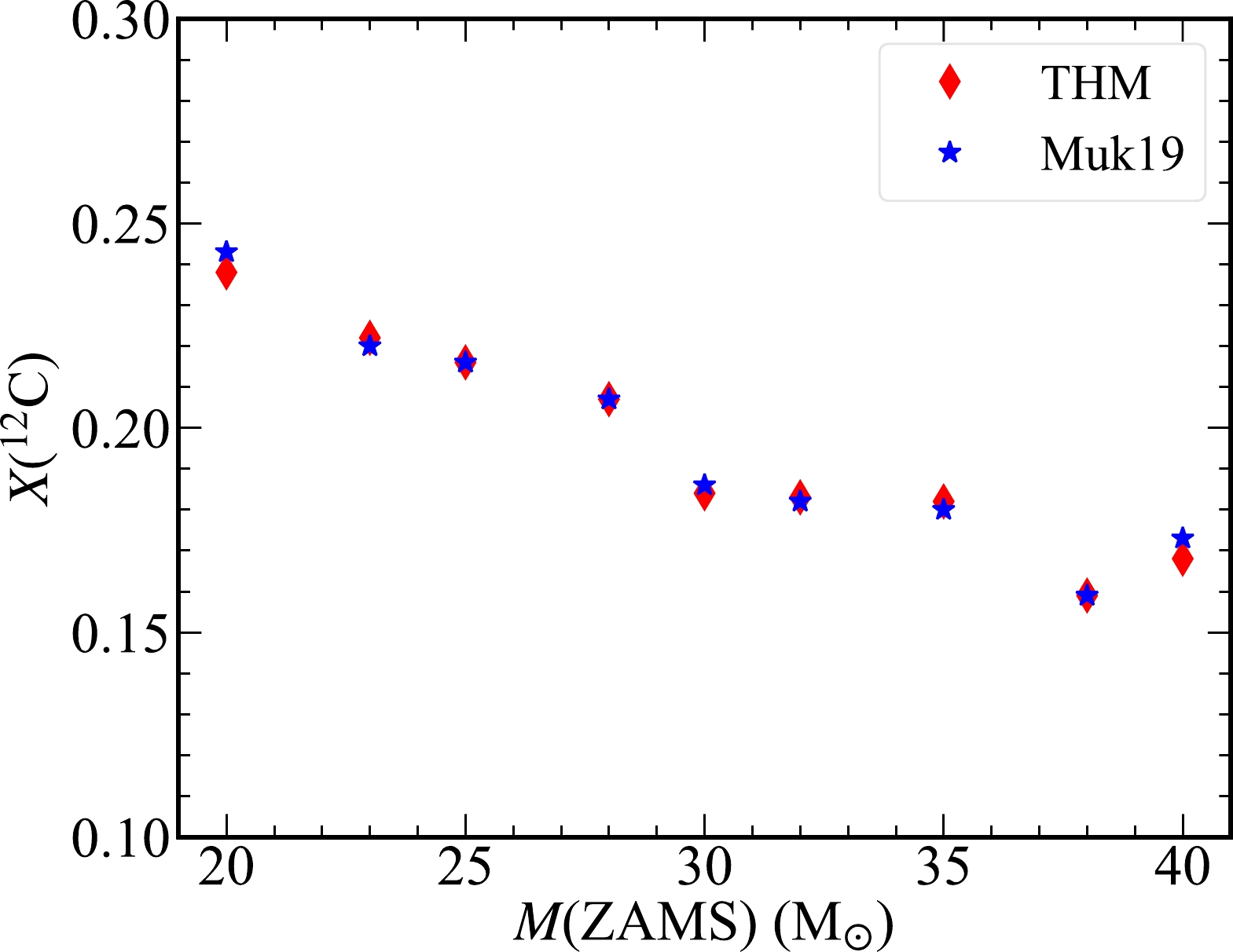
Figure 3.(color online) Mass fraction of12C as a function ofM(ZAMS) after core He burning. The models with the THM and Muk19 rates are marked by red diamonds and blue stars, respectively.
Less massive stars explode more frequently but eject less material into the interstellar medium. Conversely, more massive stars eject more material but explode less frequently [47]. Given the combined effects of ejected masses and the frequency of events, Weaveret al. [48] and Woosleyet al. [49,50] suggested that the ejecta of the explosion of theM(ZAMS) = 25M
$ _\odot $ star makes the largest contribution to chemical enrichment of the galaxy.Therefore, we use the models of theM(ZAMS) = 25M
$ _\odot $ star as a typical example to discuss the stellar evolution.The evolution of the central temperature and density (Fig. 4) and chemical elements (Fig. 5) from the end of He burning to the formation of the Fe core is compared between the THM and Muk19 models.
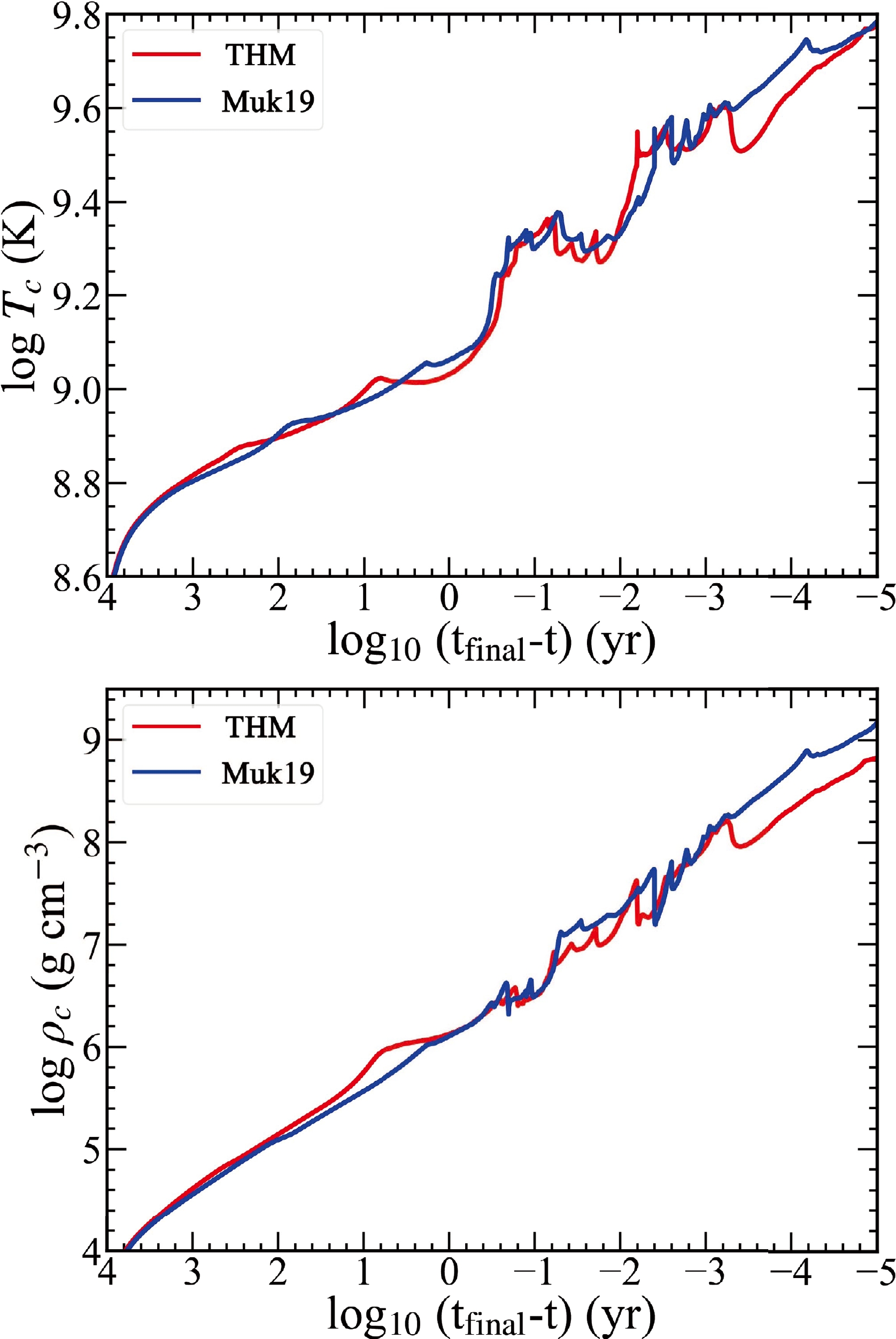
Figure 4.(color online) Time evolution of temperature (
$ T_c $ ) and density ($ \rho_c $ ) at the center of stars withM(ZAMS) = 25M$ _{\odot} $ for the THM and Muk19 models.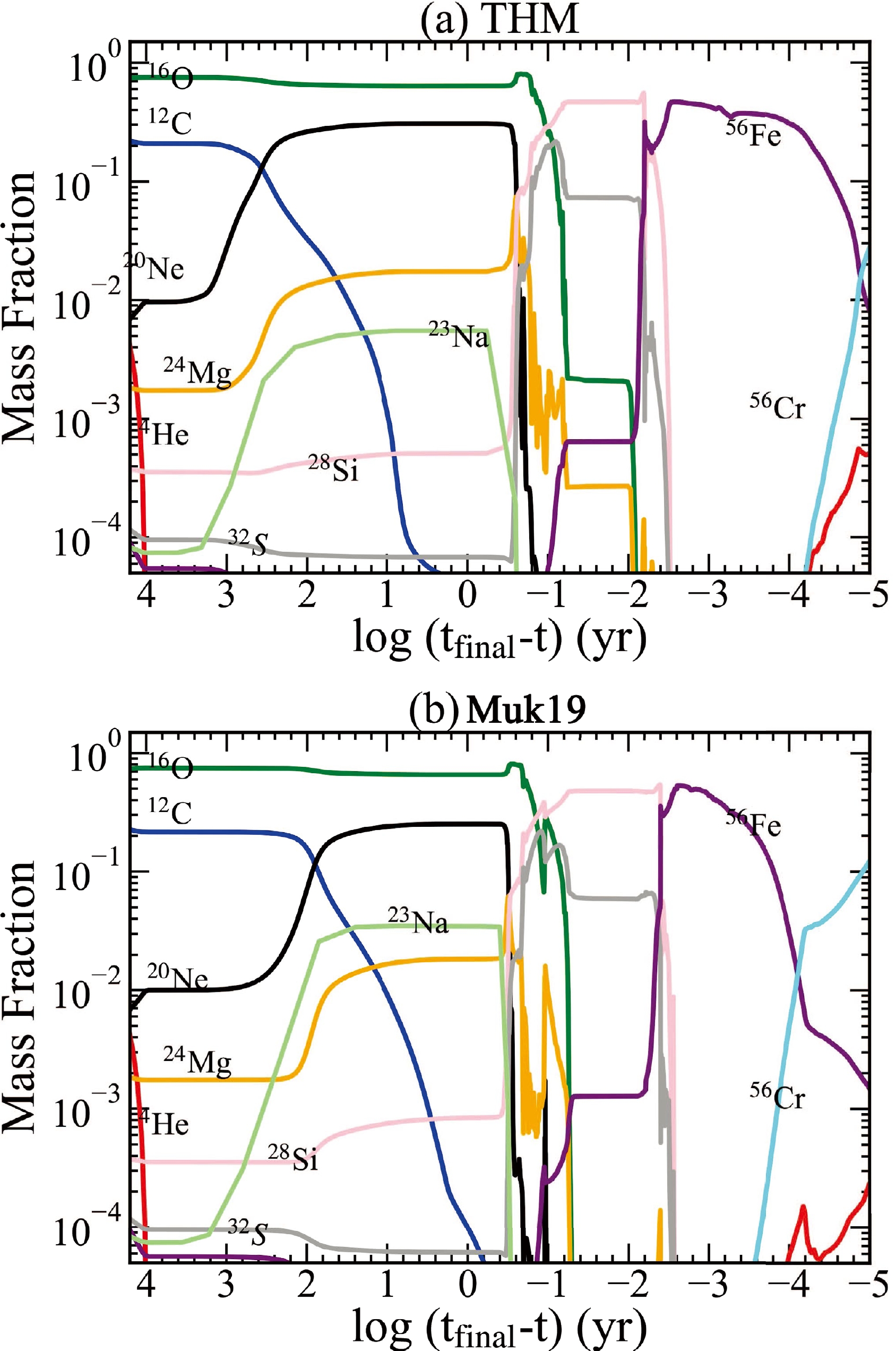
Figure 5.(color online) Time evolution of the mass fractions of several isotopes at the center of stars withM(ZAMS) = 25M
$ _{\odot} $ for the THM (top) and Muk19 (bottom) models.The adoption of a higher rate makes C ignite earlier and burn at lower temperatures. With the Muk19 rate, stars ignite C burning at log
$ \tau \sim $ 2, where the temperature ($ T_9 \equiv T/10^9 $ K) and density are$ T_9 \sim $ 0.8 and$ \rho \sim $ 1.26$ \times $ 10$ ^5 $ g cm$ ^{-3} $ , respectively, whereas with the THM rate, C is ignited hundreds of years earlier with a lower temperature ($ T_9 \sim $ 0.63) and density ($ \rho \sim $ 5.01$ \times $ 10$ ^4 $ g cm$ ^{-3} $ ) in the core. Of course, with a higher rate (THM), C is also exhausted more rapidly. The time for C exhaustion in the core is log$ \tau \sim $ 1 and 0 for the THM and Muk19 rates, respectively. The evolution of the mass fractions of12C,20Ne,23Na, and24Mg with the temperature at the center is shown inFig. 6.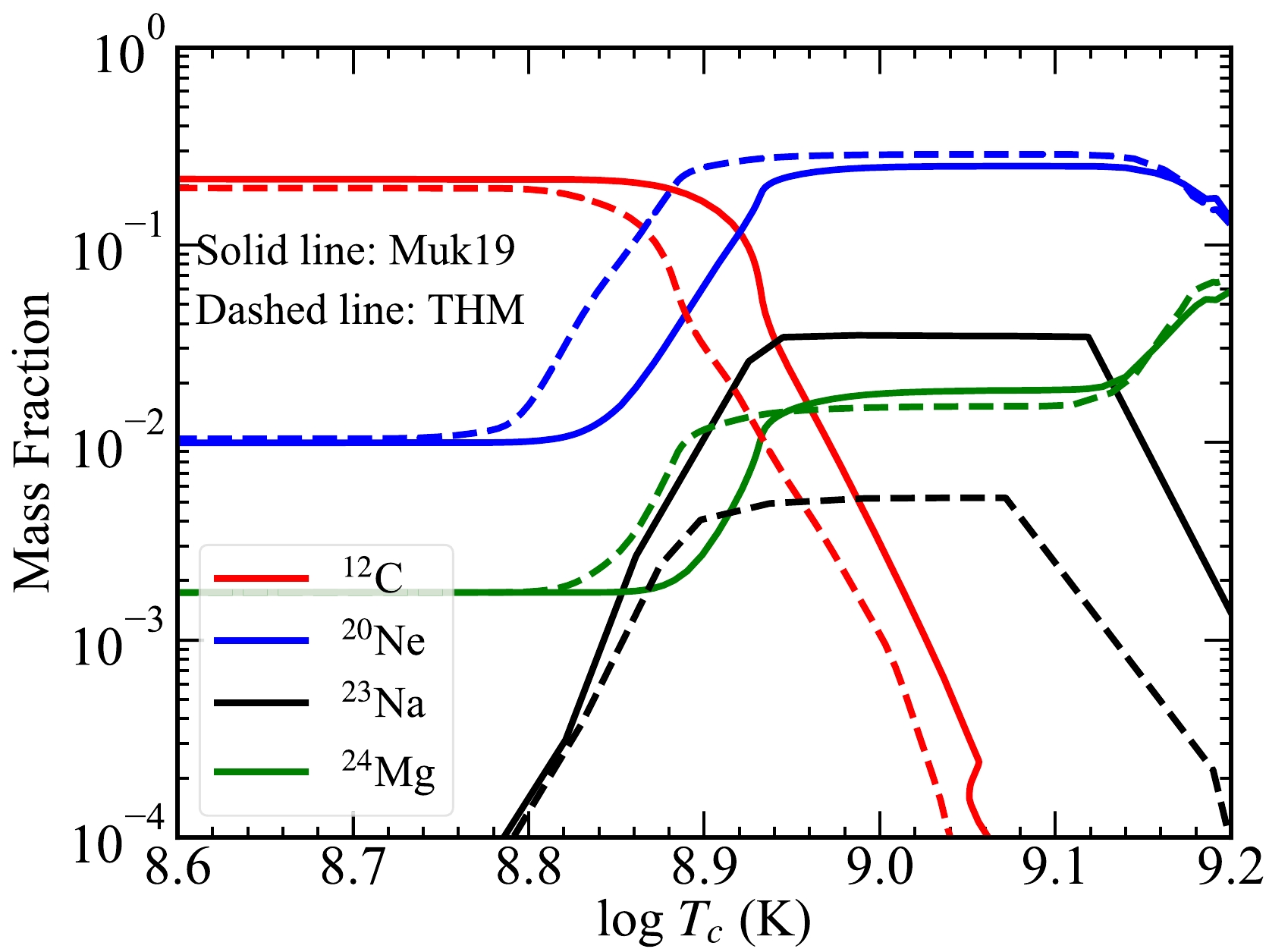
Figure 6.(color online) Mass fraction of12C,20Ne,23Na, and24Mg as a function of temperature at the center. The models with the THM and Muk19 rates are marked by dashed and solid lines, respectively.
Figure 7(a) and (b) compare the distributions of several isotopes against
$ M_r $ for the THM and Muk19 models when C is exhausted. We define the end of C burning as whenX(C)$ < $ 10$ ^{-4} $ at the center. In addition to16O remaining after He burning, the abundant product is20Ne, followed by23Na and$ ^{24,\, 25} $ Mg in the ONe core. As mentioned inFig. 1, theαandpchannels have the equivalent branching ratio (55.4% for theαchannel and 44.6% for thepchannel) at the temperature of C burning. Because$ \sim $ 99% of23Na produced through thepchannel are destructed by the efficient23Na(p,α)20Ne reaction during core C burning [28,51], the production of23Na is lower compared with that of20Ne.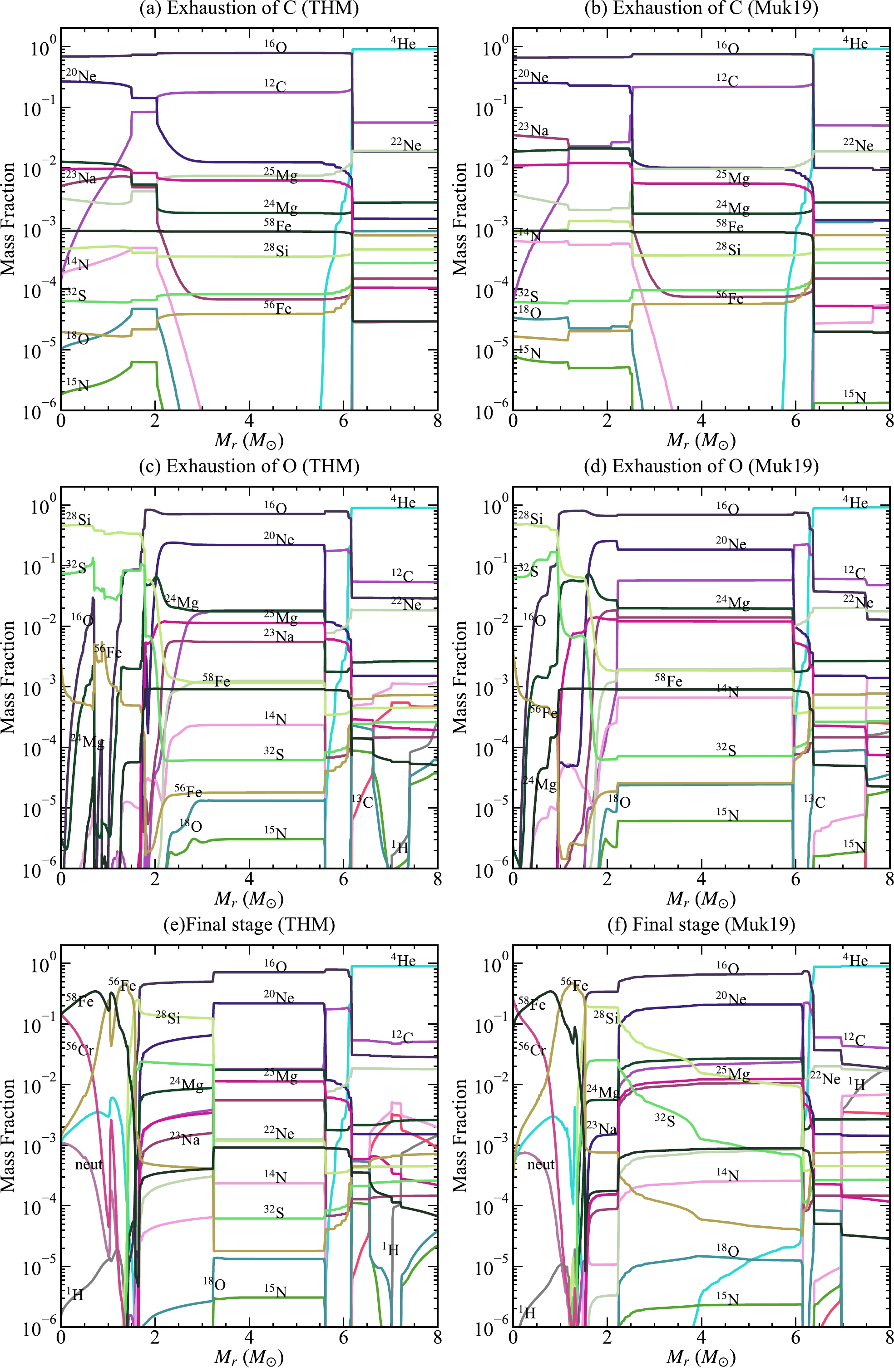
Figure 7.(color online) Abundance distributions of stars withM(ZAMS) = 25M
$ _{\odot} $ at the exhaustion of C burning (top row), O burning (center row), and the final stage (bottom row) for the THM (left) and Muk19 (right) rates. The exhaustion of C or O is defined asX(C) orX(O) lower than 10$ ^{-4} $ at the center. The final stage is defined as when the temperature reaches 1010K at the center.After core He burning, the neutron excess (
$\eta=1- 2Y_{\rm e}$ ) is$ \sim $ 0 in the core because16O and12C have an equal proton number (Z) and neutron number (N).Here,
$ Y_{\rm e} $ is the electron mole number, defined as$ Y_{\rm e} = \frac{n_{\rm e}}{\rho N_{\rm A}}, $

(1) where
$ n_{\rm e} $ is the electron number density, and$ N_{\rm A} $ is the Avogadro constant.The production of isotopes with
$ N>Z $ is sensitive to the neutron excess [52]. However,12C(12C,p)23Na cannot change the neutron excess in the core, and thus23Na produced by this reaction is unstable and rapidly converts to20Ne. Bucheret al. [53] indicated that though the branching ratio of12C(12C,n)23Mg is small, the contribution to the production of23Na is important becauseβdecay in the12C(12C,n)23Mg( $ \beta^- $ )23Na chain can change the neutron excess. Woosleyet al. [52] mentioned that the reaction chain20Ne(p,γ)21Na($ \beta^- $ )21Ne(p,γ)22Na($ \beta^- $ )22Ne(p,γ)23Na (Ne-Na chain) also increases the neutron excess significantly during C burning. Therefore, the contribution of the Ne-Na chain to the production of23Na is also important.The main contributors to the production of23Na in the core are12C(12C,n)23Mg(
$ \beta^- $ )23Na and the Ne-Na chain. As shown inFig. 8, the Muk19 model has higher burning temperatures in the core. The higher temperatures lead to these two reaction chains being more active. Therefore, the neutron excess is enhanced and more23Na is produced in the core. Owing to the larger neutron excess in the core of the Muk19 model, several neutron-rich isotopes, such as15N and18O, exhibit higher production.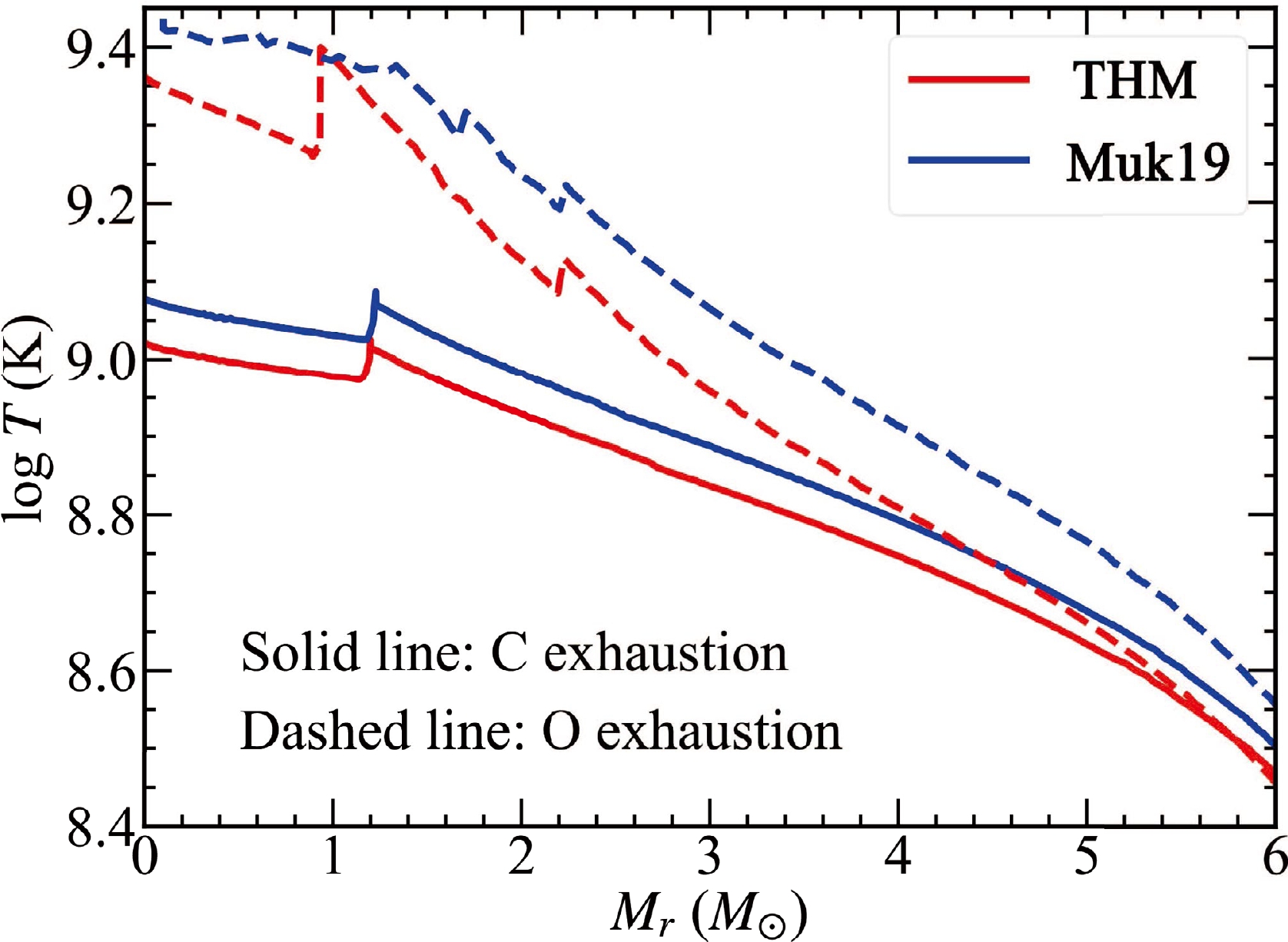
Figure 8.(color online) Temperature distribution against
$ M_r $ within$ M_r= $ 6M$ _\odot $ for the THM (red) and Muk19 (blue) models. The solid and dashed lines represent the exhaustion of C and O, respectively.Pignatariet al. [29] noted that a higher12C+12C rate may increase thes-process production during C burning because the13C(α,n)16O reaction emerges as a more dominant neutron source than22Ne(α,n)25Mg. However, this reaction is only active at the beginning of C burning in the THM model, which is not high enough to have an obvious effect on thes-process. Thus,s-process isotopes, such as58Fe, behave with no obvious difference at the end of C burning in the two models. When C at the core is almost exhausted (log
$ \tau \simeq $ 1 yr), the core contracts and gravitational energy is released to balance the energy lost by neutrinos. Owing to the lower temperature in the core, stars with the THM rate require more time to contract and reach the temperatures of the Ne and O ignitions.InFig. 7(c) and (d), when O is exhausted (X(O)
$ < $ 10$ ^{-4} $ ) at the center, a core composed mainly of28Si and32S is formed.Figure 8shows that the CO shell has a lower temperature in the THM than Muk19. The THM model consumes more12C but produces less23Na in the shell. As mentioned, most of the23Na produced by thepchannel is destroyed by the23Na(p,α)20Ne reaction, which is sensitive to temperature [28,29].During massive star evolution, neutrino losses decrease the central entropy that leads to the formation and contraction of the Fe core. InFig. 9, the Fe core at
$ t = t_{\rm final} $ has$Y_{\rm e} =$ 0.437 and 0.441 at the center of Muk19 and THM, which increases gradually to 0.461 and 0.460 at the core edge of the Muk19 and THM models, respectively. At$ M_r< $ 1.5M$ _\odot $ , the two models have the similar$Y_{\rm e}$ , except at the center andMr=1.2M$ _\odot $ , where the difference inYeoriginated from different production of56Cr via decay of56Fe. At 2.2M$ _\odot 3.2M$ _\odot $ , the THM model has a lower$ Y_e $ (larger neutron excess). In this layer, the Muk19 model is mainly composed of16O,20Ne, and28Si (before O burning), whereas some16O,20Ne, and28Si is consumed (during O burning) for the THM (seeFig. 7(e) and (f)). During O burning, the neutron excess is significantly enhanced by weak interactions [50]. For the outer shell of$ M_r> $ 2.2M$ _\odot $ , the lower$Y_{\rm e}$ is consistent with the higher production of23Na for Muk19.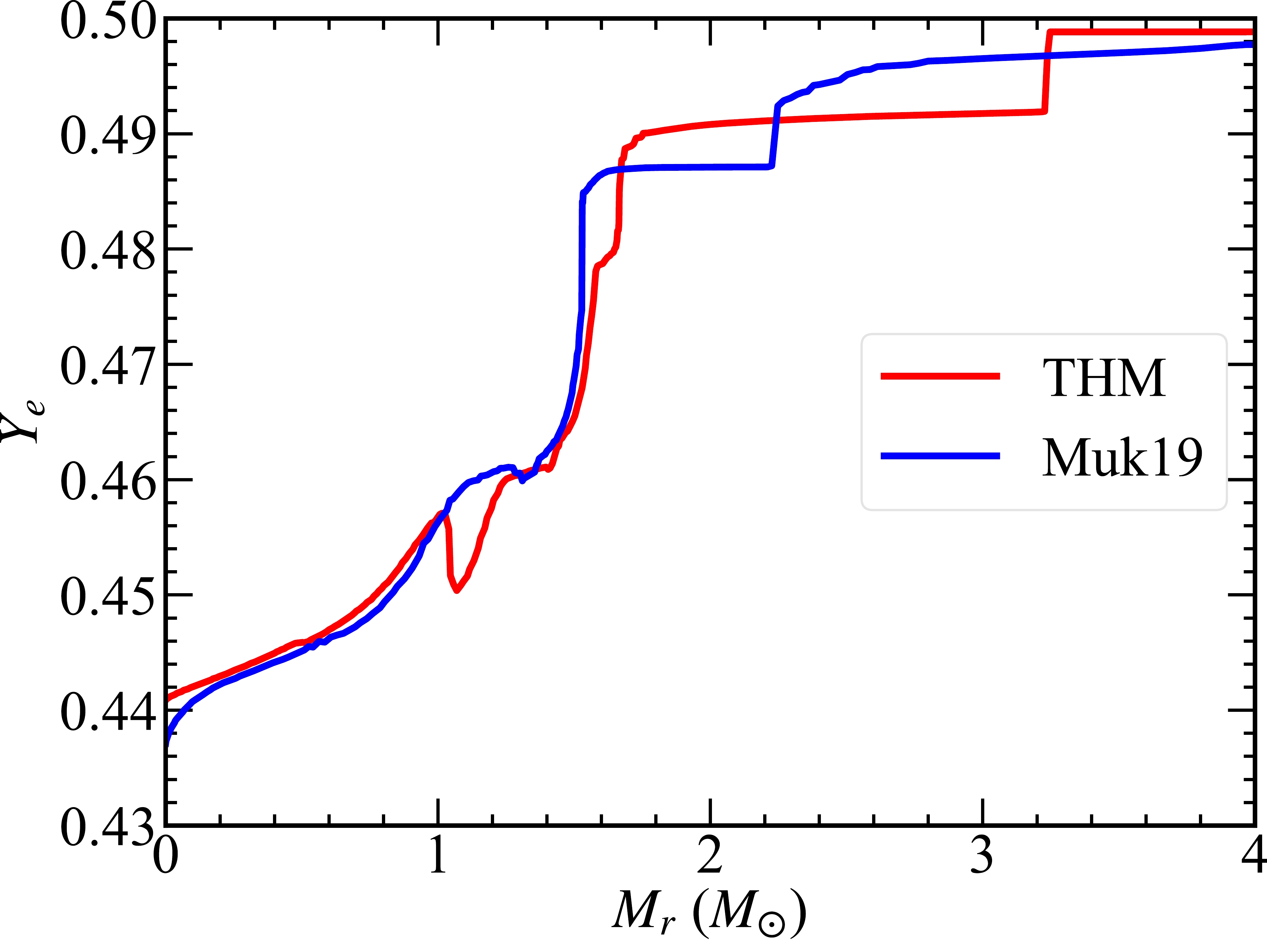
Figure 9.(color online) Distribution of electron mole number,
$ Y_e $ , against$ M_t $ within$ M_r= $ 4M$ _\odot $ at the final stage for the THM (red) and Muk19 (blue) models.$ Y_e $ is defined in Eq. (1).Therefore, the THM model can ignite core and shell C burning at lower temperatures. This leads to a lower neutron excess and decreases the production of some neutron-rich isotopes, such as15N,18O, and23Na, in the O shell. However, the burning temperature is not low enough to activate the13C(α,n)16O reaction. Thus, the difference between the THM and Muk19 rates is not sufficiently large to have an obvious effect on the s-process during C burning.
-
In the observed solar abundance, the production of the intermediate-mass isotopes (
$ A= $ 16 – 40) is mainly contributed to by Type II supernovae (SNe II, [52,54,55]). Under this assumption, similar production factors are desirable for these isotopes in stars with solar metallicity. The production factor of an isotopeiis given by Eq. (2) [56].$ P_i \equiv \frac{Y^*_i}{X_{i,\odot} \cdot \sum_{k} Y^*_k} , $

(2) where
$ X_{i, \odot} $ is the solar mass fraction of isotopei,$ \sum_{k} $ runs over all isotopes, and$ Y^*_i $ represents the yield interpolated by the initial mass function (IMF) for isotopeiand is defined in Eq. (3).$ Y^*_i = \sum\limits_{j}\int_{m_j}^{m_{j+1}} \xi(m)\cdot(s_{i,j} \cdot [m-m_j]+Y_{i,j})\cdot {\rm d}m. $

(3) In Eq. (3), the IMF
$ \xi(m)\,= $ C$ \cdot m^\gamma $ with$ \gamma=-2.35 $ for massive stars is adopted [57]. The mass grid of$ M ({\rm ZAMS}) $ s is used here for integrations.$ Y^* $ is the yield linearly interpolated value between the mass grids$ m_j $ and$ m_{j+1} $ .$ s_{i,j} $ is the slope of the integral, which is defined as$ s_{i,j}= (Y_{i,j+1}-Y_{i,j})/(m_{j+1}-m_j) $ .Based on the assumption mentioned above, Weaver and Woosley [58] and Woosley and Heger [59] constrained the reaction rate of12C(α,γ)16O with the production factors of presupernovae, which are modified by the explosion models later. In this study, we only calculate the massive stars from ZAMS until the onset of the Fe-core collapse, and we do not simulate the supernova explosion. Because Fe-peak isotopes are significantly affected by the explosion, in the following part, only the elements and isotopes from C to Ti are shown and discussed. The production factors of16O,20Ne,23Na,24Mg, and27Al for all models are shown inFig. 10. They change with
$ M{\rm (ZAMS)} $ smoothly. InFig. 11, we compare the averaged production factors of the THM and Muk19 models. To confirm how large the supernova modification can be, the production factors of several important isotopes (gray points,$ ^{16,\,18} $ O,20Ne,23Na,24Mg,28Si,32S,36Ar, and40Ca) after the explosion in Turet al.[60] (hereinafter referred to as T07) are also compared.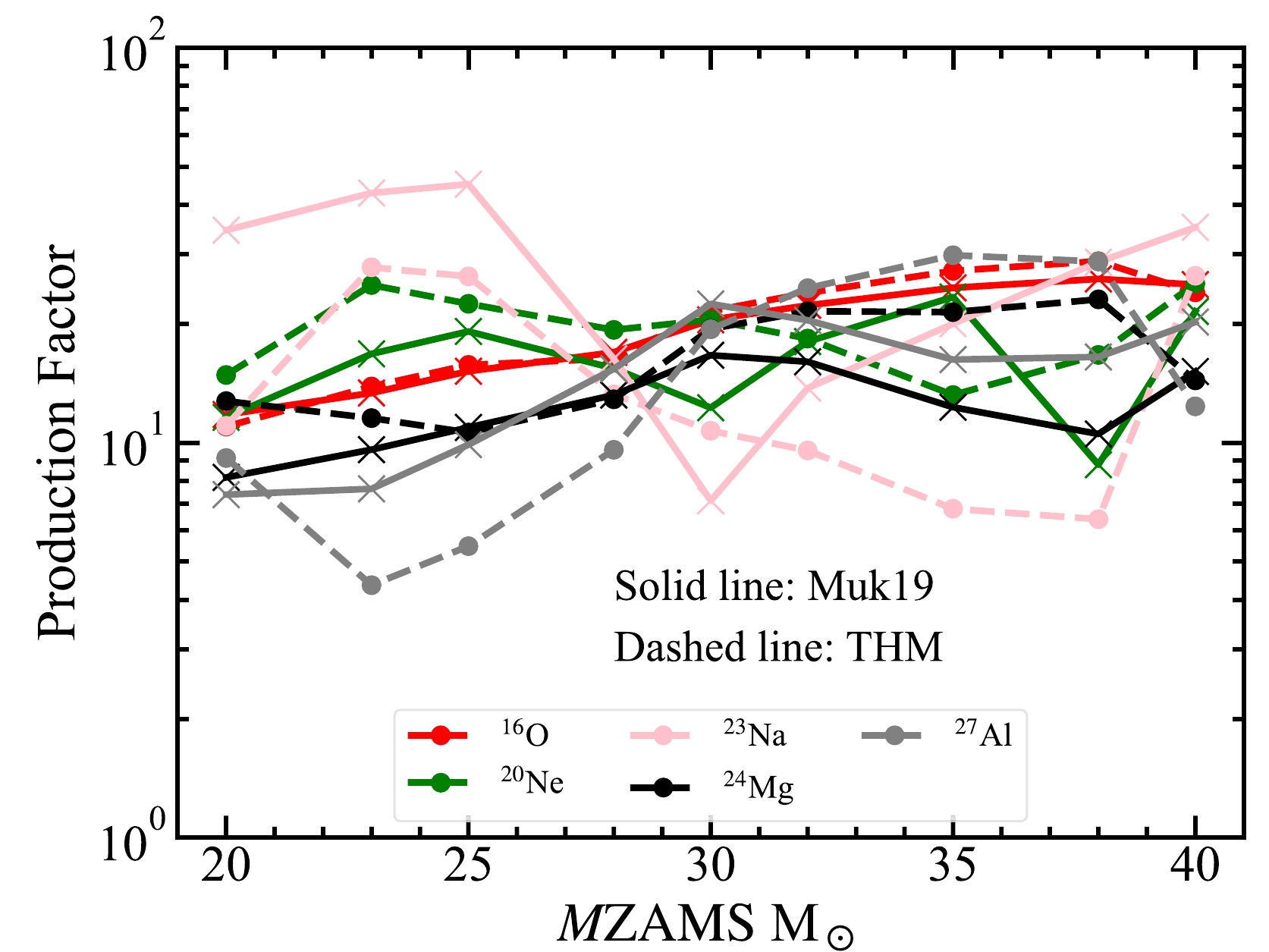
Figure 10.(color online) Production factors of16O,20Ne,23Na,24Mg, and27Al as a function ofM(ZAMS). The models with the THM and Muk19 rates are marked by dashed and solid lines, respectively.
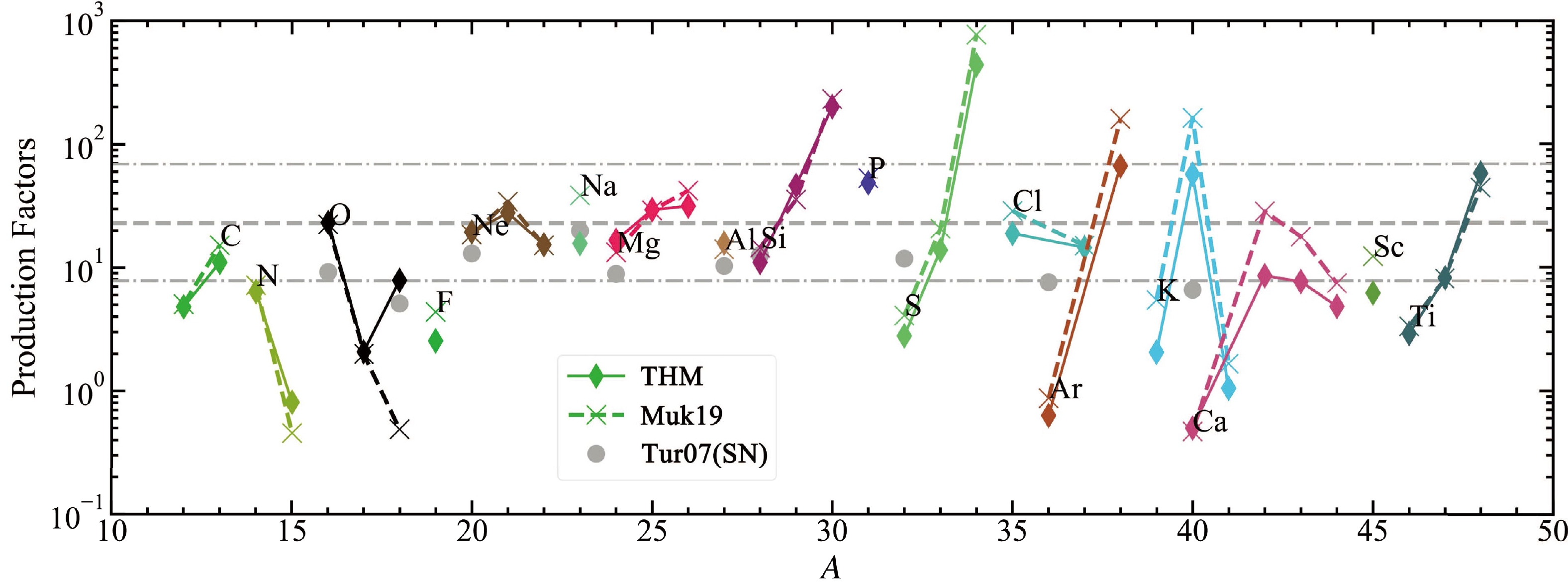
Figure 11.(color online) Production factors of isotopes averaged over the IMF from Salpeteret al. [57]. Only the isotopes from C to Ti are shown. The gray lines indicate the production factor of16O from our pre-explosion models. The dotted lines show three times and one-third of the gray dashed line. The gray points show the production factors in the post-explosion model by Turet al. [60].
The gray dashed line shows the production factor of16O, which is the most abundant 'metal' produced by massive stars. We also indicate the locations of three times and one-third of the production factor of16O using the gray dotted line. For both the THM and Muk19, most of the isotopes from C to Ti relative to O are within a factor of three of the solar ratios. Our production factor of16O is three times larger than that of T07. The difference stems from two main sources. First, the O+Si shell outside the Fe core burns explosively during the explosion, and16O in this layer converts to28Si after the explosion. Second, T07 averaged their yields over
$ M{(\rm ZAMS)}= $ 13 – 27M$ _\odot $ , whereas we average them over$ M{(\rm ZAMS)}= $ 20 – 40M$ _\odot $ . Lower$ M{(\rm ZAMS)} $ stars produce smaller16O and larger12C.20Ne,23Na,24Mg,27Al, and28Si in this study agree with those of the explosion model, whereas isotopes heavier than28Si, especially32S,36Ar, and40Ca, are underproduced. T07 also reported these differences and considered that these isotopes are significantly modified during the explosion by more than a factor of 1.5. Besides the reaction rate of12C+12C, the production factors of these intermediate-mass isotopes are affected significantly by the reaction rate of 3αand12C(α,γ)16O [56,58,60,61].The production factors of18O,23Na, and
$ ^{42,\,43} $ Ca show obvious differences between the THM and Muk19 models. To present these differences more clearly, we compare the ratio of the averaged yield between Muk19 and the THM for all isotopes from C to Ti inFig. 12. Most ratios of the averaged yield between Muk19 and the THM range from$ \sim $ 0.3 to 10. All the isotopes with the same neutron and proton number have similar production factors between the two models. For the lighter elements, owing to more H mixed into the He shell, the Muk19 model produces more isotopes related to the CNO cycle, such as13C,13N,$ ^{14,\,15} $ O,$ ^{17,\,19} $ F, and$ ^{18,\,19} $ Ne, in the He shell. In the CO shell, more neutron-rich isotopes are produced in the Muk19 model owing to the larger neutron excess. However, near the Fe core, the ratio of neutron-rich isotopes tends toward 1 because of the small difference in neutron excess between the two models.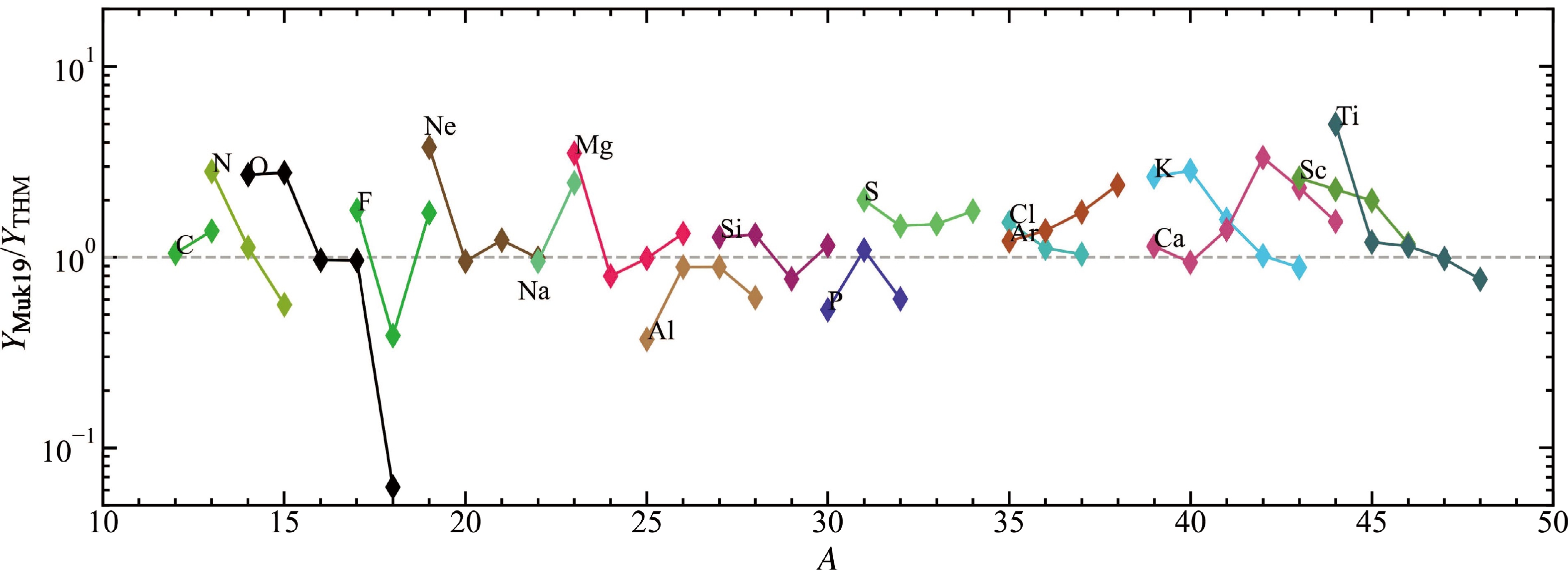
Figure 12.(color online) Ratios of the averaged yields for all isotopes used in the network, shown inTable 1, between C and Ti. The gray dashed line indicates where the ratio is 1.
-
In Sections IV and V, we conclude that owing to the lower neutron excess, the THM model produces fewer neutron-rich isotopes in the CO shell. We also confirm the conclusion made in T07 that isotopes after28Si are significantly modified by the explosion, whereas isotopes in the outer shell, such as20Ne,23Na,24Mg, and27Al, are less affected by the explosion. The main purpose of this section is to conduct a comparison between theoretical yields and observed abundances. InFig. 13, we show the abundance patterns of the presupernova yields of the THM and Muk19 models. The abundance ratio is defined as
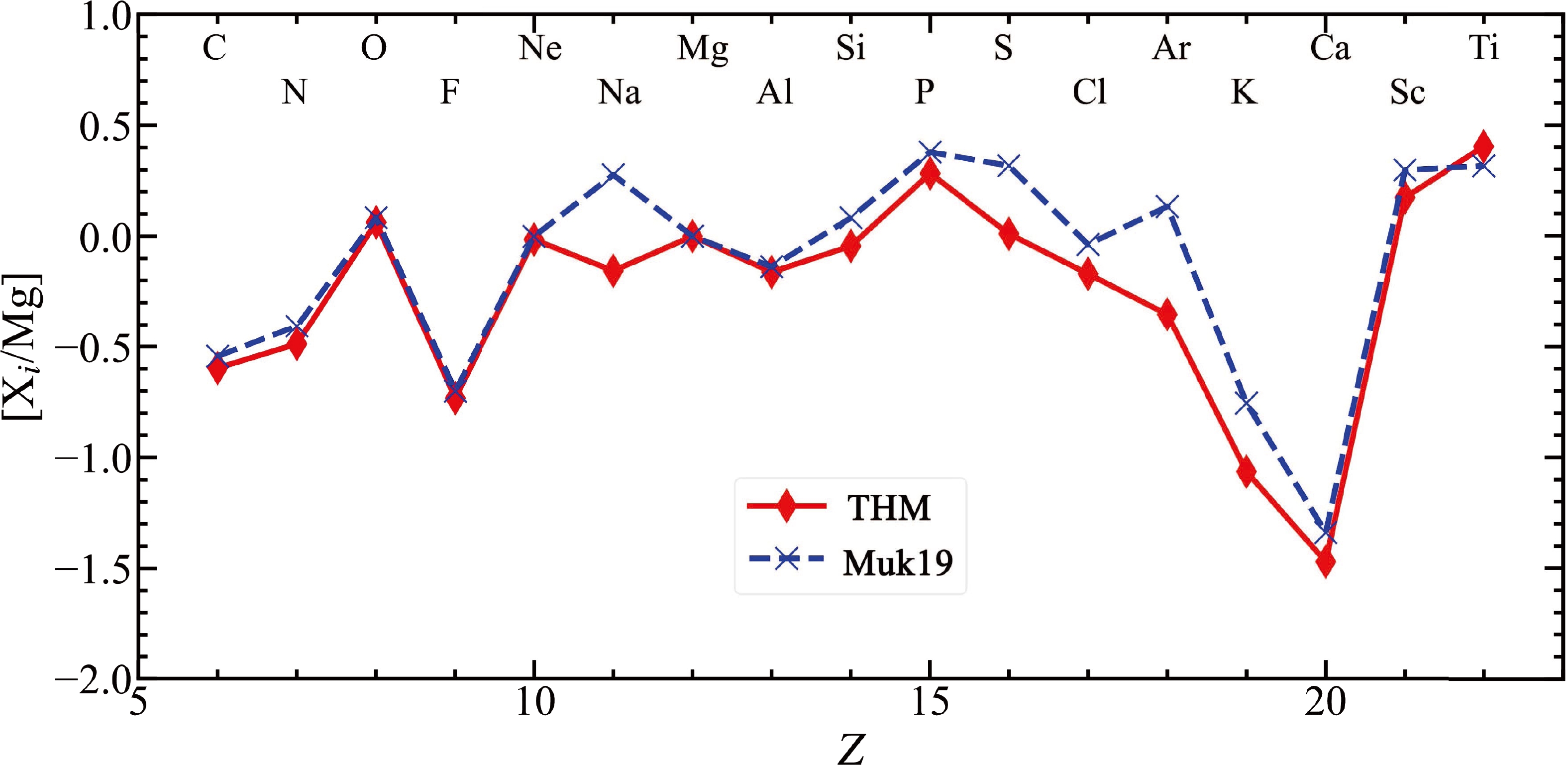
Figure 13.(color online) Abundance patterns of presupernovae averaged over the IMF from Salpeteret al. [57]. [X
$ _{i} $ /Mg] is defined in Eq. (4), where i represents the element from H to Zn.$ \begin{array}{*{20}{l}} [{N}_i/{N}_j] \equiv {\rm log} ({N}_i/{N}_j) - {\rm log} (({N}_i/{N}_j)_\odot), \end{array} $

(4) whereN
$ _i $ andN$ _j $ represent the number of speciesiandj, respectively.We select the Mg yield rather than the Fe or O yields as a denominator because of the obvious modification of these two elements during the explosion, and the Mg yield has a small deviation between the two models. We can find that the abundances of most elements are poorly affected by the12C+12C rate. Only [Na/Mg] =
$ - $ 0.16, 0.28, [S/Mg] = 0.01, 0.32, [Ar/Mg] =$ - $ 0.35, 0.13, and [K/Mg] =$ - $ 1.06,$ - $ 0.76 exhibit an obvious difference between the THM and Muk19 models.To make a comparison between the yields of stellar evolution models and observed abundances, the galactic chemical evolution (GCE) should also be considered. The latest GCE model from Kobayashiet al. [62] shows thatα-elements (namely, O, Ne, Mg, Si, S, Ar, and Ca) are mainly produced by SNe II, and 29% of S and 34% of Ar are contributed by SNe Ia. K is produced by SNe II but underproduced at all metallicities in theoretical models with respect to observations [62,63]. Na and Mg mainly originate from SNe II, and the contribution from the stellar wind of AGB stars is negligible. Therefore, in this study, [Na/Mg] is adopted to compare with observations. Besides this, the abundances of Na and Mg are the most accessible elements in the observation of near-solar-metallicity stars.
InFig. 14, we indicate the observed [Na/Mg] with blue crosses from the high resolution spectrum by Bensbyet al. [64]. They observed 714 dwarf stars with [Fe/H] ranging from
$ - $ 2.8 to 0.4 in the solar neighborhood and discussed the detailed elemental abundance. Here, we only show stars with [Fe/H] = 0.0$ \pm $ 0.5, that is, those near the solar abundances. The red solid and dashed lines show [Na/Mg] averaged over samples and the standard deviation of$ \pm $ 1σ. The averaged [Na/Mg] is$ \sim - $ 0.043 with$ \pm $ 1σof$ \pm $ 0.063 at [Fe/H]$ \simeq $ 0.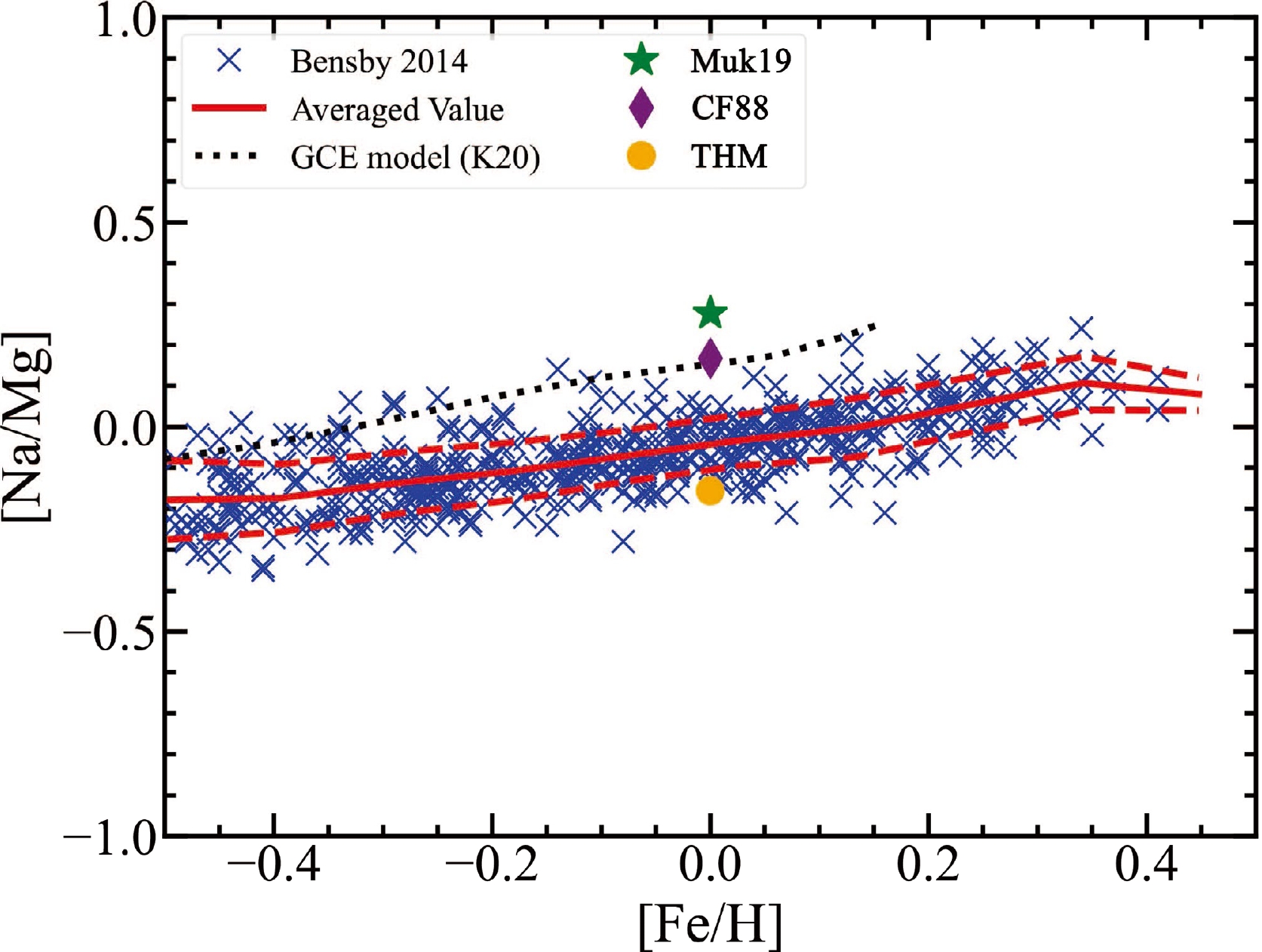
Figure 14.(color online) [Na/Mg] vs. [Fe/H]. The observation data marked with blue crosses collected from the high resolution spectrum by Bensbyet al. [64]. The black dashed line shows the predicted [Na/Mg] from the latest GCE model by Kobayashiet al. [62]. Our theoretical [Na/Mg] contributed by presupernovae models with the THM, CF88, and Muk19 is shown with the orange point, purple diamond, and green star, respectively.
The observed relation between [Na/Mg] and [Fe/H] can be interpreted as follows: With decreasing [Fe/H], [Na/Mg] decreases generally because the production of Na depends on the neutron excess owing to22Ne, which is produced in He burning byα-capture on14N and18O. Thus, the production of23Na depends on the metallicity of progenitors. Mg increases with decreasing [Fe/H] in the range [Fe/H]
$ >- $ 1 due to the contribution of SNe Ia to [Fe/H] [62].The black dotted line shows [Na/Mg] predicted by the latest GCE model from Kobayashiet al. [62]. This GCE model agrees well with observation in the range of [Fe/H] from −4 to 0.2 dex. However, near [Fe/H] = 0, the GCE model exhibits [Na/Fe]
$ \sim $ 0.153, while [Mg/Fe]$ < $ 0. Thus, the predicted [Na/Mg] near [Fe/H] = 0 deviates from the observation by$ \sim $ 3σ(seeFig. 14).[Na/Mg] predicted by our pre-supernova models with the THM, CF88, and Muk19 rates is indicated by the orange point (
$ - $ 0.156), purple diamond (0.167), and green star (0.277), respectively. [Na/Mg] predicted by the GCE model agrees with that of our CF88 model. Indeed, Kobayashiet al. [62] and Nomotoet al. [55] also adopted the CF88 rate. We find that [Na/Mg] of Muk19 and CF88 is located outside of 3σ, and that of the THM model is located within 2σ. Thus, if the THM rate is to be applied in the GCE model, the production of Na would be smaller, whereas the Mg production would be slightly higher. Then, the GCE model would predict that [Na/Fe] and [Mg/Fe] are closer to the solar abundances.However, we should note that there are large uncertainties in stellar evolution models. The uncertainties of nucleosynthesis yields are not easy to quantify. Besides the uncertainties of the12C+12C reaction rate, the12C
$ (\alpha, \gamma)^{16} $ O reaction rate also affects the production of Na and Mg [58,59]. The production of Na and Mg is also affected by convective mixing [52], rotation [65], mass loss [66], and magnetic fields [67]. For the yields of SN II models, the mechanisms of SN explosions and mass ejection from black hole formation are also uncertain [68]. -
The12C+12C reaction rate plays an essential role in stellar evolution and nucleosynthesis. However, the uncertainty of this reaction rate is still large. In this study, we compare the THM rate with the Muk19 rate by discussing nucleosynthesis through the presupernova stages.
Gasqueset al. [11] compared the CF88 and hindrance rates. Bennettet al. [28] and Pignatariet al. [29] also discussed the effect of the CF88 rate on nucleosynthesis. However, they focused ons-process isotopes and long-lived radioactive isotopes, such as26Al and60Fe. In this study, we focus on the yields of intermediate-mass isotopes (
$ A= $ 16 – 40), which are mainly produced in presupernova evolution. In$\S 4$ , we discuss the chemical evolution of 25M$ _\odot $ stars and the production of23Na. Compared with the Muk19 model, the THM model has lower burning temperatures during shell C burning and produces a smaller amount of23Na and neutron-rich isotopes in the CO shell owing to the production of lower neutron excess. The burning temperature of the THM model is not sufficiently low to activate the13C(α,n)16O reaction, and the effect of the THM rate on s-process isotopes is not significant.In Section V, we compare the production factors from our presupernova models with the explosion models from Turet al. [60]. The production factors of20Ne,23Na,24Mg, and26Al in our models agree with the explosive nucleosynthesis models well, which would imply that the effects of the explosion may not be so large for these isotopes. Isotopes heavier than28Si are underproduced but can be further produced by explosive Si and O burning during the explosion.
We also show the ratios of the yields between the Muk19 and THM models. Note that the difference in the ratios of16O/18O and14N/15N may be constrained by the study of the atmosphere of brown dwarfs or interstellar molecules. In Section VI, the abundance ratios of elements are compared between the two models. The differences between [Na/Mg], [S/Mg], [Ar/Mg], and [K/Mg] are obvious.
Finally, we compare the theoretical [Na/Mg] of our THM, CF88, and Muk19 models with the abundances in stellar atmospheres observed from high-resolution spectra near [Fe/H]
$ \sim $ 0, as well as the predicted [Na/Mg] from the latest GCE models. We find that [Na/Mg] predicted by our models are within 2σof the observed stellar ratio for the THM, near 3σfor CF88, and larger thanσfor Muk19.However, we should note that the deviation of the astronomical observations of [Na/Mg] reaches
$ \sim $ 0.378 dex for 3$ \pm \sigma $ . For theoretical [Na/Mg], the uncertainty introduced by the12C+12C reaction rate also reaches 0.433 dex. In forthcoming studies, it is necessary to include explosion models and obtain more precise theoretical yields. Higher resolution astronomical observations and larger-sample sets are expected. Additionally, more precise and lower energy measurements of the12C+12C reaction rate are necessary. -
We thank Xiao Fang and Xinyu Wang for calculating and providing the reaction rate of Muk19. We are also grateful for the helpful discussion with X. Tang, N. T. Zhang, H. N. Li, and X. F. Zhang.
Impact of the new12C+12C reaction rate on presupernova nucleosynthesis
- Received Date:2022-09-27
- Available Online:2023-03-15
Abstract:The12C+12C reaction rate plays an essential role in stellar evolution and nucleosynthesis. Nevertheless, the uncertainties of this reaction rate are still large. We calculate a series of stellar evolution models with the near solar abundance from the zero-age main-sequence through presupernova stages for initial masses of 20M


 DownLoad: