


 Abstract
 HTML
HTML Reference
 Related
 PDF
PDF


-
Vector mesons in low energy photoproduction play an essential role in understanding the vector meson-proton (V-p) interaction [1]. The most apparent manifestation is the scattering length of theV-pinteraction. Researchers now calculate the scattering length of theV-pinteraction by establishing theoretical models or analyzing experimental data, such asρ-p,ω-p,ϕ-p,
$ J/\psi $ -p,$ \psi(2S) $ -p, andΥ-p[1–10]. As a conventional$ s\bar{s} $ state,ϕhas been extensively investigated. To study the internal structure of a proton, some researchers extract the mass radius of the proton from the cross section ofϕphotoproduction at the near-threshold [11,12]. Others have moved on to the scattering length of theϕ-pinteraction. The earliest study can be traced back to 1997, when Koikeet al. [4] used QCD sum rules to analyze the scattering length of spin-isospin averageρ-p,ω-p, andϕ-p. Via the low energy limit constraint of the forward scattering amplitude of the vector-current nucleon,$ \alpha_{\rho p}=-0.47\pm0.05 $ fm,$\alpha_{\omega p}=-0.41\pm 0.05$ fm, and$ \alpha_{\phi p}=-0.15\pm0.02 $ fm were obtained. In 2000, Gaoet al. [13] analyzed theϕ-Nbound state through the QCD van der Waals attractive potential and believed that theϕ-Nbound state can help detect the strangeness content of nucleons. In 2007, the LEPS Collaboration [3] obtained$ \alpha_{\phi p}=-0.15 $ fm from the differential experimental cross sections of$ \gamma p $ $ \rightarrow $ $ \phi p $ at the near-threshold for the first time. In the same period, Titovet al. [1] related the differential cross section ofϕphotoproduction to scattering length by establishing the vector meson dominant (VMD) model. This indicates that the differential cross section ofϕat the threshold is finite, and its behavior is crucial for the QCD-inspiredϕ-pinteraction model. The study of the scattering length of theϕ-pinteraction then fell silent.In recent years, the investigation of the scattering length of theV-pinteraction has been revived owing to the accumulation of experimental data on vector meson photoproduction. In 2014, Strakovskyet al. [7] used odd power polynomials to fit the total experimental cross section ofωphotoproduction and obtained
$ |\alpha_{\omega p}|=0.81\pm 0.41 $ fm. In 2020, they [2,10] combined the total experiment cross section of vector meson photoproduction with the VMD model.$ |\alpha_{J/\psi p}| =3.08 \pm 0.55 $ am and$ |\alpha_{\phi p}| =0.063\pm 0.01 $ fm were obtained by fitting the odd power polynomials with the latest photoproduction data. Subsequently, the same researchers [9] combined the differential cross section of$ J/\psi $ photoproduction with the scattering length based on the VMD model.$|\alpha_{J/\psi p}|=3.83\pm 0.98$ am was obtained using GlueX [14] and SLAC [15] data. In our previous studies [5,6], the same method was used to calculate the average scattering lengths$ |\alpha_{J/\psi p}|=3.85\pm0.96 $ am,$ |\alpha_{\psi(2s) p}|=1.31\pm0.92 $ am, and$ |\alpha_{\rho p}|=0.29\pm0.07 $ fm at the near-threshold. We found that the mass of the vector meson was inversely proportional to the scattering length of theV-pinteraction,$ |\alpha_{\omega p}|>|\alpha_{\phi p}|>|\alpha_{J/\psi p}|>|\alpha_{\psi(2S) p}|>|\alpha_{\Upsilon p}| $ [5]. In this case,ρwas temporarily excluded owing to the particular situation.For the scattering length of theϕ-pinteraction, many research groups have also performed calculations and measurements. The scattering length
$ |\alpha_{\phi p} |\simeq2.37 $ was obtained by analyzing the QCD van der Waals potential [13], and in 2021, the real part of the scattering length ofϕ-pwas found to be$ 0.85\pm0.34 $ fm via a$ pp $ collision by the ALICE Collaboration [16]. Note that these results go beyond the scattering length of theϕ-pextracted from vector meson photoproduction data. Moreover, the scattering length ofϕ-pobtained by the VMD model was extracted from single data of vector meson photoproduction [1,3,4,13]. Considering that the extraction of theϕ-pscattering length from a single experimental data point may have an uncertainty, it is necessary to provide the distribution of theϕ-pscattering length with energy at the threshold. Therefore, in this study, the two gluon exchange model [12] and pomeron model [17,18] are established to predict the cross section ofϕphotoproduction. With the VMD model, the scattering length$ |\alpha_{\phi p}| $ is related to the photoproduction cross section and expressed as a function ofR. Combined with the$ |\alpha_{\phi p}| $ extracted directly from the experimental data [2,19,20], the value of$ |\alpha_{\phi p}| $ at the near thresholdRcan be obtained. Here,Ris the ratio of the final momentum$ |{\bf p}_3| $ to the initial momentum$ |{\bf p}_1| $ , which is directly proportional to the center of mass energyW.At present, research on the scattering length of vector mesons interacting with deuteron or helium nuclei composed of multiple nucleons is still limited. Considering the validity of the VMD model in describing the photoproduction process of vector meson and nucleus coherence [21–25], this study analyzes and calculates the scattering length ofϕ-deuteron (d). Fortunately, in 2007, the SLEP Collaboration [3] newly measured coherentϕphotoproduction from deuterons atE=
$ 1.5 $ –$ 2.4 $ GeV with a forward angle and linearly polarized beam, which provided important experimental data for our study on the scattering length ofϕ-d. The findings of this paper not only contribute to our in-depth understanding of theϕ-Ninteraction, but also provide a theoretical basis for future experimental measurements at JLab or EIC facilities [26,27].This paper is organized as follows: Expressions for scattering length correlation, two gluon exchange, and pomeron models are described in Sec. II. The results of the scattering length ofϕ-Ncoherence are presented in Sec. III. Finally, a brief summary is provided in Sec. IV.
-
The total cross section ofϕphotoproduction at the near-threshold is related to the scattering length of theϕ-Ninteraction (
$ |\alpha_{\phi N}| $ ) using the VMD model [9],$ \begin{aligned}[b] \left.\sigma ^{\gamma N \rightarrow \phi N}\right|_{{\rm t h r}}(R) &=\left.\frac{\left|\mathbf{\bf p}_3\right|}{\left|\mathbf{\bf p}_1\right|} \cdot \frac{4 \alpha_{\rm em} \pi^{2}}{g_{\phi}^{2}} \cdot \frac{{\rm d} \sigma^{\phi N \rightarrow \phi N}}{{\rm d} \Omega}\right|_{\rm {thr}} \\ &=R \cdot \frac{4 \alpha_{\rm em} \pi^{2}}{g_{\phi}^{2}} \cdot\left|\alpha_{\phi N}\right|^{2}, \end{aligned} $

(1) with the VMD coupling constant
$ g_{\phi} $ ,$ \begin{equation} g_{\phi}=\sqrt{\frac{\pi \alpha^{2}_{\rm em}m_{\phi}}{3\Gamma_{\phi \rightarrow e^+e^-}}}, \end{equation} $

(2) whereNrepresent the nucleus,
$\alpha_{\rm em}$ is the fine coupling constant,Ris the ratio of the final momentum$ |{\bf p}_3| $ to the initial momentum$ |{\bf p}_1| $ , and$ \Gamma_{e^{+}e^{-}}=1.27 $ keV is the lepton decay width taken from Ref. [2]. Using Eqs. (1) and (2), the scattering length$ |\alpha_{\phi N}| $ is$ \begin{equation} |\alpha_{\phi N}|=\frac{g_{\phi}}{2 \pi}\sqrt{\frac{\sigma^{\gamma N\rightarrow \phi N}}{\alpha_{\rm em} R}}. \end{equation} $

(3) In the center of mass frame, the initial and final momenta are
$ \begin{equation} \left|\mathbf{\bf p}_1\right|=\frac{1}{2 W} \sqrt{W^{4}-2\left(m_{1}^{2}+m_{2}^{2}\right) W^{2}+\left(m_{1}^{2}-m_{2}^{2}\right)^{2}}, \end{equation} $

(4) $ \begin{equation} \left|\mathbf{\bf p}_3\right|=\frac{1}{2 W} \sqrt{W^{4}-2\left(m_{3}^{2}+m_{4}^{2}\right) W^{2}+\left(m_{3}^{2}-m_{4}^{2}\right)^{2}}, \end{equation} $

(5) whereWis the center of mass energy for the
$ \gamma p $ collision.The total cross section can be obtained by differential cross section integration from the four momentum
$t_{\rm min}(W)$ to$t_{\rm max}(W)$ , which can be given as$ \begin{equation} \sigma^{\gamma N \rightarrow \phi N}=\int_{t_{\rm min}(W)}^{t_{\rm max}(W)}\frac{{\rm d} \sigma^{\gamma N \rightarrow \phi N}}{{\rm d} t} {\rm d} t, \end{equation} $

(6) with
$ \begin{equation} t_{\max }\left(t_{\min }\right)=m_{1}^{2}+m_{3}^{2}-2 E_{1} E_{3} \pm 2\left|\mathbf{p}_{1}\right|\left|\mathbf{p}_{3}\right|, \end{equation} $

(7) where
$ E_{i}=\sqrt{|{\bf p}_i|^{2}+m_{i}^{2}} $ (i=1, 3). As the center of mass energyWapproaches the threshold,$t_{\rm min}$ approaches$t_{\rm max}$ . Therefore, Eq. (6) is rewritten as$ \begin{equation} \left.\sigma\right|_{\rm t h r}=\left.4\left|\mathbf{p}_{1}\right| \cdot\left|\mathbf{p}_{3}\right| \frac{{\rm d} \sigma}{{\rm d} t}\right|_{\rm t h r} , \end{equation} $

(8) where
$|t_{\rm max} - t_{\rm min}|= \Delta t=4 |{\bf p}_3||{\bf p}_1|$ [9]. According to Eq. (1), the relation between the scattering length$ |\alpha_{\phi N}| $ and the differential cross section ofϕphotoproduction at the near-threshold can be expressed as$ \begin{equation} |\alpha_{\phi N}|=\frac{|{\bf p}_1|g_{\phi}}{\pi}\sqrt{\frac{1}{\alpha_{\rm em}}\frac{{\rm d} \sigma^{\gamma N \rightarrow \phi N}}{{\rm d} t}}, \end{equation} $

(9) In keeping with Eq. (3), the above formula is expressed as a function ofR,
$ \begin{equation} |\alpha_{\phi N}|=\frac{|{\bf p}_3|g_{\phi}}{R \pi}\sqrt{\frac{1}{\alpha_{\rm em}}\frac{{\rm d} \sigma^{\gamma N \rightarrow \phi N}}{{\rm d} t}}. \end{equation} $

(10) -
Photons split into a pair of dipoles, which exchange two gluons to scatter protons and finally form the mesonϕin the two gluon exchange model, as shown inFig. 1. In lowest order perturbative QCD, the differential cross section obtained from theϕphotoproduction amplitude is [17]
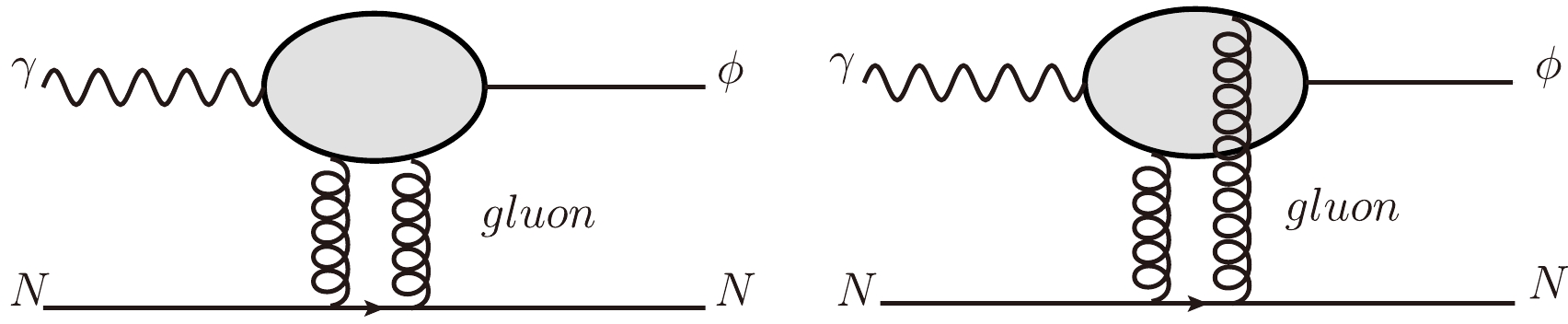
Figure 1.Feynman diagrams of the two gluon exchange model forϕphotoproduction.
$ \begin{equation} \frac{{\rm d} \sigma}{{\rm d} t}=\frac{\pi^{3} \Gamma_{e^+ e^-} \alpha_{s}}{6 \alpha m_{s}^{5}}\left[x g\left(x, m_{\phi}^{2}\right)\right]^{2} \exp \left(b_{0} t\right), \end{equation} $

(11) where the QCD coupling constant
$ \alpha_{s}=0.701 $ is from Ref. [28],$ m_{s} $ is the mass of the strange quark,$ m_{\phi}=1.019 $ GeV is the mass of the mesonϕ, and$ b_{0} $ is the slope.$ xg(x,m_{\phi}^{2})=A_{0}x^{A_{1}}(1-x)^{A_{2}} $ is the parameterized gluon distribution function, and$ A_{0} $ ,$ A_{1} $ , and$ A_{2} $ are free parameters. The total cross section ofϕphotoproduction can be obtained by integrating Eq. (11) from$t_{\rm min}(W)\rightarrow t_{\rm max}(W)$ $ \begin{equation} \sigma^{\gamma p \rightarrow \phi p}=\int_{t_{\rm min}(W)}^{t_{\rm max}(W)}\frac{{\rm d} \sigma^{\gamma p \rightarrow \phi p}}{{\rm d} t}{\rm d} t. \end{equation} $

(12) -
Figure 2represents the
$ \gamma p $ $ \rightarrow $ $ \phi p $ reaction process of the pomeron model [17,18], where the differential cross section ofϕphotoproduction is written as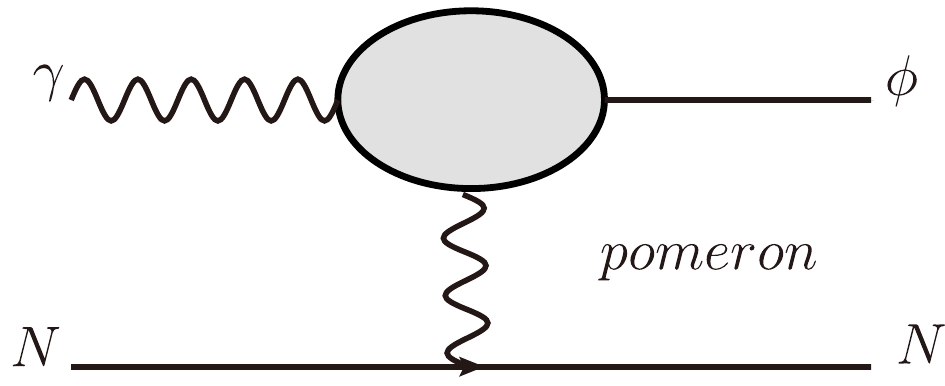
Figure 2.Feynman diagram of the pomeron model forϕphotoproduction.
$ \begin{equation} \frac{\mathrm{d} \sigma}{\mathrm{d} t}=\frac{81 m_{\phi}^{3} \beta^{4} \mu_{0}^{4} \Gamma_{\mathrm{e}^+ \mathrm{e}^-}}{\pi \alpha_{\rm em} }\left(\frac{s}{s_{0}}\right)^{2\alpha(t)-2}F_{1}(t), \end{equation} $

(13) with
$ \begin{equation} F_{1}(t)= \left(\frac{F(t)}{\left(Q^{2}+m_{\phi}^{2}-t\right)\left(Q^{2}+2 \mu_{0}^{2}+m_{\phi}^{2}-t\right)}\right)^{2}, \end{equation} $

(14) where
$ Q^{2} $ is the square of the virtual photon,$ s_0=4 $ GeV$ ^2 $ ,$\alpha_{\rm em}$ is the fine coupling constant, and$ \mu^{2}=1.1 $ GeV$ ^{2} $ .$ F(t) $ is the form factor and expressed as$ \begin{equation} F(t)=\frac{4 m_{\mathrm{N}}^{2}-2.8 t}{\left(4 m_{\mathrm{N}}^{2}-t\right)(1-t / 0.7)^{2}}, \end{equation} $

(15) where
$ m_{N} $ is the mass of a proton or deuteron. The Regge trajectory$ \alpha(t)=1.08+0.25t $ can be obtained from Ref. [29].In our previous study [12],
$ \beta^{2}=4 $ GeV$ ^{-2} $ was corrected by the nucleon and nucleon scattering amplitude from Ref. [29]. In this study,βis a free parameter and obtained by fitting the experimental data ofϕphotoproduction. -
In our previous study [12], the two gluon exchange model was established to effectively extract the mass radius of the proton, which is extremely proximate to that extracted directly from the CLAS [19] and LEPS [20] data. The free parameters,
$ A_0 $ ,$ A_1 $ ,$ A_2 $ , and$ b_0 $ , contained in this model were obtained via global fitting of the total [2,30–34] and differential [19,20] cross sections ofϕphotoproduction data. In addition, the pomeron model was introduced as an auxiliary model in contrast to the two gluon exchange model. In this study, the two gluon exchange model is still used to calculate the scattering length of theϕ-pinteraction. In addition,βin the pomeron model is considered a free parameter obtained by fitting the total [2,30–34] and differential [19,20] experimental cross section data. The parameters present in the two gluon exchange and pomeron models are shown inTable 1.Figures 3and4show the total and differential cross sections ofϕphotoproduction predicted by the two gluon exchange and pomeron models at the near-threshold, which are in good agreement with experimental data onϕ. Based on the two models, we assume that the cross section ofϕphotoproduction can be reliably predicted.$ A_{0} $ 

$ A_{1} $ 

$ A_{2} $ 

$ b_{0} $ /GeV

$ ^{-2} $ 

$ \chi^{2}/ $ d.o.f

$ 0.36 \pm 0.04 $ 

$ -0.055 \pm 0.003 $ 

$ 0.12 \pm 0.03 $ 

$ 3.60\pm0.04 $ 

$ 2.87 $ 

β/GeV $ ^{-1} $ 

− − − $ \chi^{2}/ $ d.o.f

$ 1.919\pm0.011 $ 

− − − $ 9.88 $ 

Table 1.Relevant parameters for the two gluon exchange model are in the first row, and the second row is for the pomeron model.
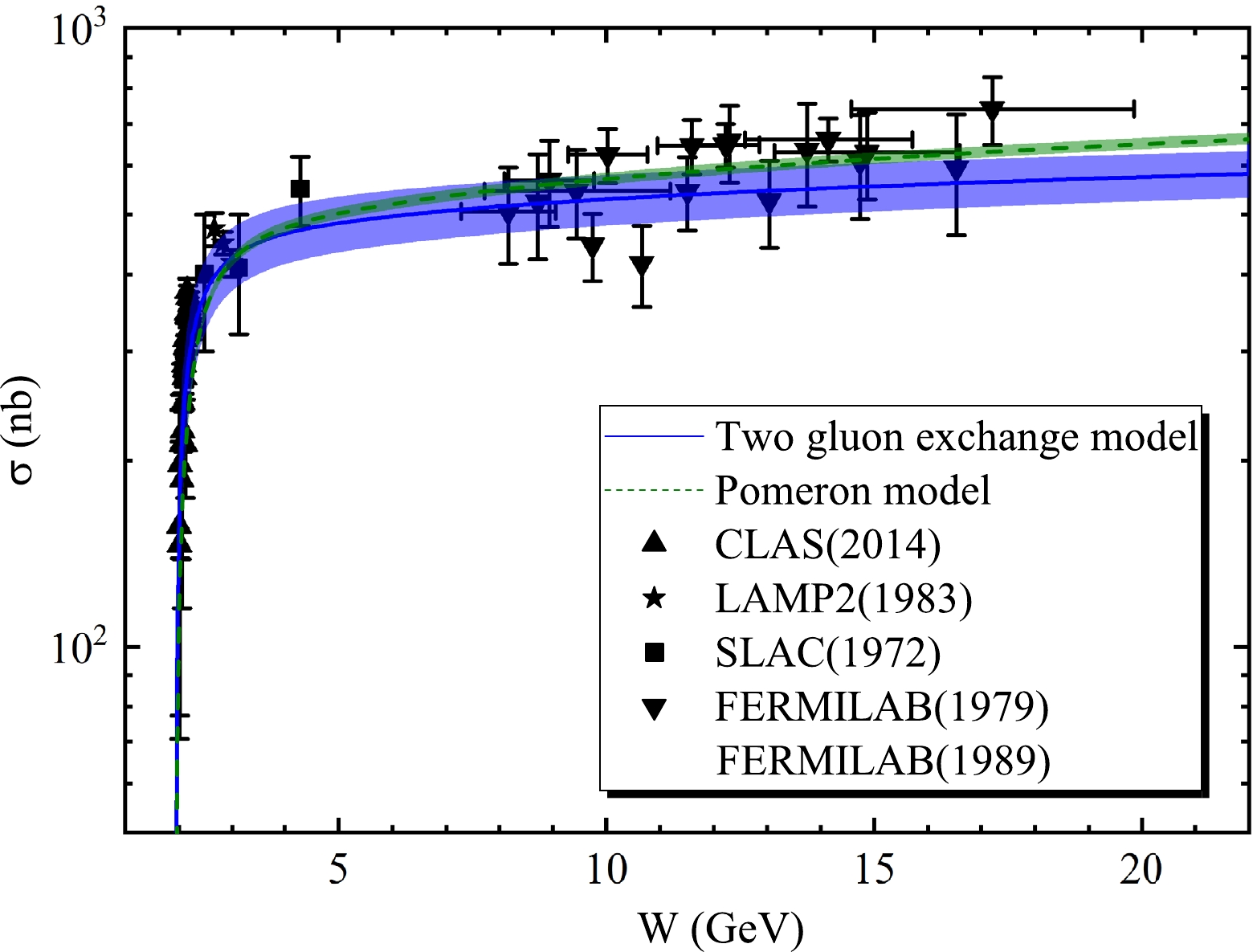
Figure 3.(color online) Total cross section ofϕphotoproduction as a function of the center of mass energyW. The solid-line (blue) and dashed line (olive-green) represent the two gluon exchange and pomeron models, respectively.
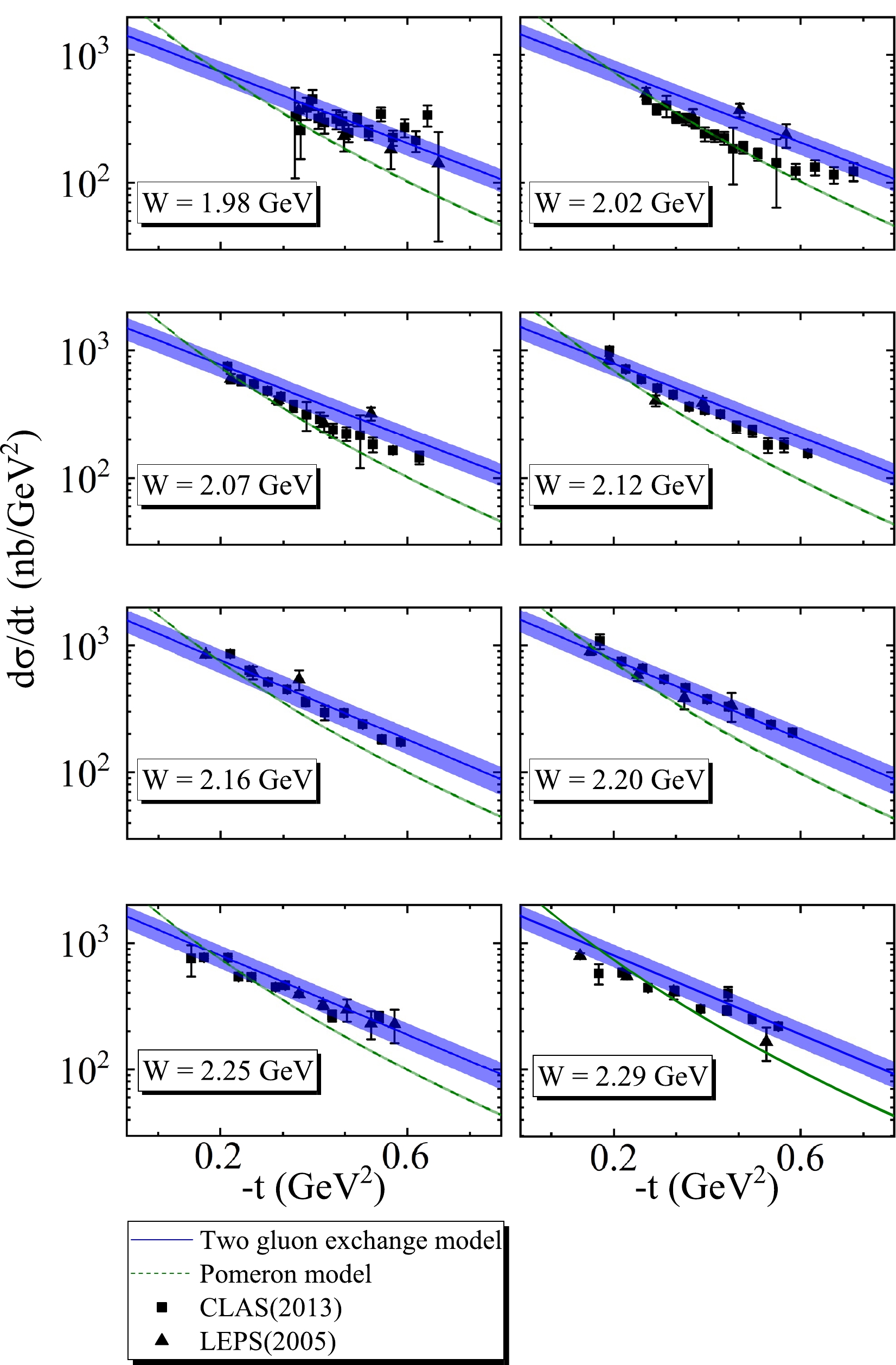
Figure 4.(color online) Differential cross sections of the channel
$ \gamma p \rightarrow \phi p $ as a function of$ -t $ at differentWvalues. Here, the notations are the same as inFig. 3.The scattering length
$ |\alpha_{\phi p}| $ obtained from the differential cross section ofϕphotoproduction has a slow upward trend withR, which can be observed inFig. 5. Here, theRinterval is selected as$ [0,0.66] $ . The blue line is$ |\alpha_{\phi p}| $ based on the two gluon exchange model, with an average scattering length of$ \sqrt{\langle |\alpha^{2}_{\phi p}|\rangle}=0.102\pm0.011 $ fm. The olive-green dashed line is$ |\alpha_{\phi p}| $ obtained from the pomeron model with$ \sqrt{\langle |\alpha^{2}_{\phi p}|\rangle}=0.087\pm0.001 $ fm, which is smaller than the result from the two gluon exchange model. The magenta circle represents$ |\alpha_{\phi p}| $ extracted directly from the CLAS [19] and LEPS [20] data. The$ |\alpha_{\phi p}| $ corresponding to each center of mass energyWis listed inTable 2, and$ \sqrt{\langle |\alpha^{2}_{\phi p}|\rangle}=0.106\pm0.005 $ fm. Overall,$ |\alpha_{\phi p}| $ obtained from the pomeron model is not in good agreement with that extracted directly from the experiment. In contrast,$ |\alpha_{\phi p}| $ based on the two gluon exchange model agrees well. This indicates that the scattering length derived from the differential cross section predicted by the two gluon exchange model is reliable.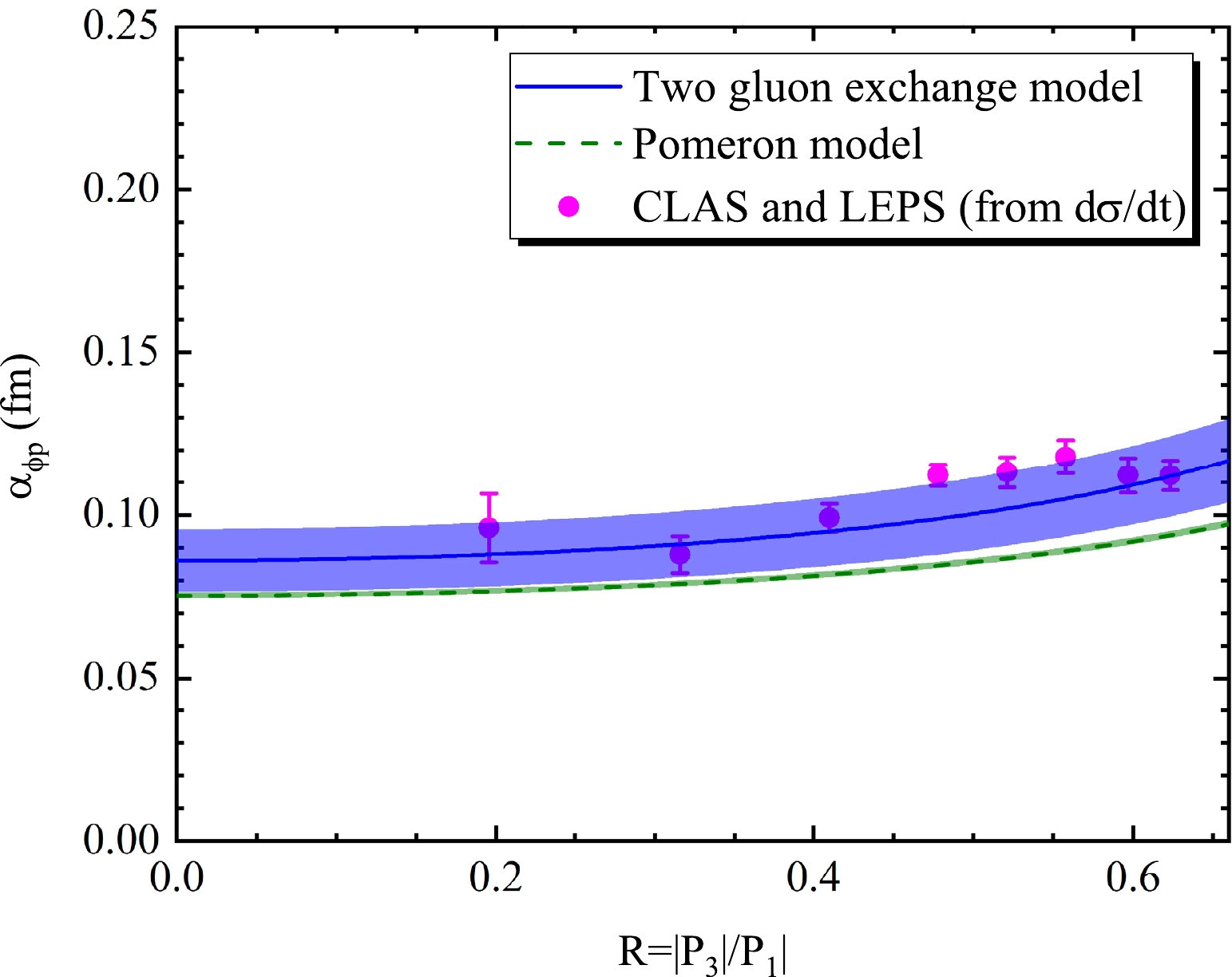
Figure 5.(color online) Function of
$ |\alpha_{\phi p}| $ withRfrom the differential experimental cross section. The blue-line is the result derived from the two gluon exchange model, and the olive green dashed-line shows the result based on the pomeron model. The magenta circle is extracted directly from CLAS [19] and LEPS [20] data.W/GeV $ 1.98 $ 

$ 2.02 $ 

$ 2.07 $ 

$ |\alpha_{\phi p}| $ /fm

$ 0.096 \pm 0.011 $ 

$ 0.088 \pm 0.006 $ 

$ 0.099 \pm 0.004 $ 

W/GeV $ 2.12 $ 

$ 2.16 $ 

$ 2.20 $ 

$ |\alpha_{\phi p}| $ /fm

$ 0.109 \pm 0.003 $ 

$ 0.113 \pm 0.005 $ 

$ 0.118 \pm 0.005 $ 

W/GeV $ 2.25 $ 

$ 2.29 $ 

− $ |\alpha_{\phi p}| $ /fm

$ 0.112\pm0.005 $ 

$ 0.108\pm0.005 $ 

− As a comparison,
$ |\alpha_{\phi p}| $ can also be calculated from the total cross section ofϕphotoproduction. The$ |\alpha_{\phi p}| $ as a function of$ R\in[0,0.66] $ directly calculated from CLAS data [2] and based on the total cross sections predicted by the two models is shown inFig. 6.$ \sqrt{\langle |\alpha^{2}_{\phi p}|\rangle}= 0.091\pm 0.010 $ fm based on the two gluon exchange model, and$ \sqrt{\langle |\alpha^{2}_{\phi p}|\rangle}=0.081\pm0.001 $ fm for the pomeron model.$ \sqrt{\langle |\alpha^{2}_{\phi p}|\rangle}=0.096\pm0.010 $ fm is obtained directly from the total experimental cross section of CLAS data [2]. Here, the same problem arises.$ |\alpha_{\phi p}| $ based on the pomeron model is obviously small and in poor agreement with that obtained directly from CLAS data [2]. This indicates that the pomeron model's overall prediction is insufficient. Therefore,$ |\alpha_{\phi p}| $ obtained by the pomeron model is ignored in the discussion below.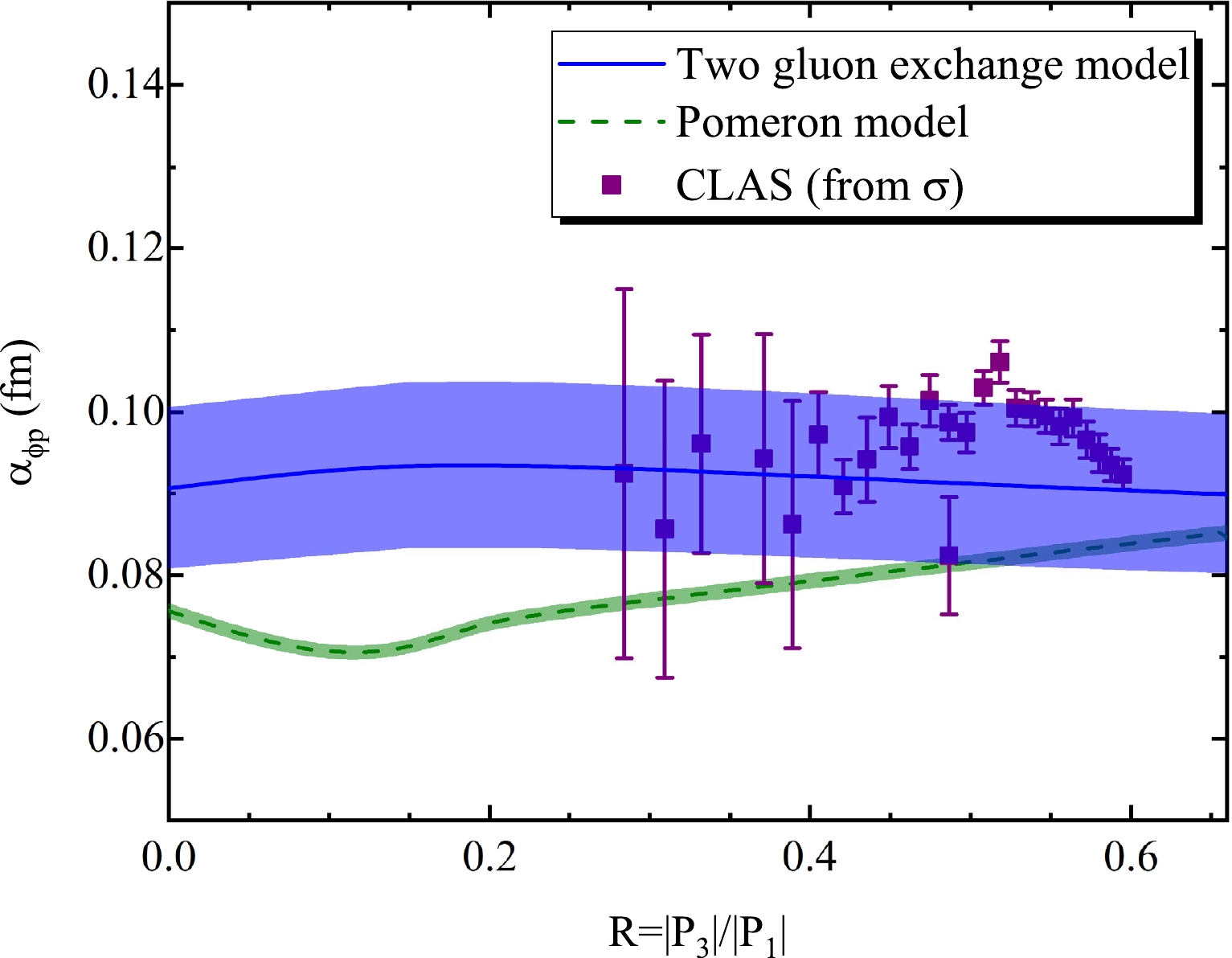
The above discussion shows differences in the scattering length obtained from the total and differential cross sections ofϕphotoproduction at
$ R\in[0,0.66] $ , which can be seen inTable 3.$ \sqrt{\langle |\alpha^{2}_{\phi p}|\rangle} $ obtained directly from experimental data [2,19,20] is slightly larger than that based on the two gluon exchange model but within the error range.$ \sqrt{\langle |\alpha^{2}_{\phi p}|\rangle} $ based on the differential cross section is barely larger than that obtained from the total cross section. This is because of the lack of experimental data. In particular, in the total cross section, the behaviour closest to the threshold scattering length cannot be observed. However, when the error bars are considered, the difference is completely eliminated, and the average scattering lengths based on the differential and total cross sections are almost identical. Therefore, we calculate the root-mean-square of the scattering length obtained from the total and differential cross sections. The final scattering length of theϕ-pinteraction is$ 0.10\pm0.01 $ fm.Model Scattering length $/\mathrm{fm}$ 

${\rm d} \sigma / {\rm d} t$ 

σ Two gluon exchange model $ 0.102 \pm 0.011 $ 

$ 0.091 \pm 0.010 $ 

Extraction from experimental data $ 0.106 \pm 0.005 $ 

$ 0.096 \pm 0.010 $ 

A comparison of the scattering lengths ofϕ-pobtained in this study with those of other groups [2–4,13,16] is shown inFig. 7. Our result is roughly in the middle, between that obtained by the LEPS laboratory [3], QCD sum rules [4], and Strakovskyet al. [2]. Particular attention should be paid to the result of QCD sum rules [4],
$ \alpha_{\phi p}=-0.15\pm0.02 $ fm, which was obtained by introducing the vector-current nucleon forward scattering amplitude relationship without any experimental data. Strakovskyet al. [2] also used the VMD model to relateσto the scattering length and obtained$ |\alpha_{\phi p}|=0.063\pm0.012 $ fm by fitting an odd power. However, two relatively large results clearly go beyond our normal understanding of the scattering length ofϕ-p. A result from QCD van der Waals [13] was$ |\alpha_{\phi p} |\simeq2.37 $ fm, and a real part of the scattering length of theϕ-pinteraction calculated by the ALICE Collaboration [16] from the cross section of high-multiplicity$ pp $ collisions was$ 0.85\pm0.34 $ fm. We suppose that different reactions should exist; hence, these two results are ignored for the time being.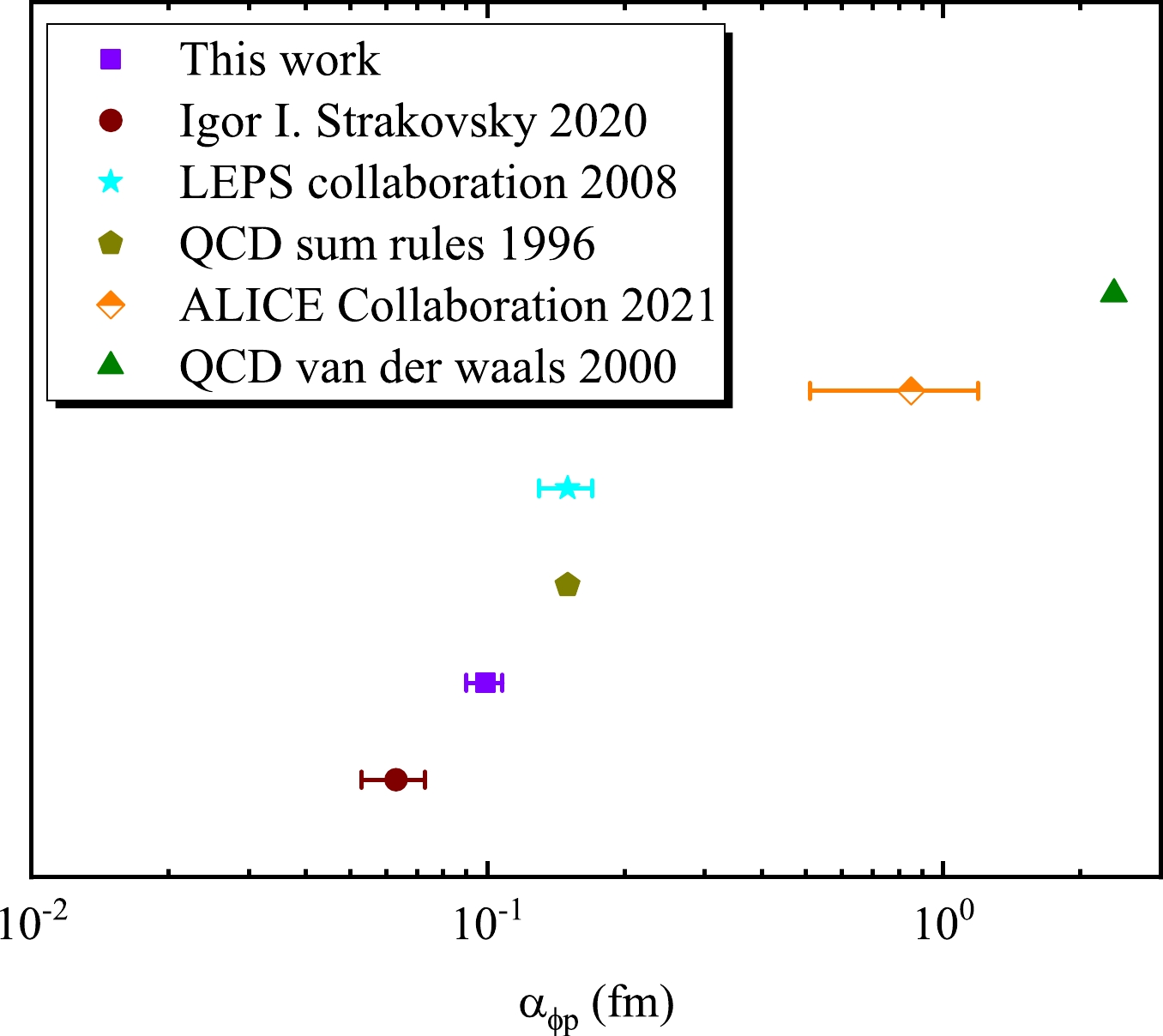
Figure 7.(color online) Scattering length obtained in this study is compared with the absolute value obtained by other groups [2–4,13]. The purple square is
$ |\alpha_{\phi p}|=0.10\pm0.01 $ fm. The burgundy circle is$ |\alpha_{\phi p}|=0.063\pm0.01 $ fm, which was obtained by CLAS data analysis with the VMD model [2]. The LEPS laboratory [3] obtained$ |\alpha_{\phi p}|=0.15 $ fm, which is represented by a cyan pentagram. The dark yellow pentagon represents$ |-0.15| \pm 0.02 $ fm, obtained with QCD sum rules [4]. The olive-green triangle represents$ |\alpha_{\phi p} |\simeq2.37 $ fm, obtained by QCD van der Waals [13]. The orange diamond is the result of the ALICE Collaboration [16].In our previous studies [5,6], the scattering lengths of
$ J/\psi $ -p,$ \psi(2S) $ -p, andρ-pwere systematically studied. In addition, relative vector meson scattering lengths have been calculated by other research groups [2–4,7,8]. The scattering lengths calculated by different groups for vector mesons with the proton interaction are shown inFig. 8. The red line represents the proportional relationship between the scattering length$ |\alpha_{Vp}| $ and$ \exp{(1/m_{V})} $ .$|\alpha_{\phi p}|= 0.10\pm0.01$ fm from this study intersects this line, demonstrating that our analysis is reliable.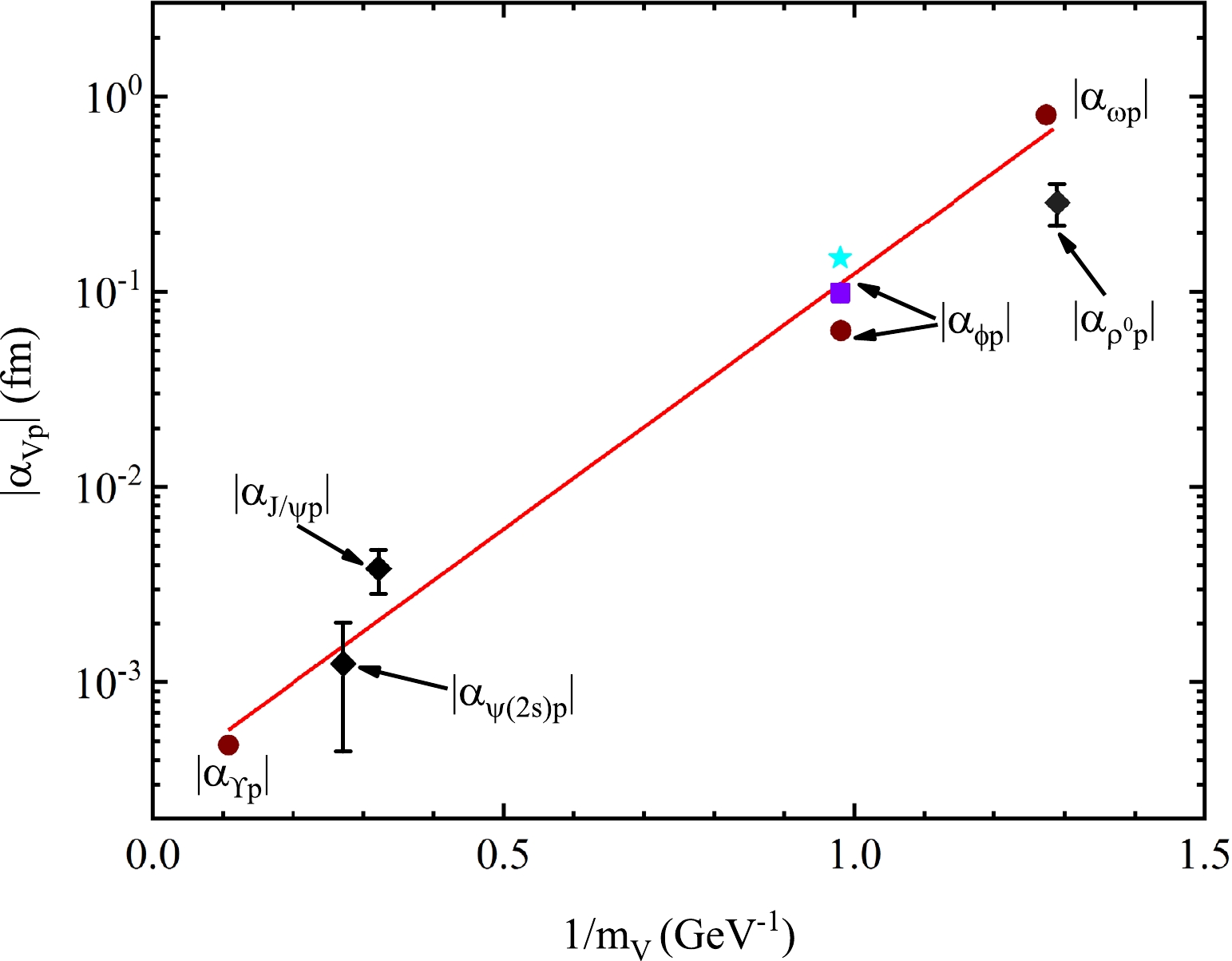
Figure 8.(color online) Scattering length of
$ |\alpha_{V p}| $ , whereVis a vector meson. The purple square represents$ |\alpha_{\phi p}|=0.10\pm0.01 $ fm. The result indicated by the black diamonds originate from our previous studies [5,6]. The burgundy circles are the results of Refs. [2,7,8]. The cyan pentagram represents the result from the LEPS laboratory [3]. -
From the analysis, we find that the slope of the cross section distribution of
$ \gamma d\rightarrow \phi d $ is larger than that of$ \gamma p \rightarrow \phi p $ ; hence, it is inappropriate to describeϕ-dbased on the two gluon exchange model with$ b_{0} $ =$ 3.6 $ GeV$ ^{2} $ . The gluon distribution function$ xg(x,m_{\phi}^{2}) $ obtained fromϕ-pis preserved. That is,$ A_{0} $ ,$ A_{1} $ , and$ A_{2} $ are retained, while$ b_{0} $ is set as a free parameter and re-fitted by LEPS [3] data. The relevant fitting results are shown inFigs. 9and10, which are in good agreement with the LEPS data, and the parameters are shown inTable 4. The differential cross sections ofϕphotoproduction from deuterons from the LEPS data are distributed at$ W\in[3.10,3.50] $ GeV, corresponding to$ R\in[0.54,0.76] $ . Based on Eq. (10), the scattering length$ |\alpha_{\phi d}| $ as a function ofRis shown inFig. 11.$ |\alpha_{\phi d}| $ obtained directly from the LEPS data is shown inTable 5, and the average scattering length$\sqrt{\langle |\alpha^{2}_{\phi d}|\rangle}= 0.015\pm 0.002$ fm. At$ R\in[0.54,0.76] $ ,$\sqrt{\langle |\alpha^{2}_{\phi d}|\rangle}=0.016\pm 0.002$ fm from the two gluon exchange model. The two average scattering lengths are extremely adjacent, with a difference of only$ 0.001 $ fm, which indicates that$ |\alpha_{\phi d}| $ obtained based on the model is reliable. Based on this, the average scattering length at$ R\in[0,0.66] $ is calculated to be$ 0.014\pm0.002 $ using the two gluon exchange model. Here,$ R\in[0,0.66] $ is selected forϕ-dfor consistency withϕ-p.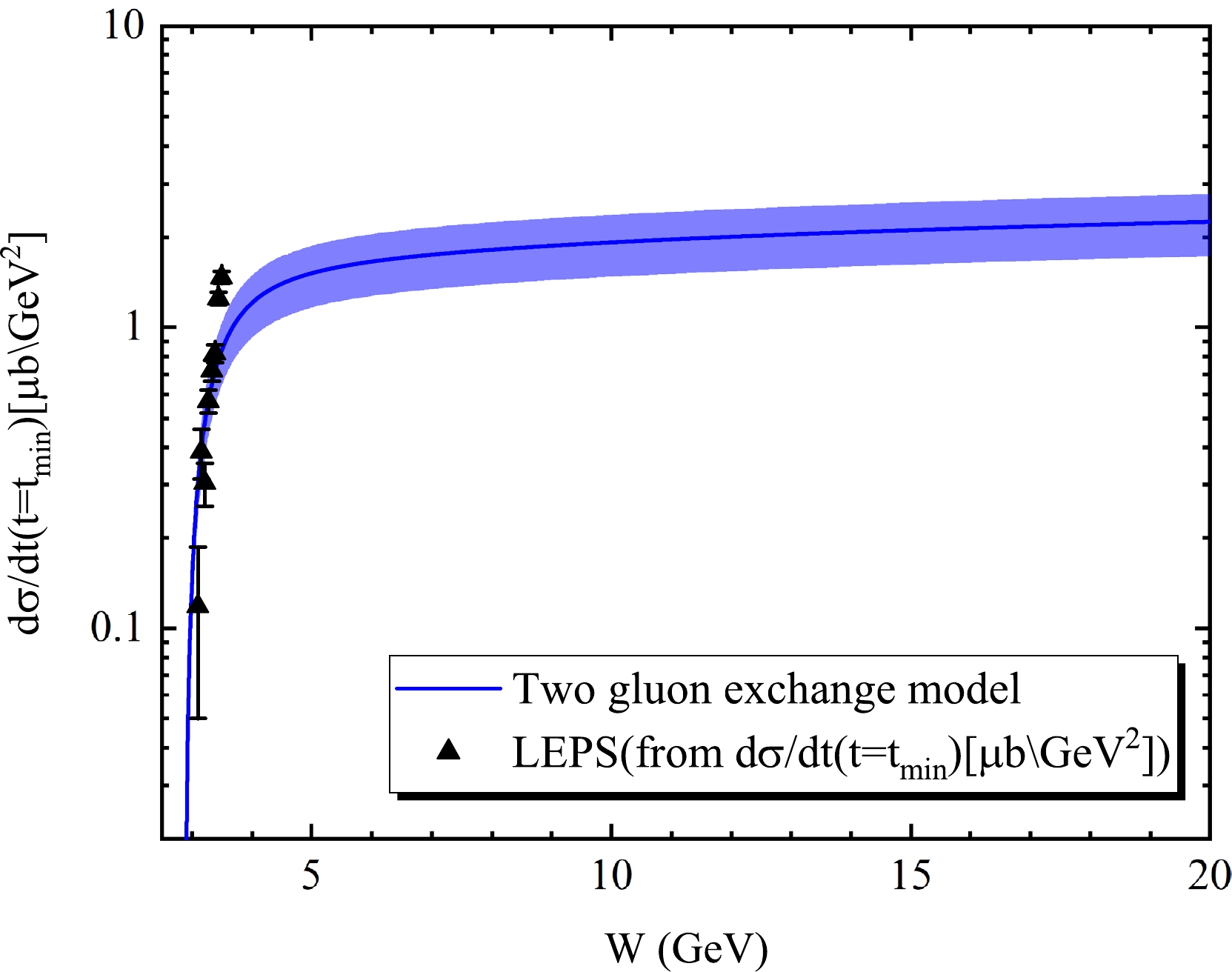
Figure 9.(color online)
${\rm d} \sigma/{\rm d}t(t=t_{\rm min})$ ofϕphotoproduction from deuterons as a function of the center of mass energyW. The solid-line (blue) is from the two gluon exchange model, and the black triangle is from the LEPS Collaboration [3].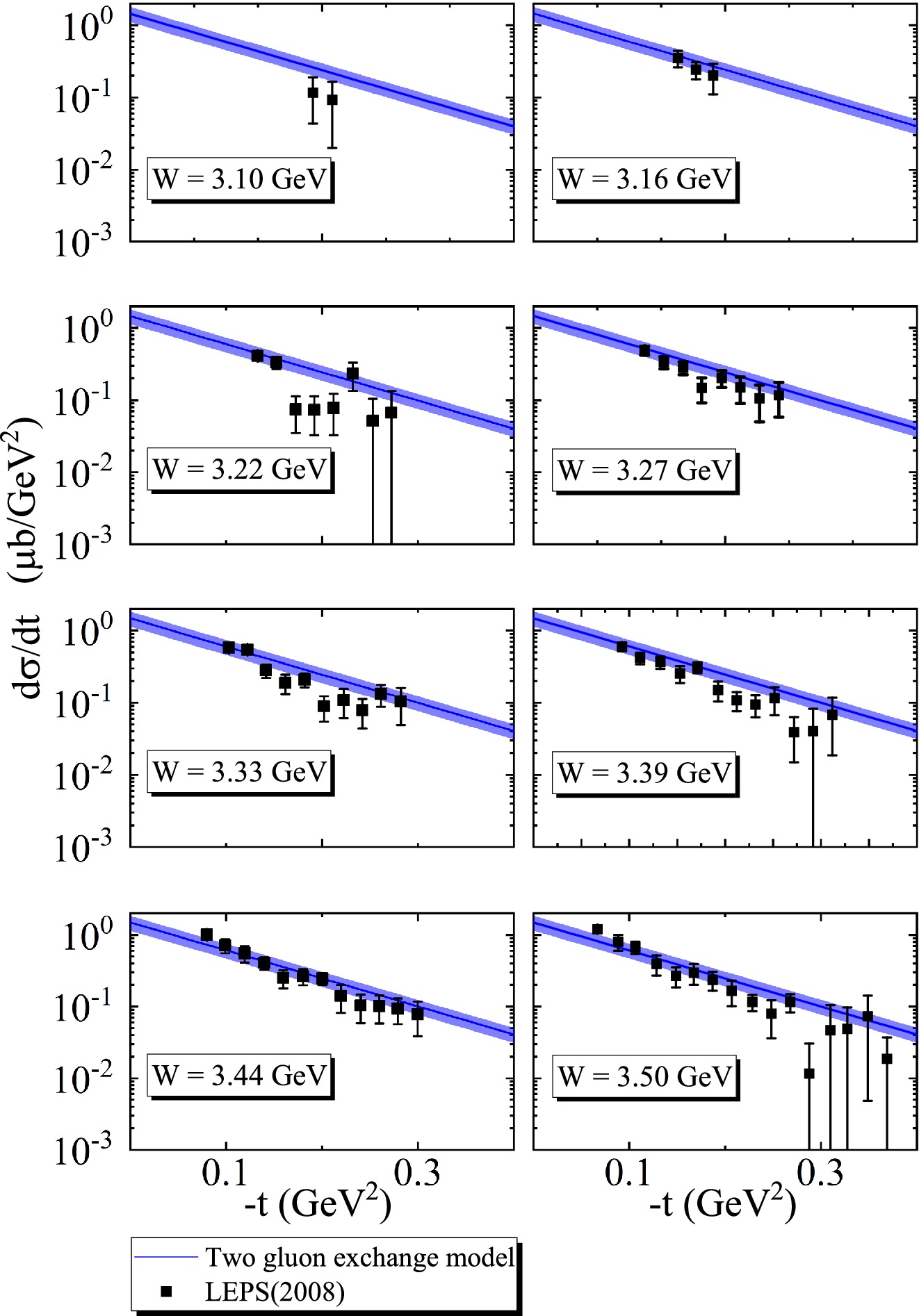
Figure 10.(color online) Differential cross sections ofϕbased on the two gluon exchange model (blue line) as a function of
$ -t $ at differentWvalues. Here, the black square represents the experimental data of$ \gamma d \rightarrow \phi d $ from the LEPS Collaboration [3].$ A_{0} $ 

$ A_{1} $ 

$ A_{2} $ 

$ b_{0} $ /GeV

$ ^{-2} $ 

$ \chi^{2} / $ d.o.f

$ 0.36 \pm 0.04 $ 

$ -0.055 \pm 0.003 $ 

$ 0.12 \pm 0.03 $ 

$ 9\pm0.29 $ 

$ 0.17 $ 

Table 4.Parameters
$ A_{0} $ ,$ A_{1} $ ,$ A_{2} $ ,$ b_{0} $ , and$ \chi^{2} / $ d.o.f are for the process$ \gamma d \rightarrow \phi d $ .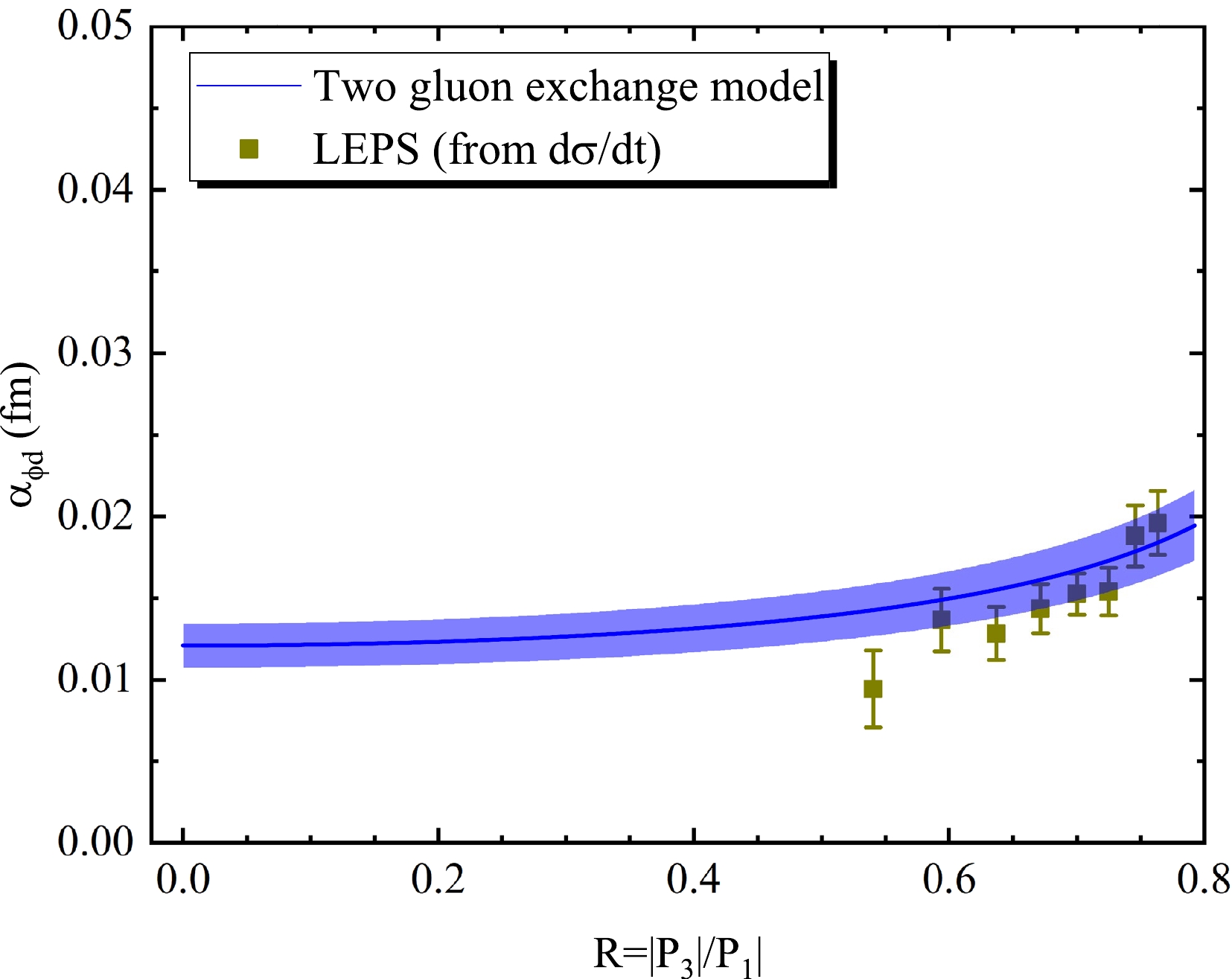
Figure 11.(color online) Function of
$ |\alpha_{\phi d}| $ withRbased on the two gluon exchange model (blue line). The dark-yellow squares are the results from LEPS [3] data.W/GeV $ 3.10 $ 

$ 3.16 $ 

$ 3.22 $ 

$ |\alpha_{\phi d}|/{\rm{fm}} $ 

$ 0.009 \pm 0.002 $ 

$ 0.014 \pm 0.002 $ 

$ 0.013 \pm 0.002 $ 

W/GeV $ 3.28 $ 

$ 3.33 $ 

$ 3.39 $ 

$ |\alpha_{\phi d}|/{\rm{fm}} $ 

$ 0.014 \pm 0.001 $ 

$ 0.015 \pm 0.001 $ 

$ 0.015 \pm 0.001 $ 

W/GeV $ 3.44 $ 

$ 3.50 $ 

- $ |\alpha_{\phi d}| /{\rm{fm}} $ 

$ 0.019\pm0.002 $ 

$ 0.020\pm0.002 $ 

- Table 5.Scattering length ofϕ-dis derived from the differential experimental cross section from LEPS [3] data, where the average is
$ 0.015\pm0.002 $ fm.According to these results,
$ |\alpha_{\phi d}| $ is relatively smaller than$ |\alpha_{\phi p}| $ As shown inFigs. 4and10, the differential cross sections ofϕ-dandϕ-pphotoproduction belong to the same order of magnitude, and there is a slight distinction between them. However, the influence of$|t_{\rm min}|$ on the differential cross section is enormous owing to the diverse nucleons or nuclei interacting withϕ.Figure 12comprehensively demonstrates this difference.$|t_{\rm min}|$ ofϕ-dis larger than that ofϕ-pat$ R\in[0,0.66] $ . Furthermore, consider the slope of the differential cross section ofϕ-dto be steeper. Therefore,$ |\alpha_{\phi d}| $ $ < $ $ |\alpha_{\phi p}| $ is adequately explained.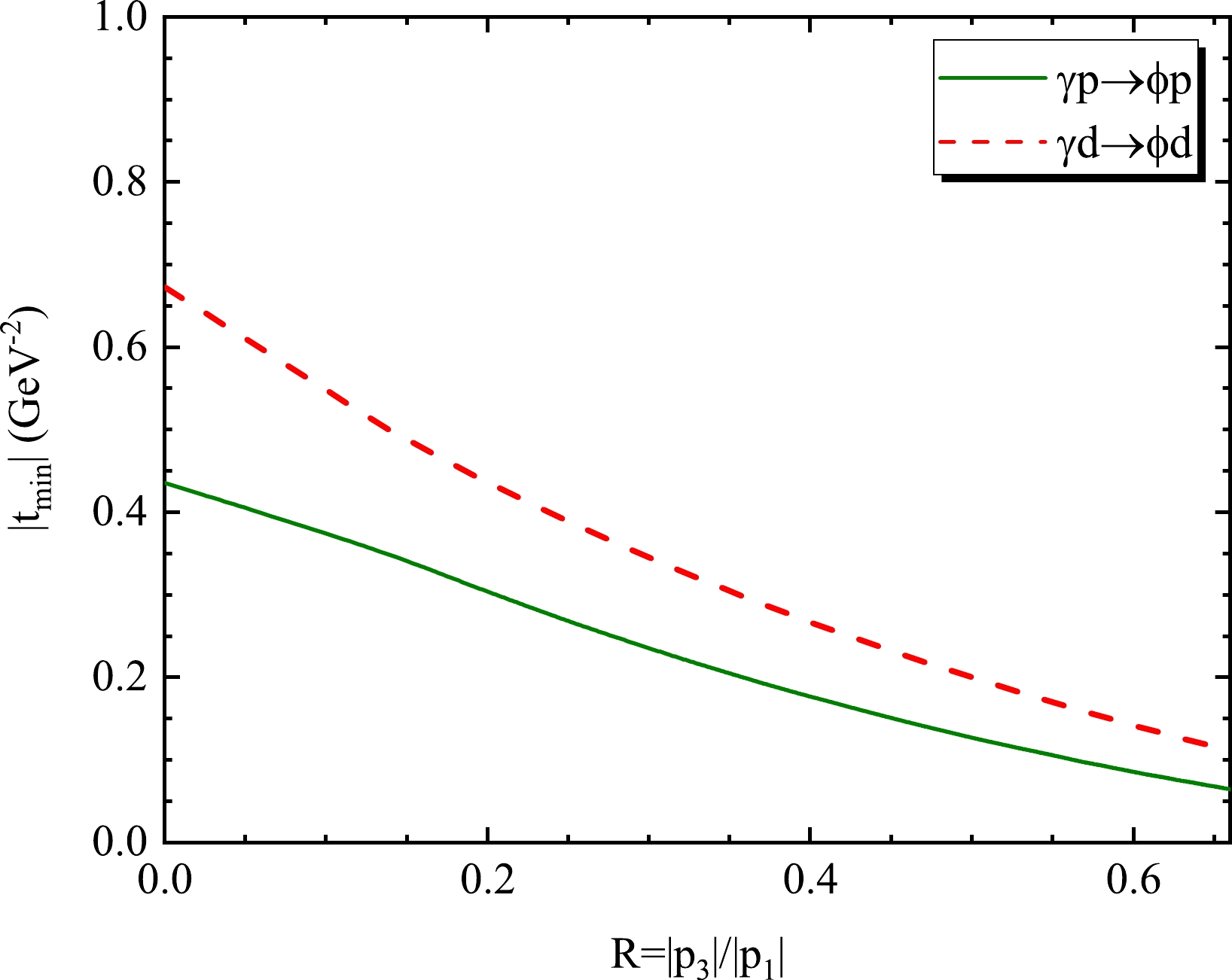
Figure 12.(color online) Function of
$|t_{\rm min}|$ withR. The solid olive green line representsϕ-p, and the red dashed-line representsϕ-d. -
In this study, based on the experimental data ofϕphotoproduction at the near threshold [2,19,20], the interaction between theϕmeson and nucleus is systematically investigated under the framework of the VMD model. Specifically, the average scattering length of theϕ-pinteraction is calculated to be
$ 0.10\pm0.01 $ fm, which satisfies$ |\alpha_{Vp}| $ proportional to$ \exp{(1/m_{V})} $ . Note that our conclusions are similar to the results given by the VMD model [2,3] and QCD sum rules [4]; however, they are different from the results obtained by the ALICE Collaboration [16]. This may be due to different reaction processes; the ALICE Collaboration measured a complete two-bodyϕ-Ninteraction, whereas the results obtained using the VMD model may refer to the properties ofϕembedding into nucleons [16].Moreover, the scattering length of theϕand deuteron interaction is investigated for the first time, and the average scattering length
$ |\alpha_{\phi d}| $ is calculated to be$ 0.014\pm0.002 $ fm, which is nearly seven times smaller than$ |\alpha_{\phi p}| $ . This result indicates that theϕ-dcoupling is considerably weaker than that ofϕ-p. One possible explanation is that because the deuteron is composed of two nucleons, theϕmeson is overall more fully embedded in the deuteron than in the nucleon [16], making theϕ-dscattering length smaller. Of course, this is still an open question, and further explanations and discussions are required.It should be noted that although the pomeron model and parameterized two gluon exchange model can describe vector meson photoproduction data well, there are usually contributions from intermediate exchange mesons or nucleon resonances in the low energy region. For example, in Refs. [35,36], the contribution of
$ \pi^{0} $ andηmeson exchange to the cross section of vector meson photoproduction was discussed. In Refs. [37–40], the role of the intermediate nucleon resonances and directϕmeson radiation via proton exchanges was also studied. These results indicate that more research on the production mechanism of vector meson photoproduction at low energies is still needed, which will be helpful to more accurately explain the interaction between a vector meson and a nucleus.To study these issues more accurately, it is necessary to measure more accurate experimental data on vector meson photoproduction or electroproduction. At present, EIC facilities [26,27] in China and the United States have listed nuclear structure and properties as important scientific objectives, and theϕ-Ninteraction is an essential direction of study. Our results can provide a crucial reference and basis for detecting the scattering length of theϕ-Ninteraction more accurately in the future.
Analysis of the interaction between theϕmeson and nucleus
- Received Date:2022-08-25
- Available Online:2023-01-15
Abstract:In this study, we systematically investigate theϕmeson and nucleus interaction by analyzing and fitting the cross sections of


 DownLoad: