


 Abstract
 HTML
HTML Reference
 Related
 PDF
PDF


-
Nickel plays an important role in the field of nuclear engineering [1-3]. In the MeV neutron energy region, the radiation damage of structural materials due to theα-particles emitted from the (n,α) reactions are non-negligible. The abundances of58Ni,60Ni and61Ni in natural nickel are 68.077%, 26.223% and 1.140%, respectively [4]. Therefore, accurate cross sections of the58,60,61Ni(n,α)55,57,58Fe reactions in the MeV energy region are important to the safety design for nuclear engineering. Also, measurements of the cross sections of the58,60,61Ni(n,α)55,57,58Fe reactions can enhance the understanding of nuclear structure and nuclear reaction mechanisms.
For the cross sections of the58Ni(n,α)55Fe (Q= 2.899 MeV) reaction, the residual nucleus55Fe is radioactive so the cross section can be measured using the activation method. In the MeV neutron energy region, there are eleven existing measurement results, but most of them were obtained in the region below 8 MeV or around 14 MeV [5-15]. In the 8.50–10.50 MeV region, there are only two measurement data [6,12] for the58Ni(n,α)55Fe reaction, and the cross sections of Qaim [12] are higher by ~18% than those of Fessler [6], showing apparent disagreement.
For the cross sections of the60Ni(n,α)57Fe (Q= 1.355 MeV) and61Ni(n,α)58Fe (Q= 3.580 MeV) reactions, measurement data are scarce because the activation method is unavailable. In the MeV energy region, for the60Ni(n,α)57Fe reaction, there are only two measurement data [5,16], both measured below 8 MeV. For the61Ni(n,α)58Fe reaction, there is only one measurement datum obtained by our group [5], and this datum was measured below 6 MeV. So, there is no data for the60Ni(n,α)57Fe and61Ni(n,α)58Fe reactions in the 8.50–10.50 MeV region.
Thus, experimental data are scarce for all the58,60,61Ni(n,α)55,57,58Fe reactions in the 8.50–10.50 MeV region. According to the JENDL-4.0 [17] and TENDL-2019 [18] libraries, the cross sections of the58,60,61Ni(n,α)55,57,58Fe reactions are nearly equal to those of the58,60,61Ni(n,xα) reactions in the energy region below 11 MeV. So, the cross sections of the (n,xα) reactions can be used as the reference for the analysis of the excitation functions of the (n,α) reactions below 11 MeV. In the 8.50–10.50 MeV energy region, there are six measurement data [19-24] for the58Ni(n,xα) reaction, four measurement data [21-24] for the60Ni(n,xα) reaction, and one measurement datum [22] for the61Ni(n,xα) reaction. Among these data, discrepancies are apparent. Furthermore, most of the experimental data for the58,60,61Ni(n,xα) reactions are characterized by large uncertainties (>10%).
Because the existing measurement data are either scarce or show discrepancies, deviations among different evaluation libraries are noticeable. For example, in the 8.50–10.50 MeV region, the amount of variation among different evaluation libraries [17,18,25-30], are 10.5%, 19.9% and 23.9% for the58Ni(n,α)55Fe,60Ni(n,α)57Fe and61Ni(n,α)58Fe reactions, respectively.
In our previous work, the cross sections of the58,60,61Ni(n,α)55,57,58Fe reactions in the 4.50
$ \leqslant E{_{\rm n}} \leqslant $ 5.50 MeV region were measured based on the 4.5 MV Van de Graaff accelerator at Peking University (PKU) [5]. In the present work, measurements were extended to the 8.50$ \leqslant E{_{\rm n}} \leqslant $ 10.50 MeV region on the HI-13 tandem accelerator at China Institute of Atomic Energy (CIAE). Details of the experiment are described in section II, data processing and results are presented in section III, theoretical analysis is described in section IV, and the conclusions are drawn in section V. -
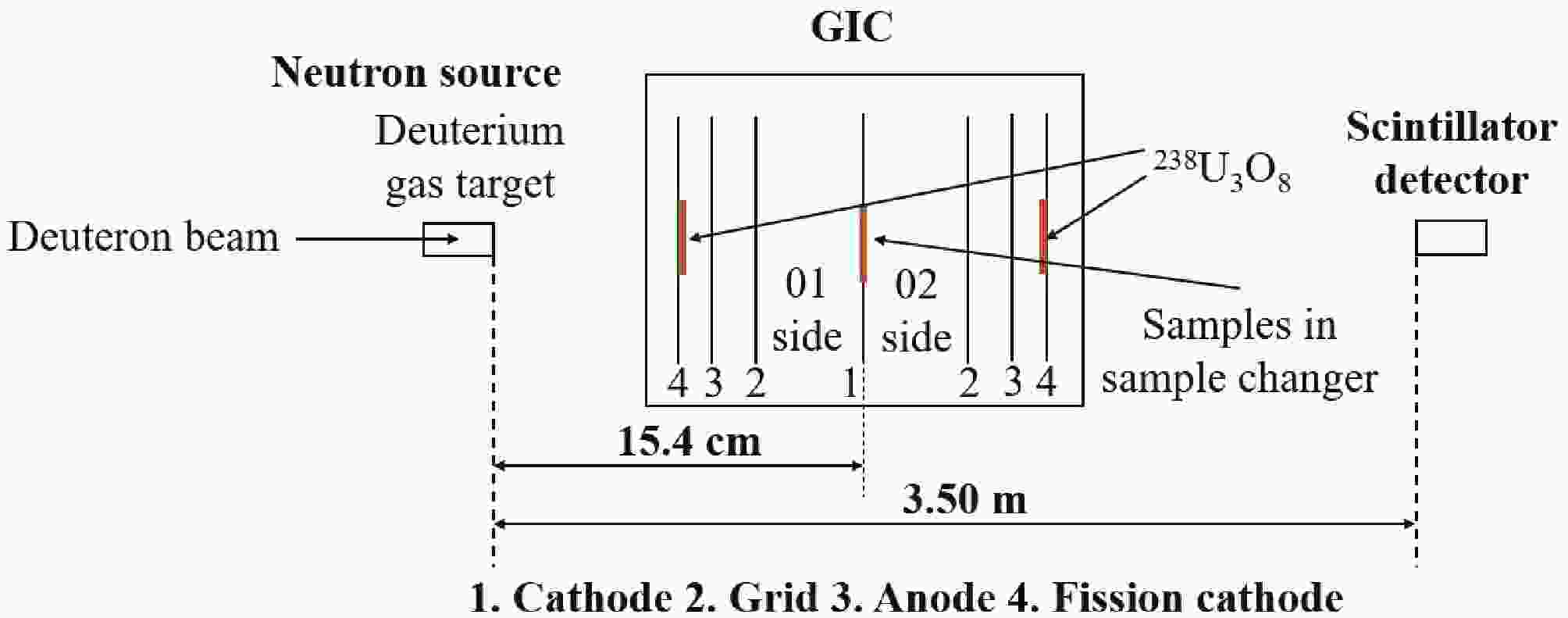
The experiments were performed using the HI-13 tandem accelerator of the China Institute of Atomic Energy (CIAE). The experimental apparatus is shown inFig. 1, which was similar to the previous measurement [5], except that the scintillator detector was further away from the neutron source because of the strongγ-background from the source.
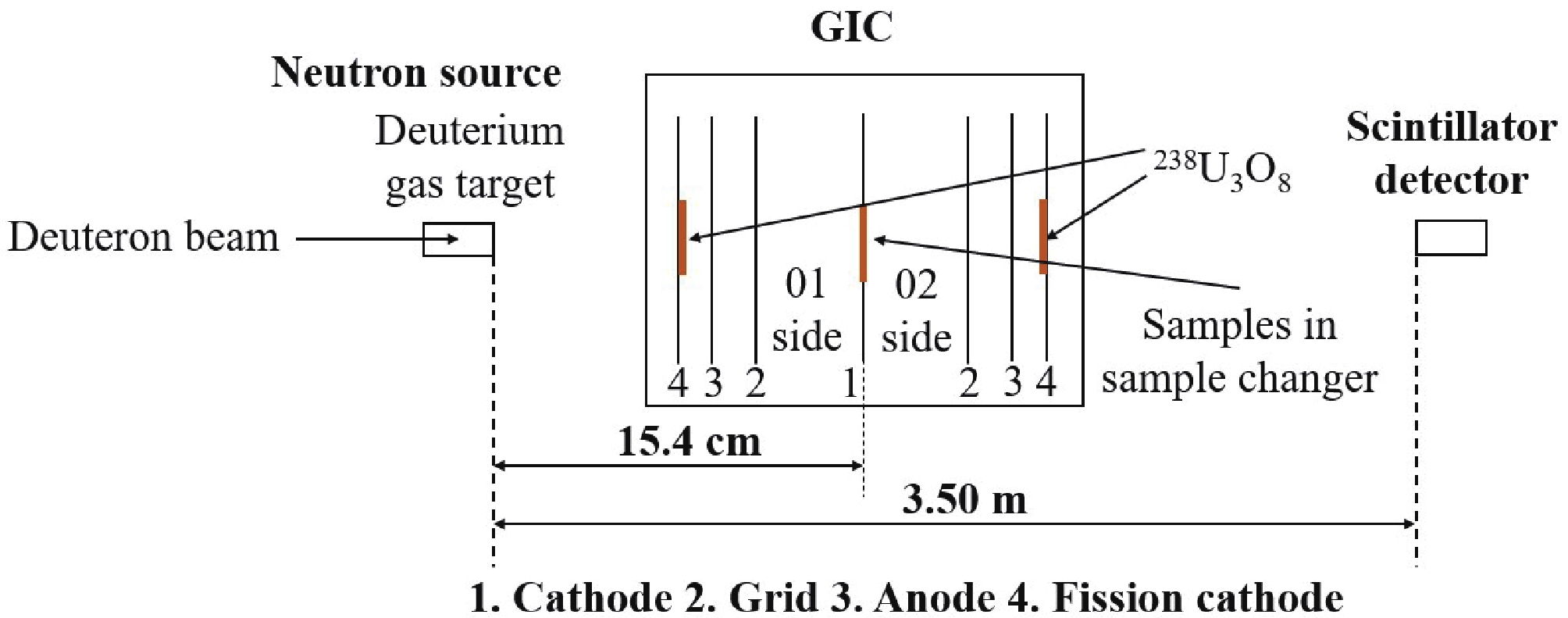
Figure 1.(color online) Schematic drawing of the experimental apparatus.
Through the2H(d,n)3He reaction, neutrons with kinetic energies of 8.50, 9.50, and 10.50 MeV were generated using the energetic deuteron beam from the accelerator to bombard the deuterium gas target with incident energies of 5.95, 6.91, and 7.90 MeV. The deuteron beam current was about 2.0 μA throughout the measurement. The deuterium gas target was 3.0 cm in length, 1.0 cm in diameter and 3.0 atm in pressure. It was separated from the vacuum tube of the accelerator by a molybdenum foil 10.0 μm in thickness. In addition to the main neutrons, low-energy neutrons will also be generated through the2H(d,np)2H reaction. To correct for this interference, the neutron energy spectra were measured using an EJ-309 liquid scintillator detector. Unfolding the pulse height spectra measured with the scintillator detector [31], the neutron energy spectra were obtained as shown inFig. 2.
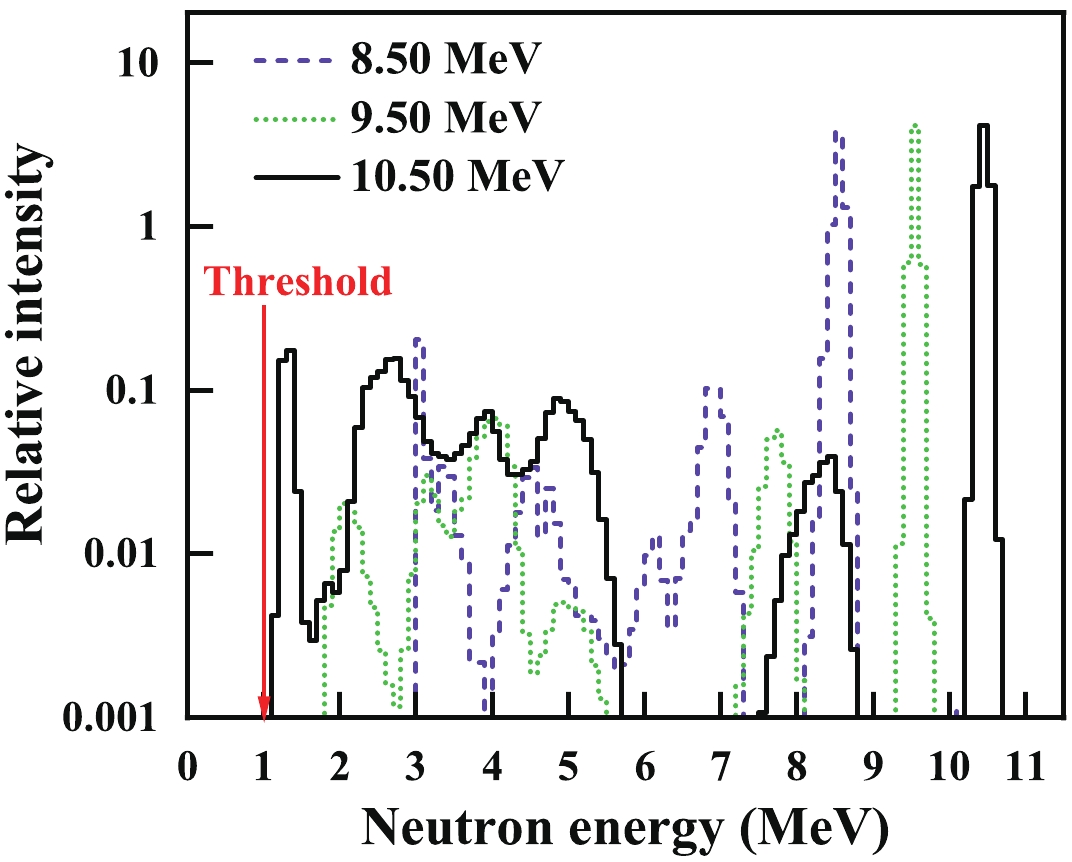
Figure 2.(color online) Measured neutron energy spectra from the EJ-309 liquid scintillator detector.
A twin gridded ionization chamber (GIC) with sides labelled '01 side' and '02 side' was used as the charged particle detector. The working gas of the GIC was Xe + 5.0% H2with the pressure of 1.161 atm. The high voltages applied on the cathodes and anodes were -1500 V and 750 V, and the grid electrodes were grounded. There is a sample changer at the common cathode of the GIC with five sample positions, on which these samples were mounted: 1) back-to-back compoundα-sources for the detection system calibration, 2)238U3O8#III/Ta samples for the absolute neutron flux measurement, 3) back-to-back58Ni#II/58Ni#I foil samples for the measurement of the58Ni(n,α)55Fe reaction (the58Ni#II sample was broken, so the cross section was obtained using the58Ni#I sample), 4) back-to-back60Ni/61Ni foil samples for the measurements of the60Ni(n,α)57Fe and61Ni(n,α)58Fe reactions, and 5) Ta/Ta backings for the measurement of the background events. To monitor the relative neutron flux, the238U3O8#I and238U3O8#II samples were glued on each of the fission cathode electrodes of the GIC, respectively. Details of the GIC, including the measurement principle, structure and electronics, together with information of the samples, including the isotopic enrichment, thickness, diameter, unevenness and impurity content can be found in Ref. [5].
The58,60,61Ni(n,α)55,57,58Fe reactions were measured atEn= 8.50, 9.50 and 10.50 MeV. For each neutron energy point, measurements were performed with the sample set sequentially at the five sample positions, then the GIC was rotated by 180° and measurements were performed for each sample position again, so that the forward (0°–90°) and the backward (90°–180°) cross sections of the (n,α) reaction could be measured. The experiment was conducted in October 2020, and the total neutron beam duration was ~ 30 h.
-
The data processing procedures are presented inFig. 3, which were the same as the previous measurements in the 4.50–5.50 MeV range [5] except that the unfolding method for reducing the uncertainty ofEnwas not used in the present work. The uncertainty of theEnat CIAE was small enough (<1%) due to the higher energy of the incident deuteron beam, therefore the unfolding method is not necessary.
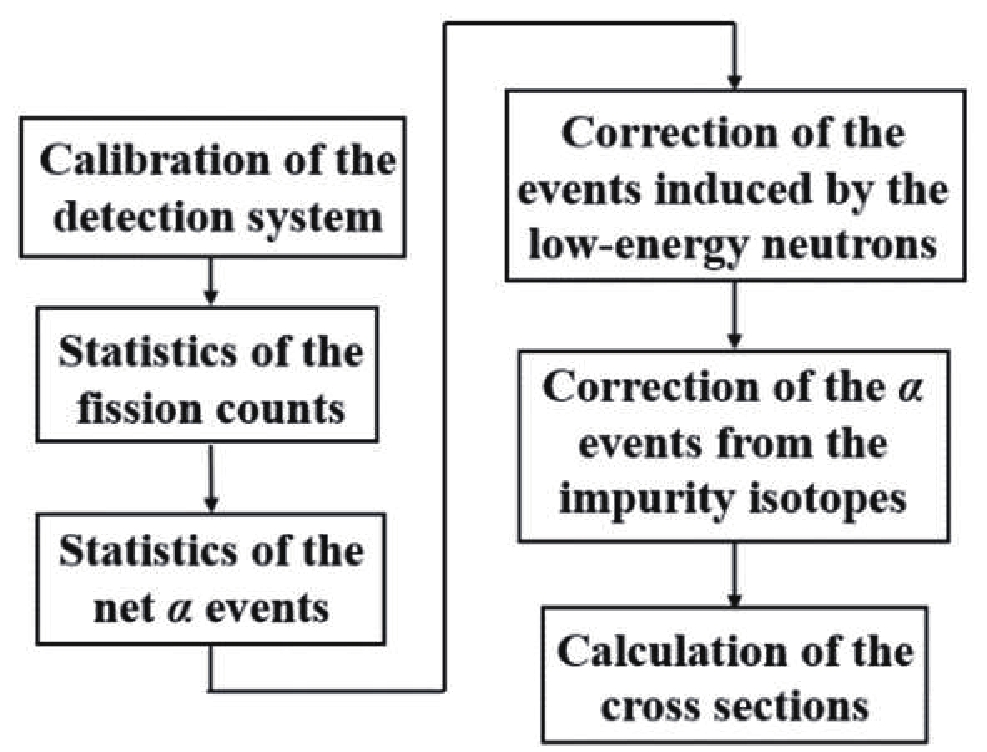
Figure 3.Data processing procedure.
The forward or backward cross sectionsσαof the (n,α) reactions can be calculated by
$ {\sigma _\alpha }{\text{ }} = {\sigma _f} \cdot \frac{{{N_{\text{U}}} \cdot {N_\alpha } \cdot {\varepsilon _f} \cdot {\rho ^{{\rm low}}} \cdot (1 - {k^{{\text{impurity}}}})}}{{{N_{{\text{Ni}}}} \cdot {N_f} \cdot {\varepsilon _\alpha } \cdot G \cdot {C^{{{f}}\_{\rm fission}}}}} , $

(1) whereσfis the standard cross section of the238U(n,f) reaction [32].NUandNNiare the numbers of the238U and58,60,61Ni nuclei in the samples, respectively.Nαis the count of the netαevents within the threshold in the anode projection spectrum after the valid-event-area determination in the cathode–anode two-dimensional spectrum and background subtraction. A typical cathode–anode two-dimensional spectrum and an anode projection spectrum are shown inFig. 4(a) and (b), respectively.Nfis the count of the fission events within the threshold in the fission anode projection spectrum as shown inFig. 5.εαandεfare the detection efficiencies for theαparticles from the58,60,61Ni(n,α)55,57,58Fe reactions and fission fragments from the238U(n, f) reaction at the specific neutron energy, respectively.ρlowis the correction coefficient of theαand fission events induced by the low-energy neutrons.kimpurityis the correction coefficient of theαevents from the nickel and oxygen impurity isotopes.Gis the ratio of the average neutron flux in the area of nickel sample to that of the238U3O8#III sample area at the sample changer.Cf_fissionis the ratio of the fission counts from the238U3O8#I or238U3O8#II sample glued on the fission cathode during the foreground measurement to that during the absolute neutron flux measurement.εα,εf,ρlow,kimpurityandGwere obtained using simulation methods; whose details can be found in Ref. [5]. Values of the parameters in Eq. (1) for the three reactions are presented inTables 1–3.
Parameters Values En= 8.50 MeV En= 9.50 MeV En= 10.50 MeV NU 1.872×10¹⁹ a, b 1.872×10¹⁹ a, b 1.872×10¹⁹ a, b NNi 9.526×10¹⁹ a, b 9.526×10¹⁹ a, b 9.526×10¹⁹ a, b σf/mb 1015.0a, b 1013.5a, b 1009.5a, b Nα 6890a
5976b7260a
6927b11335a
7867bNf 16366a
14085b17128a
16801b20307a
19284bρlow 1.031a
1.026b1.097a
1.030b1.154a
1.150bεf(%) 82.62a
84.23b81.18a
83.26b81.40a
83.25bεα(%) 93.97a
91.49b87.05a
94.06b89.05a
93.02bG 1.007a
1.002b1.010a
0.999b1.007a
1.000bkimpurity 0.007a
0.006b0.021a
0.008b0.096a
0.007baFor the forward cross section.bFor the backward cross section. Table 2.Values of the parameters in Eq. (1) for the60Ni(n,α)57Fe reaction.
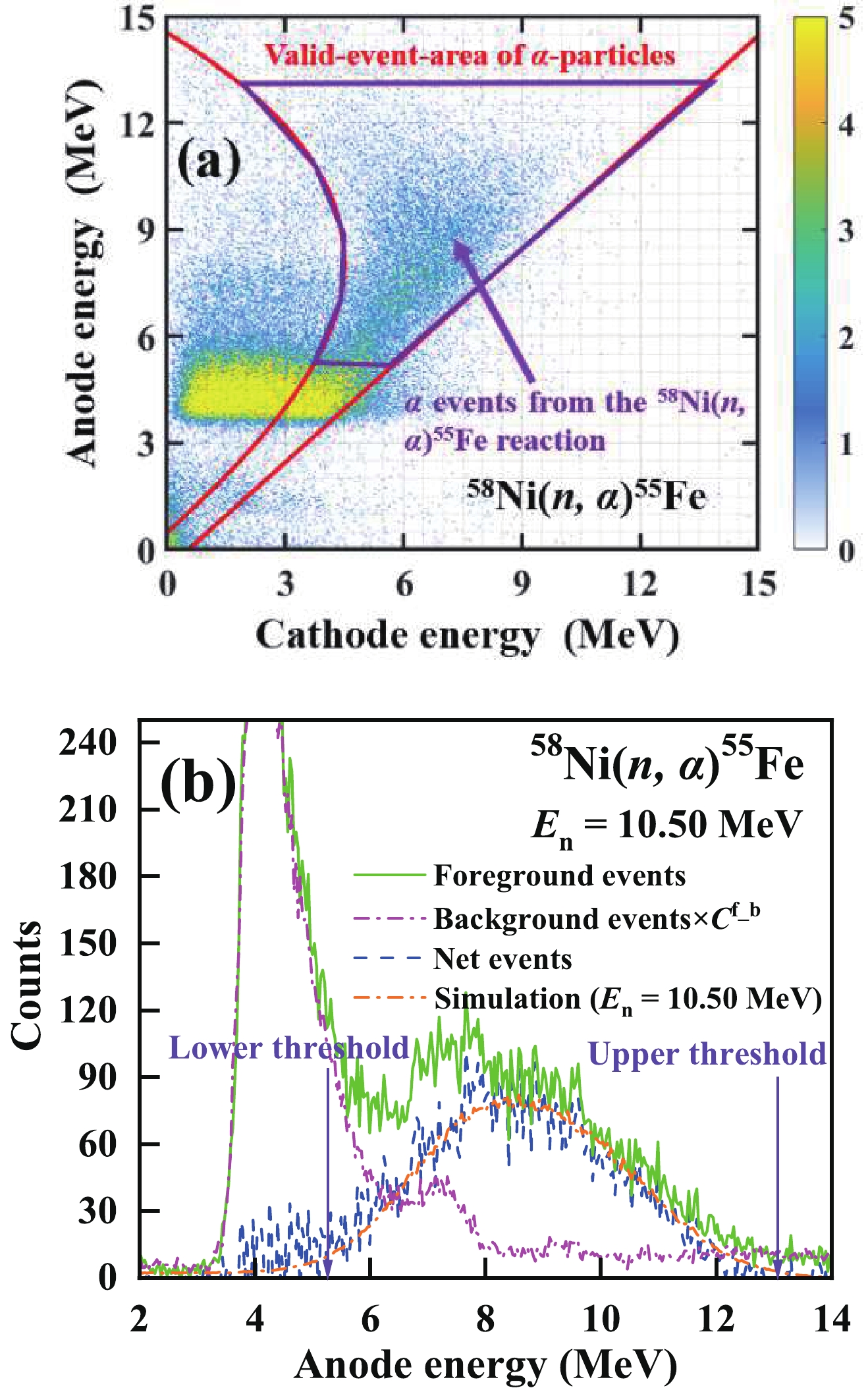
Figure 4.(color online) (a) Cathode–anode two-dimensional spectrum of the foreground events (the area between the red line is the valid-event-area ofαparticles determined using the two-dimensional spectrum obtained from theαsources). (b) Anode projection spectrum of the foreground, background and net events together with the simulated spectrum for the measurement of the58Ni(n,α)55Fe reaction in the forward direction atEn= 10.50 MeV.
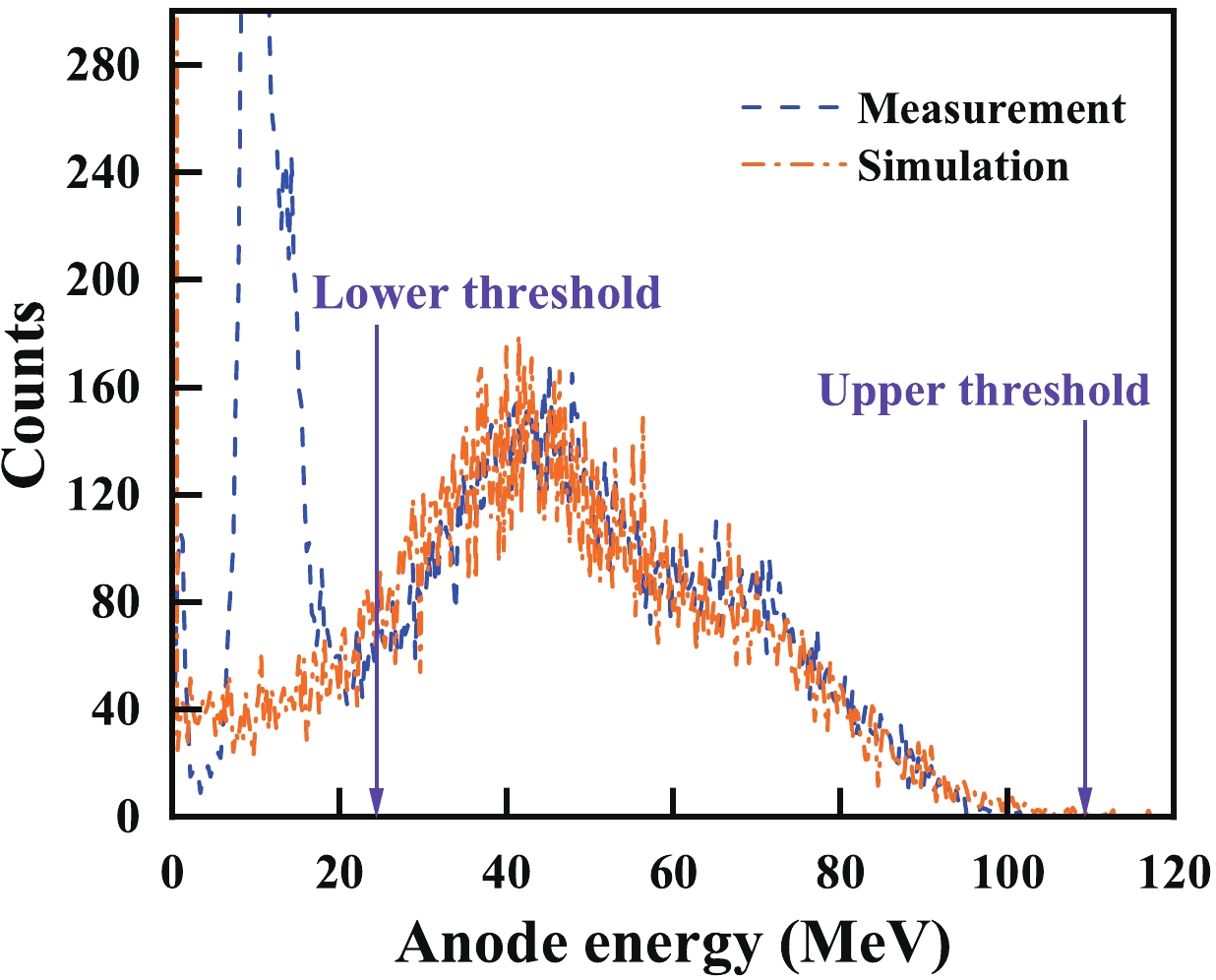
Figure 5.(color onlne) Anode spectrum of the fission fragments for the absolute neutron flux measurement atEn= 10.50 MeV.
Parameters Values En= 8.50 MeV En= 9.50 MeV En= 10.50 MeV NU 1.872×10¹⁹ a, b 1.872×10¹⁹ a, b 1.872×10¹⁹ a, b NNi 1.039×10²⁰ a b 9.526×10¹⁹ a b 4.883×10¹⁹ a b σf/mb 1015.0a b 1013.5a b 1009.5a b Nα 4764a
4768b4570a
6221b9592a
8401bNf 14085a
16366b16801a
17128b19284a
20307bρlow 1.009a
1.008b1.058a
1.048b1.010a
1.080bεf(%) 84.23a
82.62b83.26a
81.18b83.25a
81.40bεα(%) 90.01a
92.81b89.45a
93.48b92.30a
88.02bG 1.012a
1.006b1.008a
1.006b1.004a
1.009bkimpurity ~ 0a, b ~ 0a, b ~ 0a, b aFor the forward cross section.bFor the backward cross section. Table 1.Values of the parameters in Eq. (1) for the58Ni(n,α)55Fe reaction.
Parameters Values En= 8.50 MeV En= 9.50 MeV En= 10.50 MeV NU 1.872×10¹⁹ a, b 1.872×10¹⁹ a, b 1.872×10¹⁹ a, b NNi 4.883×10¹⁹ a, b 4.883×10¹⁹ a, b 4.883×10¹⁹ a, b σf/mb 1015.0a, b 1013.5a, b 1009.5a, b Nα 2155a
1937b2556a
2191b3343a
3091bNf 14085a
16366b16801a
17128b19284a
20307bρlow 1.024a
1.023b1.031a
1.075b1.139a
1.124bεf(%) 84.23a
82.62b83.26a
81.18b83.25a
81.40bεα(%) 94.88a
92.60b91.18a
90.35b93.02a
85.58bG 1.010a
0.994b0.999a
1.002b1.007a
1.005bkimpurity 0.1724a
0.1768b0.1607a
0.1600b0.1573a
0.1445baFor the forward cross section.bFor the backward cross section. Table 3.Values of the parameters in Eq. (1) for the61Ni(n,α)58Fe reaction.
-
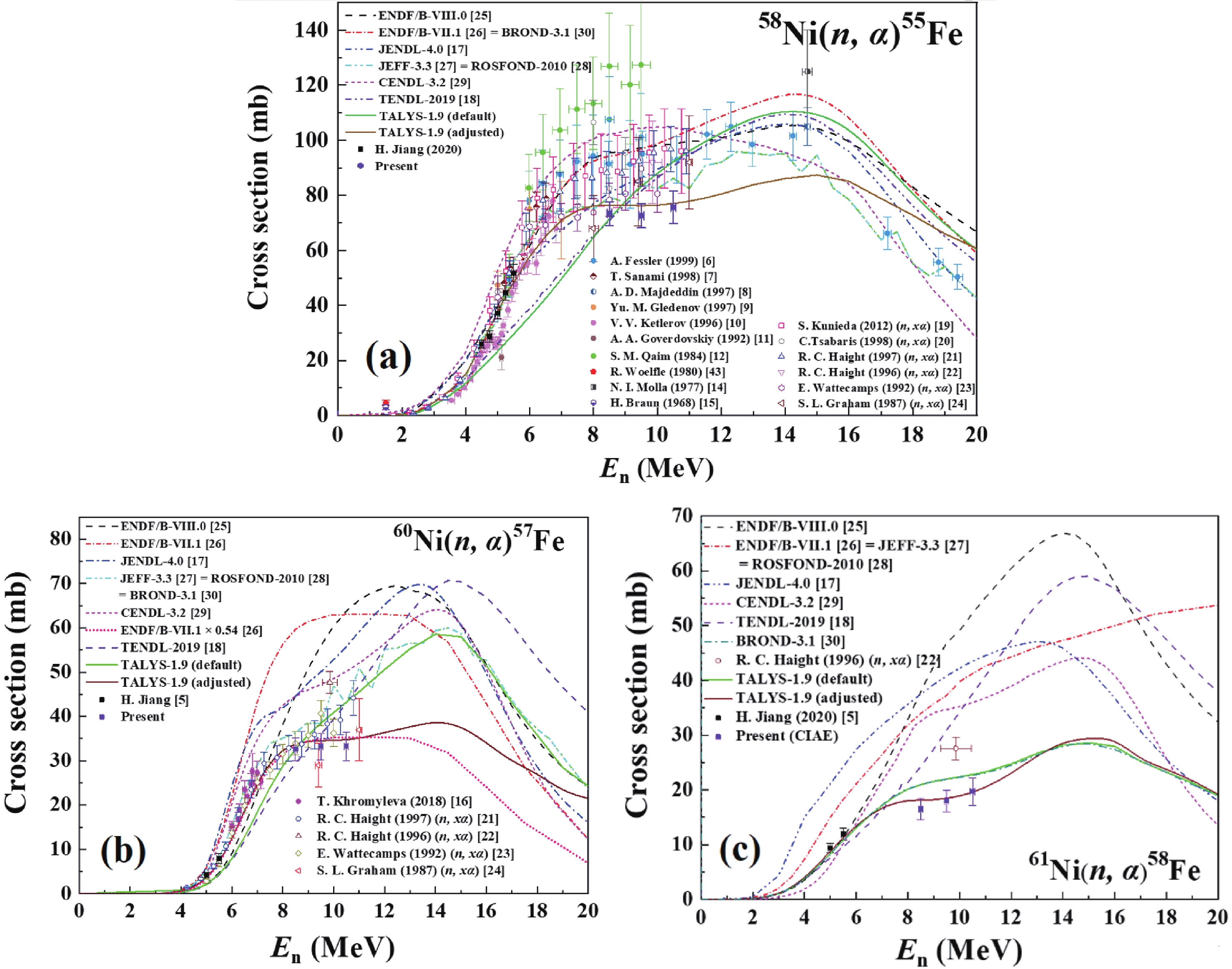
Using Eq. (4), the forward and backward cross sections of the58Ni(n,α)55Fe,60Ni(n,α)57Fe and61Ni(n,α)58Fe reactions can be calculated. Total (n,α) cross section can be acquired by adding the forward cross section and backward one together. Sources of uncertainty and their magnitudes are presented inTable 4. The measured cross sections of the three reactions are shown inTables 5–7andFig. 6(a) – (c).
Source Magnitude (%) 58Ni(n,α)55Fe 60Ni(n,α)57Fe 61Ni(n,α)58Fe NU 1.0a, b 1.0a, b 1.0a, b NNi 1.0a, b 5.0a, b 1.0a, b σf 1.4 – 1.5a, b 1.4 – 1.5a, b 1.4 – 1.5a, b Nα 2.1 – 3.8a, 2.7 – 6.5b 2.8 – 5.3a, 4.6 – 8.2b 6.4 – 8.4a, 10.2 – 13.9b Nf 0.7 – 0.9a, b 0.7 – 0.9a, b 0.7 – 0.9a, b ρlow 2.7 – 3.3a, 2.8 – 4.6b 4.4 – 4.6a, 4.0 – 4.6b 4.4 – 5.3a, 4.0 – 4.8b εf 2.0 – 2.5a, b 2.0 – 2.5a, b 2.0 – 2.5a, b εα 2.6 – 3.5a, 2.2 – 4.0b 3.0 – 6.5a, 3.0 – 4.5b 1.7 – 2.9a, 2.5 – 4.8b G 0.5 – 1.3a, b 0.5 – 1.6a, b 0.5 – 1.9a, b kimpurity ~ 0 0.1 – 4.6a, < 0.2b 3.0 – 3.1a, 3.1 – 3.2b σα 6.0 – 6.5a, 5.6 – 9.5b
5.9 – 7.8c7.2 – 10.7a, 8.3 – 10.3b
7.7 – 9.6c9.9 – 10.7a, 12.3 – 16.0b
11.0 – 12.9cEn 0.7 – 0.9a, b 0.7 – 0.9a, b 0.7 – 0.9a, b aFor the forward cross section.bFor the backward cross section.cFor the total (n,α) cross section. Table 4.Sources of uncertainty and their magnitudes.
En/MeV Cross section/mb Forward/backward ratio Measurement Calculation Measurement Calculation 8.50 ± 0.07 73.4 ± 4.3 76.4 1.22 ± 0.10 1.08 9.50 ± 0.08 72.6 ± 4.4 76.3 1.10 ± 0.09 1.17 10.50 ± 0.08 75.7 ± 5.9 77.0 1.16 ± 0.13 1.25 Table 5.Measured58Ni(n,α)55Fe cross sections and forward/backward ratios in the laboratory reference system (results obtained from the58Ni#I sample) compared with TALYS-1.9 [33] calculations using the adjusted input parameters.
En/MeV Cross section/mb Forward/backward ratio Measurement Calculation Measurement Calculation 8.50 ± 0.07 32.6 ± 2.5 33.7 1.06 ± 0.11 1.08 9.50 ± 0.08 33.2 ± 3.0 34.5 1.18 ± 0.16 1.10 10.50 ± 0.08 33.3 ± 3.2 34.8 1.27 ± 0.18 1.15 Table 6.Measured60Ni(n,α)57Fe cross sections and forward/backward ratios in the laboratory reference system compared with TALYS-1.9 [33] calculations using the adjusted input parameters.
En/MeV Cross section/mb Forward/backward ratio Measurement Calculation Measurement Calculation 8.50 ± 0.07 16.5 ± 2.0 18.1 1.18 ± 0.21 1.10 9.50 ± 0.07 18.0 ± 2.0 18.5 1.12 ± 0.18 1.16 10.50 ± 0.08 19.7 ± 2.5 19.6 1.09 ± 0.21 1.26 Table 7.Measured61Ni(n,α)58Fe cross sections and forward/backward ratios in the laboratory reference system compared with TALYS-1.9 [33] calculations using the adjusted input parameters.
-
AsFig. 6(a) – (c) show, the present reaction cross sections were compared with the data from different evaluations [17,18,25-30], as well as existing measurement data of the58,60,61Ni(n,α)55,57,58Fe reactions and the58,60,61Ni(n,xα) reactions below 11 MeV [5-16,19-24]. The three reactions are discussed as following:
1) For the58Ni(n,α)55Fe reaction, compared with different evaluations, the present results are lower by 8.1%–28.8% [17,18,25-30]. In the 8.50
$ \leqslant E{_{\rm n}}\leqslant $ 10.50 MeV region, the present results show that the change of cross section of the58Ni(n,α)55Fe reaction with the increasing ofEnis quite small, and the ENDF/B-VII.1 [26] evaluation shows the similar trend.Compared with existing measurements, the present cross sections in the 8.50
$ \leqslant E{_{\rm n}} \leqslant $ 10.50 MeV region are close to the experimental data of S. L. Graham (1987, 5.0–14.0 MeV, (n,xα)) [24] and E. Wattecamps (1992, 8.0–11.0 MeV, (n,xα)) [23] within the error range. However, the present cross sections are 42.6% and 25.9% lower than the results of S. M. Qaim (1984, 5.36–9.49 MeV) [12] and Fessler (1999, 5.36–19.4 MeV) [6]. Both Qaim [12] and Fessler [6] used the activation method, but their measurement data were characterized by large uncertainties due to the small counts and low energy of the X-ray (Kα= 5.89 keV andKβ= 6.49 keV) of the activation product55Fe (T1/2= 2.7 yr). Average uncertainties of the results of Qaim [12] and Fessler [6] are 15.8 % and 11.7 %, respectively, while that of the present result is 6.6%.Also, the present cross sections are 19.9%, 20.2%, and 20.6% lower than the experimental data of R. C. Haight (1996, 9.85 MeV, (n,xα)) [22], R. C. Haight (1997, 2.0–48.5 MeV, (n,xα)) [21], and S. Kunieda (2012, 1.7–25.0 MeV, (n,xα)) [19], respectively. The three existing measurements were all carried out using theα-particle counting method. Average uncertainties of these three results are 16.3%, 8.5%, and 14.6% which are greater than that of the present results.
2) For the60Ni(n,α)57Fe reaction, compared with different evaluations [17,18,25-30], the present results are lower by 3.8%–46.4%. The present results show that the cross section of the60Ni(n,α)57Fe reaction are nearly invariable with the increasing ofEnin the 8.50
$ \leqslant E{_{\rm n}} \leqslant $ 10.50 MeV region, which is similar to the trend of the ENDF/B-VII.1 [26] evaluation. As shown inFig. 6(b), the present results in the 8.50$ \leqslant E{_{\rm n}} \leqslant $ 10.50 MeV region together with the data measured by our group in the 5.00$ \leqslant E{_{\rm n}} \leqslant $ 5.50 MeV region [5] agree well with the evaluation results of the ENDF/B-VII.1 [26] library multiplied by the coefficient of 0.54.Compared with existing measurements, the present cross sections in the 8.50
$ \leqslant E{_{\rm n}} \leqslant $ 10.50 MeV region agree well with the measurement data of S. L. Graham (1987, 5.0–14.0 MeV, (n,xα)) [24] and E. Wattecamps (1992, 8.0–11.0 MeV, (n,xα)) [23] within the error range.R. C. Haight has measured the cross sections of the60Ni(n,α)57Fe reaction in 1996 [22] and 1997 [21], yet his data in 1997 are ~20% lower than those in 1996. Compared with the data of his two measurements, the present cross sections are close to his data measured in 1997.
3) For the61Ni(n,α)58Fe reaction, compared with different evaluations, the present results are lower by 17.5%–60.1% [17,18,25-30]. In the 8.50
$ \leqslant E{_{\rm n}} \leqslant $ 10.50 MeV region, the present results show that the cross section of the61Ni(n,α)58Fe reaction grows gradually with the increasing ofEn, which is similar to the trend of evaluations of the CENDL-3.2 [29] and BROND-3.1 [30] libraries. The present cross sections are lower by 13.9% than the experimental data of R. C. Haight (1996, 9.85 MeV, (n,xα)) [22]. -
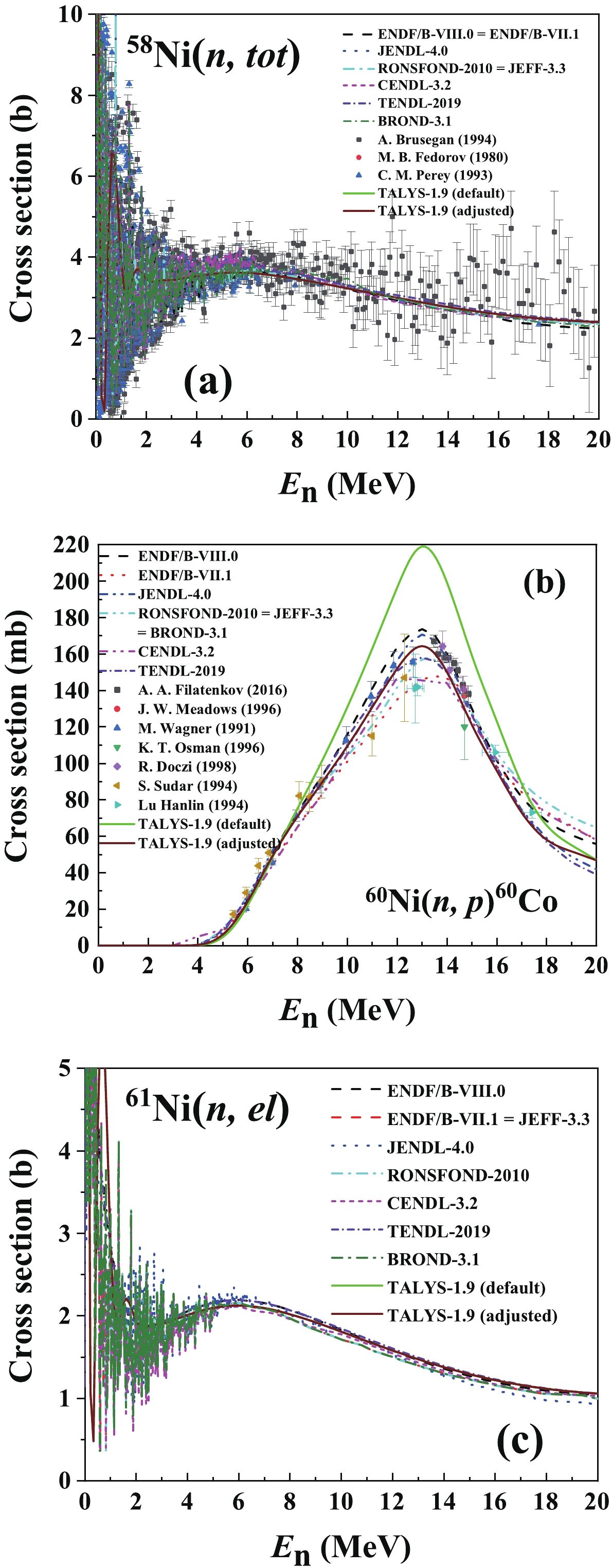
The cross sections of the58Ni(n,α)55Fe,60Ni(n,α)57Fe and61Ni(n,α)58Fe reactions were calculated using TALYS-1.9 [33]. To better agree with the present results, several input parameters of the TALYS-1.9 [33] including those of the optic model, the level density and stripping parameters were adjusted from the default values asTable 8lists. As shown inTables 5-7andFig. 6(a) – (c), the calculated cross sections and forward/backward ratios agree well with both the present measurement results and the results measured by our group in the 4.50
$ \leqslant E{_{\rm n}} \leqslant $ 5.50 MeV region [5]. Using the adjusted parameters, the calculated cross sections of other major reaction channels, including the (n,tot), (n,el), (n,inl), (n,p) reactions and the angular distributions of elastic scattering, also agree well with the results of most evaluations [34] and existing measurements [35] (three calculations are shown inFig. 7as examples), by which the reliability of the adjusted parameters was verified.58Ni(n,α)55Fe 60Ni(n,α)57Fe Keyword Parameters Keyword Parameters Tljadjusta a 2.00 0 rvadjustb a 1.08 Tljadjusta a 2.00 1 rvadjustb p 1.57 Tljadjustb a 1.75 2 aadjustd 28 60 1.22 rvadjustb a 0.95 aadjustd 27 60 1.06 rwadjustc a 1.62 Tadjuste 28 59 0.80 rvadjustb p 1.05 cstripf a 0.90 aadjustd 26 55 0.85 61Ni(n,α)58Fe Tadjuste 26 55 0.92 Keyword Parameters cstripf a 0.80 rvadjustb a 1.01 maxlevelsbing a 8 rvadjustb p 1.12 aadjustd 26 58 1.04 Tadjuste 26 58 0.93 aTljadjust: Multiplier to adjust the optical model potentials (OMP) transmission coefficient perl-value [33], whose parameters are “particle symbol, value andl-value”.
brvadjust: Multiplier to adjust the OMP parameterrvof Eq. (3) of Ref. [36]. whose parameters are “particle symbol and value”.
crwadjust: Multiplier to adjust the OMP parameterrwof Eq. (3) of Ref. [36], whose parameters are “particle symbol and value”.
daadjust: Multiplier to adjust the level density parameteraof Eq. (15) of Ref. [37], whose parameters are “atomic number, atomic mass number, and value”.
eTadjust: Normalization factor for the nuclear temperatureTof Eq. (53) of Ref. [37], whose parameters are “atomic number, atomic mass number, and value”.
fcstrip: Adjustable parameter for the stripping or pick-up process to scale the complex-particle pre-equilibrium cross section per outgoing particle [38], whose parameters are “particle symbol and value”.
gmaxlevelsbin: The number of included discrete levels for the nuclides resulting from binary emission that is considered in Hauser-Feshbach decay and the gamma-ray cascade [33], whose parameters are “particle symbol and value”.Table 8.Adjusted input parameters for TALYS-1.9 [33].
ForEn< 10.5 MeV, if the angular distributions of emittedαparticles of the58,60,61Ni(n,α)55,57,58Fe reactions are isotropic in the center-of-mass system, the forward/backward ratio in the laboratory system should be less than 1.07. However, as shown inTables 5–7, the forward/backward ratios of the58,60,61Ni(n,α)55,57,58Fe reactions are generally larger than 1.07, which reveals the non-statistical mechanisms of the58,60,61Ni(n,α)55,57,58Fe reactions in the 8.50–10.50 MeV region. Using TALYS-1.9 [33] with the adjusted parameters, the ratio of the direct, pre-equilibrium and compound components of the (n,α) cross sections were calculated as shown inFig. 8.
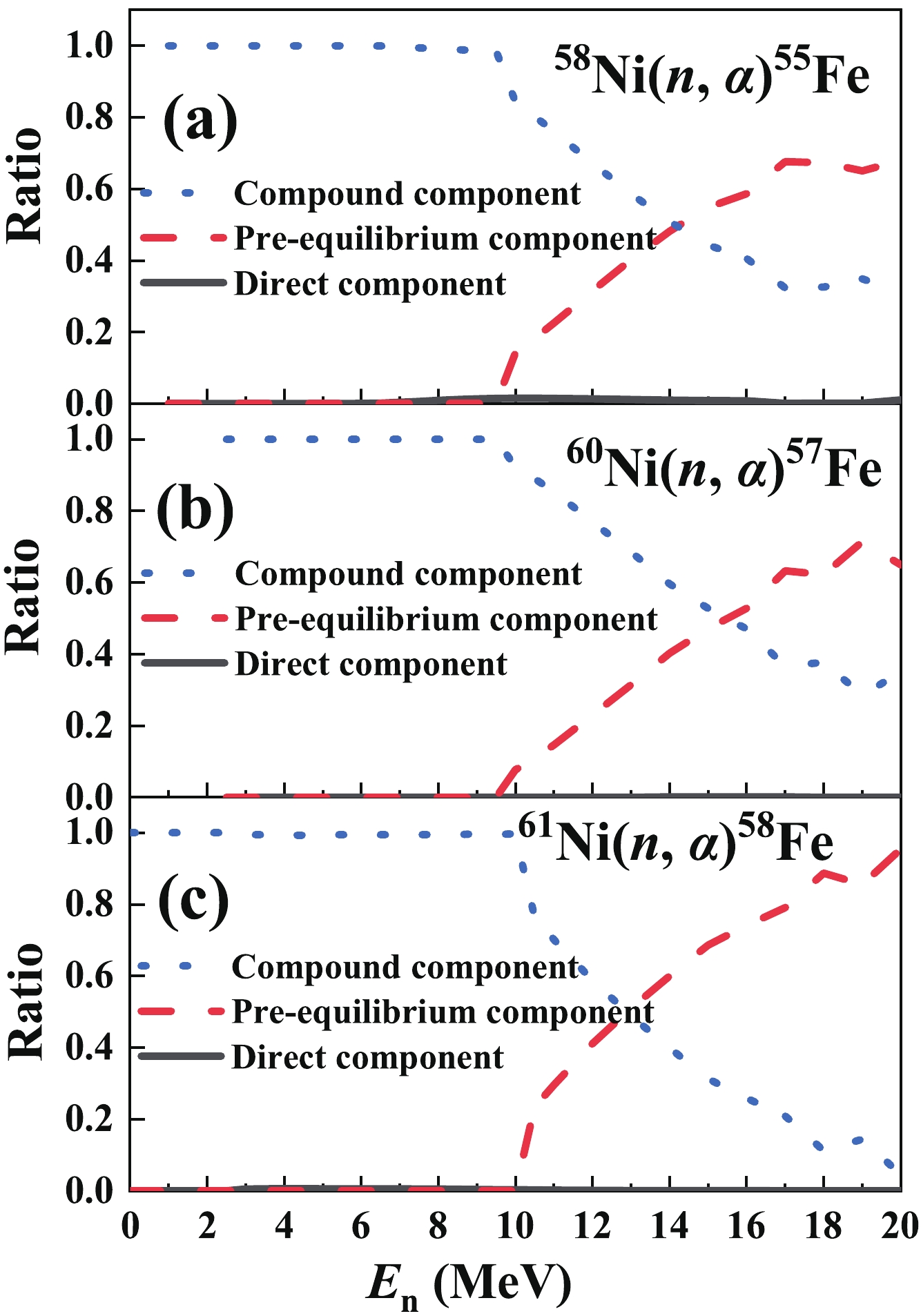
Figure 8.(color online) Ratios of the direct, pre-equilibrium and compound components of the (a)58Ni(n,α)55Fe, (b)60Ni(n,α)57Fe, and (c)61Ni(n,α)58Fe cross sections calculated using the TALYS-1.9 [33] code with the adjusted parameters.
As shown inFig. 8, for the58,60,61Ni(n,α)55,57,58Fe reactions, the compound mechanism predominates below ~ 9 MeV, and then the pre-equilibrium mechanism gradually comes into effect. The direct mechanism has little effect on the final cross sections for all three reactions below 20 MeV.
-
In the present work, the cross sections of the58Ni(n,α)55Fe,60Ni(n,α)57Fe and61Ni(n,α)58Fe reactions have been measured at 8.50, 9.5 and 10.50 MeV neutron energies using the HI-13 tandem accelerator, a GIC charged-particle detector, enriched nickel isotopic foil samples,238U3O8samples, and EJ-309 liquid scintillator detector. In the 8.50
$ \leqslant E{_{\rm n}} \leqslant $ 10.50 MeV region, the present cross sections of the58,60,61Ni(n,α)55,57,58Fe reactions change slowly with the increase ofEn, and they are generally ~20% lower than most existing measurement data and evaluations. By adjusting several default values of theoretical model parameters, the present experimental data could be reasonably reproduced by calculations with TALYS-1.9. Analyses show that for the three reactions the compound mechanism predominates below ~ 9 MeV, and then as the neutron energy increases the pre-equilibrium mechanism gradually comes into effect. The uncertainty of the present cross sections of the58Ni(n,α)55Fe reaction is smaller than most of the data of existing measurements. The present cross sections of the60Ni(n,α)57Fe and61Ni(n,α)58Fe reaction are the first measurement results above 8.0 MeV region. Considering the difference and scarcity of existing measurements and the discrepancy among evaluations, the present results are useful in the clarification of the deviations and can provide valuable information for future evaluations. -
The authors are indebted to the operating crew of Beijing HI-13 Tandem Accelerator of China Institute of Atomic Energy. Prof. Zhenpeng Chen from Tsinghua University and Prof. Vlad Avrigeanu from Bucharest University are acknowledged for their helpful suggestions.
Cross-section measurements for the58,60,61Ni(n,α)55,57,58Fe reactions at 8.50, 9.50 and 10.50 MeV neutron energies
- Received Date:2021-09-27
- Available Online:2022-02-15
Abstract:Cross sections of the58,60,61Ni(n,α)55,57,58Fe reactions were measured at 8.50, 9.50 and 10.50 MeV neutron energies based on the HI-13 tandem accelerator of China Institute of Atomic Energy (CIAE) with enriched58Ni,60Ni, and61Ni foil samples with backings. A twin gridded ionization chamber (GIC) was used as the charged particle detector, and an EJ-309 liquid scintillator was used to obtain the neutron energy spectra. The relative and absolute neutron fluxes were determined via three highly enriched238U3O8samples inside the GIC. The uncertainty of the present data of the58Ni(n,α)55Fe reaction is smaller than most existing measurements. The present data of60Ni(n,α)57Fe and61Ni(n,α)58Fe reactions are the first measurement results above 8 MeV. The present experimental data could be reasonably reproduced by calculations with TALYS-1.9 by adjusting several default values of theoretical model parameters.


 DownLoad: