


 Abstract
 HTML
HTML Reference
 Related
 PDF
PDF


-
Neutron-deficient actinide nuclei are new growing points in modern nuclear physics [1-3]. Located in the vicinity of the proton drip line, these nuclei are characterized by their large proton/neutron ratios and short half-lives. Synthesizing these nuclei is a challenging task in experimental nuclear physics. Owing to recent advances in beam facilities, detection systems, and analysis methods, a number of new neutron-deficient actinide nuclei have been synthesized since 2014, including
$ {}^{205} {\rm{Ac}}$ [4],$ {}^{211} {\rm{Pa}}$ [5],$ {}^{214,216,221} {\rm{U}}$ [3,6],$ {}^{219,220,222-224} {\rm{Np}}$ [1,2,7-9],$ {}^{236} {\rm{Bk}}$ [10],$ {}^{240} {\rm{Es}}$ [10], and$ {}^{244} {\rm{Md}}$ [11].αdecay is one of the most important decay modes in these nuclei [12-21]. It is widely adopted as a powerful tool to identify new neutron-deficient actinide nuclei in experiments. The measuredα-decay energies and half-lives also provide a valuable window to probe the evolution of shell structure and cluster formation in neutron-deficient actinide nuclei. In Refs. [1,2,7-9], theα-decay data of the new neutron-deficient Neptunium isotopes$ {}^{219,220,222-224} {\rm{Np}}$ were analyzed systematically to probe the robustness of the magic number$ N = 126 $ along the Neptunium isotopic chain. Very recently, a new neutron-deficient Uranium isotope$ {}^{214} {\rm{U}}$ was produced via the$ {}^{182}\text{W}({}^{36}\text{Ar},4n){}^{214}\text{U} $ reaction [3]. Theα-decay systematics suggest that theα-cluster formation is enhanced abnormally by a factor of two in comparison with even-even nuclei with$ 84\leqslant Z\leqslant 90 $ and$ N<126 $ . The authors of Ref. [3] conjectured that such an enhancement is closely related to the strong monopole interaction between the$ \pi1f_{7/2} $ and$ \nu1f_{5/2} $ orbits. In spite of these achievements, several crucial neutron-deficient actinide nuclei remain unknown in experiments. For example, the neutron-deficient Neptunium isotope$ {}^{221} {\rm{Np}}$ is crucial for addressing the problem of the robustness of the$ N = 126 $ magic number in Neptunium completely. However, this isotope has not been produced yet. Similarly, the neutron-deficient Uranium isotope$ {}^{220} {\rm{U}}$ has not been produced in experiments as well, which is crucial for examining the robustness of the$ N = 126 $ magic number in Uranium. Reliable theoretical predictions on theirα-decay properties may be important for their future synthesis and identification.On the theoretical side, many models have been proposed in the literature to predictα-decay energies andα-decay half-lives. Forα-decay energies, the popular models include the finite-range droplet model (FRDM) [22], the finite-range liquid-drop model (FRLDM) [22], the Thomas-Fermi (TF) model [23], the Duflo-Zuker (DZ) model [24], the empirical formula based on the liquid-drop model [25], and the linear trajectory under the valence correlation scheme [26]. Forα-decay half-lives, the popular models include the new Geiger-Nuttall law (NGNL) [27], the density-dependent cluster model (DDCM) [28-33], the multiple channel cluster model (MCCM) [34,35], the generalized liquid drop model (GLDM) [36], the universal decay law (UDL) [37], the quartetting wave function approach [38,39], and the quartet model [40]. These traditional methods have been adopted in various experimental works to provide theoretical values for comparison. In Ref. [41], the authors calculated theα-decay properties of some neutron-deficient actinide nuclei, including two new isotopes
$ {}^{219} {\rm{Np}}$ and$ {}^{220} {\rm{Np}}$ , using the improved Buck-Merchant-Perez cluster model. The theoretical results showed good agreement with the experimental data within a factor$ \approx $ 2. In spite of these successes, considering their physical importance, it is valuable to continue developing new models for reliable theoretical predictions on theα-decay properties.Machine learning has made tremendous progress in the past ten years and has changed our social life in a significant way. It is widely used in image recognition, product recommendation, autonomous vehicles, and email spam. Besides celebrated successes in computer science, machine learning algorithms have also been used to study realistic problems in modern physics. For example, machine learning was successfully used for estimating entropy production [42], distinguishing different topological phases [43], and detecting multimode Wigner negativity [44]. Meanwhile, machine learning has also been applied to the field of nuclear physics [45-60]. As one of the machine learning algorithms, the Gaussian process has provided new ideas for the studies of many important physical problems in recent years [61-66]. The Gaussian process is a popular machine learning algorithm because it can provide error bars for the predictive values. This advantage could help visualize the model uncertainties and quantify the theoretical uncertainties [67]. Forα-decay studies, only a few calculations are available based on a machine learning algorithm called the artificial neural network [68], and the power of machine learning algorithms has not been fully realized inα-decay studies.
In this work, we propose a new model forαdecay within the framework of the Gaussian process, which is an important machine learning algorithm. We use this new model to predict theα-decay energies and half-lives of some unknown neutron-deficient actinide nuclei. Our theoretical results could be useful for future experimental synthesis and identification of these isotopes. The remainder of this paper is organized as follows. In Sec. II, a brief introduction to the Gaussian process is provided. In Sec. III, the theoretical results are detailed for neutron-deficient actinide nuclei with 89
$\leqslant $ Z$\leqslant $ 94. The summary is provided in Sec. IV. -
α-decay energies andα-decay half-lives are two of the most important observables inαdecay. They depend on the neutron numberN, proton numberZ, orbital angular momentumLof theαemitter, as well as many other physical quantities in a very complicated way. It is an important problem to calculate theα-decay energies and half-lives accurately in theoretical models. In this work, we propose the use of a machine learning algorithm called the Gaussian process to capture the complex correlations between theα-decay observables and intrinsic physical properties ofαemitters. This can be implemented in three steps. In Step I, we construct our Gaussian process model under the guidance of theoretical considerations of theα-decay physics and general experience of the machine learning field. In Step II, the Gaussian process model is trained with respect to the experimentalα-decay data, which are referred to as the training set in machine learning terminologies. In Step III, the trained Gaussian process model is used to calculate theα-decay properties of unknownαemitters. These results could be helpful for their synthesis and identification in future experiments.
For later convenience, we introduce a few notations used in statistics and machine learning. LetAbe a set of independent random variables.
$ {\boldsymbol{A}} \sim {\cal{N}}({\boldsymbol{\mu}}, \Sigma) $ means that these random variables obey the multivariate Gaussian distribution with the mean vector given byµand the covariance matrix given by Σ.$ {P}({\boldsymbol{B}}|{\boldsymbol{A}}) $ denotes the conditional probability distribution ofBifAhappens.$ \left\lbrace {\boldsymbol{X}}, {\boldsymbol{Y}} \right\rbrace $ denotes the training set withnknown data points, where$ {\boldsymbol{X}} = \left[ x_1, x_2, \cdots, x_n \right]^T $ and$ {\boldsymbol{Y}} = \left[ y_1, y_2, \cdots, y_n \right]^T $ are the inputs and outputs, respectively.$ \left\lbrace {\boldsymbol{X}}_*, {\boldsymbol{Y}}_* \right\rbrace $ , with$ {\boldsymbol{X}}_* = \left[ x_{1_*}, x_{2_*}, \cdots, x_{n_*} \right]^T $ and$ {\boldsymbol{Y}}_* = \left[ y_{1_*}, y_{2_*}, \cdots, y_{n_*} \right]^T $ , denotes$ n_* $ unknown data points. The main goal of machine learning is to predict the values of the unknown outputs$ {\boldsymbol{Y}}_* $ based on the knownY.The Gaussian process is a popular nonparametric model in machine learning. It is a stochastic process based on the Gaussian distribution and is often used to study the complicated correlations between different quantities in a high-dimensional function space. It can be defined as a collection of random variables with the novel property that any finite number of them satisfies a joint Gaussian distribution [69]. Let us consider an-dimensional function
$ {\boldsymbol{Y}}({\boldsymbol{X}}) $ with$ {\boldsymbol{X}} = \left[ x_1, x_2, \cdots, x_n \right]^T $ . If$ {\boldsymbol{Y}} = \left[ y(x_1), y(x_2), \cdots, y(x_n) \right]^T = $ $ \left[ y_1, y_2, \cdots, y_n \right]^T $ obeys a joint Gaussian distribution, the Gaussian process is given by$ {\boldsymbol{Y}}\sim{\cal{GP}}({\boldsymbol{M}}({\boldsymbol{X}}),{\boldsymbol{K}}({\boldsymbol{X}},{\boldsymbol{X}})). $

(1) Here,
$ {\cal{GP}} $ is an abstract symbol for the Gaussian process and the random variables are the function values$ y_{i} = y(x_{i}) $ at the point$ x_{i} $ .XandYare the Gaussian process inputs and outputs, respectively.$ {\boldsymbol{M}}({\boldsymbol{X}})\; = \; [m(x_1), m(x_2), \cdots, m(x_n)]^T $ denotes the values of the mean function of the Gaussian process, and$ {\boldsymbol{K}}({\boldsymbol{X}}, {\boldsymbol{X}}) = [k(x_i, x_j)]_{n\times n} $ is the$ n\times n $ kernel function matrix of the Gaussian process. The kernel function$ k(x_i,x_j) $ captures the correlations between the Gaussian process outputs at the input points$ x_i $ and$ x_j $ . The details of the kernel function$ k(x_i,x_j) $ are introduced later. Because the marginal distribution of the multivariate Gaussian distribution is still Gaussian, Eq. (1) can be represented more clearly as$ \left[ {\begin{array}{*{20}{c}} {{y_1}}\\ \vdots \\ {{y_n}} \end{array}} \right]\sim {\cal{N}}\left( {\left[ {\begin{array}{*{20}{c}} {m({x_1})}\\ \vdots \\ {m({x_n})} \end{array}} \right],\left[ {\begin{array}{*{20}{c}} {k({x_1},{x_1})}& \cdots &{k({x_1},{x_n})}\\ \vdots & \ddots & \vdots \\ {k({x_n},{x_1})}& \cdots &{k({x_n},{x_n})} \end{array}} \right]} \right),$

(2) where
$ {\cal{N}} $ represents the Gaussian distribution. For consistency, the kernel function matrix$ {\boldsymbol{K}}({\boldsymbol{X}},{\boldsymbol{X}}) $ should be symmetric and positive semidefinite.For theα-decay studies, the Gaussian process inputsXcan be the proton numbersZ, neutron numbersN, and orbital angular momentaLof differentαemitters, while the Gaussian process outputsYcan be the correspondingα-decay observables, i.e., theα-decay energies and half-lives. The proton numberZand neutron numberNare chosen as the features of the inputs because they are among the most important intrinsic physical properties of nuclei. In this work, the Gaussian process input is
$ x_{i} = ( Z_{i}, N_{i} ) $ for anαemitter when its corresponding output is$ y_{i} = Q_{\alpha}^\text{Expt.} $ to describe theα-decay energy for anα-decay emitter. When describing the correspondingα-decay half-lives, the Gaussian process input and output are given by$ x_{i} = ( Z_{i}, N_{i}, L_{i} ) $ and$ y_{i} = \text{log}_{10}T_{\alpha}^\text{Expt.} $ , respectively. The featureLin the input is added as traditional models show that it is crucial for calculating the unfavoredα-decay half-lives [41]. Let$ \{{\boldsymbol{X}},{\boldsymbol{Y}}\} $ be the training set of the Gaussian process, which contains the experimental data of the observedαemitters. Then, under the framework of the Gaussian process, the knownα-decay observablesYat the pointsXand unknownα-decay observables$ {\boldsymbol{Y}}_* $ at the points$ {\boldsymbol{X}}_* $ satisfy the joint Gaussian distribution$ P({\boldsymbol{Y}}, {\boldsymbol{Y}}_*) = {\cal{N}}({\boldsymbol{M}}_{**}, {\boldsymbol{K}}_{**}) $ with$ P({\boldsymbol{Y}}_*) = {\cal{N}}({\boldsymbol{M}}_*, {\boldsymbol{K}}_*) $ , whose mean vector is$ {\boldsymbol{M}}_{**} = \left[ {\boldsymbol{M}}, {\boldsymbol{M}}_* \right]^T $ and the covariance matrix$ {\boldsymbol{K}}_{**} $ is given by$ {{\boldsymbol{K}}_{{\rm{**}}}}{\rm{ = }}\left[ {\begin{array}{*{20}{c}} {{\boldsymbol{K}}({\boldsymbol{X}},{\boldsymbol{X}})\quad {\boldsymbol{K}}({\boldsymbol{X}},{{\boldsymbol{X}}_{\rm{*}}})}\\ {{\boldsymbol{K}}({{\boldsymbol{X}}_{\rm{*}}},{\boldsymbol{X}})\;{\boldsymbol{K}}({{\boldsymbol{X}}_{\rm{*}}},{{\boldsymbol{X}}_{\rm{*}}})} \end{array}} \right].$

(3) If there are a number ofnpoints in the training set and a set of
$ n_* $ new points for the predictions,$ {\boldsymbol{K}}({\boldsymbol{X}},{\boldsymbol{X}}_*) $ and$ {\boldsymbol{K}}({\boldsymbol{X}}_*,{\boldsymbol{X}}_*) $ are the$ n\times n_* $ and$ n_*\times n_* $ matrices, respectively, and$ {\boldsymbol{K}} ( {\boldsymbol{X}}, {\boldsymbol{X}}_{*} ) = {\boldsymbol{K}} ( {\boldsymbol{X}}_*, {\boldsymbol{X}} )^T $ .To obtain a reasonable predictive distribution on
$ {\boldsymbol{Y_{*}}} $ , we are interested in the conditional distribution of$ {\boldsymbol{Y_{*}}} $ whenYis given, based on the definition of the conditional probability function$ {P}({\boldsymbol{Y}}_* | {\boldsymbol{Y}}) = \frac{{P}({\boldsymbol{Y}}, {\boldsymbol{Y}}_{*})}{{P}({\boldsymbol{Y}})}, $

(4) where
$ {P}({\boldsymbol{Y}}) = {\cal{N}}({\boldsymbol{M}}, {\boldsymbol{K}}) $ with$ {\boldsymbol{K}} = {\boldsymbol{K}} ( {\boldsymbol{X}}, {\boldsymbol{X}}) $ . After conditioning the joint Gaussian distribution, the predictive distribution on$ {\boldsymbol{Y_{*}}} $ is expressed as$ \begin{aligned}[b]& {\boldsymbol{Y_{*}}} | {\boldsymbol{Y}} \sim {\cal{N}} \big[ {\boldsymbol{M}}({\boldsymbol{X_{*}}}) + {\boldsymbol{K}}( {\boldsymbol{X}}, {\boldsymbol{X_{*}}})^T {\boldsymbol{K}}( {\boldsymbol{X}}, {\boldsymbol{X}} )^{-1} ({\boldsymbol{Y}} - {\boldsymbol{M}}({\boldsymbol{X}})), \\ &\quad{\boldsymbol{K}}( {\boldsymbol{X_{*}}}, {\boldsymbol{X_{*}}})-{\boldsymbol{K}}( {\boldsymbol{X}}, {\boldsymbol{X_{*}}})^T {\boldsymbol{K}}( {\boldsymbol{X}}, {\boldsymbol{X}})^{-1} {\boldsymbol{K}}( {\boldsymbol{X}}, {\boldsymbol{X_{*}}})\big], \end{aligned} $

(5) which is the central equation for the predictions with the Gaussian process. In this work,
$ {\boldsymbol{M}}({\boldsymbol{X}}) $ , which is the mean function for the training set, is set to zero as usual due to a lack of prior knowledge. In addition, the mean function for the prediction points, which is denoted by$ {\boldsymbol{M}}({\boldsymbol{X_{*}}}) $ , is also chosen to be zero.The kernel function
$ k(x_i,x_j) $ is crucial for the predictability of the Gaussian process. In this work, we consider three common choices:● Matérn 3/2:
$ k({x}_i,{x}_j) = \eta^2\left( 1+\frac{\sqrt{3}}{l}r_{ij}\right)\mathrm{exp}\left(-\frac{\sqrt{3}}{l}r_{ij}\right), $

● Matérn 5/2:
$ k({x}_i, {x}_j) = \eta^2\left( 1+\frac{\sqrt{5}}{l}r_{ij}+\frac{5}{3l^{2}}r_{ij}^{2}\right)\mathrm{exp}\left(-\frac{\sqrt{5}}{l}r_{ij}\right) , $

● Matérn 7/2:
$ k({x}_i, {x}_j) = \eta^2\left( 1+\frac{\sqrt{7}}{l}r_{ij}+\frac{14}{5l^{2}}r_{ij}^{2}+\frac{7\sqrt{7}}{15l^{3}}r_{ij}^{3}\right)\mathrm{exp}\left(-\frac{\sqrt{7}}{l}r_{ij}\right) , $

where
$ r_{ij}\equiv \left\| {x}_i-{x}_j \right\| $ is the distance between the input points$ x_i $ and$ x_j $ , and$ \theta\equiv\left\lbrace \eta^{2}, l\right\rbrace $ represents the hyperparameters of the Gaussian process. The free hyperparametersθcan be determined by maximizing the natural logarithm of the likelihood function$ \mathrm{ln}\,{P}\left( {\boldsymbol{Y}}|{\boldsymbol{X}}, \theta \right) = -\frac{1}{2}{\boldsymbol{Y}}^T{\boldsymbol{K}}({\boldsymbol{X}},{\boldsymbol{X}})^{-1}{\boldsymbol{Y}}-\frac{1}{2}\mathrm{ln}\left| {\boldsymbol{K}}({\boldsymbol{X}},{\boldsymbol{X}})\right|-\frac{n}{2}\mathrm{ln}(2\pi), $

(6) -
With the model discussed above, we perform predictions on theα-decay energies and half-lives for some unknown neutron-deficient actinide nuclei with 89
$\leqslant $ Z$\leqslant $ 94, respectively. To predict theα-decay energies and half-lives, the Gaussian process inputs are chosen as$ x_{i} = \left( Z_{i}, N_{i} \right) $ and$ x_{i} = \left( Z_{i}, N_{i}, L_{i} \right) $ for each nucleus, respectively. Here, the angular momentum and parity follow the conservation laws [41]$ \left|I_{f}-I_{i}\right| \leqslant L \leqslant I_{f}+I_{i},\quad \dfrac{\pi_{f}}{\pi_{i}} = (-1)^{L}, $

(7) where
$ I_{i} $ ,$ I_{f} $ ,$ \pi_{i} $ , and$ \pi_{f} $ are the spins and parities of the initial and final states, respectively. Meanwhile, the Gaussian process outputs are the correspondingα-decay energies and the common logarithm of theα-decay half-lives, respectively. Here, the Gaussian process training sets consist of, respectively, a set of 101 actinide nuclei with available experimentalα-decay energies and a set of 102 actinide nuclei with available experimentalα-decay half-lives (see the supplementary material). The corresponding experimentalα-decay energies and half-lives are obtained from the AME2016 [71,72] and the NUBASE2016 [73], respectively. Regarding the nuclei with newly reportedα-decay properties, such as$ ^{211,220} {\rm{Pa}}$ [5,74],$ ^{216,218,223} {\rm{U}}$ [3,75], and$ ^{219,220,222} {\rm{Np}}$ [1,2,7], we select the newest experimental results as the outputs for the Gaussian process training sets, while theα-decay properties of the newest neutron-deficient nucleus$ ^{214} {\rm{U}}$ are not included. For the new experimentalα-decay half-lives with asymmetric uncertainties, their uncertainties are symmetrized as in NUBASE2016 [73]. To provide the systemic error for the Gaussian process, three different kernel functions are used in this work.Table 1shows the hyperparameters of the Gaussian process determined in this work. The first column lists the three kernel functions used for calculating both theα-decay energies and half-lives. The second and third columns list the hyperparameters for calculating theα-decay energies with different kernel functions, and the last two columns list those for calculating theα-decay half-lives. Besides,Fig. 1depicts the natural logarithm of the likelihood function values for training theα-decay energies and half-lives over the hyperparameter space using the Gaussian process with three different kernel functions. The red stars indicate the maximum natural logarithm of the likelihood function values.kernel function $\eta^{2}_Q/\text{MeV}$ 

$ l_Q $ 

$ {\eta}^{2}_T $ 

$ l_T $ 

Matérn 3/2 34.480 17.010 22.566 5.389 Matérn 5/2 22.680 6.386 14.457 2.946 Matérn 7/2 18.594 4.199 13.020 2.381 Table 1.The hyperparameters
$ \theta_Q \equiv\left\lbrace \eta^{2}_Q, l_Q\right\rbrace $ and$ \theta_T \equiv\left\lbrace \eta^{2}_T, l_T\right\rbrace $ of the Gaussian process determined by two training sets for calculating theα-decay energies and half-lives, respectively.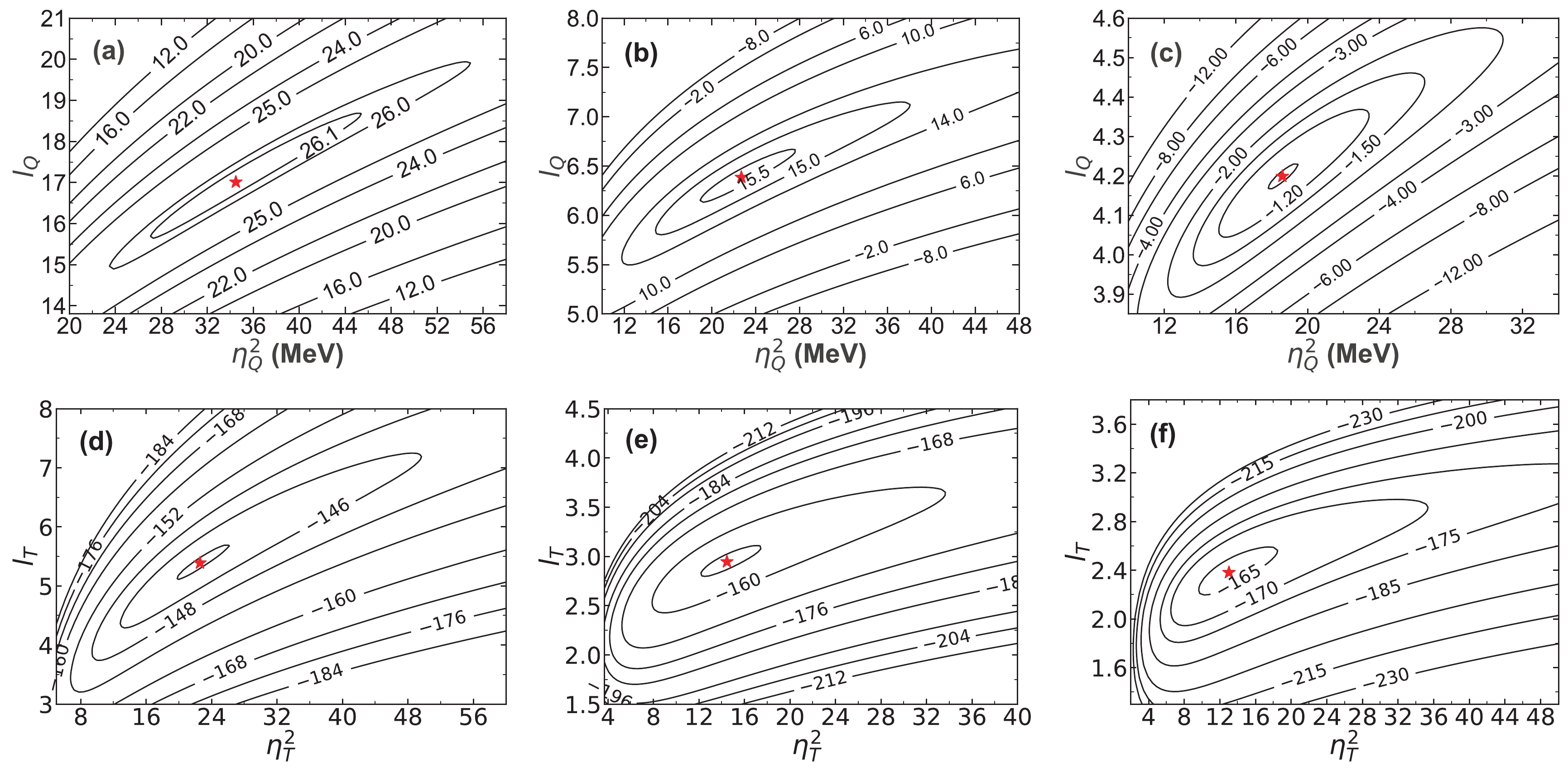
Figure 1.(color online) The natural logarithm of the likelihood function values for training theα-decay energies and half-lives over the hyperparameter space using the Gaussian process with three different kernel functions.Fig. 1(a)-(c)depict the natural logarithm of the likelihood function values over the hyperparameter space when training theα-decay energies with the Matérn 3/2, Matérn 5/2, and Matérn 7/2 kernel functions, respectively.Fig. 1(d)-(f)show, respectively, the natural logarithm of the likelihood function values for training theα-decay half-lives using the Matérn 3/2, Matérn 5/2, and Matérn 7/2 kernel functions.
We first calculate theα-decay properties of the new actinide nucleus
$ ^{214} {\rm{U}}$ to test the reliability of the Gaussian process. The predictiveα-decay energies and half-lives with three kernel functions versus the neutron number for the Uranium isotopes are shown inFig. 2. In addition, the 1σconfidence intervals provided by the Gaussian process with three kernel functions are also plotted inFig. 2. The black dashed line representsN= 128. Theα-decay energies of the new nuclei$ ^{214} {\rm{U}}$ are marked by the black arrow inFig. 2(a). It can be clearly seen that, for$ ^{214} {\rm{U}}$ , all theα-decay energies calculated with the three kernel functions can reproduce the newest experimental results well. Numerically, the calculatedα-decay energies of$ ^{214} {\rm{U}}$ are 8.679, 8.652, and 8.633 MeV using the Matérn 3/2, Matérn 5/2, and Matérn 7/2 kernel functions, respectively. In Ref. [3], the experimentalα-decay energy of$ ^{214} {\rm{U}}$ is 8.696 MeV. The deviations between the experimental result and the theoretical results calculated with the Matérn 3/2, Matérn 5/2, and Matérn 7/2 kernel functions are 0.017, 0.044, and 0.063 MeV, respectively. These small deviations show that the calculated results are in good agreement with the experimental result. Besides, we applied the leave-one-out cross-validation to the Gaussian process with three Matérn kernel functions. The root mean squared errors of the Gaussian process with the Matérn 3/2, Matérn 5/2, and Matérn 7/2 kernel functions are 0.082, 0.082, and 0.100 MeV, respectively, when calculating theα-decay energies. The results indicate that the Gaussian process is a pretty good model for calculating theα-decay energies. Similarly, theα-decay half-lives of the new nuclei$ ^{214} {\rm{U}}$ are denoted by the black arrow inFig. 2(b). It can be seen that theα-decay half-lives calculated with the Matérn 3/2, Matérn 5/2, and Matérn 7/2 kernel functions are all very close to the experimental result. The predictive results are 1.23×10⁻³, 1.28×10⁻³, and 1.37×10⁻³s, respectively. The experimentalα-decay half-life is 9.94×10$ ^{-4} $ s in Ref. [3]. Therefore, the calculatedα-decay half-lives are in good accordance with the experimental result with a factor of 1.240, 1.289, and 1.376, respectively. We also performed the leave-one-out cross-validation on the Gaussian process with three Matérn kernel functions when calculating theα-decay half-lives. The root mean squared errors of the Gaussian process with the Matérn 3/2, Matérn 5/2, and Matérn 7/2 kernel functions are 0.734, 0.807, and 0.861, respectively. These deviations are acceptable due to the difficulties in calculating theα-decay half-lives. Based on the discussion above, it can be argued that the Gaussian process is a reliable method for predicting theα-decay properties. This indicates that the complex correlations between theα-decay observables and intrinsic physical properties of theαemitters can be described using the Gaussian process.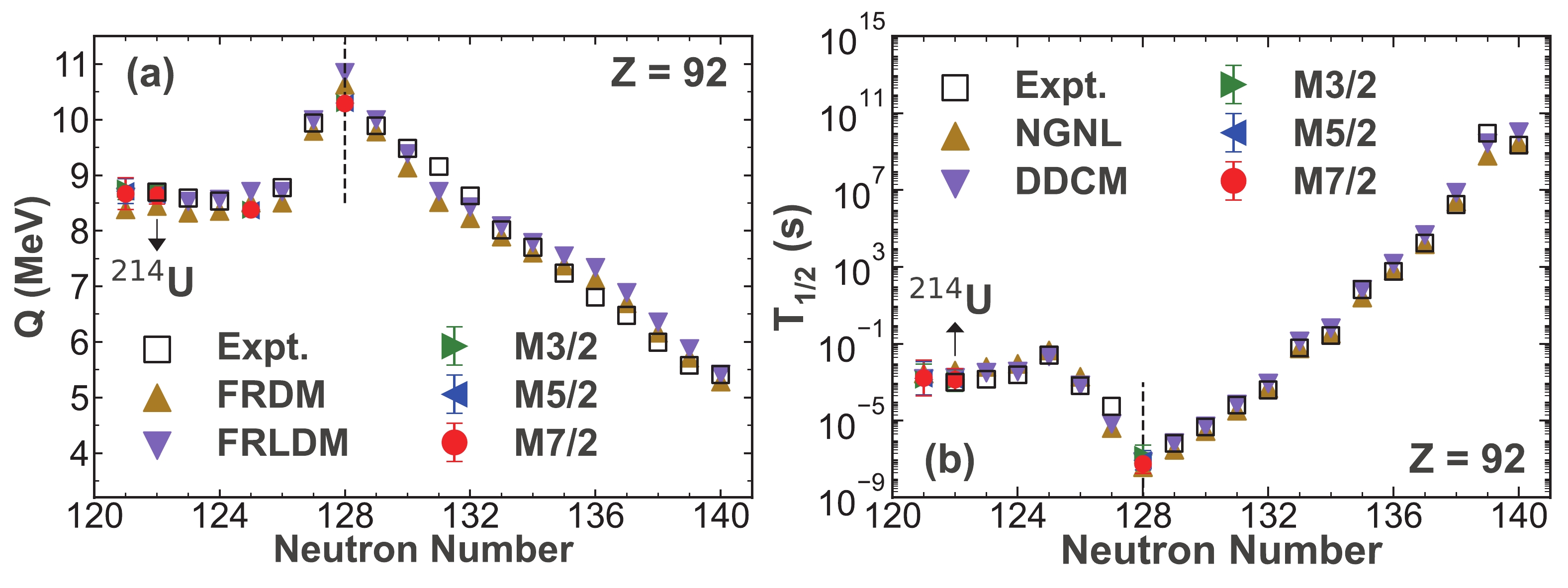
Figure 2.(color online) Predictions on (a)α-decay energies and (b) half-lives versus the neutron number for the Uranium isotopes. For (a), the black hollow squares indicate the experimentalα-decay energies. The yellow upper triangles and purple lower triangles represent theα-decay energies derived from the finite-range droplet model (FRDM) [22], and those extracted from the finite-range liquid-drop model (FRLDM) [22], respectively. The green right triangles, blue left triangles, and red dots, respectively, denote the predictiveα-decay energies obtained using the Matérn 3/2, Matérn 5/2, and Matérn 7/2 kernel functions. For (b), the black hollow squares represent the experimentalα-decay half-lives. The yellow upper triangles represent theα-decay half-lives calculated using the new Geiger-Nuttall law (NGNL) [27] and the purple lower triangles represent theα-decay half-lives calculated using the density-dependent cluster model (DDCM) [28]. The green right triangles, blue left triangles, and red dots present the predictiveα-decay half-lives obtained using the Matérn 3/2, Matérn 5/2, and Matérn 7/2 kernel functions, respectively. The predictiveα-decay properties are in good accordance with those calculated with the traditional models.
We further predict theα-decay properties of some unknown neutron-deficient actinide nuclei with 89
$\leqslant $ Z$\leqslant $ 93 using the Gaussian process, and the results are shown inTable 2. To verfiy the dependability of our predictive results, we compare them with the theoretical results calculated using the traditional models. InTable 2, the first column shows theα-decay parent nuclei. The second, third, and fourth columns denote the predictiveα-decay energies obtained with the Matérn 3/2, Matérn 5/2, and Matérn 7/2 kernel functions, respectively. The fifth and sixth columns list theα-decay energies extracted from the FRDM and FRLDM, respectively. The seventh, eighth, and ninth columns list theα-decay half-lives predicted using the Matérn 3/2, Matérn 5/2, and Matérn 7/2 kernel functions, respectively. The last two columns represent, respectively, theα-decay half-lives calculated using the new NGNL and DDCM. To compare the predictiveα-decay results with the theoretical calculations from the traditional models more visually, all results with the 1σconfidence intervals are shown inFig. 2-Fig. 6.Nucl. $ Q_{M_{3/2}}/{\rm{MeV}} $ 

$ Q_{M_{5/2}}/{\rm{MeV}} $ 

$ Q_{M_{7/2}}/{\rm{MeV}} $ 

$ Q_{22a}/{\rm{MeV}} $ 

$ Q_{22b}/{\rm{MeV}}$ 

$T_{1/2}^{M_{3/2}}/{\rm{s} }$ 

$ T_{1/2}^{M_{5/2}}/{\rm{s}} $ 

$ T_{1/2}^{M_{7/2}}/{\rm{s}} $ 

$T_{1/2}^{\rm NGNL}/{\rm{s} }$ 

$T_{1/2}^{\rm DDCM}/{\rm{s} }$ 

$ ^{204} {\rm{Ac}}$ 

8.158 8.120 8.103 8.435 8.625 2.23 $ \times 10^{-1} $ 

2.65 $ \times 10^{-1} $ 

2.49 $ \times 10^{-1} $ 

1.18 $ \times 10^{-2} $ 

1.31 $ \times 10^{-2} $ 

$ ^{206} {\rm{Th}}$ 

8.374 8.302 8.199 8.515 8.715 1.39 $ \times 10^{-2} $ 

1.92 $ \times 10^{-2} $ 

2.48 $ \times 10^{-2} $ 

8.80 $ \times 10^{-3} $ 

4.14 $ \times 10^{-3} $ 

$ ^{207} {\rm{Th}}$ 

8.289 8.255 8.205 8.205 8.405 3.22 $ \times 10^{-3} $ 

3.49 $ \times 10^{-3} $ 

4.05 $ \times 10^{-3} $ 

1.17 $ \times 10^{-2} $ 

6.56 $ \times 10^{-3} $ 

$ ^{209} {\rm{Th}}$ 

8.130 8.138 8.146 7.825 8.035 2.17 $ \times 10^{-2} $ 

2.46 $ \times 10^{-2} $ 

3.04 $ \times 10^{-2} $ 

4.46 $ \times 10^{-2} $ 

2.44 $ \times 10^{-2} $ 

$ ^{210} {\rm{Pa}}$ 

8.533 8.524 8.498 8.265 8.495 2.27 $ \times 10^{-3} $ 

2.91 $ \times 10^{-3} $ 

3.58 $ \times 10^{-3} $ 

4.44 $ \times 10^{-3} $ 

4.66 $ \times 10^{-3} $ 

$ ^{222} {\rm{Pa}}$ 

8.883 8.895 8.901 8.145 8.325 $ ^{213} {\rm{U}}$ 

8.759 8.713 8.666 8.385 8.605 1.39 $ \times 10^{-3} $ 

1.59 $ \times 10^{-3} $ 

1.67 $ \times 10^{-3} $ 

2.82 $ \times 10^{-3} $ 

1.48 $ \times 10^{-3} $ 

$ ^{214} {\rm{U}}$ 

8.679 8.652 8.633 8.445 8.665 1.23 $ \times 10^{-3} $ 

1.28 $ \times 10^{-3} $ 

1.37 $ \times 10^{-3} $ 

4.09 $ \times 10^{-3} $ 

1.70 $ \times 10^{-3} $ 

$ ^{217} {\rm{U}}$ 

8.379 8.370 8.379 8.505 8.705 $ ^{220} {\rm{U}}$ 

10.300 10.300 10.291 10.625 10.845 1.64 $ \times 10^{-7} $ 

8.69 $ \times 10^{-8} $ 

5.65 $ \times 10^{-8} $ 

3.83 $ \times 10^{-8} $ 

7.12 $ \times 10^{-8} $ 

$ ^{216} {\rm{Np}}$ 

8.804 8.678 8.572 8.625 8.845 5.98 $ \times 10^{-4} $ 

6.74 $ \times 10^{-4} $ 

7.23 $ \times 10^{-4} $ 

7.47 $ \times 10^{-3} $ 

7.62 $ \times 10^{-3} $ 

$ ^{217} {\rm{Np}}$ 

8.728 8.646 8.593 8.725 8.955 1.24 $ \times 10^{-3} $ 

1.49 $ \times 10^{-3} $ 

1.63 $ \times 10^{-3} $ 

9.02 $ \times 10^{-3} $ 

4.60 $ \times 10^{-3} $ 

$ ^{218} {\rm{Np}}$ 

8.715 8.656 8.640 8.945 9.175 7.34 $ \times 10^{-3} $ 

1.12 $ \times 10^{-2} $ 

1.43 $ \times 10^{-2} $ 

1.46 $ \times 10^{-2} $ 

1.41 $ \times 10^{-2} $ 

$ ^{221} {\rm{Np}}$ 

10.539 10.583 10.594 10.645 10.865 6.04 $ \times 10^{-7} $ 

3.14 $ \times 10^{-7} $ 

1.84 $ \times 10^{-7} $ 

1.98 $ \times 10^{-8} $ 

4.76 $ \times 10^{-8} $ 

$ ^{224} {\rm{Np}}$ 

9.339 9.330 9.323 8.905 9.105 1.47 $ \times 10^{-4} $ 

1.83 $ \times 10^{-4} $ 

2.16 $ \times 10^{-4} $ 

1.42 $ \times 10^{-5} $ 

6.16 $ \times 10^{-5} $ 

$ ^{232} {\rm{Np}}$ 

5.886 5.852 5.846 6.005 6.165 Table 2.Predictions on theα-decay energies and half-lives of the Ac-Th-Pa-U-Np isotopes in the neutron-deficient mass region. The first column shows theα-decay parent nuclei. The predictiveα-decay energies obtained with the Matérn 3/2, Matérn 5/2, and Matérn 7/2 kernel functions are shown in the second, third, and fourth columns, respectively. The fifth and sixth columns present theα-decay energies extracted from the finite-range droplet model (FRDM), denoted as 22a, and the finite-range liquid-drop model (FRLDM), denoted as 22b, in Ref. [22], respectively. The calculatedα-decay energies of
$ ^{214} {\rm{U}}$ are 8.679, 8.652, and 8.633 MeV obtained using the Matérn 3/2, Matérn 5/2, and Matérn 7/2 kernel functions, respectively, which show good agreement with the experimentalα-decay energy with a value of 8.696 MeV. In addition, theα-decay half-lives predicted using the Matérn 3/2, Matérn 5/2, and Matérn 7/2 kernel functions are shown in the seventh, eighth, and ninth columns, respectively. The last two columns, respectively, denote theα-decay half-lives calculated with the new Geiger-Nuttall law (NGNL) [27] and density-dependent cluster model (DDCM) [28]. Theα-decay half-lives of$ ^{214} {\rm{U}}$ predicted with the Matérn 3/2, Matérn 5/2, and Matérn 7/2 kernel functions are 1.23$ \times 10^{-3} $ , 1.28$ \times 10^{-3} $ , and 1.37$ \times 10^{-3} $ s, respectively, which show good agreement with the experimentalα-decay half-life of 9.94$ \times 10^{-4} $ s.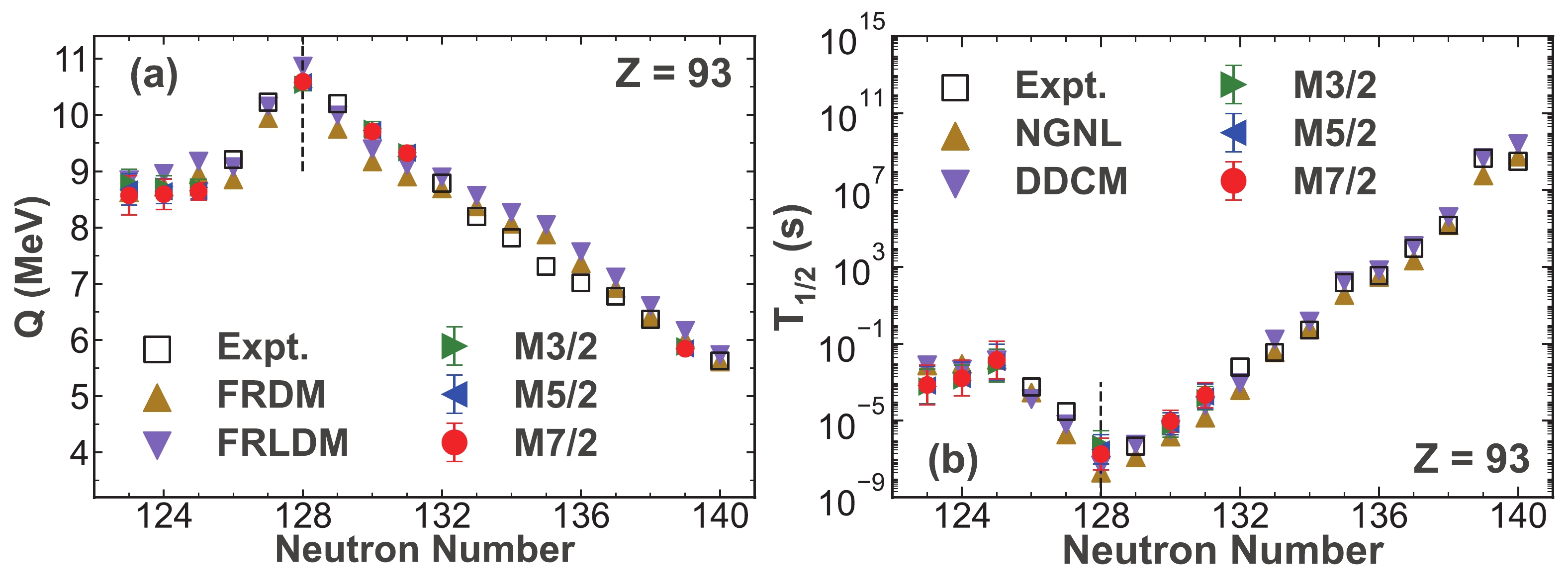
Figure 6.(color online) Similar toFig. 2but for the Neptunium isotopes.
For the Uranium isotopic chain, theα-decay energies and half-lives of the unknown nuclei
$ ^{213,220} {\rm{U}}$ are predicted using the Gaussian process with three kernel functions, as shown inFig. 2. Moreover, the unknownα-decay energies of the$ ^{217} {\rm{U}}$ are predicted. It can be seen fromFig. 2that both the predictiveα-decay energies and half-lives are in good agreement with the results calculated with the traditional models. First, we would like to discuss the predictive results for theα-decay energies, which are shown inFig. 2(a). Theα-decay energies predicted for$ ^{213} {\rm{U}}$ and$ ^{220} {\rm{U}}$ are similar to those calculated using the traditional models. For$ ^{220} {\rm{U}}$ withN= 128, the predictedα-decay energies are the largest compared with theα-decay energies of the other Uranium isotopes shown inFig. 2(a). Then, we focus on the knownα-decay energies of nuclei withN= 128, e.g.,$ ^{217} {\rm{Ac}}$ inFig. 3,$ ^{218} {\rm{Th}}$ inFig. 4, and$ ^{219} {\rm{Pa}}$ inFig. 5. All of these have the largestα-decay energies among their corresponding isotopes. This systematical behavior can be attributed to the shell effect [76,77]. The parent nuclei withN= 128 are more likely to decay into the daughter nuclei withN= 126, which is a magic number. Thus, the largestα-decay energies are observed atN= 128 for the parent nuclei. Then, as shown inFig. 2(b), for the predictiveα-decay half-lives of$ ^{213} {\rm{U}}$ and$ ^{220} {\rm{U}}$ , they coincide with the theoretical results calculated using the NGNL and DDCM. In addition, for$ ^{220} {\rm{U}}$ , the predictiveα-decay half-lives are the smallest inFig. 2(b), which means it tends to spontaneously emit anα-particle to be stable. Apparently, both the predictiveα-decay energies and half-lives show the shell effect. Thus, the Gaussian process can be used to characterize theα-decay properties even near the shell closure. Based on the above discussion, we can confirm that the predictiveα-decay properties for the Uranium isotopes are as trustworthy as the calculated results obtained using the traditional models.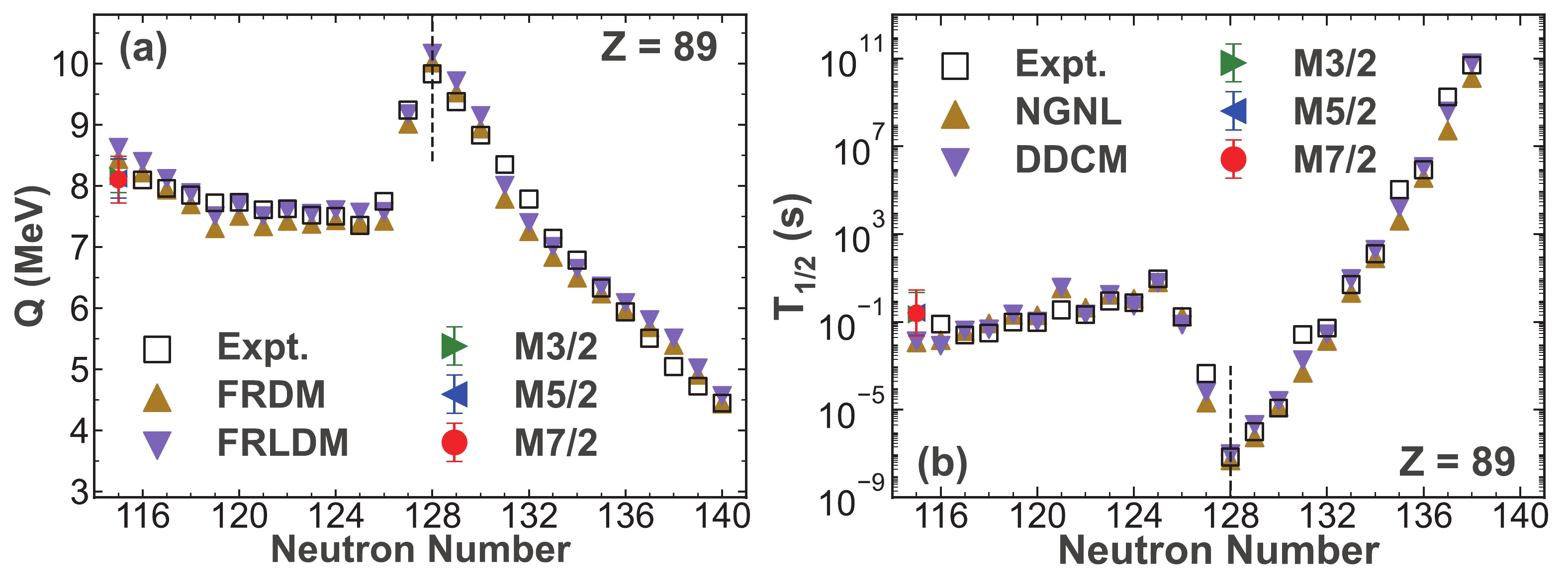
Figure 3.(color online) Similar toFig. 2but for the Actinium isotopes.
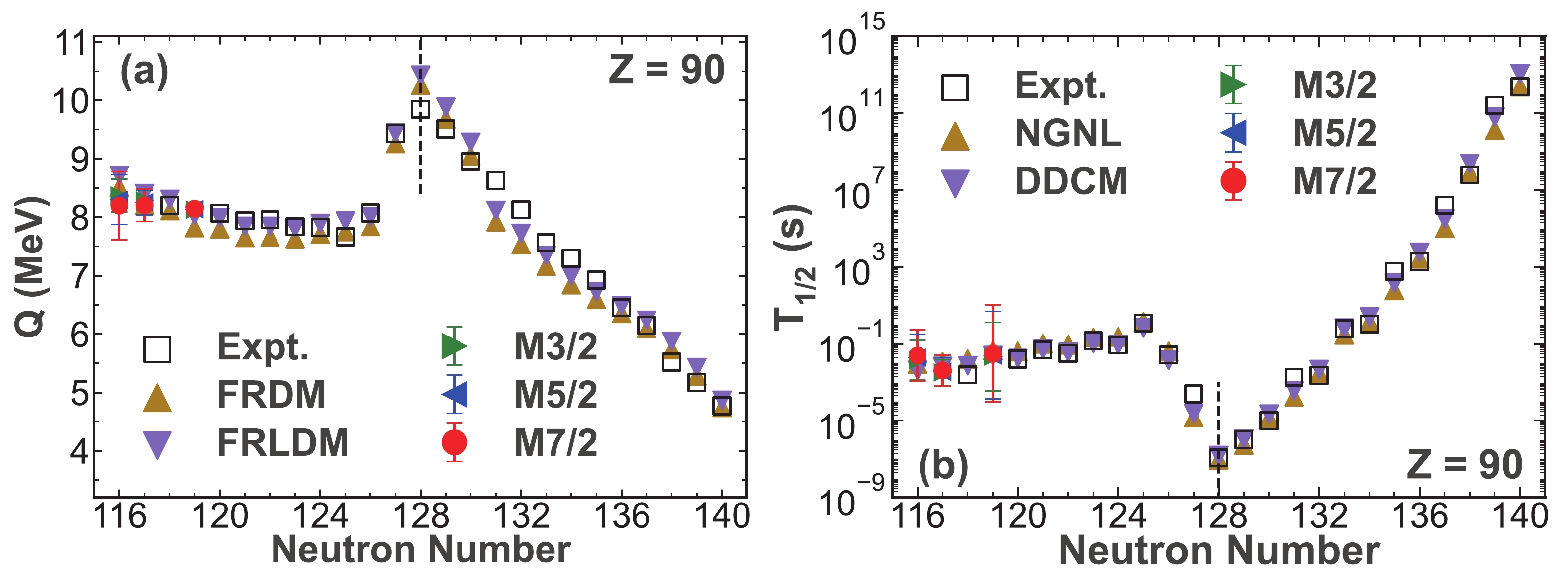
Figure 4.(color online) Similar toFig. 2but for the Thorium isotopes.
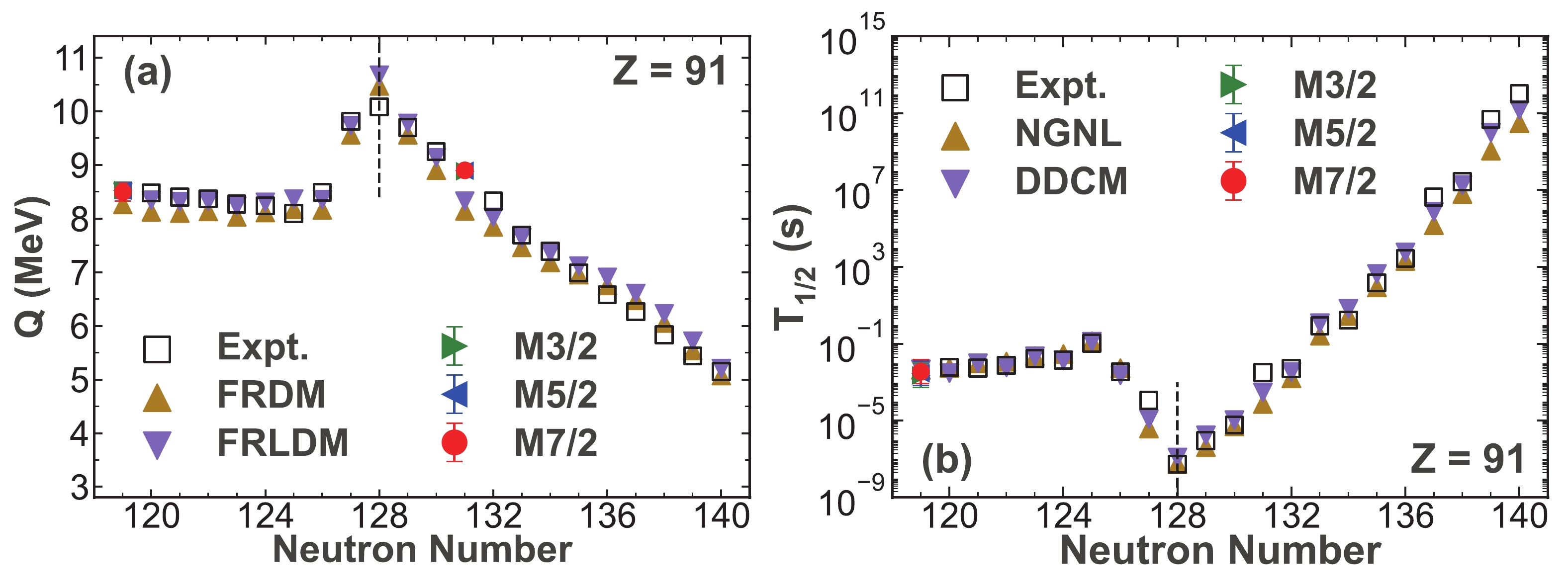
Figure 5.(color online) Similar toFig. 2but for the Protactinium isotopes.
Similarly, theα-decay properties of
$ ^{204} {\rm{Ac}}$ predicted using the Gaussian process for the Actinium isotopes are shown inFig. 3. Regarding the Thorium isotopic chain, theα-decay properties of$ ^{206,207,209} {\rm{Th}}$ are forecast, which are shown inFig. 4. Meanwhile, theα-decay energies and half-lives of$ ^{210} {\rm{Pa}}$ are predicted using the Gaussian process, as shown inFig. 5, for the Protactinium isotopes. In addition, we calculate the unknownα-decay energies of$ ^{222} {\rm{Pa}}$ using the three kernel functions. The Neptunium isotopic chain is of great interest at present. In this work, we predict theα-decay properties of the unknown nuclei$ ^{216-218,221,224} {\rm{Np}}$ , and the results are shown inFig. 6. Moreover, we predict the unknownα-decay energies of$ ^{232} {\rm{Np}}$ . It can be clearly observed that, inFig. 3(a)-Fig. 6(a), the predictiveα-decay energies are, respectively, very close to the calculated values extracted from the FRDM and FRLDM, and the predictiveα-decay half-lives show good agreement with the results calculated using the NGNL and DDCM, respectively, inFig. 3(b)-Fig. 6(b). Hence, the predictiveα-decay properties obtained with the Gaussian process are consistent with the results calculated with the traditional models. Remarkably, the predictiveαdecay properties of$ ^{221} {\rm{Np}}$ shown inFig. 6withN= 128 also exhibit the shell effect similar to those of$ ^{220} {\rm{U}}$ , as shown inFig. 2. Thus, the Gaussian process can be considered to be a trustworthy model for predicting theα-decay properties and can be used to characterize theα-decay properties even near the shell closure. Furthermore, because of the similar predictive results of theα-decay energies and half-lives obtained using the three kernel functions, it can be concluded that the systematic error of the Gaussian process is small.Finally, we use the Gaussian process to predict theα-decay properties of some unknown neutron-deficient Plutonium isotopes, as only
$ ^{228-234} {\rm{Pu}}$ have been synthesized until now and there remain gaps in the experimental observations for the Plutonium isotopic chain. We predict theα-decay energies of$ ^{217-227} {\rm{Pu}}$ , with the corresponding results listed inTable 3, and theα-decay half-lives of$ ^{227} {\rm{Pu}}$ , with the corresponding results presented inTable 4, using the Gaussian process. Only theα-decay half-life of$ ^{227} {\rm{Pu}}$ is predicted because the angular momentums of the other nuclei are uncertain. InTable. 3, the first column shows the parent nuclei forαdecay. The second, third, and fourth columns show the predictiveα-decay energies obtained with the Matérn 3/2, Matérn 5/2, and Matérn 7/2 kernel functions, respectively. The last two columns present the calculatedα-decay energies extracted from the FRDM and FRLDM, respectively. InTable 4, the first column lists the parent nucleus forαdecay. The second, third, and fourth columns show the predictiveα-decay half-lives obtained with the Matérn 3/2, Matérn 5/2, and Matérn 7/2 kernel functions, respectively. The last two columns, respectively, present theα-decay half-lives calculated using the NGNL and DDCM. The predictiveα-decay properties for the Plutonium isotopes versus the neutron number are plotted inFig. 7. It can be observed that theα-decay energy of$ ^{222} {\rm{Pu}}$ withN= 128 is the largest, which also shows the effect of the shell closure. This peak can be seen clearly inFig. 7(a)atN= 128. Furthermore, inFig. 7(a), most of the predictiveα-decay energies are consistent with the calculated results derived from the FRDM and FRLDM except for those predicted for$ ^{217-219} {\rm{Pu}}$ . Based on the predictive results for$ ^{217-219} {\rm{Pu}}$ inFig. 7(a), it can be seen that with increasing extrapolation distance, the systematic error of the Gaussian process is large. For$ ^{217-219} {\rm{Pu}}$ , the predictiveα-decay energies obtained with the Matérn 3/2 kernel function are in agreement with those obtained with the FRDM and FRLDM, while theα-decay energies obtained with the Matérn 5/2 and Matérn 7/2 kernel functions show differences from the results calculated with the traditional models, respectively. These differences must be confirmed in future experiments. InFig. 7(b), the predictiveα-decay half-lives of$ ^{227} {\rm{Pu}}$ show good agreement with the results calculated with the NGNL and DDCM. Previous studies have reported general difficulties with respect to extrapolation within the framework of the Gaussian process [61-63]. A similar problem may also exist in this work, and we expect that this problem can be further improved upon. We hope that our theoretical predictions will be helpful for the synthesis experiments of neutron-deficient actinide nuclei in the future.Nucl. $ Q_{M_{3/2}}/{\rm{MeV}} $ 

$Q_{M_{5/2} }/{\rm{MeV} }$ 

$ Q_{M_{7/2}}/{\rm{MeV}} $ 

$ Q_{22a} /{\rm{MeV}}$ 

$ Q_{22b}/{\rm{MeV}}$ 

$ ^{217} {\rm{Pu}}$ 

8.997 8.594 8.204 8.925 9.165 $ ^{218} {\rm{Pu}}$ 

8.988 8.697 8.442 8.975 9.205 $ ^{219} {\rm{Pu}}$ 

9.142 8.977 8.843 9.185 9.435 $ ^{220} {\rm{Pu}}$ 

9.663 9.665 9.634 9.165 9.395 $ ^{221} {\rm{Pu}}$ 

10.384 10.515 10.545 10.135 10.365 $ ^{222} {\rm{Pu}}$ 

10.658 10.816 10.844 10.865 11.105 $ ^{223} {\rm{Pu}}$ 

10.422 10.481 10.447 10.055 10.295 $ ^{224} {\rm{Pu}}$ 

9.980 9.942 9.853 9.565 9.805 $ ^{225} {\rm{Pu}}$ 

9.474 9.404 9.311 9.285 9.505 $ ^{226} {\rm{Pu}}$ 

8.901 8.815 8.730 9.035 9.255 $ ^{227} {\rm{Pu}}$ 

8.350 8.284 8.233 8.695 8.925 Table 3.Predictions on theα-decay energies for the unknown Pu isotopes. The first column shows the parent nuclei forα-decay. The second, third, and fourth columns show the predictiveα-decay energies obtained with the Matérn 3/2, Matérn 5/2, and Matérn 7/2 kernel functions, respectively. The last two columns present the calculatedα-decay energies extracted from the FRDM and FRLDM, which are denoted as 22a and 22b, respectively.
Nucl. $ T_{1/2}^{M_{3/2}} /{\rm{s}}$ 

$ T_{1/2}^{M_{5/2}}/{\rm{s}} $ 

$ T_{1/2}^{M_{7/2}}/{\rm{s}} $ 

$ T_{1/2}^{\rm NGNL} /{\rm{s}}$ 

$ T_{1/2}^{\rm DDCM}/{\rm{s}} $ 

$ ^{227} {\rm{Pu}}$ 

1.15 $ \times 10^{-1} $ 

2.49 $ \times 10^{-1} $ 

4.05 $ \times 10^{-1} $ 

4.37 $ \times 10^{-2} $ 

1.08 $ \times 10^{-1} $ 

Table 4.Predictions on theα-decay half-lives for the unknown Pu isotope. The first column shows the parent nucleus forα-decay. The second, third, and fourth columns present the predictiveα-decay half-lives obtained with the Matérn 3/2, Matérn 5/2, and Matérn 7/2 kernel functions, respectively. The last two columns show the calculatedα-decay half-lives obtained with the NGNL and DDCM, respectively.
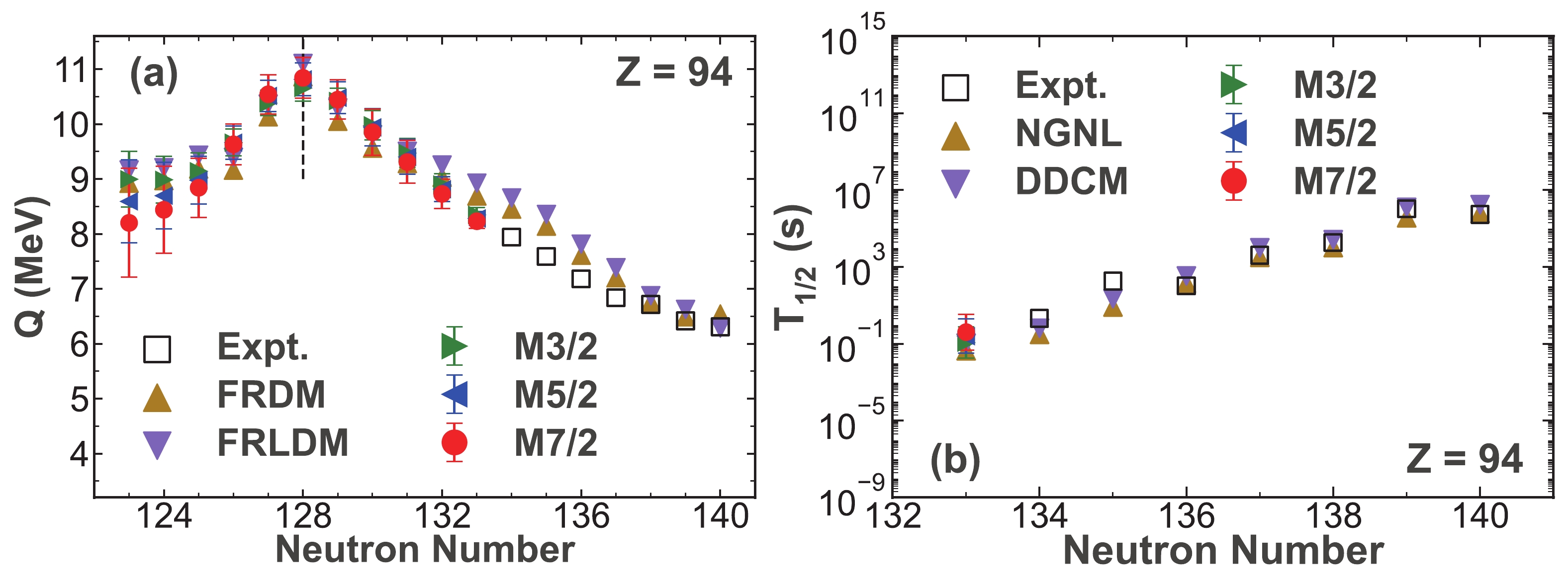
Figure 7.(color online) Similar toFig. 2but for the Plutonium isotopes.
-
In summary, a new model is used to predict theα-decay energies and half-lives of some unknown neutron-deficient nuclei with 89
$\leqslant $ Z$\leqslant $ 94 within the framework based on a machine learning algorithm called the Gaussian process. Three kernel functions, namely the Matérn 3/2, Matérn 5/2, and Matérn 7/2 kernel functions, are used to obtain the systematic error of the Gaussian process in this work. First, theα-decay properties of the new actinide nucleus$ ^{214} {\rm{U}}$ are calculated. The deviations between the experimental result and theα-decay energies calculated with the Matérn 3/2, Matérn 5/2, and Matérn 7/2 kernel functions are 0.017 MeV, 0.044 MeV, and 0.063 MeV, respectively. The predictiveα-decay half-lives show good agreement with the experimental result with a factor of 1.240, 1.289, and 1.376, respectively. It can be seen that the calculated results of both theα-decay energies and half-lives agree well with the latest experimental results. This shows the reliability of the Gaussian process for predicting theα-decay properties. Then, we further use the Gaussian process to calculate theα-decay properties of some unknown neutron-deficient nuclei with 89$\leqslant $ Z$\leqslant $ 93. The predictiveα-decay energies show good agreement with the results extracted from the FRDM and FRLDM. Moreover, theα-decay half-lives are in good accordance with the theoretical results calculated with the NGNL and DDCM. These comparative results show that the Gaussian process is a trustworthy model for predicting theα-decay properties. Noticeably, the predictiveα-decay properties of$ ^{220} {\rm{U}}$ and$ ^{221} {\rm{Np}}$ show the systematical behaviors atN= 128, which indicates that the Gaussian process can be applied to characterize theα-decay properties even near the shell closure. Finally, theα-decay energies of the unknown$ ^{217-227} {\rm{Pu}}$ and theα-decay half-lives of the unknown$ ^{227} {\rm{Pu}}$ are obtained, for the Plutonium isotopes, where few isotopes have been synthesized in experiments to date. Furthermore, the calculated results show that the systematic error of the Gaussian process is small. We believe that our work can serve as a useful reference for further studies on neutron-deficient actinide nuclei. Our work provides a new method for research onαdecay based on machine learning, and we hope that more machine learning approaches (e.g., learning machine [78]) can be generalized to studyαdecay in the future. -
The authors would like to thank Prof. Jin Lei from Tongji University and Prof. Chen Ji from Central China Normal University for their helpful discussions. We thank Prof. Hong Zhao from Xiamen University for discussions on machine learning during his visit to Tongji University. We would also like to thank the anonymous referees for their constructive comments and suggestions.
Theoretical predictions onα-decay properties of some unknown neutron-deficient actinide nuclei using machine learning
- Received Date:2021-08-23
- Available Online:2022-02-15
Abstract:Neutron-deficient actinide nuclei provide a valuable window to probe heavy nuclear systems with large proton-neutron ratios. In recent years, several new neutron-deficient Uranium and Neptunium isotopes have been observed usingα-decay spectroscopy [Z. Y. Zhanget al., Phys. Rev. Lett.122, 192503 (2019); L. Maet al., Phys. Rev. Lett.125, 032502 (2020); Z. Y. Zhanget al., Phys. Rev. Lett.126, 152502 (2021)]. In spite of these achievements, some neutron-deficient key nuclei in this mass region are still unknown in experiments. Machine learning algorithms have been applied successfully in different branches of modern physics. It is interesting to explore their applicability inα-decay studies. In this work, we propose a new model to predict theα-decay energies and half-lives within the framework based on a machine learning algorithm called the Gaussian process. We first calculate theα-decay properties of the new actinide nucleus


 DownLoad: