


 Abstract
 HTML
HTML Reference
 Related
 PDF
PDF


-
A fully microscopic proton-neutron symplectic model (PNSM) of nuclear collective motion withSp(12,R) dynamical algebra was introduced few years ago by considering the symplectic geometry and possible collective flows in the two-component many-particle nuclear system [1]. Its more general motion groupGL(6,R)
$ \subset $ Sp(12,R) introduces the wider class of allowed classical motions, including both the in-phase and out-of-phase proton-neutron collective excitations; by utilizing them, the PNSM naturally generalizes the one-componentSp(6,R) symplectic model [2,3]. The collective states in the PNSM were initially classified by the basis states of the six-dimensional harmonic oscillator by considering the following dynamical symmetry reduction chain:Sp(12,R)$ \supset $ U(6)$ \supset $ SU$ _{p} $ (3)$ \otimes $ SU$ _{n} $ (3)$ \supset $ SU(3)$ \supset $ SO(3). Using this chain, the PNSM was applied for the simultaneous description of the microscopic structure of the lowest ground,$ \beta $ , and$ \gamma $ bands in$ ^{166} {\rm{Er}}$ [4],$ ^{152} {\rm{Sm}}$ [5],$ ^{154} {\rm{Sm}}$ [6], and$ ^{238} {\rm{U}}$ [7]. The results for the microscopic structure of negative-parity states of the lowest$ K^{\pi} = 0^{-}_{1} $ and$ K^{\pi} = 1^{-}_{1} $ bands in$ ^{152} {\rm{Sm}}$ ,$ ^{154} {\rm{Sm}}$ and$ ^{238} {\rm{U}}$ were also reported [5,8,9], including the low-energy$ B(E1) $ interband transition strengths between the states of the ground band and$ K^{\pi} = 0^{-}_{1} $ band [5,9] for these three nuclei. A significant achievement of the presented approach is the simultaneous description of low-lying$ B(E2) $ and$ B(E1) $ transition strengths without introducing an effective charge.The PNSMSp(12,R) dynamical algebra has many subalgebra chains, which can be divided into two types: the shell-model and the collective-model chains. The first type of reduction chains focuses on the many-fermion nature of the nuclear systems and relates them to the microscopic shell-model theory of nuclear structure, whereas the second type of subalgebraic chains ofSp(12,R) reveals the dynamical content of the possible collective motions in atomic nuclei. The shell-model reduction chains also define different shell-model coupling schemes in which different collective Hamiltonians can be diagonalized. In the present paper, we consider the PNSM matrix elements with respect to the following reduction chainSp(12,R)
$ \supset $ SU(1,1)$ \otimes $ SO(6)$ \supset $ U(1)$ \otimes $ SU$ _{pn} $ (3)$ \otimes $ SO(2)$ \supset $ SO(3), which was recently shown to correspond to a microscopic version [10] of the Bohr-Mottelson [11] collective model. A characteristic property of this dynamical symmetry limit is that the collective dynamics separates into radial and orbital parts. According to this, the Hilbert space of the nucleus in the PNSM can be represented as a direct sum of many-particle shell-model subspaces labeled by theSO(6) seniority quantum number$ \upsilon $ , which carry an irreducible representation (irrep) of a direct product groupSU(1,1)$ \otimes $ SO(6).The general structureSU(1,1)
$ \otimes $ SO(d) appears in the central-force problems ind-dimensional Euclidean space [12]. Then, theSO(d)-invariant Hamiltonians can be diagonalized with theSU(1,1) Lie algebra used as a spectrum generating algebra. The specific cases of$ d = 3,5 $ were widely considered in the literature. For example, the algebraic solutions of the three-dimensional central-force problems were widely studied in terms of the algebra of the direct product groupSU(1,1)$ \otimes $ SO(3) (see, e.g., [13,14]). This algebraic structure accounts for the Davidson potential, originally introduced to describe the rotation-vibrational excitations of diatomic molecules in three-dimensional space [15]. In nuclear physics, the five-dimensional Davidson potential that has anSU(1,1)$ \otimes $ SO(5) algebraic structure was used by many authors [16-19] in relation with the rotations and vibrations of atomic nuclei. Recently, the Algebraic Collective Model (ACM), also based on theSU(1,1)$ \otimes $ SO(5) algebraic structure, was formulated [20,21] as an algebraic version of the Bohr-Mottelson [11] collective model which has the valuable property of diagonalizing [16] the$ \gamma $ -unstable Wilits-Jean-type Hamiltonians [22].TheSU(1,1)
$ \otimes $ SO(5) structure was also used in the boson quasi-spin formalism [23], related to the IBM [24], treating boson particles in$ l = 2 $ orbital level (i.e., consideringdbosons). Thus, this algebraic structure considers the pairing between thedbosons in IBM and diagonalizes anL= 0 pairing interaction which is anSO(5) invariant. Additionally, using the duality relationships [25] ofU(1)$ \subset $ SU(1,1) andSU(d)$ \supset $ SO(d) structures, two-level paring boson Hamiltonians expressed in terms of the boson quasi-spinSU(1,1) algebra have been considered in [26].The five-dimensional Davidson potential within the framework of the (one-component)Sp(6,R) symplectic model was used to compute the detailed microscopic collective shell-model wave functions of the ground band in
$ ^{166}{\rm Er} $ in [27]. The six-dimensional Davidson potential, based on theSU(1,1)$ \otimes $ SO(6) algebraic structure, was initially introduced in Ref. [28] in the context of the phenomenological Interacting Vector Boson Model [29], which is a trivial closed-shell irrotational-flow collective submodel of the PNSM of Bohr-Mottelson type.The purpose of the present work is to develop a computational technique for the reduction chainSp(12,R)
$ \supset $ SU(1,1)$ \otimes $ SO(6)$ \supset $ U(1)$ \otimes $ SU$ _{pn} $ (3)$ \otimes $ SO(2)$ \supset $ SO(3) of the PNSM, which will allow performing realistic shell-model calculations for determining the microscopic structure of heavy mass nuclei with various collective properties. This reduction chain provides an alternative basis for the shell-model diagonalization of an arbitrary collective Hamiltonian, which can be expressed as a polynomial in the many-particle position and momentum coordinates of the two-component proton-neutron nuclear systems, or is given in the algebraic form. The nuclear wave functions on this basis are presented as a direct product ofSU(1,1) radial wave functions with theSO(6) spherical harmonics. Then, if one knows the matrix elements of the basic many-particle Jacobi position$ x_{is}(\alpha) $ and momentum$ p_{is}(\alpha) $ operators, theSU(1,1)$ \otimes $ SO(6) algebraic structure allows us to obtain the matrix elements of any function of them (lying in the enveloping algebra of theSp(12,R) orWSp(12,R) dynamical groups; cf. Ref. [9]) in the closed analytic form. In particular, the matrix elements of the basic building blocks of the PNSM and theSp(12,R) symplectic generators are obtained along the considered reduction chain. Using the latter, one can compute other more complicated matrix elements of different physical operators. For example, the matrix elements of theSU(3) mixing interactions that couple various shell-model configurations within and between different oscillator shells are also given. This will extend the applicability of the PNSM in describing the collective properties in various nuclei. This is illustrated by considering a simple application of this theory to the microscopic description of the rotational states of the lowest positive-parity bands in$ ^{106} {\rm{Ru}}$ and$ ^{158} {\rm{Gd}}$ . -
A certain shell-model reduction chain of the PNSM is naturally explored if the following raising and lowering operators of harmonic oscillator quanta, i.e.,
$ \begin{aligned}[b] &b^{\dagger}_{i\alpha,s} =\sqrt{\frac{m_{\alpha}\omega}{2\hbar}}\Bigg(x_{is}(\alpha) -\frac{\rm i}{m_{\alpha}\omega}p_{is}(\alpha)\Bigg), \\ &b_{i\alpha,s} = \sqrt{\frac{m_{\alpha}\omega}{2\hbar}}\Bigg(x_{is}(\alpha) +\frac{\rm i}{m_{\alpha}\omega}p_{is}(\alpha)\Bigg) \end{aligned} $

(1) are introduced. Then, a basis for theSp(12,R) algebra is given by the all bilinear combinations of these harmonic oscillator operators [30]:
$ F_{ij}(\alpha,\beta) = \sum\limits_{s = 1}^{m}b^{\dagger}_{i\alpha,s}b^{\dagger}_{j\beta,s}, $

(2) $ G_{ij}(\alpha,\beta) = \sum\limits_{s = 1}^{m}b_{i\alpha,s}b_{j\beta,s}, $

(3) $ A_{ij}(\alpha,\beta) = \frac{1}{2}\sum\limits_{s = 1}^{m} (b^{\dagger}_{i\alpha,s}b_{j\beta,s}+b_{j\beta,s}b^{\dagger}_{i\alpha,s}), $

(4) which areO(m)-scalar operators with
$ m = A-1 $ and$ i,j = 1,2,3 $ ;$ \alpha,\beta = p,n $ . The operators (4) and (2)$ - $ (3) are related to the proton-neutron valence-shell and giant resonance degrees of freedom, respectively.We also introduce the operators [9]:
$ B^{\dagger}_{i}(\alpha) = \sum\limits_{s}b^{\dagger}_{i\alpha,s} $

(5) and
$ B_{i}(\alpha) = \big(B^{\dagger}_{i}(\alpha)\big)^{\dagger} $ , which together with the identity operator close the six-dimensional Heisenberg-Weyl algebrahw(6) =$ \{B^{\dagger}_{i}(\alpha), B_{i}(\alpha),I\} $ and provides the basic building blocks of the PNSM.We classify the shell-model nuclear states by the following reduction chain [10]:
$ \begin{aligned} \\[-8pt]&Sp(12,R) \supset SU(1,1) \otimes SO(6) \supset U(1) \otimes SU_{pn}(3) \otimes SO(2) \supset SO(3), \\ &\qquad\langle\sigma\rangle \qquad\quad \lambda_{\upsilon} \qquad\quad \upsilon \qquad\;\;\ p \qquad \ (\lambda,\mu) \qquad\;\; \nu \quad \ \ q \quad \ L \end{aligned} $ 
(6) where below the different subgroups, the quantum numbers that characterize their irreducible representations are given. We also note that the two groupsSU
$ _{pn} $ (3) andSO(2) are mutually complementary within the space of fully symmetricSO(6) irreps [31]; they form a direct-product subgroupSU$ _{pn} $ (3)$ \otimes $ SO(2)$ \subset $ SO(6). Hence, theSU$ _{pn} $ (3) irrep labels$ (\lambda,\mu) $ are in one-to-one correspondence with theSO(6) andSO(2) quantum numbers$ \upsilon $ and$ \nu $ , given by the following expression [10]:$ (\upsilon )_{6} = \bigoplus\limits_{\nu = \pm\upsilon ,\pm(\upsilon-2),...,0(\pm1)}\left(\lambda = \frac{\upsilon +\nu }{2},\mu = \frac{\upsilon -\nu }{2}\right)\otimes (\nu )_{2}. $

(7) TheSU(1,1) Lie algebra, related to the radial dynamics, is generated by the shell-model operators [10]:
$ S^{(\lambda_{\upsilon})}_+ = \frac{1}{2}\sum\limits_{\alpha} F^{0}(\alpha,\alpha), $

(8) $ S^{(\lambda_{\upsilon})}_- = \frac{1}{2}\sum\limits_{\alpha} G^{0}(\alpha,\alpha), $

(9) $ S^{(\lambda_{\upsilon})}_{0} = \frac{1}{2}\sum\limits_{\alpha} A^{0}(\alpha,\alpha), $

(10) with the following commutation relations
$ [S^{(\lambda_{\upsilon})}_+,S^{(\lambda_{\upsilon})}_-] = -2S^{(\lambda_{\upsilon})}_{0}, \quad [S^{(\lambda_{\upsilon})}_{0},S^{(\lambda_{\upsilon})}_{\pm}] = \pm S^{(\lambda_{\upsilon})}_{\pm}. $

(11) The operator
$ S^{(\lambda_{\upsilon})}_{0} $ itself generates theU(1) subgroup ofSU(1,1).TheSU(1,1) algebra has unitary representations with orthonormal basis states
$ \{|\lambda_{\upsilon}, p \rangle; p = 0, 1, 2, \ldots\} $ that are defined by the equations$ S^{(\lambda_{\upsilon})}_+ |\lambda_{\upsilon}, p \rangle = \sqrt{(2\lambda_{\upsilon}+p)(p+1)} |\lambda_{\upsilon}, p+1 \rangle, $

(12) $ S^{(\lambda_{\upsilon})}_- |\lambda_{\upsilon}, p \rangle = \sqrt{(\lambda_{\upsilon}-1+p)p} |\lambda_{\upsilon}, p-1 \rangle, $

(13) $ S^{(\lambda_{\upsilon})}_{0} |\lambda_{\upsilon}, p \rangle = \frac{1}{2}(\lambda_{\upsilon} + 2p) |\lambda_{\upsilon}, p \rangle, $

(14) for any value of
$ \lambda_{\upsilon} $ ($ \lambda_{\upsilon} > 1 $ ), which generally defines the modified oscillatorSU(1,1) irreps [12]. From Eqs. (4), (10) and (14), it is evident that the operator$ 2S_{0} \equiv H_{0} $ is the shell-model harmonic oscillator Hamiltonian whose eigenvalue is given by$ (\lambda_{\upsilon}+2p) $ in units of$ \hbar\omega $ ; theU(1)$ \subset $ SU(1,1) quantum numberpis related to theU(6)$ \supset $ SO(6) irrep labelsEand$ \upsilon $ (cf. Eqs. (37) and (32)) via$ p = (E-\upsilon)/2 $ .The groupSO(6) can be expressed through the number-preserving generators
$ A^{LM}(\alpha,\beta) $ (4) ofU(6) in the standard way by taking their antisymmetric combination [10]:$ \Lambda^{LM}(\alpha,\beta) = A^{LM}(\alpha,\beta) -(-1)^{L}A^{LM}(\beta,\alpha). $

(15) The generators of differentSO(6) subgroups can be obtained by considering different tensor operators with respect toSO(3) that can be constructed from (15). In this way, the generators of theSU
$ _{pn} $ (3) group are defined by the following set of operators:$ \widetilde{q}^{2M} = \sqrt{3} i[A^{2M}(p,n)-A^{2M}(n,p)], $

(16) $ Y^{1M} = \sqrt{2}[A^{1M}(p,p)+A^{1M}(n,n)], $

(17) which are rank-2 and rank-1 tensors, respectively. The single infinitesimal operator ofSO(2) is proportional to theSO(3) scalar operator
$ \Lambda^{0}(\alpha,\beta) $ :$ M = \Lambda^{0}(\alpha,\beta) = {\rm i}[A^{0}(\alpha,\beta)-A^{0}(\beta,\alpha)]. $

(18) The operators given in Eqs. (16)-(18) are 9 in number, which are obtained from
$ \Lambda^{LM}(\alpha,\beta) $ when$ \alpha\neq \beta $ forL=0,2 and$ \alpha=\beta $ forL=1. The operators$ Y^{1M} (17) $ are actually a linear combination of the independent rank-1 tensors$ A^{1M}(p,p) $ and$ A^{1M}(n,n) $ , which are 6 in number. The Lie algebra ofSO(6) is 15-dimensional, so the remaining 3 generators are obtained from$ \Lambda^{LM}(\alpha,\beta) $ for$ \alpha\neq \beta $ andL=1, which represent the components of rank-1 tensor$ A^{1M}(p, n) $ +$ A^{1M}(n,p) $ . Using the relations$ L^{p}_{1M} = $ $ \sqrt{2}A^{1M}(p,p) $ and$ L^{n}_{1M} = \sqrt{2}A^{1M}(n,n) $ , which define the angularmomentumoperators of the proton and neutron many-particle subsystems, respectively, theSO(6) group is thus generated by the following set of operatorsSO(6)$ = \{\widetilde{q}^{2M}, Y^{1M}, M, L^{p}_{1M}-L^{n}_{1M}, A^{1M}(p,n) + A^{1M}(n,p)\}$ . The operators$ L^{p}_{1M}-L^{n}_{1M} $ correspond to the infinitesimal generators of the isovector out-of-phase angular-momentum displacements of the proton subsystem with respect to the neutron one, i.e. the scissors mode excitation operators.The basis functions along the chain (6) can thus be written in the form [10]
$ \Psi_{\lambda_{\upsilon}p;\upsilon\nu qLM}(r,\Omega_{5}) = R^{\lambda_{\upsilon}}_{p}(r)Y^{\upsilon}_{\nu qLM}(\Omega_{5}), $

(19) where
$ Y^{\upsilon}_{\nu qLM}(\Omega_{5}) $ are theSO(6) Dragt's spherical harmonics [32,33]. However, the explicit form of the latter is not required for our purposes because the calculation of theSO(6)-reduced matrix elements involving theSO(6) spherical harmonics can be carried out in a purely algebraic way. Due to the complementarity relationship [25,31] of radial and orbital dynamics groups,SU(1,1) andSO(6), the states of seniority$ \upsilon $ of the PNSM span a unitary representation of the direct product groupSU(1,1)$ \otimes $ SO(6) and satisfy the equations$ S^{(\lambda_{\upsilon})}_+ R^{\lambda_{\upsilon}}_{p}(r)Y^{\upsilon}_{\nu qLM}(\Omega_{5}) = \sqrt{(\lambda_{\upsilon}+p)(p+1)} R^{\lambda_{\upsilon}}_{p+1}(r)Y^{\upsilon}_{\nu qLM}(\Omega_{5}), $

(20) $ S^{(\lambda_{\upsilon})}_- R^{\lambda_{\upsilon}}_{p}(r)Y^{\upsilon}_{\nu qLM}(\Omega_{5}) = \sqrt{(\lambda_{\upsilon}-1+p)p} R^{\lambda_{\upsilon}}_{p-1}(r)Y^{\upsilon}_{\nu qLM}(\Omega_{5}), $

(21) $ S^{(\lambda_{\upsilon})}_{0} R^{\lambda_{\upsilon}}_{p}(r)Y^{\upsilon}_{\nu qLM}(\Omega_{5}) = \frac{1}{2}(\lambda_{\upsilon} + 2p) R^{\lambda_{\upsilon}}_{p}(r)Y^{\upsilon}_{\nu qLM}(\Omega_{5}), $

(22) where for the harmonic oscillator series
$ \lambda_{\upsilon} = \upsilon + 6/2 $ . The full many-particle Hilbert space of the nucleus thus can be represented as a direct sum$ \mathbb{H} = \bigoplus\limits_{\upsilon} \mathbb{H}^{SU(1,1)}_{\upsilon} \otimes \mathbb{H}^{SO(6)}_{\upsilon} $

(23) of Hilbert spaces labeled by a seniority quantum number
$ \upsilon $ , each carrying an irrep of the direct product groupSU(1,1)$ \otimes $ SO(6). -
The Cartesian coordinates
$ \{x_{a} \equiv x_{i}(\alpha) = \sum\nolimits_{s} x_{is}(\alpha)\} $ acting in the Euclidean space$ \mathbb{R}^{6} $ can be expressed in the form$ x_{a} = r\mathcal{Q}_{a} \equiv r\mathcal{Q}_{i}(\alpha), $

(24) which is their expression in theSO(6) spherical polar coordinates. The operators
$ B^{\dagger}_{i}(\alpha) $ (5) and their conjugates$ B_{i}(\alpha) = \big(B^{\dagger}_{i}(\alpha)\big)^{\dagger} $ transform according to theU(6) fundamental irreducible representation$ [1]_{6} $ and its conjugate$ [1]^{\ast}_{6} = [1,1,1,1,1,0] \equiv [-1]_{6} $ , respectively. Under theSO(6) subgroup, bothU(6) representations reduce to the irrep$ (1)_{6} $ . Then, from$ x_{i}(\alpha) = \dfrac{1}{\sqrt{2}}[B^{\dagger}_{i}(\alpha) + $ $ B_{i}(\alpha)] $ and the factorization of the position coordinates into radial and polar parts, one obtains that$ \mathcal{Q}\equiv\mathcal{Q}_{i}(\alpha) $ is the basic$ \upsilon = 1 $ SO(6) tensor. Any operator that can be represented as a polynomial in$ x_{a} $ will then have matrix elements that factor into radial and orbital parts. -
The radial matrix elements of even powers ofrcan be obtained utilizing only the properties of theSU(1,1) algebra. Taking into account the fact that
$ r^{2} $ is simply an element of the latter$ r^{2} = S^{(\lambda_{\upsilon})}_+ + S^{(\lambda_{\upsilon})}_- +2S^{(\lambda_{\upsilon})}_{0}, $

(25) the matrix elements of
$ r^{2} $ are immediately obtained from Eqs. (20)$ - $ (22) to be$ \begin{aligned}[b] F_{\lambda_{\upsilon}p;\lambda_{\upsilon}p'}(r^{2}) =& \langle\lambda_{\upsilon}p|r^{2}|\lambda_{\upsilon}p' \rangle \\ =& \delta_{p,p'}(\lambda_{\upsilon}+2p)/2 +\delta_{p,p-1}\sqrt{(\lambda_{\upsilon}-1+p)p} \\ & + \delta_{p,p+1}\sqrt{(\lambda_{\upsilon}+p)(p+1)} . \end{aligned} $

(26) The higher powers of
$ r^{2} $ can then be obtained by summing over intermediate states, e.g.,$ \begin{aligned}[b] F_{\lambda_{\upsilon}p;\lambda_{\upsilon}p'}(r^{4}) =& \sum\limits_{p_{c}}F_{\lambda_{\upsilon}p;\lambda_{\upsilon}p_{c}}(r^{2}) F_{\lambda_{\upsilon}p_{c};\lambda_{\upsilon}p'}(r^{2}) \\ =& \delta_{p,p'}\Big((\lambda_{\upsilon}+2p)^{2} + (\lambda_{\upsilon}+p)(p+1) + (\lambda_{\upsilon}+p-1)p\Big) \\ &+\delta_{p,p+1}\Big((2\lambda_{\upsilon}+4p+2)\sqrt{(\lambda_{\upsilon}+p)(p+1)}\Big) \\ &+\delta_{p,p-1}\Big((2\lambda_{\upsilon}+4p-2)\sqrt{(\lambda_{\upsilon}+p-1)p}\Big) \\ &+\delta_{p,p+2}\sqrt{(\lambda_{\upsilon}+p+1)(\lambda_{\upsilon}+p)(p+2)(p+1)} \\ &+\delta_{p,p-2}\sqrt{(\lambda_{\upsilon}+p-2)(\lambda_{\upsilon}+p-1)p(p-1)}. \end{aligned} $

(27) The matrix elements of
$ 1/r^{2} $ ,$rd/{\rm d}r$ ,${\rm d}^{2}/{\rm d}r^{2}$ ,r,$ 1/r $ ,${\rm d}/{\rm d}r$ are given in Ref. [12]. These radial matrix elements are sufficient for deriving the matrix elements of any rotationally invariant polynomial in the many-particle collective position and momentum observables$\{x_{i}(\alpha) = $ $ \sum\nolimits_{s}x_{is}(\alpha), p_{i}(\alpha) = \sum\nolimits_{s}p_{is}(\alpha)\}$ of the PNSM. -
TheSO(6)-reduced matrix elements of an arbitrary tensor
$ T^{\upsilon_{2}}_{\nu_{2}q_{2}L_{2}M_{2}} $ are defined by the generalized Wigner-Eckart theorem$\begin{aligned}[b]& \langle \upsilon_{3}\nu_{3}q_{3}L_{3} ||T^{\upsilon_{2}}_{\nu_{2}q_{2}L_{2}M_{2}} || \upsilon_{1}\nu_{1}q_{1}L_{1} \rangle \\=& \Big\langle {}^{\upsilon_{1}}_{\nu_{1}q_{1}L_{1}} \quad {}^{\upsilon_{2}}_{\nu_{2}q_{2}L_{2}}\Big| {}^{\upsilon_{3}}_{\nu_{3}q_{3}L_{3}} \Big\rangle \langle \upsilon_{3}||| T^{\upsilon_{2}}_{\nu_{2}q_{2}L_{2}M_{2}} ||| \upsilon_{1} \rangle,\end{aligned}$

(28) where
$ \Big\langle {}^{\upsilon_{1}}_{\nu_{1}q_{1}L_{1}} \quad {}^{\upsilon_{2}}_{\nu_{2}q_{2}L_{2}}\Big| {}^{\upsilon_{3}}_{\nu_{3}q_{3}L_{3}} \Big\rangle $ are theSO(6) Clebsch-Gordan coefficients. The latter, according to the Racah's lemma [34], can be factorized in terms of the isoscalar factors that appear in each step of the reduction chain (6). Taking the correspondence$ (\lambda,\mu) \leftrightarrow (\upsilon,\nu) $ given by Eq. (7), theSO(6) Clebsch-Gordan coefficients can be written in a more convenient way as$ \begin{aligned}[b] &\Big\langle {}^{\quad \upsilon_{1}}_{\nu_{1}q_{1}L_{1}} \quad {}^{\quad \upsilon_{2}}_{\nu_{2}q_{2}L_{2}}\Big| {}^{\quad \upsilon_{3}}_{\nu_{3}q_{3}L_{3}} \Big\rangle = \Big\langle {}^{\quad \upsilon_{1}}_{(\lambda_{1},\mu_{1})} \quad {}^{\quad \upsilon_{2}}_{(\lambda_{2},\mu_{2})}\Big| {}^{\quad \upsilon_{3}}_{(\lambda_{3},\mu_{3})} \Big\rangle \\ &\times \langle (\lambda_{1},\mu_{1})q_{1}L_{1}; (\lambda_{2},\mu_{2})q_{2}L_{2}|| (\lambda_{3},\mu_{3})q_{3}L_{3} \rangle , \end{aligned} $

(29) where
$ \Big\langle {}^{\quad \upsilon_{1}}_{(\lambda_{1},\mu_{1})} \quad {}^{\quad \upsilon_{2}}_{(\lambda_{2},\mu_{2})}\Big| {}^{\quad \upsilon_{3}}_{(\lambda_{3},\mu_{3})} \Big\rangle $ and$ \langle (\lambda_{1},\mu_{1})q_{1}L_{1}; (\lambda_{2},\mu_{2})q_{2}L_{2}|| $ $ (\lambda_{3},\mu_{3})q_{3}L_{3} \rangle $ are theSO(6)$ \supset $ SU(3) andSU(3)$ \supset $ SO(3) isoscalar factors, respectively. Computer codes [35,36] exist for the calculation of the latter. From another side, by using the isomorphismSO(6)$ \approx $ SU(4) and the fact that theSO(6) tensors$ T^{(\upsilon)} $ correspond to theSU(4) tensors of the type$ T^{[\upsilon,\upsilon,0,0]} $ , the calculation of theSO(6)$ \supset $ SU(3) isoscalar factors is equivalent to the calculation of theSU(4)$ \supset $ SU(3) isoscalar factors, for which a computer code is also available [37] (Actually, the code given in [37] calculates the fullSU(4)$ \supset $ SU(3)$ \otimes $ U(1)$ \supset $ SU(2)$ \otimes $ U(1)$ \supset $ U(1) Clebsch-Gordan coefficients. The structure of the code, however, allows easily to adapt the latter for the calculation of theSU(4)$ \supset $ SU(3) isoscalar factors by using the factorization property of theSU(4) Clebsch-Gordan coefficients and modifying the line 143). Therefore, matrix elements of any operators of interest can be calculated from theirSO(6)-reduced matrix elements.TheSO(6)-reduced matrix elements of the basicSO(6) tensor
$ \mathcal{Q} $ are given by [12]$ \langle \upsilon' | \mathcal{Q} | \upsilon \rangle = \sqrt{\frac{\upsilon+1}{2\upsilon+6}}\delta_{\upsilon',\upsilon+1} +\sqrt{\frac{\upsilon+3}{2\upsilon+2}}\delta_{\upsilon',\upsilon-1} . $

(30) TheSO(6)-reduced matrix elements of other, more complicated tensors can be calculated utilizing these elementary matrix elements. For example, theSO(6)-reduced matrix elements
$ [\mathcal{Q}\times \mathcal{Q}]^{\upsilon = 2} $ , which are relevant to the mass quadrupole tensor operators$ Q_{ij}(\alpha,\beta) \rightarrow T^{\upsilon = 2}_{\nu q2m} = $ $ r^{2}Y^{\upsilon = 2}_{\nu q2m} \equiv r^{2}[\mathcal{Q}\times \mathcal{Q}]^{\upsilon = 2}_{\nu q2m} $ , are given by the standard recoupling technique:$ \langle \upsilon'|[\mathcal{Q}\times \mathcal{Q}]^{\upsilon = 2}_{\nu q2m}|\upsilon \rangle = \sum\limits_{c} U(\upsilon; 1; \upsilon'; 1||\upsilon_{c}; 2) \langle \upsilon'|\mathcal{Q}|\upsilon_{c} \rangle \langle \upsilon_{c}| \mathcal{Q}|\upsilon \rangle . $

(31) TheSO(6) recoupling coefficients
$ U(\upsilon; 1; \upsilon'; 1||\upsilon_{c}; 2) $ are equivalent to the two-rowedSU(4) Racah coefficients$ U\Big([\upsilon,\upsilon]_{4}; [1,1]_{4}; [\upsilon',\upsilon']_{4}; [1,1]_{4}||[\upsilon_{c},\upsilon_{c}]; [2,2]_{4}\Big) $ . The two-rowed or two-columnU(d) Racah recoupling coefficients, as well as otherU(d) invariant quantities, are equivalent to those of theU(2) group, as shown, for example, by Li and Paldus in Ref. [38]. For convenience, we present some of the relevant PNSMSO(6)$ \approx $ SU(4) recoupling coefficients inTable 1.$ U(\upsilon;1;\upsilon+2;1||\upsilon+1;2) = 1 $ 

$ U(\upsilon;1;\upsilon;1||\upsilon+1;2) = -(-1)^{\upsilon}\left[\dfrac{\upsilon(\upsilon+2)}{2(2+\upsilon(\upsilon+3))}\right]^{1/2} $ 

$ U(\upsilon;1;\upsilon;1||\upsilon-1;2) = -(-1)^{\upsilon}\left[\dfrac{\upsilon(\upsilon+2)}{2\upsilon(\upsilon+1)}\right]^{1/2} $ 

$ U(\upsilon;2;\upsilon+4;2||\upsilon+2;4) = 1 $ 

$ U(\upsilon;2;\upsilon;2||\upsilon;4) = \left[\dfrac{2(\upsilon-1)(\upsilon+3)}{3\upsilon(\upsilon+2)}\right]^{1/2} $ 

$ U(\upsilon;2;\upsilon+2;2||\upsilon;2) = \left[\dfrac{\upsilon(\upsilon+1)}{2(2+3\upsilon(\upsilon+3))}\right]^{1/2} $ 

$ U(\upsilon;2;\upsilon+2;2||\upsilon+2;2) = -\left[\dfrac{(\upsilon+3)(\upsilon+4)}{2(\upsilon^{2}+5\upsilon+6)}\right]^{1/2} $ 

$ U(\upsilon;2;\upsilon;2||\upsilon+2;4) = \left[\dfrac{(\upsilon+3)\upsilon(\upsilon-1)}{6(\upsilon^{3}+6\upsilon^{2}+11\upsilon+6)}\right]^{1/2} $ 

$ U(\upsilon;2;\upsilon;2||\upsilon+2;2) = \left[\dfrac{(\upsilon+3)\upsilon}{2(\upsilon^{2}+3\upsilon+2)}\right]^{1/2} $ 

$ U(\upsilon;2;\upsilon;2||\upsilon+2;0) = (-1)^{\upsilon}\left[\dfrac{\upsilon+3}{3(\upsilon+1)}\right]^{1/2} $ 

$ U(\upsilon;2;\upsilon;2||\upsilon-2;4) = \left[\dfrac{(\upsilon-1)(\upsilon^{2}+5\upsilon+6)}{6\upsilon(\upsilon^{2}-1)}\right]^{1/2} $ 

$ U(\upsilon;2;\upsilon;2||\upsilon-2;2) = -\left[\dfrac{(\upsilon-1)(\upsilon+2)}{2\upsilon(\upsilon+1)}\right]^{1/2} $ 

$ U(\upsilon;2;\upsilon;2||\upsilon-2;0) = \left[\dfrac{\upsilon-1}{3(\upsilon+1)}\right]^{1/2} $ 

$ U(\upsilon;2;\upsilon;2||\upsilon;4) = \left[\dfrac{2(\upsilon-1)(\upsilon+3)}{3\upsilon(\upsilon+2)}\right]^{1/2} $ 

$ U(\upsilon;2;\upsilon-2;2||\upsilon-2;2) = (-1)^{-\upsilon}\left[\dfrac{\upsilon-2}{2\upsilon}\right]^{1/2} $ 

Table 1.SomeSO(6) Racah recoupling coefficients.
In practice, for the calculation of the matrix elements of various algebraic interactions, it turns out to be more convenient to use theSO(6)-reduced matrix elements of the symplectic generators, which in turn are obtained from the basic creation
$ B^{\dagger}_{i}(\alpha) $ and annihilation$ B_{i}(\alpha) $ operators, respectively. TheSO(6)-reduced matrix elements of these operators can be obtained by considering the equivalent chain$ \begin{aligned} &U(6) \supset SO(6), \\ &\ \ E \qquad\quad \upsilon \end{aligned} $

(32) whose branching rules for the case of fully symmetric irreps are given by [39]
$ [E]_{6} = \bigoplus\limits_{\upsilon = E,E-2,...,0(1)}(\upsilon ,0,0)_{6} = \bigoplus\limits_{i = 0}^{\langle\frac{E}{2}\rangle}(E-2i)_{6}. $

(33) TheSO(6)-reduced matrix elements are therefore obtained by applying the Wigner-Eckart theorem with respect to this chain
$ \begin{align} &\langle E'\upsilon' |||B^{\dagger}_{i}(\alpha)|||E\upsilon \rangle = \langle E'|||B^{\dagger}_{i}(\alpha)|||E \rangle \Big\langle {}^{[E]}_{\ \upsilon} \quad {}^{[1]}_{\ 1}\Big| {}^{[E']}_{\ \upsilon'} \Big\rangle . \end{align} $

(34) Using the elementary (one-particle)U(d)
$ \supset $ SO(d) isoscalar factors, given in Ref. [40], one readily obtains for$ d = 6 $ :$ \langle E+1,\upsilon+1 |||B^{\dagger}_{i}(\alpha)|||E\upsilon \rangle = \sqrt{\frac{(\upsilon+1)(E+\upsilon+6)}{(2\upsilon+6)}}, $

(35) $ \langle E+1,\upsilon-1 |||B^{\dagger}_{i}(\alpha)|||E\upsilon \rangle = \sqrt{\frac{(E-\upsilon+2)(\upsilon+3)}{(2\upsilon+2)}}. $

(36) However, this result is valid only for the scalar
$ \langle \sigma \rangle = 0 $ irreducible representation ofSp(12,R), which corresponds to the doubly closed-shell nuclei; hence, it is not physically interesting. For non-scalar irreps$ \langle \sigma \rangle \neq 0 $ , the ket vectors$ | E\upsilon\widetilde{\eta} \rangle $ need to be replaced by theU(6)-coupled basis states$ |\sigma n \rho E\upsilon \widetilde{\eta} \rangle = [P^{(n)}(F) \times |\sigma \rangle]^{\rho E\upsilon}_{\widetilde{\eta}} $

(37) along the chain
$ \begin{align} &Sp(12,R) \ \supset \ U(6) \supset \ SO(6), \\ &\quad\quad \ \sigma \quad \ n\rho \quad \ E \qquad\quad \upsilon \end{align} $

(38) where
$ \widetilde{\eta} $ labels the basis of anSO(6) irrep$ \upsilon $ , classified further by the other subgroups along the chain (6). The basic creation$ B^{\dagger}_{i}(\alpha) $ and annihilation$ B_{i}(\alpha) $ operators couple the even and odd irreps ofSp(12,R) and belong to the larger collective algebrawsp(12,R) = [hw(6)]sp(12,R) [9], which is the semidirect sum of Heisenberg-Weyl algebrahw(6) =$ \{B^{\dagger}_{i}(\alpha), B_{i}(\alpha),I\} $ and symplectic algebrasp(12,R). Then, in order to calculate the matrix elements of$ B^{\dagger}_{i}(\alpha) $ and$ B_{i}(\alpha) $ , one must consider the representation theory of the$ wsp(12,R) $ which basis states can be represented as$ |\langle\langle\sigma\rangle\rangle l\langle \omega \rangle n \rho E\upsilon \widetilde{\eta} \rangle = \Big[P^{(n)}(F) \times \Big[Q^{(l)}\big(B^{\dagger}_{i}(\alpha)\big) \times |\sigma \rangle\Big]^{(\omega)}\Big]^{\rho E\upsilon}_{\widetilde{\eta}} $

(39) that are classified according to the reduction chain
$ \begin{align} &wsp(12,R) \quad \supset \quad sp(12,R) \quad \supset \quad u(6) \supset so(6) \ . \\ &\quad\langle\langle \sigma \rangle\rangle \quad\quad\;\; l \quad\quad\quad \langle \omega \rangle \quad\quad n\rho \quad\;\; E \quad\quad \ \upsilon \end{align} $

(40) For more details, we refer the reader to Ref. [9]. For the present purposes, it is sufficient to restrict the construction of the basis states to the form
$ |\sigma n\rho E\upsilon \widetilde{\eta} \rangle = \Big[Q^{(n)}\big(B^{\dagger}_{i}(\alpha)\big) \times |\sigma \rangle\Big]^{\rho E\upsilon}_{\widetilde{\eta}} . $

(41) Then, using a standard recoupling technique, theSO(6)-reduced matrix elements of the raising generators
$ B^{\dagger}_{i}(\alpha) $ of$ wsp(12,R) $ along the basis (41) can be written as$ \begin{aligned}[b] &\langle \sigma' n' \rho' E'\upsilon' |||| \ B^{\dagger}_{i}(\alpha) \ |||| \sigma n \rho E\upsilon \rangle \\ =& \langle \sigma n' \rho' E'\upsilon'|||B^{\dagger}_{i}(\alpha)|||\sigma n \rho E\upsilon \rangle \Big\langle {}^{[E]}_{\ \upsilon} \quad {}^{[1]}_{\ 1}\Big| {}^{[E']}_{\ \upsilon'} \Big\rangle \\ =& U\Big([\sigma]_{6};[n]_{6};[E']_{6};[1]_{6}\Big|\Big|[E]_{6};[n']_{6}\Big) \\ &\times\langle n' |||| \ B^{\dagger}_{i}(\alpha) \ |||| n \rangle \Big\langle {}^{[E]}_{\ \upsilon} \quad {}^{[1]}_{\ 1}\Big| {}^{[E']}_{\ \upsilon'} \Big\rangle, \end{aligned} $

(42) where the correspondingU(6) Racah coefficient is equal to 1. Using the latter, we obtain the following expressions for theSO(6)-reduced matrix elements of the creation operators
$ B^{\dagger}_{i}(\alpha) $ :$ \begin{aligned}[b] &\langle \sigma'n+1,\rho',E+1,\upsilon+1 |||B^{\dagger}_{i}(\alpha)|||\sigma n\rho E\upsilon \rangle \\ =& \sqrt{\frac{(n+1)(\sigma+n+\upsilon+6)(\upsilon+1)} {(\sigma+n+1)(2\upsilon+6)}} \ , \end{aligned} $

(43) $ \begin{aligned}[b] \\ &\langle \sigma'n+1,\rho',E+1,\upsilon-1|||B^{\dagger}_{i}(\alpha)|||\sigma n\rho E\upsilon \rangle \\ =& \sqrt{\frac{(n+1)(\sigma+n-\upsilon+2)(\upsilon+3)} {(\sigma+n+1)(2\upsilon+2)}}. \end{aligned} $

(44) where we have also used the relation
$ E = \sigma +n $ . We also observe that the quantum numbernis related to thepquantum number via$ n = 2p $ ; there exists a correspondence between the harmonic oscillator basis states$ |n \rangle $ and theSU(1,1) basis$ |\lambda_{\upsilon}, p \rangle $ . To observe this, one can relabel the basis states$ |n \rangle $ of the harmonic oscillator by theSU(1,1) quantum numbers$ \{|\lambda_{\upsilon}, p \rangle; p = 0, 1, 2, \ldots\} $ . Then, one readily obtains the following correspondence$ |n \rangle = |\lambda_{\upsilon} = \frac{6}{2}, p = \frac{n}{2} \rangle, $

(45) for evenn, and
$ |n \rangle = |\lambda_{\upsilon} = \frac{8}{2}, p = \frac{n-1}{2} \rangle, $

(46) for oddnvalues, respectively. Conversely, taking
$ |\lambda_{\upsilon}, p \rangle = |n \rangle $ with$ n = \lambda_{\upsilon} + 2p -6/2 $ and using Eqs. (2)$ - $ (4) and (8)$ - $ (10), one obtains for$ n = 0, 1, 2, \ldots $ the standard oscillator expressions$ S^{(\lambda_{\upsilon})}_+ |n \rangle = \frac{1}{2}\sqrt{(n+1)(n+2)} |n+2 \rangle, $

(47) $ S^{(\lambda_{\upsilon})}_- |n \rangle = \frac{1}{2}\sqrt{n(n-1)} |n-2 \rangle, $

(48) $ S^{(\lambda_{\upsilon})}_{0} |n \rangle = \frac{1}{2}\bigg(n + \frac{6}{2}\bigg) |n \rangle, $

(49) which are special cases (
$ \lambda_{\upsilon} = 6/2 $ and$ \lambda_{\upsilon} = 8/2 $ ) of the general expressions (12)$ - $ (14).The correspondingSO(6)-reduced matrix elements of the annihilation operators are obtained by the relation
$ \begin{aligned}[b] \langle \sigma'n'\rho'E'\upsilon'|||B_{i}(\alpha)|||\sigma n\rho E\upsilon \rangle \end{aligned} $

$ \begin{aligned}[b] = \sqrt{\frac{{\rm dim}(\upsilon)}{{\rm dim}(\upsilon')}} \langle \sigma n\rho E\upsilon|||B^{\dagger}_{i}(\alpha)|||\sigma'n'\rho'E'\upsilon' \rangle, \end{aligned} $

(50) where
${\rm dim}(\upsilon) = (\upsilon+3)(\upsilon+2)^{2}(\upsilon+1)/12$ is the dimension of theSO(6) irrep$ \upsilon $ . The result is$ \begin{aligned}[b] &\langle \sigma'n-1,\rho',E-1,\upsilon-1 |||B_{i}(\alpha)|||\sigma n\rho E\upsilon \rangle \\ =& \sqrt{\frac{n(\sigma+n+\upsilon+4)(\upsilon+2)(\upsilon+3)} {(\sigma+n)(\upsilon+1)(2\upsilon+4)}} \ , \end{aligned} $

(51) $ \begin{aligned}[b] \\ &\langle \sigma'n-1,\rho',E-1,\upsilon+1 |||B_{i}(\alpha)|||\sigma n\rho E\upsilon \rangle \\ =& \sqrt{\frac{n(\sigma+n-\upsilon)(\upsilon+1)(\upsilon+2)} {(\sigma+n)(\upsilon+3)(2\upsilon+4)}}. \end{aligned} $

(52) Using a standard recoupling technique, with the help of Eqs. (43)
$ - $ (52) and the values of theSO(6) Racah coefficients given inTable 1, one readily obtains theSO(6)-reduced matrix elements of the symplectic generators (2), (3), and (4):$ \begin{aligned}[b] \langle \sigma n+2,\rho',E+2,\upsilon+2 |||F_{ij}(\alpha,\beta)|||\sigma n\rho E\upsilon \rangle = \Bigg[\frac{(n+1)(n+2)(\sigma+n+\upsilon+6)(\sigma+n+\upsilon+8)} {(\sigma+n+1)(\sigma+n+2)} \frac{(\upsilon+1)(\upsilon+2)}{(2\upsilon+6)(2\upsilon+8)}\Bigg]^{1/2}, \end{aligned} $ 
(53) $ \langle \sigma n-2,\rho',E-2,\upsilon-2 |||G_{ij}(\alpha,\beta)|||\sigma n\rho E\upsilon \rangle = \Bigg[\frac{n(n-1)(\sigma+n+\upsilon+2)(\sigma+n+\upsilon+4)} {(\sigma+n)(\sigma+n-1)} \frac{(\upsilon+2)^{2}(\upsilon+3)}{\upsilon(2\upsilon+2)(2\upsilon+4)}\Bigg]^{1/2} , $

(54) $ \begin{aligned}[b] \langle \sigma n\rho E\upsilon+2 |||A_{ij}(\alpha,\beta)|||\sigma n\rho E\upsilon \rangle =& \frac{1}{2}\Bigg[ \frac{n(\upsilon+2)}{(\sigma+n)} \sqrt{\frac{(\sigma+n+\upsilon+6)(\sigma+n-\upsilon)(\upsilon+1)} {(\upsilon+3)(2\upsilon+4)(2\upsilon+8)}} \\ & +\frac{(n+1)}{(\sigma+n+1)(2\upsilon+6)} \sqrt{\frac{(\sigma+n+\upsilon+6)(\sigma+n-\upsilon)(\upsilon+1)(\upsilon+2)(\upsilon+3)} {(\upsilon+4)}} \Bigg] ,\end{aligned} $

(55) $ \begin{aligned}[b] \langle \sigma n\rho E\upsilon-2 |||A_{ij}(\alpha,\beta)|||\sigma n\rho E\upsilon \rangle =& \frac{1}{2}\Bigg[ \frac{n(\upsilon+2)}{(\sigma+n)} \sqrt{\frac{(\sigma+n+\upsilon+4)(\sigma+n-\upsilon+2)(\upsilon+3)} {(\upsilon+1)2\upsilon(2\upsilon+4)}} \\ & +\frac{(n+1)}{(\sigma+n+1)(2\upsilon+2)} \sqrt{\frac{(\sigma+n-\upsilon+2)(\sigma+n+\upsilon+4)(\upsilon+1)(\upsilon+2)(\upsilon+3)}{\upsilon}} \Bigg], \end{aligned} $

(56) $ \begin{aligned}[b] \langle \sigma n\rho E\upsilon|||A_{ij}(\alpha,\beta)|||\sigma n\rho E\upsilon \rangle = &-\frac{1}{2}\Bigg[\frac{n(\sigma+n+\upsilon+4)(\upsilon+2)} {(\sigma+n)(2\upsilon+4)(\upsilon+1)}\sqrt{\frac{\upsilon(\upsilon+3)}{2}} +\frac{n(\sigma+n-\upsilon)(\upsilon+2)}{(\sigma+n)(2\upsilon+4)} \sqrt{\frac{\upsilon(\upsilon+1)(\upsilon+4)}{2(2+\upsilon(\upsilon+3))(\upsilon+3)}} ,\end{aligned} $

$ \begin{aligned}[b]\quad\quad\quad\quad\quad\quad+\frac{(n+1)(\sigma+n-\upsilon+2)}{(\sigma+n+1)(2\upsilon+2)}\sqrt{\frac{\upsilon(\upsilon+3)}{2}} +\frac{(n+1)(\sigma+n+\upsilon+6)}{(\sigma+n+1)(2\upsilon+6)} \sqrt{\frac{\upsilon(\upsilon+1)(\upsilon+3)(\upsilon+4)}{2(2+\upsilon(\upsilon+3))}} \Bigg]. \end{aligned} $

(57) The coherent state theory of symplectic algebras [41-46] implies that the matrix elements of the raising and lowering symplectic operators (i.e., Eqs. (53) and (54)) are required to be multiplied by theK-matrix. However, in the limit of large representations
$ \langle \sigma \rangle $ ofSp(12,R) or in the multiplicity free case ($ \rho = \rho' = 1 $ ), which are the cases of practical importance, theK-matrix reduces to simple normalization coefficients (a diagonalK-matrix):$\sqrt{\Delta\Omega(\sigma n'E';nE)} = \sqrt{\Omega(\sigma n'E')-\Omega(\sigma nE)}, $

where
$ \Omega(\sigma nE) = \frac{1}{4}\sum\nolimits_{a = 1}^{6}[2E^{2}_{a}-n^{2}_{a}+ 14(E_{a}-n_{a})-2a(2E_{a}-n_{a})] \;[43]. $

Therefore, the final expressions for all matrix elements in which the raising and lowering symplectic generatorsF's andG's enter must be multiplied by the proper normalization factors.
From the matrix elements of the symplectic generators, one can obtain theSO(6)-reduced matrix elements of different algebraic interactions. For example, we present the results for theSO(6)-reduced matrix elements of the
$ \begin{aligned}[b]&A^{2}(\alpha,\beta)\cdot F^{2}(\alpha,\beta) \simeq [A^{2}(\alpha,\beta)\times F^{2}(\alpha,\beta)]^{\upsilon = 2}_{\nu = \pm2q = 1l = 0m = 0}\\& F^{2}(\alpha,\beta)\cdot F^{2}(\alpha,\beta) \simeq [F^{2}(\alpha,\beta)\times F^{2}(\alpha,\beta)]^{4}_{\pm4100} ~{\rm and} \\&G^{2}(\alpha,\beta)\cdot F^{2}(\alpha,\beta) \simeq [G^{2}(\alpha,\beta)\times F^{2}(\alpha,\beta)]^{4}_{\pm4100}\end{aligned} $

tensor operators:
$ \begin{aligned}[b] &\langle \sigma n+2,\rho',E+2,\upsilon+2 |||A^{2}(\alpha,\beta)\cdot F^{2}(\alpha,\beta)|||\sigma n\rho E\upsilon \rangle \\ =& \sqrt{\frac{5(n+1)(n+2)(\sigma+n+\upsilon+6)(\sigma+n+\upsilon+8)(\upsilon+1)(\upsilon+2)(\upsilon+3)(\upsilon+4)} {(\sigma+n+1)(\sigma+n+2)2(\upsilon^{2}+5\upsilon+6)(2\upsilon+6)(2\upsilon+8)}}\\ &\times\Bigg(\frac{(n+2)(\sigma+n+\upsilon+8)(\upsilon+4)} {(\sigma+n+2)(2\upsilon+8)(\upsilon+3)}\sqrt{\frac{(\upsilon+2)(\upsilon+5)}{2}} +\frac{(n+2)(\sigma+n-\upsilon)(\upsilon+4)}{(\sigma+n+2)(2\upsilon+8)} \sqrt{\frac{(\upsilon+2)(\upsilon+3)(\upsilon+6)} {2(2+(\upsilon+2)(\upsilon+5))(\upsilon+5)}} \\ &+\frac{(n+3)(\sigma+n-\upsilon+2)}{(\sigma+n+3)(2\upsilon+6)}\sqrt{\frac{(\upsilon+2)(\upsilon+5)}{2}} +\frac{(n+3)(\sigma+n+\upsilon+10)}{(\sigma+n+3)(2\upsilon+10)}\sqrt{\frac{(\upsilon+2)(\upsilon+3)(\upsilon+5)(\upsilon+6)} {2(2+(\upsilon+2)(\upsilon+5))}} \Bigg), \end{aligned} $ 
(58) $ \begin{aligned}[b] &\langle \sigma n+4,\rho',E+4,\upsilon+4 |||F^{2}(\alpha,\beta)\cdot F^{2}(\alpha,\beta)|||\sigma n\rho E\upsilon \rangle \\ =& \sqrt{\frac{5(n+1)(n+2)(n+3)(n+4)(\sigma+n+\upsilon+6)(\sigma+n+\upsilon+8)(\sigma+n+\upsilon+10)(\sigma+n+\upsilon+12)} {(\sigma+n+1)(\sigma+n+2)(\sigma+n+3)(\sigma+n+4)(2\upsilon+6)(2\upsilon+8)(2\upsilon+10)(2\upsilon+12)}}\\ &\times\sqrt{(\upsilon+1)(\upsilon+2)(\upsilon+3)(\upsilon+4)}, \end{aligned} $

(59) $ \begin{aligned}[b]& \langle \sigma n\rho E\upsilon|||G^{2}(\alpha,\beta)\cdot F^{2}(\alpha,\beta)|||\sigma n\rho E\upsilon \rangle \\ =& \frac{(n+1)(n+2)(\sigma+n+\upsilon+6)(\sigma+n+\upsilon+8)(\upsilon+4)} {(\sigma+n+1)(\sigma+n+2)(2\upsilon+6)(2\upsilon+8)} \sqrt{\frac{5(\upsilon-1)\upsilon(\upsilon+1)(\upsilon+3)(\upsilon+5)}{6(\upsilon^{3}+6\upsilon^{2}+11\upsilon+6)}}\\ &+\frac{(n+1)(n+2)(\sigma+n-\upsilon+2)(\sigma+n-\upsilon+4)} {(\sigma+n+1)(\sigma+n+2)(2\upsilon)(2\upsilon+2)} \sqrt{\frac{5(\upsilon-1)\upsilon(\upsilon+2)(\upsilon+3)(\upsilon^{2}+5\upsilon+6)}{6(\upsilon+1)}} . \end{aligned} $

(60) -
The fullSO(3)-reduced matrix elements of physical observables of interest are obtained by multiplying theSO(6)-reduced matrix elements with the properSO(6)
$ \supset $ SU(3) andSU(3)$ \supset $ SO(3) isoscalar factors. For example, for theSO(3)-reduced matrix elements of the raising symplectic generators we have$ \begin{aligned}[b] &\langle \sigma n+2,\rho',E+2,\upsilon+2,\nu+2,q'L'||F^{2m}(\alpha,\beta) ||\sigma n\rho E\upsilon\nu qL\rangle \\ =& \langle \sigma n+2,\rho',E+2,\upsilon+2 |||F^{2m}(\alpha,\beta)|||\sigma n\rho E\upsilon \rangle \\ &\times \Big\langle {}^{\ \ \upsilon}_{(\lambda,\mu)} \quad {}^{\ \ 2}_{(2,0)}\Big| {}^{\ \ \upsilon+2}_{(\lambda+2,\mu)} \Big\rangle \\ &\times \langle (\lambda,\mu)qL; (2,0)2|| (\lambda+2,\mu)q'L' \rangle, \end{aligned} $

(61) where theSO(6)-reduced matrix elements of
$ F^{2m}(\alpha,\beta) $ are given by Eq. (53). Similarly, one can obtain the matrix elements of other physical operators of interest. -
In practical calculation, another realization of theSO(6) algebra becomes more convenient. It is obtained using the transformation
$ \begin{aligned}[b] &a^{\dagger}_{j} = \frac{1}{\sqrt{2}}\Big(-{\rm i}B^{\dagger}_{j}(p)+B^{\dagger}_{j}(n)\Big), \\ &b^{\dagger}_{j} = \frac{1}{\sqrt{2}}\Big({\rm i}B^{\dagger}_{j}(p)+B^{\dagger}_{j}(n)\Big) \end{aligned} $

(62) and their conjugate counterparts
$ \begin{aligned}[b] &a_{j} = \frac{1}{\sqrt{2}}\Big({\rm i}B_{j}(p)+B_{j}(n)\Big), \\ &b_{j} = \frac{1}{\sqrt{2}}\Big(-{\rm i}B_{j}(p)+B_{j}(n)\Big). \end{aligned} $

(63) Then, one obtains an alternative realization ofSO(6) [32,33,47,48]:
$ \widetilde{q}^{2M} = \sqrt{3}[A^{2M}(a,a)-A^{2M}(b,b)],$

(64) $ Y^{1M} = \sqrt{2}[A^{1M}(a,a)+A^{1M}(b,b)], $

(65) $M = a^{\dagger}\cdot a - b^{\dagger}\cdot b = N_{a}-N_{b}, $

(66) In this realization, the creation operators
$ a^{\dagger}_{j} $ and$ b^{\dagger}_{j} $ carry theSU(3) irreps$ (1,0) $ and$ (0,1) $ , respectively. We recall that both$ B^{\dagger}_{j}(p) $ and$ B^{\dagger}_{j}(n) $ were transformed as two independent$ (1,0) $ SU(3) tensor operators. Correspondingly, the symplectic operators$ F^{2m}(a,a) $ ,$ F^{2m}(b,b) $ , and$ F^{2m}(a,b) $ transform as$ (2,0) $ ,$ (0,2) $ , and$ (1,1) $ SU(3) tensors, whereas$ A^{lm}(a,b) $ and$ A^{lm}(b,a) $ $ - $ as$ (2,0) $ and$ (0,2) $ SU(3) tensors, respectively. Then the construction of the basis (shown inTable 1of Ref. [10]) along the chain (6) becomes straightforward. For instance:$ |E = 2, \upsilon = 2,\nu = 2,qLM \rangle \simeq F^{LM}(a,a)|0 \rangle $ ,$|E = 2, \upsilon = 2, \nu = 0, $ $ qLM \rangle \simeq F^{LM}(a,b)|0 \rangle$ ,$|E = 2,\upsilon = 2,\nu = -2, qLM \rangle \simeq $ $ F^{LM}(b,b)|0 \rangle$ , where$ |0 \rangle = |E = 0,\upsilon = 0,\nu = 0,q = 1, L = 0, $ $ M = 0 \rangle $ .The starting point of the present application is the following dynamical symmetry Hamiltonian [10]:
$ \begin{aligned}[b] H = & \ 2S^{(\lambda)}_{0} + A\Lambda^{2} + BC_{2}[SU_{pn}(3)] \\ &+ aC_{2}[SO(3)] + b(C_{2}[SO(3)])^{2}, \end{aligned} $

(67) in which the first term
$ 2S^{(\lambda)}_{0} $ , as mentioned before, represents the harmonic oscillator mean field that defines the shell structure. The eigenvalues of this Hamiltonian are the energies$ \begin{aligned}[b] E(n,\upsilon,\lambda,\mu,L) =& n \hbar\omega +A\upsilon(\upsilon+4)\\& +\frac{2}{3} B(\lambda^{2}+\mu^{2}+\lambda\mu+3\lambda+3\mu) \\ &+ aL(L+1) + b[L(L+1)]^{2}. \end{aligned} $

(68) To illustrate the present theory, we apply it to two nuclei with various collective properties, namely
$ ^{106} {\rm{Ru}}$ and$ ^{158} {\rm{Gd}}$ with the characteristic ratios$ E_{4^{+}_{1}}/E_{2^{+}_{1}} \simeq 2.65 $ and$ 3.26 $ [49], respectively. These two isotopes were chosen as examples of nuclei with different collective structures. The purpose of the present work is not to provide a detailed and accurate description of their low-lying collective spectra that are observed experimentally; instead, we aim to illustrate the application of the developed computational technique. They are chosen as nuclei having different collective properties and not specifically as possible candidates forSO(6) symmetry (the case of$ ^{106} {\rm{Ru}}$ , whose energy ratio is close to the$ \gamma $ -unstable Wilets-Jean [22] model value 2.50). As demonstrated in Ref. [10], the present version of the PNSM represents a microscopic shell-model counterpart of the Bohr-Mottelson [11] collective model, having three classical submodel limits$ - $ the$ \gamma $ -unstable Wilets-Jean model [22], the rigid-rotor model of Ui [50], and the harmonic vibrator model. Therefore, it was suggested that these three limiting types of nuclear collective behavior can be described simultaneously within the framework of the present shell-model coupling scheme of the PNSM. However, this is beyond the scope of the present paper. Detailed application of the present approach to each type of nuclear structure behavior, corresponding to a certain submodel of the BM [11] model, will be separately provided in future publications.Because in heavy mass regions, the spin-orbit interaction is strong, we use the pseudo-SU(3) scheme [51-53] to determine the relevant irreducible representations ofSp(12,R). To obtain the leadingSU(3) irrep for these nuclei, i.e. the one which is maximally deformed and has maximal value of theSU(3) second-order Casimir operator, at the observed quadrupole deformation, one first fills the pseudo-oscillator Nilsson levels of the valence shells with protons and neutrons pairwise, from bottom up in energy. For instance, in the case of
$ ^{106} {\rm{Ru}}$ , we have 8 valence normal-parity neutrons in the pseudo-$ fp $ shell, which produce the$ (10,4) $ irreducible representation for the neutron subsystem. Using the Nilsson model ideas [54,55], however, the appropriate prolate-deformedSU(3) irrep would be$ (18,0) $ that is obtained from the$ (10,4) $ one. For the proton subsystem, the valence protons completely fill the pseudo-$ ds $ shell; consequently, they produce the scalar irrep$ (0,0) $ ofSU(3). Computer codes are available [56,57] for determining the corresponding Pauli allowedSU(3) irreducible representations in a given major shell for a given number of valence nucleons. For the highest-weightSU(3) states considered here, one can also manually obtain the relevant leading irreps. In the second step, one needs to couple the proton and neutronSU(3) subirreps to obtain the relevantSU$ _{pn} $ (3) irreducible representation of the combined proton-neutron nuclear system. For$ ^{106} {\rm{Ru}}$ , this is trivially done because$ (18,0) \otimes (0,0) \rightarrow (18,0) $ . The relevantSp(12,R) irreducible representation is fixed by the requirement that the lowest-weightU(6) irrep$\sigma = $ $ [\sigma_{1},\ldots,\sigma_{6}]_{6}$ of the symplectic bandhead should contain theSU(3) leading irrep$ (18,0) $ . Thus, the Nilsson model ideas [54,55] and shell-model considerations based on the pseudo-SU(3) scheme for$ ^{106} {\rm{Ru}}$ provide the irreducible representation$\langle \sigma \rangle = \langle 33+\dfrac{105}{2}, 15+\dfrac{105}{2}, 15+\dfrac{105}{2}, $ $ 15+ \dfrac{105}{2}, 15+ \dfrac{105}{2}, 15+\dfrac{105}{2} \rangle$ ofSp(12,R), which corresponds to the lowest-weightU(6) irreducible representation$ \sigma = [33,15,15,15,15,15]_{6} \equiv [18]_{6} $ . The latter, according to Eqs. (7) and (33), contains the lowest-energySU(3) irrep$ (18,0) $ of the ground state (when there is no$ SU(3) $ mixing) that is embedded in theSO(6) irreducible representation$ \upsilon_{0} = 18 $ . The set ofSU$ _{pn} $ (3) irreps within theSO(6) irrep$ \upsilon_{0} = 18 $ is given by$ (18,0), (17,1), (16,2) $ ,$ \ldots,(10,8),(9,9),(8,10) $ ,$ \ldots, (2,16), $ $ (1,17),(0,18) $ . Similarly, for$ ^{158} {\rm{Gd}}$ , we obtain [10] the irreducible representation$\langle \sigma \rangle = \langle 63+\dfrac{157}{2}, 27+\dfrac{157}{2}, 27+\dfrac{157}{2}, 27+\dfrac{157}{2}, 27+\dfrac{157}{2}, 27+ $ $ \dfrac{157}{2} \rangle$ ofSp(12,R), which corresponds to the lowest-weightU(6) irreducible representation$ \sigma = [63,27,27, $ $ 27,27,27]_{6} \equiv [36]_{6} $ . Likewise, the shell model considerations for$ ^{158} {\rm{Gd}}$ give the lowest-energySU(3) irrep$ (36,0) $ , which according to Eqs. (7) and (33), is contained in theSO(6) irreducible representation$ \upsilon_{0} = 36 $ . The full set ofSU$ _{pn} $ (3) multiplets that is contained in theSO(6) irrep$ \upsilon_{0} = 36 $ , according to Eq. (7), is as follows: (36,0), (35,1), (34,2),$ \dots, $ (19,17), (18,18), (17,19),$ \ldots,$ (2,34), (1,35), (0,36). Thus, in the pureSU(1,1)$ \otimes $ SO(6) dynamical symmetry limit of the PNSM, the first excited$ \beta $ and$ \gamma $ bands in$ ^{158} {\rm{Gd}}$ belong to theSU$ _{pn} $ (3) irrep$ (34,2) $ . Similarly, the$ \gamma $ band in$ ^{106} {\rm{Ru}}$ belongs to theSU$ _{pn} $ (3) irrep$ (16,2) $ .Using Eq. (68), we compare the excitation energies of the ground and
$ \gamma $ bands in$ ^{106} {\rm{Ru}}$ and those of the ground,$ \beta $ , and$ \gamma $ bands in$ ^{158} {\rm{Gd}}$ , with the experiment shown inFig. 1. The adopted values of the model parameters in MeV are$ A = 0 $ ,$ B = -0.0324 $ ,$ a = 0.032 $ , and$ b = -0.00005 $ for$ ^{106} {\rm{Ru}}$ and$ A = 0 $ ,$ B = -0.026 $ ,$ a = 0.0134 $ , and$b = $ $ -0.0000093$ for$ ^{158} {\rm{Gd}}$ . For comparison, in the case of$ ^{106} {\rm{Ru}}$ , the results of the general collective model (GCM) with a collective potential including terms up to sixth order (with 8 free parameters) are given as well [58]. This figure shows a good agreement with the experimental data for the excitation energies of the bands under consideration for the two nuclei.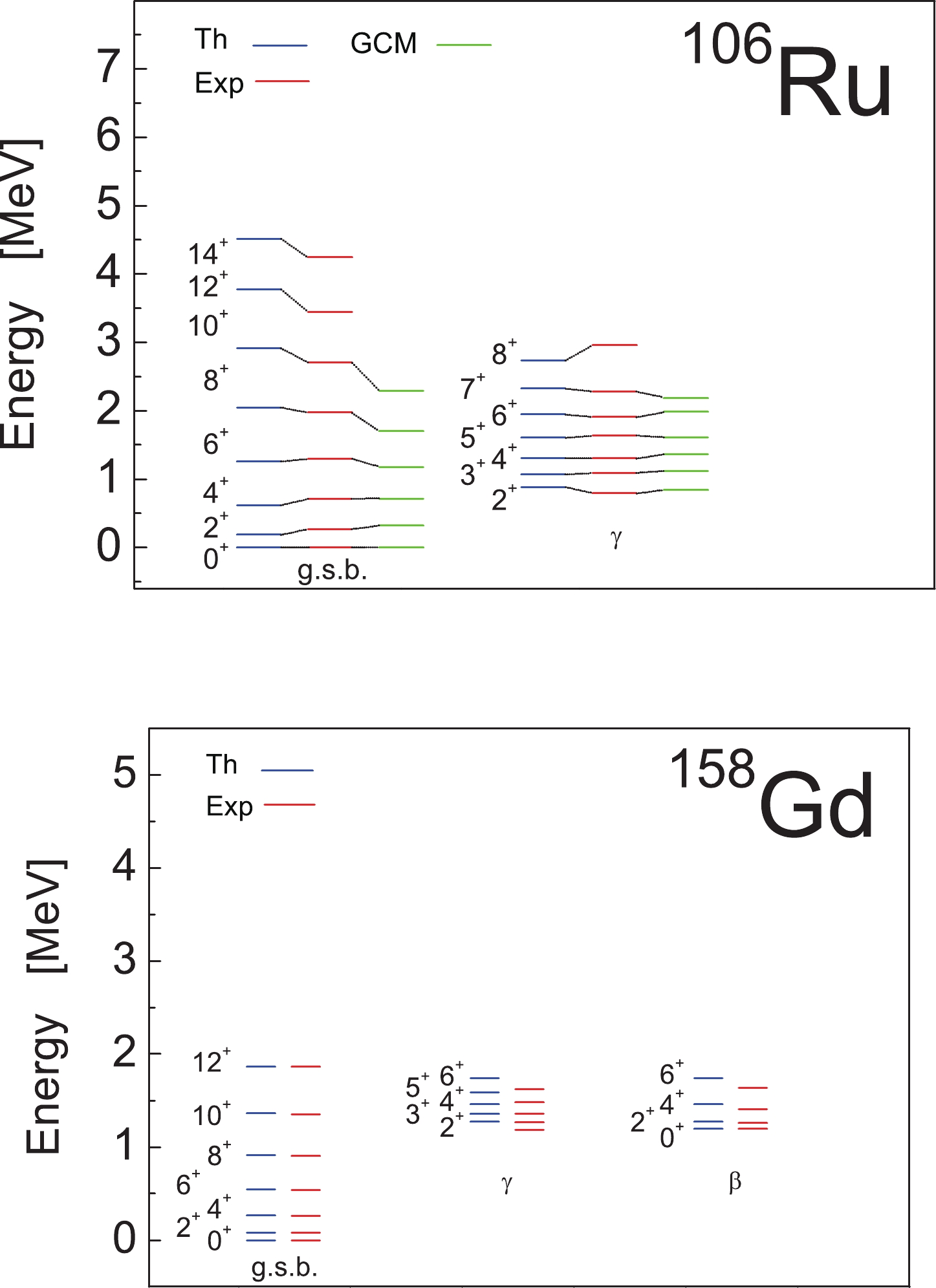
Figure 1.(color online) Comparison of the excitation energies of the ground and
$ \gamma $ bands in$ ^{106} {\rm{Ru}}$ and ground,$ \beta $ , and$ \gamma $ bands in$ ^{158} {\rm{Gd}}$ via experiments according to Eq. (68). For comparison, in the case of$ ^{106} {\rm{Ru}}$ , the results of the general collective model (GCM) with a collective potential including terms up to the sixth order are given as well [58]. -
The transition probabilities are given, by definition, by theSO(3)-reduced matrix elements of the corresponding transition operator. Here we restrict ourselves to the
$ B(E2) $ transition strengths between the states of the ground band only. We use$ T^{E2} = (eZ/(A-1)) \widetilde{q}^{2m} $ as the$ E2 $ transition operator, where$ \widetilde{q}^{2m} $ is given by Eq. (64). Because$ \widetilde{q}^{2m} $ is a generator of theSU$ _{pn} $ (3) group, we obtain the well-known result for the$ B(E2) $ transition probabilities$ \begin{aligned}[b] B(E2; L_{i} \rightarrow L_{f}) =& \frac{2L_{f}+1}{2L_{i}+1} \big|\langle f|| T^{E2} || i \rangle \big|^{2} = \frac{2L_{f}+1}{2L_{i}+1}\bigg(\frac{eZ}{A-1}\bigg)^{2}\Bigg(k\sqrt{3}\langle (\lambda,\mu)qL_{i}; (1,1)2|| (\lambda,\mu)q'L_{f} \rangle \\ &\times\sqrt{2\langle C_{2}[SU_{pn}(3)]\rangle}\Bigg)^{2}, \end{aligned} $ 
(69) where
$ \langle C_{2}[SU_{pn}(3)]\rangle = \frac{2}{3}(\lambda^{2}+\mu^{2}+\lambda\mu+3\lambda+3\mu) $ is the eigenvalue of theSU$ _{pn} $ (3) second-order Casimir operator. Additionally, because the relevant irreps in the PNSM for heavy nuclei are determined by using the pseudo-SU(3) scheme [51-53], a constant factorkenters the expression, which relates the real quadrupole operator with its pseudo-SU(3) counterpart, i.e.,$\widetilde{q}^{2m} = k\widetilde{q}^{2m}_{\rm pseudo}$ . For rare-earth and Ru regions,$ k \approx 1.20 $ and$ k \approx 1.25 $ , respectively. In present calculations, no effective charge is used (i.e.,$ e = 1 $ ).Using Eq. (69), inFig. 2, we compare the calculated intraband
$ B(E2) $ transition probabilities between the states of the ground band in$ ^{158} {\rm{Gd}}$ with experiment [49] (dashed green line). We observe that theoretical values overestimate the experimental data. For$ ^{106} {\rm{Ru}}$ , the experimental value is known only for the transition$ B(E2;2^{+}_{1} \rightarrow 0^{+}_{1}) = 66 $ W.u. [49]. The theoretical value we obtained in the pureSU$ _{pn} $ (3) dynamical symmetry limit is 95.76 W.u. The results obtained for the$ B(E2) $ transition probabilities in the two nuclei suggest that in order to reduce the theoretical values, a horizontal mixing of differentSU(3) multiplets within the correspondingSO(6) irreducible representation$ \upsilon_{0} $ is required.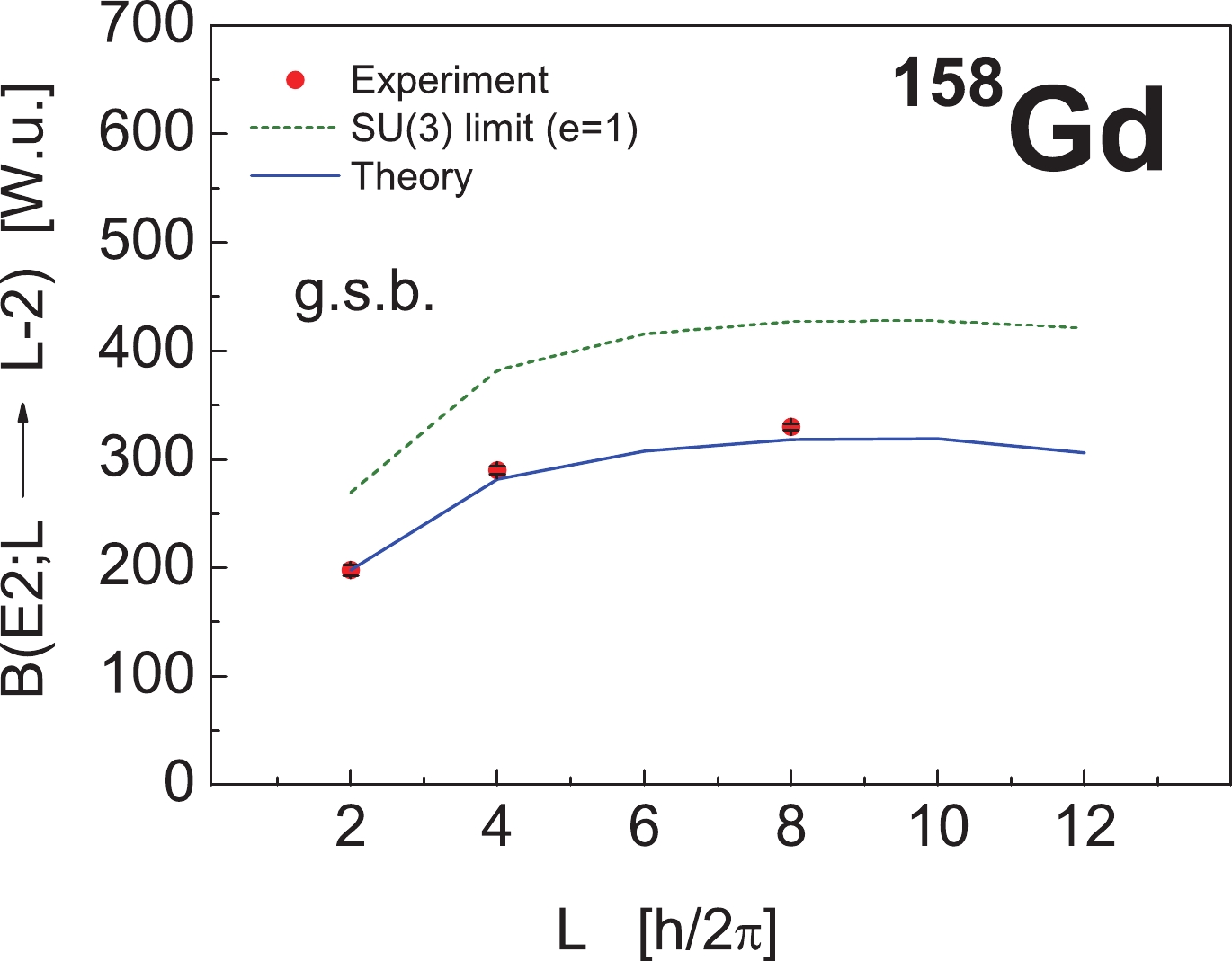
Figure 2.(color online) Calculated intraband
$ B(E2) $ values in Weisskopf units between the states of the ground band in$ ^{158} {\rm{Gd}}$ obtained in the pureSU(3) limit (dashed green line) and mixed representation calculations (continuous blue curve). No effective charge is used. -
To obtain better agreement with the experiment on
$ B(E2) $ transition probabilities, we use the following simple Hamiltonian$H_{\rm mix} = h\Big(G^{2}(a,a) \cdot F^{2}(b,b) + G^{2}(b,b) \cdot F^{2}(a,a)\Big) $

(70) that mixes differentSU(3) multiplets within the maximal senioritySO(6) representation
$ \upsilon_{0} $ contained in the corresponding symplectic bandhead. Then, for example, theSO(3)-reduced matrix elements of the tensor$ G^{2}(a,a) \cdot $ $ F^{2}(b,b) = \dfrac{2\sqrt{5}}{3}[G^{2}(a,a)\times F^{2}(b,b)]^{4}_{-4100} $ are given by$ \begin{aligned}[b] &\langle \sigma \rho En\upsilon\nu'q'L||G^{2}(a,a) \cdot F^{2}(b,b)||\sigma n\rho E\upsilon\nu qL\rangle \\ =& \langle \sigma n\rho E\upsilon |||[G^{2}(a,a)\times F^{2}(b,b)]^{4}_{-4100}|||\sigma n\rho E\upsilon \rangle \\ &\times\frac{2\sqrt{5}}{3} \Big\langle {}^{\ \ \upsilon}_{(\lambda,\mu)} \quad {}^{\ \ 4}_{(0,4)}\Big| {}^{\qquad \upsilon}_{(\lambda-2,\mu+2)} \Big\rangle \\ &\times \langle (\lambda,\mu)qL; (0,4)0|| (\lambda-2,\mu+2)q'L \rangle, \end{aligned} $

(71) where the enteringSO(6)-reduced matrix elements are given by Eq. (60). TheSO(3)-reduced matrix elements of the tensor operator
$ G^{2}(b,b) \cdot F^{2}(a,a) = \dfrac{2\sqrt{5}}{3}[G^{2}(b,b)\times $ $ F^{2}(a,a)]^{4}_{4100} $ are similarly expressed. We recall that the correspondingSO(6)$ \approx $ SU(4)$ \supset $ SU(3) andSU(3)$ \supset $ SO(3) isoscalar factors are computed numerically by using the existing codes [37] and [35,36], respectively.We diagonalize the full Hamiltonian consisting of Eqs. (67) and (70) in the collective subspace spanned by theSO(6) irreducible representation
$ \upsilon_{0} $ . Additionally, because there is a prolate-oblate degeneracy related with the conjugateSU$ _{pn} $ (3) multiplets$ (\lambda,\mu) $ and$ (\mu,\lambda) $ contained within the correspondingSO(6) irreducible representations (cf.Table 1of Ref. [10]), we consider only theSU(3) multiplets$ (\lambda,\mu) $ with$ \lambda \geqslant \mu $ in the diagonalization. The diagonalization results for the low-lying excitation spectra in both nuclei are shown inFig. 3; the intraband$ B(E2) $ transition strengths between the states of the ground band in$ ^{158} {\rm{Gd}}$ are shown inFig. 2with the continuous blue curve. We observe that the agreement on the transition probabilities, compared to the pureSU(3) limit, is improved. For$ ^{106} {\rm{Ru}}$ , the experimental value$ B(E2;2^{+}_{1} \rightarrow 0^{+}_{1}) = 66 $ W.u. [49] is also reproduced in the diagonalization without using an effective charge.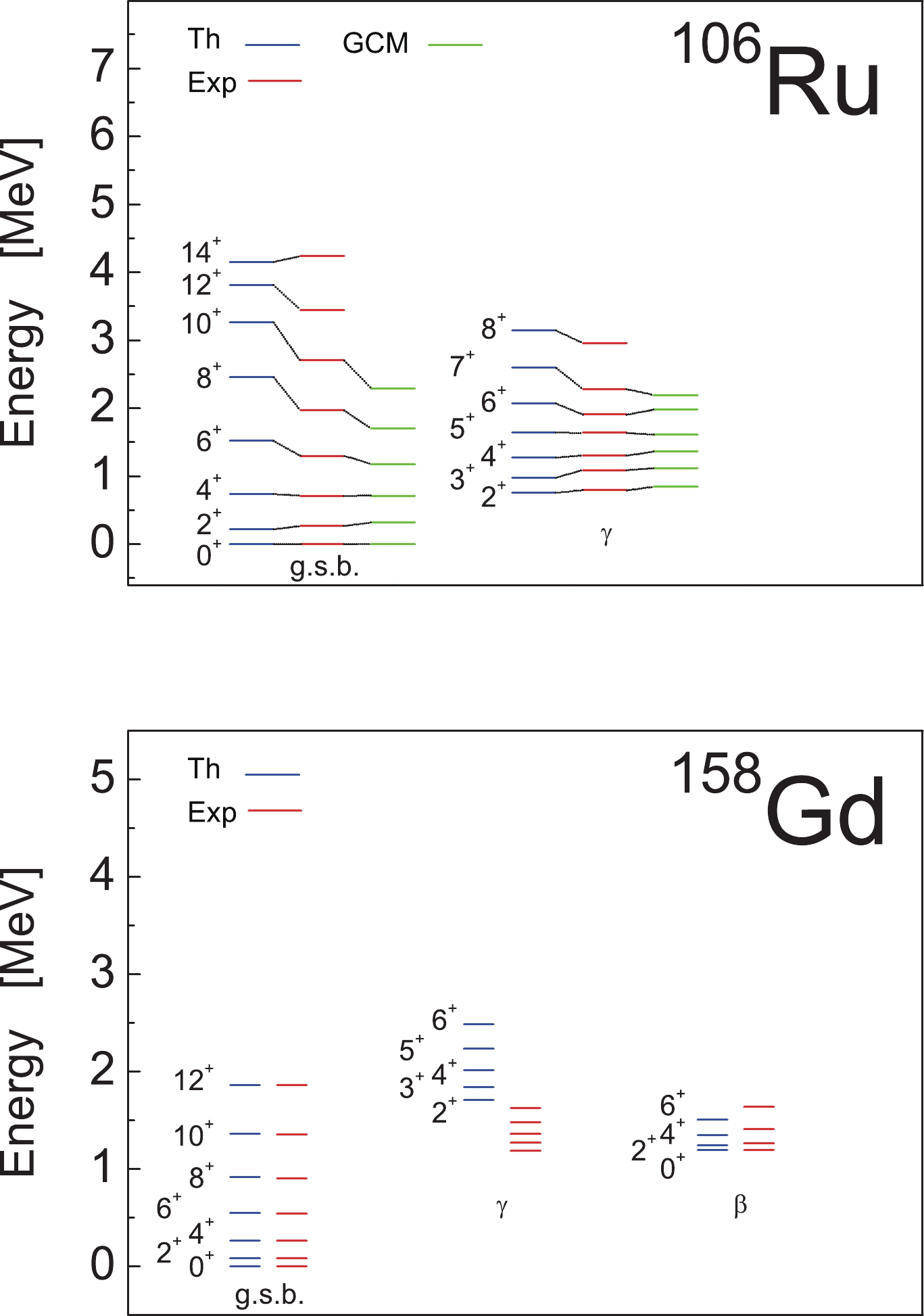
Figure 3.(color online) Comparison of the excitation energies of the ground and
$ \gamma $ bands in$ ^{106} {\rm{Ru}}$ and those of the ground,$ \beta $ , and$ \gamma $ bands in$ ^{158} {\rm{Gd}}$ via experiments according to Eqs. (67) and (70). The values of the model parameters in MeV are as follows:$ A = 0 $ ,$ B = -0.0924 $ ,$ a = 0.004 $ ,$ b = 0 $ , and$ h = -0.23 $ for$ ^{106} {\rm{Ru}}$ and$ A = 0 $ ,$ B = -0.0127 $ ,$ a = 0.0134 $ ,$ b = 0.0000093 $ , and$ h = -0.1384 $ for$ ^{158} {\rm{Gd}}$ , respectively. For$ ^{106} {\rm{Ru}}$ , the results of the general collective model (GCM) with a collective potential including terms up to the sixth order are given as well [58].InFigs. 4and5we present theSU(3) decomposition of the wave functions of the ground and
$ \gamma $ bands in$ ^{106} {\rm{Ru}}$ , and the ground,$ \beta $ , and$ \gamma $ bands in$ ^{158} {\rm{Gd}}$ for different angular momentum values. These figures show that theSU(3) symmetry is severely broken; however, the mixing of differentSU(3) multiplets is performed in an approximately coherent way in which the squared amplitudes are almostL-independent. This is accurate for the low angular momenta for which the Coriolis and centrifugal forces are not significantly strong, especially for the case of a well deformed nucleus$ ^{158} {\rm{Gd}}$ . An interesting picture for theSU(3) decomposition coefficients is observed for$ ^{158} {\rm{Gd}}$ , which resembles the eigenfunctions of the simple one-dimensional harmonic oscillator given by the Hermite polynomials.Figures 4and5thus indicate a new kind of symmetry, called quasi-dynamical symmetry [59]. This symmetry is associated with the mathematical concept of embedded representations [60]. We also note that all theSU(3) multiplets that contribute to the structure of collective states, for both nuclei, belong to a singleSO(6) irreducible representation$ - $ namely that of maximum seniority$ \upsilon_{0} $ of the corresponding bandhead structure. Thus, the results for the microscopic structure of the rotational states of the lowest collective bands in the two nuclei under consideration reveal, in addition to the goodSO(6) symmetry, the presence also of an approximateSU(3) quasi-dynamical symmetry for the low angular momenta, in the sense given in Refs. [27,59].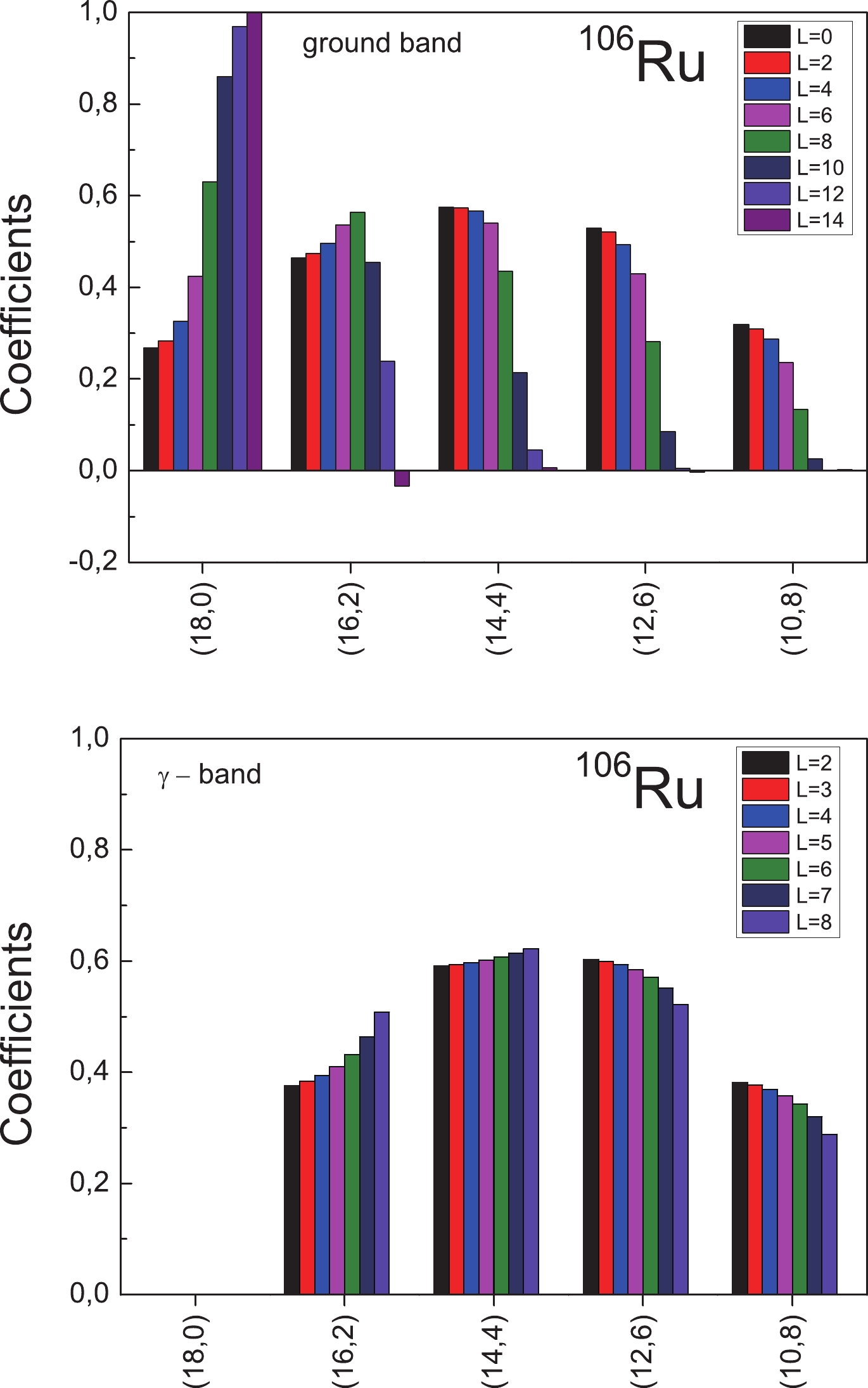
Figure 4.(color online) TheSU(3) decomposition of the wave functions of the ground and
$ \gamma $ bands in$ ^{106} {\rm{Ru}}$ for different angular momentum values.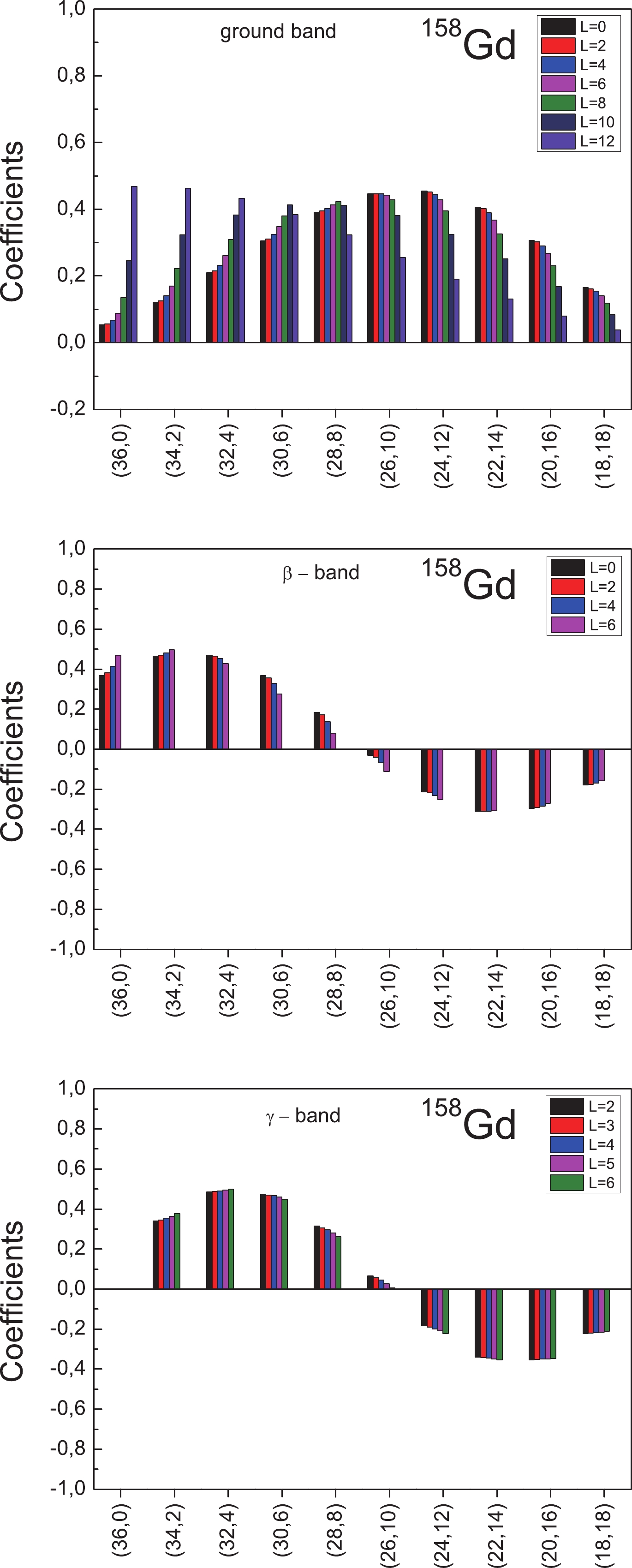
Figure 5.(color online) TheSU(3) decomposition of the wave functions of the ground,
$ \beta $ , and$ \gamma $ bands in$ ^{158} {\rm{Gd}}$ for different angular momentum values. -
The purpose of this work is to develop a computational technique for the shell-model reduction chainSp(12,R)
$ \supset $ SU(1,1)$ \otimes $ SO(6)$ \supset $ U(1)$ \otimes $ SU$ _{pn} $ (3)$ \otimes $ SO(2)$ \supset $ SO(3) of the PNSM. This dynamical symmetry limit was recently shown to correspond to a microscopic shell-model version of the generalized quadrupole-monopole Bohr-Mottelson collective model by embedding the latter in the microscopic shell-model theory [10].The shell-model coupling scheme, defined by the considered reduction chain, provides an alternative basis for the diagonalization of different Hamiltonians of the algebraic and polynomial type in the many-particle position and momentum coordinates of the nuclear system. In the present paper, however, we consider simple algebraic interactions, which are expressed as simple functions of the symplectic generators ofSp(12,R) dynamical group. Closed analytical expressions along theSp(12,R)
$ \supset $ SU(1,1)$ \otimes $ SO(6)$ \supset $ U(1)$ \otimes $ SU$ _{pn} $ (3)$ \otimes $ SO(2)$ \supset $ SO(3) dynamical symmetry chain are obtained for the matrix elements of the basic building blocks of the PNSM and theSp(12,R) symplectic generators, which in turn allows computing the matrix elements of other physical operators of interest. In particular, the reduced matrix elements of the tensor operators$ A^{2}(\alpha,\beta)\cdot F^{2}(\alpha,\beta) \simeq [A^{2}(\alpha,\beta)\times $ $ F^{2}(\alpha,\beta)]^{\upsilon = 2}_{\nu = \pm2100} $ and$ F^{2}(\alpha,\beta)\cdot F^{2}(\alpha,\beta) \simeq [F^{2}(\alpha,\beta)\times $ $ F^{2}(\alpha,\beta)]^{4}_{\pm4100} $ , which couple the microscopic shell-model states from different oscillator shells, are also explicitly provided. The matrix elements of other, more complicated interactions can be obtained utilizing the analytical expressions presented here. In this way, the computational technique developed in the present paper generally provides us with the required algebraic tool for performing realistic symplectic-based shell-model calculations of nuclear collective excitations.Two simple examples are given which illustrate the application of the theory to the determination of the microscopic shell-model structure of the observed low-energy rotational states in106Ru and158Gd, exhibiting different collectivity in their spectra. TheSU(1,1)
$ \otimes $ SO(6) shell-model coupling scheme of the PNSM will extend its applicability in describing the collective properties of different heavy mass nuclei. This variant of the PNSM provides an interesting and relevant framework for exploring the nuclear collective dynamics. More detailed application of the proton-neutron symplectic-based shell-model theory to the description of low-lying excited states in different nuclei with varying collective properties will be presented elsewhere.
Matrix elements in theSU(1,1)
${\otimes}$
SO(6) limit of the proton-neutron symplectic model
- Received Date:2021-06-30
- Available Online:2021-11-15
Abstract:The matrix elements along the reduction chainSp(12,R)


 DownLoad: