


 Abstract
 HTML
HTML Reference
 Related
 PDF
PDF


-
The importance of pairing correlation in nuclear systems was realized very early [1]. In finite nuclei, neutron-neutron (n-n) and proton-proton (p-p) pairing effects are realized in several nuclear properties such as deformation, moments of inertia, alignments, and mass systematics [2-4]. In extended systems, nuclear pairing is expected to occur in the dense matter inside the neutron stars [5,6]. This pairing is crucial for understanding various phenomena in neutron star physics, from the cooling of new born stars [7,8] to the afterburst relaxation in X-ray transients [9], as well as in the understanding of glitches [10]. However, insufficient attention is paid to the isospin-singlet pairing, i.e., the neutron-proton (n-p) paring. Recently, it was suggested that the isospin-singlet pairing is possibly crucial in understanding some nuclear structural issues, such as the Gamow-Teller transition [11,12]. In addition, considering the spin and isospin degrees of freedom, the nuclear Cooper pairs contain very interesting inner structures [13].
It is well-known that pair correlations crucially depend on the pairing near the Fermi surface. Because neutrons and protons share the same Fermi energy in symmetric nuclear matter,n-n(p-p) pairs compete intensely withn-ppairs. Generally, the most energetically favored excludes the others. The investigations on nuclear pairs relatively focus on the single pairing structure, i.e., either then-n(p-p) orn-ppair only [14-23]. Nevertheless, coexistence may emerge in special cases, such as in the case of isospin asymmetric nuclear matter. In a neutron-rich system, although the isospin-singletn-ppairing may be favored, the excess neutrons can form isospin-tripletn-npairs coexisting with the other, and they can influence each other. Furthermore, the nuclei far from the beta-stability line, i.e. the exotic nuclei, can be obtained from heavy-ion collisions (HIC), which has been addressed as a laboratory for the dynamic evolution of the superfluid state of nuclear matter [24]. New aspects of pairing could appear in these exotic nuclei, relative to isospin asymmetries, one of which might be the interplay betweenn-nandn-ppairings in the nuclei owing to the significant overlap of proton and neutron orbits [13,25].
In Ref. [13], the coexistence of isospin
$ I = 1 $ and$ I = 0 $ pairings are considered to study the inner phase structure and phase transition at low density, where the BCS-BEC crossover occurs. The result obtained indicates that including the$ I = 1 $ channel pairing significantly alters the phase structure and phase transition properties. Another challenge in nuclear matter is the interplay between the$ I = 1 $ and$ I = 0 $ pairings. Based on this motivation, to investigate the coexistence of then-n,p-p, andn-ppairings in asymmetric nuclear matter with effective contact pairing interaction in this study, we employ the extended Nambu-Gorkov propagator, which comprises the isospin-tripletn-nandp-ppairings and the isospin singletn-ppairing.The paper is organized as follows. In Sec. II, we briefly derive the gap equation and thermodynamics, as well as introduce the adopted effective pairing interaction. The numerical results and discussion are presented in Sec. III, where the results of the coexistence of three types of pairings are compared with the single pairing at a certain density. Finally, a summary and a conclusion are provided in Sec. IV.
-
The Nambu-Gorkov propagator at finite temperatures, including then-n,n-p, andp-ppairings [13], is expressed as:
$ \begin{array}{l} G = \left( \begin{array}{llll} {\rm i}\omega_{\upsilon}-\varepsilon_{n} & \ \ \ \ 0 &\ \ \Delta_{np} &\ \ \Delta_{nn}\\ \\ \ \ \ \ 0 & {\rm i}\omega_{\upsilon}-\varepsilon_{p} & \ \ \Delta_{pp} & -\Delta_{np}\\ \\ \ \ \Delta_{np} &\ \ \Delta_{pp} & {\rm i}\omega_{\upsilon}+\varepsilon_{p} &\ \ \ \ 0 \\ \\ \ \ \Delta_{nn} & -\Delta_{np} &\ \ \ \ 0& {\rm i}\omega_{\upsilon}+\varepsilon_{n} \end{array} \right)^{-1}, \end{array} $

(1) where
$ \omega_{\upsilon} = (2\upsilon+1)\pi k_{B}T $ with$ \upsilon\in \mathbb{Z} $ represents the Matsubara frequencies.$ \varepsilon_{n/p} = { p}^{2}/(2m)-\mu_{n/p} $ is the single particle (s.p.) energy with chemical potential$ \mu_{n/p} $ . In addtion,$ \Delta_{nn} $ ,$ \Delta_{pp} $ , and$ \Delta_{np} $ are the isospin-tripletn-n, isospin-tripletp-p, and isospin-singletn-ppairing gaps, respectively. -
The neutron-proton anomalous propagator, which corresponds to
$ G_{13} $ , reads$ \begin{aligned}[b] & F_{np}^{\dagger}(\omega_{\upsilon},{ p}) \\=& \frac{-\Delta_{np} [({\rm i}\omega_{\upsilon})^{2}+{\rm i}\omega_{\upsilon}(\varepsilon_{n}-\varepsilon_{p})-\varepsilon_{n}\varepsilon_{p}-\Delta_{np}^{2}-\Delta_{nn}\Delta_{pp}]} {\big[({\rm i}\omega_{\nu})^{2}-E_+^{2} \big]\big[({\rm i}\omega_{\nu})^{2}-E_-^{2} \big]}\\ =& \frac{ -\Delta_{np}\bigg\{[({\rm i}\omega_{\upsilon})^{2}-\varepsilon_+^{2}]-{\rm i}\omega_{\upsilon}(2\delta\mu)+2\delta\mu^{2}+\dfrac{(\Delta_{nn}-\Delta_{pp})^{2}}{2}\bigg\}} {\big[({\rm i}\omega_{\nu})^{2}-E_+^{2} \big]\big[({\rm i}\omega_{\nu})^{2}-E_-^{2} \big]}, \end{aligned} $

(2) where
$ E_{\pm} = \sqrt{\varepsilon_{+}^{2}\pm\sqrt{\varepsilon_{-}^{4}+\varepsilon_{\Delta}^{4}}} $ is the quasi-particle energy in the condensate with the definition$ \varepsilon_{\Delta}^{4} = $ $ \Delta_{np}^{2}[(\varepsilon_{n}-\varepsilon_{p})^{2}+(\Delta_{nn}-\Delta_{pp})^{2}] $ and$ 2\varepsilon_{\pm}^{2} = \varepsilon_{n}^{2}+\Delta_{nn}^{2}+\Delta_{np}^{2}\pm $ $ (\varepsilon_{p}^{2}+ \Delta_{pp}^{2}+\Delta_{np}^{2}) $ .$ \delta\mu = (\varepsilon_{p}-\varepsilon_{n})/2 = (\mu_{n}-\mu_{p})/2 $ represents the Fermi surface mismatch. The summation over the Matsubara frequencies provides the density matrix of particles in the condensate, i.e, then-ppairing probabilities,$ \begin{aligned}[b] \nu_{np}({ {p}}) =& -\frac{\Delta_{np}}{2}\Bigg\{\Bigg[\frac{1-2f(E_+)}{2E_+}+\frac{1-2f(E_-)}{2E_-}\Bigg]\\ & + \frac{2\delta\mu^{2}+\dfrac{(\Delta_{nn}-\Delta_{pp})^{2}}{2}}{\sqrt{\varepsilon_-^{4}+\varepsilon_{\Delta}^{4}}}\Bigg[\frac{1-2f(E_+)}{2E_+}-\frac{1-2f(E_-)}{2E_-}\Bigg]\Bigg\}.\\ \end{aligned} $

(3) Here
$ f(E) = \left[1+\exp\left(\dfrac{E}{k_{B}T}\right)\right]^{-1} $ represents the well-known Fermi-Dirac distribution function under a temperature$ T $ . Accordingly, then-pgap equation is expressed as$ \begin{aligned}[b] \Delta_{np} =& \int\frac{{\rm d}{ {p}}}{(2\pi)^{3}}V_{np}\frac{\Delta_{np}}{2}\Bigg\{\Bigg[\frac{1-2f(E_+)}{2E_+}+\frac{1-2f(E_-)}{2E_-}\Bigg]\\ & + \frac{2\delta\mu^{2}+\dfrac{(\Delta_{nn}-\Delta_{pp})^{2}}{2}}{\sqrt{\varepsilon_-^{4}+\varepsilon_{\Delta}^{4}}}\Bigg[\frac{1-2f(E_+)}{2E_+}-\frac{1-2f(E_-)}{2E_-}\Bigg]\Bigg\}. \end{aligned} $

(4) In the absence of then-nandp-ppairings, the quasi-particle energy
$ E_{\pm} $ becomes$ E_{\pm} = \sqrt{[(\varepsilon_{n}+\varepsilon_{p})/2]^{2}+\Delta_{np}^{2}} $ $ \pm\delta\mu = E_{\Delta}\pm\delta\mu $ , and the gap equation is reduced to a more familiar form for then-ppairing in asymmetric nuclear matter:$ \Delta_{np} = \int\frac{{\rm d}{ {p}}}{(2\pi)^{3}}V_{np}\frac{\Delta_{np}[1-f(E_+)-f(E_-)]}{2E_{\Delta}}. $

(5) Similarly, then-nandp-ppairing gaps are respectively expressed as
$ \begin{aligned}[b] \Delta_{nn} =& \int\frac{{\rm d}{ {p}}}{(2\pi)^{3}}V_{nn}\frac{\Delta_{nn}}{2}\Bigg\{\Bigg[\frac{1-2f(E_+)}{2E_+}+\frac{1-2f(E_-)}{2E_-}\Bigg]\\ & + \frac{\varepsilon_-^{2}+\Delta_{np}^{2}\left(1-\dfrac{\Delta_{pp}}{\Delta_{nn}}\right)}{\sqrt{\varepsilon_-^{4}+\varepsilon_{\Delta}^{4}}}\Bigg[\frac{1-2f(E_+)}{2E_+}-\frac{1-2f(E_-)}{2E_-}\Bigg]\Bigg\}, \end{aligned} $

(6) and
$ \begin{aligned}[b] \Delta_{pp} =& \int\frac{{\rm d}{ {p}}}{(2\pi)^{3}}V_{pp}\frac{\Delta_{pp}}{2}\Bigg\{\Bigg[\frac{1-2f(E_+)}{2E_+}+\frac{1-2f(E_-)}{2E_-}\Bigg]\\& - \frac{\varepsilon_-^{2}+\Delta_{np}^{2}\left(\dfrac{\Delta_{nn}}{\Delta_{pp}}-1\right)}{\sqrt{\varepsilon_-^{4}+\varepsilon_{\Delta}^{4}}}\Bigg[\frac{1-2f(E_+)}{2E_+}-\frac{1-2f(E_-)}{2E_-}\Bigg]\Bigg\}, \end{aligned} $

(7) The occupation numbers, corresponding to the matrix elements
$ G_{11} $ and$ G_{22} $ , can be calculated by$ \begin{aligned}[b] n_{n} =& \frac{1}{2}-\frac{\varepsilon_{n}}{2}\Bigg[\frac{1-2f(E_+)}{2E_+}+\frac{1-2f(E_-)}{2E_-}\Bigg]\\ & - \frac{\varepsilon_-^{2}\varepsilon_{n}-2\delta\mu\Delta_{np}^{2}}{2\sqrt{\varepsilon_-^{4}+\varepsilon_{\Delta}^{4}}}\Bigg[\frac{1-2f(E_+)}{2E_+}-\frac{1-2f(E_-)}{2E_-}\Bigg] \end{aligned} $

(8) and
$ \begin{aligned}[b] n_{p} =& \frac{1}{2}-\frac{\varepsilon_{p}}{2}\Bigg[\frac{1-2f(E_+)}{2E_+}+\frac{1-2f(E_-)}{2E_-}\Bigg]\\ & + \frac{\varepsilon_-^{2}\varepsilon_{p}-2\delta\mu\Delta_{np}^{2}}{2\sqrt{\varepsilon_-^{4}+\varepsilon_{\Delta}^{4}}}\Bigg[\frac{1-2f(E_+)}{2E_+}-\frac{1-2f(E_-)}{2E_-}\Bigg]. \end{aligned} $

(9) The neutron and proton densities are respectively defined as
$ \rho_{n} = 2\int\frac{{\rm d}{ {p}}}{(2\pi)^{3}}n_{n}, \ \ \rho_{p} = 2\int\frac{{\rm d}{ {p}}}{(2\pi)^{3}}n_{p}. $

(10) Notably, then-n,p-p, andn-ppairing gaps couple to each other. For asymmetric nuclear matter at the fixed neutron and proton densities, these gap equations (Eqs. (4), (6), and (7)) should be solved self-consistently with the densities (Eq. (10)) at given densities and temperatures.
-
In principle, the nucleon-nucleonpairing interaction in nuclear matter originates from the attractive component of the bare two-body potential and the three-body force, and this pairing interaction is modified by the nuclear medium, such as the polarization effect [26-32]. In this research, to obtain qualitative conclusions from the coexistence ofn-n,p-p, andn-ppairs, we adopt the density-dependent contact interaction developed by Gorridoet al. [33] to model the pairing potential. For uniform nuclear matter, the potential takes the form
$ \begin{array}{l} V_{I}( {r}, {r}') = g_{I}\delta( {r}- {r}'), \end{array} $

(11) with the effective coupling constant
$ \begin{array}{l} g_{I} = v_{I}[1-\eta_{I}(\rho_{I}/\rho_{0})^{\gamma_{I}}]. \end{array} $

(12) Here,
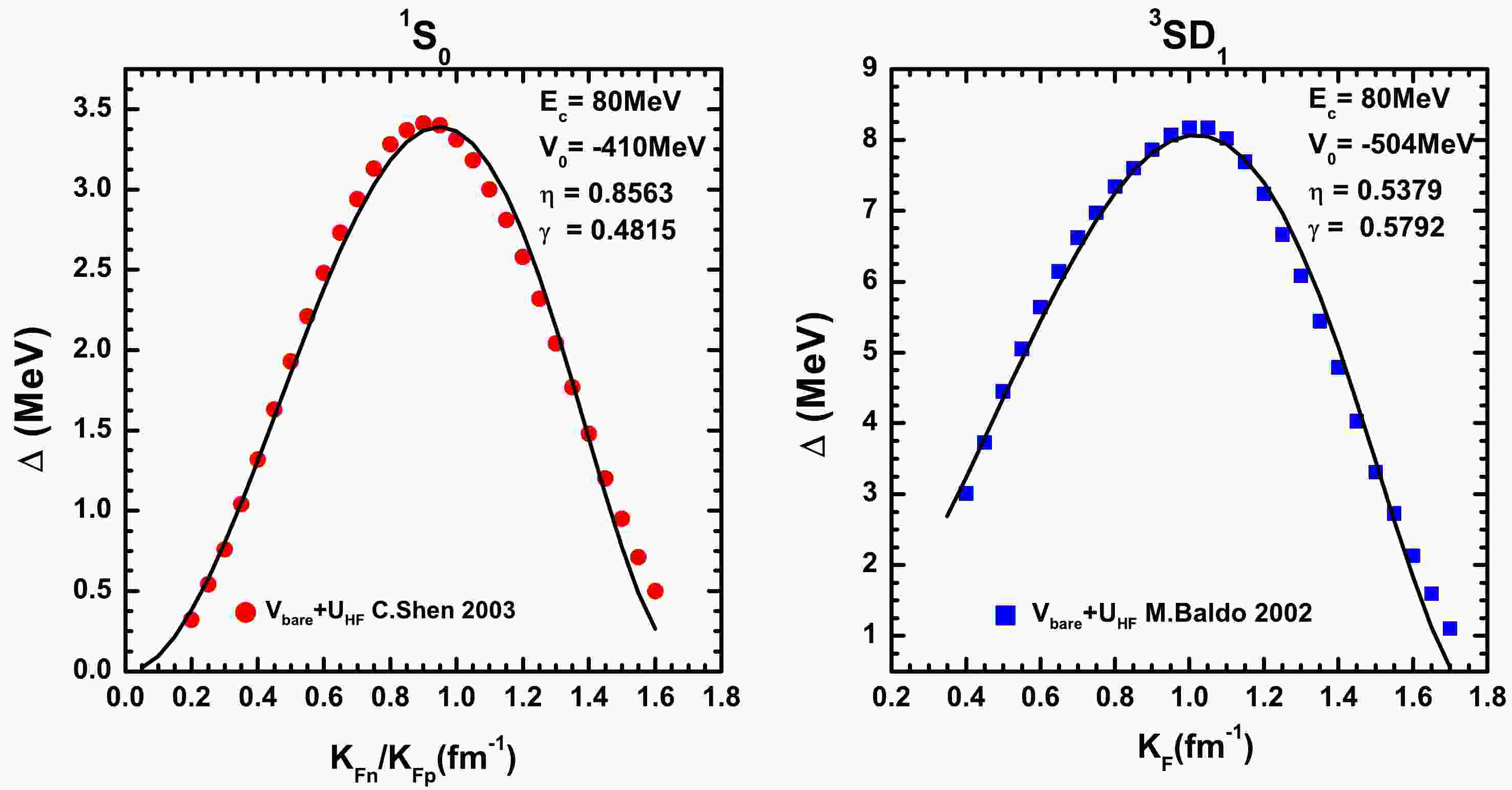
$ v_{I} $ ,$ \eta_{I} $ , and$ \gamma_{I} $ are adjustable parameters and$ I = 0,1 $ denote the total isospin of the pairs. For then-n(p-p) pairing,$ \rho_{I} = \rho_{n} $ ($ \rho_{I} = \rho_{p} $ ) and for then-ppairing,$ \rho_{I} = \rho_{n}+\rho_{p} $ .$ \rho_{0} = 0.17\; \text{fm}^{-3} $ reprsents the saturation density. Taking suitable values of the parameters, the pairing gap$ \Delta(k_{\rm F}) $ can be reproduced as a function of the Fermi momentum$ k_{F} = (3\pi^{2}\rho_{I})^{1/3} $ in the channel$ L = 0 $ ,$ I = 1 $ ,$ S = 0 $ (n-nandp-p) and$ k_{F} = (3\pi^{2}\rho_{I}/2)^{1/3} $ in channel$ L = 0 $ ,$ I = 0 $ ,$ S = 1 $ (n-p). We would like to emphasize that there is also a kind ofn-ppairing in the channel$ L = 0 $ ,$ I = 1 $ ,$ S = 0 $ for the symmetric nuclear matter. In this channel, then-ppairing force is approximately the same as then-norp-ppairing force. As will be discussed in Sec. III, even a minor asymmetry will destroy then-ppairing in this channel. Therefore, the$ I = 1 $ pairings only represent neutron-neutron and proton-proton pairings hereafter.In addition to the polarization effect, the self-energy effect of the medium quenches the pairing gaps [14,17]. Because the self-energy effect for nuclear pairing remains an open question in asymmetric nuclear matter, we adopt the calculated pairing gaps [14,18] under the Hartree-Fock approaches to calibrate the parameters presented inFig. 1. It should be noted that the self-energy [17] and polarization [32] effects should be included to obtain a more reliable pairing interaction. As is well known, to avoid the ultraviolet divergence, an energy cut is required for the contact interaction. Here, we fix the energy at approximately
$ 80 $ MeV for both cases. The left and right panels correspond to the$ I = 1 $ and$ I = 0 $ pairings, respectively.
Figure 1.(color online) The density-dependent contact pairing interaction with parameters calibrated to the calculated pairing gaps. The dots represent the pairing gaps in Refs. [14,18], whereas the lines correspond to the calculation from the effective pairing interaction. The left and right panels are related to the isospin triplet and isospin singlet channels, respectively.
-
Now, we are in a position to determine the key thermodynamic quantities. Because the occupation of the quasi-particle states is given by the Fermi-Dirac distribution function, the entropy of the system is obtained from
$ S = -2k_{B}\sum\limits_{ {p}}\sum\limits_{i}\big[f(E_{i}){\rm ln} f(E_{i})+\overline{f}(E_{i}){\rm ln} \overline{f}(E_{i})\big], $

(13) where
$ \overline{f}(E_{i}) = 1-f(E_{i}) $ and$ i = \pm $ . The internal energy of the superfluid state is expressed as$ \begin{aligned}[b] U =& 2\sum\limits_{ {p}}\big[\varepsilon_{n}n^{n}+\varepsilon_{p}n^{p}\big]\\&+\sum\limits_{ {p}}\big[g_{nn}\nu_{nn}^{2}+g_{pp}\nu_{pp}^{2}+2g_{np}\nu_{np}^{2}\big], \end{aligned}$

(14) The factor
$ 2 $ corresponds to the spin summation. The first term of Eq. (14) includes the kinetic energy of the quasi-particle as a function of the pairing gap and chemical potential. The BCS mean-field interaction among the particles in the condensate is embodied in the second term of Eq. (14). It should be noted that for asymmetric nuclear matter, then-nandp-ppairing interactions can be different, i.e.,$ g_{nn}\neq g_{pp} $ , owing to$ \rho_{n}\neq\rho_{p} $ . Accordingly, the thermodynamic potential can be given as$ \begin{array}{l} \Omega = U-TS. \end{array} $

(15) Once the contact pairing interaction is adopted, the pairing gap is momentum independent. Therefore, the thermodynamic potential can be obtained in a simple form:
$ \begin{aligned}[b] \Omega =& 2\frac{\Delta_{np}^{2}}{g_{np}}+\frac{\Delta_{nn}^{2}}{g_{nn}}+\frac{\Delta_{pp}^{2}}{g_{pp}} +\int\frac{{\rm d} {p}}{(2\pi)^{3}}\\& \times\Bigg\{\varepsilon_{n}+\varepsilon_{p} -\sum\limits_{i = \pm}\big[E_{i}+2k_{B}T{\rm ln}(1+{\rm e}^{\frac{-E_{i}}{k_{B}T}})\big]\Bigg\}. \end{aligned}$

(16) Here, we consider the property
$f(\omega){\rm ln} f(\omega) + \overline{f}(\omega){\rm ln}\overline{f}(\omega) = $ $ -\dfrac{\omega}{k_{B}T} -{\rm ln}(1+{\rm e}^{-\omega/(k_{B}T)})$ . The gap Eqs. (4), (6), and (7) and the densities of Eq. (10) can be equivalently expressed as$ \begin{aligned}[b]& \frac{\partial\Omega}{\partial\Delta_{np}} = 0,\;\;\ \ \frac{\partial\Omega}{\partial\Delta_{nn}} = 0,\ \ \;\; \frac{\partial\Omega}{\partial\Delta_{pp}} = 0,\\& \rho_{n} = -\frac{\partial\Omega}{\partial\mu_{n}},\;\;\ \ \ \ \rho_{p} = -\frac{\partial\Omega}{\partial\mu_{p}}. \end{aligned} $

(17) It should be noted that the solution of these equations corresponds to the global minimum of the free energy
$ F = \Omega+\mu_{n}\rho_{n}+\mu_{p}\rho_{p} $ , which is the essential quantity that describes the thermodynamics of asymmetric nuclear matter. -
The numerical calculations in this study focus on the coexistence of three different types of pairs in isospin asymmetric nuclear matter with total density
$ \rho = \rho_{n}+\rho_{p} $ and isospin asymmetry$ \beta = (\rho_{n}-\rho_{p})/\rho $ . We adopt the effective contact pairing interaction at zero temperature.Fig. 2illustrates the pairing gaps as a function of asymmetry$ \beta $ at the total density$ \rho = 0.068\; \text{fm}^{-3} $ , at which both the$ I = 1 $ and$ I = 0 $ pairing interactions are most attractive. The thick lines correspond to the results of the coexistence of three types of pairings, which include$ \Delta_{nn}\neq0, \; \Delta_{np}\neq0, \; \Delta_{pp}\neq0 $ . In the symmetric matter, neutrons and protons share the same Fermi surface, i.e.,$ k_{{\rm F}n} = k_{{\rm F}p} = k_{\rm F} $ , and the region near the Fermi surface contributes dominantly to the pairing gaps. Two neutrons and two protons near the Fermi surface can form an-npair and ap-ppair or twon-ppairs. Because then-ppairing strength is significantly stronger than that ofn-nandp-p, the nucleons prefer to formn-ppairs instead ofn-n(p-p) pair. Equivalently, then-ppairings severely suppress then-nandp-ppairings for$ \beta = 0 $ . As illustraed inFig. 2, then-n(p-p) gap disappears in the symmetric case. In asymmetric nuclear matter, the dominant region, which contributes significantly to then-n(p-p) pairing gap, is located at the neutron (proton) Fermi momentum$ k_{{\rm F}n} $ ($ k_{{\rm F}p} $ ), whereas the region forn-ppairing is between$ k_{{\rm F}p} $ and$ k_{{\rm F}n} $ (the average Fermi surface related to the average chemical potential of neutrons and protons). The split between neutron and proton Fermi surfaces separates the dominant regions forn-n,p-p, andn-ppairings, which enables then-nandp-ppairings. In addition, the discrepancy between$ k_{{\rm F}p} $ and$ k_{{\rm F}n} $ increases with the increasing isospin asymmetry. Therefore then-nandp-ppairing gaps increase with$ \beta $ .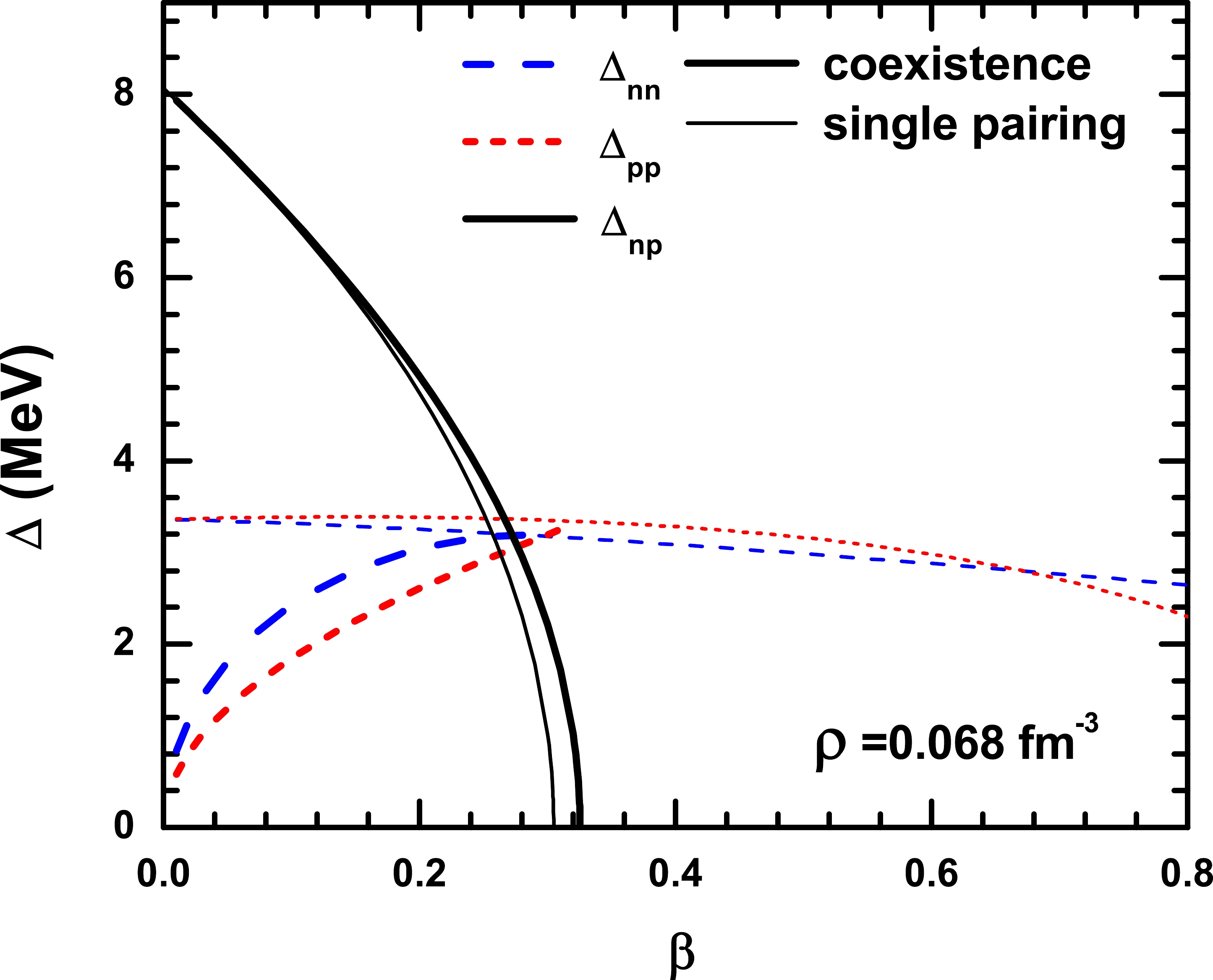
Figure 2.(color online) Then-n,p-p,n-ppairing gaps as a function of the isospin asymmetry
$ \beta $ , at a total density$ \rho = 0.068\; \text{fm}^{-3} $ . The thick and thin lines correspond to the coexistence of three types of pairings and single pairing, respectively. The dashed, short-dashed, and solid lines are related to then-n,p-p, andn-ppairings, respectively.In addition, the results for single pairing, i.e.,
$ \Delta_{nn}\neq0, \, \Delta_{pp} = \Delta_{np} = 0 $ ,$ \Delta_{np}\neq0, \, \Delta_{nn} = \Delta_{pp} = 0, $ or$ \Delta_{pp}\neq0, $ $ \, \Delta_{nn} = \Delta_{np} = 0, $ are depicted as thin lines inFig. 2for comparison. Owing to the suppression from the mismatched Fermi surfaces,n-ppairing gaps decrease with$ \beta $ and disappear at certain asymmetries for both the single pairing and the coexistence of three types of pairings. In the calculation of the coexistence of three types of pairings,$ \Delta_{nn} $ and$ \Delta_{pp} $ coincide with the results obtained from the single pairing calculation when then-ppairing disappears. In fact, if$ \Delta_{np} = 0 $ the coupled Eq. (17) degenerates into two groups of completely independent equations, which are the gap equations for$ \Delta_{nn} $ with the neutron density and the gap equation for$ \Delta_{pp} $ with proton density.Compared to single pairing, the critical isospin asymmetry, where
$ \Delta_{np} $ vanishes, is enhanced by the existence ofn-nandp-ppairs, as demonstrated inFig. 2. Unfortunately, this conclusion cannot be considered as definite, as the effective pairing interaction is simply obtained from the pairing gaps under the Hartree-Fock approximation. In addition, the effectiven-ppairing interaction can be significantly reduced by the nucleon-nucleon correlation beyond the Hartree-Fock approaches [17]. Owing to the complexity of the nuclear many-body medium effects, the exact effective pairing interaction remains an open problem. To eliminate the uncertainty of the effective pairing strength, we adjust the effective neutron-proton pairing interaction artificially to obtain the qualitative conclusion. The results obtained are presented inFig. 3. The solid and dashed lines correspond to the results obtained from the coexistence of the three types of pairings and the single pairing, respectively. For the effective interaction obtained from Ref. [18],$ g_{np}/g_{nn} = $ $ 1.3837 $ . If we reduce then-ppairing strength$ g_{np} $ , the enhancement of then-ppairing from the existence of then-n(p-p) pairs is reduced. When$ g_{np}/g_{nn} $ is under a certain value, the existence ofn-n(p-p) pairing might suppress then-ppairing eventually. An interesting property is that if$ g_{np}\simeq g_{nn} $ ,$ \Delta_{np} $ decreases rapidly with$ \beta $ . As mentioned in Sec. IIB, the channel$ L = 0 $ ,$ I = 1 $ ,$ S = 0 $ embodiesn-n,p-p, andn-ppairings, and the pairing interactions are approximately the same for the asymmetric case. A negligible asymmetry can destroy then-ppairing in the$ L = 0 $ ,$ I = 1 $ ,$ S = 0 $ channel. Therefore, in general, the$ I = 1 $ pairing solely refers to then-nandp-ppairings.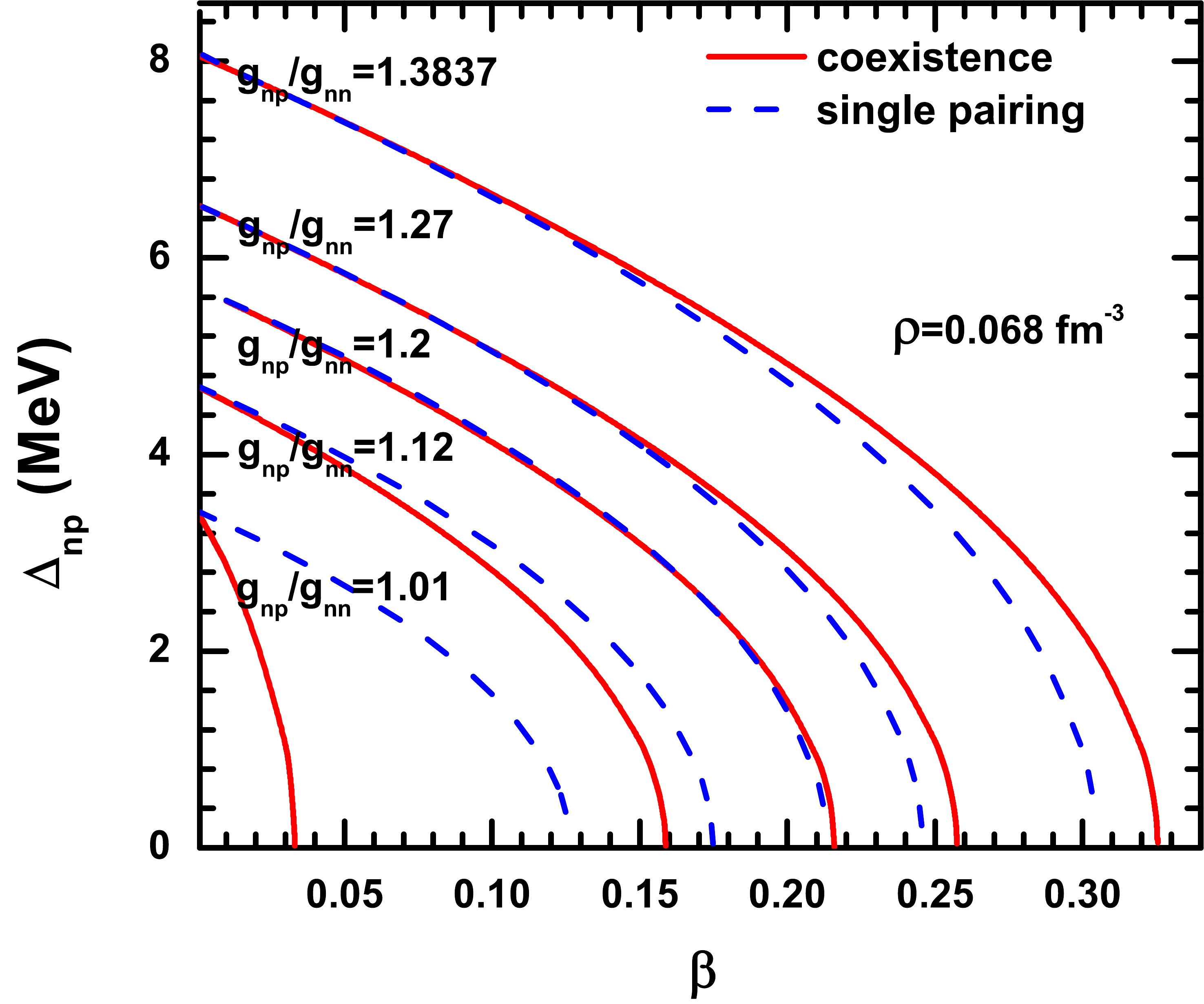
Figure 3.(color online) Then-ppairing gaps as a function of isospin asymmetry at a total density
$ \rho = 0.068\; \text{fm}^{-3} $ for differentn-ppairing strengths,$ g_{np}/g_{nn} = 1.3837 $ ,$ 1.2 $ ,$ 1.12 $ ,$ 1.01 $ . The solid and dashed lines correspond to the coexistence of three types of pairings and single pairing, respectively.One straightforward way to understand the enhancement ofn-ppairing from the existingn-nandp-ppairs is to investigate then-ppairing probabilities near the average Fermi surface (related to the average chemical potentials of the neutron and proton). The results obtained are presented inFig. 4, in the case where total density
$ \rho = 0.068\; \text{fm}^{-3} $ and isospin asymmetry$ \beta = 0.3 $ . Then-ppairing strength is set to be$ g_{np}/g_{nn} = 1.3837 $ . For the singlen-ppairing, the pairing is forbidden in a window around the average Fermi surface owing to the absence of protons. Once then-nandp-ppairings are included, the dispersion of neutron and proton Fermi surfaces can provide the kinematical phase space near the average Fermi surface for the occurence of then-ppairing phenomena. This is a positive mechanism, such that the existence ofn-nandp-ppairs enhances then-ppairing.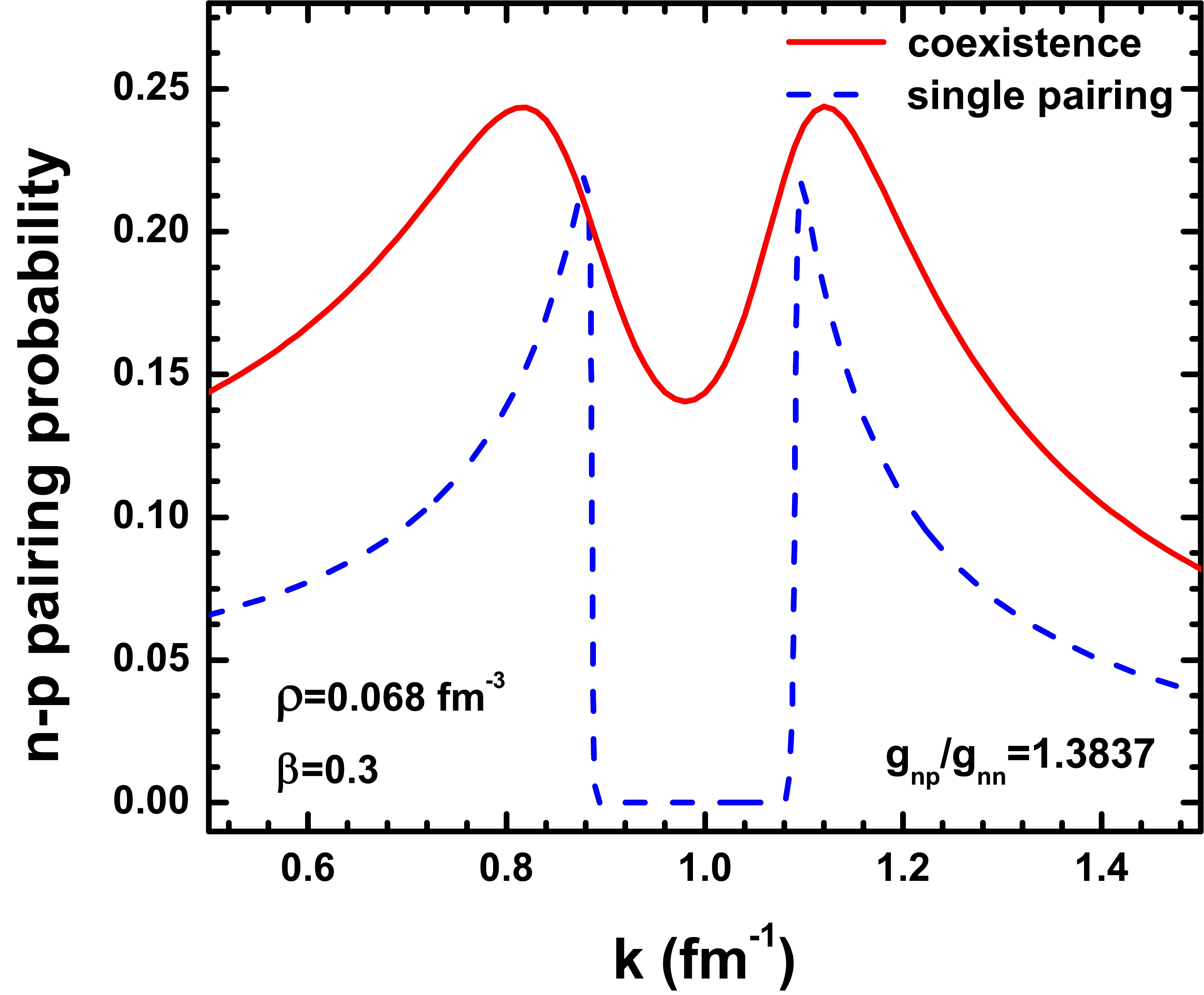
Figure 4.(color online) Then-ppairing probabilities as a function of
$ k $ near the average Fermi surface with the total density$ \rho = 0.068\; \text{fm}^{-3} $ and isospin asymmetry$ \beta = 0.3 $ . Here,$ k = p/\hbar $ is the wave number. The pairing strength is set to be$ g_{np}/g_{nn} = 1.3837 $ . The solid and dashed lines correspond to the coexistence of three types of pairings and single pairing, respectively.Another effect of the existence ofn-nandp-ppairs is that an-npair and ap-ppair ought to be broken up to form twon-ppairs. Exclusively, when the pairing energy ofn-nandp-ppairs is smaller than that of the twon-ppairs, the existence ofn-nandp-ppairs can enhance then-ppairing. The pairing energy is related to the pairing strength directly. As presented inFig. 5, when then-ppairing strength is insufficient, then-ppairing probability is suppressed significantly byn-nandp-ppairs.
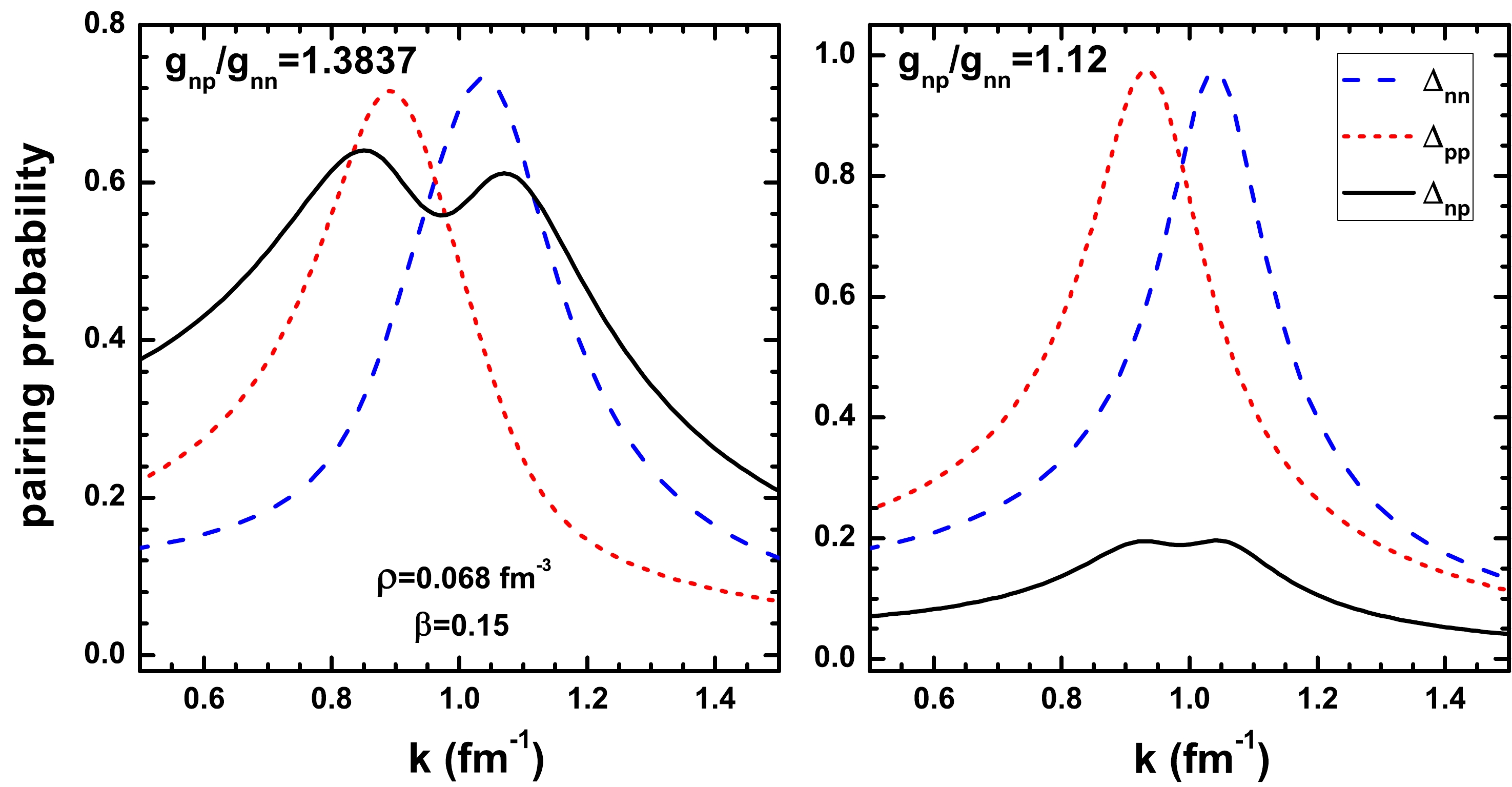
Figure 5.(color online) The pairing probabilities vs
$ k $ near the average Fermi surface at the total density$ \rho = 0.068\; \text{fm}^{-3} $ with isospin asymmetry$ \beta = 0.15 $ . Here,$ k = p/\hbar $ is the wave number. The dashed, short-dashed, and solid lines correspond to then-n,p-p, andn-ppairings, respectively. Then-ppairing strength$ g_{np}/g_{nn} $ is set to be$ 1.3837 $ ($ 1.12 $ ) in left (right) panel.In the calculations of this study, the temperature is set to be zero. However, for asymmetric nuclear matter, the temperature can also disperse the neutron and proton Fermi surfaces, which will eventually reduce the suppression of Fermi surface mismatch at low temperature. At high temperature, the temperature will destroy all types of pairings. Once the temperature is included, the enhanced and reduced effects onn-pparing from the existence ofn-nandp-ppairings should be weakened.
In finite nuclei, then-ppairing might be suppressed by the strong spin-orbit splitting [34,35]. However, in nuclei where the spin-splitting becomes small, the coexistence of three types of pairings may occur. Understanding the enhanced and reduced effects onn-pparing owing to the existence ofn-nandp-ppairings could be beneficial in elucidating then-ppairing in
$ N\approx Z $ nuclei. For asymmetric nuclei, the interplay betweenn-nandn-ppairings might be the same as that in asymmetric nuclear matter. -
In this study, we investigated the coexistence ofn-n,p-p, andn-ppairings in isospin asymmetric nuclear matter with an effective density-dependent contact pairing interaction. The three types of pairings cannot coexist in symmetric nuclear matter, onlyn-ppairs can survive when then-ppairing strength is stronger than that of then-nandp-ppairs, whereas then-nandp-ppairs are preferred if then-nandp-ppairing interactions become strong. Furthermore,n-n,p-p, andn-ppairs can coexist in isospin asymmetric nuclear matter when then-ppairing interaction is stronger than that ofn-nandp-ppairs.
Compared to the single pairing calculation (gap equation with only one kind of nucleon pair), the results indicate two effects of the existence ofn-nandp-ppairs. On the one hand, the existence ofn-nandp-ppairs can disperse the neutron and proton Fermi surfaces, which increase the phase-space overlap between neutrons and protons and eventually enhance then-ppairing near the average Fermi surface. This positive mechanism can reduce the suppression owing to the mismatched Fermi surface of neutrons and protons in the isospin asymmetric nuclear matter. On the other hand, an-npair and ap-ppair should be broken up to form twon-ppairs. In this process, the pairing interaction plays a crucial role. The final results obtained are determined by these two effects. In isospin asymmetric nuclear matter, the existence ofn-nandp-ppairs can enhance then-ppairing when then-ppairing strength is significantly stronger than that ofn-nandp-ppairs. However, the existence ofn-nandp-ppairs would reduce then-ppairing probability when then-ppairing interaction decreases in strength. Moreover, when then-ppairing strength becomes approximately that ofn-nandp-ppairs, then-ppairing rapidly disappears with the isospin asymmetries.
In this paper, the gap solution is only thermodynamically stable. The Cooper pair momentum should also be included in the future to avoid dynamic instability [36-38]. In addition, in future works, the pairing interaction should be calibrated to the pairing gaps, including the polarization correction and the correlation effect. As a prospect, this interesting coexistence of the three types of pairings should also be applied to the studies on pairing correlations in finite nuclei.
Coexistence of isospinI= 0 andI= 1 pairings in asymmetric nuclear matter
- Received Date:2021-03-09
- Available Online:2021-07-15
Abstract:The coexistence of neutron-neutron (n-n), proton-proton (p-p), and neutron-proton (n-p) pairings is investigated by adopting an effective density-dependent contact pairing potential. These three types of pairings can coexist only if then-ppairing is stronger than then-nandp-ppairings for the isospin asymmetric nuclear matter. In addition, the existence ofn-nandp-ppairs might enhancen-ppairings in asymmetric nuclear matter when then-ppairing strength is significantly stronger than then-nandp-pones. Conversely, then-ppairing is reduced by then-nandp-ppairs when then-ppairing interaction approachesn-nandp-ppairings.


 DownLoad: