


 Abstract
 HTML
HTML Reference
 Related
 PDF
PDF


-
At the neutron-deficient side of the nuclear chart, theαdecay is one of the dominating decay modes for heavy nuclides. In recent years, by utilising a gas-filled separator, many new nuclides in theA≈200 region close to the proton drip line were newly synthesized successfully via heavy-ion induced fusion-evaporation reactions [1-9]. The knownα-decay characteristics of such nuclides and their descendants help to study the new properties in the decay chains. Among the evaporating channels, we cannot distinguish the 2p2nand 1αchannels, which have the same evaporated residues (ERs). It is also known that, owing to the different decay energies, there might be differences between these two decay manners. Cross section is one of the probes in practice. In this mass region, a fine structure of the ground-stateαdecay is expected to be observed. However, owing to their low cross section, short survival time, and old technology, many of them have not been confirmed yet. In recent years, owing to the excellent separation performance of the gas-filled spectroscopy, fast data acquisition, and upgraded detector arrays, the unclearedα-decay fine structures could be elucidated.
In this paper, we will discuss the experimental results of218Ac and221Th in Section III. The details of the conducted experiments are presented in Section II.
-
The experiments were performed at the Spectrometer for Heavy Atoms and Nuclear Structure (SHANS) [10] in Institute of Modern Physics (IMP), Lanzhou, China. A beam of40Ar with an energy of 198.7 MeV and an intensitiy of 300
${\rm pnA}$ was provided by the Sector-Focusing Cyclotron (SFC) of the Heavy Ion Research Facility in Lanzhou (HIRFL). The186W target with average thickness of 200$\rm \mu g/cm^2$ was evaporated on a 50$\rm \mu g/cm^2$ of carbon, and covered with a 10$\rm \mu g/cm^2$ of carbon layer. The evaporated residues (ERs) yielded in the fusion-evaporation reaction40Ar +186W were filtrated by the separator SHANS and implanted into three 300-$\mu\rm m$ -thick position-sensitive strip detectors (PSSDs) with each active area of 50×50$\rm mm^2$ . The front surface of each PSSD was divided into 16 strips along the perpendicular direction, leading to a horizontal position resolution of 3 mm. Eight additional non-position-sensitive side silicon detectors (SSDs) were mounted upstream, thereby forming a box geometry together with PSSDs. The total detection efficiency for the emittedαwas measured to be ~72%. To distinguish theαevents from the implanting events, two multi-wire proportional counters (MWPCs) were mounted 15 cm and 25 cm upstream from the PSSDs. Three extra non-position-sensitive silicon detectors, featuring the same size as the PSSDs, were installed side by side after the PSSDs to provide the veto signals from the light particles passing through the PSSDs. Near the charged particle detection system, two High Purity Germanium (HPGe) detectors and one clover detector were mounted at the right side, downward, and downstream, respectively. Signals from the preamplifiers of the Si-box, MWPCs, and veto detectors were recorded directly by a digital data acquisition system comprising sixteen V1724 waveform digitizers from CAEN S.p.A [11]. Every event was recorded in 30$\rm \mu s$ -long trace at a sampling rate of 100 MHz. More details of the system could be found in Refs. [2,3,12].Charged-particle energy calibration was performed using the175Lu target with the same beam. With the help of an alcohol circulation cooling system, the energy resolution for unpileup trace was approximately 40 keV (FWHM) for 6.5-10 MeVαparticles, and the vertical position resolution was approximately 1.5 mm (FWHM). For pileup signals with$\bigtriangleup T > 1 \rm \mu s$ , the typical energy resolution is 47 keV. However, for$\bigtriangleup T > 1 \rm \mu s$ = 0.5-1$\rm \mu s$ , the resolution worsens, becoming 70 keV. When the time difference is less than 100 ns, the extractedαenergy from the pileup trace becomes unreliable.When ERs trigger the PSSDs, the emittedαis called
$ \alpha_{1} $ . The ERs named as the mother nuclide decayed to the excited or ground states of the daughter nuclide, which might deexcite byαdecay again, denoted as$ \alpha_{2} $ . The same rule is applied to name$ \alpha_{3} $ for theαdecay from the granddaughter nuclide following$ \alpha_{2} $ . The aforementioned signals occurred at the same position in the PSSDs. -
In the conducted experiment, some U, Pa, Th, and Ac isotopes were clearly identified, including221U,220-222Pa,219-222Th,218,219Ac, and217,218Ra. The 2D plotting of the correlated events is presented inFig. 1; the time windows were 30 ms for ER-
$ \alpha_{1} $ pairs and 50 ms for$ \alpha_{1}- \alpha_{2} $ pairs.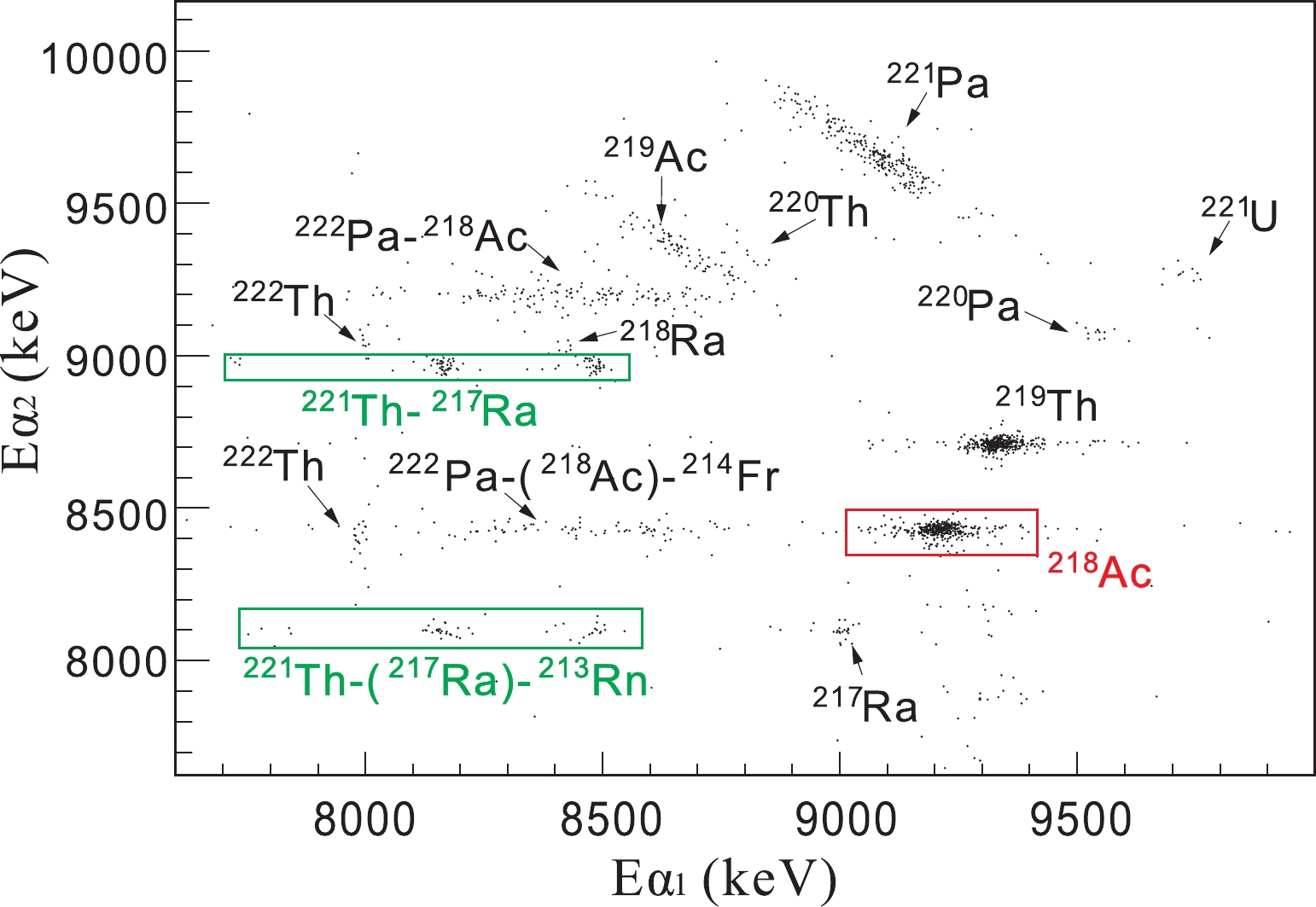
Figure 1.(color online) Two-dimensional scatter plot of α-particle energies for correlated ER-
$\alpha_{1}- \alpha_{2}$ events measured in the PSSDs. The nuclide in parentheses indicate that the detection of their signals failed. -
When the time interval of
$ \alpha_{1} $ and$ \alpha_{2} $ is in the order of a few hundred nanoseconds, the pluse piles upon the next one. Consequently, the two extracted energies will not be accurate anymore, but the sum energy value continues to be reliable; this was the case of221Pa,219Ac, and220Th clusters. Three waveforms of221Pa events are shown inFig. 2as examples. For this type of pairs, they distribute on an oblique line in the 2D plotting, such that the intercept is the sum of two energies. Similarly, the$ E_{\alpha 1} $ energy peak projected from the218Ac events is broader than that of$ E_{\alpha 2} $ from the222Pa ones. That is due to the short half-life of218Ac, whose energy could not be obtained accurately in the waveform.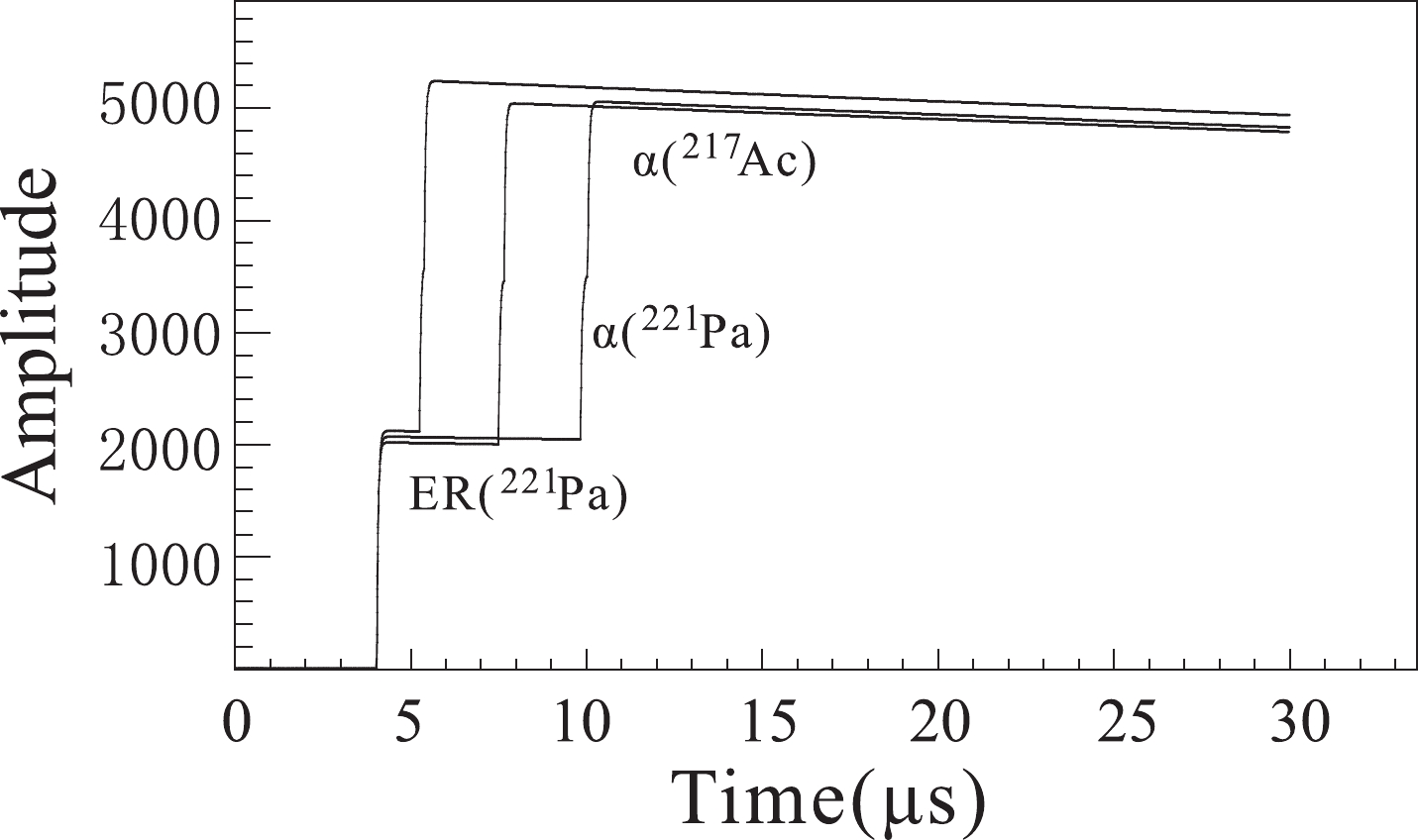
Figure 2.Waveform examples of three221Pa-217Ac events.
Each cluster of events was checked carefully. Two components are observed in the time distribution of the218Ac events, shown inFig. 3. The projected spectrum of these events displays a single-energy peak at 9205 keV, consistent with the previous measured values [13-15]. Thus, all of them are decaying from the ground state of218Ac. The isomer decay manner is not the right one, which could be excluded logically. The less-yields component (16%) is attributed to the indirect process, originated from theαdecay of222Pa, whose emittedαparticles failed to be detected. By solving the nonlinear nonhomogeneous first order differential equation with the approximation
$ \lambda _2 \gg \lambda _1 $ , the counts of218Ac$ N(t) $ in the indirect process could be obtained.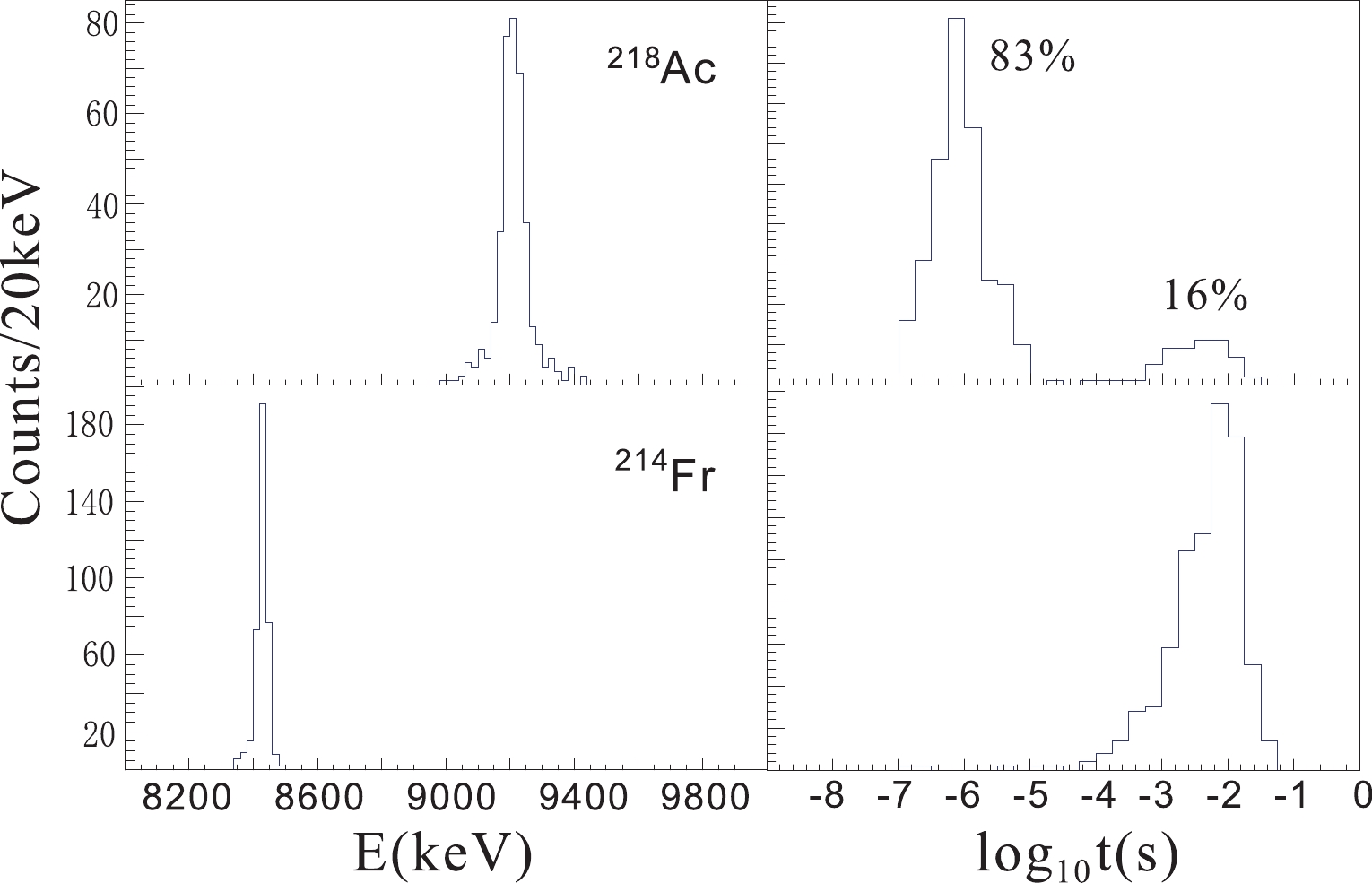
Figure 3.(color online) The energy and time distribution of the events in the218Ac cluster, with218Ac in the upper part and214Fr in the lower part.
$ \dfrac{{\rm d}N(t)}{{\rm d}t} = \lambda _1 N_0 e^{-\lambda _1 t}-\lambda _2 N(t) e^{-\lambda _2 t} . $

(1) Here,
$ N_0 $ denotes the counts of222Pa that will decay to218Ac later. For each event, the ER trigger time was set to zero, so$ N_0 $ is independent of time;$ \lambda_1 $ and$ \lambda_2 $ are the decay constants of222Pa and218Ac, respectively.Then, the second term shows the count ratio ofαparticles emitted from the ground state of218Ac, whose function corresponds to the time distribution curve. The maximum locates at
$ t = \dfrac{1}{\lambda_1} $ , 10−2.33here, whose value should correspond to the half life of222Pa. Directed by a 95.5% confidence level, a half-life of$ 3.24^{+1.13}_{-0.66} $ ms was obtained. This is consistent with the value$ 2.76{^{+0.43}_{-0.33}} $ ms deduced from the222Pa events(222Pa-218Ac and222Pa-(218Ac)-214Fr) in this study. The half-life of the another 83% component was derived to be$0.78^{+0.10}_{-0.08} \mu\rm s$ . They are the evaporation residues from the compound nuclide226U, i.e., the so called direct products. Thus, it refers to the ground state half-life of218Ac measured in this experiment.When calculating the cross section of 1p3nchannel (222Pa) in this reaction, we should take into account the contribution from the indirect process, along with the direct one of the222Pa-218Ac and the222Pa-(218Ac)-214Fr events. Simultaneously, the indirect part should be removed when counting the direct products218Ac. Given that the missing ratio when detecting the decayingαfrom222Pa and218Ac and their transporting efficiency provided by SHANS are almost same, the direct process ratio of
$\dfrac{\sigma(^{226}{\rm U}^* \rightarrow1p3n+^{222}{\rm Pa})}{\sigma(^{226}{\rm U}^*\rightarrow3p5n+^{218}{\rm Ac})}$ deduced in this study is 0.69(9). The theoretical result computed by the Hivap2 code [16] with the commonly used parameters is 0.93. Further theoretical study by adjusting the fission barrier and the preformation factor is needed to analyze the experimental results. -
The refineα-decay structure of221Th was investigated in many previous experiments [9,17-20]. However, only the branches with large ratios and the one that separates from the others clearly in energy scale were confirmed. In our measurements, besides the knownαdecays at 7731, 8164, and 8481 keV, two more small peaks were observed (shown inFig. 4). The measured results in the present study and those in previous ones are compiled together inTable 1. For the sake of more accurate results, the listed energies and the half-lives of217Ra and213Rn were extracted from the221Th-217Ra and221Th-(217Ra)-213Rn clusters, respectively, to achieve higher statistics. The ground state to ground state
$ Q_\alpha $ was deduced to be 8672(10) keV when corrected for the recoil energy and the screening effect of the atomic electrons. InFig. 4, theαspectrum of221Th was obtained from the sum of221Th-217Ra and221Th-(217Ra)-213Rn events. Meanwhile, the spectra of217Ra and213Rn were only extracted from the221Th-217Ra cluster to clarify the correlation information. The statistical countings shown in the figure are 89 and 52 for217Ra and213Rn, respectively. Two peaks at 8409 and 8249 keV, highlighted in red, are the ones that were mentioned once as a short note in Ref. [17] without spectra shown. In this measurement, there were four 4-fold coincidence chains founded for these two branches, listed inTable 2. Chains 1-3 were the ones at 8409 keV, whereas chain 4 was located at 8249 keV. These multi-correlations help to partially (not sufficiently) support their existence in the fine decay structure. To demonstrate the existence of the two controversial branches, the$ \gamma $ spectrum correlated with the decayingαparticles of the mother nuclei is presented as an additional argument (Fig. 5).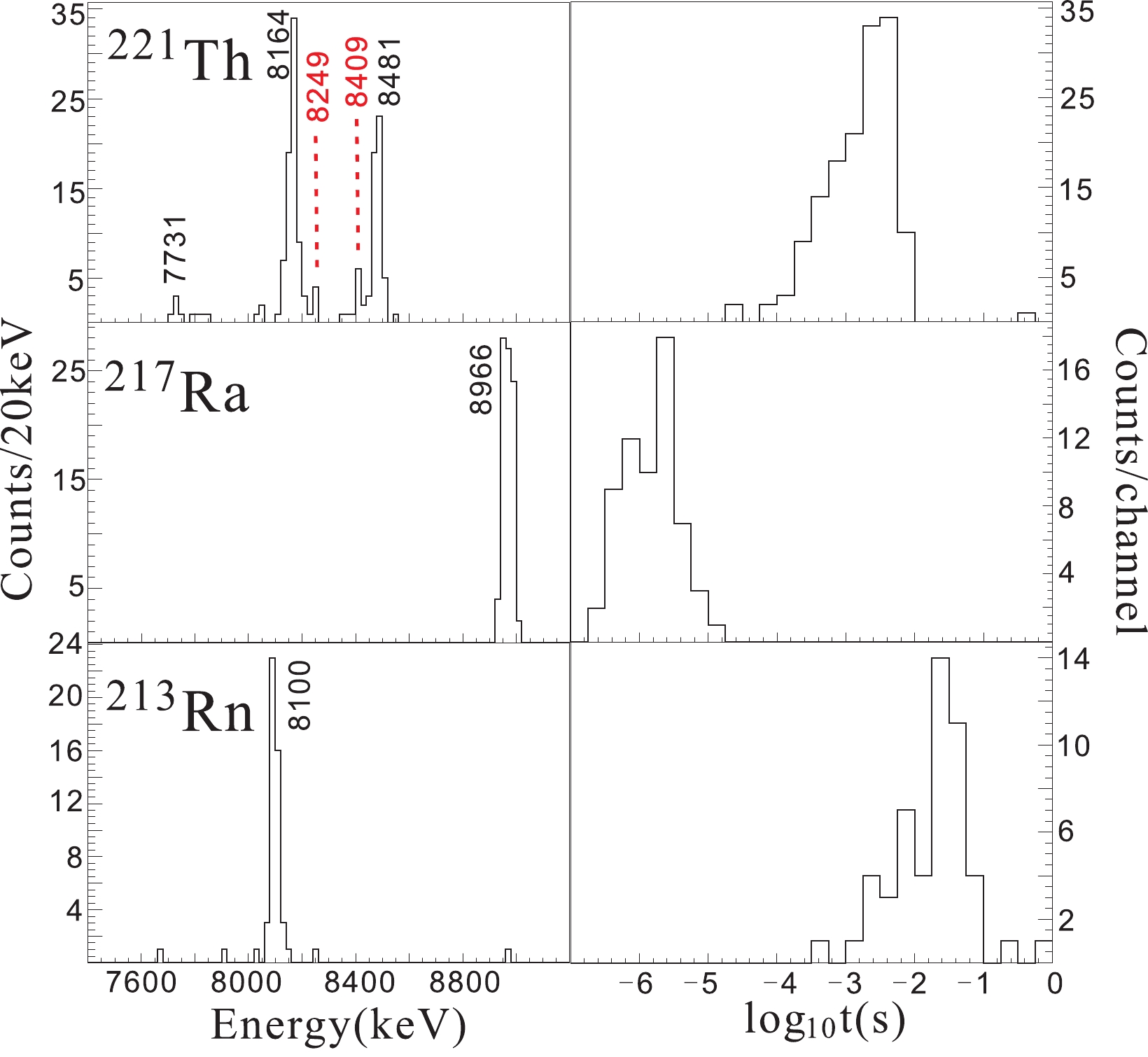
Figure 4.(color online) Energy (left) and time distribution (right) of the events relative to the221Th decay chains. The previous indeterminateαbranches are labeled in red.
Isotope Eα/keV Intensity(%) $T_{1/2}^* $ 

Previous studies,Eα(Int.) Previous studies,T1/2 7731(17) 3.5 7730(10) keV(6%)[17], 7733(8) keV(6.0%)[18],
7.73(1) MeV(8(3)%)[19], 7732(15) keV(4(3)%)[9]221Th 8164(15) 52.5 8150(10) keV(53%)[17], 8146(5) keV(62.4%)[18],
8.145(10) MeV(62(5)%)[19], 8135(10) keV(48(9)%)[9],
8.11(4) MeV[20]1.68(6) ms[18], 1.8(3) ms[19],
$ {2.0^{+0.3}_{-0.2}}$ ms[9], 1.0(2) ms[20]

8249(19) 2.1 $1.95{^{+0.38}_{-0.27}}$ ms

8265(10)(4%)[17], 8.23(4) MeV[20] 8409(16)# 6.4# 8375(10) keV(11%)[17] 8481(15) 35.5 8470 keV(10%)[17], 8472(5) keV(31.6%)[18],
8.470(10) MeV(30(5)%)[19], 8458(10) keV(48(9)%)[9]217Ra 8966(15) 100 $1.52{^{+0.42}_{-0.27} } \mu\rm s$ 

8990(8) keV[18], 8.995(10) MeV[19], 8.99(4) MeV[20] 4(2) $\mu\rm s$ [9], 1.6(2)

$\mu\rm s$ [19], 2.5(2)

$\mu\rm s$ [20]

213Rn 8100(15) $ 15.88{^{+5.47}_{-3.24}} $ ms

8.085(10) MeV(99%)[19], 7.55(15) MeV(15)(1%)[19],
8.09(1) MeV[20], 7.98(1) MeV[20]25.0(2) ms[19], 16(1) ms[20] (*) 95.5% confidence level is used to compute the half-life error; (#) tentative assignment. Table 1.Measured results in this study compared with values previously reported in the literature.
Chain No. EER/keV ${E}_{\alpha_1}$ /keV

$\Delta {\rm{t}}_{\alpha_1}$ /ms

${E}_{ \alpha_2}$ /keV

$\Delta {\rm{t}}_{ \alpha_2}$ /

$\mu{\rm{s} }$ 

${E}_{\alpha_3}$ /keV

$\Delta {\rm{t}}_{ \alpha_3}$ /ms

1 14059 8400 0.46 8958 3.00 8097 22.7 2 12498 8408 3.37 8968 3.18 8092 1.53 3 13462 8447 0.74 8971 1.98 8102 38.4 4 13100 8241 0.50 8953 0.68 8099 0.48 Table 2.Measured
$\alpha $ -decay chains ER-$ \alpha_1 - \alpha_2 - \alpha_3 $ for the two dubious components.$E_{\rm ER}$ ,$E_{\alpha 1}$ ,$E_{\alpha 2}$ , and$E_{\alpha 3}$ are the energies of the evaporation residue, mother nuclide, daughter nuclide, and granddaughter nuclide, respectively;$\Delta t$ is the decay time of the chain members.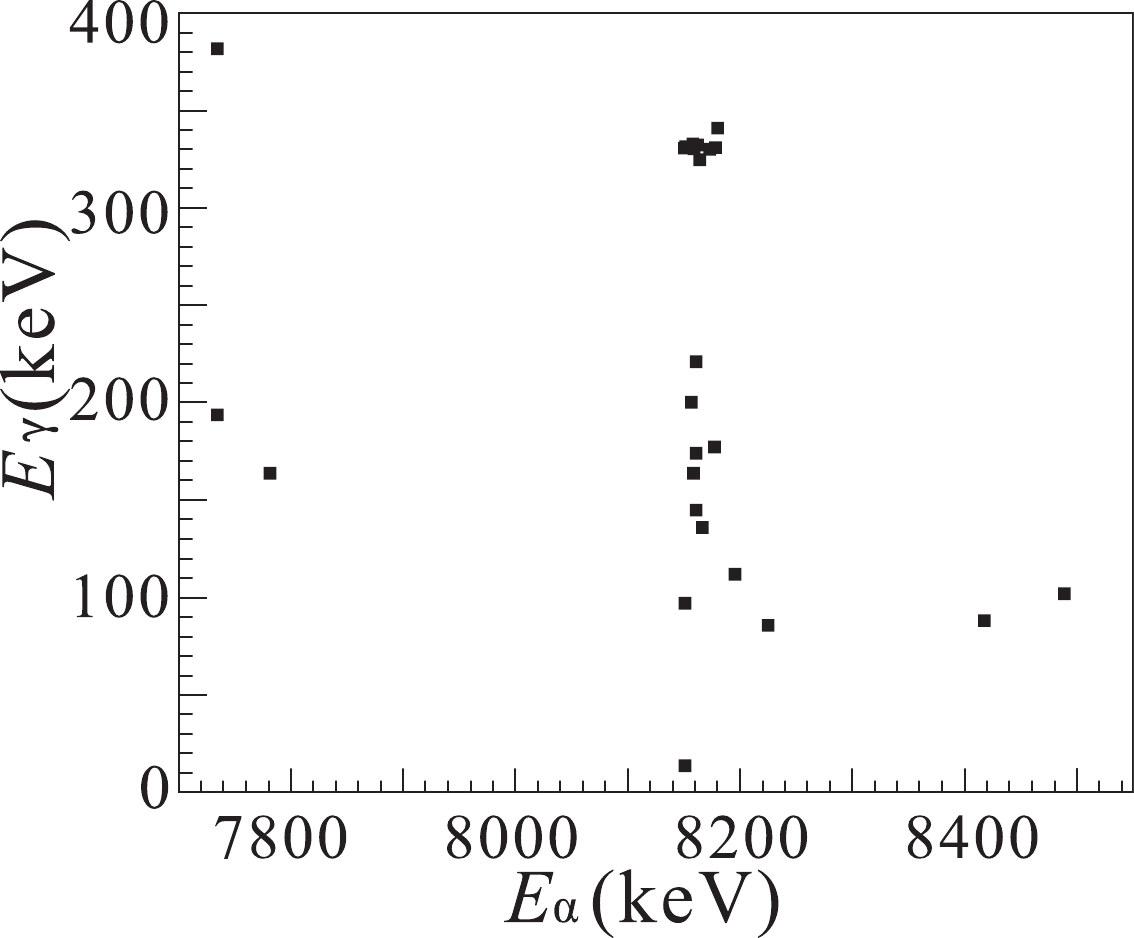
Figure 5.
${\alpha }_1-\gamma$ plot.Only the
$ \gamma $ peak at 331 keV could be recognized in the spectrum; it coincides with the emittedαat 8164 keV. This is consistent with previous$ \gamma $ information [21], i.e.,$ \gamma $ decay from the excited state (323 keV, 11/2+) to the ground state 9/2+. The kinetic energy of the internal-conversion electrons from 331 keV$ \gamma $ will overlap on the 8164 keVα. With the known binding energy of electrons atKshell, i.e., 104 keV, an additional 227 keV energy will contribute to the counts at 8391 keV. Therefore, the small peak at 8409 keV may stem from the internal conversion effect. However, we cannot exclude the possible small branch decay to the level of 73 keV. This item is labeled with corner mark#inTable 1as a tentative result. Through the Band-Raman method, the internal conversion ratios were calculated to be 0.4 and 0.06 forM1 andE2$ \gamma $ transitions, respectively. The upper-limit ratio deduced from this experiment was 0.12. Thus, this$ \gamma $ transition is mostlyE2 type mixed with lessM1. For the counts at 8249 keV, no other situations will generate them, except for a new decay branch. We list this item without the corner mark#.The reducedα-decay width
$ \delta^2 $ [22] could be deduced from the experimental information, including decay energy, half-life, relative intensity, and angular momentum$ l $ taken away by the emittedαparticles. In the case of odd-mass nuclide decay chain, the$ l $ value is related to the valence nucleus configuration of the parent and daughter nuclides. The hindrance factor (HF) of the odd-mass nuclide is the factor normalized to$ \delta^2_{ee} $ (the ground state transition of the neighboring even-even nuclide). It could help us to elucidate the centrifugal barrier effect and discuss the configuration assignments.It is well known that even-even nuclides are unhindered in general. The value of222Th is
$ 134^{+109}_{-41} $ , according to this experiment. We used this value as$ \delta^2_{ee} $ to calculate the hindrance factors of221Th, for which the$ \Omega $ = 1/2,$ i_{11/2} $ neutron orbital dominates the ground state$ 7/2^+ $ [23]. Theα-decay widths calculated from the present data are tabulated inTable 3;$ l $ was set to be 0, 2, and 2 for branches 1, 2, and 5, respectively, according to the previous spin-parity assignments [3] and the conservation law of parity and angular momentum. By employing the data listed inTable 1and the aforementioned$ l $ , the g.s to g.s decay shows an HF of 44, while decays from g.s to the excited states at 764(23) and 323(20) keV are much less retarded with HF 3. The nuclei investigated here are expected to be dominated by the shell model orbital$ g_{9/2} $ , while$ i_{11/2} $ and$ j_{15/2} $ also have certain contributions. In shell model calculation, the states dominated by$ \nu j_{15/2} $ lie higher than others. Thus, the possibility of$ \nu j_{15/2} $ is excluded at the first step. In the in-beam$ \gamma $ spectra study of217Ra [24], the ground state was assigned to$ 9/2^+ $ with the configuration of$ \nu g^3_{9/2} $ (seniority number = 1). Concerning the ground state of221Th, the odd neutron is regarded to mainly occupy the$ i_{11/2} $ orbital at moderate axial quadrupole-octupole deformation [25]. These terms strongly hinder theαdecay from the ground state$ 7/2^+ $ (221Th) to the ground state$ 9/2^+ $ (217Ra). Both$ \nu g^3_{9/2} $ and$ \nu g^2_{9/2} i_{11/2} $ could give rise to the$ 11/2^+ $ state at 323 keV, but its small HF value proposes its final valence neutron occupation to be the same as that of the ground state of221Th, that is,$ \nu i_{11/2} $ . Regarding the level at 764 keV, the HF value is as small as that of the$ 11/2^+ $ state, no matter taking eitherl=0 or 2. Consequently, it has the same configuration,$ \nu g^2_{9/2} i_{11/2} $ , and keeps the earlier assignment$7/2 ^+ $ . Similar to the$ 9/2^+ $ state, the levels at 73 and 236 keV (identified from 8249- and 8409-keVα) have larger HF values increased by two orders of magnitude, regardless of the value of$ l $ assigned. Thus, the configuration$ \nu g^3_{9/2} $ is expected for those two states tentatively. Further$ \gamma $ spectra studies on these levels are required to specify the$ J^\pi $ assignments.No. $E_{\alpha}$ /keV

$E_{x}$ /keV

$J^{\pi}$ 

$l$ 

$\delta^2 /{\rm keV}$ 

HF 1 7731(17) 764(32) $7/2^+$ [18]

0 $40^{+8}_{-6}$ 

$3.4^{+2.1}_{-0.5}$ 

2 8164(15) 323(30) $11/2^+$ [24]

2 $46^{+9}_{-6}$ 

$2.9^{+1.8}_{-0.5}$ 

3 8249(19) 236(34) 2 $1.0^{+0.2}_{-0.1}$ 

$134^{+82}_{-28}$ 

4 8409(16)# 73(31)# 2 $1.1^{+0.2}_{-0.2}$ 

$134^{+85}_{-17}$ 

5 8481(15) 0 9/2+[24] 2 $4^{+1}_{-1}$ 

$44^{+25}_{-3}$ 

Table 3.Reduced decay width and hindrance factor of221Th inferred from the experimental data.
$E_x$ and$J^\pi$ are the energy and spin-parity of states in217Ra, respectively. -
In this study, several U, Pa, Th, and Ac isotopes (221U,222-220Pa,219-222Th,218,219Ac,217,218Ra) were produced via the fusion-evaporation reaction40Ar (
$^{186}{\rm W}$ ,xpxn) in the Institute of Modern Physics, Chinese Academy of Sciences. They were separated by SHANS and identified by the charged-particle and$ \gamma $ detector array at the terminal. Some products of218Ac came from the direct process (ERs of the compound nuclide226U), specifically those left from the indirect process (αdecay from the mother nuclide222Pa). After excluding the indirect yields, the cross section ratio between222Pa and218Ac is 0.69(9), while the HIVAP2 calculation result is 0.93. By checking the multi-correlation and correlated$ \gamma $ spectrum, the refineαdecay structure of221Th was analyzed in this study. We suggest the existence of the branch with decayαat 8249 keV but could not exclude the existence of the one decayed via 8409 keVα. Their large hindrance factors indicate the$ g_{9/2} $ occupation of the valence neutron at those two excited states in217Ra. The$ \nu g^3_{9/2} $ configuration is suggested for them in this study. In future studies, further$ \gamma $ spectra information is needed to provide supplementary evidence. -
The authors would like to thank the colleagues of the SHANS and accelerator groups at the Institute of Modern Physics, Chinese Academy of Sciences, who provided great support for the experiment.
α-decay study of218Ac and221Th in40Ar+186W reaction
- Received Date:2020-11-26
- Available Online:2021-04-15
Abstract:In this study,218Ac and221Th nuclides were produced via the heavy-ion induced fusion evaporation reaction40Ar +186W. Their decay properties were studied with the help of the gas-filled recoil spectrometer SHANS and a digital data acquisition system. The cross section ratio between222Pa and218Ac was extracted experimentally, with measured value 0.69(9). Two new possibleαdecay branches to221Th are suggested. The valence neutron configurations for the daughter217Ra are discussed in terms of the hindrance factors.


 DownLoad: