


 Abstract
 HTML
HTML Reference
 Related
 PDF
PDF


-
In the last few years, reactions involving8,10,11B isotopes have increasingly been attracting intense experimental and theoretical attention. The optical model potential (OMP) plays an important role in the investigation of these reactions. Theoretical studies have already been performed on this subject using both phenomenological and microscopic approaches. In this study, the phenomenological OMP are discussed with the aim to describe elastic scattering. Since the global phenomenological OMP is achieved by fitting large quantities of experimental data in a certain range of energy and mass, the basical elastic scattering observables can be reliably predicted using it in the region where no experimental measurement data exist [1]. Thus far, the experimental data of elastic scattering involving8,10,11B projectiles are relatively scarce, because the radioactive beams are not produced at sufficiently high intensities [2]. Therefore, it is difficult to achieve reliable global OMP on the basis of existing experimental data.
In our previous work, the elastic scattering observable for8,10,11B isotopes has been predicted using the global phenomenological OMP of the7Li projectile. Reasonable agreement is obtained between the predictions and corresponding experimental data for8,10B. However, the global OMP of7Li cannot provide a good description for backward-angle area for11B, and the radius parameter of the real part potential was adjusted to improve the fit for11B on the basis of7Li global OMP [3]. Recently, the global phenomenological OMP of9Be was achieved by simultaneously fitting the experimental data of elastic-scattering angular distributions and total reaction cross-sections below 200 MeV in the range of target mass from 24 to 209 [4]. Moreover, the stable weakly bound projectile9Be is adjacent to the8,10,11B isotopes. Within this context, we intend to apply the obtained global phenomenological OMPs of9Be to perform a systematic study involving the elastic scattering of8,10,11B isotopes impinging on different targets, which can further study the nuclear reaction and structure properties for8,10,11B projectiles.
This paper is constructed as follows. In Sec. 2, the phenomenological OMP formula and methods used in this work are described for the elastic scattering of8,10,11B projectiles. The elastic scattering observables describing the reactions induced by8,10,11B are predicted using the global OMP of9Be, which are further discussed by comparison with the existing experimental data. Finally, the main conclusions of this work are summarized in Sec. 3.
-
As previously outlined [4], the optical model potential of the Woods-Saxon type,
$\begin{split} V(r,E) =& V_{R}(E)f(r,R_{R},a_{R})+{\rm i}W_{V}(E)f(r,R_{V},a_{V}) \\& +{\rm i}(-4W_{S}(E)a_{S})\frac{\rm d}{{\rm d}r}f(r,R_{S},a_{S}), \end{split}$

(1) and Coulomb potential of a uniform charged sphere with radius
$ R_{C} $ were used in OM calculations.$ V_{R}(E) $ ,$ W_{S}(E) $ , and$ W_{V}(E) $ are the energy-dependent potential depths, and they are respectively expressed as$ V_{R}(E) = V_{0}+V_{1}E+V_{2}E^{2}, $

(2) $ W_{S}(E) = {\rm max}\{0,W_{0}+W_{1}E\}, $

(3) $ W_{V}(E) = {\rm max}\{0,U_{0}+U_{1}E\}. $

(4) The radial functions are given by
$ f(r,R_{i},a_{i}) = {1+\exp[(r-R_{i})/a_{i}]}^{-1}, $

(5) $ R_{i} = r_{i}A^{\frac{1}{3}}, \; \; \; \; \; \; i = R, S, V, C, $

(6) where
$ A $ depicts the target mass number.$ r_{R} $ ,$ r_{S} $ ,$ r_{V} $ , and$ r_{C} $ are the radius parameters of real, surface, volume imaginary, and Coulomb potentials, respectively.$ a_{R} $ ,$ a_{S} $ , and$ a_{V} $ are the corresponding diffuseness parameters. The radius parameters of the real potential is expressed by$ r_{R} = r_{R_{0}}+r_{R_{1}}A^{\frac{1}{3}}. $

(7) We achieved a set of9Be global OMP parameters on the basis of experimental data of elastic-scattering angular distributions and total reaction cross-sections in the mass number range from 24 to 209 below 100 MeV [4]. The parameters of global OMP are listed inTable 1.
parameter value unit $ V_{0} $ 

268.0671 MeV $ V_{1} $ 

−0.180 $ V_{2} $ 

−0.0009 $ W_{0} $ 

52.149 MeV $ W_{1} $ 

−0.125 $ U_{0} $ 

2.965 MeV $ U_{1} $ 

0.286 $ r_{R_{0}} $ 

1.200 fm $ r_{R_{1}} $ 

0.0273 fm $ r_{S} $ 

1.200 fm $ r_{V} $ 

1.640 fm $ r_{C} $ 

1.556 fm $ a_{R} $ 

0.726 fm $ a_{S} $ 

0.843 fm $ a_{V} $ 

0.600 fm Table 1.Global phenomenological OMP parameters for9Be.
In what follows, we apply the obtained9Be global OMP to predict elastic scattering observables for8,10,11B projectiles and compared this with the available experimental data.
-
The radioactive nucleus8B is a lighter nucleus far from the β-stability valley, which is widely discussed as a candidate for a first proton drip line nucleus with a proton halo [5]. The proton separation energy is only 137 keV. Thus far, there were various reports on8B in the literature studying its properties and the respective influences on different reaction mechanisms, because of the relevance of8B in astrophysics, nuclear structure, and reaction theories [6]. However, the elastic scattering data with this projectile remain scarce because of the extreme difficulty to obtain reasonably intense beams [7]. To date, the elastic-scattering angular distributions and the total reaction cross-sections of8B have been measured for12C,27Al,28Si,58Ni, and208Pb targets [6,8-16]. These observables are predicted using obtained global OMP of9Be and compared with those predicted using global OMP of7Li [3]. Further, since8Li is the mirror nucleus of8B, they are also predicted using our global OMP of8Li [17]. These predictions are compared with existing experimental data.
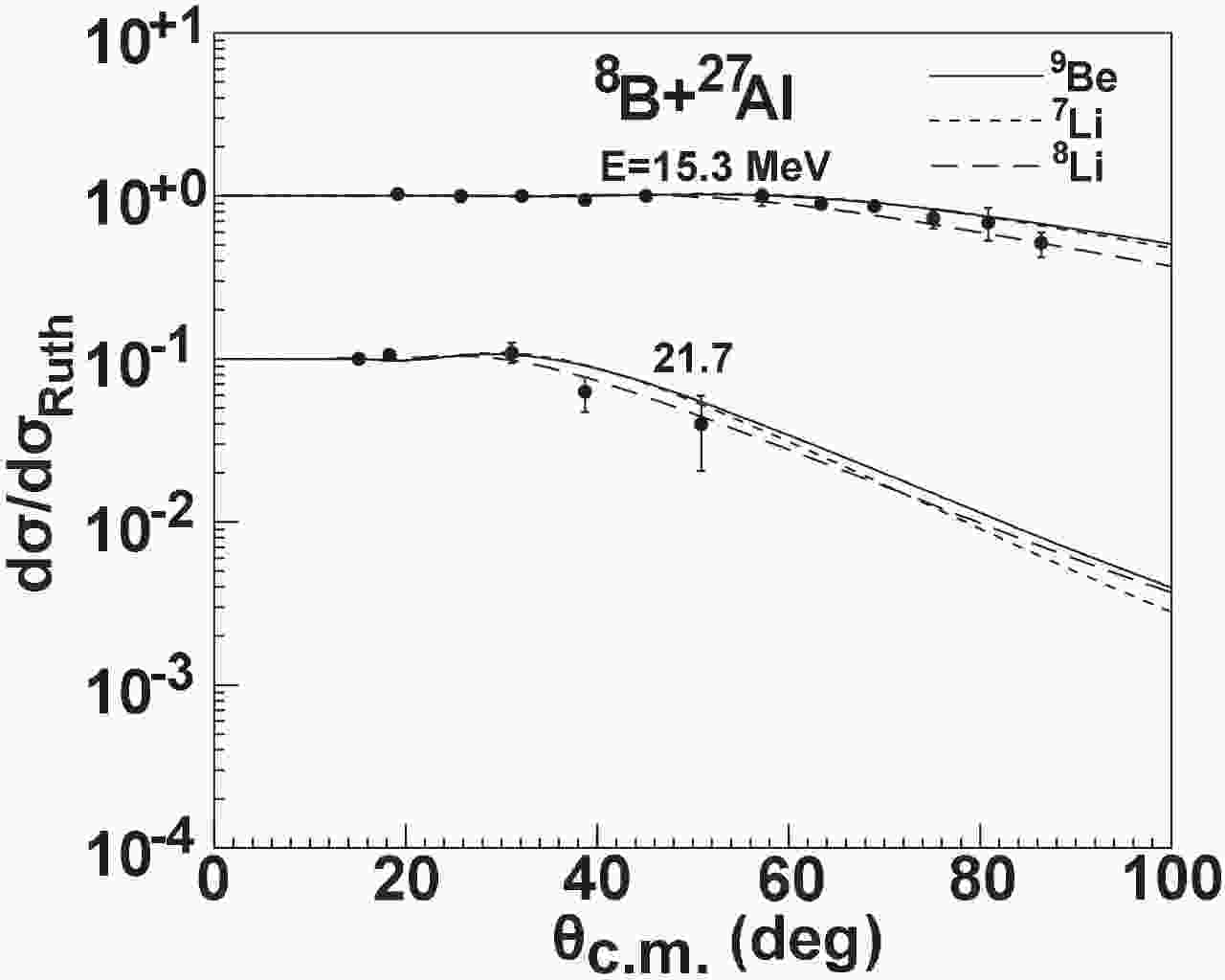
Figure 1presents the comparison of elastic-scattering angular distributions with the experimental data [6] for the8B +27Al system at incident energies of 15.3 MeV and 21.7 MeV. The figure shows that all of these global OMPs can reasonably predict the corresponding experimental data, and these predictions are relatively closed. The elastic-scattering angular distributions for the8B +58Ni system are predicted and compared with the experimental data [8] from 20.7 to 29.3 MeV, which is shown inFig. 2. Although there is some divergence among these results predicted using the different global OMPs, all of them can reasonably generate the experimental data within the error range.
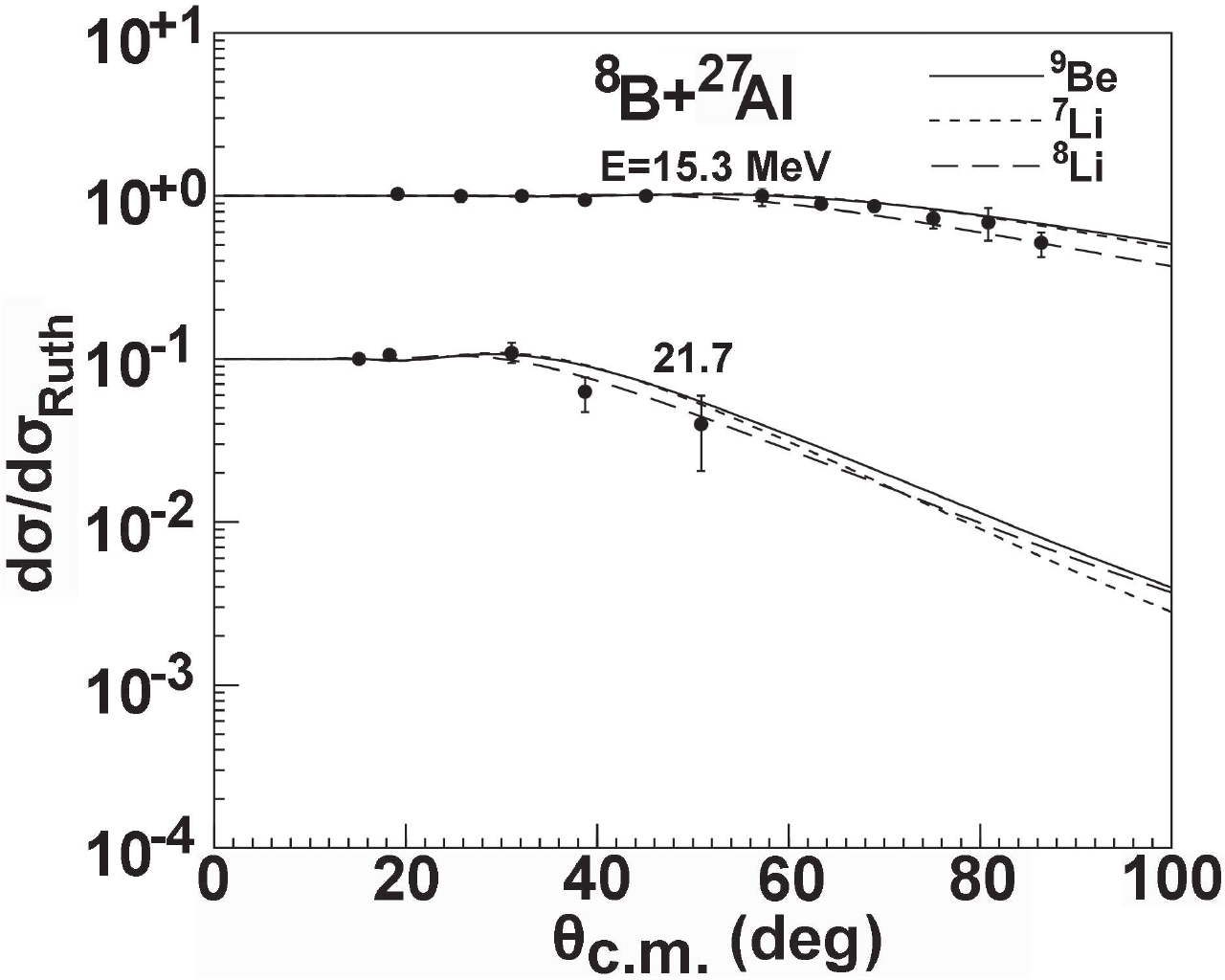
Figure 1.Comparisons of8B elastic-scattering angular distributions calculated using9Be,7Li and8Li global OMPs with corresponding experimental data for27Al.
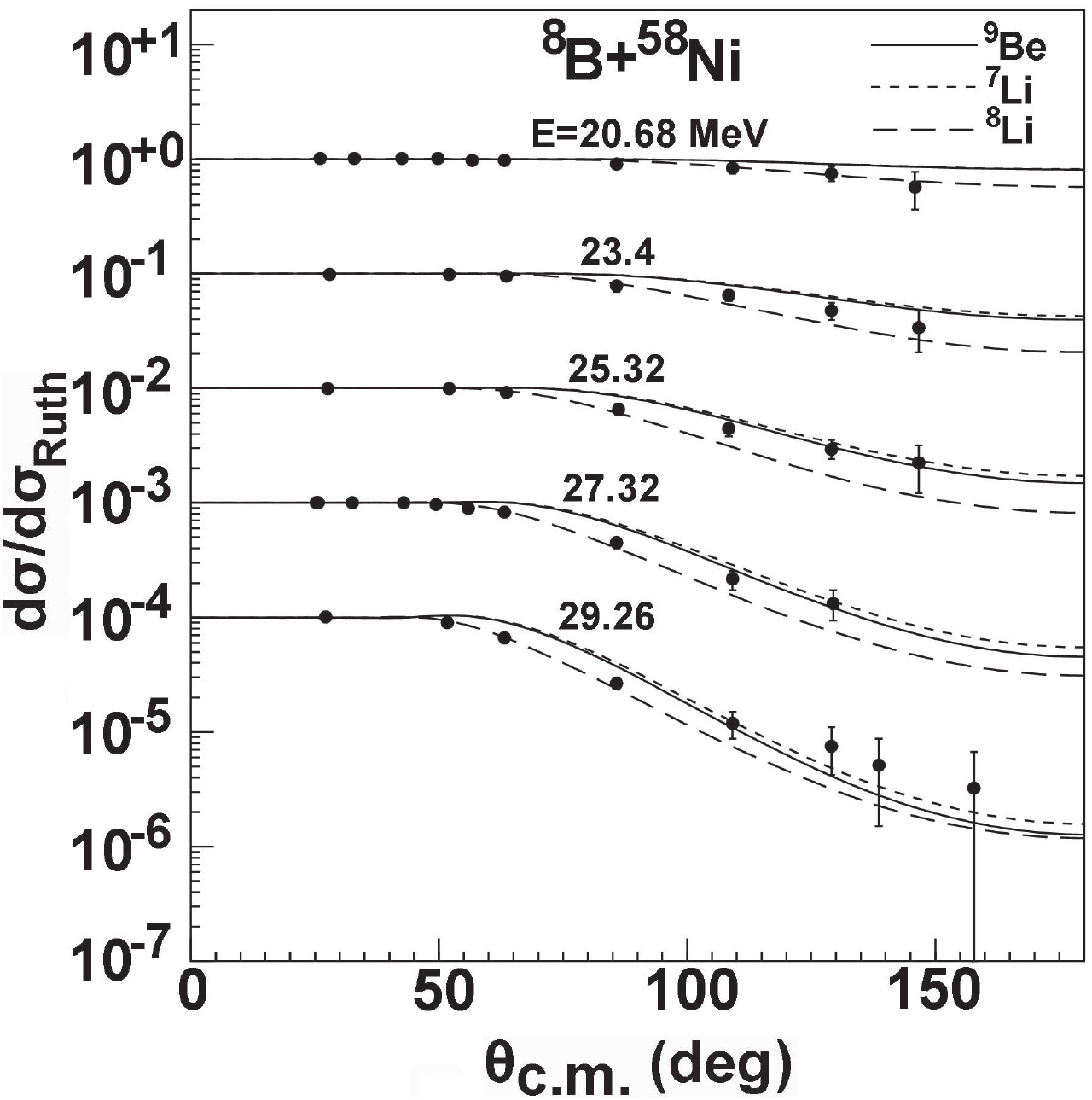
Figure 2.Same asFig. 1, but for58Ni.
For the8B +208Pb system, elastic-scattering angular distributions are also measured at incident energies of 50.0, 170.3, and 178.0 MeV [9-11]. They are further predicted using different global OMPs. The results are in good agreement with these existing experimental data [10,11] at 170.3 MeV and 178.0 MeV. As for the incident energy of 50.0 MeV, the global OMP of8Li can provide a more satisfactory description of the experimental data [9] compared with the global OMPs of9Be and7Li at backward angles. These results are shown inFig. 3.
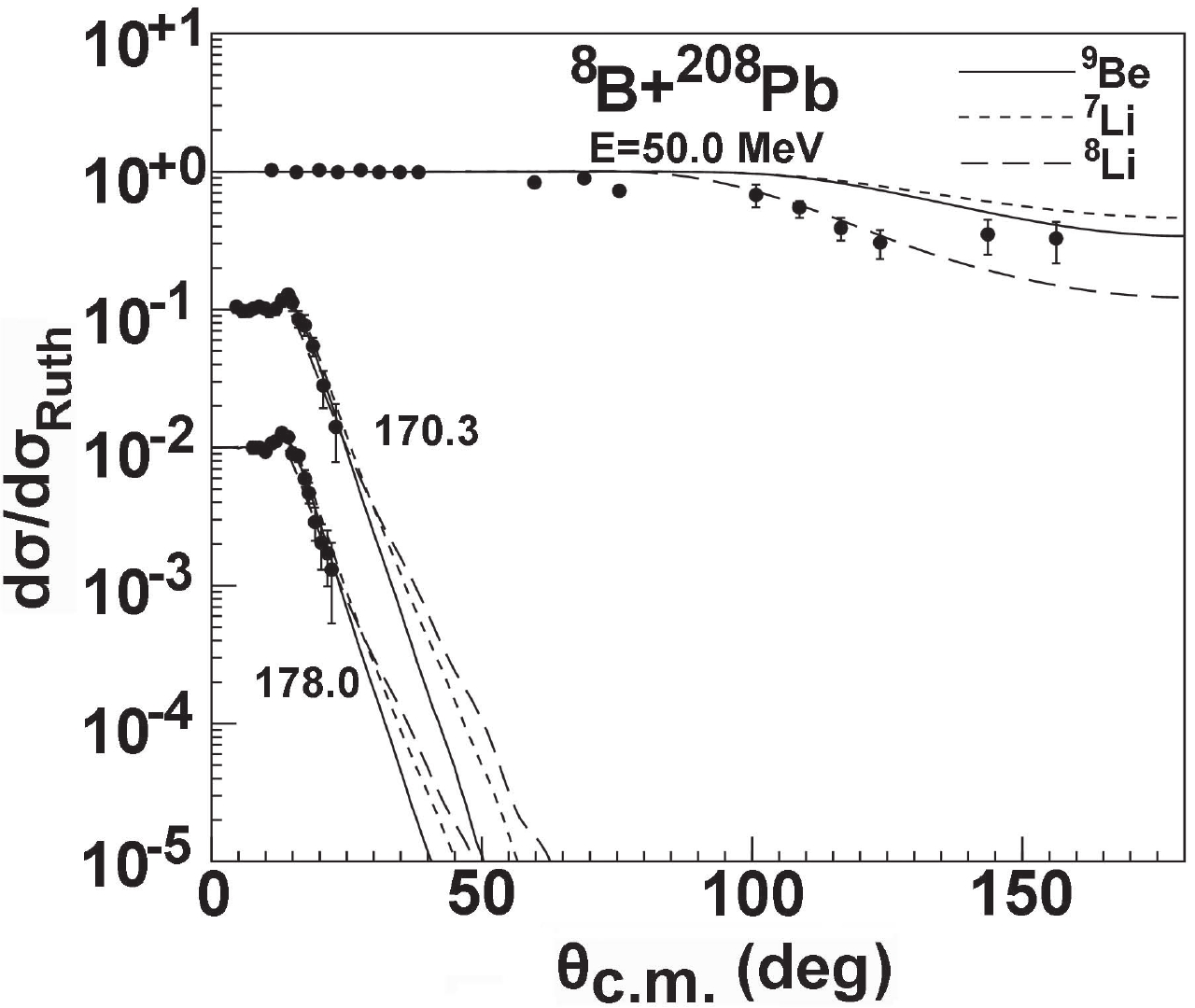
Figure 3.Same asFig. 1, but for208Pb.
Further, elastic-scattering angular distributions are also predicted using different global OMPs for the lighter target12C. Comparing with experimental data [12,13], these predictions seem inaccurate, as there is some divergence at extreme values. The result is shown inFig. 4. Since the reactions of the lighter targets (A< 24) induced by different weakly bound nuclei9Be,7Li, and8Li were not included in the process of adjusting the global OMP parameters, they should be studied using the local OMP.
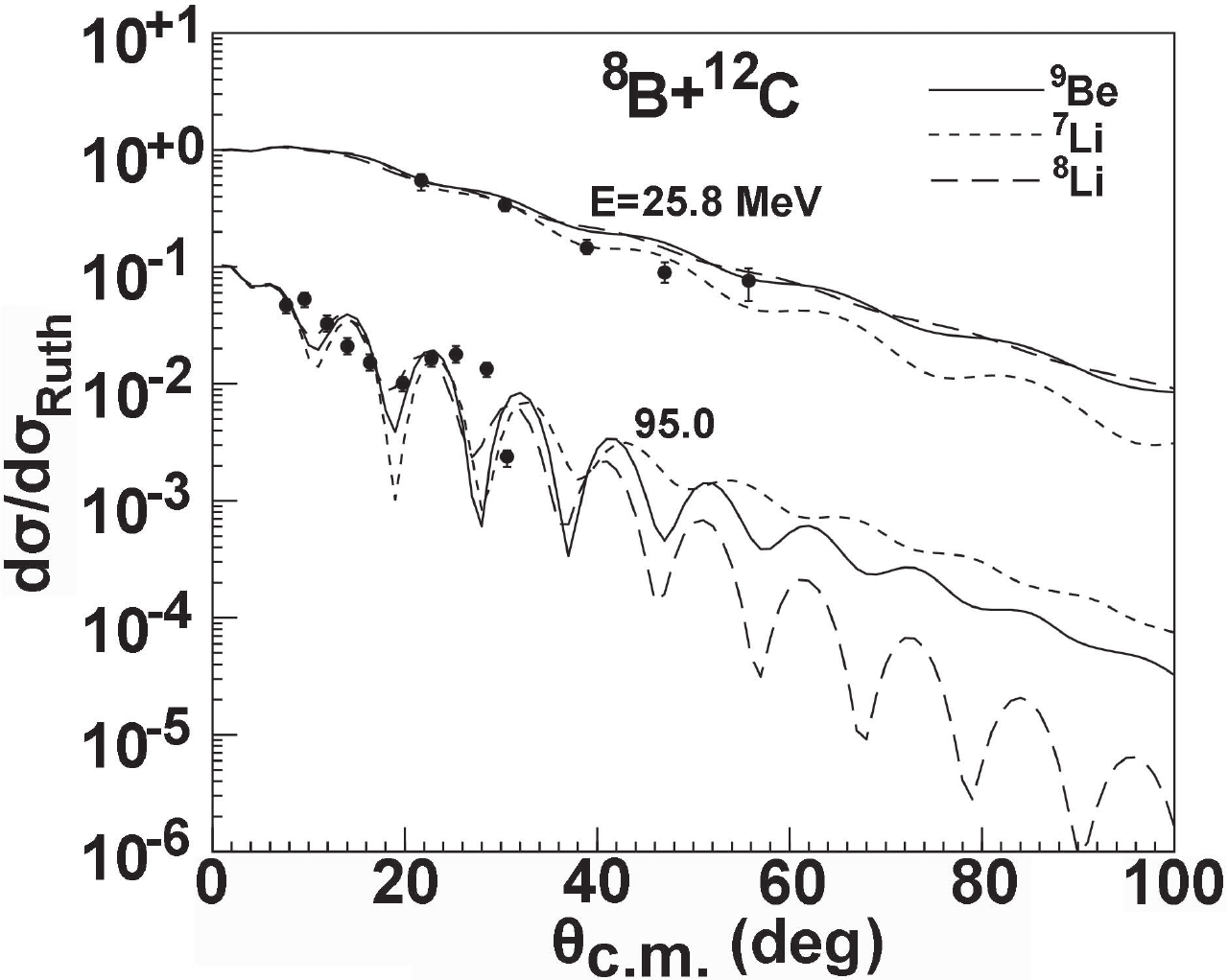
Figure 4.Same asFig. 1, but for12C.
To date, the total reaction cross-sections had been only measured for the8B +28Si system [14–16], and most of them are above 200 MeV. The comparison between the predictions and data from different experiments below 250 MeV are shown inFig. 5, which exhibits some divergences between them.
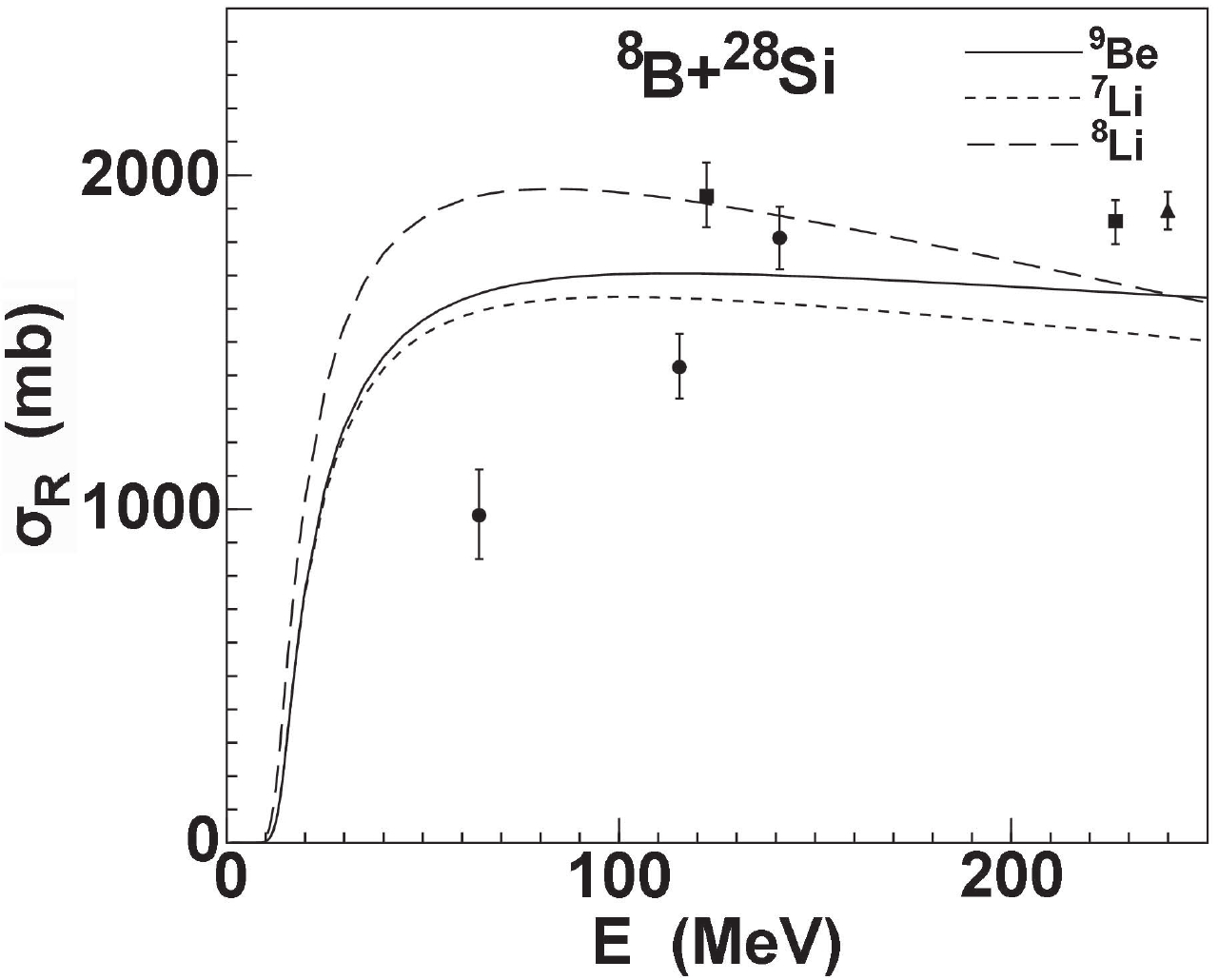
Figure 5.Comparisons of8B total reaction cross-sections calculated using9Be,7Li and8Li global OMPs with corresponding experimental data for28Si.
From the above comparisons, the theoretical results predicted using the global OMPs of9Be and7Li can provide a reasonable description of the reactions induced8B within the allowed error range, although it seems that the predictions of global OMP8Li are more consistent with the few existing experimental data.
-
In the case of the10B projectile, the elastic-scattering angular distributions and total reaction cross-sections are predicted using the global OMPs of9Be and7Li.
Figures 6and7present the comparisons of elastic-scattering angular distributions between theoretical predictions and experimental data [18] for27Al and28,30Si targets at the bombarding energies from 33.7 MeV to 50 MeV. Figure 6 shows slight oscillations in the angular distributions appearing in the angular range from 50° to 80°, while agreement between the predictions of9Be global OMP and experimental data is rather good.
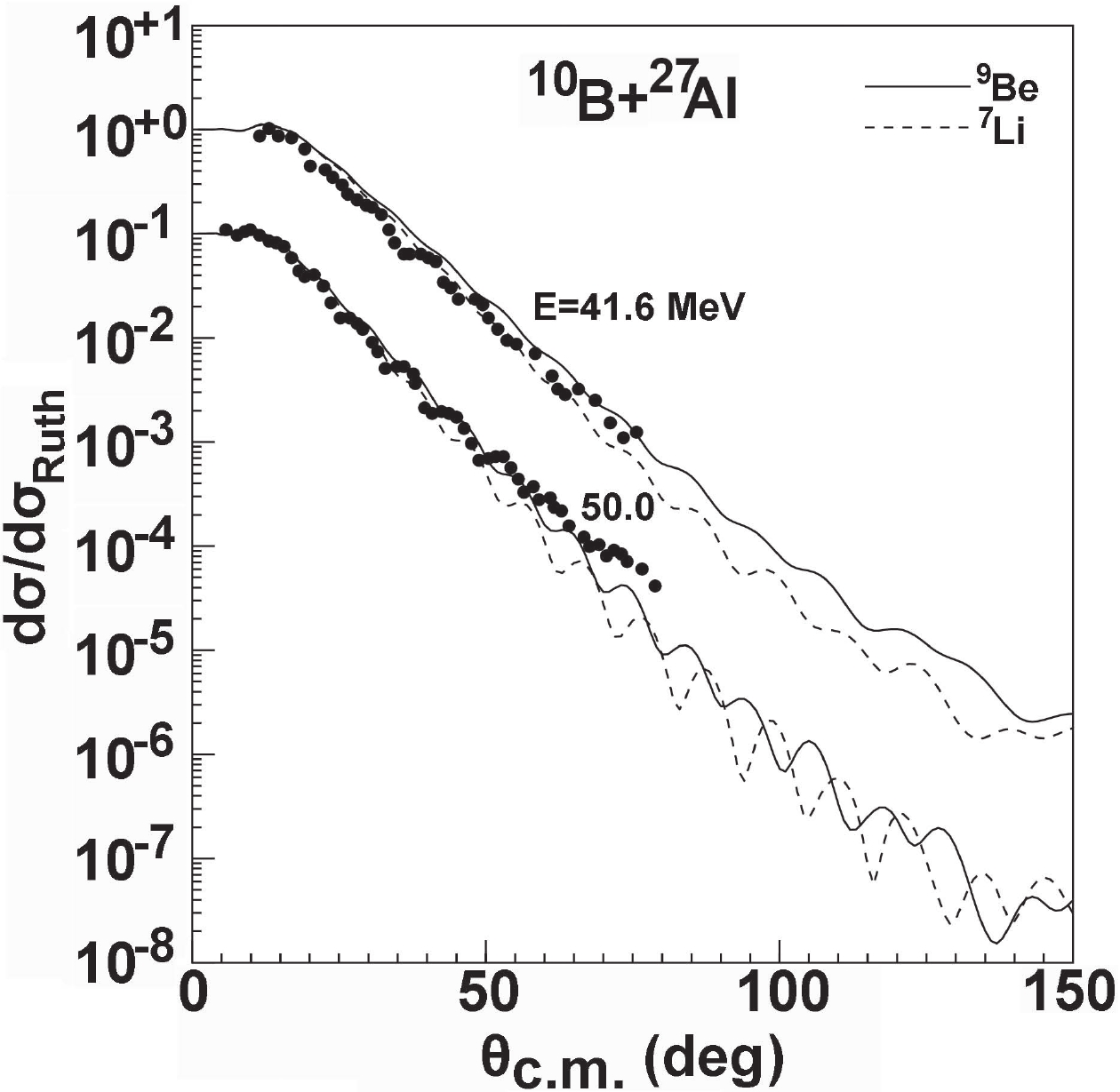
Figure 6.Comparisons of10B elastic-scattering angular distributions calculated using9Be and7Li global OMPs with corresponding experimental data for27Al.
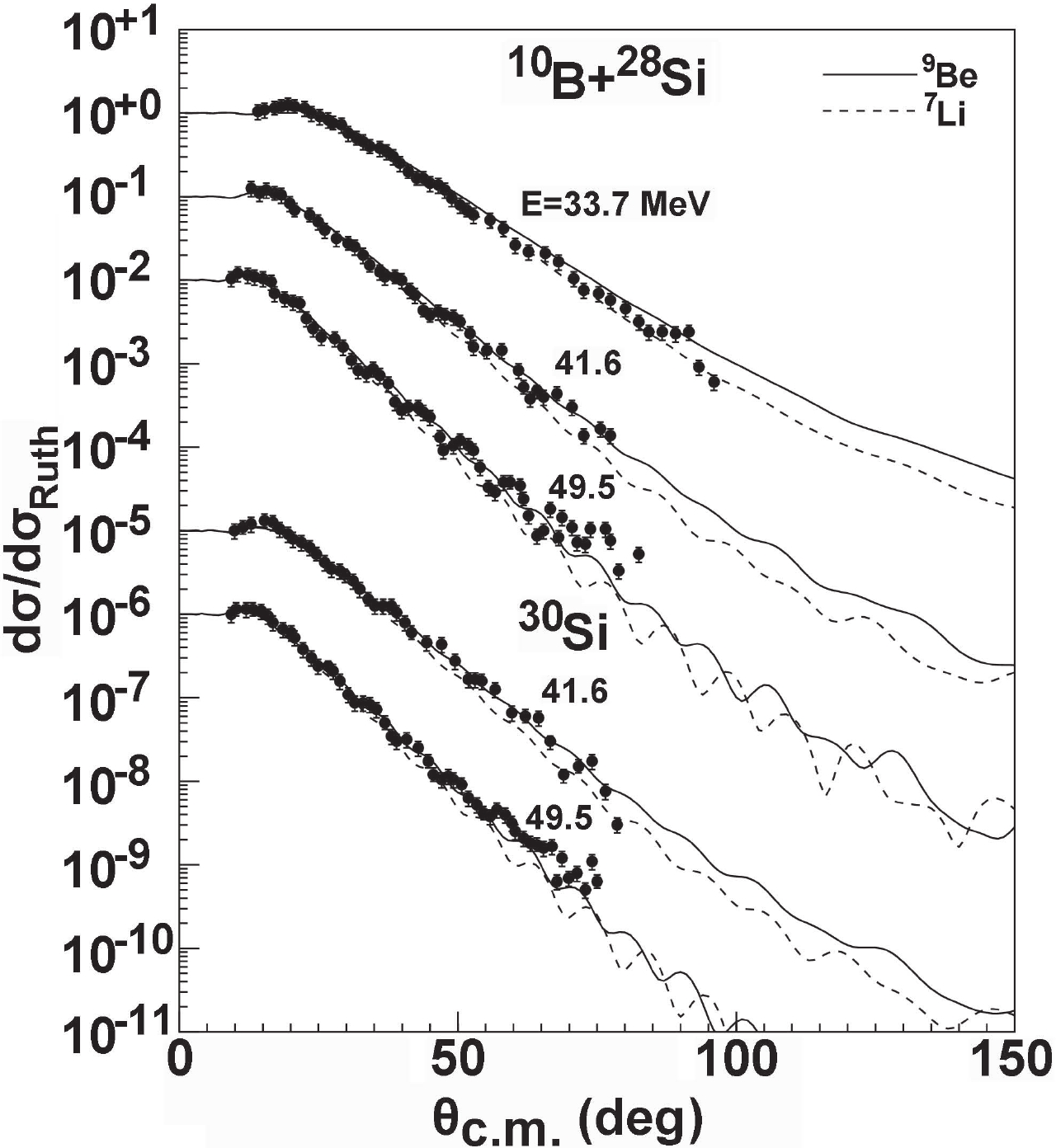
Figure 7.Same asFig. 6, but for28,30Si.
For the target58Ni, the angular distributions are predicted using global OMPs of9Be and7Li at incident energies from 19.0 MeV to 35.0 MeV. In comparison with the experimental data [19], the predictions provide a good description of these data, which is shown inFig. 8. The elastic-scattering angular distributions for10B on120Sn were measured at the bombarding energies of 31.5, 33.5, 35.0, and 37.5 MeV [20]. Global OMPs of the9Be and7Li were used to describe the experimental data. The9Be global OMP provides a better description of experimental data. The result is displayed inFig. 9.
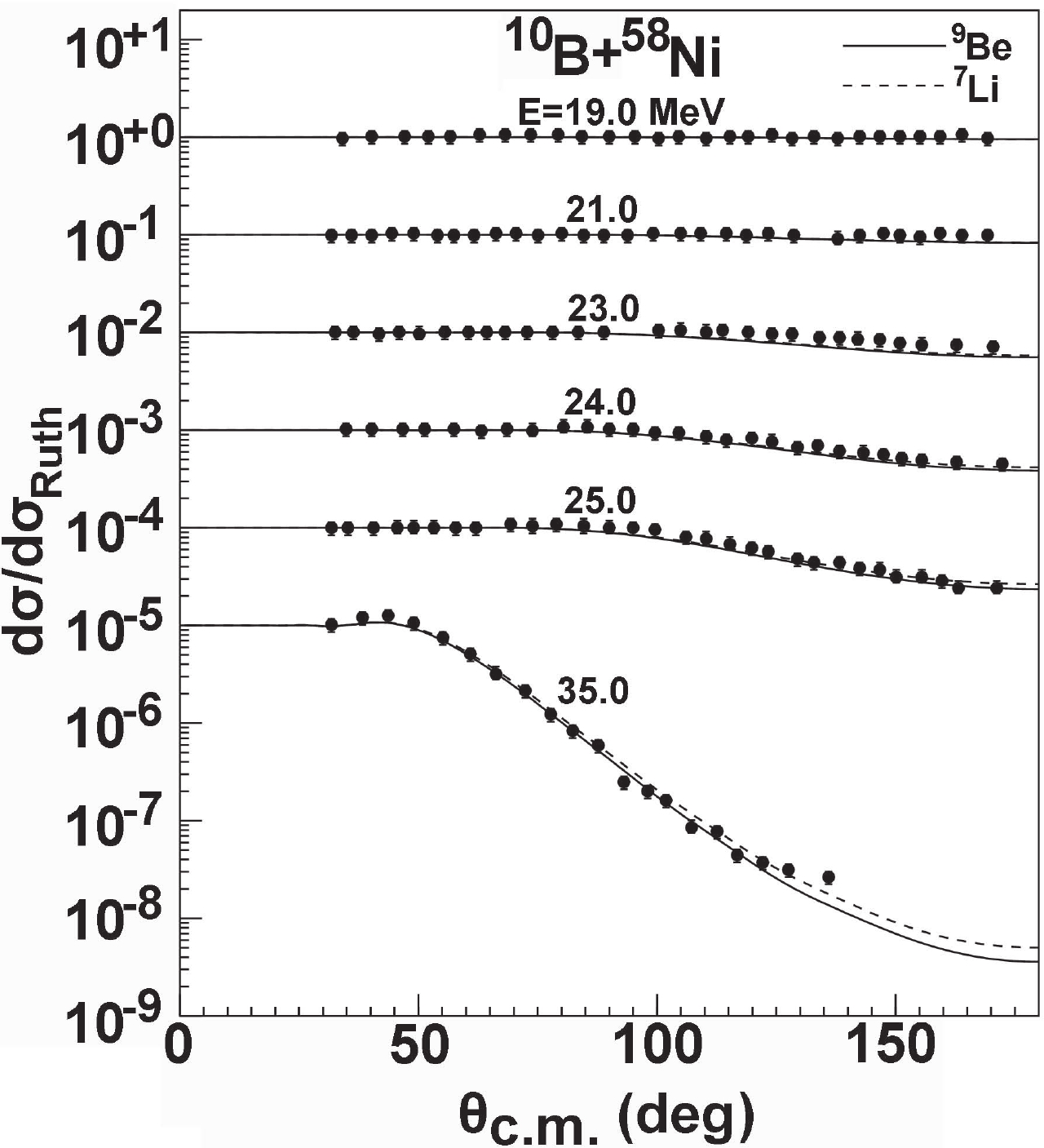
Figure 8.Same asFig. 6, but for58Ni.
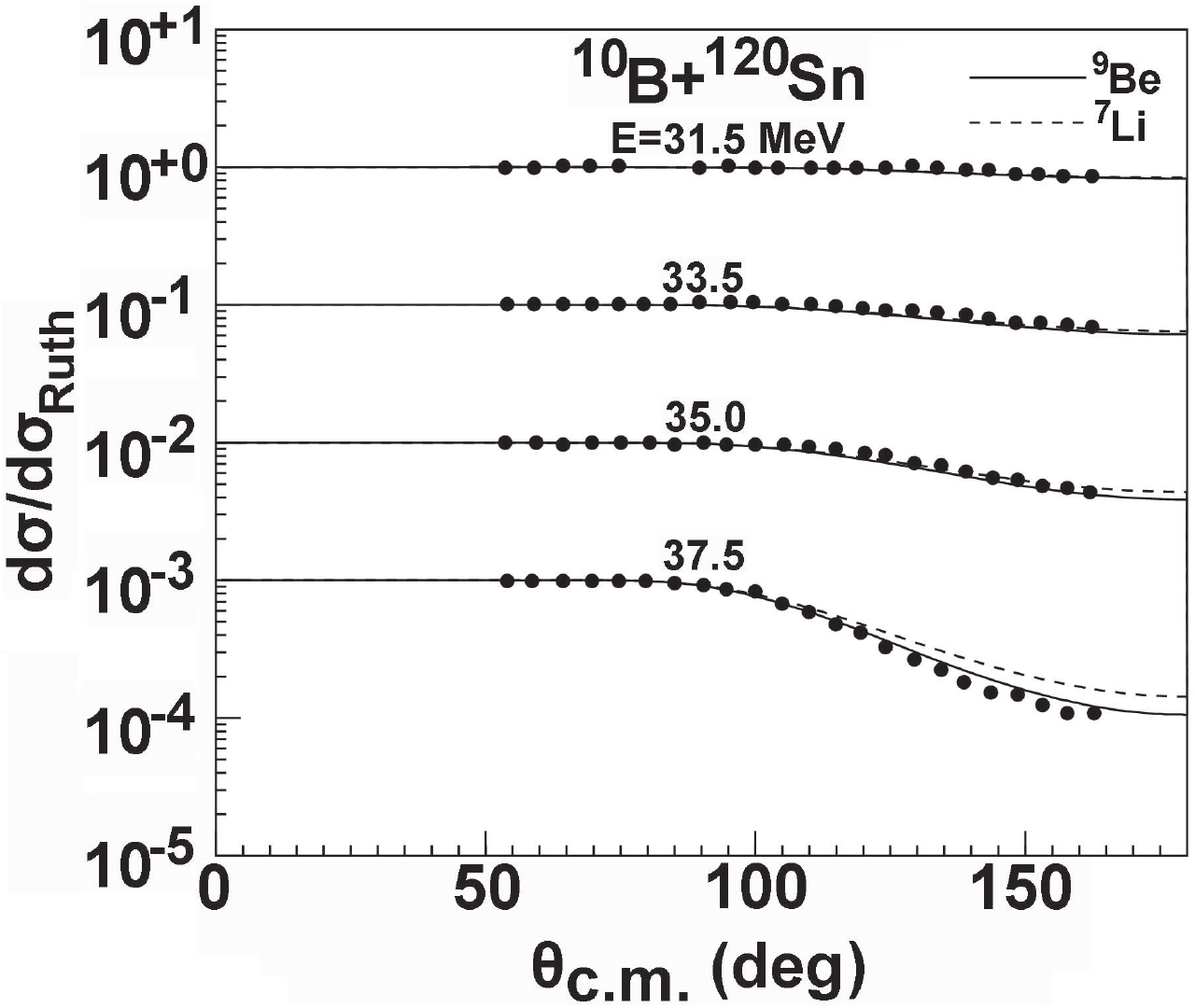
Figure 9.Same asFig. 6, but for120Sn.
Figure 10presents the theoretical results of angular distributions along with experimental measurements [21-23] for different targets. The theoretical results predicted using global OMPs of9Be and7Li give a satisfactory description for40Ca and208Pb. There are some discrepancies between them for lighter targets16O and20Ne, while the results of9Be global OMP are more consistent with the corresponding measurements.
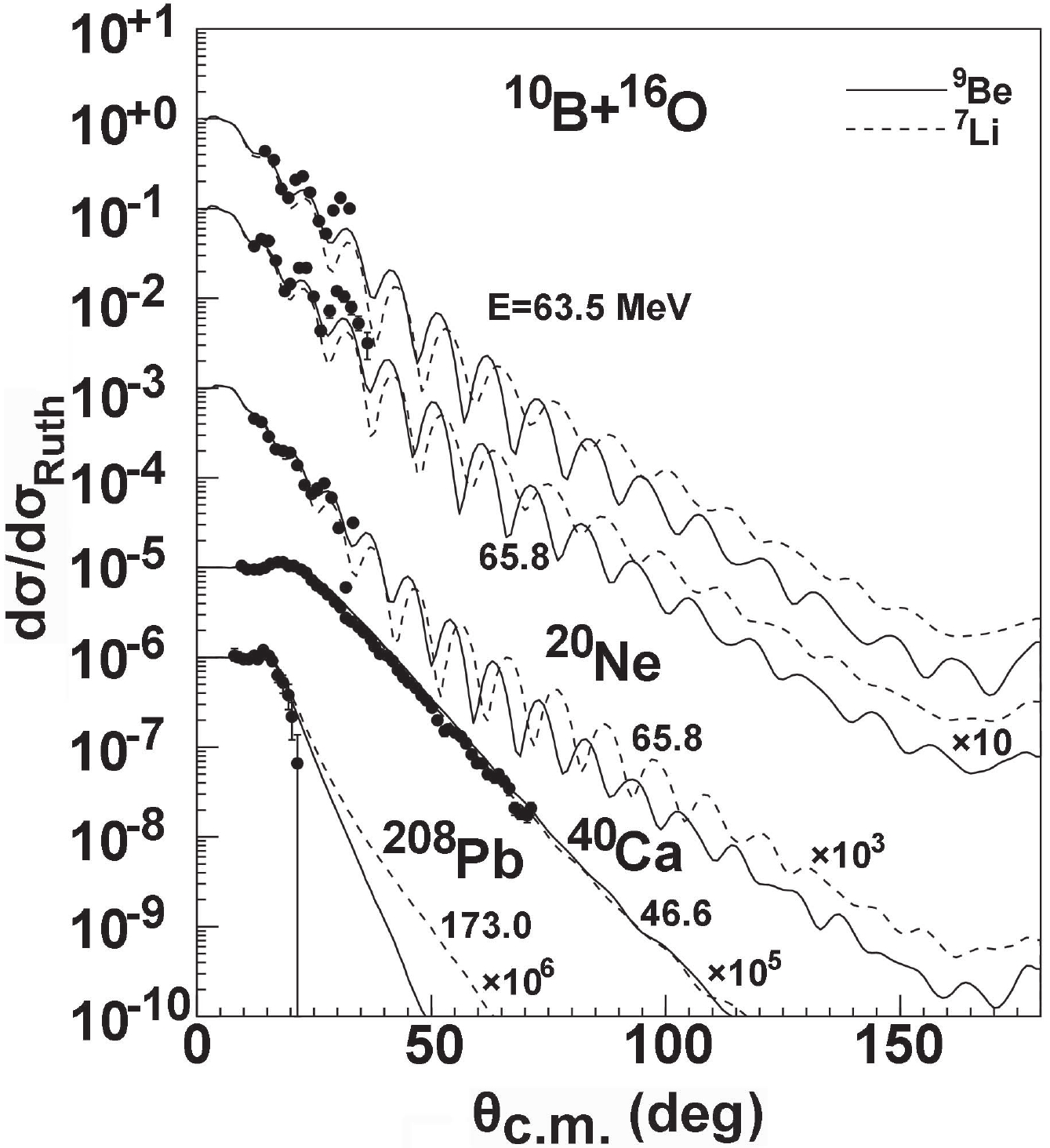
Figure 10.Same asFig. 6, but for16O,20Ne,40Ca, and208Pb.
For the other lighter targets, the elastic-scattering angular distributions are also measured by different experiments. These reactions are further predicted using different global OMPs.Figure 11presents the comparisons between them for9Be. The discrepancy observed inFig. 11between theory and experiment [24,25] indicates that the addition of coupled channels effects is needed in the backward-angle area for some lighter targets.
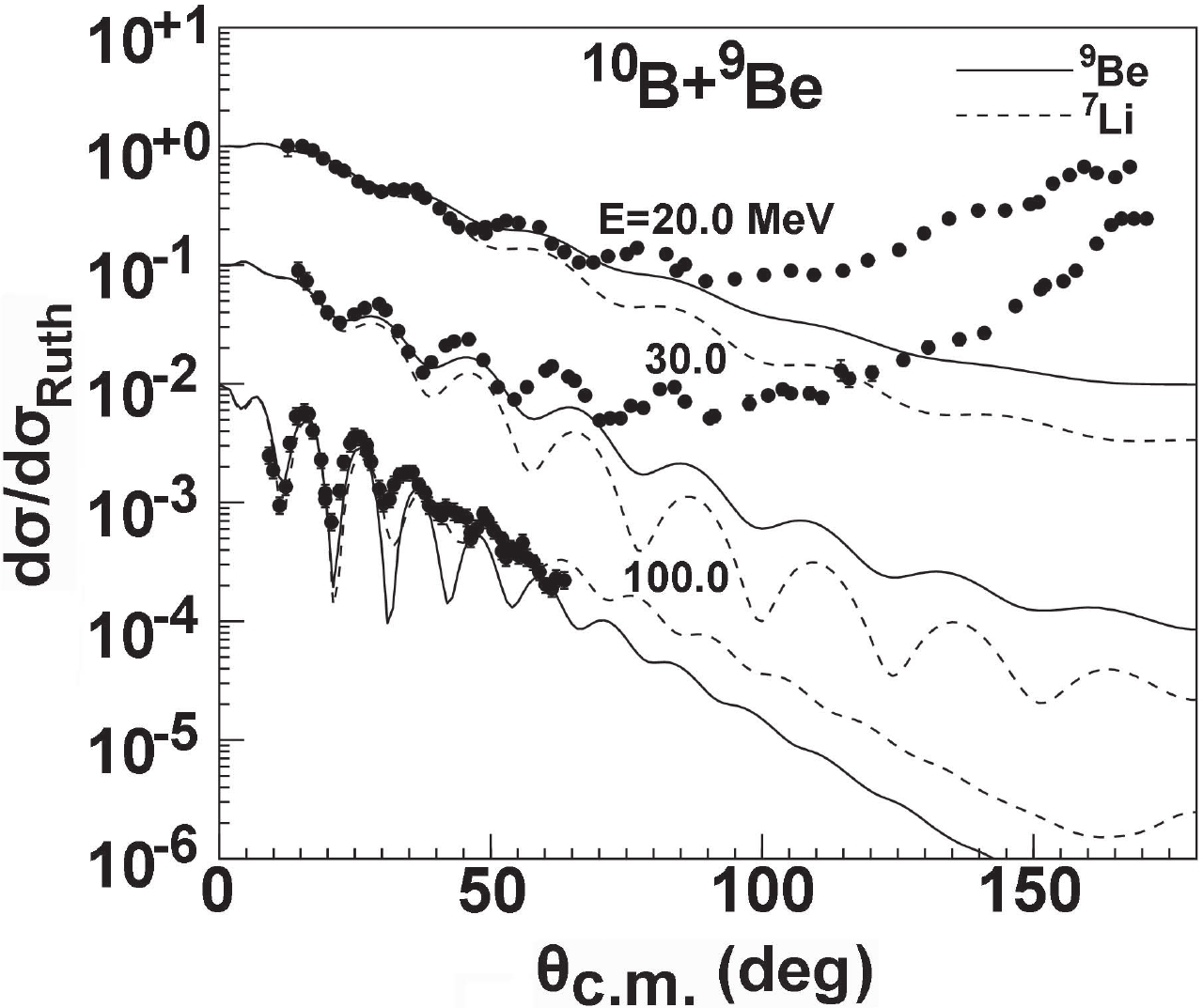
Figure 11.Same asFig. 6, but for9Be.
For the total reaction cross-sections of10B, there are only the experimental data fornat.Si. We compare the predicted results of total reaction cross-sections to the experimental data [16,26,27] for28Si. The result is shown inFig. 12. The results of the9Be global OMP are completely in agreement with all of the experimental data within the error range. For208Pb, the data of total reaction cross-sections [23] was derived in terms of the optical model by analyzing the elastic scattering data at different incident energies. The predictions of the global OMP of9Be and7Li are also compared with the data, which is shown inFig. 13. All of them are in good agreement.
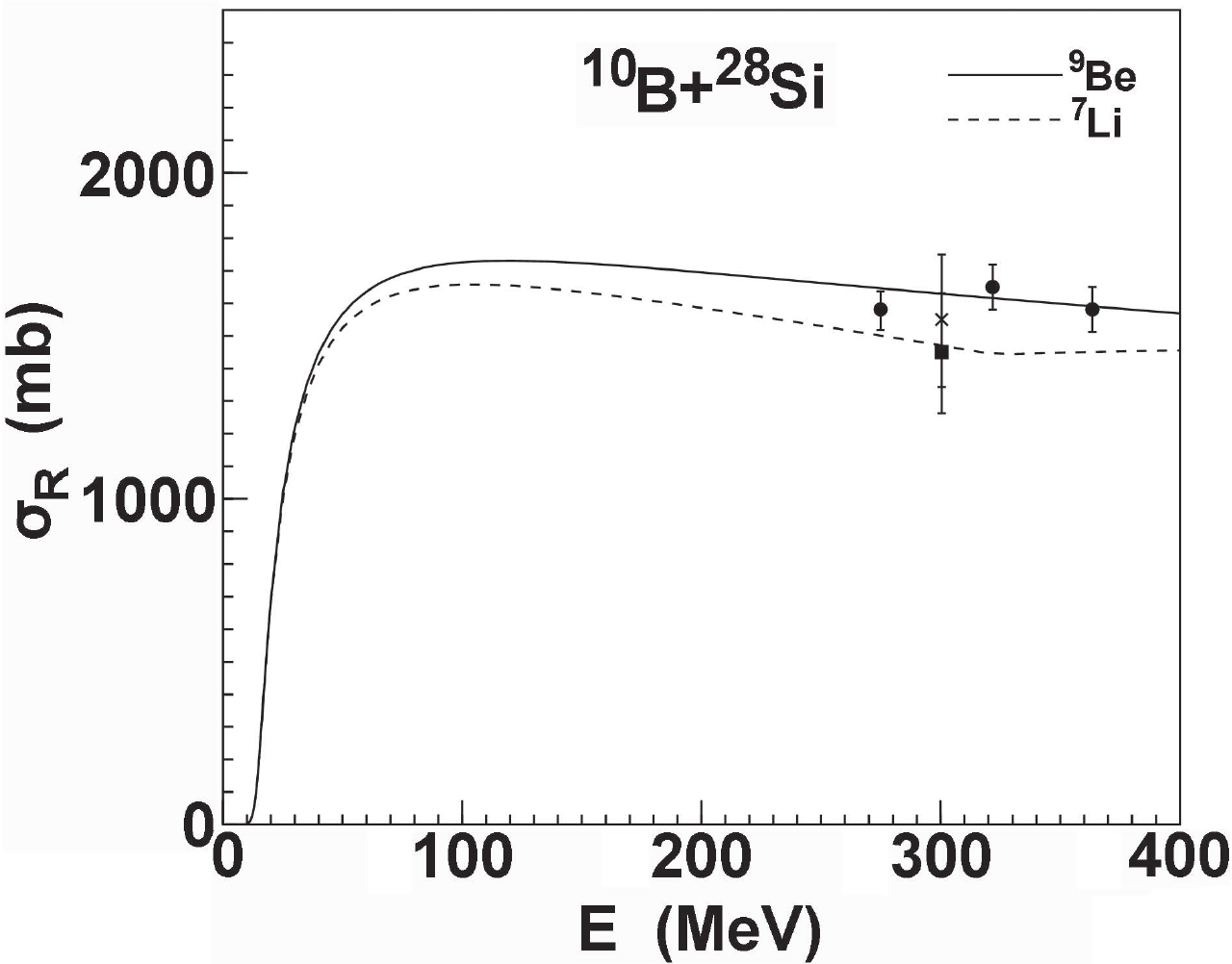
Figure 12.Comparison of10B total reaction cross-sections calculated using9Be and7Li global OMPs with corresponding experimental data for28Si.
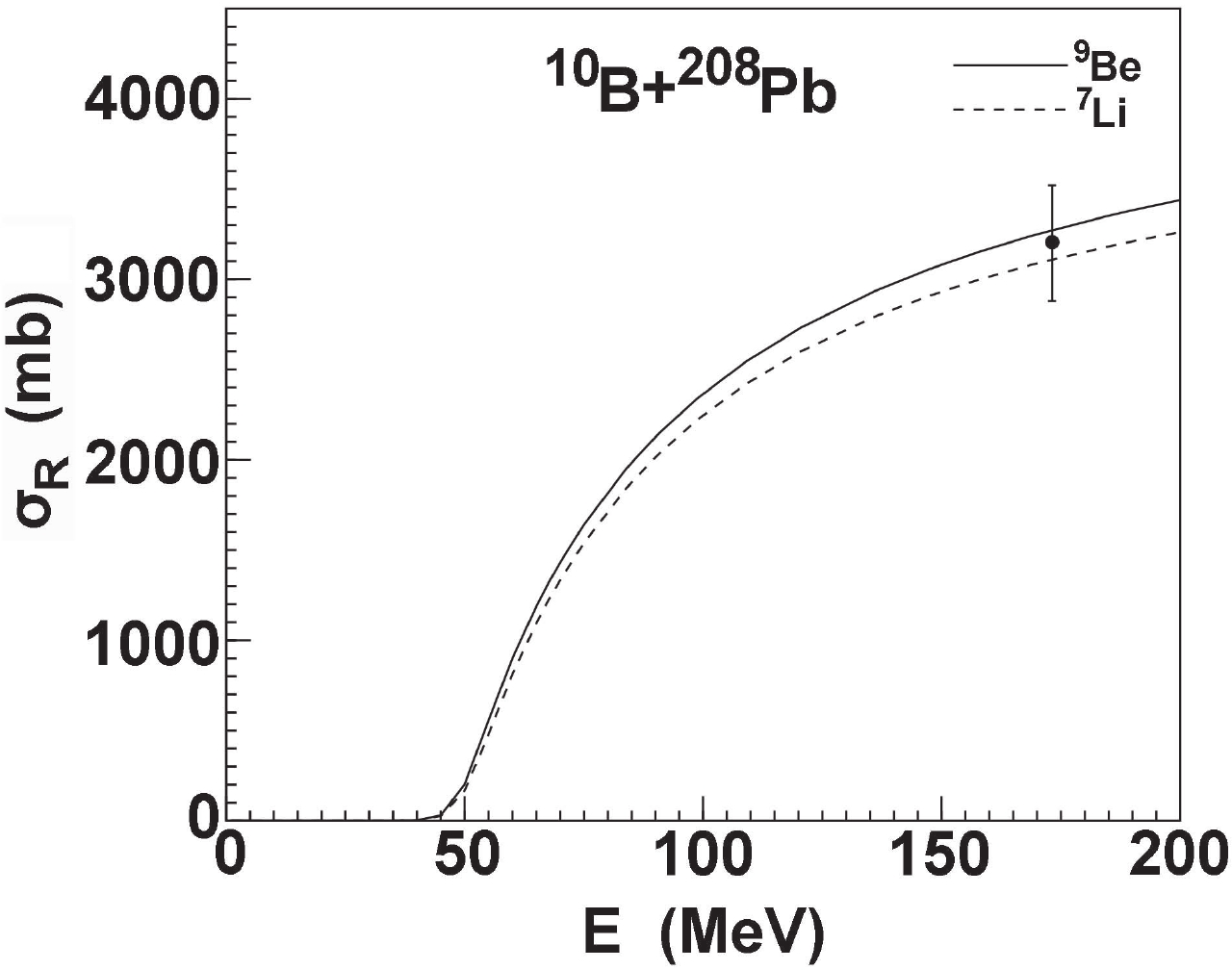
Figure 13.Same asFig. 12, but for208Pb.
-
For the11B projectile, we obtained the global OMP [3] by adjusting the radius parameters of the real part potential on the basis of global OMP of7Li. Although the predictions gave a reasonable description of the11B elastic scattering for most of targets, the OMP cannot provide a satisfactory agreement with the experimental data in the backward-angle area for a few targets. In this section, the elastic scattering observables are predicted using the global OMPs of9Be and11B. The predictions are further compared with the existing experimental data.
Figure 14presents the comparisons of elastic-scattering angular distributions between theoretical predictions and experimental data [18] for28,30Si targets at the bombarding energies from 33.7 MeV to 50 MeV. The fits are generally reasonable with no apparent systematic nor major discrepancy of the data. However, the results predicted using the global OMP of9Be are more consistent with the experimental data.
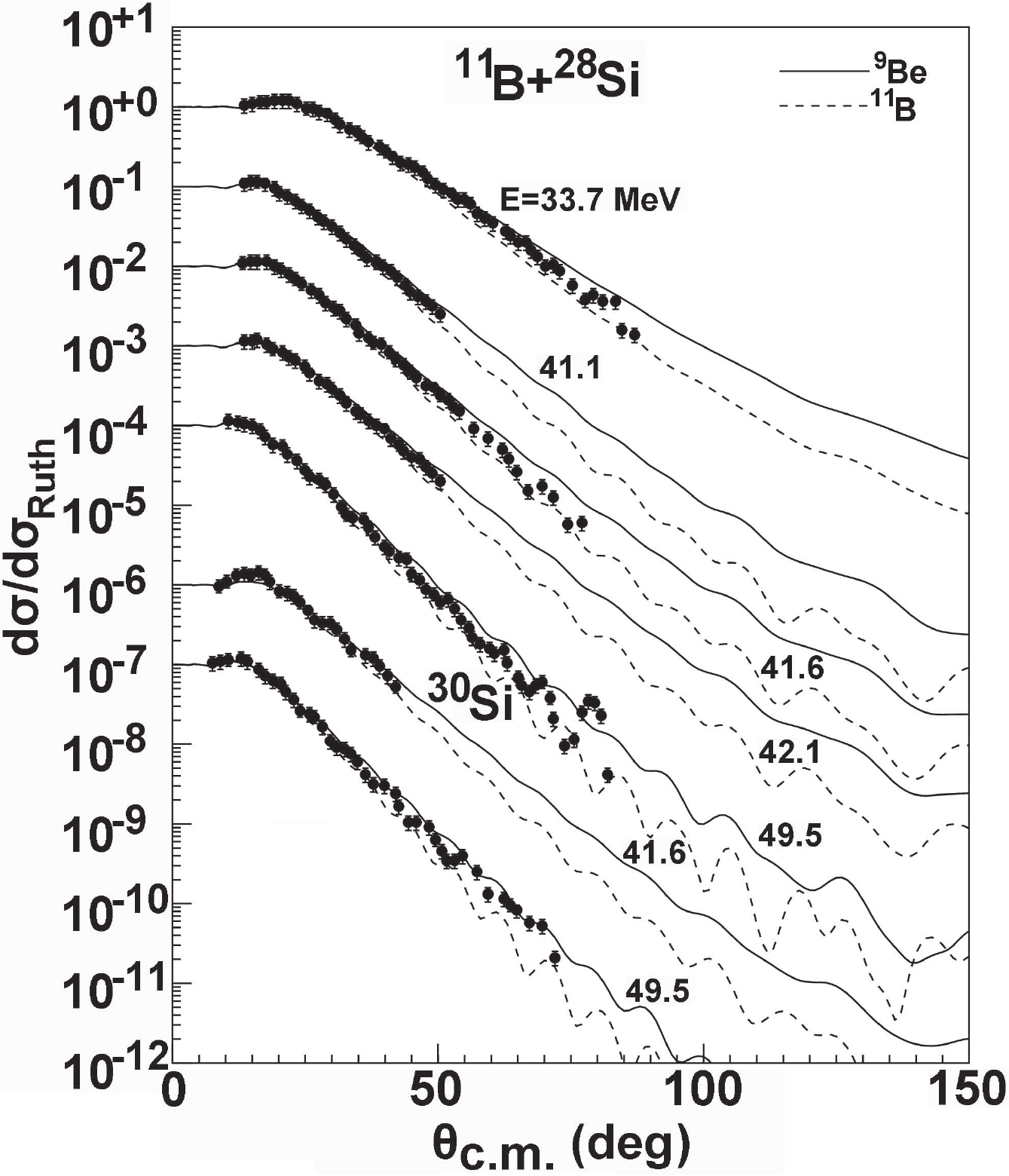
Figure 14.Comparisons of11B elastic-scattering angular distributions calculated using9Be and11B global OMPs with corresponding experimental data for28,30Si.
The elastic-scattering angular distributions for58Ni are measured at incident energies from 19.0 MeV to 35.0 MeV [28]. The comparison between the predictions and experimental data is shown inFig. 15. The figure shows that the predictions using global OMPs of9Be and11B are almost consistent and in good agreement with the data, except for 35.0 MeV, where the prediction using the global OMP11B is more consistent with the experimental data. Moreover, the elastic angular distributions for58Ni are measured at the same incident angle with different incident energies [29]. Comparisons of the predictions of elastic-scattering angular distributions from the global OMP of9Be and11B show that all of them are identical and can reproduce the data, which is shown inFig. 16.
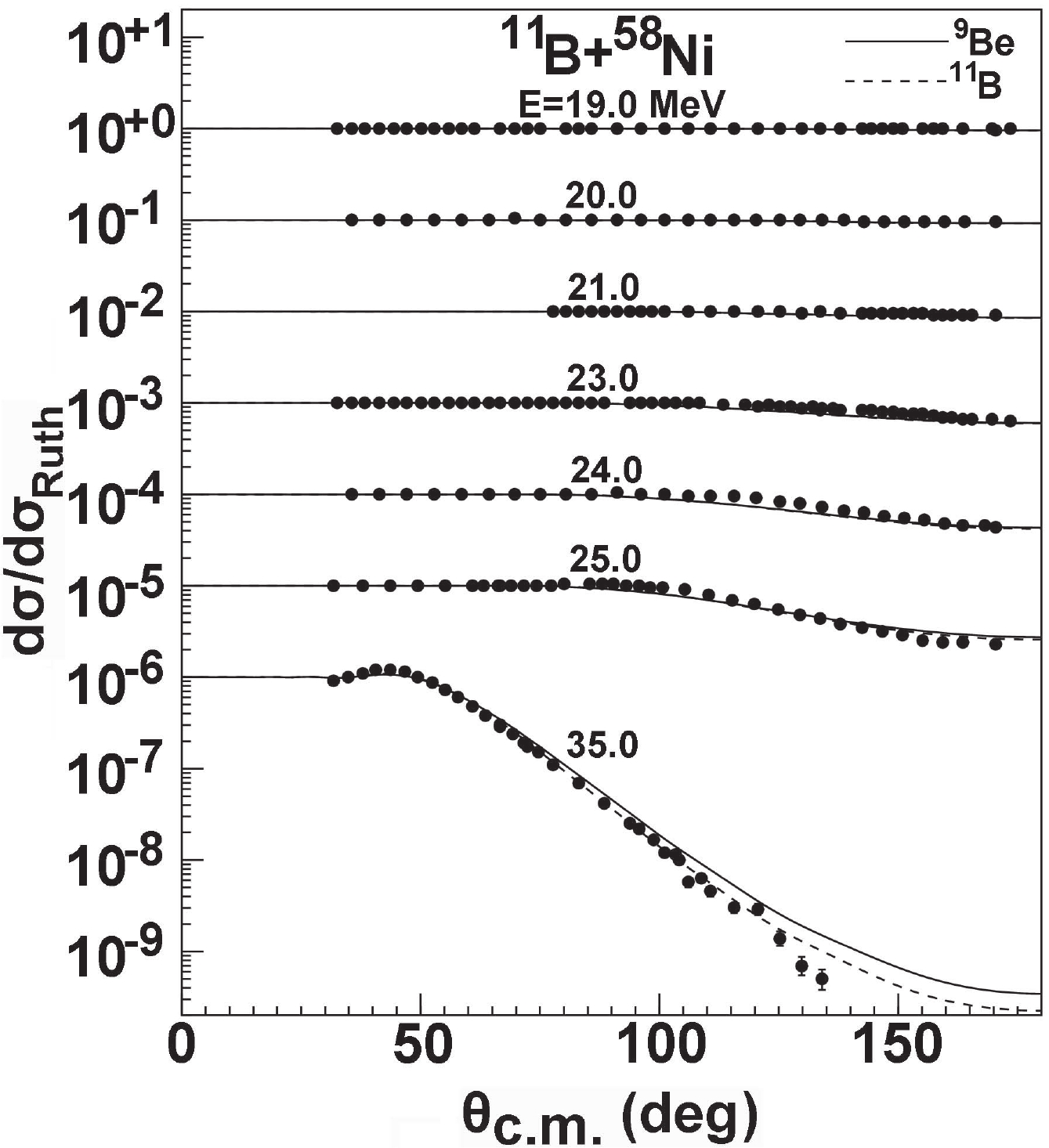
Figure 15.Same asFig. 14, but for58Ni.
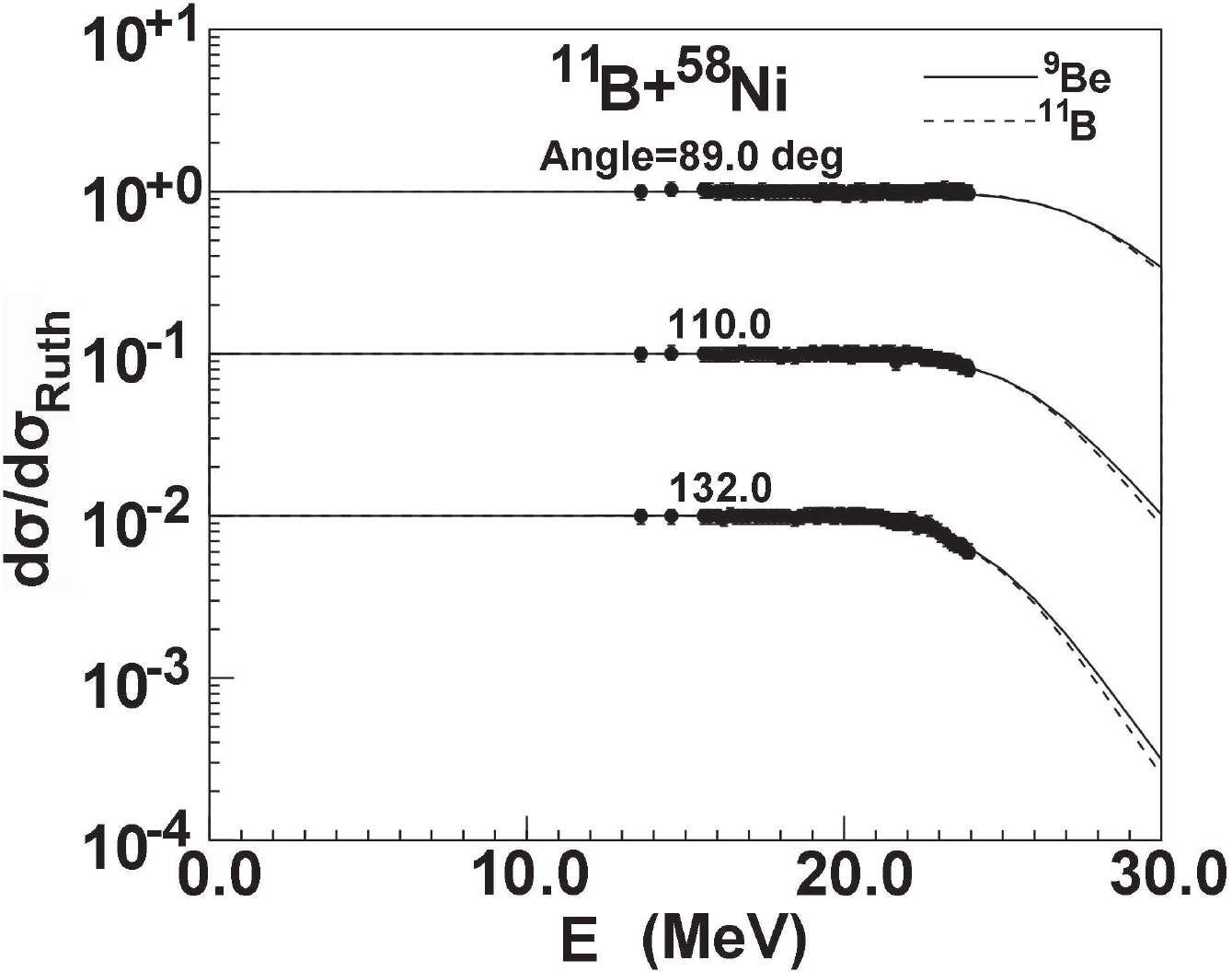
Figure 16.Calculated elastic-scattering angular distributions in Rutherford ratio at same incident angles compared with experimental data for58Ni target.
For40Ca and208Pb, the elastic angular distributions are measured at incident energies of 51.5 MeV and 69.0 MeV [21,30].Figure 17presents the comparisons between the predictions and experimental data. The predictions of9Be and11B are in good agreement with the experimental data. For209Bi, the angular distributions for elastic scattering calculated using the11B global OMP were larger than the experimental data [30,31] at backward angles. Hence, the radius of the real part for the11B global phenomenological OMP was added by 0.15 to improve the fit with the data [3].Figure 18presents the theoretical results predicted using the global OMPs of9Be and11B together with the experimental data. From the figure, one can see that the calculations of9Be global OMP are in excellent agreement with the experimental data at all energies. Compared to those of the global OMP11B, the global OMP of9Be can give a better prediction for the11B +209Bi reaction. One of the reasons may be that the11B global OMP was obtained by only adjusting the radius parameters of the real part potential on the basis of the global OMP of7Li [3], since the existing experimental data on elastic scattering is scarce for the reactions induced by the11B projectile. Moreover, this may be the influence of target shell effects for the doubly closed shell208Pb nucleus and one proton outside the closed shell209Bi nucleus. Meanwhile, the radius parameter of the real potential of the global OMP9Be was further defined by
$ r_{R_{0}}+r_{R_{1}}A^{\frac{1}{3}} $ as compared to$ r_{R_{0}} $ of the global OMP11B, which may compensate the influence of target shell effects.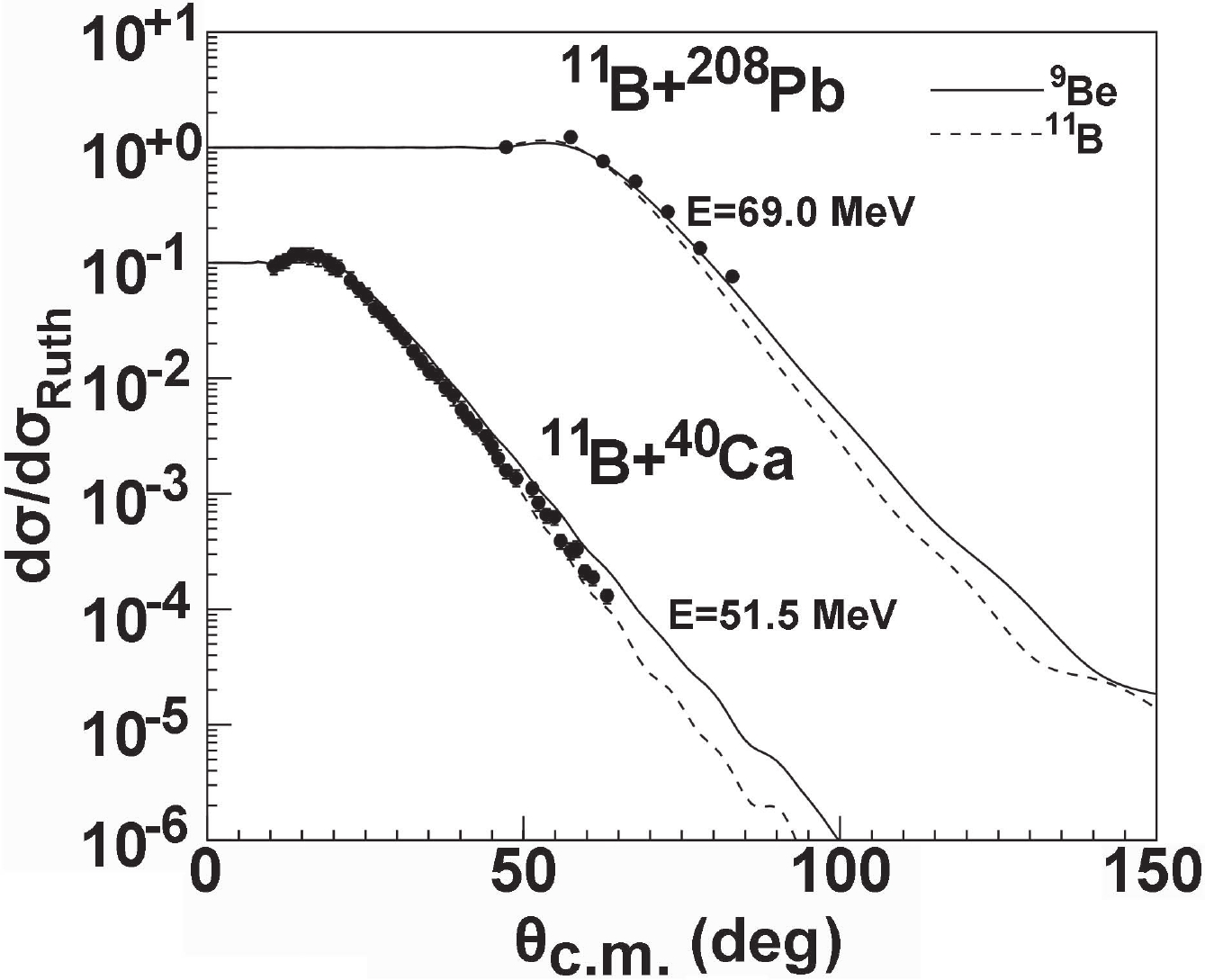
Figure 17.Same asFig. 14, but for40Ca and208Pb.
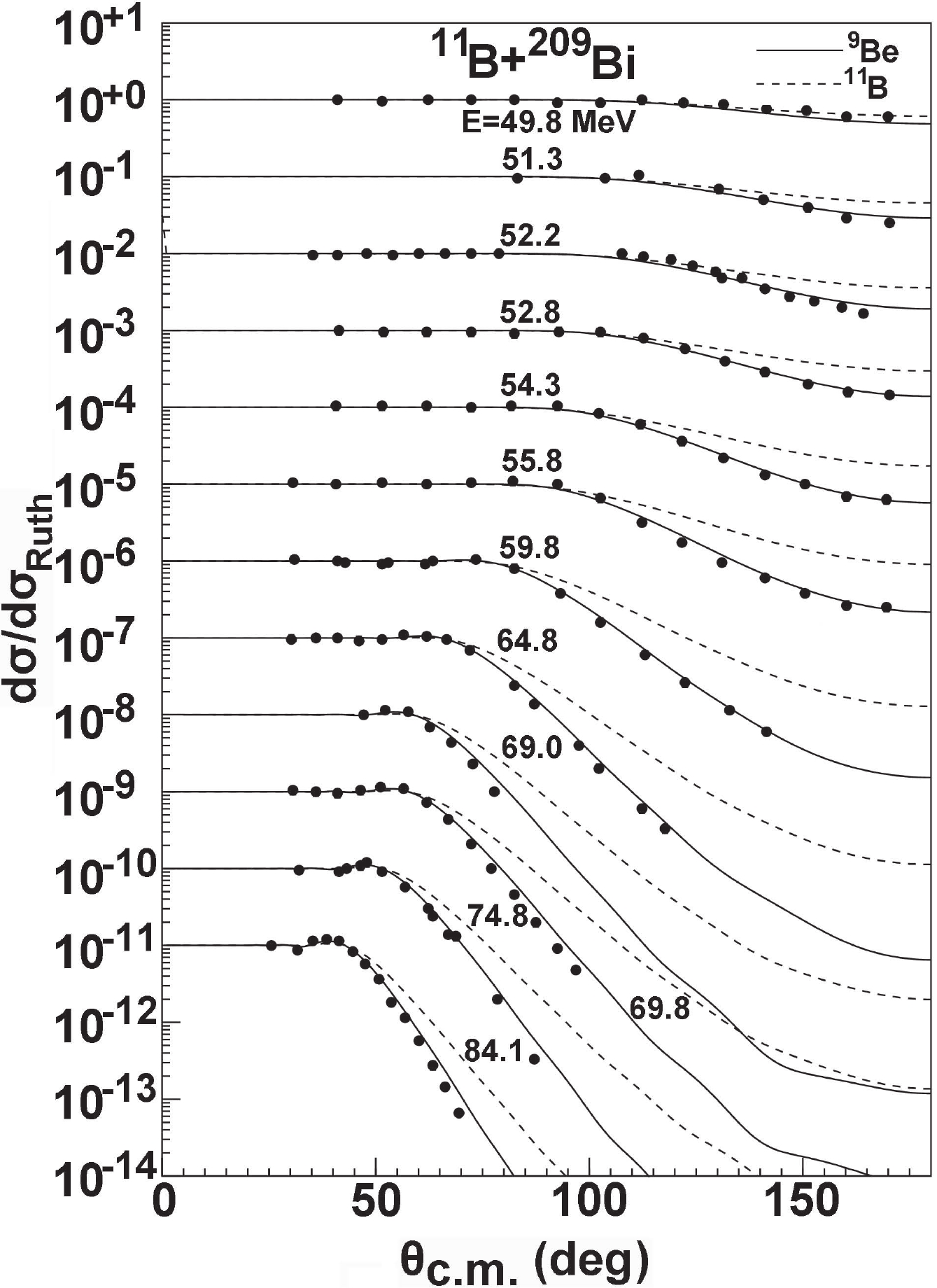
Figure 18.Same asFig. 14, but for209Bi.
Similarly, the elastic-scattering angular distributions for some lighter targets are predicted using the global OMPs of9Be and11B.Figure 19presents the comparisons for12,13C. The discrepancy observed inFig. 19between theory and experiment [32-34] shows that it possibly requires the addition of coupled channels effects in the backward-angle area for some lighter targets.
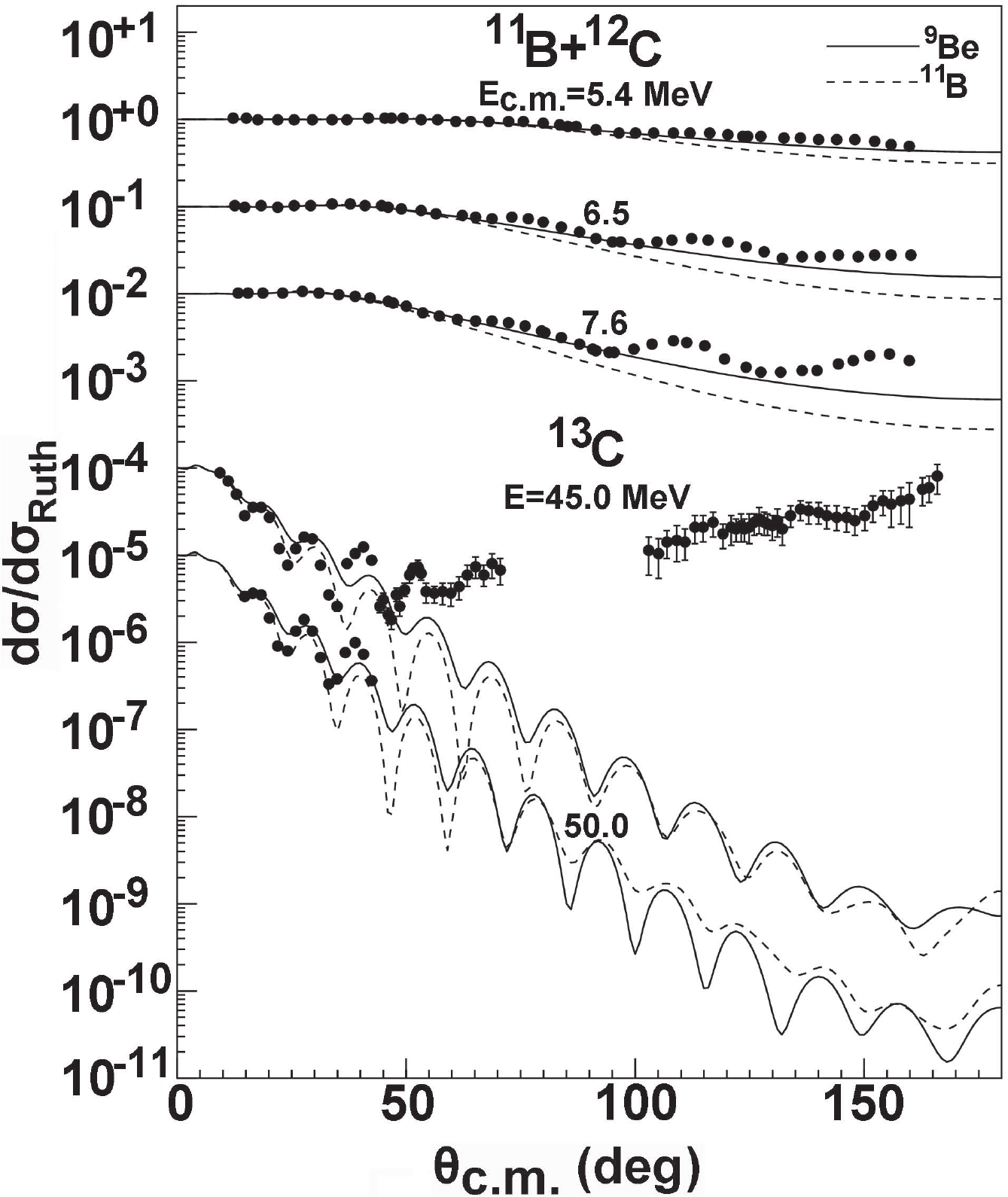
Figure 19.Same asFig. 14, but for12,13C.
There are no measurements of the total reaction cross-sections for the reactions induced by11B. The existing data of total reaction cross-sections for209Bi were extracted from the experimental elastic scattering data [31]. The predictions of total reaction cross-sections are further compared with the data for209Bi, which is shown inFig. 20. The predictions are in satisfactory agreement with the data extracted from the measured elastic-scattering angular distributions.
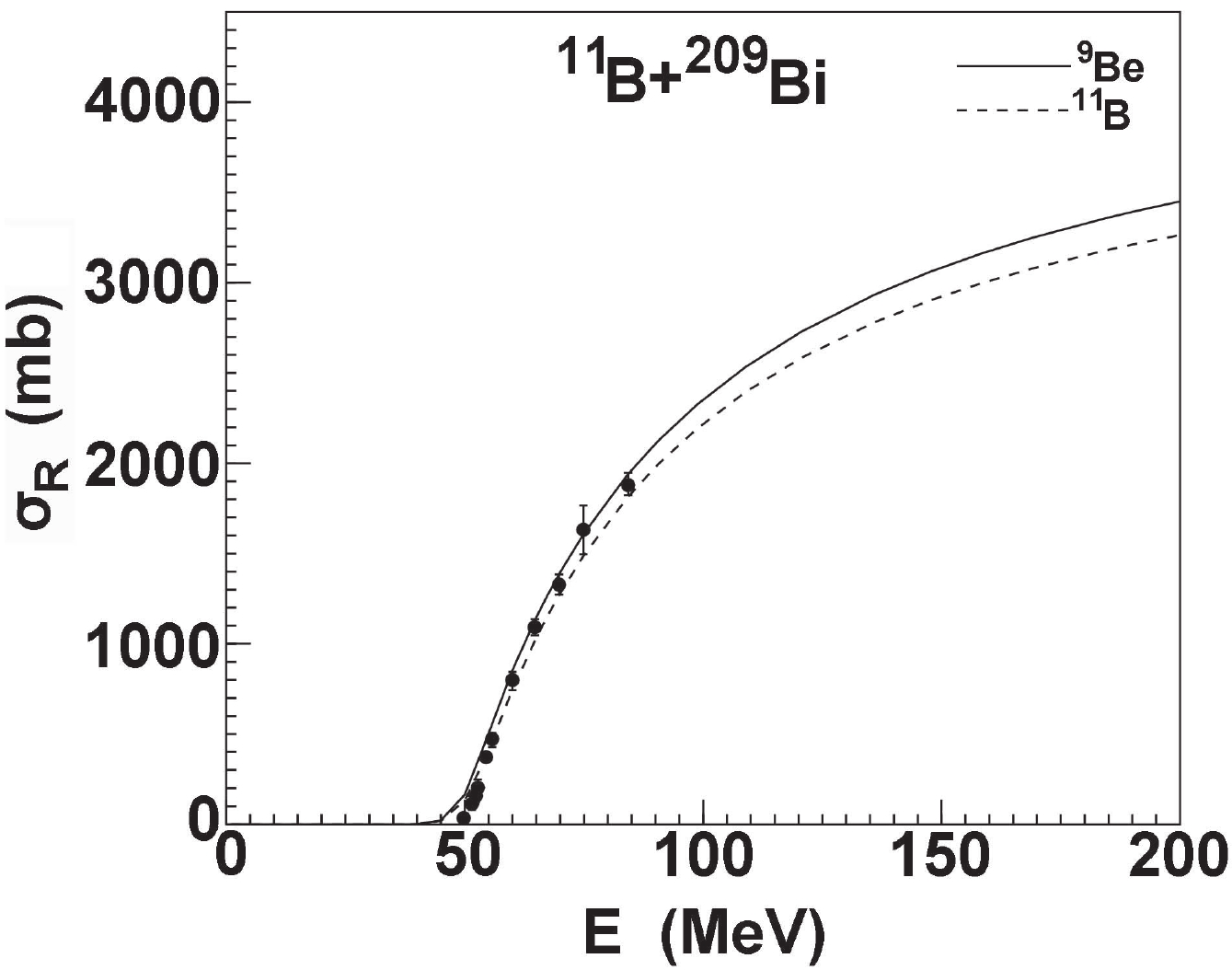
Figure 20.Comparisons of11B total reaction cross-sections calculated using9Be and11B global OMPs with corresponding data for209Bi.
-
We predicted elastic scattering observables involving8,10,11B projectiles by applying the obtained global OMP of9Be. We compared these predictions with those of the other global OMPs, and investigated and analyzed them in detail. The theoretical results predicted using the global OMP of9Be give a more satisfactory description of the elastic scattering for8,10,11B projectiles for targets from27Al to209Bi. For the lighter targets, we made a tentative prediction. All of the results predicted using different global OMPs are not in good agreement with the experimental data in the backward-angle area for lighter targets. The reason is that the other reaction mechanisms have to be considered in the calculations for such light systems, such as transfer or breakup. The present work shows that the global OMP of9Be is useful to systematically investigate the reactions involving8,10,11B projectiles.
Applicability of9Be global optical potential to description of8,10,11B elastic scattering
- Received Date:2019-11-09
- Available Online:2020-03-01
Abstract:We achieved a set of9Be global phenomenological optical model potentials by fitting a large experimental dataset of the elastic scattering observable for target mass numbers from 24 to 209. The obtained9Be global optical model potential was applied to predict elastic-scattering angular distributions and total reaction cross-sections of8,10,11B projectiles. The predictions are made by performing a detailed analysis comparing with the available experimental data. Furthermore, these elastic scattering observables are also predicted for some lighter targets outside of the given mass number range, and reasonable results are obtained. Possible physical explanations for the observed differences are also discussed.


 DownLoad: