


 Abstract
 HTML
HTML Reference
 Related
 PDF
PDF


HTML
-
The idea of hadronic molecules is largely motivated by the existence of the deuteron as a bound state of a proton and neutron. For a recent review, see [1]. Thus, any development in nuclear physics could have an impact on hadron physics. An example would be the triton, which is a bound state consisting of three nucleons. This raises the question of whether there exist hadronic molecules formed of three hadrons. Another hint from nuclear physics is the existence of a possible kaonic nuclear bound state.The strong attraction of the
$\bar{K}N$ systems leads to the bound state Λ(1405) [2-10], and especially to its two-pole structure, as reviewed by PDG [11]. This has led to speculations concerning deeply-bound kaonic states in light nuclei, i.e.,$\bar{K}NN$ .The confirmation of such a kaonic light nuclei in the${}^{3}{\rm{He}}({{\rm{K}}}^{-}, \Lambda {\rm{p}})n$ process by the E15 Collaboration [12,13] adds further motivation for both nuclear and hadronic physicists to consider three-body bound states. It also indicates that there could be three-body bound states formed by three hadrons. Several similar studies on three-body systems in hadron physics have been performed based on a quasi-two-body scattering approximation, such as theψ′π+π−[14],$\phi K\bar{K}$ [15],$KK\bar{K}$ [16],${f}_{0}(980)\pi \pi $ [17],$J/\psi K\bar{K}$ [18],$DKK(\bar{K})$ [19],$BD\bar{D}$ ,BDD[20],${B}^{(* )}{B}^{(* )}{\bar{B}}^{(* )}$ [21],KX(3872),KZc(3900) [22],${B}^{* }{B}^{* }\bar{K}$ [23], and${D}^{* }{D}^{* }{\bar{D}}^{(* )}$ [24] mesonic systems and theDNN[25],NDK,$\bar{K}DN$ ,$ND\bar{D}$ [26], and$N\bar{K}K$ [27] baryonic systems. We focus on the${D}^{(* )}{D}^{(* )}K$ system, which is a simple extension of the$\bar{K}NN$ system resulting by replacing the nucleons with charmed mesons. The advantage of this three-body system is that the dynamics of its two-body sub-system are well constrained by the current experimental data.To leading order, the behavior of three constituents sharing one virtual pion is similar to the idea of the delocalizedπ bondfor the formation of benzene in molecular physics, as illustrated inFig. 1. We deal with the three-body problem in coordinate space by solving the Schrödinger equation, because one can directly extract the size of the bound state, which could be utilized as a criterion for whether hadrons represent the effective degrees of freedom.
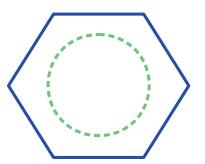
Figure 1.(color online) A simplified illustration of a benzene ring as a hexagon, with a circle describing the delocalizedπ bondinside.
In this work, we solve the three-body Schrödinger equation to study whether there exists a bound state for theDD*Ksystem1). As the kaon mass is considerably smaller than those of the charmed mesons, the Born-Oppenheimer (BO) approximation can be applied to simplify this case, although this involves an uncertainty of the order
${\mathcal{O}}({m}_{K}/{m}_{{D}^{(* )}})$ . The procedure is divided into two steps. First, we keep the two heavy mesons,DandD*, at a given fixed locationRand study the dynamical behavior of the light kaon. In the next step, we solve the Schrödinger equation of theDD*system with the effective BO potential arising from the interaction with the kaon.1) In principle, all the channels with the same quantum number should couple with each other. However, in our case, because the binding energy of the two-body subsystem is approximately 40 MeV and the corresponding binding momentumγis approximately 150 MeV, the interaction through the one-meson exchange diagram scales on the order of
${\mathcal{O}}({\gamma }^{2}/{m}_{E}^{2})$ , withmEbeing the mass of the exchanged meson. As a result, interactions with an exchanged meson other than the pion will be suppressed. Transitions amongDsD*π,DDs*π, andDD*Koccur either throughKorK*, which is suppressed compared to the one-pion-exchanged potential. Thus, theDsD*πandDDs*πchannels are not included in our calculation.In our case, as the typical momentum is approximately 150 MeV, a diagram with the mass of the exchanged particle being higher than the pion can be considered as a short-ranged contribution. Thus, we only consider the pion-exchange potential. Note that the two-pion-exchange (TPE) diagrams (Figs. 2(d)and(e)) comprise the next-to-leading order contribution, similar to that in nuclear physics. See, for example, [28-30] for reviews. Thus, we only consider the leading order one-pion-exchange (OPE) diagrams, i.e., those inFigs. 2(a),(b), and(c). This situation is analogous to the delocalizedπ bondin molecular physics. This is because there is only one virtual pion shared by the three constituents, as shown inFigs. 2(a),(b), and(c), instead of localizing between any two of them. We also note that it is important to consider these diagrams together. In this sense, this behavior is similar to that when three pairs of electrons are shared by the six carbon atoms in benzene. As a result, we work within the framework that respects SU(2) flavor symmetry2). The relevant Lagrangian is
2) The Lagrangian in Ref. [31] is invariant under the SU(3) symmetry when the interactions ofDKandD*Kare the same to the leading order.

Figure 2.Diagrams (a), (b), and (c) show the leading one-pion-exchange (OPE) diagrams for the transitions among the relevant three-body channels, i.e., theDD*K,DDK*, andD*DKchannels. These three channels are labeled as the first, second, and third channels, respectively. Thus, the diagrams (a), (b), and (c) represent the transition potentialsV12,V23, andV13, respectively. The (double) solid dashed lines represent theD(*) andK(*) fields. The dotted lines denote pion fields. The two-pion-exchange (TPE) diagrams, (d) and (e), comprise the next-to-leading order contributions.
$ \begin{eqnarray*}\begin{array}{ll} {\mathcal L} &=-{\rm{i}}\frac{2{g}_{P}}{{F}_{\pi }}\bar{M}{P}_{b}^{* \mu }{\partial }_{\mu }{\phi }_{ba}{P}_{a}^{\dagger }+{\rm{i}}\frac{2{g}_{P}}{{F}_{\pi }}\bar{M}{P}_{b}{\partial }_{\mu }{\phi }_{ba}{P}_{a}^{* \mu \dagger }\\ &\quad +\frac{{F}_{\pi }^{2}}{4}\langle {\partial }_{\mu }U{({\partial }^{\mu }U)}^{\dagger }\rangle +\frac{{F}_{\pi }^{2}}{4}\langle {\mathcal M} {U}^{\dagger }+U{ {\mathcal M} }^{\dagger }\rangle \end{array}\end{eqnarray*} $
where
$U=\exp ({\rm{i}}\phi /{F}_{\pi })$ with$ \begin{eqnarray}\phi =\left(\begin{array}{cc}\frac{{\pi }^{0}}{\sqrt{2}}&{\pi }^{+}\\ {\pi }^{-}&-\frac{{\pi }^{0}}{\sqrt{2}}\end{array}\right).\end{eqnarray} $
(1) andP(*) = (D(*)0,D(*)+) or
$({K}^{(* )-}, {\bar{K}}^{(* )0})$ . The last two terms in the Lagrangian above comprise the pion propagator. Here,$\bar{M}=\sqrt{{M}_{P}{M}_{{P}^{* }}}$ is the difference between the normalization factor for the relativistic and non-relativistic fields. The effective couplingsgD= 0.57 (gK= 0.88) can be extracted from the partial width of the${D}^{* }\to D\pi $ (${K}^{* }\to K\pi $ ) process. This coupling for the bottom sector is taken to have the same value as that in the charm sector, which is consistent with the recent lattice result [32] to within 10%. As there is no direct OPE diagram for theD*Kchannel, an additional channelDK*1)is included as an intermediate channel. Because the three-momentumpKof theD*Ksystem at theDK*threshold is 61% of its reduced massμD*K, the relativistic effect of the kaon is not negligible. This is the reason why we employ the relativistic form of the interaction, and keep the expression for the kaon to the order${\mathcal{O}}(\frac{{p}_{K}}{{m}_{K}})$ . To take the substructure for each pion vertex into account, we adopt a monopole form factor$ {\mathcal F} (q)=\frac{{\Lambda }^{2}-{m}_{\pi }^{2}}{{\Lambda }^{2}-{q}^{2}}$ , withqbeing the four-momentum of the pion and Λ the cutoff parameter. With the cutoff ΛD*K= 803.2 MeV, we find aD*Kbound state with a mass corresponding to theDs1(2460). The dynamics of the$I=\frac{1}{2}$ DD*Ksystem with an isosingletD*Kdo not depend on the cutoff parameter for theDD*system, whose attractive and repulsive parts are precisely cancelled [33]. TheDKsubsystem cannot interact with each other through the OPE, even after considering the coupled channel effect.1) The reason for theD*K*channel not being included is that it is the next higher threshold.
The BO approximation is based on the factorized wave function
$ \begin{eqnarray}|{\Psi }_{T}(\mathit{\boldsymbol{R}}, r)\rangle =|\Phi (\mathit{\boldsymbol{R}})\Psi (\mathit{\boldsymbol{r}}_{1}, \mathit{\boldsymbol{r}}_{2})\rangle, \end{eqnarray} $
(2) with the two charmed mesons and the light kaon located at ±R/2 andr, respectively. Here,r1=r+R/2 andr2=r-R/2 are the coordinates of the kaon relative to the first and second interactingD*, respectively. In our case, owing to the OPE potential the three channelsDD*K,DDK*, andD*DKare coupled with each other, as shown inFigs. 2(a),(b), and(c). The wave function of the kaon in theDD*Ksystem is the superposition of the two two-body subsystems
$ \begin{eqnarray*}\begin{array}{ll}|\Psi (\mathit{\boldsymbol{r}}_{1}, \mathit{\boldsymbol{r}}_{2})\rangle &={C}_{0}\{\psi (\mathit{\boldsymbol{r}}_{2})\, |D{D}^{\ast }K\rangle +\psi (\mathit{\boldsymbol{r}}_{1})\, |{D}^{\ast }DK\rangle \\ &\quad +C[{\psi }^{^{\prime} }(\mathit{\boldsymbol{r}}_{1})+{\psi }^{^{\prime} }(\mathit{\boldsymbol{r}}_{2})]|DD{K}^{\ast }\rangle \}\, .\end{array}\end{eqnarray*} $
The constantC0can be fixed by the normalization constraint of the total wave function. The wave functionsψ(ri) andψ′(ri) of the two-body subsystemsD*KandDK*are obtained by solving Schrödinger equation with these two channels coupled with each other.
In the BO approximation, the three-body Schrödinger equation can be simplified into two sub-Schrödinger equations [33]. One is the equation for the kaon,
$ \begin{eqnarray}H(\mathit{\boldsymbol{r}}_{1}, \mathit{\boldsymbol{r}}_{2})|\Psi (\mathit{\boldsymbol{r}}_{1}, \mathit{\boldsymbol{r}}_{2})\rangle ={E}_{K}(R)|\Psi (\mathit{\boldsymbol{r}}_{1}, \mathit{\boldsymbol{r}}_{2})\rangle \end{eqnarray} $
(3) at any givenRwith
$ \begin{eqnarray*}H(\mathit{\boldsymbol{r}}_{1}, \mathit{\boldsymbol{r}}_{2})=\left(\begin{array}{ccc}{T}_{11}(\mathit{\boldsymbol{r}}_{1}, \mathit{\boldsymbol{r}}_{2})&{V}_{12}(\mathit{\boldsymbol{r}}_{2})&0\\ {V}_{21}(\mathit{\boldsymbol{r}}_{2})&\delta M+{T}_{22}(\mathit{\boldsymbol{r}}_{1}, \mathit{\boldsymbol{r}}_{2})&{V}_{23}(\mathit{\boldsymbol{r}}_{1})\\ 0&{V}_{32}(\mathit{\boldsymbol{r}}_{1})&{T}_{33}(\mathit{\boldsymbol{r}}_{1}, \mathit{\boldsymbol{r}}_{2})\end{array}\right).\end{eqnarray*} $
Here,Tiiis the relative kinetic energy for theKin theith channel, andδM=MD+MK*-MD*-MKis the mass gap between theDDK*andDD*K(D*DK) channels. The explicit forms of the kinetic terms and the potentials can be found in App.. The parameterCcan be determined using the variational principle∂EK(R)/∂C= 0. The other sub-Schrödinger equation, for the two heavy charmed mesons, is
$ \begin{eqnarray}{H}^{^{\prime} }(\mathit{\boldsymbol{R}})|\Phi (\mathit{\boldsymbol{R}})\rangle =-{E}_{3}|\Phi (\mathit{\boldsymbol{R}})\rangle \end{eqnarray} $
(4) with
$ \begin{eqnarray*}\begin{array}{ll}{H}^{^{\prime} }(\mathit{\boldsymbol{R}})&={T}_{h}(\mathit{\boldsymbol{R}})+{V}_{h}(\mathit{\boldsymbol{R}})+{V}_{{\rm{BO}}}(\mathit{\boldsymbol{R}})\\ &=\left(\begin{array}{ccc}{T}_{D{D}^{\ast }}(\mathit{\boldsymbol{R}})&0&{V}_{13}(\mathit{\boldsymbol{R}})\\ 0&{T}_{DD}(\mathit{\boldsymbol{R}})&0\\ {V}_{31}(\mathit{\boldsymbol{R}})&0&{T}_{D{D}^{\ast }}(\mathit{\boldsymbol{R}})\end{array}\right)\\ &+{V}_{{\rm{BO}}}(\mathit{\boldsymbol{R}})\end{array}\end{eqnarray*} $
whereVBO(R)=EK(R)+EBis the BO potential provided by the kaon, andEBis the binding energy of the isosingletD*Ksystem. The total energy of the three-body system relative to theDD*Kthreshold isE=-(E3+EB). The explicit forms ofTDD*(R),TDD(R),V13(R), andV31(R) can be found in App..Because the three-body force only appears at next-to-leading order, which is neglected here, the dynamics of the three-body system can be described by those of its two-body sub-systems. Because the potential of the isospin singlet (triplet)D*Kis attractive (repulsive), only the three-bodyDD*Ksystem with the total isospin
$\frac{1}{2}$ and the isosingletD*Kcan form a bound state:$ \begin{eqnarray*}\begin{array}{c}|D{D}^{* }K{\rangle }_{\frac{1}{2}, \frac{1}{2}}=\frac{1}{\sqrt{2}}[|{D}^{+}{(}_{{D}^{\ast +}}\rangle +|{D}^{+}{(}_{{D}^{\ast 0}}\rangle ], \\ |D{D}^{* }K{\rangle }_{\frac{1}{2}, -\frac{1}{2}}=\frac{1}{\sqrt{2}}[-|{D}^{0}{(}_{{D}^{\ast +}}\rangle -|{D}^{0}{(}_{{D}^{\ast 0}}\rangle ], \end{array}\end{eqnarray*} $
where the subscripts denote the isospin and its third component. How deep this is depends on how strong theD*Kattraction is.Fig. 3(a)shows the dependence of the energyE3forDD*Kof the
$I({J}^{P})=\frac{1}{2}({1}^{-})$ system on the binding energyEBof its isosinglet two-bodyD*Ksystem. The analogous bottom system is illustrated inFig. 3(b). The two vertical bands inFig. 3represent the binding energies ofD*Kand${B}^{* }\bar{K}$ in Ref. [34], which allows one to deduce the energiesE3of the two systems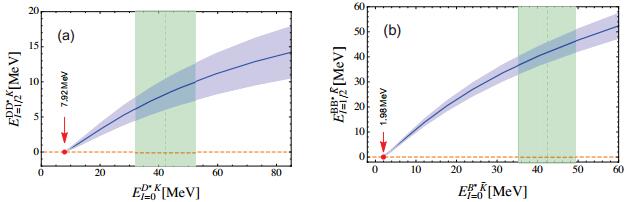
Figure 3.(color online) The binding energy of theDD*Kthree-body system withI= 1/2 in terms of that of the isosingletD*Ktwo-body system is presented in the left panel, as defined in Eq. 3. The uncertainty is estimated asmK/(2μDD*). The right panel shows the corresponding dependence for the
$B{B}^{* }\bar{K}$ system. The red point indicates the critical point, which represents the lower limit of the required binding energy of the isosingletD*Kor${B}^{* }\bar{K}$ to form a three-body bound state. The vertical dashed lines and bands represent the central values and uncertainties of the binding energies of the two-body subsystems from the chiral dynamics analysis [34].$ \begin{eqnarray*}{E}_{I=1/2}^{D{D}^{* }K}={8.29}_{-3.66}^{+4.32}\, {\rm{MeV}}, {E}_{I=1/2}^{B{B}^{* }\bar{K}}={41.76}_{-8.49}^{+8.84}\, {\rm{MeV}}, \end{eqnarray*} $
where the uncertainties are estimated asmK/(2μDD*) andmK/(2μBB*), as discussed above. That means that after including the binding energies of theD*Kand
${B}^{* }\bar{K}$ subsystems, there are two bound states with masses${4317.92}_{-4.32}^{+3.66}\, {\rm{MeV}}$ and${11013.65}_{-8.84}^{+8.49}\, {\rm{MeV}}$ , respectively. The critical point inFig. 3refers to the case that when the binding energy ofD*Kor${B}^{* }\bar{K}$ is larger than that value, a three-body bound state begins to emerge.The corresponding root-mean-square radii for each two-body subsystem are shown inFigs. 4and5for the charm and bottom sectors, respectively.The root-mean-square betweenKandD(*) is 1.14 fm. The value forDD*is 1.65 fm. Both of these are of the order
$\hslash c/{m}_{\pi }1.41\, {\rm{fm}}$ , which characterizes the size of the state bound by the OPE1).Because theS-wave component dominates the isosingletD*Kwave function, the kaon is distributed evenly on an ellipse (grey dashed line inFig. 4), with a root-mean-square radius of 0.79 fm on the plane perpendicular to theDD*direction. The case for the bottom sector is similar, as shown inFig. 5. The root-mean-square radius between the kaon and bottom mesons is 0.96 fm. The distance between a pair of bottom mesons is 0.65 fm, which indicates that the kaon is distributed on a circle, with a root-mean-square radius of 0.90 fm on the plane perpendicular to theBB*direction. All of the above root-mean-square radii are sufficiently large to separate the two relevant constituents, making hadrons the effective degrees of freedom. In particular, although the root-mean-square radius betweenBB*is as small as 0.65 fm, it is still significantly larger than twice the Compton wavelength of the bottom meson.1) One should note that the typical size for the vector meson exchange potential isħc/mρ∼0.26 fm, which is even smaller than the size (0.47 fm) ofJ/ψ[35]. In this case, hadrons can no longer be viewed as the effective degrees of freedom. In other words, the vector meson-exchanged potentials are part of the unknown short-distance contributions, which are of higher order from the effective field theory point of view, and require data to fix the corresponding coupling constants. This short-distance contribution is effectively modeled by the form factor that was introduced earlier.
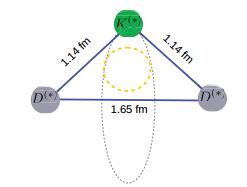
Figure 4.(color online) Formation of the three-bodyDD*Kbound state through the delocalizedπ bond(orange long-dashed curve). The root-mean-square radius of each two-body subsystem is explicitly indicated. The kaon is evenly distributed on the grey dashed ellipse.
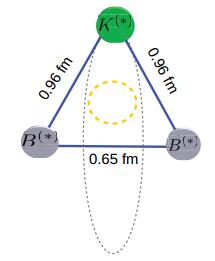
Figure 5.(color online) The same asFig. 4, but for the
$B{B}^{* }\bar{K}$ system.The kaon energy in the three-body system defined in Eq. 3 is shown inFig. 6, in terms of the distance between the two heavy mesons. When the distance goes to infinity, this returns to the binding energy of the two-body subsystem. Furthermore, when the charmed (bottomed) system gains another 42.29 MeV (42.19 MeV) of energy, the three-body system will totally break up into three individual particles. The dependence of the bottom system (blue dashed curve) is narrower but deeper, which means that its size is smaller, but its binding energy is larger. This is consistent with what we obtained above.
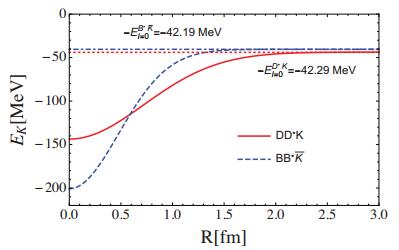
Figure 6.(color online) The kaon energy in the three-body system as a function of the distanceRbetween two heavy-light mesons. The red dotted and blue dot-dashed horizontal lines represent the binding energies of the isosingletD*Kand
${B}^{* }\bar{K}$ systems, respectively. When the distanceRis larger than a certain value, the kaon energy of the three-body system is equal to the binding energy of either the isosingletD*Kor${B}^{* }\bar{K}$ two-body system. The two-body binding energies are from Ref. [34].The long-distanceDD*(D*K) potential from the OPE is related to that of the
$D{\bar{D}}^{* }({\bar{D}}^{* }K)$ potential byG-parity [36], i.e., the corresponding potentialsV12(r2),V23(r1) andV13(R) change sign. As all of these are off-diagonal elements in the Hamiltonian, their signs do not affect the eigenvalues, but only affect the interference pattern of different components in the final physical wave function. Thus, there could also exist a three-body$D{\bar{D}}^{* }K$ bound state with the same binding energy. However, this introduces the additional uncertainty${m}_{\pi }^{2}/(2{\mu }_{D{D}^{* }})$ (which characterizes the natural energy scale of the OPE [37]), stemming from the unknown short-distance interaction, which is considered as the next-leading order contribution. Thus, for the$D{\bar{D}}^{* }K$ and$B{\bar{B}}^{* }\bar{K}$ system, the three-body binding energies are$ \begin{eqnarray*}{E}_{I=1/2}^{D{\bar{D}}^{* }K}={8.29}_{-6.13}^{+6.55}\, {\rm{MeV}}, \, {E}_{I=1/2}^{B{\bar{B}}^{* }\bar{K}}={41.76}_{-8.68}^{+9.02}\, {\rm{MeV}}\end{eqnarray*} $
with the additional uncertainty arising from the missing short-distance interaction. These correspond to two bound states with masses
${4317.92}_{-6.55}^{+6.13}\, {\rm{MeV}}$ and${11013.65}_{-9.02}^{+8.68}\, {\rm{MeV}}$ . The coincidence of the positions of theDD*K($B{B}^{* }\bar{K}$ ) and$D{\bar{D}}^{* }K$ ($B{\bar{B}}^{* }\bar{K}$ ) systems is because only the leading-order OPE is considered in the calculation.Our result for the$D{\bar{D}}^{* }K$ system agrees with the value 4337.0-i3.3 MeV predicted in [22] within 3σafter considering the vector meson-exchanged potentials. This gives further support to the assertion that the vector meson-exchange potentials are higher order short-distance contributions.For theI= 1/2
$D{\bar{D}}^{* }K$ three-body bound state$ \begin{eqnarray*}\begin{array}{l}|D{\bar{D}}^{* }K{\rangle }_{\frac{1}{2}, \frac{1}{2}}=\frac{1}{\sqrt{2}}[-|{D}^{+}{(}_{{\bar{D}}^{\ast 0}}\rangle +|{D}^{+}{(}_{{D}^{\ast -}}\rangle ], \\ |D{\bar{D}}^{* }K{\rangle }_{\frac{1}{2}, -\frac{1}{2}}=\frac{1}{\sqrt{2}}[|{D}^{0}{(}_{{\bar{D}}^{\ast 0}}\rangle -|{D}^{0}{(}_{{D}^{\ast -}}\rangle ], \end{array}\end{eqnarray*} $
because the total isospin ofD*Kis 0, the fraction of
$D{\bar{D}}^{* }$ for the isospin triplet in the bound state is two times larger than that of the isospin singlet. Thus, the easiest channel for detecting this is theJ/ψπKchannel. One may also notice that the three-body$D{\bar{D}}^{* }K$ ($B{\bar{B}}^{* }\bar{K}$ ) bound states have either neutral or positive (negative) charge. Aiming atX(3872), LHCb, Belle, and BABAR have collected quite numerous data forBdecays in theJ/ππKchannel. However, these focus on theJ/ψππchannel. The existence of the$D{\bar{D}}^{* }K$ bound state could be verified from the experimental side by analyzing the current world data on the channelsJ/ψπ+K0,J/ψπ0K+,J/ψπ0K0, andJ/ψπ−K+. As the charged particle is most easily detectable by experiment, the last channel is the most promising one for searching for the new state.To summarize, the dynamics of the three-body system can be reflected by those of its two-body subsystem to leading order.Based on the attractive force of the isosingletD*Kand
${B}^{* }\bar{K}$ systems, we predict that there exist twoDD*Kand$B{B}^{* }\bar{K}$ bound states, with$I({J}^{P})=\frac{1}{2}({1}^{-})$ and masses${4317.92}_{-4.32}^{+3.66}\, {\rm{MeV}}$ and${11013.65}_{-8.84}^{+8.49}\, {\rm{MeV}}$ , respectively. The$D{\bar{D}}^{* }K$ and$B{\bar{B}}^{* }\bar{K}$ systems are their analogues, with masses${4317.92}_{-6.55}^{+6.13}\, {\rm{MeV}}$ and${11013.65}_{-9.02}^{+8.68}\, {\rm{MeV}}$ , with the additional uncertainties stemming from the unknown short-distance interaction. The existence of the$D{\bar{D}}^{* }K$ bound state could be verified from the experimental side by analyzing the data for theB→J/ψππKchannel, by focusing on theJ/ψπKchannel.We are grateful to Johann Haidenbauer, Jin-Yi Pang, and Akaki G. Rusetsky for useful discussions, and especially to Meng-Lin Du and Jia-Jun Wu. We acknowledge contributions from Martin Cleven during the early stages of this investigation.
-
The kinematic termsTii(r1,r2) in Eq. (3) are
$ \begin{eqnarray}\begin{array}{c}{T}_{11}({r}_{1}, {r}_{2})=-\frac{{\hslash }^{2}}{2{M}_{K}}{\nabla }_{{r}_{2}}^{2}=-\frac{{\hslash }^{2}}{2{M}_{K}}\left(\frac{1}{{r}_{2}}\frac{{{\rm{d}}}^{2}}{{\rm{d}}{r}_{2}^{2}}{r}_{2}-\frac{{\mathit{\boldsymbol{L}}}^{2}}{{r}_{2}^{2}}\right), \\ \begin{array}{ll}{T}_{22}({r}_{1}, {r}_{2})&=-\frac{{\hslash }^{2}}{2{M}_{K}^{* }}{\nabla }_{{r}_{1(2)}}^{2}\\ &=-\frac{{\hslash }^{2}}{2{M}_{K}^{* }}\left(\frac{1}{{r}_{1(2)}}\frac{{{\rm{d}}}^{2}}{{\rm{d}}{r}_{1(2)}^{2}}{r}_{1(2)}-\frac{{\mathit{\boldsymbol{L}}}^{2}}{{r}_{1(2)}^{2}}\right), \end{array}\\ {T}_{33}({r}_{1}, {r}_{2})=-\frac{{\hslash }^{2}}{2{M}_{K}}{\nabla }_{{r}_{1}}^{2}=-\frac{{\hslash }^{2}}{2{M}_{K}}\left(\frac{1}{{r}_{1}}\frac{{{\rm{d}}}^{2}}{{\rm{d}}{r}_{1}^{2}}{r}_{1}-\frac{{\mathit{\boldsymbol{L}}}^{2}}{{r}_{1}^{2}}\right), \end{array}\end{eqnarray} $
(A1) whereLis the angular momentum operator ofK(K*) with respect to the corresponding heavy meson. Here,r1=r+R/2 andr2=r−R/2 are the coordinates of the kaon relative to the first and second interactingD*, respectively, with the two charmed mesons and the light kaon located at ±R/2 andr, respectively. The kinetic termT22(r1,r2) can be expressed in terms of eitherr1orr2, as these are equivalent. When calculating the energy of the kaon, the variableRis fixed to a given value, i.e., the two heavy mesons are static.
The effective potentialsV23(r1) andV32(r1) in Eq. (3) for theD*Ksystem are
$ \begin{eqnarray}\begin{array}{c}{V}_{23}({r}_{1})=-{C}_{\pi }(i, j)\frac{4{g}_{D}{g}_{K}}{{f}_{\pi }^{2}}\left(2-\frac{\Delta M}{{M}_{K}^{* }}\right)\left\{\frac{1}{3}\mathit{\boldsymbol{\epsilon \cdot {\epsilon }}}_{K}^{\dagger }\left[\, -{\mathop{m}\limits^{\sim }}_{\pi }^{2}\mathop{\Lambda }\limits^{\sim }Y(\mathop{\Lambda }\limits^{\sim }{r}_{1})+{\mathop{m}\limits^{\sim }}_{\pi }^{3}\frac{\cos ({\mathop{m}\limits^{\sim }}_{\pi }{r}_{1})}{{\mathop{m}\limits^{\sim }}_{\pi }{r}_{1}}+({\Lambda }^{2}-{m}_{\pi }^{2})\mathop{\Lambda }\limits^{\sim }\frac{{{\rm{e}}}^{-\mathop{\Lambda }\limits^{\sim }{r}_{1}}}{2}\right]\right.\\ \left.+\frac{1}{3}{S}_{23}({r}_{1})\left[{\mathop{m}\limits^{\sim }}_{\pi }^{3}{Z}^{{\prime} }({\mathop{m}\limits^{\sim }}_{\pi }{r}_{1})+{\mathop{\Lambda }\limits^{\sim }}^{3}Z(\mathop{\Lambda }\limits^{\sim }{r}_{1})+({\Lambda }^{2}-{m}_{\pi }^{2})(1+\mathop{\Lambda }\limits^{\sim }{r}_{1})\frac{\mathop{\Lambda }\limits^{\sim }}{2}Y(\mathop{\Lambda }\limits^{\sim }{r}_{1})\right]\right\}, \end{array}\end{eqnarray} $
(A2) $ \begin{eqnarray}\begin{array}{c}{V}_{32}({r}_{1})=-{C}_{\pi }(i, j)\frac{4{g}_{D}{g}_{K}}{{f}_{\pi }^{2}}\left(2-\frac{\Delta M}{{M}_{K}^{* }}\right)\left\{\frac{1}{3}\mathit{\boldsymbol{{\epsilon }}}_{K}\cdot \mathit{\boldsymbol{{\epsilon }}}^{\dagger }\left[-{\mathop{m}\limits^{\sim }}_{\pi }^{2}\mathop{\Lambda }\limits^{\sim }Y(\mathop{\Lambda }\limits^{\sim }{r}_{1})+{\mathop{m}\limits^{\sim }}_{\pi }^{3}\frac{\cos ({\mathop{m}\limits^{\sim }}_{\pi }{r}_{1})}{{\mathop{m}\limits^{\sim }}_{\pi }{r}_{1}}+({\Lambda }^{2}-{m}_{\pi }^{2})\mathop{\Lambda }\limits^{\sim }\frac{{{\rm{e}}}^{-\mathop{\Lambda }\limits^{\sim }{r}_{1}}}{2}\right]\right.\\ \left.+\frac{1}{3}{S}_{32}({r}_{1})\left[{\mathop{m}\limits^{\sim }}_{\pi }^{3}{Z}^{{\prime} }({\mathop{m}\limits^{\sim }}_{\pi }{r}_{1})+{\mathop{\Lambda }\limits^{\sim }}^{3}Z(\mathop{\Lambda }\limits^{\sim }{r}_{1})+({\Lambda }^{2}-{m}_{\pi }^{2})(1+\mathop{\Lambda }\limits^{\sim }{r}_{1})\frac{\mathop{\Lambda }\limits^{\sim }}{2}Y(\mathop{\Lambda }\limits^{\sim }{r}_{1})\right]\right\}, \end{array}\end{eqnarray} $
(A3) where
${\mathop{m}\limits^{\sim }}_{\pi }^{2}=\Delta {M}^{2}-{m}_{\pi }^{2}$ ,$\Delta M=\{({M}_{D}^{* 2}+{M}_{K}^{* 2})-({M}_{D}^{2}+{M}_{K}^{2})\}/\{2({M}_{D}+{M}_{K}^{* })\}$ , and${\mathop{\Lambda }\limits^{\sim }}^{2}={\Lambda }^{2}-\Delta {M}^{2}$ . The D-wave structureS23reads${S}_{2}3({r}_{1})=3(\mathit{\boldsymbol{{r}_{1}}}\cdot \hat{\mathit{\boldsymbol{{\epsilon }_{2}}}})(\mathit{\boldsymbol{{r}_{1}}}\cdot {\hat{\mathit{\boldsymbol{{\epsilon }_{3}}}}}^{\dagger })-\hat{\mathit{\boldsymbol{{\epsilon }_{2}}}}\cdot {\hat{\mathit{\boldsymbol{{\epsilon }_{3}}}}}^{\dagger }$ , withϵibeing the polarization vector of the corresponding particle. The potentialsV12(r2) andV21(r2) are similar to those ofV23(r1) andV32(r1), but with the variabler1replaced byr2. The factorCπ(i,j) represents the channel-dependent coefficients. We summarize all such coefficients utilized in this paper in Table A1. Thecoccurring in Table A1 represents the C parity of the corresponding channels. Here, we keep the effective potentials in coordinate space to the order$O(\frac{1}{{M}_{K}^{\ast }})$ .channel isospin C(i,j) channel C(i,j) DD* I=1 1/2 D+D+ 1/2 I=0 −3/2 D+D*0 −1/2 D*K I=1 −1/2 B+B*+ 1/2 I=0 3/2 B+B*0 −1/2 $D{\bar{D}}^{* }$ I=1 c/2 ${D}^{+}{\bar{D}}^{\ast 0}$ −1/2 I=0 −3c/2 D+D*− 1/2 ${\bar{D}}^{\ast }K$ I=1 1/2 ${B}^{+}{\bar{B}}^{\ast 0}$ −1/2 I=0 −3/2 B+B*− 1/2 Table A1.Channel-dependent coefficients. Here,cdenotes the C parity of the two-body system.
-
The kinetic termsTDD*(R) andTDD(R) in Eq. (4) are
$ \begin{eqnarray}{T}_{D{D}^{* }}=-\frac{{\hslash }^{2}}{2{\mu }_{1}}{\nabla }_{R}^{2}=-\frac{{\hslash }^{2}}{2{\mu }_{1}}\left(\frac{1}{R}\frac{{{\rm{d}}}^{2}}{{\rm{d}}{R}^{2}}R-\frac{{\mathit{\boldsymbol{L}}}_{R}^{2}}{{R}^{2}}\right)\end{eqnarray} $
(B1) $ \begin{eqnarray}{T}_{DD}=-\frac{{\hslash }^{2}}{2{\mu }_{2}}{\nabla }_{R}^{2}=-\frac{{\hslash }^{2}}{2{\mu }_{2}}\left(\frac{1}{R}\frac{{{\rm{d}}}^{2}}{{\rm{d}}{R}^{2}}R-\frac{{\mathit{\boldsymbol{L}}}_{R}^{2}}{{R}^{2}}\right)\end{eqnarray} $
(B2) where
${\mu }_{1}=\frac{{M}_{D}{M}_{D}^{* }}{{M}_{D}+{M}_{D}^{* }}$ and${\mu }_{2}=\frac{{M}_{D}}{2}$ are the reduced masses of theDD*andDDsystems, respectively. Furthermore,LRis the angular momentum operator between the two heavy mesons.The effective potentialV13(R) in Eq. (4) is illustrated in Eq. (B3). The potentialV31(R) is the same asV13(R). The D-wave structureS13(R) is similar to that ofS23(r1) defined in the above section. Here,
${\mathop{\Lambda }\limits^{\sim }}^{2}={\Lambda }^{2}-\Delta {M}^{2}$ , with$\Delta M={M}_{D}^{* }-{M}_{D}$ and Λ being the cutoff parameter in the form factor. TheCπ(i,j) are the channel-dependent coefficients summarized in Table A1.$ \begin{eqnarray}\begin{array}{c}{V}_{13}(\mathit{\boldsymbol{R}})=-{C}_{\pi }(i, j)\frac{{g}_{D}^{2}}{12\pi {f}_{\pi }^{2}}\left\{\epsilon \cdot {\epsilon }^{\dagger }\left[-{\mathop{m}\limits^{\sim }}_{\pi }^{2}\mathop{\Lambda }\limits^{\sim }Y(\mathop{\Lambda }\limits^{\sim }R)+{\mathop{m}\limits^{\sim }}_{\pi }^{3}\frac{\cos ({\mathop{m}\limits^{\sim }}_{\pi }R)}{{\mathop{m}\limits^{\sim }}_{\pi }R}+({\Lambda }^{2}-{m}_{\pi }^{2})\mathop{\Lambda }\limits^{\sim }\frac{{{\rm{e}}}^{-\mathop{\Lambda }\limits^{\sim }R}}{2}\right]\right.\\ \left.+{S}_{13}(R)\left[{\mathop{m}\limits^{\sim }}_{\pi }^{3}{Z}^{{\prime} }({\mathop{m}\limits^{\sim }}_{\pi }R)+{\mathop{\Lambda }\limits^{\sim }}^{3}Z(\mathop{\Lambda }\limits^{\sim }R)+({\Lambda }^{2}-{m}_{\pi }^{2})(1+\mathop{\Lambda }\limits^{\sim }R)\frac{\mathop{\Lambda }\limits^{\sim }}{2}Y(\mathop{\Lambda }\limits^{\sim }R)\right]\right\}, \end{array}\end{eqnarray} $
(B3)


 DownLoad: