


 Abstract
 HTML
HTML Reference
 Related
 PDF
PDF


HTML
-
The mass yield of fission fragments is the most studied feature of nuclear fission [1-35]. The mass yield is often described by the several Gaussians [6,9,22,23], which have the corresponding widthsσ2. The width of the fission-fragment mass yield is a very important quantity of the fission process [3-6,9-11,13-20,23,24,26,29,31,32,35].
Neuzil and Fairhall proposed a simple empirical relationship for the width of the fission-fragment mass yield [3]. Strutinsky found that in the framework of statistical model, the width of the fission-fragment mass yield is proportional to the temperatureTof the fissioning system at the saddle point, the square of the number of nucleonsA2, and inversely proportional to the stiffness parameterCof the potential related to the mass-asymmetric degree of freedom [4]. Nix showed that the width in very low-energy fission is strongly influenced by the zero-point motion of the corresponding quantum oscillators [5]. The zero-point motion is important only in the very low temperature limit, where the values of the width evaluated using the Nix expression are larger than those obtained by the Strutinsky formula. However, the results of Strutinsky and Nix are the same for high temperatures. The numerical studies of the width in the framework of the diffusion model of fission are reported in Refs. [10,11,32].
The mass distribution of the fission-fragments of highly-excited fissioning nucleus with the number of nucleonsA≲ 220 is related to the two-body saddle point [33]. Recently, we found a simple expression for the width of the fission-fragment mass yield at moderate and high excitation energies of the fissioning system in the framework of the statistical approach [35]. In contrast to previous results [4,5,9] we take into account both the volume and surface terms of the energy level density parameter [36]. As a result, the temperature dependence of the width is modified due to the contribution of the surface term of the energy level density parameter. However, our expression for the width reduces to the Strutinsky formula in the low temperature limit. Note that we consider temperatures at which the zero-point motion of the corresponding quantum oscillators is negligible. The difference between our and Strutinsky formulas increases with the temperature of the fissioning nucleus and becomes important at temperaturesT≳ 1 MeV. The width of the fission-fragment mass yield evaluated by using the volume and surface terms of the energy level density parameter is smaller than the one obtained for the same values of parameters and using the volume term only [35].
In this paper, we discuss the energy dependence of the widths of the fission-fragment mass yields in the photo-fission of197Au and209Bi in a wide energy interval. The energy dependence of the width was measured in the photo-fission of197Au target by bremsstrahlung with end-point energies of 300-1100 MeV in Ref. [13]. The data for the widths obtained in the photo-fission of209Bi target by bremsstrahlung with end-point energies of 40-1100 MeV are given in Refs. [14-18]. These data have not been analyzed up to now using the expressions for the width proposed in Refs. [4,35]. We also take into account the effect of neutron evaporation on the width of the fission-fragment mass yields and apply the expressions for the width from Refs. [4,35].
The paper is organized as follows. The expressions for the fission width proposed in [4,35] are shortly described in Sec. 2. A discussion of the results and conclusions are given in Sec. 3.
-
As pointed out in the introduction, the mass yields of the fission fragments are often described by several Gaussians [6,9,22,23]. The widthσ2describes the yield of a fission fragment with massA1for the symmetric fission of a nucleus withAnucleons, exp[-(A1−A/2)2/σ2] [6,22,35].
The width of the mass distribution of the fission fragments obtained in Ref. [35] is given by
$ \begin{eqnarray}{\sigma }^{2}=\frac{2{A}^{2}T}{C+2\kappa {A}^{2/3}{T}^{2}}.\end{eqnarray} $
(1) Here,Ais the number of nucleons of the fissioning system at the two-body saddle point,Tis the temperature of the system, which is related to the excitation energyE⋆=as(A)T2of the system of two identical fission fragments at the saddle point,Cis the stiffness parameter of the potential related to the mass-asymmetric degree of freedom at the saddle point, and
$ \begin{eqnarray}\kappa =\frac{4\cdot {2}^{1/3}}{9}\beta, \end{eqnarray} $
(2) $ \begin{eqnarray}{a}_{{\rm{sp}}}(A)=\alpha A+{2}^{1/3}\beta {A}^{2/3}, \end{eqnarray} $
(3) is the asymptotic value of the energy level density parameter of a system of two identical nuclei formed by fission of a nucleus withAnucleons. The asymptotic value of the energy level density parameter of a nucleus withAnucleons has the volume and surface contributions related to coefficientsαandβ, respectively, and is written as [36]
$ \begin{eqnarray}(a)(A)=\alpha A+\beta {A}^{2/3}.\end{eqnarray} $
(4) The values of these coefficients obtained in the framework the back-shifted Fermi gas model areα=0.0722396 MeV−1andβ=0.195267 MeV−1[36]. Forβ=0, Eqs. (2) and (3) reduce to
$ \begin{eqnarray}\kappa =0, \end{eqnarray} $
(5) $ \begin{eqnarray}{a}_{{\rm{sp}}}(A)=\alpha A.\end{eqnarray} $
(6) As a result, the expression for the width is written in this case as
$ \begin{eqnarray}{\sigma }_{{\rm{S}}}^{2}=\frac{2{A}^{2}T}{C}.\end{eqnarray} $
(7) This expression was obtained by Strutinsky [4]. (Note that the expression for the width obtained in Ref. [4] has a different numerical coefficient, because a different definition of the asymmetry of the fission fragments is used.)
From Eq (1), the fission-fragment width
${\sigma }^{2}\propto \frac{2{A}^{2}T}{C}={\sigma }_{{\rm{S}}}^{2}$ increases linearly with temperature in the low temperature limit 2κA2/3T2≪ C. The widthσ2has a maximum atC=2κA2/3T2. In the limit of extremely high temperatures 2κA2/3T2≫C, the width${\sigma }^{2}\sim\frac{{A}^{4/3}}{\kappa T}$ is inversely proportional to temperature. The influence of the surface energy level density parameter on the width of the fission-fragment mass yield increases with the number of nucleons of the fissioning nucleus and with the temperature. In contrast, the width${\sigma }_{{\rm{S}}}^{2}$ increases linearly with temperature in all temperature ranges.
-
The bremsstrahlung spectrum is continuous; therefore, the nucleus can be excited byγ-quanta of different energies in an experiment using bremsstrahlung. However, theγ-fission cross-section strongly increases with energy [7]. Therefore, we consider that the excitation energy of a fissioning compound nucleus
${E}_{{\rm{cn}}}^{\star }$ is very close to the end-point energy of bremsstrahlung.The excitation energy of the fissioning compound nucleus
${E}_{{\rm{cn}}}^{\star }$ and the excitation energy of the fissioning system at the saddle point${E}_{{\rm{sp}}}^{\star }$ , associated to the formation of the mass yield, are related by the equation [33,35]$ \begin{eqnarray}{E}_{{\rm{cn}}}^{\star }={E}_{{\rm{sp}}}^{\star }+{V}_{{\rm{sp}}}-{Q}_{{\rm{fiss}}}={E}_{{\rm{sp}}}^{\star }[1+({V}_{{\rm{sp}}}-{Q}_{{\rm{fiss}}})/{E}_{{\rm{sp}}}^{\star }].\end{eqnarray} $
(8) Here,Qfissis theQ-value of the fission reaction in two symmetric fragments, andVspis the height of the saddle point which defines the yield of symmetric fission fragments. The values ofVspandQfissare similar [33]. As a result,
$({V}_{{\rm{sp}}}-{Q}_{{\rm{fiss}}})/{E}_{{\rm{sp}}}^{\star }\ll 1$ for a highly-excited nucleus, and${E}_{{\rm{cn}}}^{\star }\approx {E}^{\star }$ . Therefore, the temperature of the fissioning compound nucleus$ \begin{eqnarray}{T}_{{\rm{cn}}}=\sqrt{{E}_{{\rm{cn}}}^{\star }/a(A)}=\sqrt{{E}_{{\rm{cn}}}^{\star }/(\alpha A+\beta {A}^{2/3})}\end{eqnarray} $
(9) is close to the temperature of a two-fragment system at the saddle point
$ \begin{eqnarray}T=\sqrt{{E}_{{\rm{sp}}}^{\star }/{a}_{{\rm{sp}}}(A)}=\sqrt{{E}_{{\rm{sp}}}^{\star }/(\alpha A+{2}^{1/3}\beta {A}^{2/3})}.\end{eqnarray} $
(10) The ratio of these temperatures for the same excitation energy, and forA≳200, is in the range
$ \begin{eqnarray}0.96\le \frac{T}{{T}_{{\rm{cn}}}}=\sqrt{\frac{\alpha +\beta {A}^{-1/3}}{\alpha +{2}^{1/3}\beta {A}^{-1/3}}}\le 1.\end{eqnarray} $
(11) The differences between the excitation energies
${E}_{{\rm{cn}}}^{\star }$ and${E}_{{\rm{sp}}}^{\star }$ , and the temperaturesTcnandT, are negligible. Nevertheless, small differences between the excitation energies and temperatures should be considered in a careful analysis.The evaporation of neutrons from the fissioning nuclei withA≲ 220 is a very important process at high excitation energies [13-18,20,21], because, as a rule, the values of the fission barrier in these nuclei are larger than the values of the neutron separation energy. Due to evaporation of many neutrons, the most probable mass of the experimental fragment mass distributionAprobis significantly smaller thanA/2 at excitation energies higher than the fission barrier [13-18,20,21]. For example,Aprobfor photo-fission of197Au by bremsstrahlung with end-point energy of 1100 MeV is 92 [13], which is smaller thanA/2=197/2=98.5. This means that the fission occurs after evaporation of about 13 neutrons. Note that the number of evaporated neutrons is a statistical average. Due to neutron evaporation the number of nucleons in the fissioning system at the saddle point is close to 2Aprob. Therefore, we should useA=2Aprobin Eqs. (1) and (7). The experimental values ofAprobdepend on the excitation energy and are extracted from an analysis of the experimental fragment mass distributions [13-18,20,21].
The excitation energy of the fissioning system is reduced due to the emission of pre-fission neutrons. Therefore, the average excitation energy of the nucleus at the moment of scission can be written as
$ \begin{eqnarray}{E}_{{\rm{eff}}}^{\star }\approx {E}_{{\rm{sp}}}^{\star }-(A-2{A}_{{\rm{prob}}}){\mathop{E}\limits^{\sim }}_{{\rm{n}}}.\end{eqnarray} $
(12) Here,
${\mathop{E}\limits^{\sim }}_{{\rm{n}}}$ is the average energy removed by a neutron from the fissioning nucleus during evaporation ofA− 2Aprobneutrons. The value of${\mathop{E}\limits^{\sim }}_{{\rm{n}}}$ has two contributions related to the neutron binding energy and the average kinetic energy of the evaporated neutron$ \begin{eqnarray}{E}_{{\rm{kin}}}\approx \frac{3}{2}{T}_{{\rm{eff}}}\approx \frac{3}{2}{({E}_{{\rm{eff}}}^{\star }/a(2{A}_{{\rm{prob}}}))}^{1/2}.\end{eqnarray} $
(13) As a result,
${\mathop{E}\limits^{\sim }}_{{\rm{n}}}$ can be approximated as$ \begin{eqnarray}{\mathop{E}\limits^{\sim }}_{{\rm{n}}}\approx \frac{BE(A, Z)-BE(2{A}_{{\rm{prob}}}, Z)}{A-2{A}_{{\rm{prob}}}}+\frac{3}{2}{T}_{{\rm{eff}}}, \end{eqnarray} $
(14) whereBE(A,Z) is the binding energy of nucleus withAnucleons andZprotons [37]. Using Eqs. (12)-(14) we find the effective temperature
$ \begin{eqnarray}\begin{array}{ll}{T}_{{\rm{eff}}}&=\left[\frac{{E}_{{\rm{sp}}}^{\star }-(BE(A, Z)-BE(2{A}_{{\rm{prob}}}, Z))}{a(2{A}_{{\rm{prob}}})}\right.\\ &{\left. +{\left(\frac{3(A-2{A}_{{\rm{prob}}})}{4a(2{A}_{{\rm{prob}}})}\right)}^{2}\right]}^{1/2}-\frac{3(A-2{A}_{{\rm{prob}}})}{4a(2{A}_{{\rm{prob}}})}, \end{array}\end{eqnarray} $
(15) which should be used in Eqs. (1) and (7).
The values of 2AprobandTeffcan be evaluated in the framework of complex statistical codes, which take into account the competition between emission of neutrons and fission. However, using 2AprobandTeff, instead ofAandT, in Eqs. (1) and (7) is very useful and significantly simplifies the application of these equations. Moreover, we can compare the values of the stiffness parameterCobtained for various reactions. The effect of neutron emission on the values ofAandEis not taken into account in Ref. [35].
The width of the fission-fragment mass yield evaluated using Eqs. (1) and (7) in our approach are compared with experimental data for197Au and209Bi inFigs. 1and2, respectively. The experimental data for the width andAprobfor197Au, obtained for bremsstrahlung end-point energies of 300, 350, 400, 450, 500, 600, 700, 800, 900, 1000, and 1100 MeV, are taken from Refs. [13,18]. The corresponding experimental data for209Bi, for bremsstrahlung end-point energies of 40, 65, 85, 600, and 700 MeV, are taken from Refs. [14-18], and data for bremsstrahlung end-point energies of 450, 500, 600, 700, 800, 900, 1000, and 1100 MeV are from Ref. [18]. (Note that the width of the fission-fragment mass yield was also measured in the photo-fission of209Bi target by bremsstrahlung with end-point energy of 2500 MeV in [19]. The excitation energy per nucleon after absorption of such a high-energy gamma-quantum is larger than the binding energy per nucleon in209Bi. As the formation of fission fragments in such a case is affected by various pre-equilibrium and non-equilibrium effects, we ignore this data point in our analysis.)
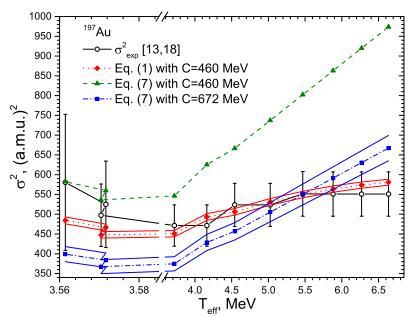
Figure 1.(color online) The temperature dependence of the fission-fragment widthσ2for nuclei197Au evaluated by using Eqs. (1) and (7) for various values of the stiffnessC. The thin lines show the range of uncertainty of the width induced by uncertainty ofC. The experimental data are taken from Refs. [13,18].
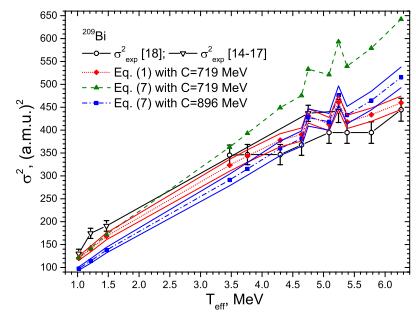
Figure 2.(color online) The temperature dependence of the fission-fragment widthσ2for nuclei209Bi evaluated by using Eqs. (1) and (7) for various values of the stiffnessC. The thin lines show the range of uncertainty of the width induced by uncertainty ofC. The experimental data are taken from Refs. [14-18].
The experimental data points from the different references and the theoretical results, shown inFigs. 1and2, are connected by lines. The data are ordered according to increasing bremsstrahlung end-point energy. As a rule, the temperature and the width of the fission-fragment mass yield increase with bremsstrahlung end-point energy. The most probable fragment massesAprobfor fission of197Au at bremsstrahlung energies of 300, 350, and 400 MeV are 97, 95, and 93 [13-18]. The corresponding effective temperaturesTeffat the saddle point are 3.561, 3.572, and 3.570 MeV. Due to such values ofAprobandTeff, the width of the fission-fragment mass yield decreases with bremsstrahlung end-point energy in the range of 300÷400 MeV [13-18]. Such a dependence is outside the common trend, and we propose additional experimental studies of fission of197Au for bremsstrahlung end-point energies of 300, 350, and 400 MeV.
The values of the stiffness parameter of the potential related to the mass-asymmetric degree of freedom at the saddle point,C=460±10 MeV for197Au andC=719±20 MeV for209Bi, are found by fitting the experimental data with Eq. (1). The uncertainties inCare evaluated using the experimental uncertainties ofσandAprobgiven in Refs. [13-18]. The uncertainties inClead to a range of values of the fission-fragment widths shown by thin lines inFigs. 1and2. The value ofCfor197Au is close toC= 382.5 MeV obtained for the slightly heavier nucleus201Tl for temperatures 0.9 MeV ≲T≲1.4 MeV in Ref. [35]. However, the value ofCfor209Bi obtained in our analysis is higher than the one found in an analysis of the particle-induced fission of the nearest nuclei209Bi and210Po in the range 0.8 MeV ≲T≲1.4 MeV in Ref. [35]. Note that the wider temperature interval and experimental data for 2Aprobused here lead to a more accurate determination of the stiffness.
The energy dependence of the width of the fission-fragment mass yield evaluated using Eq. (1) agrees well with experimental data, as seen inFigs. 1and2. If we substitute the above stiffness values in Eq. (7), then the calculated widths significantly overestimate the data at high energies. We recall that Eqs. (1) and (7) lead to very similar widths for small temperatures and the same stiffness parameterC, seeFig. 2.
The quality of fit of the width can be estimated by using the relation
$ \begin{eqnarray}S=\frac{1}{N-1}\displaystyle \sum _{i=1}^{N}{(\frac{{\sigma }_{i{\rm{theor}}}^{2}-{\sigma }_{i{\rm{\exp }}}^{2}}{\Delta {\sigma }_{i{\rm{\exp }}}^{2}})}^{2}, \end{eqnarray} $
(16) where
${\sigma }_{i\, {\rm{theor}}}^{2}$ and${\sigma }_{i\, {\rm{\exp }}}^{2}$ are the theoretical and experimental values of the width for a data pointi, while$\Delta {\sigma }_{i\, {\rm{\exp }}}^{2}$ is the error of the experimental value${\sigma }_{i\, {\rm{\exp }}}^{2}$ . The values ofSfor197Au are 0.194 and 18.4 when using Eqs. (1) and (7), respectively. The corresponding values for209Bi are 1.99 and 26.4.We also find the values ofCby fitting the experimental data with the help of Eq. (7). The values ofCobtained for197Au and209Bi are 672±32 MeV and 896±41 MeV, respectively. These values are larger than those obtained previously. The uncertainties inC, leading to uncertainties in the corresponding widths, are shown inFigs. 1and2. The values ofSfor197Au and209Bi are in this case 1.80 and 7.76, respectively, and are considerably larger than the ones found using Eq. (1).
Comparing the values ofSobtained by different approaches and the results presented inFigs. 1and2, we conclude that Eq. (1) for the width describes the data in a wide range of temperatures of the fissioning nuclei. In contrast, Eq. (7) cannot describe the data in such a wide range of temperatures. As we have pointed out, the uncertainties inClead to uncertainties in the corresponding widths. Taking into account the uncertainties in the calculated values of the widths shown inFigs. 1and2, we conclude that in the framework of the proposed approach, application of Eq. (1) leads to a better description of the widths than Eq. (7).
In conclusion, Eq. (1) for the temperature dependence of the width of the fission-fragment mass yield describes well the data for bremsstrahlung fission of197Au and209Bi for intermediate energies. The difference between our results and those of Strutinsky occurs at high temperatures. The width of fission-fragment mass yield evaluated by using the volume and surface terms describes better the data for high excitation energies than the one obtained for the same values of parameters and using the volume term only. The substitutions ofAfor 2AprobandTforTeffin Eq. (1) are very useful for application of this equation in the case of emission of pre-fission neutrons.


 DownLoad: