


 Abstract
 HTML
 Reference
 Related
 PDF


-
New isotopes of the elements Rf, Db, and Sg have been previously synthesized in the cold-fusion reactions of the doubly-magic nuclei208Pb and209Bi with massive ions having proton numbersZ=22−30 and neutron numbersN=28−40. In addition, new elements from Bh to Nh (Z=107−113) with cross sections ranging from 530 pb to 22 fb (see Reviews [1−4] and the references therein) have been reported. Progress toward more heavy elements was achieved through the fusion reactions of doubly magic48Ca with nuclei from238U to249Cf. In these reactions, approximately 40 new nuclides withZ=104−113 and isotopes of new elements from Fl to Og (Z=114−118) with cross sections from 17 pb to 0.5 pb were synthesized (see Reviews [5,6] and the references therein).
Since 2007, attempts have been made to synthesize even heavier elements 119 and 120. However, they did not lead to a positive result [7−11]. The reasons for such a relentless interest in the synthesis of new elements is not limited to the desire of researchers to claim the naming rights. The properties of the decay of new elements and, especially, the cross sections of their formation can shed light on one of the fundamental properties of nuclear matter - the magic proton numberZmagfor the heaviest nuclei. As is known, there is still no agreement among theoreticians regarding theZmagvalue; some considerZmag= 114, whereas others considerZmag= 120−126. It may be expected that as we approach or move away fromZmag, the value of the fission barrier will increase or decrease, respectively. The magnitude of the fission barrier plays a determining role in the survival probability of the compound nucleus (CN) and, ultimately, in the value of the reaction cross section.
Recently, several studies have focused on choosing the optimal reaction for the synthesis of new elements or testing the facilities where these investigations can be carried out [12−16]. The reactions249Bk(50Ti, 3−4n)295,296119,248Cm(51V, 3−4n)295,296119,243Am(54Cr, 3−4n)293, 294119 are considered optimal for the synthesis of element 119.
The first two reactions, after the probableαdecay of isotopes295,296119, lead to unknown nuclei291,292Ts, and then to the known chain of287,288Mc –267,268Db [17]. The reliable identification of the mother nuclei will be based on the method of genetic relations [17]. The decays of the243Am(54Cr,3n)294119 reaction products also lead to the known chain of286Mc –266Db. However, among the potential products of the 4nreaction channel,i.e.,293119, only spontaneously fissioning261Lr is considered known. However, it may not be realized if265Db is also spontaneously fissioning.
In this case, it is important to measure in advance the decay properties of isotopes starting from285Mc or281Nh, which are products of the 4nchannel of reactions of48Ca with241Am or237Np, as well as the reaction excitation function. Then, combinations of criteria related to cross-bombardments (or cross-reactions in Ref. [17]), excitation functions or yield curves, properties of heavy ion separators, systematics of experimental results, and theoretical predictions can be used to more reliably prove the synthesis of a new element 119.
The relatively short half-life of241Am (432.6 y [18]) creates some difficulties when using it in an experiment. Therefore, we decided to repeat the237Np+48Ca experiment that was performed in 2006 with use of position-sensitive detectors and a low time resolution (0.1 ms) [19] but at a slightly higher beam energy, which would correspond to the expected maximum of the 4n-reaction channel. The choice was based on the previously measured excitation functions of the48Ca-induced reactions with the nuclei of actinide elements [5,6].
In addition to the properties of the new isotopes in the chain281Nh-265Db, clarifying the properties of the nuclei in the chain starting with282Nh was of interest. In Refs. [19,20], we observed two decay chains of282Nh in the237Np(48Ca, 3n) reaction and one after the decay of286Mc, which is the243Am(48Ca, 5n) reaction product.
However, in the first chain of the237Np+48Ca reaction, theα-particle energyEαof274Mt was measured only by the side detector with a low accuracy (1.08 MeV). In the second chain, theαparticle of278Rg was registered by the focal detector and the energy of274Mt was 9.76 MeV, although one would expect a value of 10.45±0.23 MeV, almost 0.7 MeV higher, according to Ref. [21]. In the decay chain of286Mc, theαparticle of274Mt escaped the focal detector, leaving 0.963 MeV, and did not enter the side detector (the location of similar detectors is described below). In addition, from the extrapolation of the half-lifeTαof275,276,278Mt, one would expectTαof several milliseconds for274Mt [1−6,16,18−20]. However, the decay times of274Mt in the three decay chains were in the range of 0.47−1.48 s. Such differences in the energy and half-life of274Mt from the expected values may indicate the presence of a long-lived state. Thus, the clarification of the decay properties of274Mt was also of interest from the point of view of studying the structure of superheavy nuclei.
-
The237Np+48Ca reaction was studied using the Dubna gas-filled separator DGFRS-2 [22,23] and the cyclotron DC280 of the SHE Factory at FLNR, JINR [24]. Some parameters of the experiment and results are listed inTable 1.
Target
thickness
/(mg·cm−2)Elaba
/MeVE* b
/MeVBeam dose
×1019No. of chains
3n/ 4nσ3n
/pbσ4n
/pb0.89 248.3 40.2−44.5 1.0 3 / 0 $0.43^{+0.46}_{-0.25}$ $\leqslant $ 0.280.37 244 36.9−41.3 1.1 2 / 0 $ 0.85^{+1.61}_{-0.59}$ − aThe beam energy was measured with a systematic uncertainty of 1 MeV. bThe excitation-energy ranges of the CN285Nh were estimated by the Monte Carlo method taking into account the beam-energy resolution, small variation in the beam energy during irradiation, and energy loss in the target. Table 1.237Np target thickness; reaction-specific laboratory-frame48Ca energyElabin the middle of the target layer; interval of resulting excitation energyE*(using the mass tables [18] for237Np and48Ca and [25] for285Nh;Qvalue is 164.17 MeV); total beam dose; number of observed decay chains of282Nh (3n) and281Nh (4n); and production cross sectionσ. Data in the last row are from Ref. [19].
Similar to the experiments [13,14,20], the237Np target consisted of twelve segments, which were produced by electrodeposition on 0.6-mg/cm2Ti backing and mounted on a disk with a diameter of 24 cm, rotated at 980 rpm. The reaction products, before implantation into focal detectors, passed through the H2gas-filled DGFRS-2 separator at a pressure of 0.9 mbar. The separator had a 0.7-μm mylar separating foil and two multiwire proportional chambers located in pentane at a pressure of 1.6 mbar. For reducing the counting rate of low-energy particles, which are the dominant background source on the detectors, a 0.2 mg/cm2thick Al foil was installed in front of the detectors before observing the third chain of282Nh in this experiment (see below). Al foil led to a slight decrease in the implantation energy of the nucleus and a 6-fold decrease in the background. The transmission efficiency was estimated to be approximately 0.35 for a 0.89 mg/cm2thick target and the detector used in the experiment [23]. The typical beam intensity in front of the target was approximately 3 pμA.
After the experiment, an analysis of the target material was conducted. In the238U+48Ca experiment [26] with a maximum beam intensity of 6.5 pμA and beam dose of 2.6×10¹⁹, the target thickness decreased by 3%, and the thickness of the backing increased slightly. In this experiment, the layers of Np and Ti were damaged after a total beam dose of 2.1×10¹⁹. Approximately 20% of the thick Np material was lost in the beam spot area, and the Ti backing was damaged by 5%−80% across different sectors. For this reason, the data of the first part of the experiment with the dose of 1×10¹⁹ions were used in the analysis. Beyond this point, the experimental conditions changed, as both the beam energy inside the target and amount of target material became poorly defined. No events were observed after a dose of 1×10¹⁹ions.
Two double-sided silicon strip detectors (DSSDs) with an active area of 60 mm×120 mm and a thickness of 0.3 mm were installed close to each other in the focal plane of the separator. Thus, the total horizontal width was 240 mm. These detectors had 48 1.25-mm horizontal strips at the front of the detector and 48 2.5-mm vertical strips at the back, which were used to determine the vertical and horizontal positions of the nuclei on the detectors, respectively. The focal detector was surrounded by ten 60 mm×120-mm side silicon detectors (SSDs), each with eight strips, constituting a box with a depth of 120 mm. The signals in the focal and side detectors with amplitudes above the thresholds of ≈0.5 and ≈2.7 MeV, respectively, were recorded independently by digital and analog data acquisition systems.
The analog system, along with ordinary signal processing, was also used for the online registration of the correlations of the evaporation residues (ERs) andαparticles registered with full energy in the DSSD, with the energies and ER-αtime interval expected for implantation in the DSSD and subsequentαdecays of the parent or daughter nuclei. This pair of events caused the beam to be switched off in approximately 0.1 ms to observe the decays of the descendant nuclei under low background conditions.
-
The energies of theαparticles and spontaneous fission (SF) fragments and decay times of the nuclei in the decay chains observed in this study are shown inFig. 1(d-f). The same details are shown for the nuclei obtained in Ref. [19] and Ref. [20] inFig. 1(a,b) andFig. 1(c), respectively, for comparison.
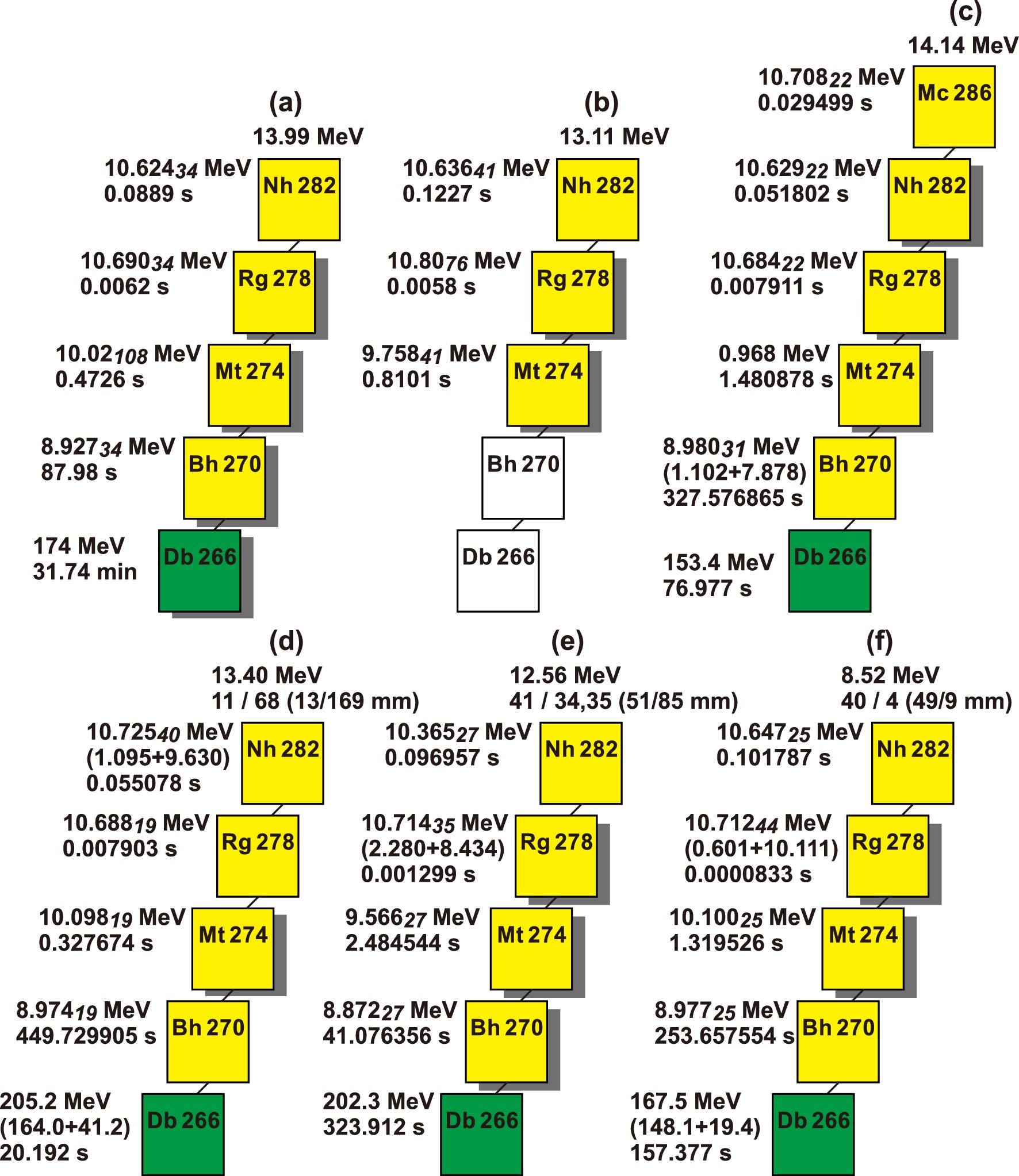
Figure 1.(color online) Decay chains originating from286Mc and282Nh observed in the243Am +48Ca and237Np +48Ca reactions, respectively. Chains (a, b) and (c) were published in Ref. [19] and Ref. [20], respectively. Chains (d-f) are results of this study. The upper rows show the ER energy in chains (a-f) and vertical and horizontal positions on the detector in chains (d-f). The left rows provide theα-particle [in yellow (light gray)] and SF [in green (dark gray)] energies and time intervals between the events. The energies of the summed signals (in DSSD + SSD) are given in parentheses. The events marked with a shadow were registered during the beam-off period. Theα-particle energy errors (standard deviations) are shown by smaller italic numbers. The decays of270Bh and266Db in chain (b) were not recorded in Ref. [19].
The number of random sequences imitating any of the chains inFig. 1(d-f) was estimated based on the average counting rates of the beam-on full energyαparticles (Eα= 8.5−11 MeV) and SF events registered in the DSSD (ESF> 120 MeV). Time intervals of 10 s for the first three α decays and 1000 s for the fourthαdecay and SF were used. Under these conditions, the number of random sequences was found to be less than 10–14[27]. Observing eachαparticle during the beam-off interval or registering it simultaneously by the DSSD and SSD reduces this probability by an additional factor of 10 or 2, respectively.
The energy spectra and lifetime distributions of theαparticles of282Nh,278Rg,274Mt,270Bh, and266Db (only lifetime distribution) observed in Refs. [19,20] and this study are shown inFig. 2. Note that the distributions of the decay times for all of the observed isotopes from282Nh to266Db satisfy the criterion for a single radioactive species suggested in Ref. [28].
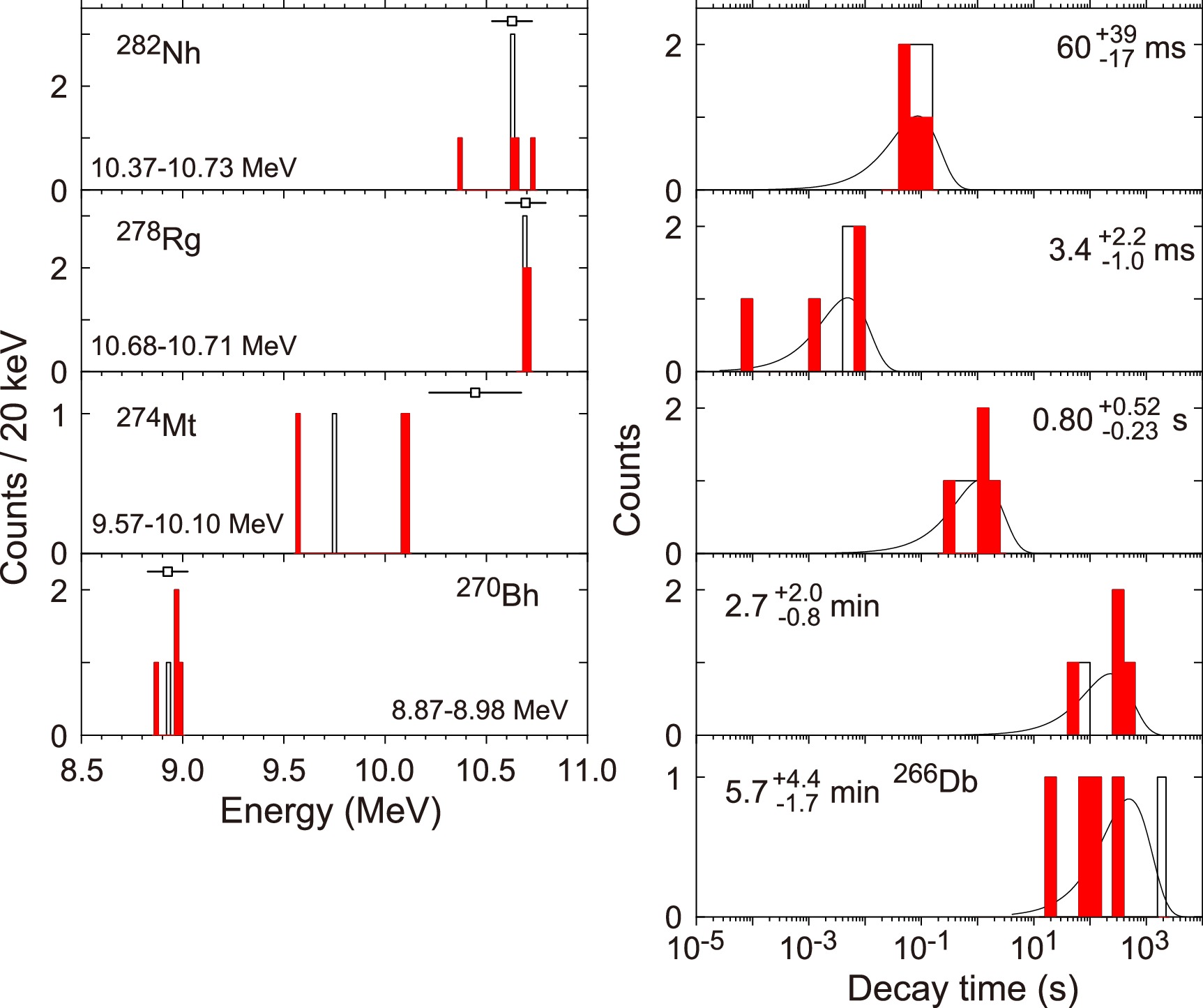
Figure 2.(color online) Alpha-particle energy spectra (left-hand panel) and decay-time distributions on a logarithmic scale (right-hand panel) for282Nh and descendant nuclei. The events originating from282Nh observed at DGFRS-2 in Ref. [20] and this study are shown by full red histograms; previous results obtained at DGFRS [19] are shown by open histograms. Forα-particle spectra, events with an energy resolution of
$\leqslant $ 45 keV were selected. At the top of each spectrum, the averageEαvalue and uncertainty interval recalculated from theQαvalue according to Ref. [21] are shown. Alpha-particle energy intervals given on the left-hand panels for each isotope are determined from all known events. Regarding the distribution of the decay times, the smooth curves are the time distributions for exponential decays calculated with the half-livesT1/2shown in the figures.Theα-particle energies of the nuclei observed in this study are consistent with those in Refs. [19,20]. In addition, the measured decay times in this and previous experiments do not contradict each other. The energiesEαand intervals recalculated from theα-decay energiesQαaccording to Ref. [21] are shown above the energy spectra. There is a good agreement between the experimental results and calculations for all nuclei except274Mt. From Ref. [21], theEαvalue of 10.45±0.23 MeV is obtained, although the measured values range from 9.57 to 10.10 MeV.
In addition, the decay times of274Mt are in the range of 0.3−2.5 s, which is significantly higher than the half-life according to the systematics ofT1/2for neighboring odd-Znuclei (Fig. 3). As stated above, from the dependence ofT1/2of isotopes275,276,278Mt on the number of neutrons, this value for274Mt could be several milliseconds. However, theT1/2value determined for all six decays was
$0.8^{+0.52}_{-0.23} $ s,i.e., two orders of magnitude higher.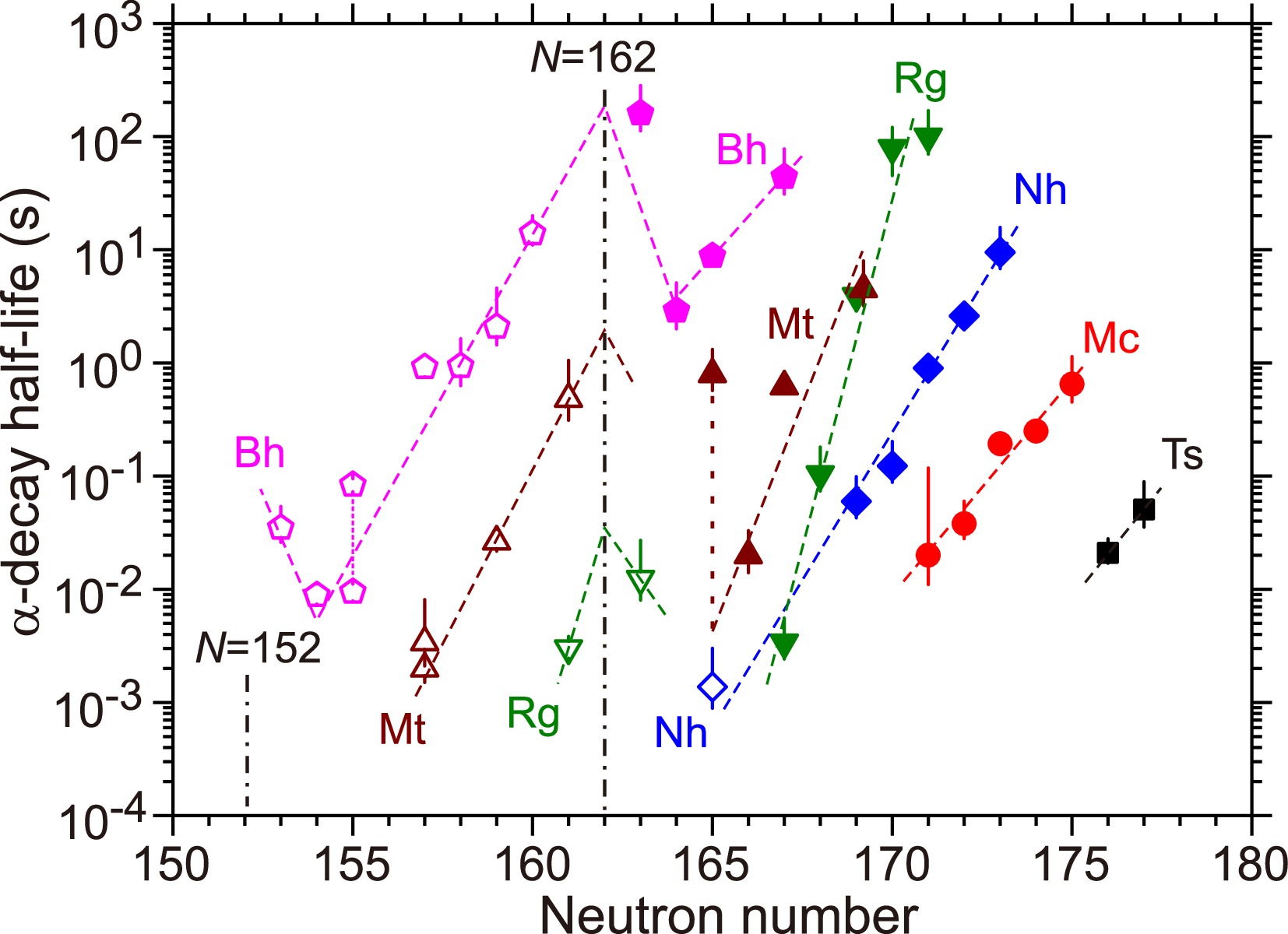
Figure 3.(color online) Partial half-livesTαvs neutron numberNfor the isotopes of odd-Z elements Bh–Ts (Refs. [1-6,16,18-20]. Full and open symbols refer to nuclei produced in the reactions with48Ca and other reactions, respectively. The lines are drawn to guide the eye. Vertical dotted brown line shows the deviation ofTαfor274Mt from the systematics.
In addition to274Mt, among the remaining 37 odd-Znuclei withZ=107−117, two states with different half-lives are known only for262Bh and presumably for its precursor266Mt (see,e.g., Refs. [18,29−32]). Furthermore, it remains unclear which of the states belongs to the ground one (g.s.) and which is an isomeric (i.s.) state [32].
To extract information about the nuclear structure from our experimental data, we used a cluster model based on a dinuclear system approach. As shown in Refs. [33−38], the cluster model well describes the experimental half-lives of theαdecay and SF from the ground and isomeric states of nuclei with even atomic numbersZ. Moreover, new calculations within the cluster model also demonstrate good descriptions ofTαandTSFfor odd-Znuclei (seeTable 2).
Nucleus K $ T_{a}^{\rm th} $ /s$ T_{\rm SF}^{\rm th} $ /sTα/s TSF/s 243Am 5/2 4.29 × 10¹¹ 8.06 × 10²² 2.32 × 10¹¹ 6.28 × 10²¹ 249Bk 7/2 7.05 × 10¹² 9.87 × 10¹⁵ 2.06 × 10¹² 6.01 × 10¹⁶ 253Es 7/2 2.36 × 10⁶ 8.88 × 10¹² 1.77 × 10⁶ 2.03 × 10¹³ 256Md 1 8.78 × 10⁴ 3.04 × 10⁵ 5.07 × 10⁴ >1.55 × 10⁵ 267Db 7/2 5.26 × 10⁴ 3.08 × 10³ $\geqslant $ 1.90 × 1044.74 × 103 Table 2.Calculated half-lives of α decay (
$ T_{a}^{\rm th} $ ) and SF ($ T_{\rm SF}^{\rm th} $ ) from the ground state for various odd-Znuclei in comparison with experimental data (TαandTSF) [39]. TheKvalue represents the projection of the total nuclear spin along the symmetry axis of the nucleus.Within the cluster model, one can determine the possibleKvalue of a nuclear state using the experimental values of theQαenergy andαdecay half-lifeTα, as well as the SF half-lifeTSF. In this regard, we vary theKvalue so that the calculated
$ T_{a}^{\rm th} $ values and/or$ T_{\rm SF}^{\rm th} $ half-lives become close to the experimental values ofTαand/orTSF, respectively. The same extraction method was used in Ref. [40] for theα-decay chains of273,275Ds.In some cases, the experimental uncertainties inTαare large enough to affect theKvalue. In that case, the correspondingKrange can be obtained. All calculated half-lives compared with experimental values, along with the respectiveK, are presented inTable 3. A decay scheme is also proposed and shown inFig. 4. Note, that the cluster model cannot provide definite information about the state (ground, isomeric or low-lying ones) of a nucleus.
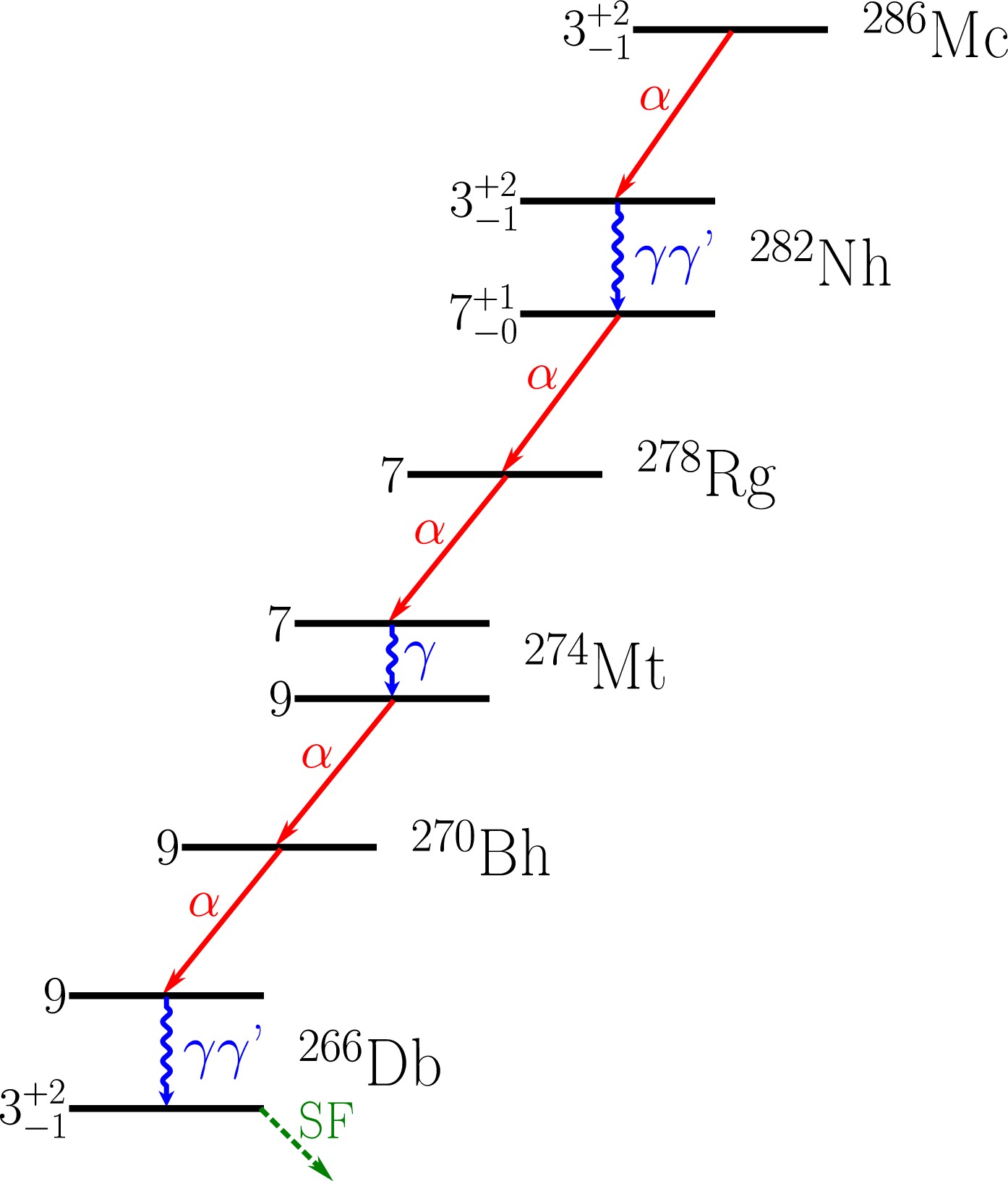
Figure 4.(color online) Possibleα-decay scheme for286Mc. γγ’ represents γ-cascade. Extracted spin values with their corresponding uncertainties are shown. For the nuclei278Rg,274Mt, and270Bh, only one spin value is possible according to the experimental half-life error bars.
Nucleus Decay
modeT1/2/s K $ T_{a}^{\rm th} $ /s$ T_{\rm SF}^{\rm th} $ /s286Mc α $2.0^{+9.8}_{-0.9} $ × 10−2a3 2.46 × 10⁻² 1.98 × 10⁵ 282Nh α $6.0^{+3.9}_{-1.7} $ × 10−27 5.30 × 10⁻² 2.02 × 101 278Rg α $3.4^{+2.2}_{-1.0} $ × 10−37 3.67 × 10⁻³ 4.63 × 10² 274Mt α $0.80^{+0.52}_{-0.23}$ 9 0.896 6.78 × 10⁵ 270Bh α $ 1.6^{+1.2}_{-0.5}$ × 1029 2.41 × 10² 2.22 × 10⁶ 266Db SF $3.4^{+2.6}_{-1.0} $ × 1023 4.47 × 10⁴ 1.04 × 10² aValue is taken from Ref. [20]. Table 3.Calculated half-lives of α decay and SF and values ofKfor the nuclei in theα-decay chain of286Mc.
For the observed decays of274Mt, withK= 9, which is higher than that of the neighboring nuclei in the isotopic chain,e.g., for275Mt, theKof around 3/2 is predicted. Therefore, its robustness toαdecay is lower. This is the main reason for the “increased” stability of this transition of274Mt.
The energies of the observed decays of274Mt are noticeably lower than that obtained from theQαvalue predicted in Ref. [21] (Qα= 10.60±0.23 MeV), as shown inFig. 2. For thisQαvalue andTαof a few ms (in particular, 6.7 ms according to calculations), we getK= 7. Thus, we can assume an α transition from the state withK= 7 in274Mt to the state withK= 7 in270Bh. This transition was not observed in this and previous [19,20] experiments, which may be because of insufficient statistics. One may assume thatK=9 is the isomeric state for274Mt and270Bh, and the ground state in274Mt will be atK=7. However, in this case, a short decay would be observed in the experiment, as the transition from278Rg is from the state withK=7. In the case whereK=7 lies higher, the transition to a lower-energy state withK=9 is acceptable and probably proceeds quickly enough. Thus, no decay fromK=7 is observed in the experiment.
Similarly, we can propose a decay scheme for the isotope262Bh, for which two states are assumed. The258Db nucleus is formed as a result of theαdecay of262Bh. As is known,258Db has a state with an energy of 156.5 keV and a spin range from 4 to 7 [32]. The half-lives obtained from the cluster model show (seeTable 4) that the shorter-lived state in262Bh can be well described as an isomer with an energy of 0.25 MeV andK= 7. Moreover,Qα= 10.41 MeV, which is consistent with the experimental value ofQαfor this state (in the range from 10.4 to 10.53 MeV) [41]. Therefore, the longer-lived state of the262Bh nucleus is assumed to be the ground state. In this case, α decay can occur to the 222 or 358 keV levels [32], leading toQα= 10.1 or 9.95 MeV, which are consistent with the experimental data (covering the range from 9.8 to 10.22 MeV) [32]. Theα-decay scheme of262Bh is shown inFig. 5andTable 4. The higher stability of the ground state of262Bh is explained by the higher spinK= 9, corresponding to
$ T_{a}^{\rm th} $ = 1.40 × 10⁻¹s.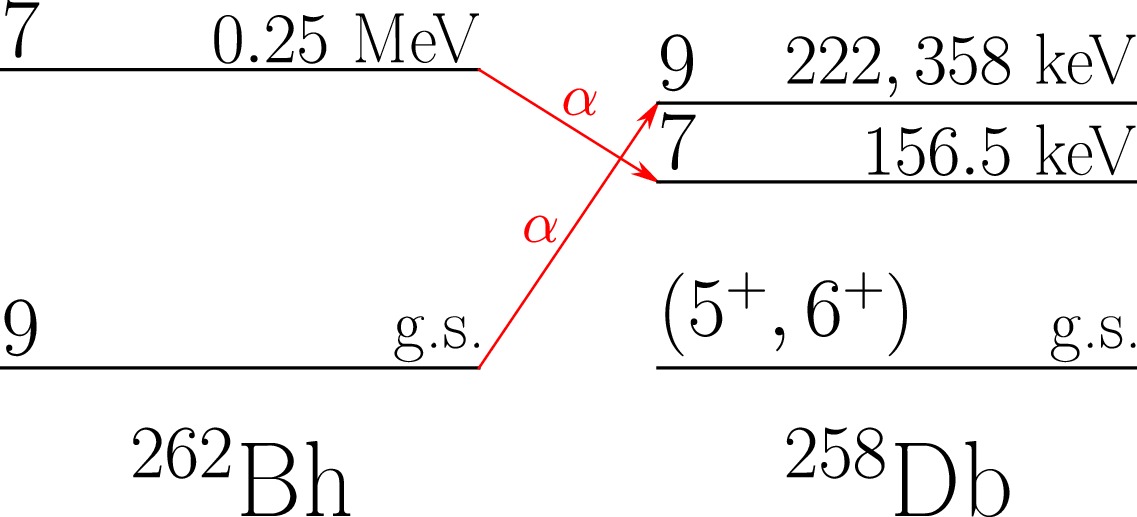
Figure 5.(color online) Possibleα-decay scheme for262Bh.
State Eis/MeV K Tα/s $ T_{a}^{\rm th} $ /s$ T_{\rm SF}^{\rm th} $ /sg.s. − 9 8.80 × 10⁻² 1.40 × 10⁻¹ 3.01 × 10³ i.s. 0.25 7 9.40 × 10⁻³ 6.59 × 10⁻³ 5.43 × 10² Table 4.Calculated half-lives of α decay and SF from g.s. and i.s. of262Bh. TheEisvalue is the energy of the isomeric state.
The237Np+48Ca reaction cross sections, measured in Ref. [19] and this study, are listed inTable 1andFig. 6. An increase inE*of the285Nh CN by 3 MeV led to a decrease in the cross section of the 3nchannel by approximately 2 times. Only the upper limit is set for the 4nreaction channel (Table 1). These cross sections are consistent with the predictions [49] made before the experiment [19] (see,e.g., Refs. [5,6]). In numerous subsequent theoretical studies, the measured cross sections were reproduced well by different authors.
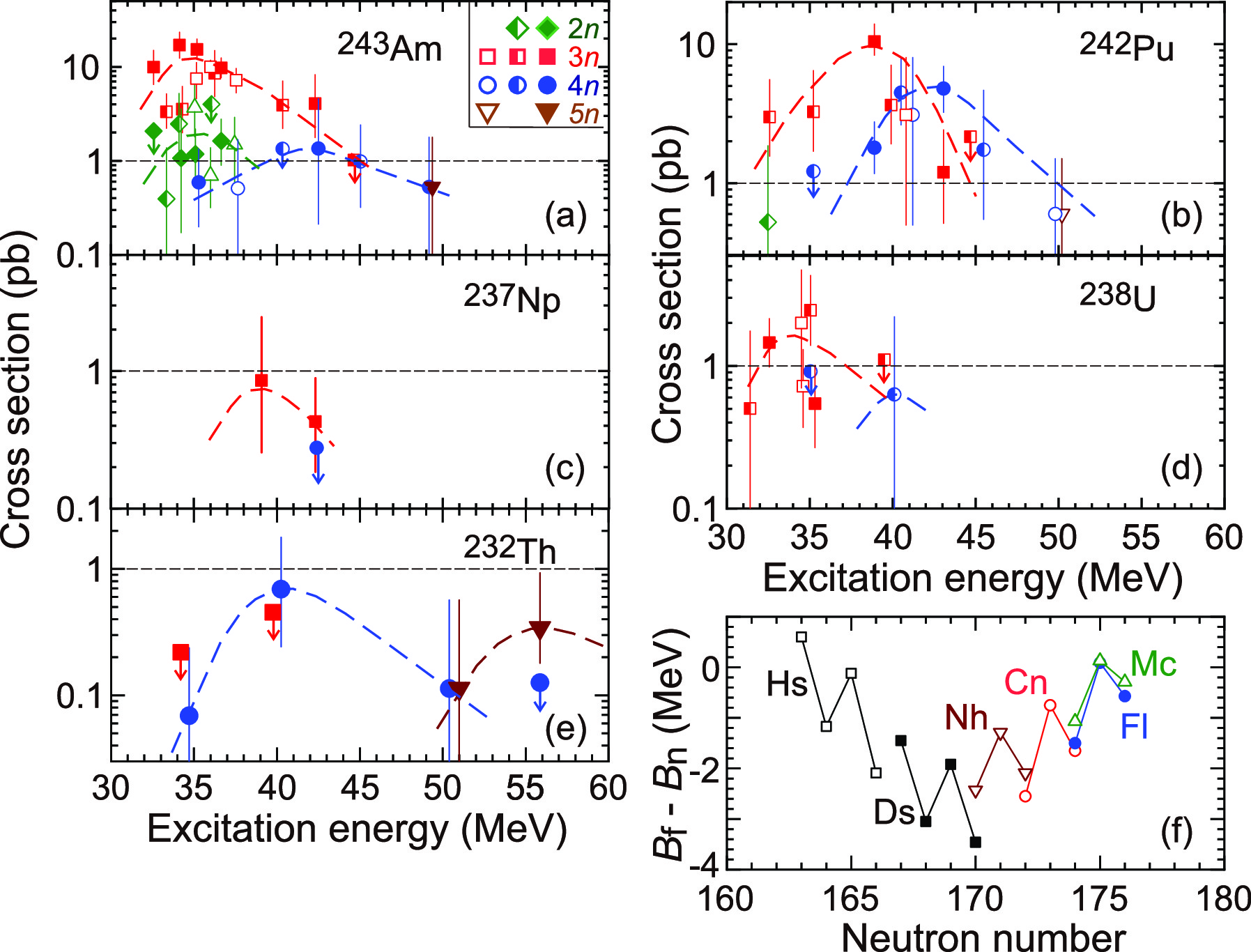
Figure 6.(color online) Cross sections for the 2n- to 5n-evaporation channels for the243Am (a),242Pu (b),237Np (c),238U (d), and232Th+48Ca (e) reactions. Vertical error bars correspond to total uncertainties. The symbols with arrows show the upper cross-section limits. The data are represented by open (from Refs. [42−45]), half-closed (from Refs. [46,47]), and closed symbols (from Refs. [19,20,26,40] and this study). The dashed lines through the data are drawn to guide the eye. Panel (f) shows the difference between the fission barriersBfand neutron binding energyBnfor the compound nuclei and neutron evaporation products of the243Am,242Pu,237Np,238U,232Th, and226Ra reactions with48Ca [48].
As can be seen inFig. 7, the237Np+48Ca reaction cross section was slightly smaller than the cross sections for the nuclei of the neighboring elements Cn and Fl. The reason for this may be the lower number of neutrons in237Np than those in238U and242.244Pu. Thus, the reaction with237Np leads to a more neutron-deficient compound nucleus285Nh, which is farther from the influence of the magical neutron shell atN=184. As a result, there is a smaller difference (Bf-Bn), which determines the survival probability of CN in the process of deexcitation, as shown inFig. 6(f). The cross sections for the elements Hs-Og (the maximum total cross section of thexn-channels), shown inFig. 7, were obtained from the fusion-evaporation reactions of226Ra,232Th,238U,237Np,242,244Pu,243Am,245,248Cm,249Bk, and249Cf with48Ca projectiles, which led to the synthesis of isotopes withZ=108, 110, and 112−118.
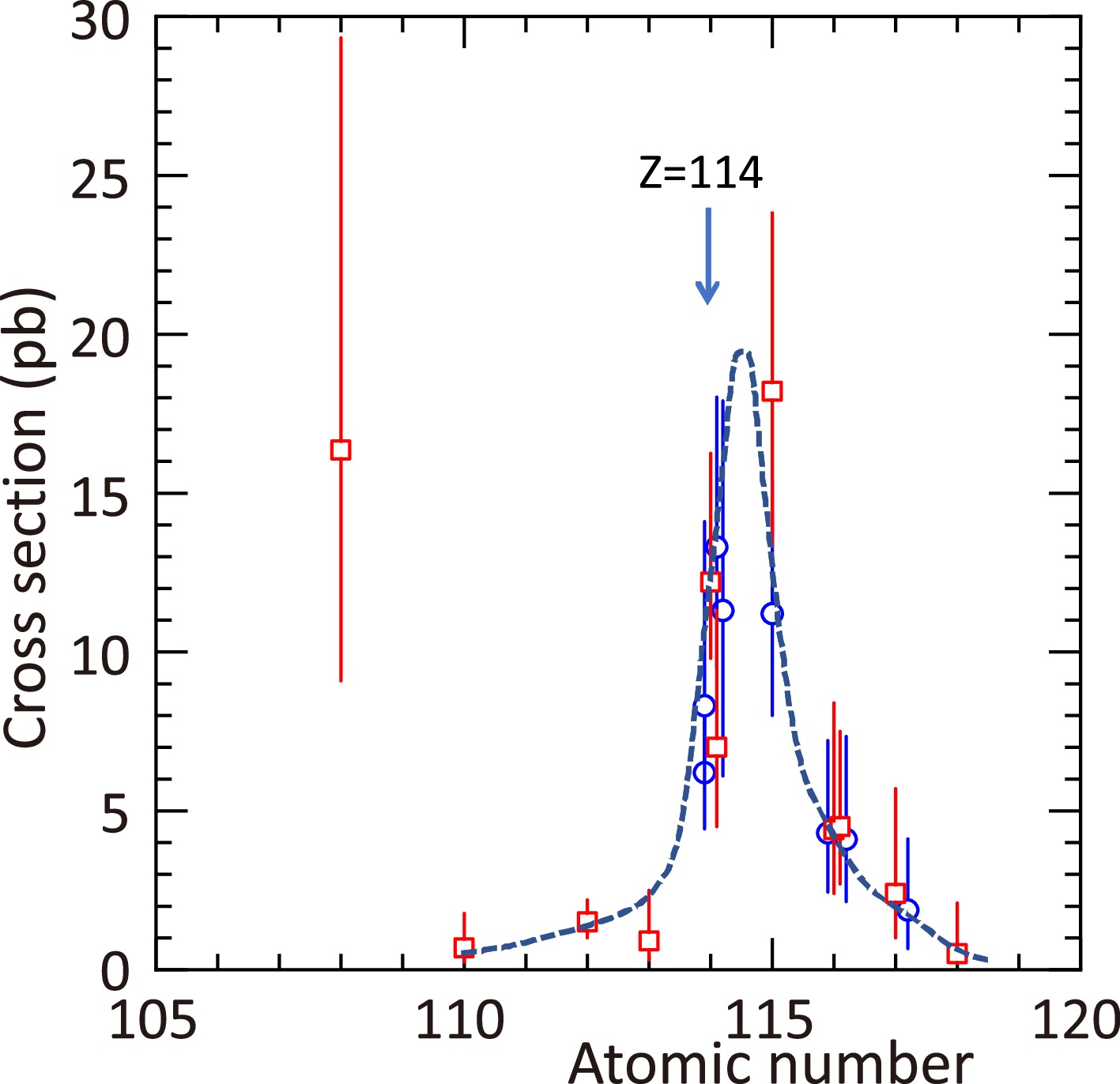
Figure 7.(color online) Maximum production cross sections for the isotopes of heavy elements in the48Ca-induced reactions with226Ra,232Th,238U,242,244Pu,243Am,245,248Cm,249Bk, and249Cf. Data measured at DGFRS and DGFRS-2 are shown by red squares [5,6,19,20,26,40,46,47,50], whereas the results obtained at SHIP, BGS, TASCA, and GARIS are shown by blue circles [15,41,45,51-53]. The dashed line through the data is drawn to guide the eye.
Cross-section variations, seen inFig. 7, depend on both the properties of the interacting nuclei and the CN resulting from their complete fusion. These features of the nuclei determine the capture of interacting nuclei, formation of an almost spherical CN, and its survival during deexcitation. According to the theory (seee.g., Refs. [54−56] and recent papers [57−60]), the drop in the48Ca-induced complete-fusion reaction cross sections, caused by the survivability of CN during deexcitation, are by orders of magnitude higher than the drop owing to the formation probability of compound nuclei. Thus, the changes in the reaction cross sections are largely determined by the survival of CN, which, in turn, depends on their fission barriers. As can be seen inFig. 7, the dependence of the cross sections on the atomic number of CN is a rather narrow function. A deviation from the presumed magic numberZ=114 by 1−2 units leads to noticeable drops in the cross sections. This fact may indicate the magical value ofZ= 114. The increase in the reaction cross section for Hs, produced in the226Ra+48Ca reaction, may also be due to the influence of the shells atZ= 108 andN= 162.
-
The objective of this study was to measure the decay properties of the daughter products of the243Am +54Cr reaction, which can be used for the synthesis of element 119. The237Np+48Ca reaction has been studied using the gas-filled separator DGFRS-2 at the SHE Factory (FLNR, JINR). We obtained three chains of consecutiveαdecays of282Nh,278Rg,274Mt, and270Bh, which stopped by the SF of266Db. The results of this experiment are consistent with our previous data [19,20]. The half-lives of282Nh,278Rg, and270Bh are consistent with the values that can be expected for them based on the systematics of the experimental properties of odd-Znuclei. However, the half-life of274Mt is two orders of magnitude longer than expected. Such a large difference has been observed for the first time for the heaviest nuclei.
The decay schemes for some heavy odd-Znuclei were extracted by using the experimentalQαandTαvalues and the cluster model based on the dinuclear system approach. As it follows from the model, the observation of a lowerEαvalue for274Mt, when compared with the predictions [21], and longer decay times than those expected from systematics (Fig. 3), may be owing to the decays of274Mt and270Bh into i.s. withK=9. The transition to g.s. fromK=7 to the state withK=9 may occur owing to a rapidγdecay, as a result of which the decay from the state withK=7 was not observed.
The measured cross section of
$0.43^{+0.46}_{-0.25}$ pb atE*= 42 MeV is consistent with the behavior of the excitation functions for the 3nchannel in the48Ca-induced reactions. An increase inE*of the285Nh CN by 3 MeV when compared with the observation in Ref. [19] atE*= 39 MeV led to a decrease in the cross section of the 3nchannel by approximately 2 times.The upper cross-section limit of the 4nreaction channel was 0.28 pb. The decay chain of the unknown isotope281Nh has not been detected, although the decay properties of the odd-even isotopes281Nh,277Rg,273Mt, and269Bh are of great interest. The isotope277Rg (N= 166) may be the least stable of all odd-Zheavy nuclei (seeFig. 3), as the Rg isotopes have the largest drop inT1/2with decreasingN. The half-life of273Mt (N= 164) may correspond to theT1/2trend for the isotopes of Mt and reach approximately 1 ms if its decay is not hindered to the extent as in the case of274Mt. Isotope269Bh (N=162) may be the first of the isotopes of odd-Zelements with a magic numberN= 162. However, the small reaction cross section may cause a serious challenge for future research.
The previously observed lower cross section for Nh than those for the isotopes of neighboring elements Cn and Fl (Fig. 7) may be owing to the relatively small number of neutrons in237Np and CN, respectively (Fig. 6). This should lead to a decrease in the fission barriers of CN when moving away from the magic neutron numberN= 184 and a decrease in the survival probability of CN.
Investigation of the237Np(48Ca,xn)285-xNh reaction: Long-lived state in274Mt
- Received Date:2026-07-21
- Available Online:2027-01-15
Abstract:The237Np+48Ca reaction was studied using the gas-filled separator DGFRS-2 of the SHE Factory at the Flerov Laboratory of Nuclear Reactions, Joint Institute for Nuclear Research. We observed threeα-decay chains of282Nh and its descendant nuclei278Rg,274Mt, and270Bh terminated by the spontaneous fission of266Db. The half-lifeTαof the isotopes282Nh,278Rg, and270Bh correspond to the values expected from the experimental systematics for the odd-Znuclei; however,Tαfor274Mt exceeds this value by two orders of magnitude. These results are in agreement with those previously measured by Oganessianet al. [Phys. Rev. C76, 011601(R) (2007); Phys. Rev. C106, 064306 (2022)]. Such a significant difference in the measuredTαfor274Mt is observed for the first time for the heaviest nuclei withZ≥ 107. The decay properties of a few heavy odd-Znuclei are compared with the predictions of a cluster model based on a dinuclear system approach, and their corresponding decay schemes are proposed. The reaction cross section is measured to be $0.43^{+0.46}_{-0.25} $ pb, which is consistent with the expectation for the excitation functions of the 3nchannel in48Ca-induced reactions. The upper cross-section limit of the 4nreaction channel is 0.28 pb.


 DownLoad: