










Highlights
- Resonance of hypernuclei with complex momentum representation
2025, 49(4): 044101. doi: 10.1088/1674-1137/ad9a8c
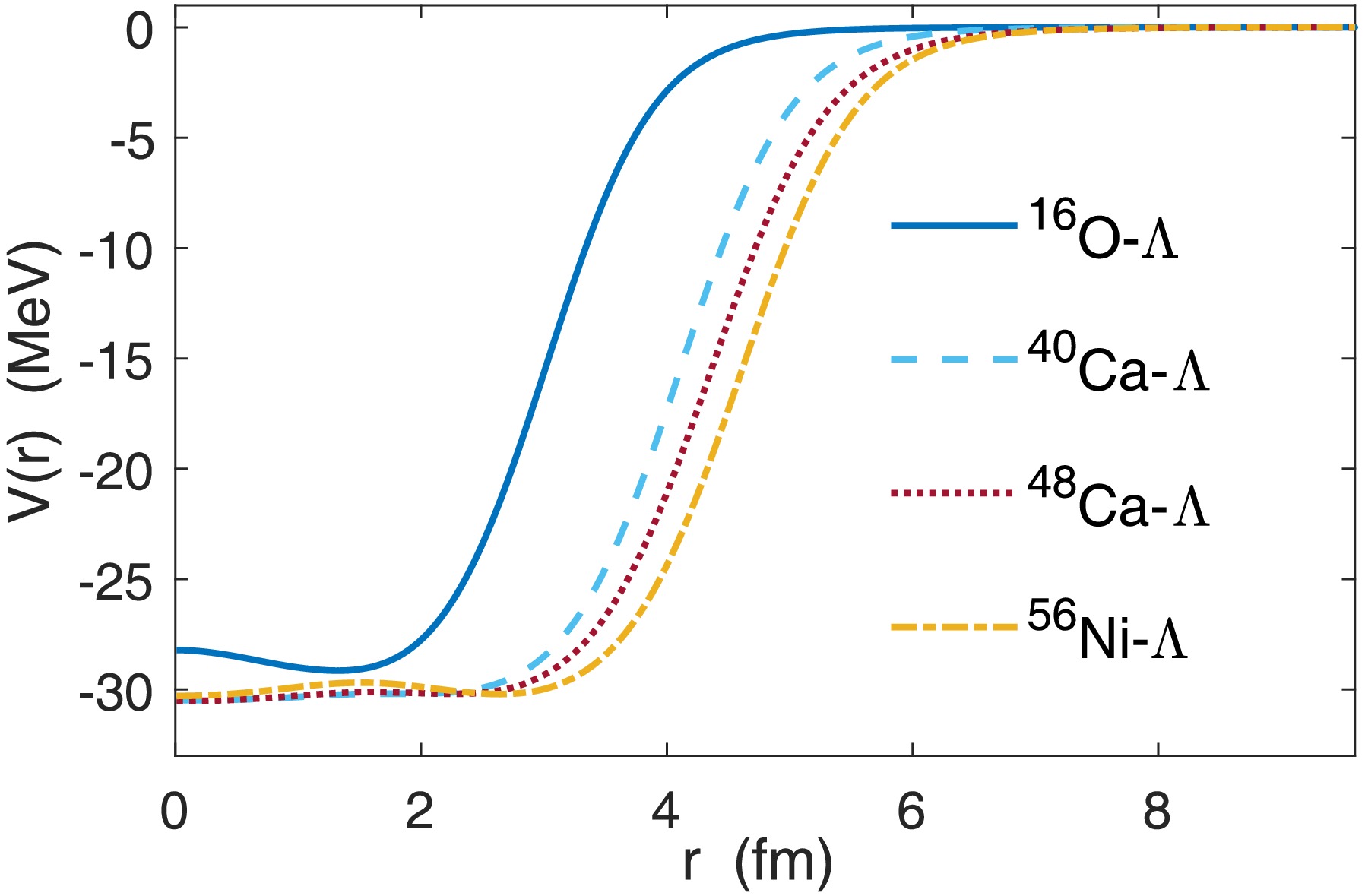 By combining the Skyrme-Hartree-Fock method with complex momentum representation (CMR), the resonant states of
$ {}^{17}_\Lambda $ O,$ {}^{41}_{\Lambda} $ Ca,$ {}^{49}_{\Lambda} $ Ca, and$ {}^{57}_\Lambda $ Ni were investigated. The phase shifts for hyperon-nucleus elastic scattering were determined with continuum level density (CLD), and the scattering length as well as the resonance energy were obtained by utilizing the effective range expansion. Our method, abbreviated as CMR-CLD, exhibits good consistency with traditional approaches and provides ground work for investigating scattering and resonance problems in deformed and multi-hyperon hypernuclei. - Inferring a spinning black hole in an expanding universe via the S2 star around the galactic center
2025, 49(4): 045106. doi: 10.1088/1674-1137/ad9304
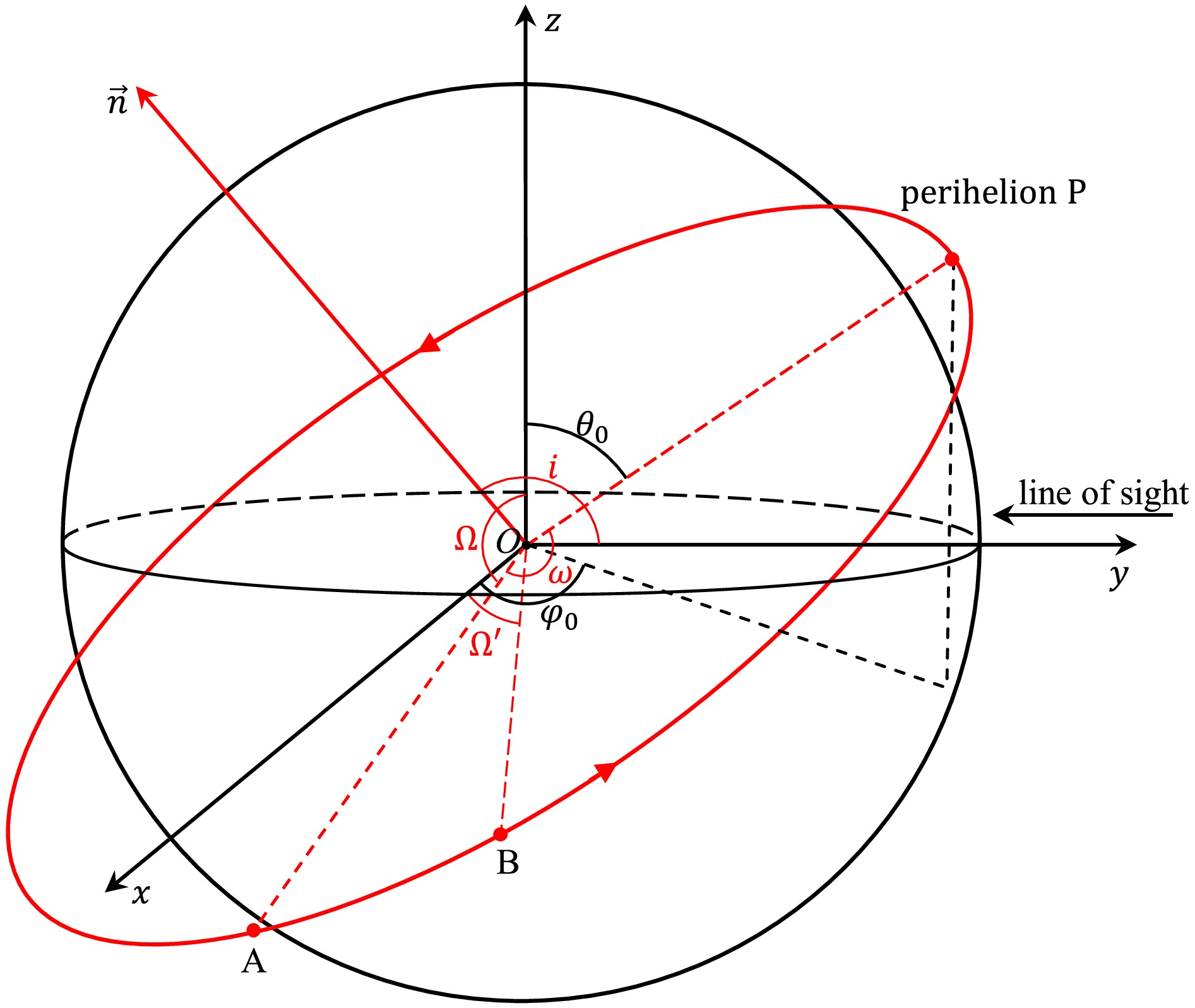 The nearest black hole to Earth, Sagittarius A
$ ^\star $ (Sgr A$ ^\star $ ), with its intense gravitational field, provides a unique opportunity to explore black hole mysteries. Over the past few decades, monitoring of the S2 star has provided extensive valuable data that can be utilized to examine various gravity theories and black hole paradigms. This paper focuses on the most intriguing objects in astronomy, spinning black holes, and investigates the effects of spin on orbital motion. By applying the Markov Chain Monte Carlo algorithm to publicly available observational data of the S2 star, our findings indicate that current data fail to constrain the spin of Sgr A$ ^\star $ . Simulated stars with smaller semi-major axes reveal that the direction of Lense-Thirring precession aligns with the spin direction of Sgr A$ ^\star $ . Additionally, by incorporating the cosmological constant, which accounts for the expansion of the universe, into our analysis, we establish an upper limit of$ \Lambda \lesssim 7.3 \times 10^{-34} \text{ km}^{-2} $ on the cosmological constant at the$ 1\sigma $ confidence level. Future long-term monitoring of S-cluster stars, combined with enhanced observational precision, may enable the determination of the spin of Sgr A$ ^\star $ and further tighten the bound on the cosmological constant. - An empirical formula of nuclearβ-decay half-lives with the transition-strength contribution
2025, 49(4): 044110. doi: 10.1088/1674-1137/ad9303
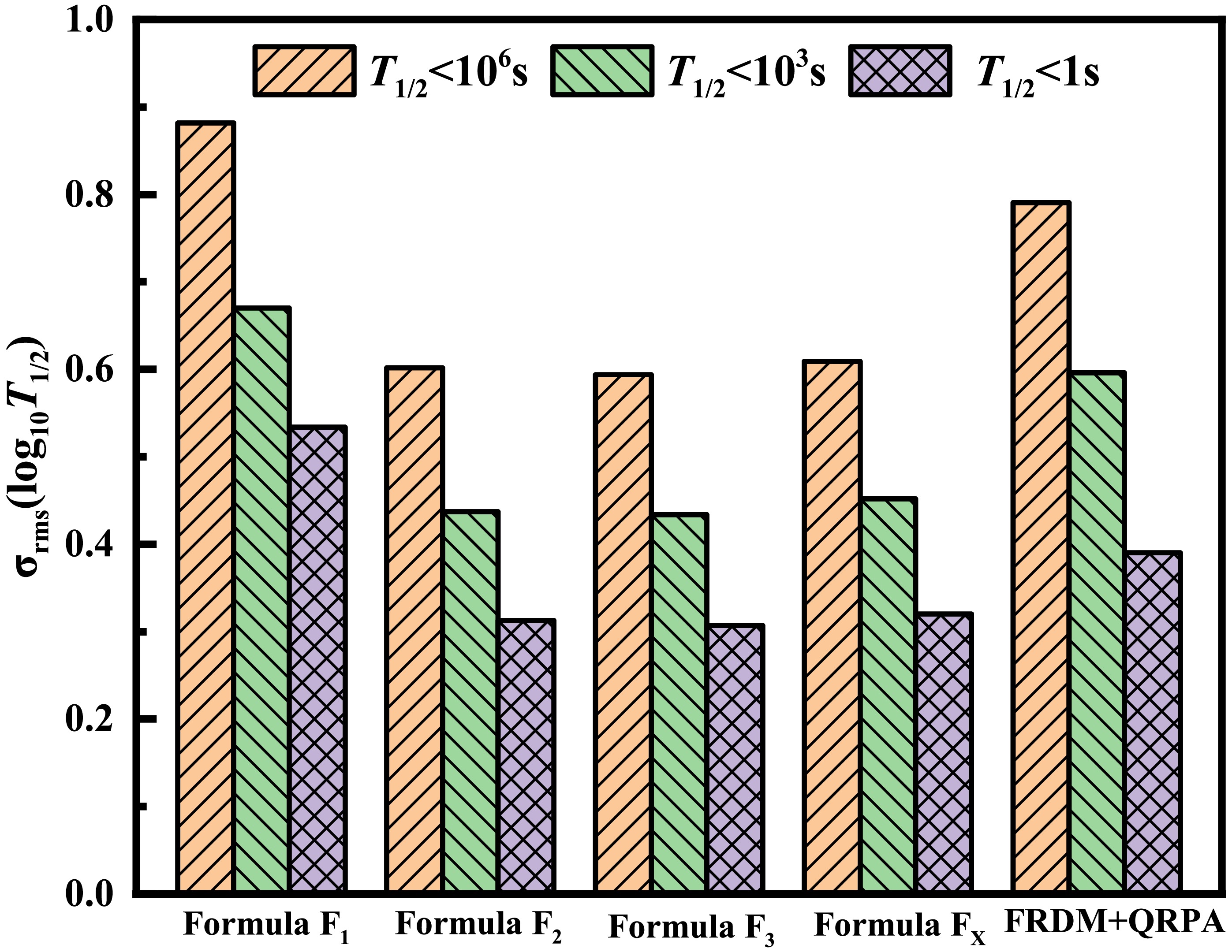 An empirical formula of nuclear β-decay half-lives is proposed by including the transition-strength contribution. The inclusion of the transition-strength contribution can reduce nuclear β-decay half-lives by about an order of magnitude, and its effect gradually increases toward the neutron-rich or heavy nuclear regions. For nuclear β-decay half-lives less than 1 s, the empirical formula can describe the experimental data within approximately2 times, which is more accurate than the sophisticated microscopic models. The transition-strength contribution can also be effectively considered by refitting the parameters of other empirical formulas without the transition-strength term although they will still significantly deviate from the new empirical formula in light or heavy neutron-rich nuclear regions. This indicates that the inclusion of the transition-strength contribution in the empirical formula is crucial for the global description of nuclear β-decay half-lives. The extrapolation ability of the new empirical formula was verified by the newly measured β-decay half-lives.


Just Accepted
More >
- Note on single-trace EYM amplitudes with MHV configuration
Published: 2025-04-23, doi: 10.1088/1674-1137/adc189
- Traversable wormholes in AdS and entanglement
Published: 2025-04-23, doi: 10.1088/1674-1137/adbd1b
- Testing redshift variation of the X-ray and ultraviolet luminosity relations of quasars
Published: 2025-04-20
Recent
More >
- Configuration-interaction relativistic Hartree-Fock model
2025, 49(6): 064104-064104-13.doi: 10.1088/1674-1137/adbdbaShow AbstractThe configuration interaction relativistic Hartree-Fock (CI-RHF) model is developed in this work. Compared to the conventional configuration interaction shell model (CISM), the CI-RHF model can be applied to study the structural properties of a wide range of nuclei without readjusting any parameters, as the effective Hamiltonian for different model spaces can be deduced consistently from a universal density-dependent Lagrangian based on the Hartree-Fock single-particle basis. The convergence of intermediate-state excitations has been examined in evaluating the effective interactions, and the core-polarization effects are illustrated, taking
$ ^{18} {\rm{O}}$ as an example. Employing the CI-RHF model, both the bulk properties and low-lying spectra of even-even nuclei$^{18-28} {\rm{Ne}}$ have been well-reproduced with the model space restricted to the$ sd $ shell. Studies of the isotopic evolution concerning charge radii and low-lying spectra highlight the shell closure at$ N=14 $ for neon isotopes. Furthermore, the cross-shell calculations extending from the$ sd $ to$ pf $ shell successfully reproduced the low-lying spectra of$ ^{30} {\rm{Ne}}$ and$ ^{32} {\rm{Ne}}$ . Notably, remarkably low excitation energies$ E(2^{+}_{1}) $ of$ ^{30} {\rm{Ne}}$ suggest the disappearance of the conventional magicity$ N=20 $ . - Collective impact of higher-order deformations of target nuclei on the fusion dynamics of heavy-ion induced reactions
2025, 49(6): 064110-064110-12.doi: 10.1088/1674-1137/adbaceShow AbstractSeveral studies on fusion reaction dynamics focused on the impact of quadrupole
$\beta_2^{\pm}$ deformation. However, existing literature highlights the importance of the octupole$\beta_3^{\pm}$ and hexadecapole$\beta_4^{\pm}$ deformations associated with both the projectile and target nuclei. However, the collective influence of these deformations ($\beta_2$ ,$\beta_3$ , and$\beta_4$ ) on the fusion reaction dynamics has not been examined explicitly. In this study, we investigated the collective influence of higher-order deformations up to$\beta_4$ on the barrier characteristics, in particular$V_B$ ,$R_B$ , and$\hbar\omega$ , and their impact on the fusion cross-sections of heavy-ion induced reactions in the mass range$163\leq{ {A}}\leq182$ . The reactions were examined at both compact and elongated configurations of the deformed nuclei. Heavy ion-induced reactions, which consist of target nuclei with higher-order deformations up to$\beta_4$ , reveal a notable alteration in the barrier characteristics$V_B$ and$R_B$ , along with a significant change in orientation$\theta_i$ for both compact and elongated configurations. In addition, the incorporation of deformations up to$\beta_4$ and their corresponding orientations$\theta_i$ contributes to enhanced capture cross-sections$\sigma_{cap}$ as well as integrated cross-sections$\sigma_{int.}$ , resulting in better agreement with experimental data for$^{16}{\rm{O}}$ -induced reactions with$^{148}{\rm{Nd}}$ ,$^{149-150}{\rm{Sm}}$ , and$^{32}{\rm{S}}$ -induced reactions with$^{150}{\rm{Sm}}$ . We conclude that the incorporation of deformations of all orders up to$\beta_4$ at their optimized compact and elongated configurations is essential because it provides better outcomes compared to the optimized configurations of$\beta_2$ and$\beta_3$ deformed nuclei. - Nuclear stability and ratio of kinetic to potential energy
2025, 49(6): 064108-064108-7.doi: 10.1088/1674-1137/adc3ffShow AbstractThe Skyrme energy density functional was used to systematically analyze the ratio of repulsive kinetic to attractive potential energy (
$ T/U $ ) for even-even nuclei in their ground states. Notably, the nuclei with maximal value of$ T/U $ are generally stable for a certain isobaric chain with$ Z\le 82 $ . However, the known magic numbers can be more clearly observed from the$ T/U $ ratio than from nuclear binding energy, particularly for the isobaric chains with semi-magic nuclei. Combining the predicted binding energies and the$ T/U $ ratios from the Skyrme Hartree-Fock-Bogoliubov (HFB) code transformed harmoic oscilattor (HFBTHO) with the parameter set based on the Universal Nuclear Energy Density Funcitonal (UNEDF0), the possible magic numbers in super-heavy mass region were simultaneously studied. The neutron magic number$ N=184 $ can be clearly observed from the calculated values of$ T/U $ and the extracted microscopic energies of the nuclei.


Current Issued

2025 Vol. 49, No. 4
Published: 28 March 2025
Published: 28 March 2025
Archive
IF: 3.6
Monthly issued, founded in 1977
Sponsored by:
ISSN1674-1137 CN11-5641/O4
Original research articles, Ietters and reviews Covering theory and experiments in the fieids of
- Particle physics
- Nuclear physics
- Particle and nuclear astrophysics
- Cosmology
Author benefits
- A SCOAP3 participating journal - free Open Access publication for qualifying articles
- Average 24 days to first decision
- Fast-track publication for selected articles
- Subscriptions at over 3000 institutions worldwide
- Free English editing on all accepted articles
News
- Chinese Physics C Outstanding Reviewer Award 2023
- Impact factor of Chinese Physics C is 3.6 in 2022
- 2022 CPC Outstanding Reviewer Awards
- The 2023 Chinese New Year-Office closure
- 《Chinese Physics C》BEST PAPER AWARDS 2022
Cover Story
- Cover Story (Issue 1, 2025) Comments on Prediction of Energy Resolution inthe JUNO Experiment
- Cover Story (Issue 12, 2024) | Doubly heavy meson puzzle: precise prediction of the mass spectra and hadronic decay with coupled channel effects to hunt for beauty-charm family
- Cover Story (Issue 9, 2024) Measurement of solar pp neutrino flux using electron recoil data from PandaX-4T commissioning run
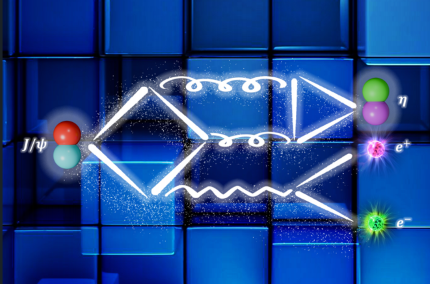
- Cover Story (Issue 11, 2024) | Form factor for Dalitz decays from J/ψ to light pseudoscalars
- Cover Story (Issue 3, 2024) | First measurement of the ground-state mass of 22Al helps to evaluate the ab-initio theory
Advertising