


 Abstract
 HTML
 Reference
 Related
 PDF


-
Type I X-ray bursts (XRBs) are thermonuclear phenomena characterized by a rapid increase in X-ray luminosity over a short duration (10−100 s). These bursts occur on the surfaces of neutron stars in low-mass X-ray binaries and provide deep insights into the properties of neutron stars [1]. As a neutron star accretes hydrogen- and helium-rich material from its companion star, an extreme environment of high temperature (T~108−109K) and density (ρ~106g/cm3) is created. This extreme environment triggers a thermonuclear explosion in the accreted material, leading to thermal X-ray emission from the dramatically heated neutron star photosphere [2]. The nuclear reaction sequences powering these bursts include the
$ 3\alpha $ -reaction, theαp-process, and the rapid proton-capture process (rp-process). Among these, the rp-process is a key pathway for heavy-element nucleosynthesis [3−7].Nuclear masses can significantly affect the light curves, reaction pathways, and final composition of nuclear ashes in the rp-process [8−10]. For nuclides with unknown masses, theoretical predictions or extrapolations are typically adopted, such as the finite-range droplet model (FRDM2012) [11], the Weizsäcker-Skyrme model (WS4) [12], the deformed relativistic Hartree–Bogoliubov theory in continuum (DRHBc) [13], and the Atomic Mass Evaluation (AME2020) [14]. However, differences in the mass values predicted by various mass models can reach the MeV level [15], whereas the mass uncertainties of key nuclides in the rp-process are generally required to be on the order of 50 keV [10] or even as low as 10 keV [8,9]. For example, the first precise mass measurement and improved precision for a series of nuclides around64As [16] and26P [17] have provided deeper insights into the main reaction pathways and produced elements in the rp-process.
In the proton-rich region around mass numberA~80, numerous nuclides had either unknown masses or large mass uncertainties [18,19], despite playing a critical role in the rp-process [9]. Over the past few years, many experimental studies have provided new mass values in this region [20−23]. Nevertheless, there are still some nuclides, such as83,84Mo,82Nb, and80Zr, with only predicted masses or mass uncertainties much larger than 10 keV, as shown inFig. 1. The corresponding effects on the nucleosynthesis of the rp-process have not yet been specifically investigated.

Figure 1.(color online) Schematic rp-process path nearA~80. The key relates an arrow to a specific interaction. The uncertainty of the mass excess is presented below the symbol of a nuclide. The values with symbol#are from the extrapolations in AME2020 [14]. The dotted line in the figure highlights the group of nuclides involved in the so-called Zr-Nb cycle [4].
Furthermore, a proposed Zr-Nb cycle in this region, as illustrated inFig. 1, can exert a considerable influence on rp-process nucleosynthesis [4,24]. Although the Zr-Nb cycle has been claimed to be excluded on the basis of the experimentally determined
$ S_{ \alpha} $ of 1.434(83) MeV for84Mo [23], the extent and conditions under which the Zr-Nb cycle can be excluded remain unclear—particularly given that a mass uncertainty of 80 keV still exists for80Zr.In this paper, we first study the impact of the current mass uncertainties of83,84Mo,82Nb, and80Zr on the composition of the nuclear ashes in XRBs. Then, we clarify the potential influence of the Zr-Nb cycle on the rp-process given the current mass values and uncertainties.
-
To explore the impact of nuclear masses on rp-process nucleosynthesis, reaction network calculations were carried out using the one-zone post-processing code NucNet [25]. The XRB model follows the approach of Schatzet al. [26], with initial mass fractions of accreted hydrogen and helium of
$ X^{0}_{{\mathrm{H}}} = 0.645 $ and$ X^{0}_{^{4}{\mathrm{He}}} = 0.355 $ , respectively. The ignition temperature was set to 0.23 GK at a density of$ 1.08 \times10^{6} $ g/cm3. The burst phase lasted 4 seconds, reaching a peak temperature of 1.9 GK, followed by a cooling phase that persisted for 200 seconds.The nuclides studied in the network calculation are listed inTable 1. First, for each nuclide, the mass was independently varied by ±
$ 2\sigma $ . The corresponding reaction rates were then calculated using the TALYS code [27], and the reverse reaction rates were determined by the NucNet code based on detailed balance principles and the reactionQ-values. Finally, the resulting abundances were compared with those obtained using the central mass value to assess the influence of each mass uncertainty on the ash composition.Table 1.The nuclear masses of interest studied in the network calculations. Also listed are the corresponding proton separation energies (
$S_{ p}$ ). The symbol#denotes extrapolated value from AME2020.Figure 2shows, as a function of mass numberA, the fractional difference, defined as the change in abundance relative to the results obtained using the AME2020 central mass values. It is evident that the ±
$ 2\sigma $ mass variations of all studied nuclides, except82Nb, have a negligible impact on the abundances.
Figure 2.(color online) Using the calculation results with AME2020 masses as a reference,the fractional difference of abundance as a function of mass numberA. The solid and dashed lines represent the results obtained with the nuclide mass increased and decreased by
$2\sigma$ deviated from the AME2020 central mass value, respectively. In addition, the results using the82Nb mass value from FRDM2012 [11] and WS4 [12] theoretical predictions are also presented.Here, the first striking finding is that the quite large mass variations of ± 800 keV in83Mo still have a negligible impact on the final abundances. As illustrated inFig. 3, although the large mass variations in83Mo alter the primary net flows beyond82Nb, these flows ultimately converge at83Nb with no significant leakage. This behavior is ensured by the short half-life of83Mo (23 ± 19 ms) and the long half-life of82Zr (32 ± 5 s), which channel the flow through82Nb(p, γ)83Mo(
$ \beta^{+}) $ 83Nb and82Nb($ \beta^{+}) $ 82Zr(p, γ)83Nb, respectively.
Figure 3.(color online) The rp-process reaction net flow near83Mo. The thickness of these arrows indicates the strength of reaction flows. Left: ME(83Mo) + 800 keV, Right: ME(83Mo) - 800 keV.
Another notable feature inFig. 2is that, for82Nb, a 2σmass decrease has only a relatively minor influence on the calculated abundances, whereas a mass increase of the same magnitude leads to a pronounced change, particularly at
$ A=81 $ . This asymmetry arises because, when the lower mass value of82Nb is used, as in the case with the central value, the forward81Zr(p, γ)82Nb reaction dominates over its reverse for most of the time (see the red and green lines inFig. 4). In contrast, when the higher mass value is adopted, the (p, γ)-(γ, p) equilibrium between81Zr and82Nb is more readily established (see the blue line inFig. 4). This leads to a pronounced accumulation of81Zr, which in turn enhances the abundance at$ A=81 $ . Similarly, inFig. 2, we also include a comparison using the predicted mass values of82Nb from FRDM2012 [11] (ME(82Nb) = –50830 keV) and WS4 [12] (ME(82Nb) = –51090 keV), together with that from AME2020 (ME(82Nb) = –51810 keV). The higher mass value of82Nb corresponds to a larger fractional abundance difference at$ A=81 $ , which is consistent with the above analysis.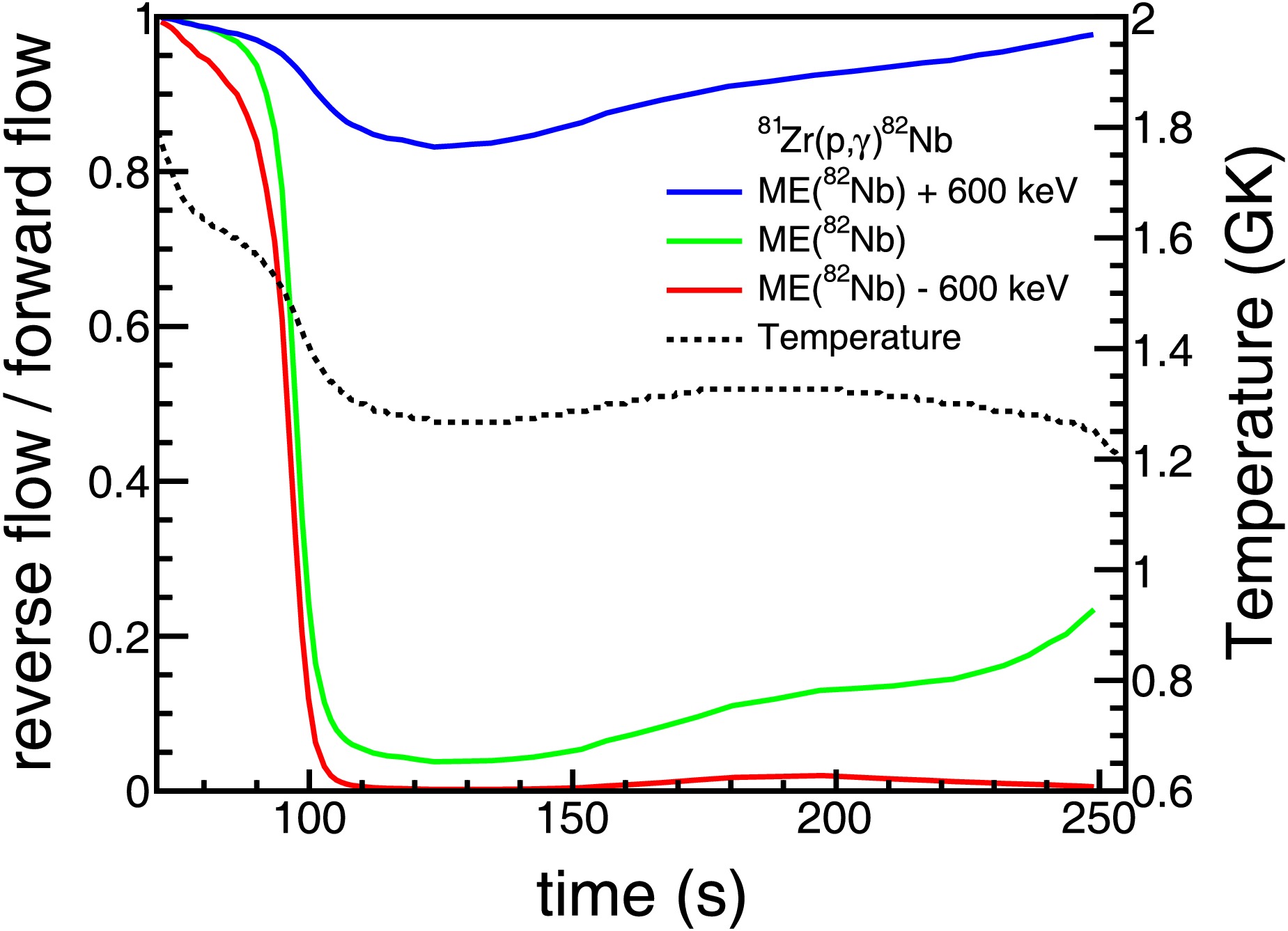
Figure 4.(color online) Ratio of reverse to forward flow for81Zr(p, γ)82Nb under different82Nb mass values, as a function of time. The temperature profile is also shown as the dotted line.
For84Mo and80Zr, although the mass uncertainties exceed 10 keV, the resulting ± 2σvariations in their
$ S_{ p} $ values remain small relative to the large$ S_{ p} $ values themselves (seeTable 1). This appears to be the primary reason why the mass uncertainties have only a minor effect on the fractional differences in the abundances. -
When the flow returning to80Zr is comparable to the flow escaping the
$ N=42 $ isotonic chain owing to a sufficiently low mass value of80Zr, the Zr-Nb cycle emerges as an endpoint of the rp-process.In Refs. [20,24], to quantitatively estimate the contribution of the Zr-Nb cycle to the rp-process, a cycle branching ratio was defined as the fraction of the flow ending at80Zr via the83Nb(p, α)80Zr and84Mo(γ,α)80Zr reactions. In the more recent work of Ref. [20], the mass values of80Zr and84Mo were extrapolated. Then, a favorable condition was defined by assuming the
$ 1\sigma $ upper or lower limits of the mass uncertainties that give the largestQ-value for the83Nb(p, α)80Zr reaction and the minimum$ S_{ \alpha} $ (84Mo). Under this favorable condition, the calculated branching ratio was several orders of magnitude lower than that obtained using the AME2012 mass values [28,29] (see the red and black solid lines inFig. 5orFig. 4in Ref. [20]). As a result, the Zr-Nb cycle was believed either not to exist or, at least, to be much weaker than previously expected. However, the masses of80Zr and84Mo were later experimentally measured [22,23] (seeTable 1), and the$ S_{ \alpha} $ (84Mo) was obtained as 1.434(83) MeV, almost 0.8 MeV lower than the extrapolated value in Ref. [20].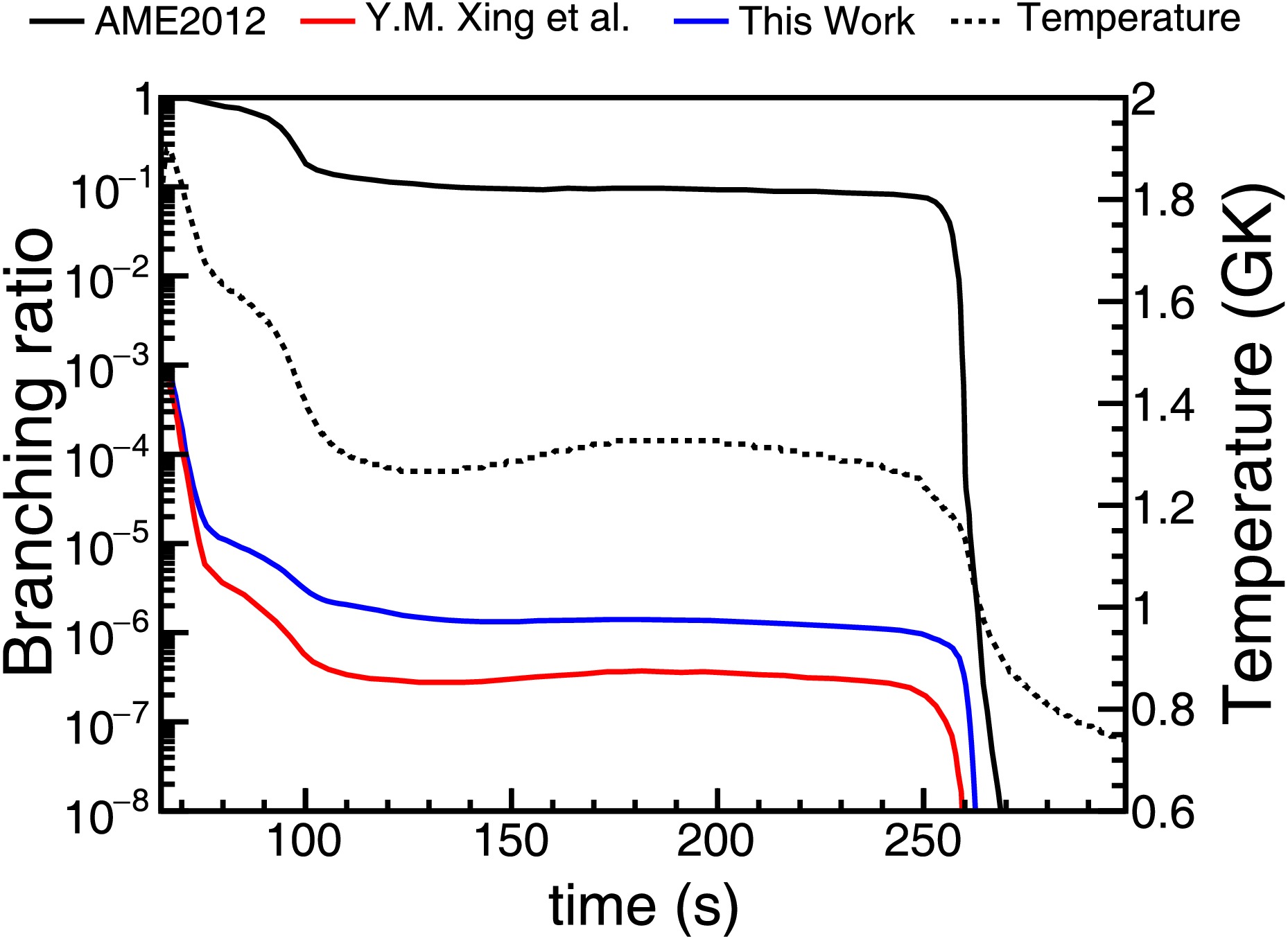
Figure 5.(color online) Ratio of the reaction flows branching into the Zr–Nb cycle. The black and red lines are adopted from Ref. [20] (see text for details). The blue line is under the favorable condition with the masses of80Zr and84Mo being 2σlower and upper over their central values, respectively.
To demonstrate the effect of the new mass measurements of80Zr and84Mo on the Zr-Nb cycle, a more favorable scenario is assumed, in which the masses of80Zr and84Mo are respectively 2σbelow and above their central values.
Under this more favorable condition, the branching ratio is shown by the blue line inFig 5, confirming that the Zr-Nb cycle can be unambiguously excluded, even at the peak temperature of ~1.9 GK.
-
We have investigated the impact of current mass uncertainties of83,84Mo,82Nb, and80Zr on the final ash composition of the rp-process in XRBs. Our results reveal that the long half-life of82Zr plays an important role, rendering the large mass uncertainty of83Mo irrelevant to the abundances at
$ A=82 $ and beyond. In contrast, the mass uncertainty of82Nb exerts a significant influence on the$ A=81 $ abundance, which is notably enhanced as the mass of82Nb increases. This finding highlights the particular importance of future high-precision mass measurements of82Nb for more accurate modeling of the rp-process. Furthermore, our results confirm that the Zr-Nb cycle remains negligible under the newly measured masses and associated uncertainties of84Mo and80Zr.
Impact of mass uncertainties of83,84Mo,82Nb and80Zr on the rp-process nucleosynthesis
- Received Date:2026-03-04
- Available Online:2026-08-15
Abstract:Precise nuclear mass values are key parameters for modeling astrophysical X-ray bursts. In this work, we investigate the impact of current mass uncertainties of83,84Mo,82Nb, and80Zr on the nucleosynthesis of the rp-process. The results reveal that the impact of the mass uncertainties of83,84Mo and80Zr on the final abundances is negligible, although the large mass uncertainty of83Mo can reach a level close to 1 MeV. In contrast, the final abundances are highly sensitive to the mass value of82Nb. An increase in the mass of82Nb can significantly enhance the abundance at $ A=81 $. Furthermore, the Zr-Nb cycle in the rp-process is investigated and confirmed to play a minor role in the rp-process flows.


 DownLoad: