


 Abstract
 HTML
 Reference
 Related
 PDF


-
In high-energy heavy-ion collisions, a new state of matter—the quark-gluon plasma (QGP)—can be created, whose properties can be indirectly probed through modifications experienced by hard probes traversing it [1−5]. This phenomenon is known as jet quenching. A prominent hard probe comprises high-energy partons, or jets, produced in an initial hard scattering. Their evolution generally proceeds as follows: first, the high-transverse-momentum parton generated in the hard collision carries finite virtuality and undergoes initial splittings in vacuum, described by perturbative QCD via DGLAP evolution [6]. Subsequently, the evolution proceeds to progressively smaller angles through parton showering and eventually becomes nonperturbative as the partons hadronize, after which the resulting hadrons are reconstructed as jets via clustering algorithms.
Studying how jets are modified as they propagate through the QGP has long been a central topic in the field. In recent years, sustained investigation of jet substructure has deepened our understanding of jet modification and evolution in the hot and dense medium. Jet substructure observables, constructed from final-state hadrons, encode information about parton-shower evolution and hadronization [7]. A class of such observables, specifically designed to constrain nonperturbative processes, has been used to study modifications to the perturbative phase of jet evolution in the medium. Another category of substructure observables enables the separation of perturbative and nonperturbative regimes across the full angular range—particularly shedding light on the hadronization process [8−15]. The two-point energy–energy correlator (EEC) [16−19]. emerges as one such observable and exhibits a distribution separable into three distinct angular regimes: small angles dominated by the free diffusion of hadrons, large angles governed by perturbative parton-shower evolution, and an intermediate transition region between them [20−27]. In recent years, the EEC has been explored from multiple aspects as a probe of jet quenching phenomena [28−50]. In heavy-ion collisions, it further provides insights into initial-state cold nuclear matter effects [28−32], parton energy-loss mechanisms [33,34], medium response [35−37], the properties of in-medium light-flavor quarks [34,38], mass effects in the in-medium evolution of heavy-flavor quarks [24,32,39,40], and the physical properties of the quark-gluon plasma (QGP) [25,41−50].
Refs. [51,52] categorize the EEC by considering hadron pairs carrying like or opposite charges, enabling the study of charge correlations during hadronization and providing constraints on hadronization models. This is achieved by including the charge product in the energy weighting, yielding the charge-weighted EEC. Furthermore, the ratio of the charge-weighted EEC to the inclusive EEC offers a reweighted measure of charge correlations as a function of hadron-pair angular separation. These observables have garnered significant attention from experimental collaborations such as STAR and ALICE [21,53]. Owing to their sensitivity to timescale separation within jets, a detailed investigation of the modification patterns of these observables inA+Acollisions is essential. Such studies not only help probe and track jet evolution in the hot and dense medium [24,54−56], but also establish a valuable baseline for future exploration of hadronization mechanisms in heavy-ion collisions, both theoretically and experimentally.
In this work, we present, in Section II, the theoretical baseline obtained with PYTHIA and compare it with experimental results from RHIC and the LHC. In Section III, we provide, for the first time, theoretical predictions for the charge-weighted EEC distribution of charged-hadron jets with 40−60 GeV andR= 0.4 in 0−10% central Pb+Pb collisions, and discuss the observed jet quenching effects. In Section IV, we compute theoretical predictions for theRLdistribution, the ratio of the charge-weighted EEC to the inclusive EEC, and analyze the influence of the medium on the magnitude of charge correlations as a function of the particle-pair angle. Finally, in Section V, we summarize our conclusions and outline future perspectives.
-
The charge-weighted EEC for final-state charged hadrons within jets is constructed in the same way as in previous studies [22,34], but incorporates the product of the hadron-pair charges into the energy weighting [21]. Experimentally, it is defined as follows:
$ \begin{aligned}[b]& Charge-weighted\ EEC \\=& \frac{1}{ N_{{\rm{jet}}}\cdot\Delta R}\int_{R_{{\rm{L}}}-\frac{1}{2}\Delta R}^{R_{{\rm{L}}}+\frac{1}{2}\Delta R}\sum_{{\rm{jets}}}\sum_{i, j}\frac{Q_iQ_jp_{T, i}p_{T, j}}{p^2_{T,\rm jet}}\delta(R_{{\rm{L}}}-R_{{\rm{L}}, ij})\mathrm{d}R_{{\rm{L}}}\\=& EEC_{\rm{like}} - EEC_{\rm{opposite}}, \end{aligned} $
(1) whereiandjdenote two particles within a jet;
$ R_{L,ij} = \sqrt{(\phi_j - \phi_i)^2 + (\eta_j - \eta_i)^2} $ is their angular separation;$ Q_i $ and$ Q_j $ are their electric charges; and$ p_{T, i}/p_{T,{\rm{jet}}} $ and$ p_{T,j}/p_{T,{\rm{jet}}} $ are their transverse-momentum fractions relative to the jet.$ \Delta R $ is the angular bin width, and$ N_{{\rm{jet}}} $ is the total number of jets. This definition naturally separates the EEC into two components: one constructed using only like-charge pairs and one using only opposite-charge pairs. When accounting for the sign of the charge product$ Q_iQ_j $ , the charge-weighted EEC corresponds to the contribution from like-charge pairs minus the contribution from opposite-charge pairs. The EEC without considering the charges of particle pairs, as discussed earlier, is the sum of these two contributions. To distinguish it from the charge-weighted EEC, we refer to it as the inclusive EEC hereafter. In addition, the jets in this definition are all reconstructed from final-state charged hadrons, and we will refer to them as charged jets hereafter.To provide a fairp+pbaseline for the jet-quenching study, we used the Monte Carlo event generator PYTHIA v8.313 [57] to simulatep+pcollisions at the LHC energy
$ \sqrt{s}=5.02 $ TeV with the default tune [58] and at the RHIC energy$ \sqrt{s}=200 $ GeV with the Detroit tune [59], matching the STAR Collaboration implementation in [21]. Details are summarized here: Jets were reconstructed using the anti-$ k_T $ algorithm from the FᴀJᴛᴊᴇᴛ v3.4.0 package [60], with a jet radius parameterR= 0.4. At$ \sqrt{s}=200 $ GeV, we select jets with transverse momenta 20 GeV/c<pT,jet< 30 GeV/c, jet rapidity$ |\eta_{{\rm{jet}}}| \lt 0.6 $ , composed of charged particles with$ p_{T,\rm had} >0.2$ GeV/c. At$ \sqrt{s}=5.02 $ TeV, we select jets with transverse momenta 40 GeV/c<pT,jet< 60 GeV/c, jet rapidity$ |\eta_{{\rm{jet}}}| \lt 0.5 $ , composed of charged particles with$ p_{T,\rm had} >1$ GeV/c. To facilitate the subsequent discussion, we define the$ R_{{\rm{L}}} $ intervals used in this study as follows: we denote$ R_{{\rm{L}}} \lt 0.05 $ as small angles dominated by free diffusion of hadrons,$ R_{{\rm{L}}} \gt 0.2 $ as large angles governed by perturbative parton-shower evolution, and the intermediate region$ 0.05 \lt R_{{\rm{L}}}< 0.2 $ as the transition region.We computed, inp+pcollisions at both
$ \sqrt{s}=200 $ GeV and$ 5.02 $ TeV, the distributions of the charge-weighted EEC (upper panel ofFig. 1) and the ratio of the charge-weighted EEC to the inclusive EEC (lower panel). The like-charge component (dashed line), the opposite-charge component (dash-dotted line), and the inclusive EEC distributions (solid line) are plotted together for each collision energy. They are consistent with simulations by the experimental collaborations and also align with the ALICE [53] and STAR experimental data [21]. We find that, for both cases, the like-charge components agree well with the experimental data across the entireRLrange. The opposite-charge component underestimates the experimental data at largerRLand overestimates it at smallerRL. Its peak is shifted toward smaller angles, causing the inclusive distribution to shift to larger angles and to overpredict the experimental data at smallerRL. Please note that the ALICE experimental data points shown here are preliminary results, and the data points in the ratio in the lower panel are also derived from these preliminary results.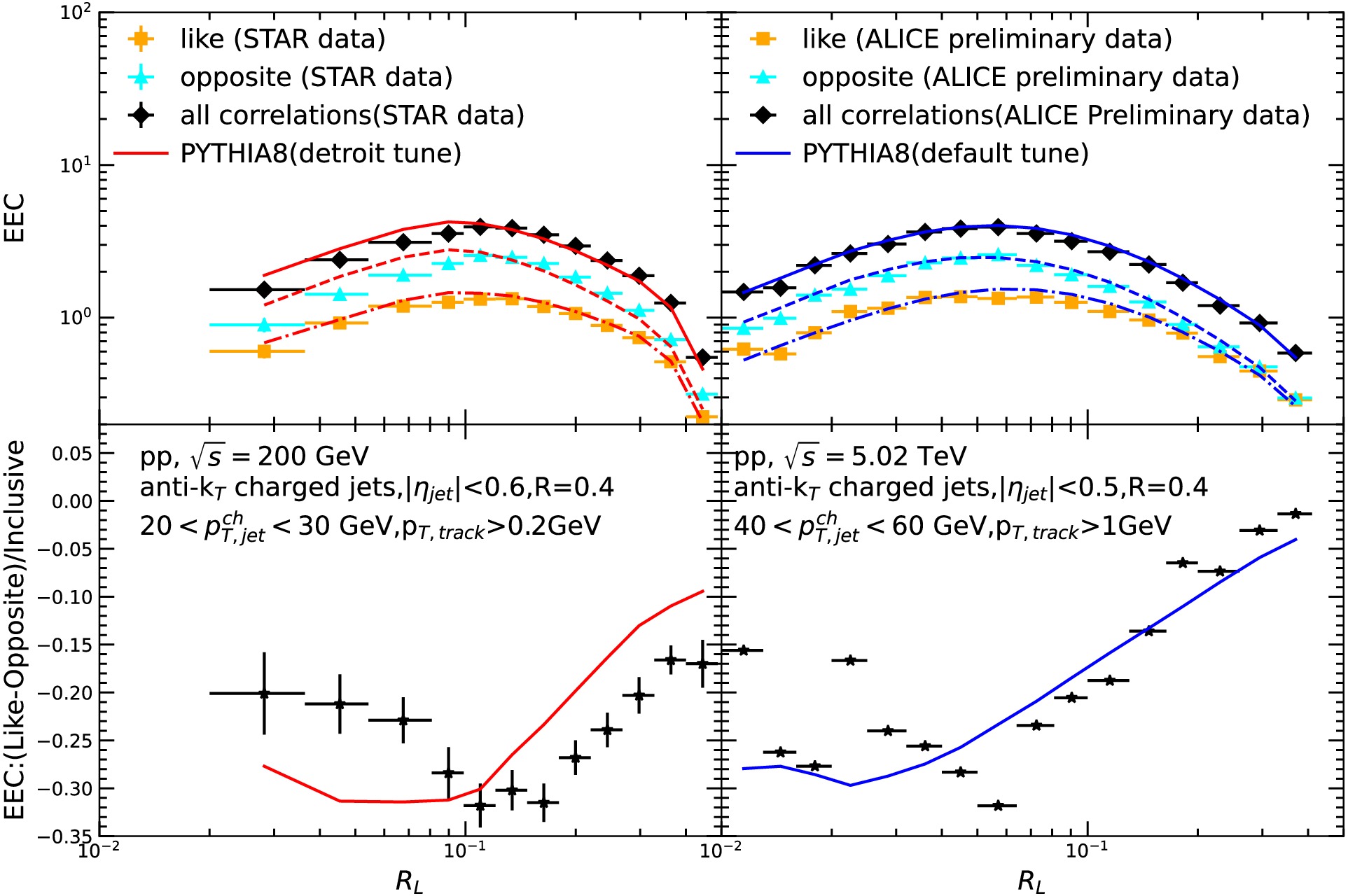
Figure 1.(color online) PYTHIA 8 simulation results for the normalized charge-weighted EEC, together with its like-charge and opposite-charge components (upper panels), and for the ratio of the charge-weighted to inclusive EEC distributions (lower panels), are presented as functions ofRLfor inclusive charged jets with a jet size ofR= 0.4 produced inp+pcollisions at
$ \sqrt{s}=200 $ GeV (left panel) and$ \sqrt{s}=5.02 $ TeV (right panel). The results are compared with STAR [21] and ALICE [53] experimental data, respectively.In the lower panel ofFig. 1, we present the ratio of the charge-weighted distribution to the inclusive EEC at two collision energies, 200 GeV and 5.02 TeV. As suggested in [21], this ratio quantifies the magnitude of charge correlations across the full range from –1 to +1. For the jets in the kinematic range studied, the distribution is concentrated at negative values. A ratio of zero corresponds to the extreme scenario of an infinite thermal bath, where the probabilities of forming like-charge and opposite-charge pairs are equal. However, within our studied range (with an average jet charge
$ Q=0.006 $ and limited particle numbers within a jet), the opposite-charge correlations are stronger than the like-charge correlations, both overall and predominantly—a consequence of charge conservation. This observable reflects the relative abundance of these two types of correlations as a function of relative angular distance (RL), with more negative values corresponding to stronger correlations of opposite-charge pairs.In the largerRLregion beyond the transition, the positive slope of the ratio with increasingRLindicates that opposite-charge correlations become decorrelated in the shower-dominated regime. This feature is also captured by PYTHIA simulations performed by the experimental collaborations and by us; the predicted slope agrees with the experimental data. Conversely, in the smallRLregion below the transition—dominated by free diffusion of hadrons—the opposite-charge correlations are strongest and remain relatively flat as a function ofRL. Intriguingly, we are also unable to account for the experimentally observed negative slope in this region using PYTHIA. This suggests the emergence of opposite-charge decorrelations as theRLdistance decreases. Nevertheless, these results form the baseline for this study.
The mechanism of vacuum hadronization remains an open question; the EEC observables provide valuable constraints on this. STAR and ALICE have also noted in their reports that neither PYTHIA's string-fragmentation mechanism nor Herwig's cluster mechanism can explain this phenomenon. In this paper, we do not intend to explore or attempt to resolve this issue. Our only concern is whether such ap+pbaseline affects our study of the nuclear modification effects for this observable. The answer is no. This is because, in the high-transverse-momentum region, jet-quenching effects are typically factorized into parton-level modifications in the hot, dense medium and the hadronization process in vacuum outside the `fireball', and our calculations are performed precisely in this manner. Under this assumption, we attempt to isolate and study the jet-quenching effects for this observable, thereby laying the foundation for subsequent investigations into the hadronization mechanism in the hot and dense medium. Therefore, in the following sections of the paper, we continue to use the PYTHIA description as the pp baseline for theA+A/ppratio, and also use the parton-level events generated by PYTHIA as input for the transport model.
-
The charge-weighted EEC for final-state charged hadrons within jets is constructed in the same way as in previous studies [22,34], but incorporates the product of the hadron-pair charges into the energy weighting [21]. Experimentally, it is defined as follows:
$ \begin{aligned}[b]& Charge-weighted\ EEC \\=& \frac{1}{ N_{{\rm{jet}}}\cdot\Delta R}\int_{R_{{\rm{L}}}-\frac{1}{2}\Delta R}^{R_{{\rm{L}}}+\frac{1}{2}\Delta R}\sum_{{\rm{jets}}}\sum_{i, j}\frac{Q_iQ_jp_{T, i}p_{T, j}}{p^2_{T,\rm jet}}\delta(R_{{\rm{L}}}-R_{{\rm{L}}, ij})\mathrm{d}R_{{\rm{L}}}\\=& EEC_{\rm{like}} - EEC_{\rm{opposite}}, \end{aligned} $
(1) whereiandjdenote two particles within a jet;
$ R_{L,ij} = \sqrt{(\phi_j - \phi_i)^2 + (\eta_j - \eta_i)^2} $ is their angular separation;$ Q_i $ and$ Q_j $ are their electric charges; and$ p_{T, i}/p_{T,{\rm{jet}}} $ and$ p_{T,j}/p_{T,{\rm{jet}}} $ are their transverse-momentum fractions relative to the jet.$ \Delta R $ is the angular bin width, and$ N_{{\rm{jet}}} $ is the total number of jets. This definition naturally separates the EEC into two components: one constructed using only like-charge pairs and one using only opposite-charge pairs. When accounting for the sign of the charge product$ Q_iQ_j $ , the charge-weighted EEC corresponds to the contribution from like-charge pairs minus the contribution from opposite-charge pairs. The EEC without considering the charges of particle pairs, as discussed earlier, is the sum of these two contributions. To distinguish it from the charge-weighted EEC, we refer to it as the inclusive EEC hereafter. In addition, the jets in this definition are all reconstructed from final-state charged hadrons, and we will refer to them as charged jets hereafter.To provide a fairp+pbaseline for the jet-quenching study, we used the Monte Carlo event generator PYTHIA v8.313 [57] to simulatep+pcollisions at the LHC energy
$ \sqrt{s}=5.02 $ TeV with the default tune [58] and at the RHIC energy$ \sqrt{s}=200 $ GeV with the Detroit tune [59], matching the STAR Collaboration implementation in [21]. Details are summarized here: Jets were reconstructed using the anti-$ k_T $ algorithm from the FᴀJᴛᴊᴇᴛ v3.4.0 package [60], with a jet radius parameterR= 0.4. At$ \sqrt{s}=200 $ GeV, we select jets with transverse momenta 20 GeV/c<pT,jet< 30 GeV/c, jet rapidity$ |\eta_{{\rm{jet}}}| \lt 0.6 $ , composed of charged particles with$ p_{T,\rm had} >0.2$ GeV/c. At$ \sqrt{s}=5.02 $ TeV, we select jets with transverse momenta 40 GeV/c<pT,jet< 60 GeV/c, jet rapidity$ |\eta_{{\rm{jet}}}| \lt 0.5 $ , composed of charged particles with$ p_{T,\rm had} >1$ GeV/c. To facilitate the subsequent discussion, we define the$ R_{{\rm{L}}} $ intervals used in this study as follows: we denote$ R_{{\rm{L}}} \lt 0.05 $ as small angles dominated by free diffusion of hadrons,$ R_{{\rm{L}}} \gt 0.2 $ as large angles governed by perturbative parton-shower evolution, and the intermediate region$ 0.05 \lt R_{{\rm{L}}}< 0.2 $ as the transition region.We computed, inp+pcollisions at both
$ \sqrt{s}=200 $ GeV and$ 5.02 $ TeV, the distributions of the charge-weighted EEC (upper panel ofFig. 1) and the ratio of the charge-weighted EEC to the inclusive EEC (lower panel). The like-charge component (dashed line), the opposite-charge component (dash-dotted line), and the inclusive EEC distributions (solid line) are plotted together for each collision energy. They are consistent with simulations by the experimental collaborations and also align with the ALICE [53] and STAR experimental data [21]. We find that, for both cases, the like-charge components agree well with the experimental data across the entireRLrange. The opposite-charge component underestimates the experimental data at largerRLand overestimates it at smallerRL. Its peak is shifted toward smaller angles, causing the inclusive distribution to shift to larger angles and to overpredict the experimental data at smallerRL. Please note that the ALICE experimental data points shown here are preliminary results, and the data points in the ratio in the lower panel are also derived from these preliminary results.
Figure 1.(color online) PYTHIA 8 simulation results for the normalized charge-weighted EEC, together with its like-charge and opposite-charge components (upper panels), and for the ratio of the charge-weighted to inclusive EEC distributions (lower panels), are presented as functions ofRLfor inclusive charged jets with a jet size ofR= 0.4 produced inp+pcollisions at
$ \sqrt{s}=200 $ GeV (left panel) and$ \sqrt{s}=5.02 $ TeV (right panel). The results are compared with STAR [21] and ALICE [53] experimental data, respectively.In the lower panel ofFig. 1, we present the ratio of the charge-weighted distribution to the inclusive EEC at two collision energies, 200 GeV and 5.02 TeV. As suggested in [21], this ratio quantifies the magnitude of charge correlations across the full range from –1 to +1. For the jets in the kinematic range studied, the distribution is concentrated at negative values. A ratio of zero corresponds to the extreme scenario of an infinite thermal bath, where the probabilities of forming like-charge and opposite-charge pairs are equal. However, within our studied range (with an average jet charge
$ Q=0.006 $ and limited particle numbers within a jet), the opposite-charge correlations are stronger than the like-charge correlations, both overall and predominantly—a consequence of charge conservation. This observable reflects the relative abundance of these two types of correlations as a function of relative angular distance (RL), with more negative values corresponding to stronger correlations of opposite-charge pairs.In the largerRLregion beyond the transition, the positive slope of the ratio with increasingRLindicates that opposite-charge correlations become decorrelated in the shower-dominated regime. This feature is also captured by PYTHIA simulations performed by the experimental collaborations and by us; the predicted slope agrees with the experimental data. Conversely, in the smallRLregion below the transition—dominated by free diffusion of hadrons—the opposite-charge correlations are strongest and remain relatively flat as a function ofRL. Intriguingly, we are also unable to account for the experimentally observed negative slope in this region using PYTHIA. This suggests the emergence of opposite-charge decorrelations as theRLdistance decreases. Nevertheless, these results form the baseline for this study.
The mechanism of vacuum hadronization remains an open question; the EEC observables provide valuable constraints on this. STAR and ALICE have also noted in their reports that neither PYTHIA's string-fragmentation mechanism nor Herwig's cluster mechanism can explain this phenomenon. In this paper, we do not intend to explore or attempt to resolve this issue. Our only concern is whether such ap+pbaseline affects our study of the nuclear modification effects for this observable. The answer is no. This is because, in the high-transverse-momentum region, jet-quenching effects are typically factorized into parton-level modifications in the hot, dense medium and the hadronization process in vacuum outside the `fireball', and our calculations are performed precisely in this manner. Under this assumption, we attempt to isolate and study the jet-quenching effects for this observable, thereby laying the foundation for subsequent investigations into the hadronization mechanism in the hot and dense medium. Therefore, in the following sections of the paper, we continue to use the PYTHIA description as the pp baseline for theA+A/ppratio, and also use the parton-level events generated by PYTHIA as input for the transport model.
-
In this work, we examine the impact of jet quenching on charge correlations, as revealed by the ratio of the charge-weighted EEC to the inclusive EEC, using a two-step approach. We first compute theA+A-to-p+pratio of the charge-weighted EEC within the same transverse-momentum interval as thep+pbaseline.
We have developed an updated Monte Carlo framework, primarily based on a Langevin transport equation, to simulate the energy-loss processes of partons produced in initial hard scatterings as they traverse the Quark-Gluon Plasma (QGP) in heavy-ion collisions, referred to as the SHELL model. It incorporates three key physical processes: elastic collisional energy loss, in-medium gluon radiation, and medium response. This model has successfully described a wide range of experimental observables, including those related to jet quenching [61−66].
The model initializes the dynamical distribution of partons using a Glauber-model-based nuclear geometry [67]. These partons are then propagated step by step through a QGP medium whose evolution is governed by relativistic hydrodynamics. At each evolution time step
$ \Delta t $ , a parton may simultaneously undergo elastic scattering, radiate gluons, and induce a medium response. The elastic energy loss per unit length is calculated using the Hard Thermal Loop (HTL) formula [68]:$ \frac{\mathrm{d}E}{\mathrm{d}t}=\frac{\alpha_sC_s}{2}\mu_D^2\ln\left(\frac{\sqrt{ET}}{\mu_D}\right), $
(2) where
$ \alpha_s $ is the running coupling constant of the strong interaction, taken to be 0.3 in our calculations;$ C_s $ is the Casimir operator ($ C_A=3 $ for a gluon,$ C_F=4/3 $ for a quark);$ \mu_D $ is the Debye screening mass; andEandTare the parton energy and the local medium temperature, respectively.The energy deposited into the medium via these elastic collisions accumulates within and interacts with the QGP, eventually hadronizing at freeze-out to form "wake" particles. This constitutes the medium-response mechanism in SHELL. The momentum distribution of these wake hadrons is computed using the Cooper-Frye prescription including perturbations [69,70]:
$ \begin{aligned}[b] E\frac{ \ {\rm{d}} \Delta N}{ \ {\rm{d}}^3p}=&\frac{1}{32 \pi} \, \frac{m_{T}}{T^5} \, \cosh(y-y_j) \exp\left[-\frac{m_{T}}{T}\cosh(y-y_j)\right] \\ &\times \Big\{ p_T \Delta P_{T} \cos (\phi-\phi_j) \\ &+\frac{1}{3}m_{T} \, \Delta M_{T} \, \cosh (y-y_j) \Big\}, \end{aligned} $
(3) Here,E,
$ {\boldsymbol{p}} $ ,$ \Delta N $ ,$ m_T $ ,$ p_T $ ,y, andϕdenote the energy, momentum, yield, transverse mass, transverse momentum, rapidity, and azimuthal angle of the wake hadron, respectively.$ y_j $ and$ \phi_j $ denote the rapidity and azimuthal angle of the energy-depositing parton.$ \Delta P_T $ and$ \Delta M_T = \Delta E / \cosh(y_j) $ represent the transverse momentum and transverse mass transferred to the medium, where$ \Delta E $ is the accumulated deposited energy. The first and second terms on the right-hand side correspond to the momentum and energy of the wake hadrons, respectively.Within SHELL, the probability that a parton radiates a gluon during a time step
$ \Delta t $ in the QGP is given by:$ P_{\rm rad}(t,\Delta t)=1-{\rm e}^{-\langle N(t,\Delta t)\rangle}, $
(4) where
$ \langle N(t, \Delta t)\rangle $ denotes the average number of radiated gluons, obtained from the medium-induced gluon spectrum within the higher-twist (HT) formalism [71−74]:$ \frac{ \ {\rm{d}} N}{ \ {\rm{d}} x \ {\rm{d}} k^{2}_{\perp} \ {\rm{d}} t}=\frac{2\alpha_{s}C_sP(x)\hat{q}}{\pi k^{4}_{\perp}}\sin^2\left(\frac{t-t_i}{2\tau_f}\right)\left(\frac{k^2_{\perp}}{k^2_{\perp}+x^2M^2}\right)^4, $
(5) Here,
$ k_\perp $ is the transverse momentum of the radiated gluon;$ x = E_g/E_p $ is the energy fraction of the gluon relative to the parent parton; M is the mass of the parent parton;$ P(x) $ is the vacuum QCD splitting function;$ \tau_f = 2Ex(1-x)/(k_\perp^2 + x^2 M^2) $ is the gluon formation time;$ t - t_i $ is the time interval in the parton frame; and$ \hat{q} = \hat{q}_0 (T/T_0)^3 p_\mu u^\mu $ is the jet transport parameter, where$ \hat{q}_0 = 1.5\; {\rm{GeV}}^2/{\rm{fm}} $ ,$ u^\mu $ is the four-velocity of the QGP at the given space-time point, and$ T_0 $ is the initial temperature. This transport parameter is the key dynamical quantity governing the strength of parton energy loss. The number of radiated gluons in a given step is sampled from a Poisson distribution, and their four-momenta are subsequently calculated.The space-time evolution of the expanding QGP fireball is provided by the (3+1)-dimensional CLVisc hydrodynamic model [75]. The hadronization temperature is set to
$ T_c = 165 $ MeV; partons, as well as the deposited wake energy, are hadronized once the local temperature falls below this value. Final-state hadrons are obtained by first forming color-singlet strings using the colorless method from the JETSCAPE collaboration [76], followed by hadronization and hadron decays via the PYTHIA Lund string model.Based on Eq. (2), we note that the charge-weighted EEC is numerically equivalent to the like-charge component minus the opposite-charge component of the inclusive EEC. Our previous work [34] further demonstrated that the in-medium modification of the EEC exhibits distinct behaviors for gluon- and quark-initiated jets. We present inFig. 2the charge-weighted EEC distributions inp+pandA+A(upper panel) and theirA+A/p+pratios (lower panel) for inclusive charged jets, quark-initiated jets, and gluon-initiated jets in central (0−10%) Pb+Pb collisions at
$ \sqrt{s_{NN}} = 5.02 $ TeV. All jets are reconstructed from charged particles with$ p_{T,\rm had} >1$ GeV/c using the anti-$ k_T $ algorithm with a radius parameter ofR= 0.4, and are selected with transverse momentum in the range 40−60 GeV/cand pseudorapidity$ |\eta^{{\rm{jet}}}| \lt 0.5 $ . Variations of the jet transport parameter and the hadronization threshold temperature within their uncertainty ranges lead to only minor changes in theRLdistribution and do not significantly alter the main features of itsA+A/p+pratio. The figure also displays the statistical-uncertainty bands. In the subsequent discussion of the underlying mechanisms, we will adopt fixed values of the transport parameter and hadronization threshold temperature consistent with our previous work, including Ref. [34].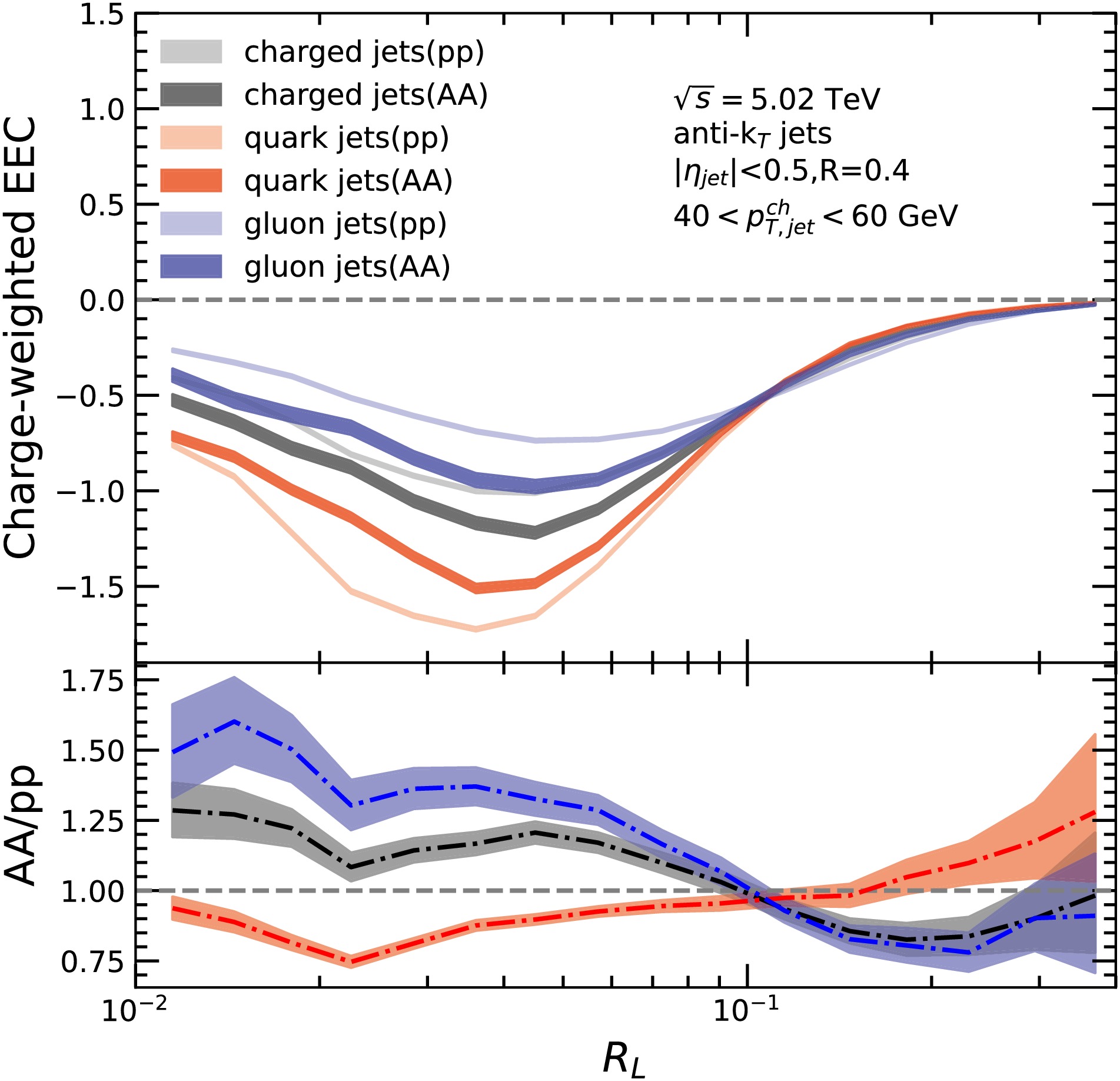
Figure 2.(color online) Charge-weighted EEC inp+pand central (0−10%) Pb+Pb collisions, and the correspondingA+A/p+pratio distributions, with statistical uncertainties, shown as functions ofRLfor inclusive charged, gluon, and quark jets with radiusR= 0.4 in the jet
$ p_{T} $ interval 40−60 GeV at$ \sqrt{s}=5.02 $ TeV.In thep+psystem, the charge-weighted EEC distribution lies predominantly in the negative region under the studied conditions, indicating that opposite-charge pairs contribute more than like-charge pairs. Beyond the transition region toward largerRL, the distribution exhibits a positive slope. In contrast, toward smallerRLit shows a negative slope—that is, the difference between opposite- and like-charge contributions decreases asRLdecreases. Regarding flavor dependence, the charge-weighted distribution of gluon-initiated jets lies closer to zero than that of quark-initiated jets. In the small-RLregion, the difference between opposite- and like-charge pairs is significantly smaller in gluon jets than in quark jets, while in the large-RLregion, this difference becomes slightly larger in gluon jets than in quark jets. InA+A, we observe that the behavior of theA+A/p+pratios resembles the previously reported modification of the EEC in a hot, dense medium, with characteristic modification patterns for quark and gluon jets also being consistent [34]. This suggests a common modification mechanism for the EEC distributions: the enhancement in the small-RLregion is dominated by selection bias and the initial spectral properties of gluon jets, while the suppression at largerRLthat increases withRLis primarily driven by broadening effects due to radiative energy loss. Notably, in the small-RLregion around
$ R \approx 0.02 $ , we observe a characteristic V-shaped modification pattern. To further investigate the origin of this feature, it is necessary to examine the medium modifications of the like-charge and opposite-charge components separately.InFig. 3, we present the distributions of the like-charge and opposite-charge components inp+pandA+Acollisions (upper panel), with their correspondingA+Atop+pratios shown in the bottom panel. While their modification patterns are generally similar to those of the inclusive EEC, the opposite-charge component exhibits a stronger enhancement in both the transition region and at smallRLcompared with the like-charge component. Moreover, the V-shaped modification structure at smallRLis found exclusively in the opposite-charge component. This is consistent with the pattern observed in the charge-weighted EEC at smallRL.

Figure 3.(color online) The like and opposite components of the EEC inp+pand central (0−10%) Pb+Pb collisions, and the distributions of theirA+A/p+pratios with statistical uncertainties, as functions ofRLfor inclusive charged jets with radiusR= 0.4 at
$ \sqrt{\rm{s}}=5.02 $ TeV in the jet$ p_{\rm{T}} $ interval$ 40-60 $ GeV.To further investigate the raw charge correlations without energy weighting and to understand how jet quenching manifests, we adopt the same methodology as in previous work [34]: we factorize the EEC distribution into the distribution of the average number of final-state charged hadron pairs per jet as a function ofRLand the corresponding average energy-energy weighting of hadron pairs within eachRLbin,
$ \langle {\rm{weight}} \rangle $ . The hadron pairs can then be categorized as like-charge or opposite-charge. We therefore decompose the EEC distribution for the like-charge and opposite-charge components as follows:$ \Sigma^{{\rm{comp}}}_{{\rm{EEC}}} = \frac{N^{\rm{total}}_{\rm{pair}}}{N_{\rm{jet}}} \thinspace \cdot \frac{\Delta N^{{\rm{comp}}}_{\rm{pair}}}{N^{\rm{total}}_{\rm{pair}} \Delta R} \thinspace \cdot \langle \rm weight \rangle^{{\rm{comp}}} , $
(6) where
$ N^{{\rm{total}}}_{{\rm{pair}}} $ is the total number of particle pairs,$ \Delta N_{{\rm{pair}}} $ is the number of pairs within an angular bin of width$ \Delta R $ centered atR, and$ \langle {\rm{weight}} \rangle $ represents the average energy weight carried by the pairs in that bin.In the upper panel ofFig. 4, theRLdistributions of like-charge and opposite-charge hadron pairs inp+pcollisions are shown as solid lines. Without energy weighting, the raw hadron pairs are predominantly distributed at largeRLvalues. As required by charge conservation, the number of opposite-charge pairs exceeds that of like-charge pairs across the entireRLrange. InA+Acollisions, theRLdistributions of both types of hadron pairs shift toward largerRL. The suppression of opposite-charge pairs at small angles is slightly weaker than that of like-charge pairs, and the enhancement at large angles is also somewhat milder for opposite-charge pairs. In the lower panel ofFig. 4, we observe that the average energy weighting of opposite-charge pairs is significantly larger than that of like-charge pairs in both the transition region and at smallRL. Although this difference becomes modest at largeRL, it is compounded by the contrasting angular distributions of hadron pairs in this region. In theA+Acase, opposite-charge pairs exhibit a stronger enhancement relative top+pcollisions at smallRLthan do like-charge pairs, whereas the suppression at largeRLis nearly identical for both types. Notably, a characteristic V-shaped modification pattern emerges in the opposite-charge component, manifested as a pronounced enhancement in the small-RLregion. This can be identified as the underlying origin of the analogous modification pattern observed in the charge-weighted EEC. We also analyzed this phenomenon by separating different jet quenching mechanisms and found that, whether it is elastic energy loss, inelastic energy loss, or medium excitation processes, the dip appears at the sameRL, suggesting that it is not caused by any specific jet quenching mechanism.

Figure 4.(color online) Per-jet normalized pair-number distributions (upper panel) and average energy-weight distributions (lower panel), with statistical uncertainties, for the like and opposite components of the EEC inp+pand central (0−10%) Pb+Pb collisions, and the correspondingA+A/p+pratios, shown as functions ofRLfor inclusive charged jets with radiusR= 0.4 at
$ \sqrt{s}=5.02 $ TeV in the jet$ p_{T} $ interval$ 40-60 $ GeV.Calculating the charge-weighted EEC for a more specific hadronization channel, such as
$ \pi^+ \pi^- $ pairs, and itsA+A/ppratio yields a much clearer valley structure than the results in the bottom panel ofFig. 3. For the$ \pi^+ \pi^- $ pair channel, the more pronounced bump in the energy-weighting distribution in pp collisions (similar to that shown in the lower panel ofFig. 4) is smeared out inA+Acollisions, resulting in a larger dip in itsA+A/ppratio. This indicates that the underlying physical mechanism is parton-level splitting broadening induced by the hot, dense medium, which causes charged di-hadron pairs like$ \pi^+ \pi^- $ that are present inppcollisions to be dissociated inA+Acollisions. -
In this work, we examine the impact of jet quenching on charge correlations, as revealed by the ratio of the charge-weighted EEC to the inclusive EEC, using a two-step approach. We first compute theA+A-to-p+pratio of the charge-weighted EEC within the same transverse-momentum interval as thep+pbaseline.
We have developed an updated Monte Carlo framework, primarily based on a Langevin transport equation, to simulate the energy-loss processes of partons produced in initial hard scatterings as they traverse the Quark-Gluon Plasma (QGP) in heavy-ion collisions, referred to as the SHELL model. It incorporates three key physical processes: elastic collisional energy loss, in-medium gluon radiation, and medium response. This model has successfully described a wide range of experimental observables, including those related to jet quenching [61−66].
The model initializes the dynamical distribution of partons using a Glauber-model-based nuclear geometry [67]. These partons are then propagated step by step through a QGP medium whose evolution is governed by relativistic hydrodynamics. At each evolution time step
$ \Delta t $ , a parton may simultaneously undergo elastic scattering, radiate gluons, and induce a medium response. The elastic energy loss per unit length is calculated using the Hard Thermal Loop (HTL) formula [68]:$ \frac{\mathrm{d}E}{\mathrm{d}t}=\frac{\alpha_sC_s}{2}\mu_D^2\ln\left(\frac{\sqrt{ET}}{\mu_D}\right), $
(2) where
$ \alpha_s $ is the running coupling constant of the strong interaction, taken to be 0.3 in our calculations;$ C_s $ is the Casimir operator ($ C_A=3 $ for a gluon,$ C_F=4/3 $ for a quark);$ \mu_D $ is the Debye screening mass; andEandTare the parton energy and the local medium temperature, respectively.The energy deposited into the medium via these elastic collisions accumulates within and interacts with the QGP, eventually hadronizing at freeze-out to form "wake" particles. This constitutes the medium-response mechanism in SHELL. The momentum distribution of these wake hadrons is computed using the Cooper-Frye prescription including perturbations [69,70]:
$ \begin{aligned}[b] E\frac{ \ {\rm{d}} \Delta N}{ \ {\rm{d}}^3p}=&\frac{1}{32 \pi} \, \frac{m_{T}}{T^5} \, \cosh(y-y_j) \exp\left[-\frac{m_{T}}{T}\cosh(y-y_j)\right] \\ &\times \Big\{ p_T \Delta P_{T} \cos (\phi-\phi_j) \\ &+\frac{1}{3}m_{T} \, \Delta M_{T} \, \cosh (y-y_j) \Big\}, \end{aligned} $
(3) Here,E,
$ {\boldsymbol{p}} $ ,$ \Delta N $ ,$ m_T $ ,$ p_T $ ,y, andϕdenote the energy, momentum, yield, transverse mass, transverse momentum, rapidity, and azimuthal angle of the wake hadron, respectively.$ y_j $ and$ \phi_j $ denote the rapidity and azimuthal angle of the energy-depositing parton.$ \Delta P_T $ and$ \Delta M_T = \Delta E / \cosh(y_j) $ represent the transverse momentum and transverse mass transferred to the medium, where$ \Delta E $ is the accumulated deposited energy. The first and second terms on the right-hand side correspond to the momentum and energy of the wake hadrons, respectively.Within SHELL, the probability that a parton radiates a gluon during a time step
$ \Delta t $ in the QGP is given by:$ P_{\rm rad}(t,\Delta t)=1-{\rm e}^{-\langle N(t,\Delta t)\rangle}, $
(4) where
$ \langle N(t, \Delta t)\rangle $ denotes the average number of radiated gluons, obtained from the medium-induced gluon spectrum within the higher-twist (HT) formalism [71−74]:$ \frac{ \ {\rm{d}} N}{ \ {\rm{d}} x \ {\rm{d}} k^{2}_{\perp} \ {\rm{d}} t}=\frac{2\alpha_{s}C_sP(x)\hat{q}}{\pi k^{4}_{\perp}}\sin^2\left(\frac{t-t_i}{2\tau_f}\right)\left(\frac{k^2_{\perp}}{k^2_{\perp}+x^2M^2}\right)^4, $
(5) Here,
$ k_\perp $ is the transverse momentum of the radiated gluon;$ x = E_g/E_p $ is the energy fraction of the gluon relative to the parent parton; M is the mass of the parent parton;$ P(x) $ is the vacuum QCD splitting function;$ \tau_f = 2Ex(1-x)/(k_\perp^2 + x^2 M^2) $ is the gluon formation time;$ t - t_i $ is the time interval in the parton frame; and$ \hat{q} = \hat{q}_0 (T/T_0)^3 p_\mu u^\mu $ is the jet transport parameter, where$ \hat{q}_0 = 1.5\; {\rm{GeV}}^2/{\rm{fm}} $ ,$ u^\mu $ is the four-velocity of the QGP at the given space-time point, and$ T_0 $ is the initial temperature. This transport parameter is the key dynamical quantity governing the strength of parton energy loss. The number of radiated gluons in a given step is sampled from a Poisson distribution, and their four-momenta are subsequently calculated.The space-time evolution of the expanding QGP fireball is provided by the (3+1)-dimensional CLVisc hydrodynamic model [75]. The hadronization temperature is set to
$ T_c = 165 $ MeV; partons, as well as the deposited wake energy, are hadronized once the local temperature falls below this value. Final-state hadrons are obtained by first forming color-singlet strings using the colorless method from the JETSCAPE collaboration [76], followed by hadronization and hadron decays via the PYTHIA Lund string model.Based on Eq. (2), we note that the charge-weighted EEC is numerically equivalent to the like-charge component minus the opposite-charge component of the inclusive EEC. Our previous work [34] further demonstrated that the in-medium modification of the EEC exhibits distinct behaviors for gluon- and quark-initiated jets. We present inFig. 2the charge-weighted EEC distributions inp+pandA+A(upper panel) and theirA+A/p+pratios (lower panel) for inclusive charged jets, quark-initiated jets, and gluon-initiated jets in central (0−10%) Pb+Pb collisions at
$ \sqrt{s_{NN}} = 5.02 $ TeV. All jets are reconstructed from charged particles with$ p_{T,\rm had} >1$ GeV/c using the anti-$ k_T $ algorithm with a radius parameter ofR= 0.4, and are selected with transverse momentum in the range 40−60 GeV/cand pseudorapidity$ |\eta^{{\rm{jet}}}| \lt 0.5 $ . Variations of the jet transport parameter and the hadronization threshold temperature within their uncertainty ranges lead to only minor changes in theRLdistribution and do not significantly alter the main features of itsA+A/p+pratio. The figure also displays the statistical-uncertainty bands. In the subsequent discussion of the underlying mechanisms, we will adopt fixed values of the transport parameter and hadronization threshold temperature consistent with our previous work, including Ref. [34].
Figure 2.(color online) Charge-weighted EEC inp+pand central (0−10%) Pb+Pb collisions, and the correspondingA+A/p+pratio distributions, with statistical uncertainties, shown as functions ofRLfor inclusive charged, gluon, and quark jets with radiusR= 0.4 in the jet
$ p_{T} $ interval 40−60 GeV at$ \sqrt{s}=5.02 $ TeV.In thep+psystem, the charge-weighted EEC distribution lies predominantly in the negative region under the studied conditions, indicating that opposite-charge pairs contribute more than like-charge pairs. Beyond the transition region toward largerRL, the distribution exhibits a positive slope. In contrast, toward smallerRLit shows a negative slope—that is, the difference between opposite- and like-charge contributions decreases asRLdecreases. Regarding flavor dependence, the charge-weighted distribution of gluon-initiated jets lies closer to zero than that of quark-initiated jets. In the small-RLregion, the difference between opposite- and like-charge pairs is significantly smaller in gluon jets than in quark jets, while in the large-RLregion, this difference becomes slightly larger in gluon jets than in quark jets. InA+A, we observe that the behavior of theA+A/p+pratios resembles the previously reported modification of the EEC in a hot, dense medium, with characteristic modification patterns for quark and gluon jets also being consistent [34]. This suggests a common modification mechanism for the EEC distributions: the enhancement in the small-RLregion is dominated by selection bias and the initial spectral properties of gluon jets, while the suppression at largerRLthat increases withRLis primarily driven by broadening effects due to radiative energy loss. Notably, in the small-RLregion around
$ R \approx 0.02 $ , we observe a characteristic V-shaped modification pattern. To further investigate the origin of this feature, it is necessary to examine the medium modifications of the like-charge and opposite-charge components separately.InFig. 3, we present the distributions of the like-charge and opposite-charge components inp+pandA+Acollisions (upper panel), with their correspondingA+Atop+pratios shown in the bottom panel. While their modification patterns are generally similar to those of the inclusive EEC, the opposite-charge component exhibits a stronger enhancement in both the transition region and at smallRLcompared with the like-charge component. Moreover, the V-shaped modification structure at smallRLis found exclusively in the opposite-charge component. This is consistent with the pattern observed in the charge-weighted EEC at smallRL.
Figure 3.(color online) The like and opposite components of the EEC inp+pand central (0−10%) Pb+Pb collisions, and the distributions of theirA+A/p+pratios with statistical uncertainties, as functions ofRLfor inclusive charged jets with radiusR= 0.4 at
$ \sqrt{\rm{s}}=5.02 $ TeV in the jet$ p_{\rm{T}} $ interval$ 40-60 $ GeV.To further investigate the raw charge correlations without energy weighting and to understand how jet quenching manifests, we adopt the same methodology as in previous work [34]: we factorize the EEC distribution into the distribution of the average number of final-state charged hadron pairs per jet as a function ofRLand the corresponding average energy-energy weighting of hadron pairs within eachRLbin,
$ \langle {\rm{weight}} \rangle $ . The hadron pairs can then be categorized as like-charge or opposite-charge. We therefore decompose the EEC distribution for the like-charge and opposite-charge components as follows:$ \Sigma^{{\rm{comp}}}_{{\rm{EEC}}} = \frac{N^{\rm{total}}_{\rm{pair}}}{N_{\rm{jet}}} \thinspace \cdot \frac{\Delta N^{{\rm{comp}}}_{\rm{pair}}}{N^{\rm{total}}_{\rm{pair}} \Delta R} \thinspace \cdot \langle \rm weight \rangle^{{\rm{comp}}} , $
(6) where
$ N^{{\rm{total}}}_{{\rm{pair}}} $ is the total number of particle pairs,$ \Delta N_{{\rm{pair}}} $ is the number of pairs within an angular bin of width$ \Delta R $ centered atR, and$ \langle {\rm{weight}} \rangle $ represents the average energy weight carried by the pairs in that bin.In the upper panel ofFig. 4, theRLdistributions of like-charge and opposite-charge hadron pairs inp+pcollisions are shown as solid lines. Without energy weighting, the raw hadron pairs are predominantly distributed at largeRLvalues. As required by charge conservation, the number of opposite-charge pairs exceeds that of like-charge pairs across the entireRLrange. InA+Acollisions, theRLdistributions of both types of hadron pairs shift toward largerRL. The suppression of opposite-charge pairs at small angles is slightly weaker than that of like-charge pairs, and the enhancement at large angles is also somewhat milder for opposite-charge pairs. In the lower panel ofFig. 4, we observe that the average energy weighting of opposite-charge pairs is significantly larger than that of like-charge pairs in both the transition region and at smallRL. Although this difference becomes modest at largeRL, it is compounded by the contrasting angular distributions of hadron pairs in this region. In theA+Acase, opposite-charge pairs exhibit a stronger enhancement relative top+pcollisions at smallRLthan do like-charge pairs, whereas the suppression at largeRLis nearly identical for both types. Notably, a characteristic V-shaped modification pattern emerges in the opposite-charge component, manifested as a pronounced enhancement in the small-RLregion. This can be identified as the underlying origin of the analogous modification pattern observed in the charge-weighted EEC. We also analyzed this phenomenon by separating different jet quenching mechanisms and found that, whether it is elastic energy loss, inelastic energy loss, or medium excitation processes, the dip appears at the sameRL, suggesting that it is not caused by any specific jet quenching mechanism.
Figure 4.(color online) Per-jet normalized pair-number distributions (upper panel) and average energy-weight distributions (lower panel), with statistical uncertainties, for the like and opposite components of the EEC inp+pand central (0−10%) Pb+Pb collisions, and the correspondingA+A/p+pratios, shown as functions ofRLfor inclusive charged jets with radiusR= 0.4 at
$ \sqrt{s}=5.02 $ TeV in the jet$ p_{T} $ interval$ 40-60 $ GeV.Calculating the charge-weighted EEC for a more specific hadronization channel, such as
$ \pi^+ \pi^- $ pairs, and itsA+A/ppratio yields a much clearer valley structure than the results in the bottom panel ofFig. 3. For the$ \pi^+ \pi^- $ pair channel, the more pronounced bump in the energy-weighting distribution in pp collisions (similar to that shown in the lower panel ofFig. 4) is smeared out inA+Acollisions, resulting in a larger dip in itsA+A/ppratio. This indicates that the underlying physical mechanism is parton-level splitting broadening induced by the hot, dense medium, which causes charged di-hadron pairs like$ \pi^+ \pi^- $ that are present inppcollisions to be dissociated inA+Acollisions. -
Finally, we turn to the interpretation of the ratio between the charge-weighted distribution and the inclusive EEC. As noted earlier, this ratio quantitatively characterizes the degree of charge correlation, allowing us to focus specifically on correlations among hadron pairs. Because theRLvariable of the EEC observable can be used to infer the jet formation process in reverse,Fig. 1shows that, as the jet evolves from the large-RLregion—dominated by QCD shower processes—toward the transition region, opposite-charge correlations strengthen relative to like-charge ones. Moving further into the hadronization stage (from the transition toward smallRL), where hadron pairs form at the smallest angular separations, opposite-charge correlations are strongest. We now assess the impact of jet quenching on these charge correlations.
InFig. 5, we present the charge correlations and theirA+A/p+pratios for charged-hadron jets, gluon-initiated jets, and quark-initiated jets with a momentum of 40−60 GeV andR= 0.4 in 0−10% Pb+Pb collisions at 5.02 TeV. In thep+pbaseline, the slope of the charge correlations as a function ofRLis steeper for quark jets than for gluon jets. Consequently, quark jets exhibit faster opposite-charge decorrelation at largeRLwhile showing the strongest opposite-charge correlations at smallRL. TheA+A/p+pratios for all three jet types display a consistent modification pattern: a plateau-like enhancement in the transition and small-RLregion and a suppression that increases withRLin the large-RLregion. This demonstrates that jet quenching reduces opposite-charge correlations at largeRLwhile enhancing them in the transition and small-RLregion, resulting in an increased slope of the charge correlations withRL. Two important observations emerge. First, the characteristic modification patterns that distinguish quark jets from gluon jets in the charge-weighted EEC and inclusive EEC are canceled when taking their ratio. Second, the distinctive V-shaped medium modification observed in theA+A/p+pratio of the opposite-charge component of the charge-weighted EEC appears at the sameRLposition, independent of the jet-initiator flavor.
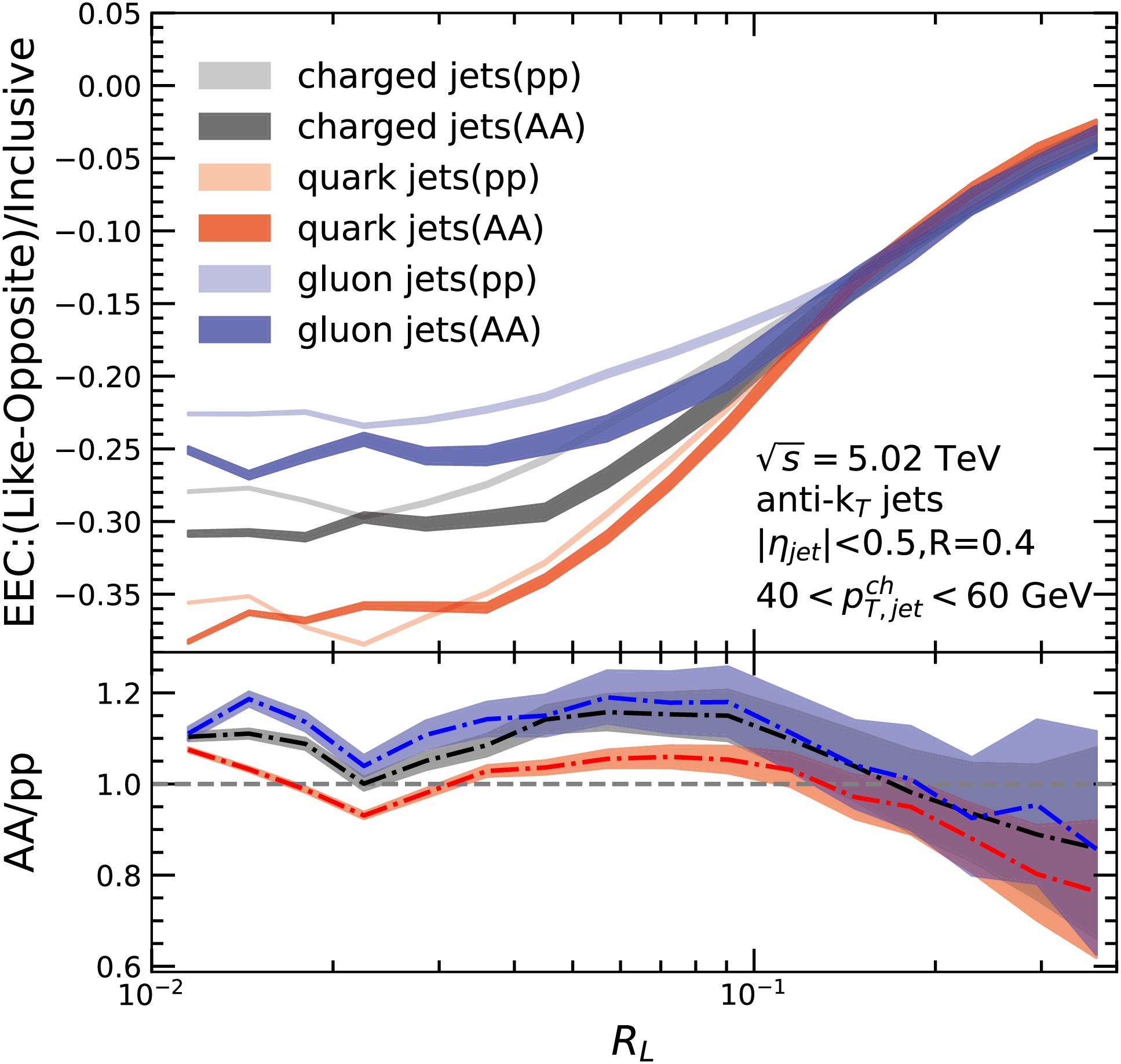
Figure 5.(color online) Charge-weighted EEC-to-inclusive EEC ratios inp+pand central (0−10%) Pb+Pb collisions, and the correspondingA+A/p+pratio distributions, shown with statistical uncertainties as functions of
$ R_{\rm L} $ , for inclusive charged, gluon, and quark jets with radiusR= 0.4 in the jet$ p_{T} $ interval$ 40-60 $ GeV at$ \sqrt{s}=5.02 $ TeV.From the analysis inFig. 2, we observe that the jet-quenching modification patterns for charged EEC (like-opposite) of quark jets and gluon jets are highly consistent with those for EEC (opposite+like), as their modifications are predominantly governed by the energy-weighting correction. Furthermore, the component-wise analysis inFig. 3andFig. 4reveals that both the opposite component and the like component exhibit modification patterns in the same direction. Consequently, the charge correlations, represented by (like-opposite)/(opposite+like), tend to cancel out the characteristic modification patterns present in both the charged EEC and the inclusive EEC for quark jets and gluon jets. Therefore, it is justified to conclude that the redistribution of charge correlations is independent of the initiator's color charge.
Next, we examine whether the plateau-like enhancement of charge correlations in the transition and small-RLregion is related to selection bias, since such an effect dominates the enhancement of the inclusive EEC in the small-RLregion. Can it be canceled in this ratio? We plot inFig. 6(upper panel) the separate contributions of thesurvivalandfall-downmechanisms to theA+A/p+pratio for both like-charge and opposite-charge components, while the lower panel compares their impacts on theA+A/p+pratio of the charge correlations. Here,survivaldenotes jets inA+Acollisions whose corresponding progenitor jets inp+pcollisions fall within the same momentum interval, whereasfall-downrefers toA+Ajets originating fromp+pjets initially at higher momentum. In the decomposed view (upper panel), the effects of both mechanisms on theA+A/p+pratio are consistent with our earlier EEC results—thefall-downcontribution enhances the distribution in the small-RLregion. However, the lower panel reveals that the overall behaviors of thesurvivalandfall-downcases are qualitatively similar, with only a minor difference in the small-RLregion. At largeRL, thefall-downcontribution induces a more rapid decorrelation asRLincreases. We therefore conclude that the plateau-like enhancement of the charge correlations in the transition and small-RLregion is unrelated to selection bias, as this effect is canceled by constructing the ratio.

Figure 6.(color online)survivalandfall-downcontributions to theA+A/p+pratios of the like-charge and opposite-charge components of the EEC (upper panel) and to the charge-weighted EEC/inclusive EEC (bottom panel) in central (0−10%) Pb+Pb collisions, with statistical uncertainties, as functions ofRLfor inclusive charged jets with a radius ofR= 0.4 in the jet
$ p_{T} $ interval 40−60 GeV at$ \sqrt{s_{NN}}=5.02 $ TeV. -
Finally, we turn to the interpretation of the ratio between the charge-weighted distribution and the inclusive EEC. As noted earlier, this ratio quantitatively characterizes the degree of charge correlation, allowing us to focus specifically on correlations among hadron pairs. Because theRLvariable of the EEC observable can be used to infer the jet formation process in reverse,Fig. 1shows that, as the jet evolves from the large-RLregion—dominated by QCD shower processes—toward the transition region, opposite-charge correlations strengthen relative to like-charge ones. Moving further into the hadronization stage (from the transition toward smallRL), where hadron pairs form at the smallest angular separations, opposite-charge correlations are strongest. We now assess the impact of jet quenching on these charge correlations.
InFig. 5, we present the charge correlations and theirA+A/p+pratios for charged-hadron jets, gluon-initiated jets, and quark-initiated jets with a momentum of 40−60 GeV andR= 0.4 in 0−10% Pb+Pb collisions at 5.02 TeV. In thep+pbaseline, the slope of the charge correlations as a function ofRLis steeper for quark jets than for gluon jets. Consequently, quark jets exhibit faster opposite-charge decorrelation at largeRLwhile showing the strongest opposite-charge correlations at smallRL. TheA+A/p+pratios for all three jet types display a consistent modification pattern: a plateau-like enhancement in the transition and small-RLregion and a suppression that increases withRLin the large-RLregion. This demonstrates that jet quenching reduces opposite-charge correlations at largeRLwhile enhancing them in the transition and small-RLregion, resulting in an increased slope of the charge correlations withRL. Two important observations emerge. First, the characteristic modification patterns that distinguish quark jets from gluon jets in the charge-weighted EEC and inclusive EEC are canceled when taking their ratio. Second, the distinctive V-shaped medium modification observed in theA+A/p+pratio of the opposite-charge component of the charge-weighted EEC appears at the sameRLposition, independent of the jet-initiator flavor.
Figure 5.(color online) Charge-weighted EEC-to-inclusive EEC ratios inp+pand central (0−10%) Pb+Pb collisions, and the correspondingA+A/p+pratio distributions, shown with statistical uncertainties as functions of
$ R_{\rm L} $ , for inclusive charged, gluon, and quark jets with radiusR= 0.4 in the jet$ p_{T} $ interval$ 40-60 $ GeV at$ \sqrt{s}=5.02 $ TeV.From the analysis inFig. 2, we observe that the jet-quenching modification patterns for charged EEC (like-opposite) of quark jets and gluon jets are highly consistent with those for EEC (opposite+like), as their modifications are predominantly governed by the energy-weighting correction. Furthermore, the component-wise analysis inFig. 3andFig. 4reveals that both the opposite component and the like component exhibit modification patterns in the same direction. Consequently, the charge correlations, represented by (like-opposite)/(opposite+like), tend to cancel out the characteristic modification patterns present in both the charged EEC and the inclusive EEC for quark jets and gluon jets. Therefore, it is justified to conclude that the redistribution of charge correlations is independent of the initiator's color charge.
Next, we examine whether the plateau-like enhancement of charge correlations in the transition and small-RLregion is related to selection bias, since such an effect dominates the enhancement of the inclusive EEC in the small-RLregion. Can it be canceled in this ratio? We plot inFig. 6(upper panel) the separate contributions of thesurvivalandfall-downmechanisms to theA+A/p+pratio for both like-charge and opposite-charge components, while the lower panel compares their impacts on theA+A/p+pratio of the charge correlations. Here,survivaldenotes jets inA+Acollisions whose corresponding progenitor jets inp+pcollisions fall within the same momentum interval, whereasfall-downrefers toA+Ajets originating fromp+pjets initially at higher momentum. In the decomposed view (upper panel), the effects of both mechanisms on theA+A/p+pratio are consistent with our earlier EEC results—thefall-downcontribution enhances the distribution in the small-RLregion. However, the lower panel reveals that the overall behaviors of thesurvivalandfall-downcases are qualitatively similar, with only a minor difference in the small-RLregion. At largeRL, thefall-downcontribution induces a more rapid decorrelation asRLincreases. We therefore conclude that the plateau-like enhancement of the charge correlations in the transition and small-RLregion is unrelated to selection bias, as this effect is canceled by constructing the ratio.
Figure 6.(color online)survivalandfall-downcontributions to theA+A/p+pratios of the like-charge and opposite-charge components of the EEC (upper panel) and to the charge-weighted EEC/inclusive EEC (bottom panel) in central (0−10%) Pb+Pb collisions, with statistical uncertainties, as functions ofRLfor inclusive charged jets with a radius ofR= 0.4 in the jet
$ p_{T} $ interval 40−60 GeV at$ \sqrt{s_{NN}}=5.02 $ TeV. -
This work presents a systematic investigation of medium modifications to the charge-dependent jet substructure using the charge-weighted EEC inp+pand 0−10% central Pb+Pb collisions at
$ \sqrt{s_{NN}} = 5.02 $ TeV. We analyze charged-hadron jets along with flavor-separated quark- and gluon-initiated jets in the 40−60 GeV momentum range withR= 0.4. Inp+pcollisions, the charge correlations are consistently negative, reflecting the dominance of opposite-charge pairs due to charge conservation. In the transition and largeRLregions, opposite-charge pairs exhibit progressively stronger decorrelation asRLincreases. While PYTHIA simulations predict that opposite-charge correlations reach their maximum in the small-RLregion and then remain approximately constant, they fail to describe the experimentally observed decorrelation behavior asRLincreases. Meanwhile, a clear flavor dependence emerges: gluon-initiated jets exhibit weaker opposite-charge correlations in the transition and small-RLregions than quark-initiated jets, but stronger correlations in the large-RLregion.In Pb+Pb collisions, significant medium modifications are observed. A detailed calculation of theA+A/p+pratio for the charge-weighted EEC reveals a modification pattern highly consistent with that of the inclusive EEC. A distinctive V-shaped modification appears exclusively in the opposite-charge component of the charge-weighted EEC, occurring at the sameRLposition regardless of jet flavor. By factorizing the EEC into the charged-hadron pair multiplicity and the average energy-weighting distributions as functions ofRL, we find that the enhanced but smeared energy weighting of opposite-charge pairs at smallRLis the origin of the observed modification. This indicates that the phenomenon stems from medium-induced broadening of parton splittings, which leads to the dissociation of dihadron (
$ \pi^+ \pi^- $ ) pairs inA+Acollisions, rather than their survival as in thep+pbaseline.TheA+A/p+pratio for charge correlations shows a universal pattern across all jet types: a plateau-like enhancement in the transition and small-RLregions, and increasing suppression withRLin the large-RLregion. Jet quenching enhances opposite-charge correlations at small angles while reducing them at large angles, resulting in a steeperRLdependence and a more rapid decorrelation with increasingRL. The flavor dependence appears to cancel when taking the ratio of the charge-weighted distribution to the inclusive EEC. The distinctive V-shaped modification, which appears exclusively in the opposite-charge component of the charge-weighted EEC, occurs at the sameRLposition regardless of jet flavor. The plateau-like enhancement of charge correlations in the transition and small-RLregions is unrelated to selection-bias effects, based on the analysis of survival and fall-down contributions.
Our results establish charge-sensitive correlators as a powerful tool for probing jet-quenching mechanisms and the redistribution of charge correlations within jets in the quark-gluon plasma, and pave the way to further constrain hadronization mechanisms in the hot QCD medium.
-
This work presents a systematic investigation of medium modifications to the charge-dependent jet substructure using the charge-weighted EEC inp+pand 0−10% central Pb+Pb collisions at
$ \sqrt{s_{NN}} = 5.02 $ TeV. We analyze charged-hadron jets along with flavor-separated quark- and gluon-initiated jets in the 40−60 GeV momentum range withR= 0.4. Inp+pcollisions, the charge correlations are consistently negative, reflecting the dominance of opposite-charge pairs due to charge conservation. In the transition and largeRLregions, opposite-charge pairs exhibit progressively stronger decorrelation asRLincreases. While PYTHIA simulations predict that opposite-charge correlations reach their maximum in the small-RLregion and then remain approximately constant, they fail to describe the experimentally observed decorrelation behavior asRLincreases. Meanwhile, a clear flavor dependence emerges: gluon-initiated jets exhibit weaker opposite-charge correlations in the transition and small-RLregions than quark-initiated jets, but stronger correlations in the large-RLregion.In Pb+Pb collisions, significant medium modifications are observed. A detailed calculation of theA+A/p+pratio for the charge-weighted EEC reveals a modification pattern highly consistent with that of the inclusive EEC. A distinctive V-shaped modification appears exclusively in the opposite-charge component of the charge-weighted EEC, occurring at the sameRLposition regardless of jet flavor. By factorizing the EEC into the charged-hadron pair multiplicity and the average energy-weighting distributions as functions ofRL, we find that the enhanced but smeared energy weighting of opposite-charge pairs at smallRLis the origin of the observed modification. This indicates that the phenomenon stems from medium-induced broadening of parton splittings, which leads to the dissociation of dihadron (
$ \pi^+ \pi^- $ ) pairs inA+Acollisions, rather than their survival as in thep+pbaseline.TheA+A/p+pratio for charge correlations shows a universal pattern across all jet types: a plateau-like enhancement in the transition and small-RLregions, and increasing suppression withRLin the large-RLregion. Jet quenching enhances opposite-charge correlations at small angles while reducing them at large angles, resulting in a steeperRLdependence and a more rapid decorrelation with increasingRL. The flavor dependence appears to cancel when taking the ratio of the charge-weighted distribution to the inclusive EEC. The distinctive V-shaped modification, which appears exclusively in the opposite-charge component of the charge-weighted EEC, occurs at the sameRLposition regardless of jet flavor. The plateau-like enhancement of charge correlations in the transition and small-RLregions is unrelated to selection-bias effects, based on the analysis of survival and fall-down contributions.
Our results establish charge-sensitive correlators as a powerful tool for probing jet-quenching mechanisms and the redistribution of charge correlations within jets in the quark-gluon plasma, and pave the way to further constrain hadronization mechanisms in the hot QCD medium.
The medium modification of the charge-weighted Energy-Energy Correlators in Pb+Pb collisions at ${\sqrt{{\boldsymbol s}_{\boldsymbol{NN}}}\bf =5.02}$ TeV
- Received Date:2026-01-25
- Available Online:2026-07-15
Abstract:We report a systematic study and predictions of medium-induced modifications in charge-dependent jet substructure using the charge-weighted Energy-Energy Correlators (EEC) in 0−10% central Pb+Pb collisions at $ \sqrt{s_{NN}} = 5.02\ {\rm{TeV}} $. Charged-hadron jets, as well as flavor-separated quark- and gluon-initiated jets with momenta of 40−60 GeV andR= 0.4, are analyzed. The ratio of the charge-weighted distribution to the inclusive EEC, which reflects the magnitude of charge correlations, is uniformly negative, demonstrating the dominance of opposite-charge pairs due to charge conservation. A clear flavor dependence is observed: gluon-initiated jets exhibit weaker opposite-charge correlations in the transition and small-RLregions than quark-initiated jets, but stronger opposite-charge correlations at largerRL. In Pb+Pb collisions, theA+A-to-p+pratio for charge correlations exhibits a universal, flavor-independent pattern: jet quenching enhances opposite-charge correlations at small angles while suppressing them at large angles, leading to a steeperRLdependence of charge correlations inA+Aand indicating more rapid decorrelation asRLincreases. A distinctive V-shaped modification, together with a plateau-like enhancement, appears in the transition and small-RLregions, independent of jet flavor. By factorizing the EEC into the charged-hadron–pair multiplicity and the average energy-weighting distribution, we identify an enhanced but smeared energy weighting of opposite-charge pairs at smallRLas the origin of this modification. These observations indicate that medium-induced broadening of parton-level splittings in the hot, dense medium dissociates the charged di-hadron pairs (such as $ \pi^+\pi^{-} $) present inp+pcollisions. The plateau-like enhancement of charge correlations is also found to be unrelated to selection-bias effects.


 DownLoad: