


 Abstract
 HTML
HTML Reference
 Related
 PDF
PDF




-
The radiative capture reaction of protons12C(p,γ0)13N has been the subject of careful research, both experimental and theoretical, for a number of reasons. This process occurring at low energies is a starting point of the solar CNO nuclear fusion cycle [1–3], as well as a part of the nucleosynthesis evolution of other hydrogen-burning stars such as Asymptotic Giant Branch (AGB) and Red Giant Branch (RGB) stars (see, for example, [4] and [5–8]).
The novel review "Solar fusion III" (SF III) summarizes the data on the proton-induced reactions and overviews the progress made in the last ten years in the comprehension of stellar thermonuclear reactions at a postpp-cycle stage [9].
The results of five new direct measurements of low-energy12C(p,γ0)13N cross sections converted to astrophysicalS-factors are included in SF III: Csedrekiet al., 2023 [10]; Gyürkyet al., 2023 [11]; Kettneret al., 2023 [12]; and Skowronskiet al., 2023 [13,14]). These data cover theEc.m.energy interval from 76 keV LUNA (Laboratory for Underground Nuclear Astrophysics) up to 2300 keV,i.e., spanning the resonance energy range and low energies appropriate for the extrapolation of the astrophysicalS-factor to stellar energies of up to 25 keV. In the present work, we provide a comparative analysis of these modern SF III data and some early ones with a theoretical study of12C(p,γ0)13N reactions in Sec. III.
Our discussions are focused on three main works for the following reasons: Skowronskiet al.[14] outlined the range of main issues related to the carbon isotopes ratio12C/13C in AGB and RGB stars, basing their study on theR-matrix processing of their own experimental data on the12C(p,γ0)13N and13C(p,γ0)14N reactions. Meanwhile, almost simultaneously with works [13,14], Kettneret al.also published their paper [12], and therefore, these three publications have no corresponding cross-references. We assume it reasonable to compare our model calculations for the process12C(p,γ0)13N with theR-matrix results of both [12] and [13,14] for the astrophysicalS(E)-factor. In particular, the valueS(25 keV) can be selected as a reference point.
In general, our goal is to clarify how all three approaches conform with each other and what new qualitative features may suggest the exploited modified potential cluster model (MPCM) for analyzing the12C(p,γ0)13N reaction. So, for example, in Ref. [15], we suggested the12B(n, γ)13B(β−)13C alternative chain, comparing the neutron-inducedAC(n, γ)A+1C series on carbon isotopes leading to13C creation but without combustion of12C. Our study was based on a comparative analysis of reaction rates for10-12B(n,γ)11-13B,12C(n,γ0+1+2+3)13C processes calculated within the frame of MPCM and with the12C(p,γ)13N reaction rate taken from NACRE II [16]. In the present work, we calculate the rate of the12C(p,γ)13N reaction in the same model formalism,i.e., MPCM, and may support our proposal [15] in a more consistent way.
-
The main principles and methods of the modified potential cluster model have been discussed in recent works [17–19]. The formalism of MPCM is based on the solution of a single-channel radial Schrödinger equation for the discrete bound and continuum states, which is specified by the corresponding interaction potential defined for each partial wave. We use the standard central Gaussian potential,
$ V(r,JLS,\{ f\} ) = - {V_0}(JLS,\{ f\} ){\text{exp}}\left[ { - \alpha (JLS,\{ f\} ){r^2}} \right] . $

(1) We demonstrated the advantages and capabilities of the two-parameter Gaussian potential in solving problems on bound states and scattering states in a study of reactions involving the radiative capture of nucleons (N,γ) on 1p-shell nuclei, as well as the radiative capture of the lightest clusters. In a book by Dubovichenkoet al. [20], the results of 15 reactions are presented with detailed descriptions of the numerical calculation methods and original programs. Additionally, about 10 capture reactions on light nuclei with charged particles have been considered in analyses presented in recent papers; references to some of these articles may be found in our latest work [19].
To preface the calculations for the astrophysicalS-factor for the reaction
${{}^{12}}{\text{C}}{(p,{\gamma _0})^{13}}{\text{N}}$ , let us provide some input data. The following values were used for the radii of the proton and12С nucleus:rp= 0.841 fm [21,22] andRch(12C) = 2.483(2) fm [23]. The mass of12C,m(12C), is 12 atomic mass units (amu), and the mass of the protonmp= 1.007276467 amu [21,22].The Coulomb potential is of the point-like formVcoul(MeV) = 1.439975·Z1Z2/r, whereris the relative distance in fm, andZiis the charge of the particles in units of the elementary charge. The Sommerfeld parameter
$\eta = \mu {Z_1}{Z_2}{e^2}/\left( {k{\hbar ^2}} \right)$ is therefore reformulated as$\eta = 3.44476\;\times {10^{ - 2}}{Z_1}{Z_2}\mu /k$ , whereμis the reduced mass of the12C +psystem in amu.k(fm-1) is the wave number related to the center-of-mass energyЕc.m.and is defined as${k^2} = 2\mu {E_{{\text{c}}{\text{.m}}{\text{.}}}}/{\hbar ^2}$ .In the current work, the
${\hbar ^2}/{m_0}$ constant is set to 41.4686 MeV·fm2. We use this value of the constant, which had been in use since the 1980s, to allow a comparison between earlier and new calculation results. The new value${\hbar ^2}/{m_0}$ = 41.8016 MeV·fm2comes from the updated value ofm0. At the same time, we check that the new value does not lead to significant changes in the binding energy, or the energy of the resonances. The difference in the constant values has a minimal effect (~ 1°−2°) on the scattering phase shifts.The construction of radial wave functions in MPCM is based on a choice of optimal interaction potentials deep enough to include the Pauli forbidden states (FS), if any, along with the allowed states (AS). Since the classification of orbital states based on using the Young's diagrams {f} methods in thep+12C channel was implemented in our early works [24,25], here a short summary is suggested. The direct product {1} × {444} = {544} + {4441} shows one forbidden Young diagram {544} and another one, {4441}, that is allowed. Even orbital angular momentumsL=S,D,Grefer to the {544} diagram, and corresponding waves should have an internal node. Meanwhile, the {4441} diagram refers to the odd wavesL=PandF, and corresponding radial wave functions should be nodeless. This classification concerns both discrete and continuous states and is used while determining the Gauss' potential parameters.
-
Now, we consider the spectrum of resonance levels and determine their role in the studied reaction,
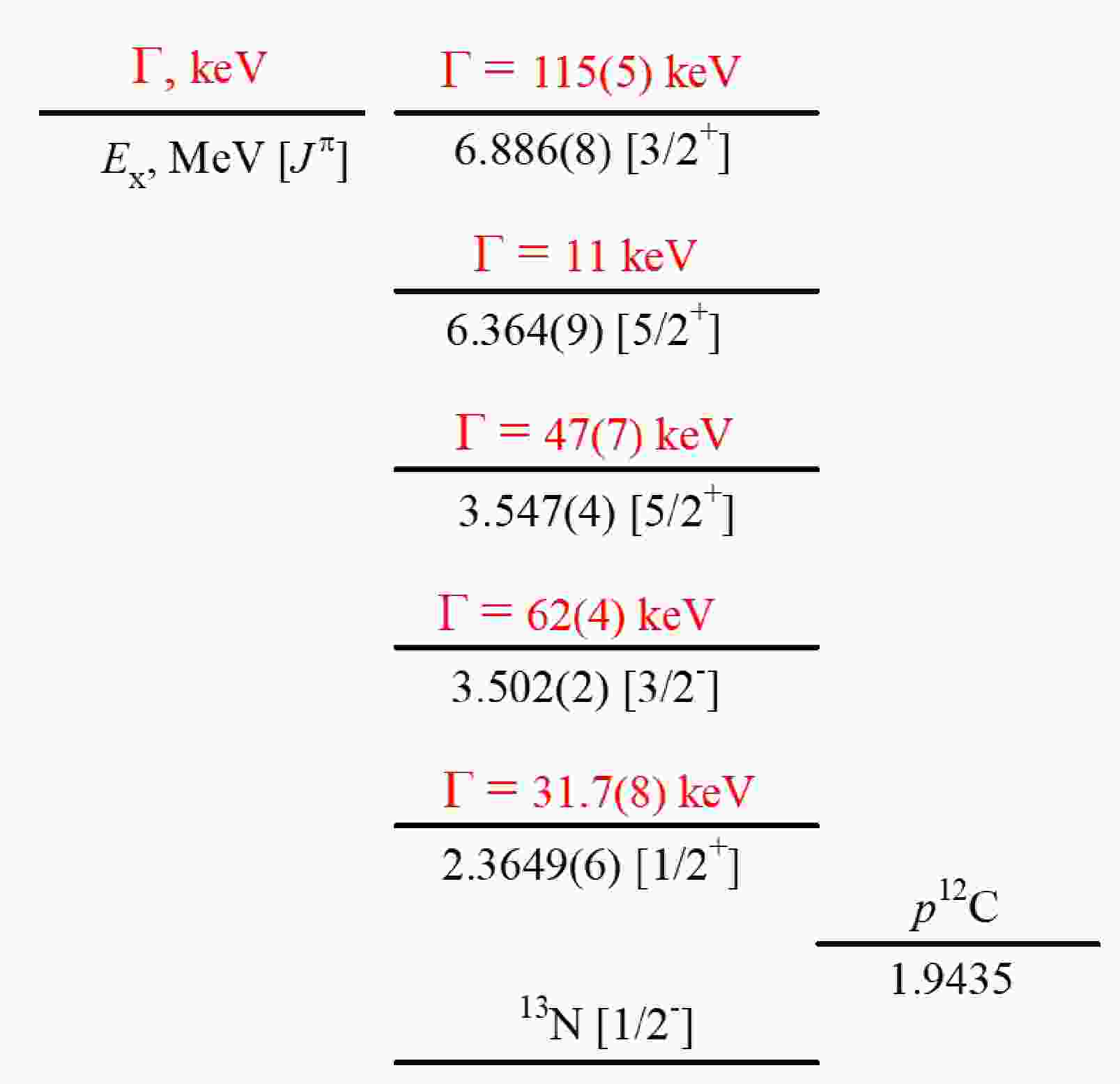
${^{12}}{\text{C}}{(p,{\gamma _0})^{13}}{\text{N}}$ . The spectrum of the13N levels at energies up to 5 MeV above thep12C channel threshold is shown inFig. 1.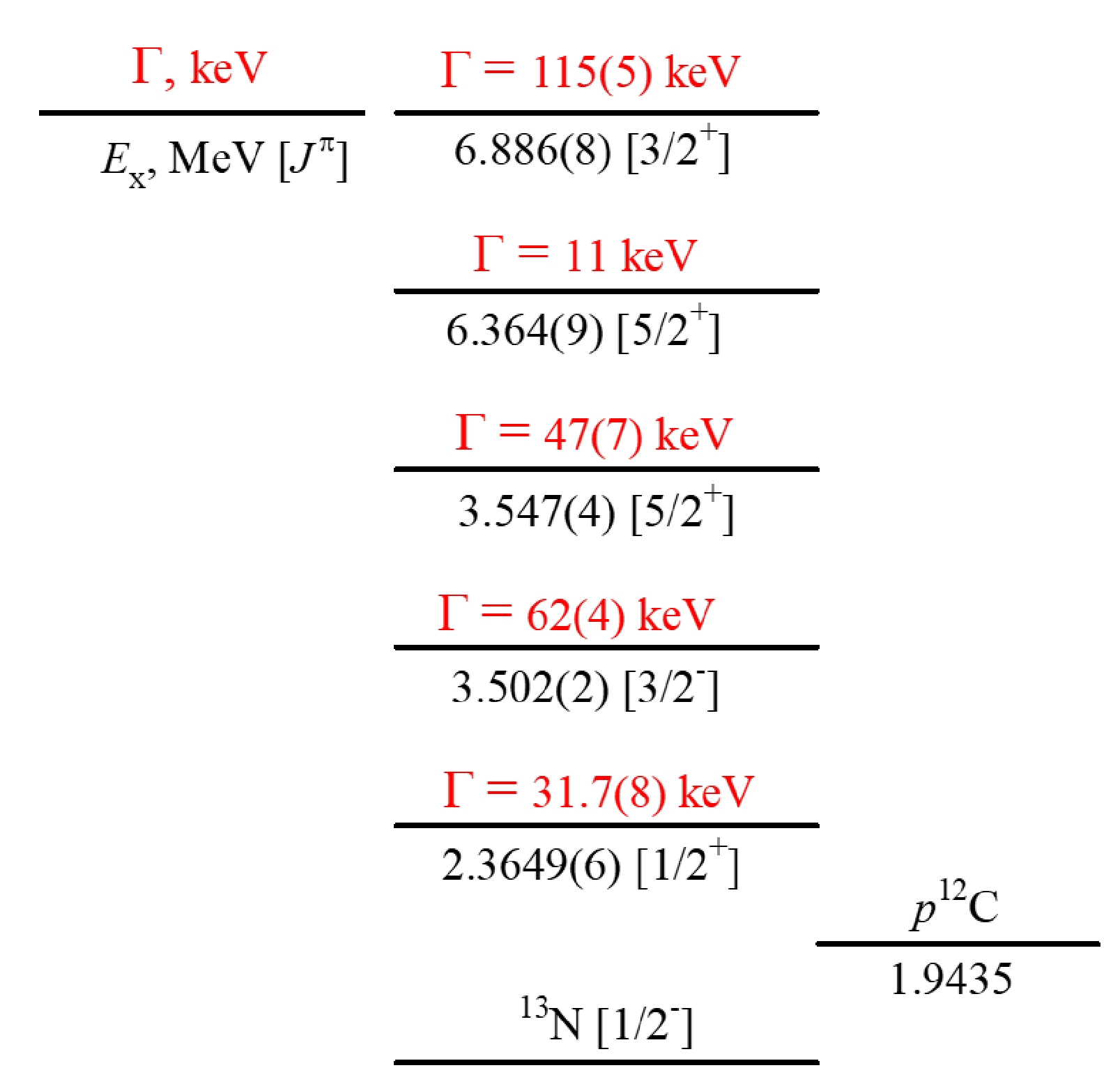
Figure 1.(color online) Energy spectrum of13N in MeV [26]. The widths Γ of the levels in c.m. are marked in red.
The available experimental data on the astrophysicalS-factor [13,14,27,28] show the presence of a narrowJπ= 1/2+resonance with a width of about 32 keV atEc.m.= 0.421 MeV or the excitation energyEx= 2.3649(6) MeV. Presently, it can be considered precisely established that this resonance is due to the2S1/2-wave, and consequently, its excitation inS(E) factor is the signature of anE1 transition to the ground2Р1/2state of the13N nucleus.
Another resonance taken into consideration corresponds to theJπ= 3/2-state at the excitation energyEx= 3.502 MeV (Ec.m.= 1.559 MeV). It is compared with the2P3/2-wave without FS.
All other resonances inFig. 1do not lead top,γ-channels and will not be studied [26] (see Table 13, Table 14). However, we consider the2D3/2-wave with FS and quantum numbersJπ= 3/2+. Present calculations are limited toE1 andM1 processes. That is why states with a momentum of 5/2+atEx= 3.547 and 6.564 MeV compared to the2D5/2-wave, providing anM2 transition, are out of consideration.
Thereby, we treated three partial transitions of proton radiative capture to the
$ {}^2{P_{1/2}} $ GS of13N. They are classified following the spectroscopic notation${\left[ {{}^{2S + 1}{L_J}} \right]_i} \xrightarrow{{NJ}} {}^2{P_{1/2}}$ . These are two resonance transitions,$ {}^2{S_{1/2}}\xrightarrow{{E1}}{}^2{P_{1/2}} $ and$ {}^2{P_{3/2}}\xrightarrow{{M1}}{}^2{P_{1/2}} $ , and a non-resonance one,${}^2{D_{3/2}}\xrightarrow{{E1}} {}^2{P_{1/2}}$ .Table 1presents the results on the potential parameters ofp+12C elastic scattering waves included in consideration for the analysis of the astrophysicalS-factor in Sec. III.
No Ex, exp. $ J_i^\pi $ ,2S+1LJ

Γc.m., exp. Eres, exp. V0 α Eres, theory Γc.m., theory 1 2.3649(6) 1/2+,2S1/2 31.7(8) 0.4214(6) 101.486 0.195 0.422 32 2 3.502(2) 3/2-,2P3/2 62(4) 1.559(2) 833.114 2.9 1.560 53 3 — 3/2+,2D3/2 — — 320.0 0.4 — — Note: The recent experimental data on the 1/2+and 3/2-levels are reported by Csedrekiet al., 2023:Eres= 424.2 ± 0.7 keV, Γc.m.= 35.2 ± 0.5 keV, andEres= 1554.6 ± 0.6 keV, Γc.m.= 53.1 ± 0.7 keV, respectively [10]. Comparison with the recommended data from Ajzenberg-Selove, 1991 [26], shows the greatest difference for the 3/2-level widths. Therefore, while fitting the corresponding potential parameters of the2P3/2resonance wave, we oriented them on Ref. [10]. Table 1.Characteristics of continuous spectrum states in thep12C channel. Excitation and resonance energiesExandEresare provided in MeV, and level widths Γc.m.are in keV.
$ J_i^\pi $ is the total angular momentum and parity of the initial state. Parameters of interaction potential (1) areV0in MeV and α in fm-2. Experimental data are from Ref. [26].TheR-matrix fits of Refs. Kettneret al., 2023 [12] and Skowronskiet al. [13,14] give the following values: Γc.m.( 1/2+) = 31.4 ± 0.2 keV and 33.8 keV, Γc.m.(3/2-) = 50.9 ± 0.3 keV and 54.2 keV, respectively. These parameters are comparable with the MPCM ones.
Kelleyet al. [29], 2024, provide the most complete data on13N levels in a recent compilation , whereas Anhet al. [30], 2024, reported the results of measurements on 1/2+and 3/2-resonances, as follows:Eres= 421 keV, Γc.m.= 34.1 keV, andEres= 1554 keV, Γc.m.= 56.5, respectively.
Figure 2shows the phase shifts of2S1/2,2P3/2, and2D3/2partial waves calculated using the parameters listed inTable 1. Here and elsewhere, the scattering phase shifts atEc.m.= 0 are determined based on the generalized Levinson theorem [31].
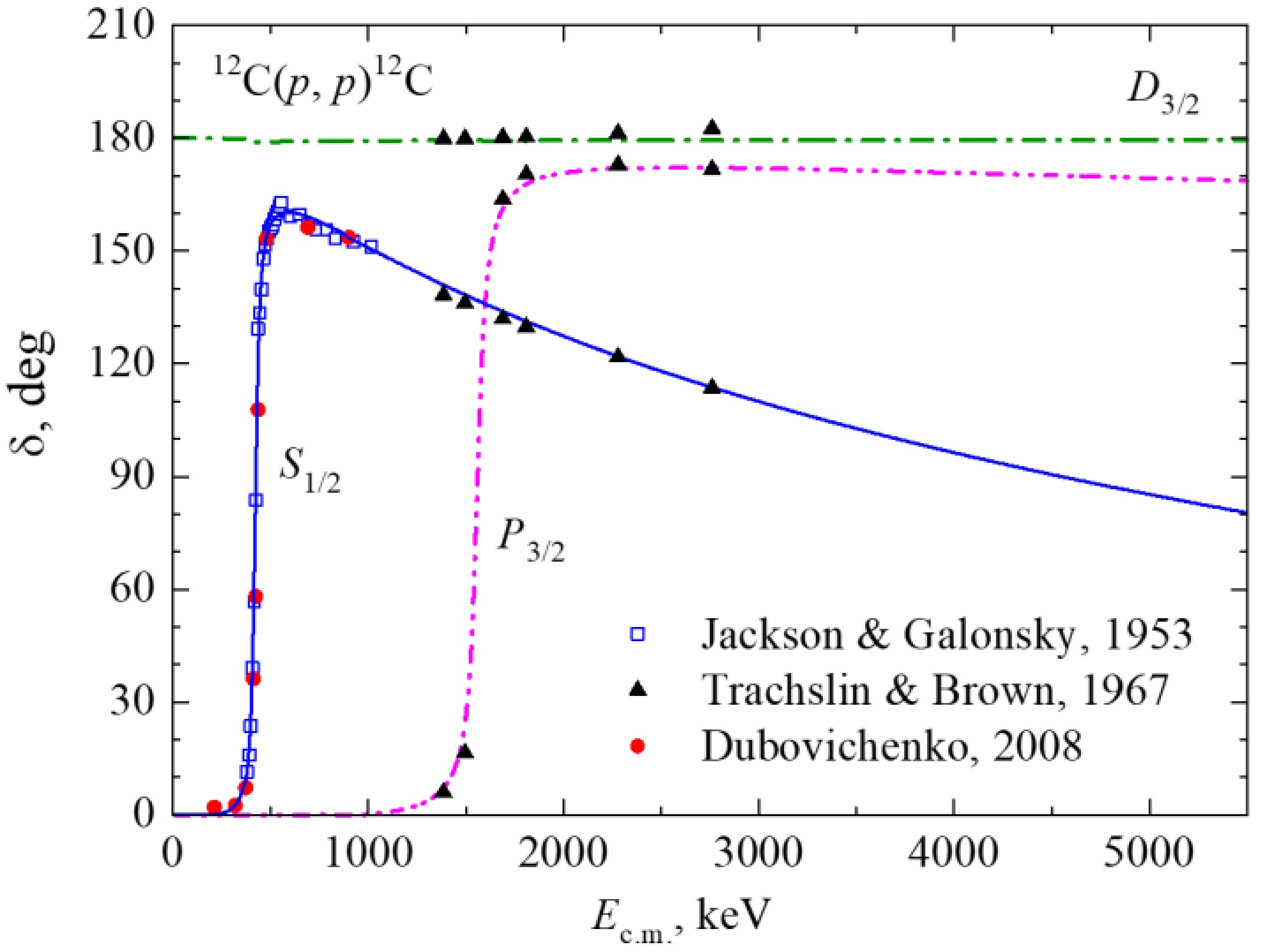
Figure 2.(color online) Elasticp12С scattering phase shifts at low energies. Results of2S1/2phase shift analysis: red dots are from Ref. [31], Dubovichenko, 2008; blue open squares are from Ref. [32], Jackson & Galonsky, 1953; black solid triangles are from Ref. [33], Trachslin & Brown, 1967. Curves are calculated using potential parameters fromTable 1.
$ {\delta _L} = \pi \left( {{N_L} + {M_L}} \right) , $

(2) whereNLandMLare the numbers of forbidden and allowed bound states, respectively, andLis the orbital angular momentum. According to this theorem, the phase shifts are positive and tend toward zero at high energies. The2D3/2potential with FS leads to a phase shift of 180(1)°. TheS-wave phase shift should beδS(0) = 180° according to the Levinson theorem (2). InFig. 2, it starts from zero to confine all curves within a uniform range of values.
A comparison of the calculated phase shifts
$ {\delta _{^2{S_{1/2}}}} $ ,$ {\delta _{^2{P_{3/2}}}} $ , and$ {\delta _{^2{D_{3/2}}}} $ with the experimental data from Refs. [31,32,34] shows very good agreement in the energy region up toEc.m.= 3 MeV. An independent checkup of MPCM results is available for the resonance phase shifts$ {\delta _{^2{S_{1/2}}}} $ ,$ {\delta _{^2{P_{3/2}}}} $ calculated using the multilevel, multichannelR-matrix code, AZURE –Fig. 1in Ref. [35]. A cross-confirmation of the energy dependence of the$ {\delta _{^2{S_{1/2}}}} $ and$ {\delta _{^2{P_{3/2}}}} $ phase shifts is provided by calculations in the framework of the cluster effective field theory (CEFT), shown in Fig. 6 of early Ref. [36]. The results of CEFT may be assumed as an additional confirmation for the MPCM approach. -
The bound state potential construction is conditioned by independent information on the asymptotic normalization coefficients (ANC) in the single cluster channel. The ANC is related to the dimensional asymptotic constantCvia the spectroscopic factorSf:
${A_{NC}} = \sqrt {{S_f}} \cdot C$ [37].We use the dimensionless asymptotic constantCwintroduced in Ref. [38], which is related to the dimensional
$ C=\sqrt{2{k}_{0}}\cdot {C}_{w} $ . Therefore, the following expression holds:${C_w} = \frac{{{A_{NC}}}}{{\sqrt {{S_f}} \cdot \sqrt {2{k_0}} }}$ . The wave number${k_0}$ is related to the binding energy${E_b} = k_0^2{\hbar ^2}/2\mu $ and$\sqrt {2{k_0}} = 0.768$ fm-1/2for thep12C system.Table 2gives known values of ANC and their recalculation to the dimensionless asymptotic constantCw.Reference ANC/ fm−1/2 Sf Cw Barker & Ferdous, 1980 [39] 1.84 1 2.396 Yarmukhamedov, 1997 [40] 1.43(6) 1 1.86(8) Liet al., 2010 [41] 1.64(11) 0.64(9) 2.71(37) Azumaet al., 2010 [35] 1.87(24) 1 2.43(31) Timofeyuk, 2013 [42] 1.38 0.61(2) 2.30(4) Artemovet al., 2022 [43] 1.63(12) 1 2.12(16) Kettneret al., 2023 [12] 1.62(5) 1 2.11(7) Range of ANC: 1.37 – 2.11 fm−1/2. Range ofCw: 1.78–3.08 Table 2.Asymptotic constant data for the13N ground state in thep12C channel.
For the value of the spectroscopic factorSf, we utilized the data provided inTable 2from Ref. [41]. The data from 18 studies have been analyzed in [41], focusing on stripping and pickup reactions on12C target with projectilesd,3He,α,7Li,10B,14N,16O within the time range of 1967 to 2010. The averaged range of values for the spectroscopic factor isSf= 0.87(62).
The potential parameters for the GS of13N are adjusted in such a way as to reproduce the channel binding energy and experimental data for the mean charge radius with a given accuracy. In theр12С channel,Eb= 1.9435 MeV [28]. For the charge radius data, Ref. [44] givesRch(13N) = 2.45(4) fm, whereas the most recent work published in 2024 reports the valueRch(13N) = 2.37(16) fm [45].
InTable 3, we present two sets of potential parameters that differ in their asymptotic constantСwvalues but both reproduce the binding energyEbwith an accuracy of 10-5and yield a charge radius ofRch(13N) = 2.465
$\pm\; 0.05\,\,{\text{fm}}$ , which is within the range of experimental values [44,45].Set Vg.s./MeV αg.s./fm-2 Еb/MeV Rch(13N)/fm Cw I 157.13831 0.47 1.94350 2.46 1.30(2) II 143.701125 0.425 1.94350 2.47 1.37(1) Table 3.Parameters of ground state potential for two sets ofCw.
Let us discuss the computing procedure providing the calculation of the radial matrix elements ofEJ-transitions
$ {I_{{\text{E}}J}}(k,{J_f},{J_i}) = \left\langle {{\chi _f}} \right|{r^J}\left| {{\chi _i}} \right\rangle $ andMJ-transitions$ {I_{{\text{M}}J}}(k,{J_f},{J_i}) = \left\langle {{\chi _f}} \right|{r^{J - 1}}\left| {{\chi _i}} \right\rangle $ (for the formalism details, see [24]). Overlapping integrals are calculated up to 50 fm. The initial scattering radial WF$ {\chi _i}(r) $ is normalized to the asymptotics at the edge of the 50 fm interval, denoted asR.$ {\chi }_{JLS}{(r\to R)}_{ }\to \mathrm{cos}({\delta }_{S,L}^{J}){F}_{L}\left(kr\right)+\mathrm{sin}({\delta }_{S,L}^{J}){G}_{L}\left(kr\right) , $

(3) whereFLandGLare the regular and irregular Coulomb functions, and
$ \delta _{S,L}^J $ are the scattering phase shifts. Relation (3) provides the calculation of phase shifts at two matching points [20].The final radial WF
$ {\chi _f}(r) $ for the bound states are the numerical ones on the intervalr =0–12 fm because at larger distances the function reaches stable asymptotic behavior [38].$ {{{\chi }}_L}(r) = \sqrt {2{k_0}} {C_w}{W_{ - {{\eta }}L + 1/2}}(2{k_0}r) , $

(4) where
${W_{ - \eta \,\,L + 1/2}}(2{k_0}r)$ is the Whittaker function. The difference between the AC values at the beginning of the stabilization region, starting fromR= 12 fm, usually does not exceed 10-3–10-4– this value is specified as the relative accuracy of determining the AC.Figure 3shows the radial dependence of the2P1/2GS wave function, scatteringS-wave function calculated atEc.m.= 5 MeV, and integrandI(r) corresponding to theE1 matrix element
$ I_{E1} (k,{J_f},{J_i}) = \left\langle {{\chi _f}} \right|{r^{}}\left| {{\chi _i}} \right\rangle $ . One can see the internal node in the${\chi _i}$ wave owing to the FS according to the above symmetry classification, in contrast to the nodeless${\chi _f}$ bound state function. Thereby, we illustrated the peripheral character of the${^{12}}{\text{C}}{(p,{\gamma _0})^{13}}{\text{N}}$ process,i.e.,that the integral${I_{E1}}(k,{J_f},{J_i})$ accumulates in the intervalr~ 5−10 fm atEc.m.= 5 MeV. We tried to employ shallow phase-equivalent potentials for theS-wave [24], but they led to the completely inappropriate description of the first 1/2+resonance at 0.421 MeV in theS-factor,i.e., an overestimation of 2−3 orders of magnitude. -
The results of MPCM calculations of the astrophysicalS-factor in the energy interval from 25 keV to 5 MeV are shown inFig. 4. The magenta band is the totalS-factor and refers to the interval of the asymptotic constant
$1.30 \leqslant {C_w} \leqslant 1.37$ . The low and upper bounding band curves refer to Set I and Set II for the GS potential fromTable 3, respectively.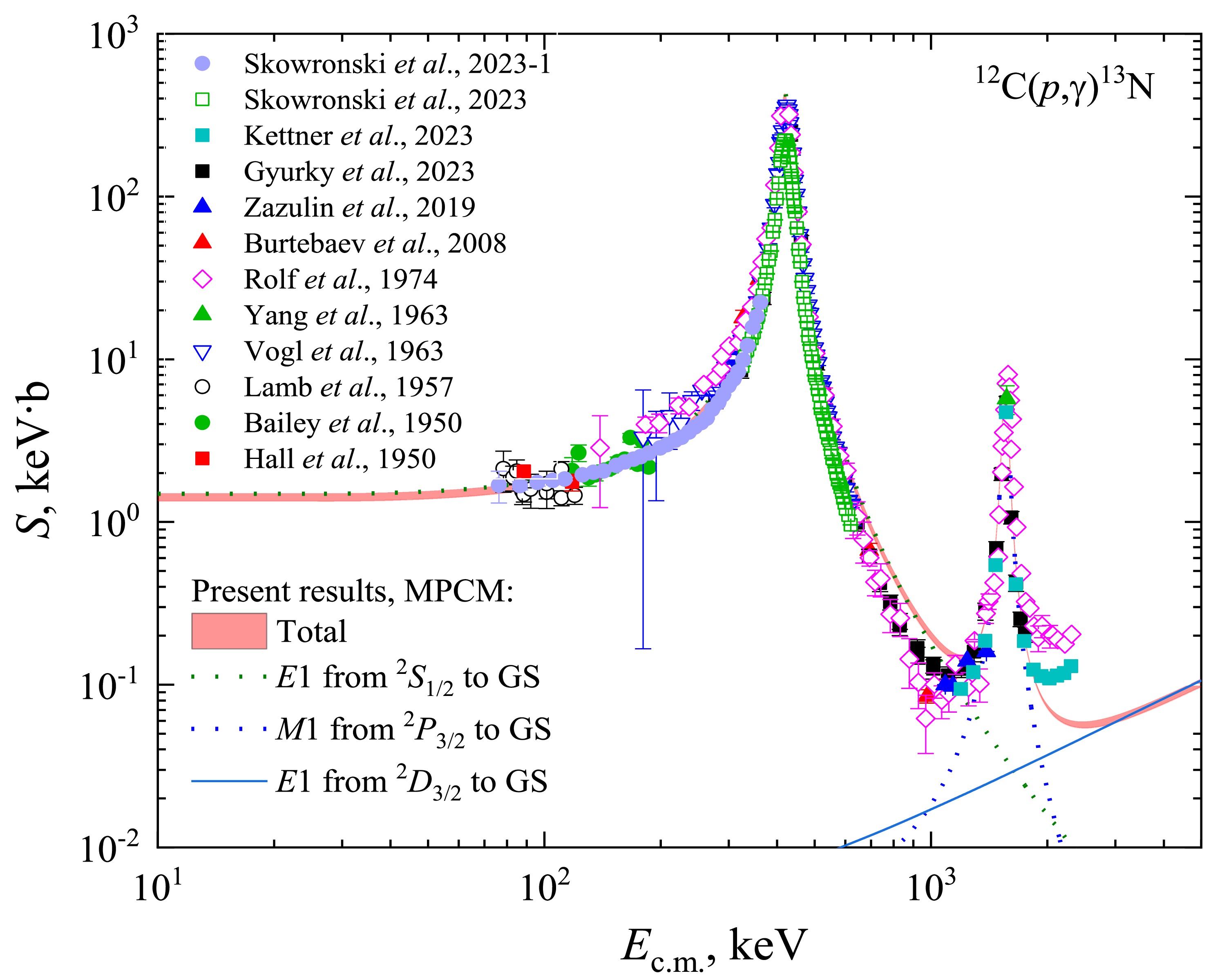
The partial structure of theS-factor is determined well enough. The resonances 1/2-and 3/2+are revealed atEc.m.= 0.421 MeV andEc.m.= 1.559 MeV, respectively. The 1stresonance is determined by a
$ {}^2{S_{1/2}}\xrightarrow{{E1}}{}^2{P_{1/2}} $ transition and a tail of the 2ndresonance due to a$ {}^2{P_{3/2}}\xrightarrow{{M1}}{}^2{P_{1/2}} $ partial transition. The energy dependence of theS-factor above 2 MeV is provided predominantly by the non-resonance$ {}^2{D_{3/2}}\xrightarrow{{E1}}{}^2{P_{1/2}} $ transition. TheS-factor error of ~ 1%−2% is determined by the error of the numerical methods used.The comparison of the calculatedS-factor and experimental data inFig. 4shows good agreement in general, but there are some deviations. In the intervalEc.m.~ 640–930 keV, the average overestimation factor is ~ 1.3−1.5. On the right of the minimum in the region of the 2ndresonance,i.e.,Ec.m.~ 1200–1850 keV, the theory is in very good agreement with the experimental data from Gyürkyet al., 2023 [11] and Kettneret al., 2023 [12]. However, the experimental values atEc.m.> 2000 keV from Refs. [27] and [12] are higher than the MPCM curves.
We cannot explain the origin of these differences given that both the experimental data on the scattering phase shifts inFig. 2and the parameters of the resonance levels (Table 1) are reproduced with high accuracy. However, these deviations do not affect the value of theS(E)-factor at low energies relevant to the astrophysical applications.
Note that some other model calculations of theS-factor meet the analogous problems with reproducing the right slope of the 1stresonance [52–55].
Let us now turn to the discussion of the astrophysicalS-factor at low energies relevant to the stellar temperature conditions. To implement the extrapolation of the astrophysicalS-factor to the low energies, we use the well-known expression forS-factor parametrization (see, for example, Ref. [56]):
$ S(E) = {S_0} + E \cdot {S_1} + {E^2} \cdot {S_2}. $

(5) The interpolation procedure for our results was done in the range 25–100 keV with an average χ2= 0.001. The parameters of expression (5) are given inTable 4.
S0/keV·b S1/b S2/keV-1·b χ2 S(0)/keV·b S(25)/keV·b Set I 1.3376221 -0.10687459·10-02 0.40271982·10-04 0.001 1.34 1.34 Set II 1.4821 -7.7013·10-4 4.1620·10-5 0.001 1.48 1.49 Table 4.Parameters for theS-factor parametrization (5).
A summary of the astrophysicalS-factors at 25 keV andS(0) discussed in literature from 1960 to today is compiled inTable 5.
Reference S(25)/keV·b S(0)/keV·b Hebbard & Vogl, 1960 [57] 1.33 ± 0.15 1.25 ± 0.15 Rolfs & Azuma, 1974 [26] 1.45 ± 0.20 1.43 Barker & Ferdous, 1980 [39] 1.54 ± 0.08 — Caughlanet al., 1988 [58] — 1.4 Burtebaevet al., 2008 [46] 1.75 ± 0.22 1.62 ± 0.20 Azumaet al.,2010 [35] 1.61 ± 0.29 — Liet al., 2010 [41] 1.87 ± 0.13 — Adelbergeret al., 2011 [59] — 1.34 ± 0.21 Moghadasiet al., 2018 [7] — 1.32 ± 0.19 Irgazievet al., 2018 [60] — 1.37 Kabiret al., 2020 [61] — 1.31 Artemovet al.,2022 [43] 1.72 ± 0.15 1.6 ± 0.15 Kettneret al.,2023 [12] 1.48 ± 0.09 — Skowronskiet al., 2023 [14] 1.34 ± 0.09 — Present work, Set I 1.34 ± 0.02 1.34 ± 0.02 Present work, Set II 1.49 ± 0.02 1.48 ± 0.02 We would like to concentrate the discussion on the present low-energy results for Sets I and II with Luna data [14] and results reported by Kettneret al.,2023 [12]. As follows fromTable 5, Set I leads to the astrophysical factorS(25) = 1.34 ± 0.02 keV·b, which is in excellent agreement with data from Skowronskiet al., 2023,i.e., 1.34 ± 0.09 keV·b [14]. Meanwhile, MPCM calculations with Set II yieldS(25) = 1.49 ± 0.02 keV·b, which is in excellent agreement with data from Kettneret al.,2023,i.e., 1.48 ± 0.09 keV·b [12]. The difference between these two data sets is ~ 9%−11% at 25 keV.
Another, albeit slight, conformity follows from the data given in work [9]: the astrophysicalS-factorS(E) for the range 5−140 keV in the first row ofTable 6are taken from SF III [9] (see Table XI) and referred to in Skowronskiet al. [14]; the % uncertainty is indicated in parentheses. A comparison with present MPCM calculations shows very good agreement with results obtained with Set II for the potential parameters ofTable 3. We believe that any feedback on some of these differences should be addressed to the authors of [9]. The analysis of the causes is beyond our competence.
Ec.m. 5 keV 10 keV 20 keV 40 keV 60 keV 100 keV 140 keV Ref. [9] 1.46(4.1%) 1.47(4.1%) 1.51(4.1%) 1.58(4.1%) 1.67(4.1%) 1.89(4.0%) 2.19(4.1%) Set I (Low) 1.34 1.34 1.34 1.36 1.42 1.63 1.94 Set II (Up) 1.48 1.48 1.48 1.52 1.59 1.82 2.17 Table 6.Low energy astrophysicalS-factor of12C(p,γ)13N reaction in keV·b.
InFig. 5, we illustrate the accuracy of reproducing the LUNA data [14] for the astrophysicalS-factor and in the framework of MPCM – the experimental points within the error bars lie within the calculated band.
-
The reaction rate of the radiative capture of protons (p,γ) with an equilibrium velocity distribution in the stellar environment is calculated as an integral of the total cross section weighted by the Maxwell-Boltzmann factor [4]:
$ {N_A}\left\langle {\sigma v} \right\rangle = {N_A}{\left( {\frac{8}{{\pi \mu }}} \right)^{1/2}}{({k_B}T)^{ - 3/2}}\int {\sigma (E)E\exp \left( { - \frac{E}{{{k_B}T}}} \right){\rm d}E} , $

(6) whereNAis the Avogadro number,µis the reduced mass of two interacting particles,kBis the Boltzmann constant, andTis the temperature of the stellar environment.
Specifying the numerical constants in (6) and measurement units, one obtains the reaction rate in the units of cm3mol-1s-1:
$\begin{aligned}[b] {N_A}\left\langle {\sigma v} \right\rangle =\;& 3.7313 \cdot {10^4}{\mu ^{ - 1/2}}T_9^{ - 3/2}\\&\times\int\limits_0^\infty {\sigma (E)E\exp ( - 11.605E/{T_9}){\rm d}E} \end{aligned}$

(7) whereТ9is in 109К,Еis in MeV, the cross section
$ \sigma (E) $ is in μb, andμis in amu.The total cross sections
$ \sigma (E) $ forEc.m.ranging from 1 keV to 5 MeV are used for the calculation of the reaction rate. To provide the cross sections at ultra-low energy, we use the well-known relation$S(E) = \sigma (E)E{{\rm e}^{2\pi \eta }}$ . Numerical calculation of theS-factor is performed from 25 keV to 5 MeV, and at lower energies, its value for 25 keV is used. In the energy range of 1–25 keV, theS-factor enters the stabilization region, which follows from the approximation (5) with parameters fromTable 4and illustrated inFig. 5.The results of the MPCM calculations of the reaction rate
$ {N_A}\left\langle {\sigma v} \right\rangle $ for the rangeT9= 0.001 toT9= 10 based on the astrophysicalS-factor illustrated inFig. 4are shown inFig. 6. As for the value of$ {N_A}\left\langle {\sigma v} \right\rangle $ varying near 50 orders of magnitude in the pointedT9interval, the band corresponding to the two sets ofS-factors is visible only in the inset ofFig. 6.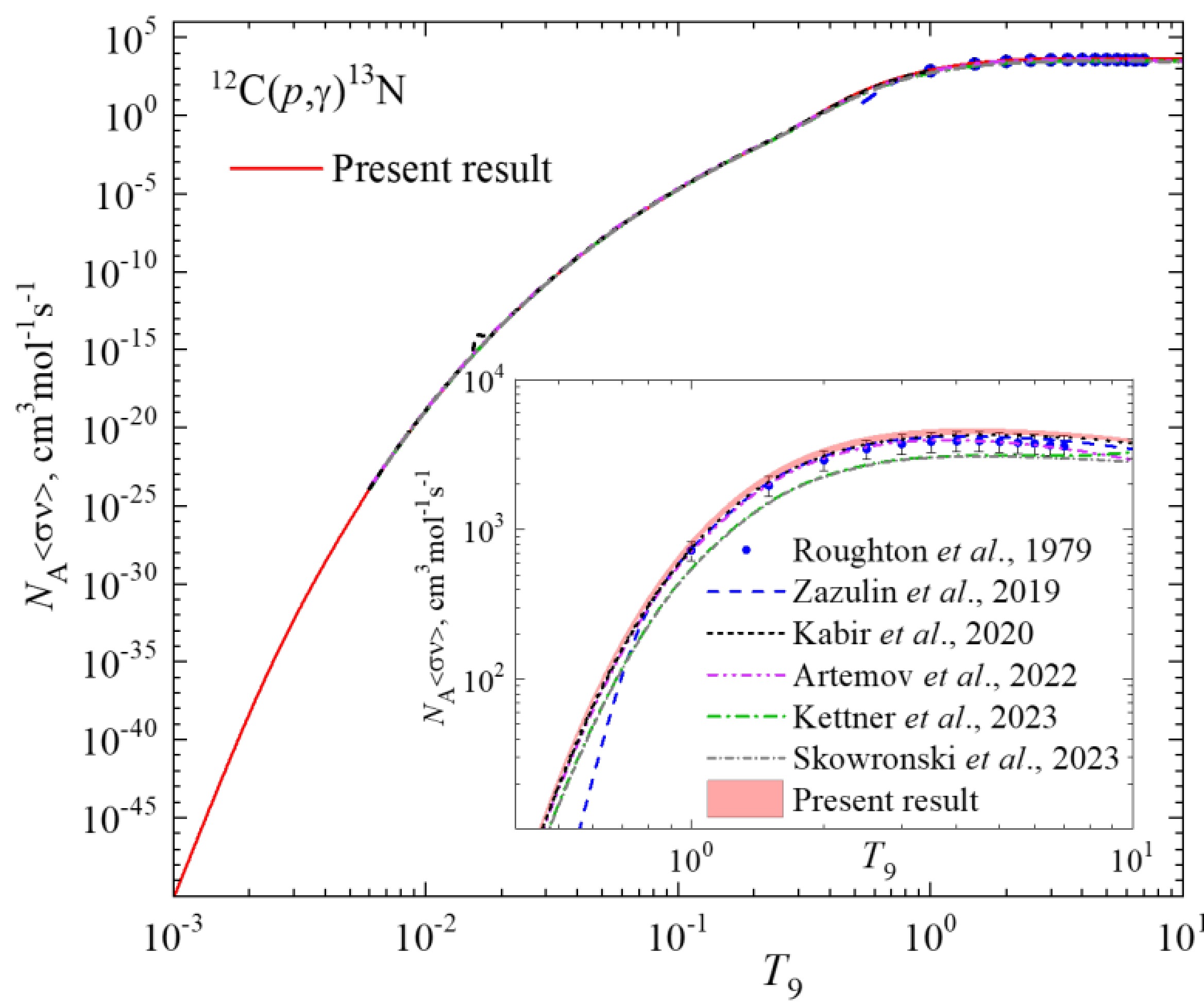
Figure 6.(color online)p12C capture reaction rate. Blue dots are from work [62], blue dashed curve is from [47], black short-dashed curve is from Ref. [61], purple dash-double-dotted curve is from Ref. [43], green dash-dotted curve is from Ref. [12], gray short-dash-dotted curve is from Ref. [13], and red solid curve shows the present MPCM results. Inset shows interval ofT9= 0.4–10.
The difference between the current calculations and the available reaction rates is evident in the inset ofFig. 6, where the disparity in absolute values is clearly visible. The ratios of the reaction rates to NACRE II [16], as depicted inFig. 7, reveal additional information.
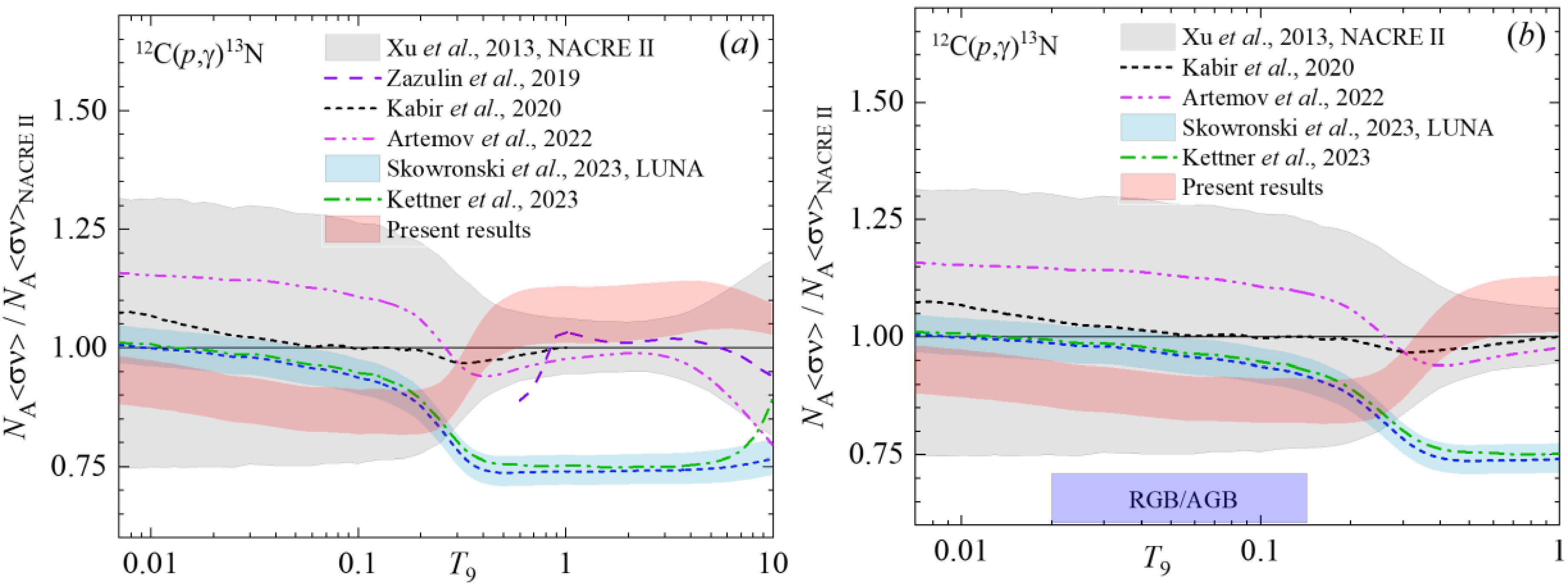
Figure 7.(color online) Reaction rate ratio to NACRE II values for12C(p,γ)13N [16]: (a) temperature rangeT9= 0.007–10; (b) temperature rangeT9= 0.007–1. Violet bar indicates the temperature range of relevance for RGB and AGB stars. In both panels, the central blue short-dashed curve in the band refers to the reaction rate adopted from [13,14].
Figure 7shows the results of only the most recent publications [12,13,43,47,61]. TheR-matrix procedure was employed by Zazulinet al., (2019) [47], Artemovet al., (2022) [43], Kettneret al., (2023) [12], and Skowronskiet al. [13] for the calculation ofS-factors and consequent reaction rates. The comparison of the rates inFig. 7shows the differences in-between, as well as with the adopted NACRE II values. However, the rates from Zazulinet al., (2019) [47] and Artemovet al., (2022) [43] are within the gray band corresponding to the low and high NACRE II data.
Figure 7(a) shows near-precise reproduction of the adopted NACRE II reaction rate forT9= 0.006–1 by Kabiret al., (2020) [61]. This work uses the potential model for the calculation of the cross section in the energy range corresponding to the 1stresonance,i.e., coversEc.m.≤ 1 MeV.
Our focus is on the results of the works of Kettneret al., (2023) [12] and Skowronskiet al., (2023) [13,14]. As follows fromFig. 7, the reaction rates obtained in these works via theR-matrix best-fit procedure for the experimentalS-factors are consistent throughout the entire temperature range, with deviations less than 2%, except for the temperatures 6 ≤Т9≤ 10, where the difference reaches 2.4%–16.6%. The ~ 5% deviation from NACRE II appears atТ9
$\simeq $ 0.1 and reaches ~ 25% at higherТ9. Compared to the results for NACRE II, the reaction rate obtained in this study is ~ 10 % lower atТ9< 0.2 but becomes higher than the corresponding value obtained via NACRE II near 5%–15% starting fromТ9$\simeq $ 0.4 and up toТ9= 10.Figure 8illuminates the range of deviation between the current MPCM reaction rate and those obtained based on theR-matrix fit done in Refs. [12] and [14]. Skowronskiet al., (2023)[14] discuss in detail the12C/13C evolution in AGB and RGB stellar environments in theT9= 0.02–0.14 range and propose a value of 3.6 ± 0.4, which is the most precise up to now. Following, the carbon isotopic ratio is defined via the12C and13C densities
${n_{12}}$ and${n_{13}}$ inversely proportional to the reaction rates: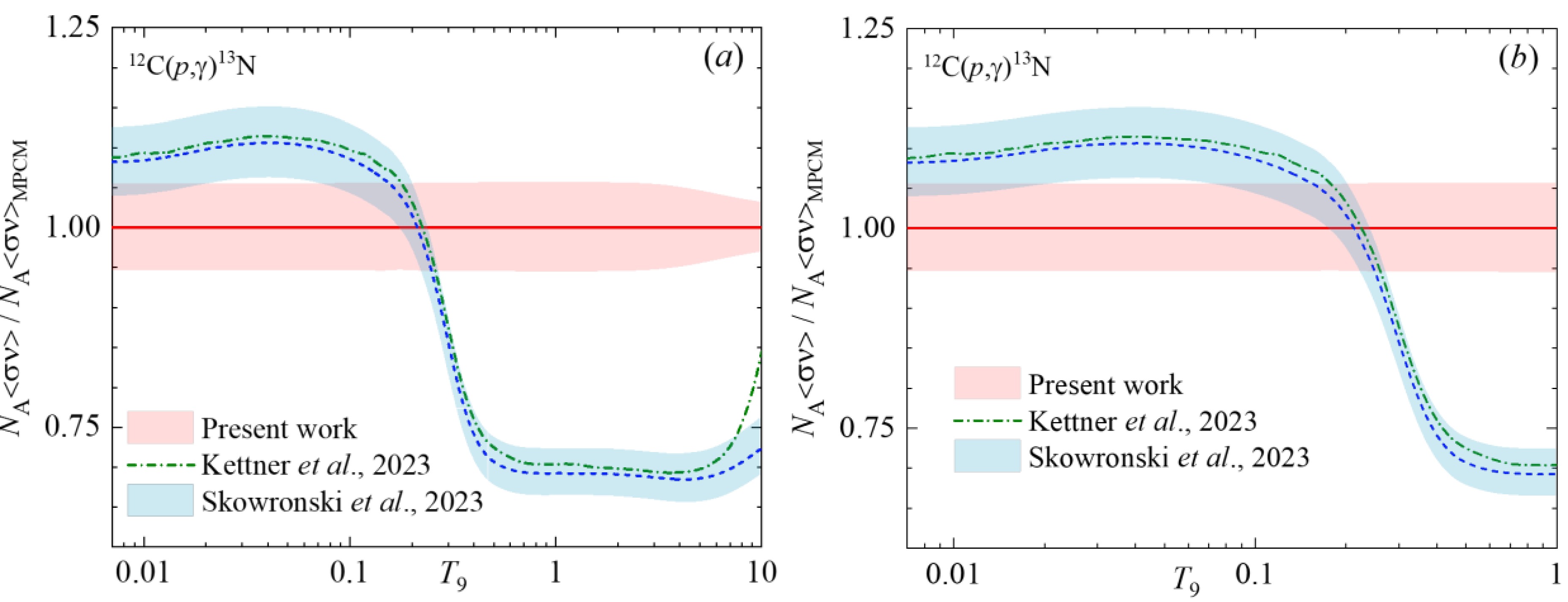
Figure 8.(color online) Reaction rates from Kettneret al., (2023) [12] and Skowronskiet al. [13,14], ratio to MPCM values for12C(p,γ)13N: (a) temperature rangeT9= 0.007–10; (b) temperature rangeT9= 0.007–1. In both panels, the central blue short-dashed curve in the band refers to the reaction rate adopted from [13,14].
$ {R_{^{12}C{/^{13}}C}} = \frac{{{n_{12}}}}{{{n_{13}}}} = \frac{{{{\left\langle {\sigma v} \right\rangle }_{13}}}}{{{{\left\langle {\sigma v} \right\rangle }_{12}}}}. $

(8) For the reaction12C(p,γ)13N in temperaturesT9ranging from 0.02 to 0.14, the reaction rates
${\left\langle {\sigma v} \right\rangle _{12}}$ vary from${10^{ - 14}}$ cm3mol-1s-1to 10-4cm3mol-1s-1; that is, the difference is 10 orders of magnitude.Even a small change in the numerical values of the rates may affect the calculated value of the ratio12C/13C. It is most reliable to compare the reaction rates of12C(p,γ)13N and13C(p,γ)14N as obtained in the same formalism. An example is how it is done in the work of Skowronskiet al., (2023)[13,14], where the rates of these reactions are obtained viaR-matrix calculations – this is a consistent approach. In this context, calculations of the reaction rate of13C(p,γ)14N in MPCM and its comparison with that of12C(p,γ)13N can make an additional contribution to the independent assessment of the12C/13C ratio because the model errors are reduced.
In the present stage, we may compare the reaction rates for the processes12B(n,γ)13B(βν)13C and12C(p,γ0)13N(β+)13C calculated in the MPCM –Fig. 9. Both reactions are leading to the creation of the carbon isotope13C, but in the first case, the boron sequence is involved (see our works [15] and [63]) without combustion of12C. The second chain refers to the hydrogen burning of12C, and therefore, the amount of13C increases, while the abundance of12C decreases.
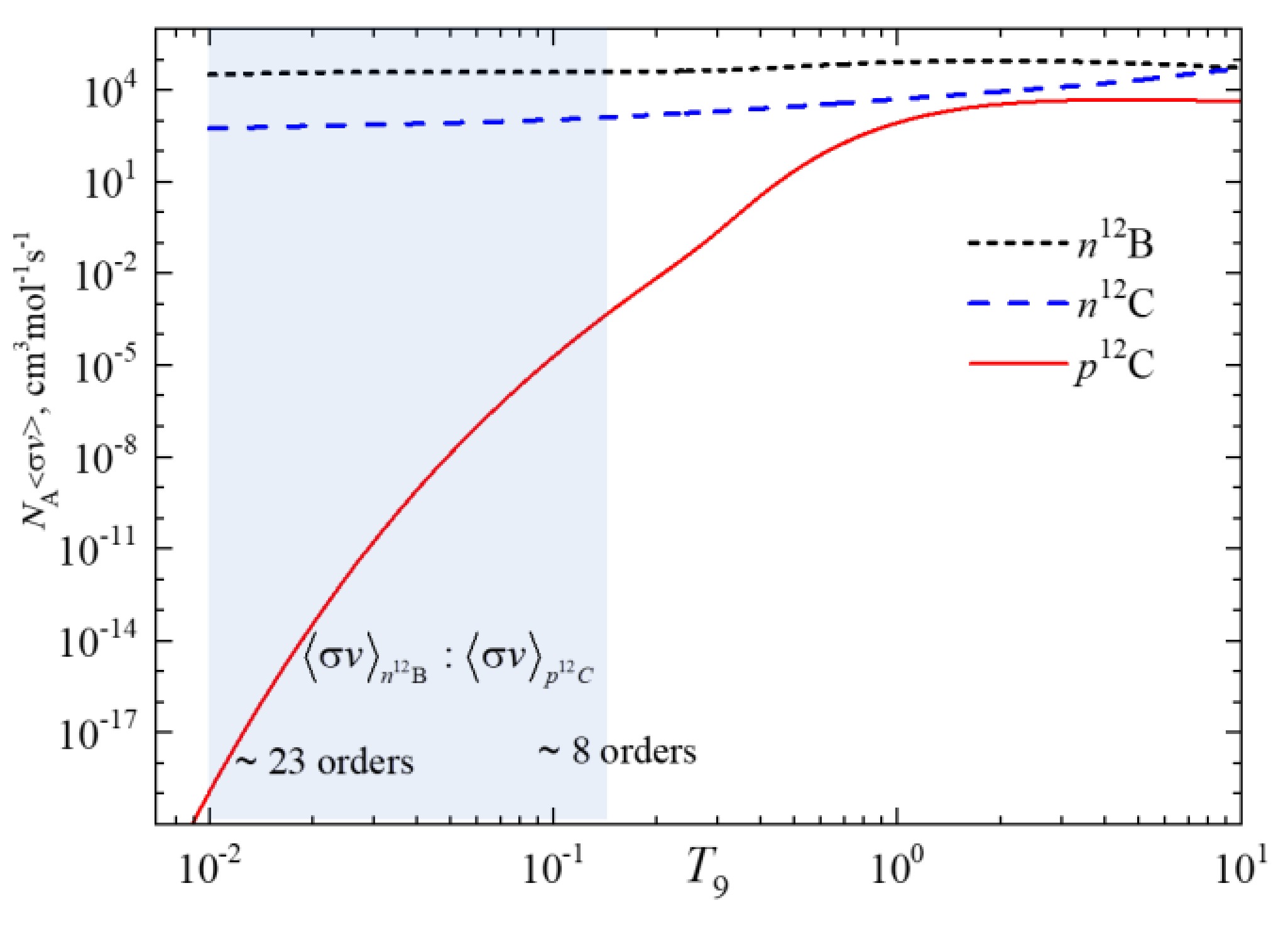
Figure 9.(color online) Reaction rates calculated in MPCM: black dotted curve is for12B(n,γ0)13B, dashed blue curve is for12C(n,γ0+1+3+2)13C [15]; red solid curve is for
${^{13}}{\text{C}}{(p,{\gamma _0})^{14}}{\text{N}}$ , present work. Filled area refers to the intervalT9= 0.01–0.14.To compare the reaction rates inFig. 9, the temperature rangeT9= 0.01–0.14 relevant to the post-BBN nucleosynthesis and stellar CNO cycles is highlighted in blue. The ratio of reaction rates
$ {R_{{\text{B}}/{\text{C}}}} = \dfrac{{{{\left\langle {\sigma v} \right\rangle }_{{n^{12}}{\text{B}}}}}}{{{{\left\langle {\sigma v} \right\rangle }_{{p^{12}}{\text{C}}}}}} $ is of ~ 1023orders of magnitude atT9= 0.01, and ~ 108atT9= 0.14. One may assume that such dominance of the12B(n,γ)13B(βν)13C chain over the rate of the12C(p,γ0)13N(β+)13C path may change the initial composition in terms of12C and lead to the redistribution of12C and13C. It is expedient to estimate this correction for the${R_{^{12}C{/^{13}}C}}$ ratio. -
We calculated the astrophysicalS-factor for the proton radiative capture reaction12C(p,γ)13N in the energy rangeEc.m.= 1–5000 keV. The reliability of the current MPCM calculations is demonstrated by reproducing the experimental phase shifts
$ {\delta _{^2{S_{1/2}}}} $ ,$ {\delta _{^2{P_{3/2}}}} $ , and$ {\delta _{^2{D_{3/2}}}} $ at energies of up toEc.m.= 3 MeV with high accuracy. Moreover, the determined parameters of the 1/2+and 3/2-resonances,i.e.,Eres= 422 keV, Γc.m.= 32 keV, andEres= 1560 keV, Γc.m.= 53 keV, respectively, are in good agreement both with the recent experimental data from Csedrekiet al., 2023, as well as with the most recent results ofR-matrix fitting from Refs. [12–14,43].The GS main characteristics, namely the binding energy in thep+12C channelEb= 1.94350 MeV and charge radius
$ {R_{{\text{ch}}}}{(^{13}}{\rm N}) = 2.465 \pm 0.05\,\,{\text{fm}} $ , are calculated with accuracies of 10-5MeV and 10-2fm, respectively. Two sets of potential parameters for the GS radial wave function have been found under the condition thatEbremains constant, but the values of the asymptotic constantCware different. Set I refers toCw= 1.30(2), and Set II refers toCw= 1.37(1).Set I leads to the astrophysical factorS(25) = 1.34 ± 0.02 keV·b, which is in excellent agreement with data from Skowronskiet al., (2023)[14],i.e., 1.34 ± 0.09 keV·b . Set II yieldsS(25) = 1.49 ± 0.02 keV·b, which is in excellent agreement with data from Kettneret al.,(2023)[12],i.e., 1.48 ± 0.09 keV·b . The difference between these two data sets is ~ 9%–11% at 25 keV. Therefore, we are able to reproduce both results for theS(0), which demonstrates the flexibility of MPCM formalism at a well-substantiated level.
One cannot but agree that theR-matrix approach is a fitting of experimental data, and that it is difficult for model calculations to compete with it. The MPCM succeeded in reproducing the current known experimental data for the astrophysicalS(E) factor in the energy range of 76 keV to 2000 keV, but met a problem at energiesEc.m.~ 640–930 keV, which correspond to the "slope" of the 1st(1/2+) resonance. Current calculations show a near 30%–50% overestimation of the experimentalS-factor within this energy range, which has no explanation at the moment, given that the phase shifts
$ {\delta _{^2{S_{1/2}}}} $ ,$ {\delta _{^2{P_{3/2}}}} $ , and$ {\delta _{^2{D_{3/2}}}} $ providing the energy dependence of the calculatedS-factor are reproduced precisely up toEc.m.= 3 MeV, as we have stated above.The reaction rate of the process12C(p,γ)13N is calculated forT9= 0.001–10. Typically, the NACRE II data are used as a benchmark for comparing subsequent calculations of the reaction rates.Figures 6and7show neither qualitative nor quantitative exact agreement with the NACRE II data for all cited Refs. [12,13,43,47,61] and the present work throughout the entire range ofT9(there may be some exception in Ref. [61]; see comments above). However, there are temperature areas where acceptable agreement is observed for the reaction rates. TheR-matrix results for the reaction rate from Skowronskiet al., (2023) [13] and Kettneret al.,[12] show excellent agreement up toT9
$\simeq $ 6 between themselves. However, there are alsoR-matrix calculations, for example, [43] and [47], with very close input parameters that yield noticeably different outcomes.Finally, we may conclude that any of the known reaction rates of the12C(p,γ)13N process may be recommended for the calculation of astrophysical macro-characteristics such as mass fraction or efficiency of12C production if deviations within ~ 30%–50% are considered acceptable. Otherwise, the issue of12C(p,γ)13N reaction rate consensus remains open.
During this study on the12C(p,γ)13N reaction, the results of the MPCM approach have shown a reasonable level of reliability; consequently, applying this model to the analysis of the13C(p,γ)14N reaction is a sensible approach.
-
We approximate the reaction rates inTable A1calculated based on MPCM with the following expression:
T9 Set I Set II Set II/ Set I T9 Set I Set II Set II/ Set I 0.001 6.04×10−51 6.74×10−51 1.12 0.14 3.39×10⁻⁴ 3.79×10⁻⁴ 1.12 0.002 7.21×10−39 8.04×10−39 1.12 0.15 6.08×10⁻⁴ 6.79×10⁻⁴ 1.12 0.003 5.15×10⁻³³ 5.75×10⁻³³ 1.12 0.16 1.04×10⁻³ 1.16×10⁻³ 1.12 0.004 2.52×10⁻²⁹ 2.82×10⁻²⁹ 1.12 0.18 2.73×10⁻³ 3.04×10⁻³ 1.12 0.005 1.06×10⁻²⁶ 1.18×10⁻²⁶ 1.12 0.2 6.36×10⁻³ 7.10×10⁻³ 1.12 0.006 1.06×10⁻²⁴ 1.18×10⁻²⁴ 1.12 0.25 3.93×10⁻² 4.39×10⁻² 1.12 0.007 4.17×10⁻²³ 4.65×10⁻²³ 1.12 0.3 2.01×10⁻¹ 2.25×10⁻¹ 1.12 0.008 8.63×10⁻²² 9.63×10⁻²² 1.12 0.35 8.71×10⁻¹ 9.73×10⁻¹ 1.12 0.009 1.12×10⁻²⁰ 1.25×10⁻²⁰ 1.12 0.4 3.02×100 3.37×100 1.12 0.01 1.01×10⁻¹⁹ 1.13×10⁻¹⁹ 1.12 0.45 8.37×100 9.37×100 1.12 0.011 6.93×10⁻¹⁹ 7.74×10⁻¹⁹ 1.12 0.5 1.93×101 2.16×101 1.12 0.012 3.81×10⁻¹⁸ 4.25×10⁻¹⁸ 1.12 0.6 6.79×101 7.60×101 1.12 0.013 1.75×10⁻¹⁷ 1.95×10⁻¹⁷ 1.12 0.7 1.65×10² 1.84×10² 1.12 0.014 6.89×10⁻¹⁷ 7.69×10⁻¹⁷ 1.12 0.8 3.15×10² 3.53×10² 1.12 0.015 2.40×10⁻¹⁶ 2.68×10⁻¹⁶ 1.12 0.9 5.14×10² 5.75×10² 1.12 0.016 7.50×10⁻¹⁶ 8.37×10⁻¹⁶ 1.12 1 7.50×10² 8.39×10² 1.12 0.018 5.63×10⁻¹⁵ 6.28×10⁻¹⁵ 1.12 1.25 1.42×10³ 1.59×10³ 1.12 0.02 3.19×10⁻¹⁴ 3.57×10⁻¹⁴ 1.12 1.5 2.08×10³ 2.32×10³ 1.12 0.025 1.03×10⁻¹² 1.15×10⁻¹² 1.12 1.75 2.64×10³ 2.96×10³ 1.12 0.03 1.46×10⁻¹¹ 1.63×10⁻¹¹ 1.12 2 3.10×10³ 3.46×10³ 1.12 0.04 6.93×10⁻¹⁰ 7.73×10⁻¹⁰ 1.12 2.5 3.70×10³ 4.13×10³ 1.12 0.05 1.08×10⁻⁸ 1.20×10⁻⁸ 1.12 3 4.02×10³ 4.48×10³ 1.11 0.06 8.76×10⁻⁸ 9.78×10⁻⁸ 1.12 3.5 4.18×10³ 4.65×10³ 1.11 0.07 4.68×10⁻⁷ 5.22×10⁻⁷ 1.12 4 4.26×10³ 4.71×10³ 1.11 0.08 1.86×10⁻⁶ 2.08×10⁻⁶ 1.12 5 4.27×10³ 4.69×10³ 1.10 0.09 6.02×10⁻⁶ 6.72×10⁻⁶ 1.12 6 4.21×10³ 4.59×10³ 1.09 0.1 1.65×10⁻⁵ 1.85×10⁻⁵ 1.12 7 4.12×10³ 4.45×10³ 1.08 0.11 4.01×10⁻⁵ 4.48×10⁻⁵ 1.12 8 4.01×10³ 4.31×10³ 1.07 0.12 8.82×10⁻⁵ 9.85×10⁻⁵ 1.12 9 3.89×10³ 4.16×10³ 1.07 0.13 1.79×10⁻⁴ 2.00×10⁻⁴ 1.12 10 3.77×10³ 4.02×10³ 1.06 Table A1.Radiativep12C capture reaction rates in units of cm3mol−1s−1.
$ \begin{aligned}[b]{N_A}\left\langle {\sigma v} \right\rangle =\;& \frac{{{a_1}}}{{T_9^{{b_1}}}}\exp \left[ {\frac{{{a_2}}}{{T_9^{{b_2}}}} - {{\left( {\frac{{T_9^{}}}{{{a_3}}}} \right)}^2}} \right]\left[ {1.0 + {a_4}T_9^{} + {a_5}T_9^{{b_3}}} \right] \\&+ \frac{{{a_6}}}{{T_9^{{b_4}}}}\exp \left( {\frac{{{a_7}}}{{T_9^{}}}} \right) + \frac{{{a_8}}}{{T_9^{{b_5}}}}\exp \left( {\frac{{{a_9}}}{{T_9^{}}}} \right). \end{aligned}$

(A1) The parametersaiandbifor the two sets are provided inTable A2.
i Set I Set II ai bi ai bi 1 2.209016×10⁴ 7.5647×10⁻¹ 3.390734×10⁴ 8.1676×10⁻¹ 2 −1.222668×101 3.4343×10⁻¹ −1.230191×101 3.4328×10⁻¹ 3 2.06057×100 8.05532×100 2.23773×100 8.46417×100 4 7.060818×10² 9.4588×10⁻¹ 5.202753×10² 9.4487×10⁻¹ 5 2.24×10⁻² 3.48415×100 5.86×10⁻³ 3.55824×100 6 5.529536×10⁴ 5.966096×10⁴ 7 −4.36135×100 −4.33828×100 8 −2.99216×10⁶ −4.68741×10⁶ 9 −1.212292×101 −1.287131×101 χ2= 0.05 χ2= 0.05 Table A2.Parameters of the reaction rate approximation (A1).
The calculation of
${\chi ^2}$ is performed following the standard definition (see,e.g., [20]):$ {\chi ^2} = \frac{1}{N}{\sum\limits_{i = 1}^N {\left[ {\frac{{\left\langle {\sigma v} \right\rangle _i^{\rm app.}({T_9}) - \left\langle {\sigma v} \right\rangle _i^{\rm calc.}({T_9})}}{{\Delta \left\langle {\sigma v} \right\rangle _i^{\rm calc.}({T_9})}}} \right]} ^2} = \frac{1}{N}\sum\limits_{i = 1}^N {\chi _i^2} , $

(A2) whereNis the number of the calculation points;
$\left\langle {\sigma v} \right\rangle _i^{\rm app.}({T_9})$ is the approximated reaction rate from Eq. (A1);$\left\langle {\sigma v} \right\rangle _i^{\rm calc.}({T_9})$ is the calculated reaction rate according to Eq. (7); and the error$\Delta \left\langle {\sigma v} \right\rangle _i^{\rm calc.}({T_9})$ we assume here to be 5% of the calculated reaction rate.
Reaction rate of radiativep12C capture in a modified potential cluster model
- Received Date:2024-11-13
- Available Online:2025-04-15
Abstract:The astrophysicalS-factor of the12C(p,γ0)13N reaction at energies from 25 keV to 5 MeV within the framework of a modified potential cluster model with forbidden states is considered. The experimental phase shifts resonant


 DownLoad: