


 Abstract
 HTML
HTML Reference
 Related
 PDF
PDF


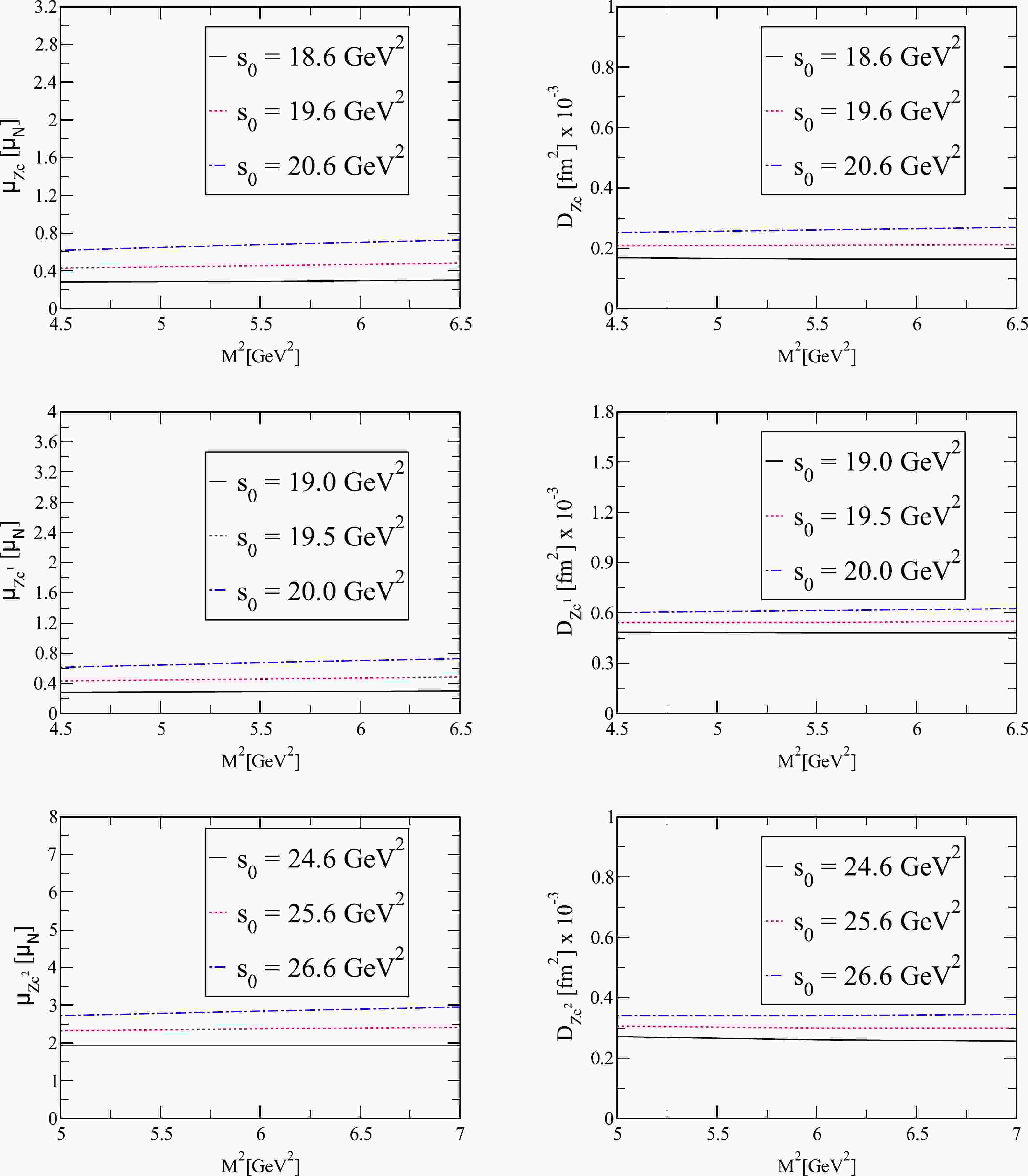


-
Since the observation of the X(3872) state by the Belle collaboration in 2003 [1], many hadronic states have been observed that cannot be classified in the conventional two- or three-quark picture. The LHCb, BESIII, CDF, BABAR, CMS, Belle, and D0 collaborations have subsequently observed numerous states that cannot be classified in the conventional quark picture and are represented asXYZparticle, hybrid, and pentaquark states; however, some are still awaiting confirmation, and quantum numbers have not yet been assigned. The most important achievement in the field of non-conventional states has been the discovery of charged tetraquark states. Currently, there are ten members in the set of charged hidden-charmed tetraquark states,
$ Z_c(3900) $ ,$ Z_c(4020) $ ,$ Z_c(4050) $ ,$ Z_c(4100) $ ,$ Z_c(4200) $ ,$ Z_2(4250) $ ,$ Z_c(4430) $ ,$ Z_c(4600) $ ,$ Z_{cs}(3985) $ ,$ Z_{cs}(4000) $ , and$ Z_{cs}(4220) $ , reported in decays into final states that contain a pair of light and charm quarks [2−14]. They cannot be classified as conventional charmonium mesons because of their electric charge and must be nonconventional states with a minimum quark content$ c \bar {c} u \bar {d} $ /$ c \bar {c} d \bar {u} $ /$ c \bar {c} s \bar {u} $ /$ c \bar {c} u \bar {s} $ . The charged tetraquark states receive considerable attention because of their different properties. The study of these states can help to not only elucidate their nature and substructure but also obtain functional data on the nature of the strong interaction inside these particles. As tetraquark states with a$ c \bar {c} u \bar {d} $ /$ c \bar {c} d \bar {u} $ /$ c \bar {c} s \bar {u} $ /$ c \bar {c} u \bar {s} $ quark content, this family of charged states has generally been studied as molecular and compact diquark-antiquark pictures. Many comprehensive reviews on this subject can be found in literature [15−30].Magnetic and quadrupole moments are important parameters of hadrons that can be measured and calculated, just like mass and decay. In studying the internal structure and possible deformation of the hidden-charm tetraquark states, magnetic and quadrupole moments are of particular interest. The magnetic and quadrupole moments of hidden-charm tetraquark states have been extracted in several studies in literature [31−38]. Moreover, in Ref. [39], QCD calculations of radiative heavy-meson decay form factors were performed by including the subleading power corrections of the twist-two photon distribution amplitude in the next-to-leading order in
$ \alpha_s $ using QCD light-cone sum rules. In this study, we evaluate the magnetic and quadrupole moments of the tetraquark states$ Z_{c}(4020)^+ $ ,$ Z_{c}(4050)^+ $ , and$ Z_{c}(4600)^{+} $ (hereafter,$ Z_{c} $ ,$ Z^1_{c} $ , and$ Z^2_{c} $ , respectively) by considering them as the diquark-antiquark picture within QCD light-cone sum rules. The QCD light-cone sum rules method is a powerful technique for studying exotic hadron properties and has been successfully applied to the calculation of masses, form factors, magnetic moments, decay constants, and so on. The correlation function is evaluated in terms of both hadrons (the so-called hadronic part) and the quark-gluon degrees of freedom (the QCD part) according to the QCD light-cone sum rules technique. By equating these two descriptions of the correlation function, the physical quantities, that is, the magnetic and quadrupole moments, are evaluated [40−42].This paper is organized as follows. In Sec. II, we construct the QCD light-cone sum rules for the magnetic and quadrupole moments of the hidden-charm tetraquark states. The numerical results and the corresponding discussion of the magnetic and quadrupole moments of the compact hidden-charm tetraquark states are presented in Sec. III. In Sec. IV, the obtained results are summarized and discussed. For the sake of brevity, the expressions of the correlation function for the
$ Z_{c}(4020)^+ $ tetraquark state and the distribution amplitudes of the photon are given in Appendix A and B, respectively. -
In this section, we explore the magnetic and quadrupole moment of hidden-charm tetraquark states composed of compact diquark-antidiquarks. To do this, we write the two-point correlation function in the QCD sum rules in the presence of an external electromagnetic background field as follows:
$ \Pi _{\mu \nu }(p,q)={\rm i}\int {\rm d}^{4}x{\rm e}^{{\rm i}p\cdot x}\langle 0|\mathcal{T}\{J_{\mu}(x) J_{\nu }^{\dagger }(0)\}|0\rangle_{\gamma}, $

(1) whereγrepresents the external electromagnetic background field,qis the momentum of the photon, and
$ J_{\mu(\nu)}(x) $ is the interpolating current of the$ Z_{c} $ states with quantum numbers$ J^{P}=1^{+} $ , which are given as$ \begin{aligned}[b] J_{\mu}^{Z_{c}}(x)=&\frac{\epsilon \tilde{\epsilon}}{\sqrt{2}}\Big\{ [ { u^{bT}}(x) C \sigma_{\alpha\mu} \gamma_5 c^c(x)] [ \bar d^d(x) \gamma^{\alpha} C { \bar c^{bT}}(x)]\\ & -[ { u^{bT}}(x) C \gamma^{\alpha} c^c(x)] [ \bar d^d(x) \gamma_5 \sigma_{\alpha\mu} C {\bar c^{eT}} (x)] \Big\}, \end{aligned} $

(2) $ \begin{aligned}[b] J_{\mu}^{Z^1_{c}}(x)=&\frac{\epsilon \tilde{\epsilon}}{\sqrt{2}}\Big\{ [ { u^{bT}}(x) C \sigma_{\alpha\mu} c^c(x)] [ \bar d^d(x) \gamma_5 \gamma^{\alpha} C { \bar c^{bT}}(x)] \\ & +[ { u^{bT}}(x) C \gamma^{\alpha}\gamma_5 c^c(x)] [\bar d^d(x) \sigma_{\alpha\mu} C {\bar c^{eT}} (x)] \Big\}, \end{aligned} $

(3) $ \begin{aligned}[b] J_{\mu}^{Z^2_{c}}(x)=&\frac{\epsilon \tilde{\epsilon}}{\sqrt{2}}\Big\{ [ { u^{bT}}(x) C \sigma_{\alpha\mu} c^c(x)] [ \bar d^d(x) \gamma_5 \gamma^{\alpha} C { \bar c^{bT}}(x)] \\ & -[ { u^{bT}}(x) C \gamma^{\alpha}\gamma_5 c^c(x)] [ \bar d^d(x) \sigma_{\alpha\mu} C {\bar c^{eT}} (x)] \Big\}, \end{aligned} $

(4) where
$ \epsilon =\epsilon _{abc} $ ;$\tilde{\epsilon}=\epsilon _{\rm dec}$ ;a,b,c,d, andeare color indexes;$\sigma_{\mu\nu}=\dfrac{\rm i}{2}[\gamma_{\mu},\gamma_{\nu}]$ ; andCis the charge conjugation matrix.Now, let us first calculate the hadronic side of the correlation function. The cor relation function in Eq. (1) can be acquired by entering it into all intermediate hadronic sum rules, with the same quantum numbers as the corresponding interpolating currents
$ J_\mu $ . After isolating the contributions of the ground$ Z_c $ states, we obtain$ \begin{aligned}[b] \Pi_{\mu\nu}^{\rm Had} (p,q) =& \frac{1}{ [m_{Z_c}^2 - (p+q)^2][m_{Z_c}^2 - p^2]} \\ & \times \langle 0 \mid J_\mu (x) \mid Z_{c}(p, \varepsilon^\theta) \rangle \\ & \times \langle Z_{c}(p, \varepsilon^\theta) \mid Z_{c}(p+q, \varepsilon^\delta) \rangle_\gamma \\ & \times \langle Z_{c}(p+q,\varepsilon^\delta) \mid {J^\dagger}_\nu (0) \mid 0 \rangle +\cdot \cdot \cdot\,, \end{aligned} $

(5) where dots denote the contributions from the higher states and continuum.
The matrix elements of the interpolating current between one hadron and vacuum states in terms of the polarization vectors and residues are given as
$ \langle 0 \mid J_\mu(x) \mid Z_{c}(p,\varepsilon^\theta) \rangle = \lambda_{Z_{c}} \varepsilon_\mu^\theta\,, $

(6) $ \langle Z_{c}(p+q,\varepsilon^\delta) \mid {J^\dagger}_\nu (0) \mid 0 \rangle = \lambda_{Z_{c}} \varepsilon_\nu^{*\delta}\,. $

(7) The radiative transition matrix element in Eq. (5) is written in terms of three Lorentz invariant form factors
$ G_1(Q^2) $ ,$ G_2(Q^2) $ , and$ G_3(Q^2) $ as$ \begin{aligned}[b]& \langle Z_{c}(p,\varepsilon^\theta) \mid Z_{c} (p+q,\varepsilon^{\delta})\rangle_\gamma\\ &= - \varepsilon^\tau (\varepsilon^{\theta})^\alpha (\varepsilon^{\delta})^\beta \Big\{ G_1(Q^2) (2p+q)_\tau \; g_{\alpha\beta} \\ & + G_2(Q^2) ( g_{\tau\beta}\; q_\alpha - g_{\tau\alpha}\; q_\beta) \\ &- \frac{1}{2 m_{Z_{c}}^2} G_3(Q^2)\; (2p+q)_\tau q_\alpha q_\beta \Big\}, \end{aligned} $

(8) where
$ \varepsilon^\tau $ and$ \varepsilon^{\delta(\theta)} $ are the polarization vectors of the photon and$ Z_c $ states, respectively.Employing Eqs. (5)−(8), the hadronic part of the correlation function becomes
$ \begin{aligned}[b] \Pi_{\mu\nu}^{\rm Had}(p,q) =& \frac{\varepsilon_\rho \, \lambda_{Z_c}^2}{ [m_{Z_c}^2 - (p+q)^2][m_{Z_c}^2 - p^2]} \bigg\{G_1(Q^2) \\ & \times (2p+q)_\rho\bigg(g_{\mu\nu}-\frac{p_\mu p_\nu}{m_{Z_c}^2} -\frac{(p+q)_\mu (p+q)_\nu}{m_{Z_c}^2} \\ &+\frac{(p+q)_\mu p_\nu}{2m_{Z_c}^4} (Q^2+2m_{Z_c}^2) \bigg)\\ & + G_2 (Q^2) \bigg(q_\mu g_{\rho\nu} - q_\nu g_{\rho\mu} - \frac{p_\nu}{m_{Z_c}^2} \big(q_\mu p_\rho \\ & - \frac{1}{2} Q^2 g_{\mu\rho}\big) + \frac{(p+q)_\mu}{m_{Z_c}^2} \big(q_\nu (p+q)_\rho+ \frac{1}{2} Q^2 g_{\nu\rho}\big) \\ &- \frac{(p+q)_\mu p_\nu p_\rho}{m_{Z_c}^4} \, Q^2 \bigg)\\ & -\frac{G_3(Q^2)}{m_{Z_c}^2}(2p+q)_\rho \bigg( q_\mu q_\nu -\frac{p_\mu q_\nu}{2 m_{Z_c}^2} Q^2 \\ &+\frac{(p+q)_\mu q_\nu}{2 m_{Z_c}^2} Q^2 -\frac{(p+q)_\mu q_\nu}{4 m_{Z_c}^4} Q^4\bigg) \bigg\}\,. \end{aligned} $

(9) The magnetic and quadrupole moments of hadrons are related to their magnetic and quadrupole form factors; more precisely, the magnetic and quadrupole moments are equal to the magnetic and quadrupole form factor at zero momentum square. Magnetic (
$ F_M(Q^2) $ ) and quadrupole ($ F_{\mathcal D} (Q^2) $ ) form factors, which are more directly accessible in experiments, are described via the form factors$ G_1(Q^2) $ ,$ G_2(Q^2) $ , and$ G_3(Q^2) $ $ \begin{aligned}[b] &F_M(Q^2) = G_2(Q^2)\,, \\ &F_{\mathcal D}(Q^2) = G_1(Q^2)-G_2(Q^2)+(1+\lambda) G_3(Q^2)\,, \end{aligned} $

(10) where
$ \lambda=Q^2/4 m_{Z_c}^2 $ with$ Q^2=-q^2 $ . At the static limit, that is,$ Q^2 = 0 $ , the form factors$ F_M(Q^2=0) $ and$ F_{\mathcal D}(Q^2=0) $ are proportional to the magnetic ($ \mu_{Z_c} $ ) and quadrupole ($ \mathcal {D}_{Z_c} $ ) moments in the following way:$ \begin{aligned}[b] &e F_M(Q^2=0) = 2 m_{Z_c} \mu_{Z_c} \,, \\ &e F_{\cal D}(Q^2=0) = m_{Z_c}^2 {\mathcal {D}_{Z_c}}\,. \end{aligned} $

(11) Let us evaluate the QCD part of the correlation function. The QCD side of the above correlation function is computed considering the QCD degrees of freedom in the deep Euclidean region. To do this, we must insert the interpolating currents in Eqs. (2)−(4) into the correlation function. After substituting the explicit forms of the interpolating currents into the correlation function and applying contractions through Wick’s theorem, we obtain the QCD side as
$ \begin{aligned}[b] \Pi _{\mu \nu }^{\mathrm{QCD-Z_{c}}}(p,q)=&\frac{ \epsilon \tilde{\epsilon} \epsilon^{\prime} \tilde{\epsilon}^{\prime}}{2} \int {\rm d}^{4}x{\rm e}^{{\rm i}px} \langle 0 | \Big\{ \mathrm{Tr}\Big[\gamma^{\alpha}{\tilde S}_{c}^{e^{\prime }e}(-x)\gamma ^{\beta}S_{d}^{d^{\prime }d}(-x)\Big] \mathrm{Tr}\Big[\sigma_{\mu\alpha}\gamma _{5 }{S}_{c}^{cc^{\prime }}(x)\gamma _{5}\sigma_{\nu\beta}\tilde S_{u}^{bb^{\prime }}(x)\Big] \\ &-\mathrm{Tr}\Big[ \gamma^{\alpha}{\tilde S}_{c}^{e^{\prime }e}(-x)\gamma _{5}\sigma_{\nu\beta}S_{d}^{d^{\prime }d}(-x)\Big] \mathrm{Tr}\Big[ \sigma_{\mu\alpha}\gamma_{5 }{S}_{c}^{cc^{\prime }}(x)\gamma^{\beta}\tilde S_{u}^{bb^{\prime }}(x)\Big] \\ &-\mathrm{Tr}\Big[\sigma_{\mu\alpha}\gamma _{5}{\tilde S}_{c}^{e^{\prime }e}(-x)\gamma^{\beta }S_{d}^{d^{\prime }d}(-x)\Big] \mathrm{Tr}\Big[ \gamma^{\alpha}{S}_{c}^{cc^{\prime }}(x)\gamma_{5}\sigma_{\nu\beta}\tilde S_{u}^{bb^{\prime }}(x)\Big] \\ &+\mathrm{Tr}\Big[\sigma_{\mu\alpha}\gamma_{5 }{\tilde S}_{c}^{e^{\prime }e}(-x)\gamma _{5}\sigma_{\nu\beta}S_{d}^{d^{\prime }d}(-x)\Big] \mathrm{Tr}\Big[\gamma^{\alpha}{S}_{c}^{cc^{\prime }}(x) \gamma^{\beta}\tilde S_{u}^{bb^{\prime }}(x)\Big] \Big\}| 0 \rangle_\gamma, \end{aligned} $ 
(12) $ \begin{aligned}[b] \Pi _{\mu \nu }^{\mathrm{QCD-Z_{c}^1}}(p,q)=&\frac{ \epsilon \tilde{\epsilon} \epsilon^{\prime} \tilde{\epsilon}^{\prime}}{2} \int {\rm d}^{4}x{\rm e}^{{\rm i}px} \langle 0 | \Big\{ \mathrm{Tr}\Big[ \gamma _{5 }\gamma^{\alpha}{\tilde S}_{c}^{e^{\prime }e}(-x)\gamma ^{\beta} \gamma _{5 }S_{d}^{d^{\prime }d}(-x)\Big] \mathrm{Tr}\Big[\sigma_{\mu\alpha}{S}_{c}^{cc^{\prime }}(x)\sigma_{\nu\beta}\tilde S_{u}^{bb^{\prime }}(x)\Big] \\ &+\mathrm{Tr}\Big[ \gamma _{5 } \gamma^{\alpha}{\tilde S}_{c}^{e^{\prime }e}(-x)\sigma_{\nu\beta}S_{d}^{d^{\prime }d}(-x)\Big] \mathrm{Tr}\Big[ \sigma_{\mu\alpha}{S}_{c}^{cc^{\prime }}(x)\gamma^{\beta} \gamma_{5 }\tilde S_{u}^{bb^{\prime }}(x)\Big] \\ &+\mathrm{Tr}\Big[\sigma_{\mu\alpha}{\tilde S}_{c}^{e^{\prime }e}(-x)\gamma^{\beta } \gamma _{5}S_{d}^{d^{\prime }d}(-x)\Big] \mathrm{Tr}\Big[ \gamma _{5}\gamma^{\alpha}{S}_{c}^{cc^{\prime }}(x)\sigma_{\nu\beta}\tilde S_{u}^{bb^{\prime }}(x)\Big] \\ &+\mathrm{Tr}\Big[\sigma_{\mu\alpha}{\tilde S}_{c}^{e^{\prime }e}(-x)\sigma_{\nu\beta}S_{d}^{d^{\prime }d}(-x)\Big] \mathrm{Tr}\Big[\gamma_{5} \gamma^{\alpha}{S}_{c}^{cc^{\prime }}(x) \gamma^{\beta} \gamma_{5}\tilde S_{u}^{bb^{\prime }}(x)\Big] \Big\}| 0 \rangle_\gamma, \end{aligned} $

(13) $ \begin{aligned}[b] \Pi _{\mu \nu }^{\mathrm{QCD-Z_{c}^2}}(p,q)=&\frac{ \epsilon \tilde{\epsilon} \epsilon^{\prime} \tilde{\epsilon}^{\prime}}{2} \int {\rm d}^{4}x{\rm e}^{{\rm i}px} \langle 0 | \Big\{ \mathrm{Tr}\Big[ \gamma _{5 }\gamma^{\alpha}{\tilde S}_{c}^{e^{\prime }e}(-x)\gamma ^{\beta} \gamma _{5 }S_{d}^{d^{\prime }d}(-x)\Big] \mathrm{Tr}\Big[\sigma_{\mu\alpha}{S}_{c}^{cc^{\prime }}(x)\sigma_{\nu\beta}\tilde S_{u}^{bb^{\prime }}(x)\Big] \\ &-\mathrm{Tr}\Big[ \gamma _{5 } \gamma^{\alpha}{\tilde S}_{c}^{e^{\prime }e}(-x)\sigma_{\nu\beta}S_{d}^{d^{\prime }d}(-x)\Big] \mathrm{Tr}\Big[ \sigma_{\mu\alpha}{S}_{c}^{cc^{\prime }}(x)\gamma^{\beta} \gamma_{5 }\tilde S_{u}^{bb^{\prime }}(x)\Big] \\ &-\mathrm{Tr}\Big[\sigma_{\mu\alpha}{\tilde S}_{c}^{e^{\prime }e}(-x)\gamma^{\beta } \gamma _{5}S_{d}^{d^{\prime }d}(-x)\Big] \mathrm{Tr}\Big[ \gamma _{5}\gamma^{\alpha}{S}_{c}^{cc^{\prime }}(x)\sigma_{\nu\beta}\tilde S_{u}^{bb^{\prime }}(x)\Big] \\ &+\mathrm{Tr}\Big[\sigma_{\mu\alpha}{\tilde S}_{c}^{e^{\prime }e}(-x)\sigma_{\nu\beta}S_{d}^{d^{\prime }d}(-x)\Big] \mathrm{Tr}\Big[\gamma_{5} \gamma^{\alpha}{S}_{c}^{cc^{\prime }}(x) \gamma^{\beta} \gamma_{5}\tilde S_{u}^{bb^{\prime }}(x)\Big] \Big\}| 0 \rangle_\gamma, \end{aligned} $

(14) where
$ S_{c}(x) $ and$ S_{q}(x) $ represent the propagators of heavy and light quarks. The explicit forms of the quark propagators are written as [43,44]$ \begin{aligned}[b] S_{q}(x) =& S_q^{\rm free} - \frac{\langle \bar qq \rangle }{12} \Big(1-{\rm i}\frac{m_{q} {\not x}}{4} \Big) - \frac{\langle \bar q \sigma.G q \rangle }{192}x^2 \Big(1 \\ &-{\rm i}\frac{m_{q} {\not x}}{6} \Big) -\frac {{\rm i} g_s }{32 \pi^2 x^2} \; G^{\mu \nu} (x) \bigg[\not {x} \sigma_{\mu \nu} + \sigma_{\mu \nu} \not {x} \bigg], \end{aligned} $

(15) and
$ \begin{aligned}[b] S_{c}(x)=&S_c^{\rm free} -\frac{g_{s}m_{c}}{16\pi ^{2}} \int_0^1 {\rm d}v\, G^{\mu \nu }(vx)\Bigg[ (\sigma _{\mu \nu }{{\not x}} +{{\not x}}\sigma _{\mu \nu }) \\ & \times \frac{K_{1}\Big( m_{c}\sqrt{-x^{2}}\Big) }{\sqrt{-x^{2}}} +2\sigma_{\mu \nu }K_{0}\Big( m_{c}\sqrt{-x^{2}}\Big)\Bigg], \end{aligned} $

(16) where
$ S_q^{\rm free} =\frac{1}{2 \pi^2 x^2}\Big( {\rm i} \frac{{{\not x}}}{x^{2}}-\frac{m_{q}}{2 } \Big), $

(17) $ S_c^{\rm free} = \frac{m_{c}^{2}}{4 \pi^{2}} \Bigg[ \frac{K_{1}\Big(m_{c}\sqrt{-x^{2}}\Big) }{\sqrt{-x^{2}}} +{\rm i}\frac{{{\not x}}\; K_{2}\Big( m_{c}\sqrt{-x^{2}}\Big)} {(\sqrt{-x^{2}})^{2}}\Bigg]. $

(18) The correlation functions in Eqs. (12)−(14) contain short distance (perturbative) and long distance (nonperturbative) contributions. To obtain the expressions of the contributions when the photon is radiated at a short distance, it is adequate to modify one of the propagators in Eqs. (12)−(14) as follows:
$ \begin{array}{*{20}{l}} S^{\rm free}(x) \rightarrow \int {\rm d}^4y\, S^{\rm free} (x-y)\,\rlap/{ A}(y)\, S^{\rm free} (y)\,, \end{array} $

(19) where the remaining three propagators in Eqs. (12)−(14) are considered free propagators. This amounts to taking
$ \bar T_4^{\gamma} (\underline{\alpha}) = 0 $ and$ S_{\gamma} (\underline {\alpha}) = \delta(\alpha_{\bar q})\delta(\alpha_{q}) $ as the light-cone distribution amplitude in the three particle distribution amplitudes (see Ref. [39]).To obtain the expressions for when the photon is radiated at a long distance, the correlation function can be acquired from Eqs. (12)−(14) by substituting one of the u/d-quark propagators via
$ \begin{array}{*{20}{l}} S_{\mu\nu}^{ab}(x) \rightarrow -\dfrac{1}{4} \big[\bar{q}^a(x) \Gamma_i q^b(x)\big]\big(\Gamma_i\big)_{\mu\nu}, \end{array} $

(20)
Magnetic and quadrupole moments of the
${\boldsymbol Z_{\boldsymbol c}\bf (4020)^+} $
,
$ {\boldsymbol Z_{\boldsymbol c}\bf (4050)^+} $
, and
$ {\boldsymbol Z_{\boldsymbol c}\bf (4600)^{+}} $
states in the diquark-antidiquark picture
- Received Date:2023-08-01
- Available Online:2024-01-15
Abstract:The magnetic and quadrupole moments of the


