


 Abstract
 HTML
HTML Reference
 Related
 PDF
PDF




-
In ultra-relativistic collisions of nuclei at both the Relativistic Heavy Ion Collider (RHIC) [1−4] and Large Hadron Collider (LHC) [5−8], a hot and dense system of strongly interacting quarks and gluons, known as “quark-gluon plasma” (QGP), is created. One of the key observables used to study the properties of QGP is the anisotropic collective flow, quantified by Fourier harmonics
$ {v_n} $ . Many methods have been developed to measure these harmonics [9−11]. One such method, the method of cumulants based on multi-particle correlations [12,13], enables the suppression of short-range correlations arising from jets and resonance decays and then reveals a genuine collectivity arising from the expansion of QGP. TheQ-cumulant method [14] is an improved version of the initial cumulant method. Recently,Q-cumulants were employed to examine hydrodynamics predictions in Ref. [
Decomposition of multi-particle azimuthal correlations inQ-cumulant analysis
- Received Date:2023-05-05
- Available Online:2023-10-15
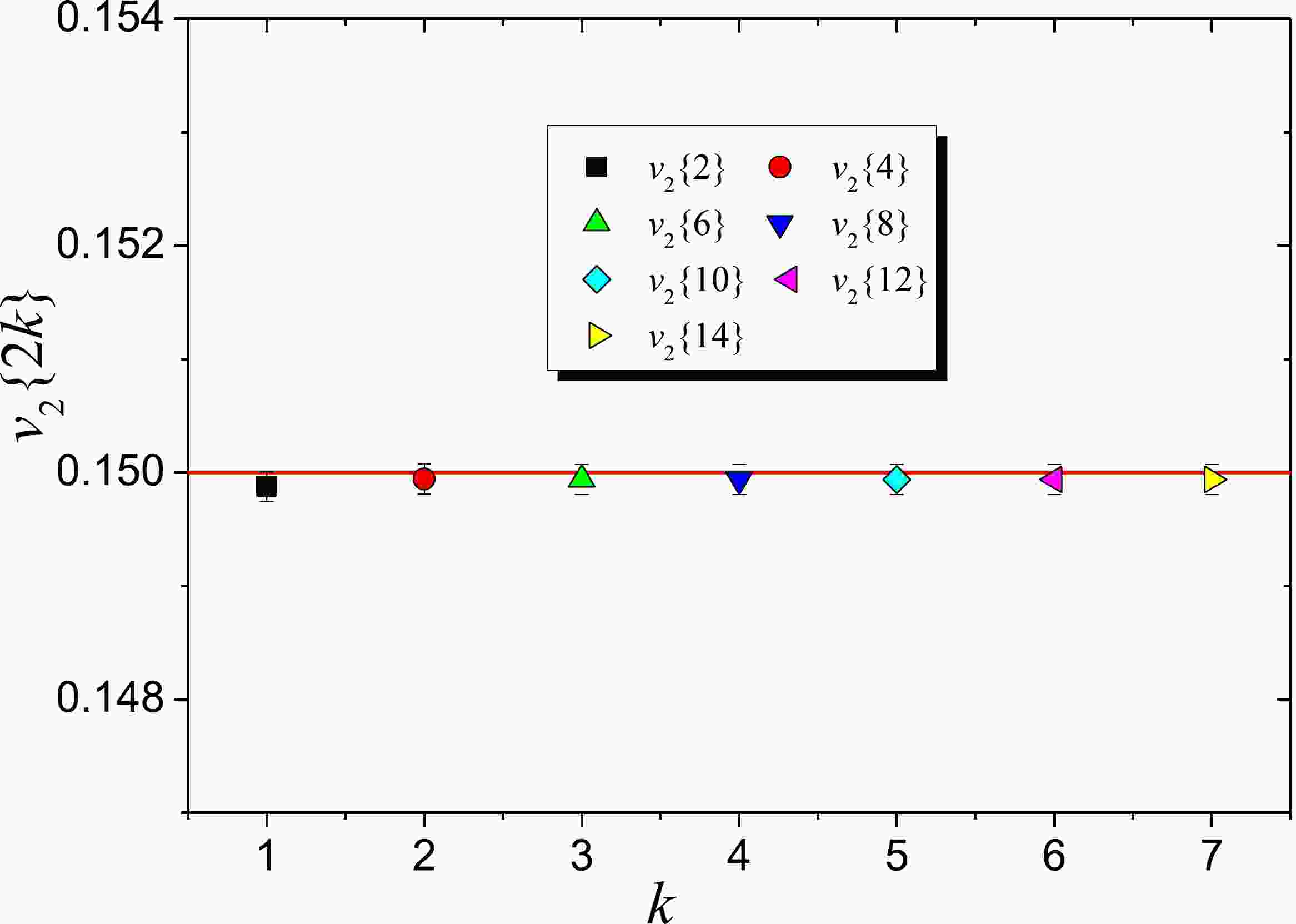
Abstract:The method ofQ-cumulants is a powerful tool for studying the fine details of azimuthal anisotropies in high energy nuclear collisions. This paper presents a new method, based on mathematical induction, to evaluate the analytical form of high-orderQ-cumulants. The capability of this method is demonstrated via a toy model that uses the elliptic power distribution to simulate the anisotropic emission of particles, quantified in terms of Fourier flow harmonics