Dissociation ofJ/ψin hot medium and magnetic field

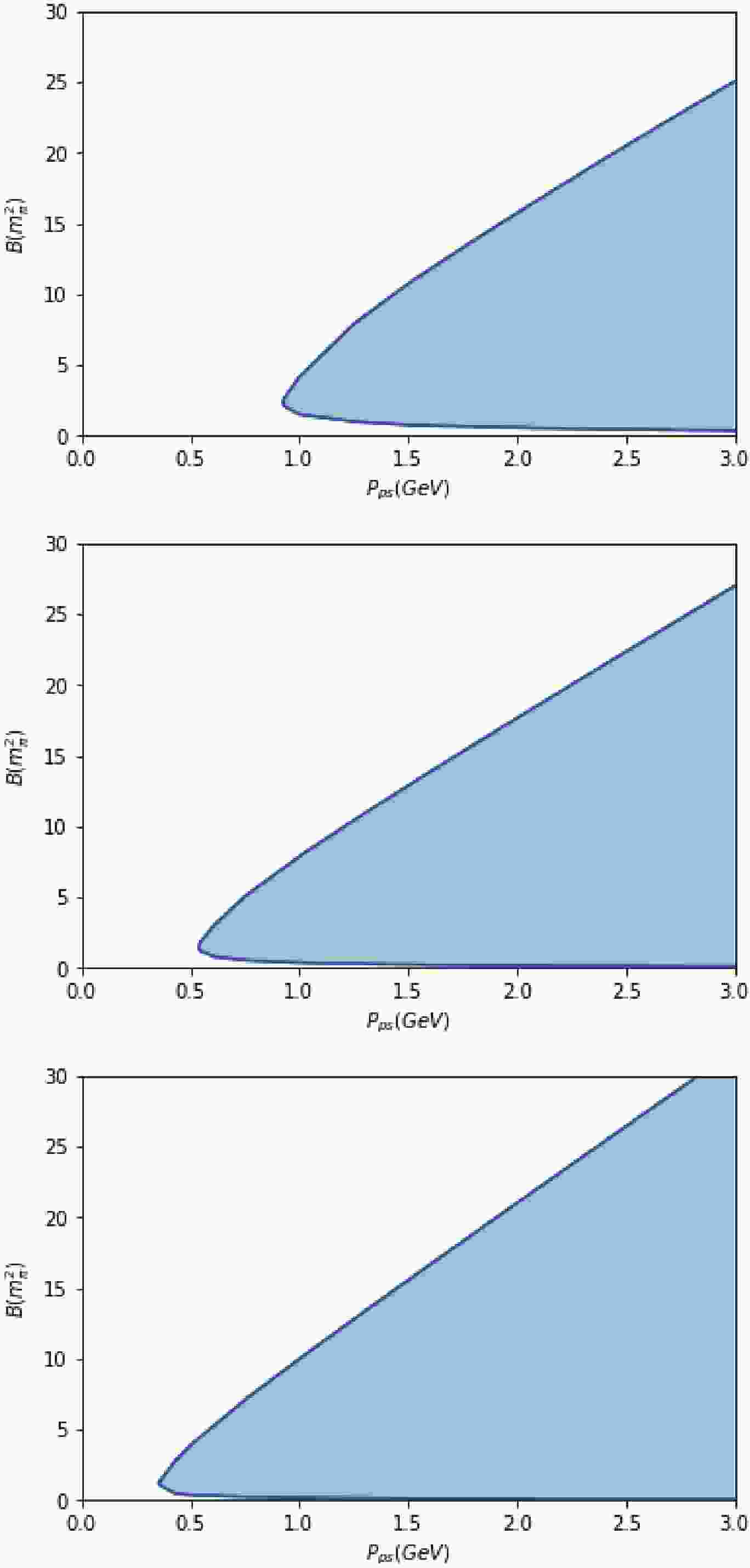
  • Charmonium dissociation is an important probe of the quark–gluon plasma medium in heavy-ion collisions. The magnetic field produced in non-central collisions can affect the charmonia and their dissociation. We study the $ c\bar{c} $ bound state in magnetic field and at finite temperature using the Schrödinger equation. We find that below the dissociation temperature, both the magnetic field and momentum of the charmonia affect the formation or dissociation of the bound state, forming a non-trivial structure.
  • 加载中
  • [1] J. C. Collins and M. J. Perry, Phys. Rev. Lett.34, 1353 (1975) doi:10.1103/PhysRevLett.34.1353
    [2] E. Brunaet al. (ALICE), Nucl. Phys. News24(2), 13-19 (2014) doi:10.1080/10619127.2014.910429
    [3] T. Matsui and H. Satz, Phys. Lett. B178, 416-422 (1986) doi:10.1016/0370-2693(86)91404-8
    [4] K. Fukushima, D. E. Kharzeev, and H. J. Warringa, Phys. Rev. D78, 074033 (2008), arXiv:0808.3382[hep-ph] doi:10.1103/PhysRevD.78.074033
    [5] V. Skokov, A. Y. Illarionov, and V. Toneev, Int. J. Mod. Phys. A24, 5925-5932 (2009), arXiv:0907.1396[nucl-th] doi:10.1142/S0217751X09047570
    [6] K. Fukushima, D. E. Kharzeev, and H. J. Warringa, Phys. Rev. Lett.104, 212001 (2010), arXiv:1002.2495[hep-ph] doi:10.1103/PhysRevLett.104.212001
    [7] V. Voronyuk, V. D. Toneev, W. Cassinget al., Phys. Rev. C83, 054911 (2011), arXiv:1103.4239[nucl-th] doi:10.1103/PhysRevC.83.054911
    [8] W. T. Deng and X. G. Huang, Phys. Rev. C85, 044907 (2012), arXiv:1201.5108[nucl-th] doi:10.1103/PhysRevC.85.044907
    [9] K. Tuchin, Adv. High Energy Phys.2013, 490495 (2013), arXiv:1301.0099[hep-ph] doi:10.1155/2013/490495
    [10] X. Guo, S. Shi, N. Xuet al., Phys. Lett. B751, 215-219 (2015), arXiv:1502.04407[hep-ph] doi:10.1016/j.physletb.2015.10.038
    [11] X. Guo, S. Shi, and P. Zhuang, Phys. Lett. B718, 143-146 (2012), arXiv:1209.5873[hep-ph] doi:10.1016/j.physletb.2012.10.032
    [12] E. Eichten, K. Gottfried, T. Kinoshitaet al.,Phys. Rev. D17, 3090 (1978) [Erratum: Phys. Rev. D21, 313 (1980)]
    [13] H. Satz, J. Phys. G32, R25 (2006), arXiv:hep-ph/0512217[hep-ph] doi:10.1088/0954-3899/32/3/R01
    [14] W. E. Lamb and R. C. Retherford, Phys. Rev.79, 549-572 (1950) doi:10.1103/PhysRev.79.549
    [15] J. Alford and M. Strickland, Phys. Rev. D88, 105017 (2013), arXiv:1309.3003[hep-ph] doi:10.1103/PhysRevD.88.105017
    [16] J. Rafelski and B. Muller, Phys. Rev. Lett.36, 517 (1976) doi:10.1103/PhysRevLett.36.517
    [17] R. Vogt, Nucl. Phys. A700, 539-554 (2002), arXiv:hep-ph/0107045[hep-ph] doi:10.1016/S0375-9474(01)01313-6
    [18] O. Kaczmarek, S. Ejiri, F. Karschet al., Prog. Theor. Phys. Suppl.153, 287-294 (2004), arXiv:hep-lat/0312015[hep-lat] doi:10.1143/PTPS.153.287
    [19] J. Hu, S. Shi, Z. Xuet al.,arXiv: 2202.07938[nucl-th]
  • 加载中

Figures(2)

Get Citation
Da Teng and Xingyu Guo. Dissociation of J/ ψin hot medium and magnetic field[J]. Chinese Physics C. doi: 10.1088/1674-1137/ac6fc8
Da Teng and Xingyu Guo. Dissociation of J/ ψin hot medium and magnetic field[J]. Chinese Physics C. doi:10.1088/1674-1137/ac6fc8 shu
Milestone
Received: 2022-03-13
Article Metric

Article Views(2822)
PDF Downloads(27)
Cited by(0)
Policy on re-use
To reuse of subscription content published by CPC, the users need to request permission from CPC, unless the content was published under an Open Access license which automatically permits that type of reuse.
    通讯作者:陈斌, bchen63@163.com
    • 1.

      沈阳化工大学材料科学与工程学院 沈阳 110142

    1. 本站搜索
    2. 百度学术搜索
    3. 万方数据库搜索
    4. CNKI搜索

    Email This Article

    Title:
    Email:

    Dissociation ofJ/ψin hot medium and magnetic field

    • 1. Guangdong Provincial Key Laboratory of Nuclear Science, Institute of Quantum Matter, South China Normal University, Guangzhou 510006, China
    • 2. Guangdong-Hong Kong Joint Laboratory of Quantum Matter, Southern Nuclear Science Computing Center, South China Normal University, Guangzhou 510006, China

      Abstract:Charmonium dissociation is an important probe of the quark–gluon plasma medium in heavy-ion collisions. The magnetic field produced in non-central collisions can affect the charmonia and their dissociation. We study the $ c\bar{c} $ bound state in magnetic field and at finite temperature using the Schrödinger equation. We find that below the dissociation temperature, both the magnetic field and momentum of the charmonia affect the formation or dissociation of the bound state, forming a non-trivial structure.

        HTML

        I. INTRODUCTION
        • In recent decades, heavy-ion collisions have served as one of the essential methods to study quantum chromodynamics (QCD). It is widely accepted that when heavy nuclei collide at high energy, a deconfinement phase transition takes place and a new state of matter is created, called quark–gluon plasma (QGP) [1,2]. The interaction between quarks and gluons is dominated by the strong interaction, therefore by studying the properties of QGP, one could gain crucial knowledge of QCD. Various probes have been proposed for this purpose, including quarkonium. Heavy quarkonia such as charmonia can survive the QGP and have interesting phenomena including dissociation and recombination while moving in the fireball. Therefore, they are proposed as one of the sensitive probes of QGP [3].

          Nuclei are positively charged, so non-centered collisions produce extremely strong magnetic fields. At the initial stage of the collision, one would expect a magnetic field at the magnitude of $ 1\; m_\pi^2 $ at RHIC and $ 15\; m_\pi^2 $ at the LHC [49]. Strong magnetic fields will affect the properties of QGP. Various novel phenomena, including the chiral magnetic effect (CME), have been proposed. The quarkonia will also be affected by the magnetic field. Since some of them are created in initial collisions, they can carry the information of the magnetic field when it is strongest [10]. Therefore, it is possible to study the magnetic field using quarkonia if we quantitatively determine how they are affected by both the hot medium and the strong magnetic field.

          At zero temperature, the interaction between thecand $ \bar{c} $ quark can be described by the Cornell potential. Due to the mass of the heavy quarks, the relativity correction for quarkonia is small [11], and one can safely use the Schrödinger equation to study them [12]. The Schrödinger equation has been successfully used to study the dissociation of quarkonium in the hot medium using the free energy from lattice simulation [13]. It is also used to study quarkonium properties in strong magnetic fields [10]. Therefore, it is straightforward to consider these two at the same time.

        II. SCHRÖDINGER EQUATION WITH A CONSTANT MAGNETIC FIELD
        • The Schrödinger equation for a pair of particles in vacuum can be expressed as

          $ \left [\frac{{\boldsymbol{p}}_{a}^{2}}{2m_{q}}+\frac{{\boldsymbol{p}}_{b}^{2}}{2m_{q}} +{\boldsymbol{V}} \right ]\Phi \left ( {\boldsymbol{R}},{\boldsymbol{r}} \right )=\left [ E-2m_{q} \right ]\Phi \left ( {\boldsymbol{R}},{\boldsymbol{r}} \right ), $

          (1)

          where the eigenvalue E means the total energy of the system, including static mass $ m_{m} $ and the kinetic energyE $ _{k} $ . Using minimal coupling to introduce an electromagnetic field, the Schrödinger equation becomes

          $ \begin{aligned}[b] &\left[ \frac{\left( {\boldsymbol{p}}_{a}-q_{a}{\boldsymbol{A}}_{a}\right) ^{2}}{2m_{q}}+ \frac{\left( {\boldsymbol{p}}_{b}-q_{b}{\boldsymbol{A}}_{b}\right) ^{2}}{2m_{q}}+{\boldsymbol{V}} -{\boldsymbol{\mu}}\cdot {\boldsymbol{B}}\right] \Phi \left( {\boldsymbol{R}}, {\boldsymbol{r}}\right) \\ =&\left[ E-2m_{q}\right] \Phi \left( {\boldsymbol{R}},{\boldsymbol{r}}\right), \end{aligned} $

          (2)

          where $ {\boldsymbol{\mu}}=\dfrac{q}{m_{q}}\left({\boldsymbol{S}}_{a}-{\boldsymbol{S}}_{b}\right) $ is the spin magnetic moment. As the kinetic momentum ${\boldsymbol{P}}_{\rm kin}={\boldsymbol{p}}_a+{\boldsymbol{p}}_b-q_a {\boldsymbol{A}}_a-q_b{\boldsymbol{A}}_b$ is no longer conserved in such a system, we should define the kinetic energy using its expectation value, so the meson mass here should be defin

      Baidu
      map