Role of neutrino form factors in the energy loss rates of the pair annihilation process

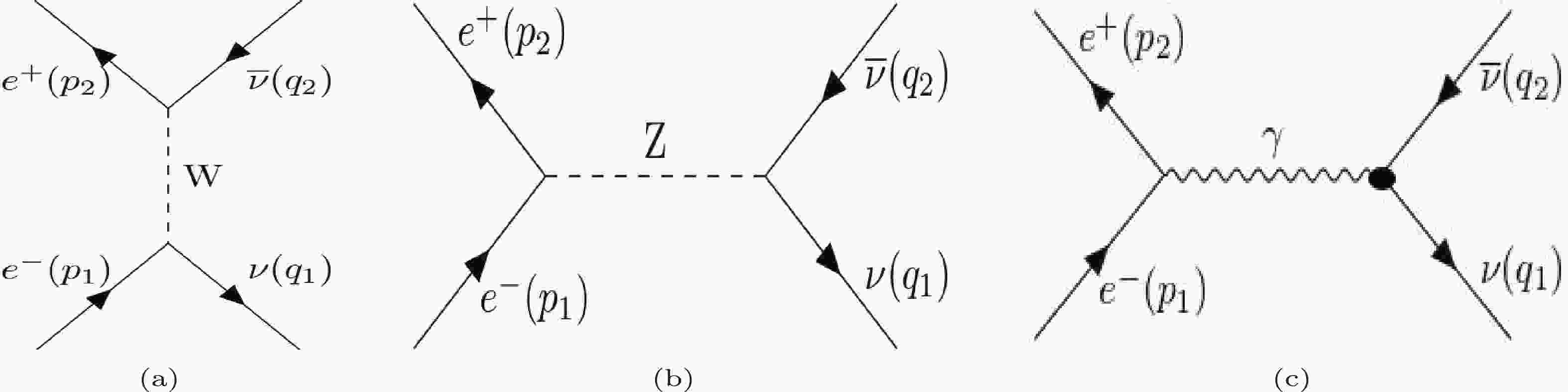
  • The stellar energy loss rates due to the production of neutrino pairs $ e^+e^- \rightarrow (W, Z, \gamma) \rightarrow \nu_e \overline{\nu_e} $ are calculated using the minimal extension of the Standard Model with the electromagnetic properties of the Dirac neutrinos, which takes the contributions of the neutrino charge radius, anapole moment, and dipole moments into account. We show that the contribution of the electron neutrino's dipole moment is small compared with that of the charge radius. The obtained results are also compared with the results obtained using the Standard Model.
  • 加载中
  • [1] G. Gamov and M. Schöberg, Phys. Rev.59, 329 (1941)
    [2] M. Schöberg and S. Chaundrasekhar, Ap. J.96, 161 (1942) doi:10.1086/144444
    [3] B. Pontecorvo, Sov. Phys. JETP26, 984 (1968)
    [4] M. Fukugita, T. Yanagida, Physics of Neutrinos and Applications to Astrophysics, Springer-Verlag (2003)
    [5] M. Abak and C. Aydın, Europhys. Lett.4, 881 (1987) doi:10.1209/0295-5075/4/8/004
    [6] D. Dicus, E. W. Kolb, D. N. Schrammet al., Ap. J.210, 481 (1976) doi:10.1086/154851
    [7] C. Aydın, Modern Phys. Lett. A16, 1823 (2001) doi:10.1142/S0217732301005114
    [8] C. Guinti, K.A. Kouzakov, Y.-F. Liet al., Ann. Phys.528, 198 (2016) doi:10.1002/andp.201500211
    [9] M. Dvornikov and A, Studenikin, Phys. Rev. D69, 073001 (2004) doi:10.1103/PhysRevD.69.073001
    [10] M. Dvornikov and A Studenikin, J. Exp. Theor. Phys.99, 254 (2004) doi:10.1134/1.1800181
    [11] C. Giunti and A. Studenikin, Rev. Mod. Phys.87, 531 (2015) doi:10.1103/RevModPhys.87.531
    [12] J. Bernabe, J. Papavassiliou, and J. Vidal, Nucl. Phys. B680, 450 (2004) doi:10.1016/j.nuclphysb.2003.12.025
    [13] J. Berntein, M. Ruderman, and G. Feinberg, Phys. Rev.132, 1227 (1963) doi:10.1103/PhysRev.132.1227
    [14] A. Heger, A. Friedland, M. Gionnottiet al., Astrophys. J.696, 608 (2009) doi:10.1088/0004-637X/696/1/608
    [15] T. Fischer, K. Langanke, and G. Martinez-Pinedo, Phys. Rev. C88, 065804 (2003)
    [16] G. Martinez-Pinedo, T. Fischer, and L. Luther, J. Phys. G: Nucl. Part. Phys.41, 044008 (2014) doi:10.1088/0954-3899/41/4/044008
    [17] I. Bhattacharyya, arXiv: 1510.02678[physics.gen-ph]
    [18] G. Beaudet, V. Petrosian, and E. Salpeter, Astrophys. J.150, 979 (1967) doi:10.1086/149398
    [19] D. A. Dicus, Phys. Rev. D6, 941 (1972) doi:10.1103/PhysRevD.6.941
    [20] S. Alam, J. Anand, S. Bisuaset al., Phys. Rev. D40, 2712 (1989)
    [21] A. Gutierrez-Rodriguez, E. Torres-Lomas, and A. Gonzalez-Sanchez, Int. J. Mod. Phys. A25, 12 (2010)
    [22] N. Itoh, H. Hayashi, and A. Nishikawa, Ap. J.102, 411 (1996)
    [23] N. Itoh, T. Adachi, M. Nakagavaet al., Ap. J.339, 354 (1989) doi:10.1086/167301
    [24] M. A. Hermantez-Ruiz, A. Gutierrez-Rodriguez, and A. Gonzalez-Sanchez, Eur. Phys. J. A53, 1 (2007)
    [25] A. Llamas-Bugarin, A. Gutierrez-Rodriguez, A. Gonzalez-Sanchezet al., Eur. Phys. J. Plus135, 481 (2020) doi:10.1140/epjp/s13360-020-00454-0
    [26] D. T. Binh, L. T. Hue, V. H. Binhet al., Int. J. Mod. Phys. A36, 2150179 (2021) doi:10.1142/S0217751X21501797
    [27] C. Aydın, Il Nuovo Cimento A105, 843 (1992) doi:10.1007/BF02799099
    [28] B. K. Kerimov, S. M. Zeinalov, V. N. Alizadeet al., Phys. Lett. B274, 477 (1992) doi:10.1016/0370-2693(92)92019-D
    [29] B. Kayser and A. S. Goldhaber, Phys. Rev. D28, 2341 (1983) doi:10.1103/PhysRevD.28.2341
    [30] R. E. Shrock, Nucl. Phys. B206, 359 (1982) doi:10.1016/0550-3213(82)90273-5
    [31] C. Aydın, arXiv: 1910.09545[hep-ph]
    [32] K. A. Kouzakov and A. I. Studenikin, Phys. Rev. D95, 055013 (2017) doi:10.1103/PhysRevD.95.055013
    [33] P. T. P. Hutauruk, C. Oh, and K. Tsushima, Phys. Rev. D98, 013009 (2018) doi:10.1103/PhysRevD.98.013009
    [34] P. T. P. Hutauruk, A. Sulaksono, and K. Tsushima, Nucl. Phys. A1017, 122356 (2022) doi:10.1016/j.nuclphysa.2021.122356
    [35] M. Cadeddu, C. Giunti, K. A. Kouzakovet al., Phys. Rev. D98, 113010 (2018) doi:10.1103/PhysRevD.98.113010
    [36] B. Dutta, S.Liao, S.Sinhaet al., Phys. Rev. Lett.123(6), 061801 (2019) doi:10.1103/PhysRevLett.123.061801
    [37] S. Arceo-Daz, K.-P.Schröer, K. Zuberet al., Astropar. Phys.70, 1 (2015) doi:10.1016/j.astropartphys.2015.03.006
    [38] F. Capozzi and G. Raffelt, Phys. Rev. D102, 083007 (2020) doi:10.1103/PhysRevD.102.083007
    [39] N. F. Bell, V. Cirigliano, M. J. Ramsey-Musolfet al., Phys. Rev. Lett.95, 151802 (2005) doi:10.1103/PhysRevLett.95.151802
  • 加载中

Figures(5)

Get Citation
C. Aydın. The Role of the Neutrino Form Factors in the Energy Loss Rates of Pair Annihilation Process[J]. Chinese Physics C. doi: 10.1088/1674-1137/ac62ca
C. Aydın. The Role of the Neutrino Form Factors in the Energy Loss Rates of Pair Annihilation Process[J]. Chinese Physics C. doi:10.1088/1674-1137/ac62ca shu
Milestone
Received: 2022-02-12
Article Metric

Article Views(3018)
PDF Downloads(31)
Cited by(0)
Policy on re-use
To reuse of Open Access content published by CPC, for content published under the terms of the Creative Commons Attribution 3.0 license (“CC CY”), the users don’t need to request permission to copy, distribute and display the final published version of the article and to create derivative works, subject to appropriate attribution.
    通讯作者:陈斌, bchen63@163.com
    • 1.

      沈阳化工大学材料科学与工程学院 沈阳 110142

    1. 本站搜索
    2. 百度学术搜索
    3. 万方数据库搜索
    4. CNKI搜索

    Email This Article

    Title:
    Email:

    Role of neutrino form factors in the energy loss rates of the pair annihilation process

    • Department of Physics, Karadeniz Technical University, 61080, Trabzon, Turkey

      Abstract:The stellar energy loss rates due to the production of neutrino pairs $ e^+e^- \rightarrow (W, Z, \gamma) \rightarrow \nu_e \overline{\nu_e} $ are calculated using the minimal extension of the Standard Model with the electromagnetic properties of the Dirac neutrinos, which takes the contributions of the neutrino charge radius, anapole moment, and dipole moments into account. We show that the contribution of the electron neutrino's dipole moment is small compared with that of the charge radius. The obtained results are also compared with the results obtained using the Standard Model.

        HTML

        I. INTRODUCTION
        • Neutrinos are among the most fascinating and enigmatic particles in nature. They are also the second most abundant particles after photons in the visible universe. Unlike photons, the interactions of neutrinos are extremely weak. Neutrinos are the lightest of all known particles; they also do not interact with normal matter. When they are produced in stellar interiors, they can easily absorb energy that would otherwise take much longer to be transported to the surface by radiation or convection. The resulting energy sink in the center of the star can dictate the star's rate of nuclear burning, structure and evolution, and ultimately how its life ends. Any process that produces neutrinos in stellar interiors acts as a sink of stellar energy, as the mean free path of neutrinos is much longer than the scale of the stellar radius. Neutrinos are very important in high energy physics, astrophysics, and cosmology [14]. Gamov and Pontecorvo were the first to indicate the important role played by neutrinos in the evolution of stars. Therefore, the neutrino emissions process may affect the properties of matter at high temperatures and also affect stellar evolution. The properties of neutrinos have been increasingly researched over the last sixty years. The possible electromagnetic properties of massive neutrinos include a charged radius, an anapole moment, a dipole magnetic, and an electric moment [512]. Research on neutrino mass, whether they are Dirac or Majorana particles, oscillations, and form factors and especially on the magnetic moment is of great significance for the choice of the theory of elementary particles and for clarifying phenomena such a supernova dynamics, stellar evaluation, and the production of sun neutrinos. The energy loss due to neutrino pair production is huge, and it is an important process in a wide range of astrophysical problems, such as in the red giant stages of stellar evolution, neutron stars, supernova collapse, and for the cooling of white dwarfs [1317]. While the three thermal neutrino processes, namely plasmon decay ( $ \gamma_{\rm plasmon} \rightarrow \nu_e + \overline{\nu}_e $ ), photo neutrino production ( $ e^-+\gamma \rightarrow e^- + \nu_e + \overline{\nu}_e $ ), and pair annihilation ( $ e^- + e^+ \rightarrow \nu_e + \overline{\nu}_e $ ) are dominant, the bremstrahlung ( $ e^- + Z \rightarrow e^- + Z + \nu_e + \overline{\nu}_e $ ) and recombination processes ( $ e^-_{\rm continuum} \rightarrow e^-_{\rm bound} + \nu_e + \overline{\nu}_e $

      Baidu
      map