


 Abstract
 HTML
HTML Reference
 Related
 PDF
PDF



-
The widely used nonrelativistic QCD (NRQCD) factorization [1] has encountered notable difficulties in describing heavy quarkonium data. As the NRQCD factorization is based on the NRQCD effective field theory [2], it is likely rigorous, although for inclusive quarkonium production, only two-loop verification is available at present [3-5]. The main known problem of NRQCD factorization is the bad convergence of its relativistic expansion [6], which may be responsible for its deficiencies. Recently, a new factorization approach called soft gluon factorization (SGF) [7,8] was proposed to describe quarkonium production and decay. The aim of SGF is to resum the series of relativistic corrections originating from the kinematic effects in NRQCD, which are the main cause of the poor convergence of the relativistic expansion.
Nevertheless, SGF has not been well-established. In SGF, the hadronization of intermediate quark-antiquark pairs to physical quarkonium is described by nonperturbative soft gluon distributions (SGDs), which are only formally defined by QCD fields in asmallloop momentum region [7]. Without an explicit definition of asmallregion, it is hard to prove the validity of SGF for physical processes. Furthermore, the unclear relation between SGF and NRQCD factorization makes it impossible to verify whether the kinematic effects have been correctly resummed.
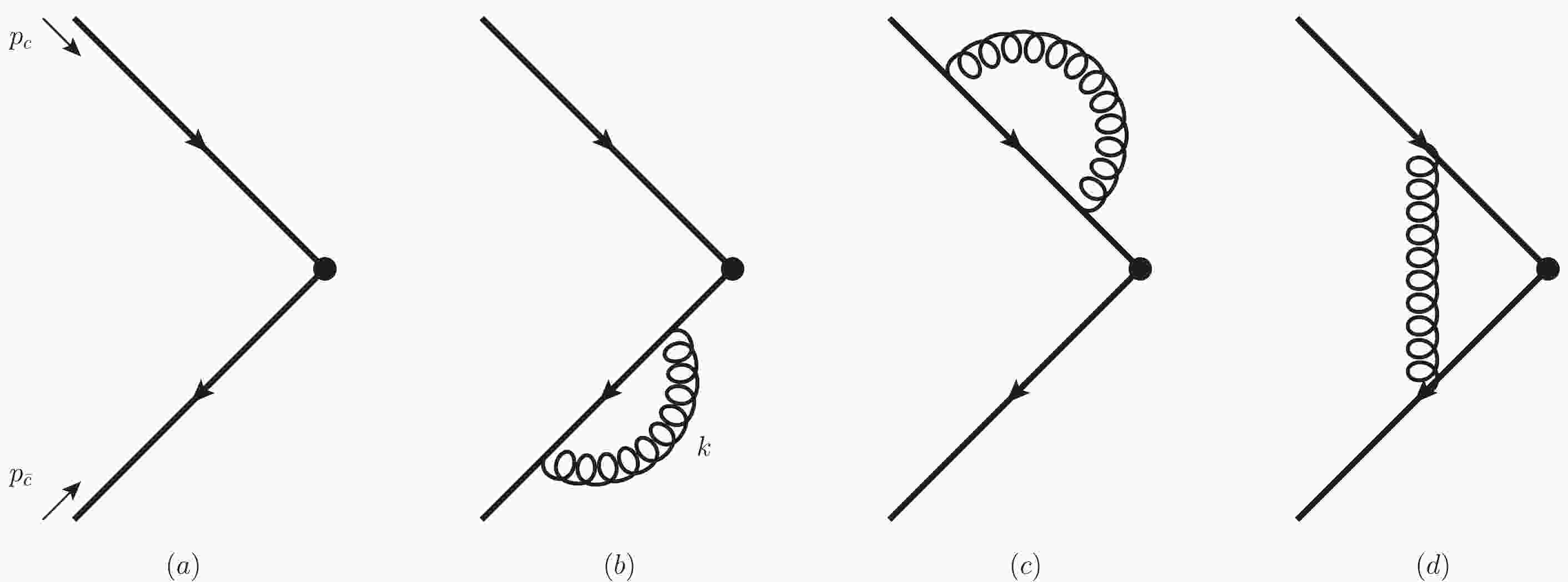
In this paper, with the help of a new regulator, we provide a rigorous definition of asmallregion in SGF. We then present two strategies for exploring the relationship between SGF and NRQCD factorization. In the first strategy, we apply the two factorization theories to the physical process of
$ J/\psi \to e^+e^- $ and show that both SGF and NRQCD factorization can correctly reproduce all the low energy physics of full QCD in this process. In the second strategy, we argue that the SGF formula can be deduced from NRQCD at the operator level by using equations of motion. Both strategies demonstrate that SGF and NRQCD factorization are equivalent, which means that, for any process, the two factorizations theories are either both valid or both violated. By identifying the two theories, we generate complete relations between the nonperturbative matrix elements in SGF and NRQCD; this proves the generalized Gremm-Kapustin relation [9] as a byproduct.The rest of this paper is organized as follows. In Sec. II, we study the exclusive process
$ J/\psi \to e^+e^- $
Theory for quarkonium: from NRQCD factorization to soft gluon factorization
- Received Date:2020-05-19
- Accepted Date:2020-09-23
- Available Online:2021-01-15
Abstract:We demonstrate that the recently proposed soft gluon factorization (SGF) is equivalent to the nonrelativistic QCD (NRQCD) factorization for heavy quarkonium production or decay, which means that, for any given process, these two factorization theories are either both valid or both violated. We use two methods to arrive at this conclusion. In the first method, we apply the two factorization theories to the physical process