A family of double-beauty tetraquarks: Axial-vector state ${{T}^{{-}}_{{bb};\overline{{u}}\overline{{s}}}}}$

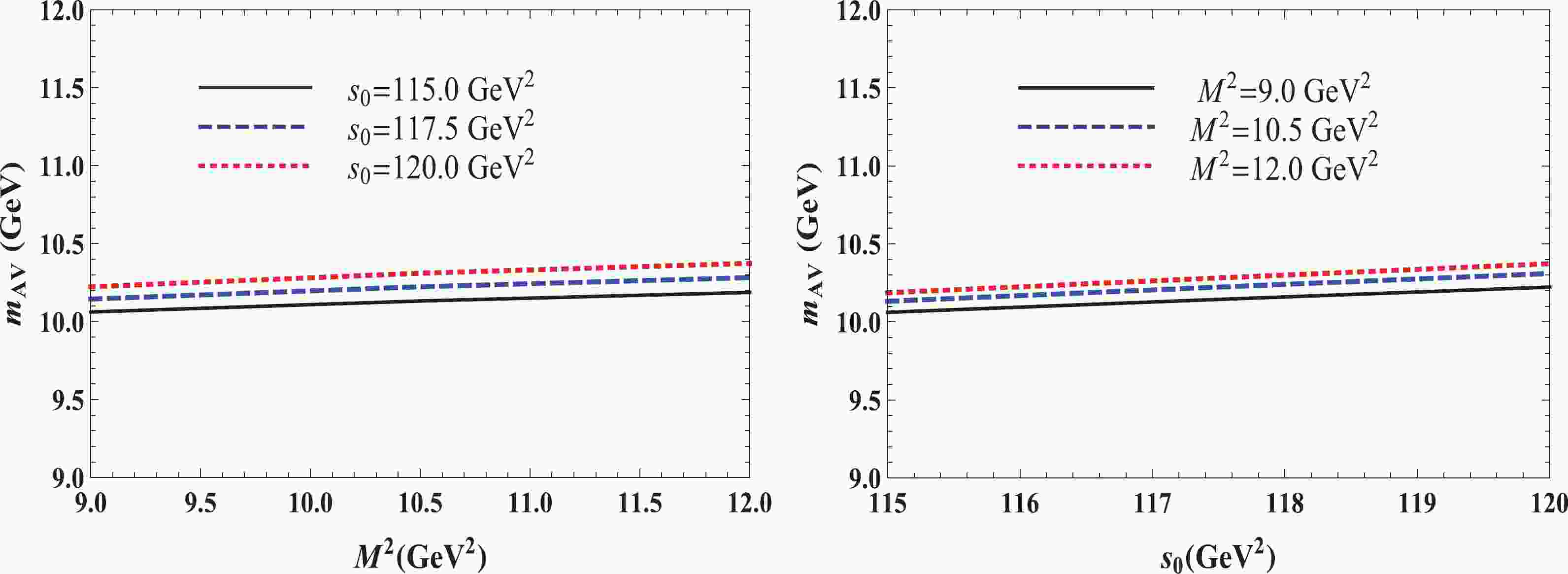
  • The spectroscopic parameters and decay channels of the axial-vector tetraquark $ T_{bb;\overline{u}\overline{s}}^{-} $ (in what follows, $ T_{b:\overline{s}}^{\mathrm{AV}} $ ) are explored using the quantum chromodynamics (QCD) sum rule method. The mass and coupling of this state are calculated using two-point sum rules by taking into account various vacuum condensates, up to 10 dimensions. Our prediction for the mass of this state $ m = (10215\pm 250)\; \mathrm{MeV} $ confirms that it is stable with respect to strong and electromagnetic decays and can dissociate to conventional mesons only via weak transformations. We investigate the dominant semileptonic $ T_{b:\overline{s}}^{\mathrm{AV}} \to {\cal{Z}}_{b:\overline{s}}^{0}l\overline{\nu}_l $ and nonleptonic $ T_{b:\overline{s}}^{\mathrm{AV}} \to {\cal{Z}}_{b:\overline{s}}^{0}M $ decays of $ T_{b:\overline{s}}^{\mathrm{AV}} $ . In these processes, $ {\cal{Z}}_{b:\overline{s}}^{0} $ is a scalar tetraquark $ [bc][\overline{u}\overline{s}] $ built of a color-triplet diquark and an antidiquark, whereas Mis one of the vector mesons $ \rho ^{-} $ , $ K^{\ast}(892) $ , $ D^{\ast }(2010)^{-} $ , and $ D_{s}^{\ast -} $ . To calculate the partial widths of these decays, we use the QCD three-point sum rule approach and evaluate the weak transition form factors $ G_{i} $ ( $ i = 0,1,2,3 $ ), which govern these processes. The full width $ \Gamma _{\mathrm{full}} = (12.9\pm 2.1)\times 10^{-8}\; \mathrm{MeV} $ and the mean lifetime $ \tau = 5.1_{-0.71}^{+0.99}\; \mathrm{fs} $ of the tetraquark $ T_{b:\overline{s}}^{\mathrm{AV}} $ are computed using the aforementioned weak decays. The obtained information about the parameters of $ T_{b:\overline{s}}^{\mathrm{AV}} $ and $ {\cal{Z}}_{b:\overline{s}}^{0} $ is useful for experimental investigations of these double-heavy exotic mesons.
  • 加载中
  • [1] M. Karliner and J. L. Rosner, Phys. Rev. Lett.119, 202001 (2017) doi:10.1103/PhysRevLett.119.202001
    [2] E. J. Eichten and C. Quigg, Phys. Rev. Lett.119, 202002 (2017) doi:10.1103/PhysRevLett.119.202002
    [3] S. S. Agaev, K. Azizi, B. Barsbayet al., Phys. Rev. D99, 033002 (2019) doi:10.1103/PhysRevD.99.033002
    [4] E. Hernandez, J. Vijande, A. Valcarceet al., Phys. Lett. B800, 135073 (2020) doi:10.1016/j.physletb.2019.135073
    [5] A. Ali, A. Y. Parkhomenko, Q. Qinet al., Phys. Lett. B782, 412 (2018) doi:10.1016/j.physletb.2018.05.055
    [6] A. Ali, Q. Qin, and W. Wang, Phys. Lett. B785, 605 (2018) doi:10.1016/j.physletb.2018.09.018
    [7] R. Aaijet al. (LHCb Collaboration), Phys. Rev. Lett.119, 112001 (2017) doi:10.1103/PhysRevLett.119.112001
    [8] J. P. Ader, J. M. Richard, and P. Taxil, Phys. Rev. D25, 2370 (1982) doi:10.1103/PhysRevD.25.2370
    [9] H. J. Lipkin, Phys. Lett. B172, 242 (1986) doi:10.1016/0370-2693(86)90843-9
    [10] S. Zouzou, B. Silvestre-Brac, C. Gignouxet al., Z. Phys. C30, 457 (1986) doi:10.1007/BF01557611
    [11] J. Carlson, L. Heller, and J. A. Tjon, Phys. Rev. D37, 744 (1988) doi:10.1103/PhysRevD.37.744
    [12] A. V. Manohar and M. B. Wise, Nucl. Phys. B399, 17 (1993) doi:10.1016/0550-3213(93)90614-U
    [13] S. Pepin, F. Stancu, M. Genoveseet al., Phys. Lett. B393, 119 (1997) doi:10.1016/S0370-2693(96)01597-3
    [14] D. Janc and M. Rosina, Few Body Syst.35, 175 (2004)
    [15] Y. Cui, X. L. Chen, W. Z. Denget al., HEPNP31, 7 (2007)
    [16] J. Vijande, A. Valcarce, and K. Tsushima, Phys. Rev. D74, 054018 (2006) doi:10.1103/PhysRevD.74.054018
    [17] D. Ebert, R. N. Faustov, V. O. Galkinet al., Phys. Rev. D76, 114015 (2007) doi:10.1103/PhysRevD.76.114015
    [18] F. S. Navarra, M. Nielsen, and S. H. Lee, Phys. Lett. B649, 166 (2007) doi:10.1016/j.physletb.2007.04.010
    [19] M. L. Du, W. Chen, X. L. Chenet al., Phys. Rev. D87, 014003 (2013) doi:10.1103/PhysRevD.87.014003
    [20] J. Schaffner-Bielich and A. P. Vischer, Phys. Rev. D57, 4142 (1998) doi:10.1103/PhysRevD.57.4142
    [21] A. Del Fabbro, D. Janc, M. Rosinaet al., Phys. Rev. D71, 014008 (2005) doi:10.1103/PhysRevD.71.014008
    [22] S. H. Lee, S. Yasui, W. Liuet al., Eur. Phys. J. C54, 259 (2008) doi:10.1140/epjc/s10052-007-0516-z
    [23] T. Hyodo, Y. R. Liu, M. Okaet al., Phys. Lett. B721, 56 (2013) doi:10.1016/j.physletb.2013.02.045
    [24] A. Esposito, M. Papinutto, A. Pilloniet al., Phys. Rev. D88, 054029 (2013) doi:10.1103/PhysRevD.88.054029
    [25] S. S. Agaev, K. Azizi, B. Barsbayet al., Phys. Rev. D101, 094026 (2020) doi:10.1103/PhysRevD.101.094026
    [26] S. S. Agaev, K. Azizi, B. Barsbayet al., Eur. Phys. J. A56, 177 (2020) doi:10.1140/epja/s10050-020-00187-9
    [27] Y. Kondo, O. Morimatsu, and T. Nishikawa, Phys. Lett. B611, 93 (2005) doi:10.1016/j.physletb.2005.01.070
    [28] S. H. Lee, H. Kim, and Y. Kwon, Phys. Lett. B609, 252 (2005) doi:10.1016/j.physletb.2005.01.029
    [29] Z. G. Wang, Int. J. Mod. Phys. A30, 1550168 (2015) doi:10.1142/S0217751X15501687
    [30] H. Sundu, S. S. Agaev, and K. Azizi, Eur. Phys. J. C79, 215 (2019) doi:10.1140/epjc/s10052-019-6737-0
    [31] B. L. Ioffe, Prog. Part. Nucl. Phys.56, 232 (2006) doi:10.1016/j.ppnp.2005.05.001
    [32] L. Maiani, F. Piccinini, A. D. Polosaet al., Phys. Rev. D89, 114010 (2014) doi:10.1103/PhysRevD.89.114010
    [33] Z. G. Wang, Commun. Theor. Phys.63, 325 (2015) doi:10.1088/0253-6102/63/3/325
    [34] S. S. Agaev, K. Azizi, and H. Sundu, Phys. Rev. D96, 034026 (2017) doi:10.1103/PhysRevD.96.034026
    [35] Q. N. Wang and W. Chen, Eur. Phys. J. C80, 389 (2020) doi:10.1140/epjc/s10052-020-7938-2
    [36] M. Wirbel, B. Stech, and M. Bauer, Z. Phys. C.29, 637 (1985) doi:10.1007/BF01560299
    [37] P. Ball, V. M. Braun, and H. G. Dosch, Phys. Rev. D44, 3567 (1991) doi:10.1103/PhysRevD.44.3567
    [38] M. Tanabashiet al. (Particle Data Group), Phys. Rev. D98, 030001 (2018)
    [39] M. Beneke, G. Buchalla, M. Neubertet al., Phys. Rev. Lett.83, 1914 (1999) doi:10.1103/PhysRevLett.83.1914
    [40] M. Beneke, G. Buchalla, M. Neubertet al., Nucl. Phys. B591, 313 (2000) doi:10.1016/S0550-3213(00)00559-9
    [41] H. Sundu, S. S. Agaev, and K. Azizi, Eur. Phys. J. C79, 753 (2019) doi:10.1140/epjc/s10052-019-7268-4
    [42] S. S. Agaev, K. Azizi, and H. Sundu, Phys. Rev. D100, 094020 (2019) doi:10.1103/PhysRevD.100.094020
    [43] G. Li, X. F. Wang, and Y. Xing, Eur. Phys. J. C79, 210 (2019) doi:10.1140/epjc/s10052-019-6729-0
    [44] G. Li, X. F. Wang, and Y. Xing, Eur. Phys. J. C79, 645 (2019) doi:10.1140/epjc/s10052-019-7150-4
    [45] V. Lubicz, A. Melis, and S. Simula, PoS LATTICE2016, 291 (2017)
    [46] A. J. Buras, M. Jamin, and M. E. Lautenbacher, Nucl. Phys. B400, 75 (1993) doi:10.1016/0550-3213(93)90398-9
    [47] M. Ciuchini, E. Franco, G. Martinelliet al., Nucl. Phys. B415, 403 (1994) doi:10.1016/0550-3213(94)90118-X
    [48] G. Buchalla, A. J. Buras, and M. E. Lautenbacher, Rev. Mod. Phys.68, 1125 (1996) doi:10.1103/RevModPhys.68.1125
  • 加载中

Figures(5)/Tables(3)

Get Citation
S. S. Agaev, K. Azizi, B. Barsbay and H. Sundu. A family of double-beauty tetraquarks: Axial-vector state ${{T}^{{-}}_{{bb};\overline{{u}}\overline{{s}}}}}$ [J]. Chinese Physics C. doi: 10.1088/1674-1137/abc16d
S. S. Agaev, K. Azizi, B. Barsbay and H. Sundu. A family of double-beauty tetraquarks: Axial-vector state ${{T}^{{-}}_{{bb};\overline{{u}}\overline{{s}}}}}$ [J]. Chinese Physics C. doi:10.1088/1674-1137/abc16d shu
Milestone
Received: 2020-07-13
Article Metric

Article Views(4268)
PDF Downloads(40)
Cited by(0)
Policy on re-use
To reuse of Open Access content published by CPC, for content published under the terms of the Creative Commons Attribution 3.0 license (“CC CY”), the users don’t need to request permission to copy, distribute and display the final published version of the article and to create derivative works, subject to appropriate attribution.
    通讯作者:陈斌, bchen63@163.com
    • 1.

      沈阳化工大学材料科学与工程学院 沈阳 110142

    1. 本站搜索
    2. 百度学术搜索
    3. 万方数据库搜索
    4. CNKI搜索

    Email This Article

    Title:
    Email:

    A family of double-beauty tetraquarks: Axial-vector state ${{T}^{{-}}_{{bb};\overline{{u}}\overline{{s}}}}}$

    • 1. Institute for Physical Problems, Baku State University, Az–1148 Baku, Azerbaijan
    • 2. Department of Physics, University of Tehran, North Karegar Avenue, Tehran 14395-547, Iran
    • 3. Department of Physics, Doǧuş University, Acibadem-Kadiköy, 34722 Istanbul, Turkey
    • 4. Department of Physics, Kocaeli University, 41380 Izmit, Turkey

      Abstract:The spectroscopic parameters and decay channels of the axial-vector tetraquark $ T_{bb;\overline{u}\overline{s}}^{-} $ (in what follows, $ T_{b:\overline{s}}^{\mathrm{AV}} $ ) are explored using the quantum chromodynamics (QCD) sum rule method. The mass and coupling of this state are calculated using two-point sum rules by taking into account various vacuum condensates, up to 10 dimensions. Our prediction for the mass of this state $ m = (10215\pm 250)\; \mathrm{MeV} $ confirms that it is stable with respect to strong and electromagnetic decays and can dissociate to conventional mesons only via weak transformations. We investigate the dominant semileptonic $ T_{b:\overline{s}}^{\mathrm{AV}} \to {\cal{Z}}_{b:\overline{s}}^{0}l\overline{\nu}_l $ and nonleptonic $ T_{b:\overline{s}}^{\mathrm{AV}} \to {\cal{Z}}_{b:\overline{s}}^{0}M $ decays of $ T_{b:\overline{s}}^{\mathrm{AV}} $ . In these processes, $ {\cal{Z}}_{b:\overline{s}}^{0} $ is a scalar tetraquark $ [bc][\overline{u}\overline{s}] $ built of a color-triplet diquark and an antidiquark, whereasMis one of the vector mesons $ \rho ^{-} $ , $ K^{\ast}(892) $ , $ D^{\ast }(2010)^{-} $ , and $ D_{s}^{\ast -} $ . To calculate the partial widths of these decays, we use the QCD three-point sum rule approach and evaluate the weak transition form factors $ G_{i} $ ( $ i = 0,1,2,3 $ ), which govern these processes. The full width $ \Gamma _{\mathrm{full}} = (12.9\pm 2.1)\times 10^{-8}\; \mathrm{MeV} $ and the mean lifetime $ \tau = 5.1_{-0.71}^{+0.99}\; \mathrm{fs} $ of the tetraquark $ T_{b:\overline{s}}^{\mathrm{AV}} $ are computed using the aforementioned weak decays. The obtained information about the parameters of $ T_{b:\overline{s}}^{\mathrm{AV}} $ and $ {\cal{Z}}_{b:\overline{s}}^{0} $ is useful for experimental investigations of these double-heavy exotic mesons.

        HTML

        I. INTRODUCTION
        • Recently, double-beauty tetraquarks, composed of a $ bb $ diquark and a light antidiquark $ \overline{q}\overline{q}^{\prime } $ , became a subject of intensive theoretical studies [1-6]. The interest in these states was inspired by the experimental observation of baryons $ \Xi _{cc}^{++} $ and measurements of their parameters [7]. The measurements were used in phenomenological models, to estimate the masses of double-beauty states [1]. These investigations demonstrated that the axial-vector tetraquark $ T_{bb;\overline{u}\overline{d}}^{-} $ (hereafter $ T_{bb}^{-} $ ) with the mass $ m = (10389\pm 12)\; \mathrm{MeV} $ is stable with respect to strong and electromagnetic decays and can dissociate into a conventional meson only via a weak transformation. A similar conclusion about the stable nature of some tetraquarks $ bb\overline{q}\overline{q}^{\prime } $ was reached in Ref. [2] as well, where the authors of that study used methods of heavy-quark symmetry analysis.

          Double-heavy tetraquarks $ QQ^{\prime }\overline{q}\overline{q}^{\prime } $ , in fairness, were studied already in classical articles [8-12], in which they were examined as candidate stable four-quark compounds. The main qualitative conclusion drawn in these works was the existence of a constraint on the masses of constituent quarks. It was found that tetraquarks $ QQ^{\prime }\overline{q}\overline{q}^{\prime } $ may form strong-interaction stable exotic mesons, provided the ratio $ m_{Q}/m_{q} $ is large. Therefore, tetraquarks $ bb \overline{q}\overline{q}^{\prime } $ are the most promising candidates for stable four-quark mesons.

          Quantitative analysis of these problems continued in the following years, using the frameworks of various models and using different methods from high-energy physics. Thus, tetraquarks $ T_{QQ} $ were explored using the chiral, dynamical, and relativistic quark models [13-17]. Axial-vector states $ T_{QQ;\overline{u}\overline{d}} $ were considered in the context of the sum rule method [18,19]. Processes in which tetraquarks $ T_{cc} $ may be produced, namely electron-positron annihilation, heavy-ion and proton-proton collisions, and $ B_{c} $ meson and $ \Xi _{bc} $ baryon decays, also attracted the interest of researchers [20-24].

          The axial-vector particle $ T_{bb}^{-} $ was studied in our work as well [3]. We employed the quantum chromodynamics (QCD) sum rule method and evaluated the mass of this state $ m = (10035\; \pm 260)\; \mathrm{MeV} $ . This means thatmis below both the $ B^{-}\overline{B}^{\ast 0} $ and $ B^{-}\overline{B}^{0}\gamma $ thresholds; hence, this state is a strong- and electromagnetic-interaction stable tetraquark. We also explored the semileptonic decays $ T_{bb}^{-} $ $ \rightarrow Z_{bc}^{0}l\overline{\nu }_{l} $ , where $ Z_{bc}^{0} $ is the scalar tetraquark $ [bc][\overline{u}\overline{d}] $ composed of color-triplet diquarks, and calculated their partial widths. The predictions for the full width and mean lifetime of $ T_{bb}^{-} $ obtained in Ref. [3] are useful for experimental investigations of double-beauty exotic mesons.

          Other members of the $ bb\overline{q}\overline{q}^{\prime } $ family, studied in a rather detailed form, are the scalar tetraquarks $ T_{bb;\overline{u} \overline{s}}^{-} $ and $ T_{bb;\overline{u}\overline{d}}^{-} $ (in short forms, $ T_{b:\overline{s}}^{-} $ and $ T_{b:\overline{d}}^{-} $ , respectively). The mass and coupling of $ T_{b:\overline{s}}^{-} $ and $ T_{b:\overline{d}}^{-} $ were calculated in Refs. [25,26], in which we demonstrated that they cannot decay to ordinary mesons through strong and electromagnetic processes. We also investigated dominant semileptonic and nonleptonic weak decays of these tetraquarks and estimated their full width and lifetime characteristics.

          In the present article, we extend our analysis and investigate the axial-vector partner of $ T_{b:\overline{s}}^{-} $ with the same quark content $ bb\overline{u}\overline{s} $ . It can be treated also as "s" member of the axial-vector multiplet of the states $ bb\overline{u}\overline{q} $ . We denote this tetraquark as $ T_{b:\overline{s}}^{\mathrm{AV}} $ and compute its spectroscopic parameters using the two-point QCD sum rule method. Calculations are performed by taking into account various vacuum condensates, up to 10 dimensions. The obtained result for its mass $ m = (10215\pm 250)\; \mathrm{MeV} $ proves that this state is stable against strong and electromagnetic decays. In fact, $ T_{b:\overline{s}}^{\mathrm{AV}} $ in theS-wave can decompose into pairs of conventional mesons $ B^{-}B_{s}^{\ast } $ and $ B^{\ast -}\overline{B}_{s}^{0} $ , providedmexceeds the corresponding thresholds $ 10695/ 10692\; \mathrm{MeV} $ , respectively. The threshold for the electromagnetic decay to the final state $ B^{-}\overline{B}_{s}^{0}\gamma $ is $ 10646\; \mathrm{MeV} $ . It is seen that even the maximal allowed value of the mass $ 10465\; \mathrm{MeV} $ is below all of these limits.

          Therefore, to evaluate the full width and lifetime of $ T_{b:\overline{s}}^{\mathrm{AV}} $ , we analyzed the semileptonic and nonleptonic weak decays $ T_{b:\overline{s}}^{\mathrm{AV}}\rightarrow {\cal{Z}}_{b:\overline{s}}^{0}l \overline{\nu }_{l} $ and $ T_{b:\overline{s}}^{\mathrm{AV}}\rightarrow {\cal{Z}}_{b:\overline{s}}^{0}M $ , respectively. Here, $ {\cal{Z}}_{b:\overline{s}}^{0} $ is the scalar tetraquark $ [bc][\overline{u}\overline{s}] $ built of a color-triplet diquark and an antidiquark, andMis one of the vector mesons $ \rho ^{-} $ , $ K^{\ast }(892) $ , $ \ D^{\ast }(2010)^{-} $ , and $ \ D_{s}^{\ast -} $ . The weak transitions of $ T_{b:\overline{s}}^{\mathrm{AV}} $ can be described by the form factors $ G_{i}(q^{2}) $ ( $ i = 0,1,2,3 $ ), which determine the differential rates ${\rm d}\Gamma /{\rm d}q^{2}$ of the semileptonic and partial widths of the nonleptonic processes. These weak form factors are extracted from the QCD three-point sum rules in Section III.

          This work is structured as follows. In Section II, we calculate the mass and coupling of the tetraquarks $ T_{b:\overline{s}}^{\mathrm{AV}} $ and $ {\cal{Z}}_{b:\overline{s}}^{0} $

      Baidu
      map