


 Abstract
 HTML
HTML Reference
 Related
 PDF
PDF



-
One hundred years ago, Einstein proposed the general theory of relativity (GR), thereby describing gravity successfully. One of the important fundamentals of GR is to assume that the covariant derivative of the energy-momentum tensor is zero, and that GR naturally satisfies the equivalence principle. Rastall generalized the covariant conservation of the energy-momentum tensor [1,2] and obtained the conservation equation of the energy-momentum tensor in the form
$ T^{\mu\nu}_{;\mu} = \lambda R^{,\nu} $ , where$ T^{\mu\nu} $ is the energy momentum tensor,$ R $ is the Ricci curvature (or Ricci scalar) and$ \lambda $ is the parameter of the Rastall gravity. This theory can be reduced to GR in asymptotically flat space-time. However, Rastall gravity is still a controversial gravitational theory. One view is that Rastall gravity is equivalent to GR [3], and the parameter$ \lambda $ represents the re-arrangement of perfect fluid matter. According to this view, we simply need to redefine the energy-momentum tensor so as to satisfy the covariant conservation. The only change is the addition of matter fields with different distributions in space-time. In contrast, Darabiet al. [4] considered that Rastall gravity is not equivalent to GR. Rastall gravity strengthens the role of the Mach principle in gravity theory [5], in which the local structure depends on the distribution of matter across the entire space-time.Although the nature of Rastall gravity is not clear, we attempt to constrain its properties by using observational events. On the cosmological scale, Batistaet al. [6] used the data of
Observational constraints on Rastall gravity from rotation curves of low surface brightness galaxies
- Received Date:2020-02-25
- Accepted Date:2020-04-16
- Available Online:2020-08-01
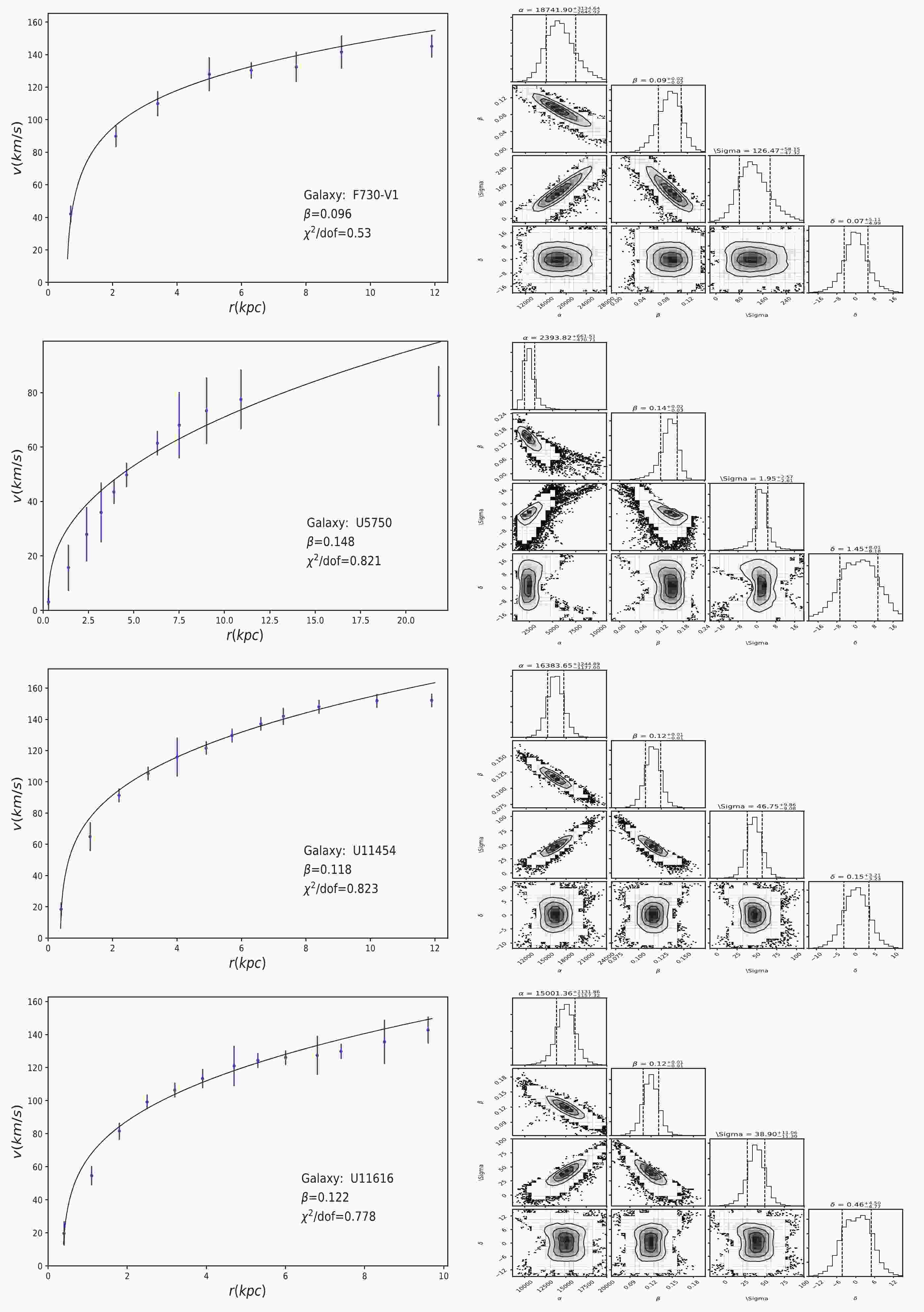
Abstract:Rastall gravity is a modification of Einstein's general relativity in which the energy-momentum conservation is not satisfied and depends on the gradient of the Ricci curvature. It is currently in dispute whether Rastall gravity is equivalent to general relativity (GR). In this work, we constrain the theory using the rotation curves of low surface brightness (LSB) spiral galaxies. By fitting the rotation curves of LSB galaxies, we obtain parameter