


 Abstract
 HTML
HTML Reference
 Related
 PDF
PDF


HTML
-
Ever since the description of the mechanism of superconducting-type pair correlations in atomic nuclei [1], a huge amount of experimental data has been collected and a significant number of effective theoretical models has been proposed to describe the importance of neutron and proton pairs for various properties of atomic nuclei [2-4]. However, due to the constant development of experimental techniques, it became possible to expand the range of the nuclei studied in the region far from stability and to refine significantly the experimental data for known isotopes, which led to a new wave of theoretical studies of the structure and dynamics of atomic nuclei. One of the important questions discussed at present concerns the neutron-proton correlations in atomic nuclei [5-9]. The analysis ofnppairing is of particular interest since it is possible in this case to study the relationship between the isoscalar (T= 0) and isovector (T= 1) pairing of nucleons, and to map the change of this relation as function of the mass numberA. Traditionally, the main object of thenp-paring studies is the chain of nuclei withN=Z. These nuclei are a clear example of the isospin symmetry of the nucleon-nucleon interaction, which is a consequence of the charge independence of nuclear forces.
One of the ways to study the structure of atomic nuclei, including the effects of two-nucleon correlations, is to systematically analyse the mass surface of atomic nuclei, its global behaviour and local fluctuations. This is an important source of information as the experimental values of nuclear masses are known with high accuracy, and the number of isotopes for which this information is available is constantly increasing [10]. Mass relations allow to extract the information concerning the magnitude of the interaction between nucleons as function of the mass numberAand of the occupation probabilities of the subshells near the Fermi energy. For example, it is well known that pairing of identical nucleons leads to stratification of the mass surface and can be quantified from the odd-even staggering (OES) value [11-13]. Several approximate relations for the pairing energy of identical nucleons in even-even isotopes based on the masses of neighbouring nuclei have been studied in detail, but despite the long history of the problem, the question of which relation corresponds best to the pair interaction is still under discussion [14-19].
The mass relations for neutron-proton pairing are more diverse [6,20-23]. In this case, however, they are mainly studied for nuclei withN=Z, and primarily for odd-odd nuclei. These nuclei allow to address both the isovector spin-zero and isoscalar deuteron-like (or maximum spin neutron-proton) coupling. Due to the assumption that isoscalar pairing of nucleons in heavy nuclei contributes significantly to collective effects, the analysis of calculations based on mass relations should allow to draw conclusions regarding the effect ofnppairing, and of the possibility of treatingnppairs as deuteron-like states in nuclei. The analysis of mass relations for the chainN=Zis made more complicated by the presence of the Wigner energy, which is closely connected withnp-pairing [5,24-26].
In this paper, the ideas underlying various mass relations associated with neutron-proton correlations in different types of atomic nuclei are considered. Examples ofN−Z= Const chains are studied in order to compare the behaviour of the mass relations under consideration. Binding energy parametrization based on the Shell Model makes it possible to clarify the structure of the mass relations obtained, and to reveal their relationship with thenpinteraction.
-
There is a large number of indicators fornpcorrelations based on the masses of neighbouring nuclei available in literature. Below we consider the basic relations.
-
In our previous work [19], relationship between different mass formulas and their connection with the pairing energy of identical nucleons was shown. Various indicators of like-nucleon pairing based on the odd-even splitting of the mass surface with different degrees of averaging were considered, as was the correspondence of these relations with the explicit definition of the nucleon pairing energy, given as the difference between two-nucleon separation energy in nucleus (A) and the doubled one-nucleon separation energy in nucleus (A−1):
$ \begin{eqnarray}{\Delta }_{nn}(N, Z)\, ={S}_{2n}(N, Z)-2{S}_{n}(N-1, Z), \end{eqnarray} $
(1) whereS2nandSnare two- and one-neutron separation energies, respectively. This relation gives the magnitude of neutron pairing. A similar relation for the proton pairing energy Δpp(N,Z), using the proton separation energiesS2pandSp, can be obtained by interchangingNandZ.
To determine the neutron-proton pairing energy in an odd-odd nucleus having annp-pair above the double-closed core, one should consider the difference between thenpseparation energy in (N,Z) nucleus and the separation energies of a neutron and of a proton in nuclei (N,Z−1) and (N−1,Z), respectively [27]:
$ \begin{eqnarray}\begin{array}{lll}{\Delta }_{np}(N, Z)&=&{S}_{np}(N, Z)-[{S}_{n}(N, Z-1)+{S}_{p}(N-1, Z)]\\ &=&B(N, Z)+B(N-1, Z-1)\\ &&-B(N-1, Z)-B(N, Z-1), \end{array}\end{eqnarray} $
(2) whereSnp(N,Z) is thenp-pair separation energy, andB(N,Z) is the binding energy. This relation, suggested in [28] for both even and oddNandZ, was widely applied [29-36].
Averaging Δnpover nuclei (N,Z) and (N+1,Z+1) belonging to the chainN-Z= Const
$ \begin{eqnarray}{\Delta }_{np}^{(7)}(N, Z)=\frac{1}{2}({\Delta }_{np}(N, Z)+{\Delta }_{np}(N+1, Z+1)).\end{eqnarray} $
(3) can give a more accurate estimate ofnp-correlations. Illustrative diagrams with multipliers of binding energies of neighbouring nuclei in formulas (2) and (3) are shown inFig. 1(a)and(b).
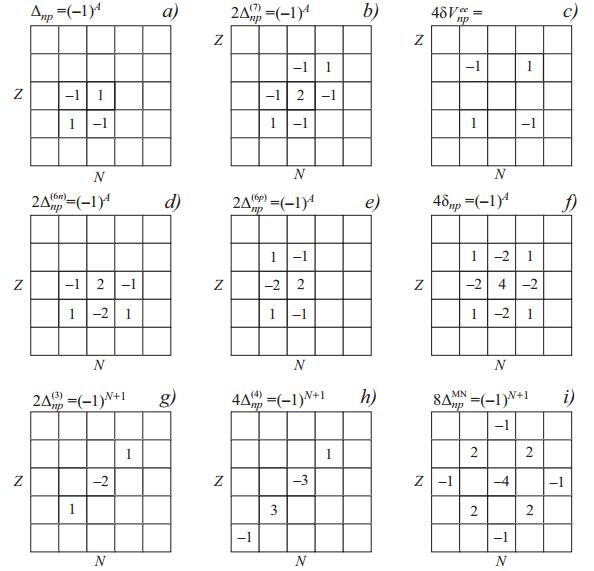
Figure 1.Diagrams of various indicators ofnp-correlations in nuclei. The coefficients are multipliers of the binding energies in the relations for (a) Δnp- indicator (2), (b)
$2{\Delta }_{np}^{(7)}$ — (3), (c)$4\delta {V}_{np}^{ee}$ — (6), (d)$2{\Delta }_{np}^{(6n)}$ — (12), (e)$2{\Delta }_{np}^{(6p)}$ — (13), (f) 4δnp— (19), (g)$2{\Delta }_{np}^{(3)}$ — (14), (h)$4{\Delta }_{np}^{(4)}$ — (16), (i)$8{\Delta }_{np}^{MN}$ — indicator (18), for nuclei with evenA.Fig. 2shows the dependence of indicators Δnpand
${\Delta }_{np}^{(7)}$ on the mass numberAin self-adjoint nucleiN=Z. The monotonous dependence and agreement between the values of Δnpand${\Delta }_{np}^{(7)}$ forA>10 are worth pointing out. Indeed, the results of formula (2) for neighbouring even-even and odd-odd nuclei are not only very close for the chainN=Z, but also in other isotope regions. This can be seen from the diagrams inFig. 1: the difference in the indicators Δnpfor nuclei (N,Z) and (N+1,Z+1) leads to the well-known Garvey-Kelson mass relations [37,38]: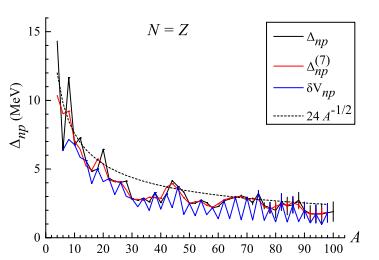
Figure 2.(color online) Indicators Δnp(A),
${\Delta }_{np}^{(7)}(A)$ andδVnpfor even-even and odd-odd nuclei as function of the mass numberAin nucleiN=Z. The dashed line corresponds to 24/A1/2. Nuclear mass data are from [10].$ \begin{eqnarray}\begin{array}{ll}&M(N+2, Z-2)-M(N, Z)+M(N, Z-1)\\ -&M(N+1, Z-2)+M(N+1, Z)-M(N+2, Z-1)=0;\\ &M(N+2, Z)-M(N, Z-2)+M(N+1, Z-2)\\ -&M(N+2, Z-1)+M(N, Z-1)-M(N+1, Z)=0.\end{array}\end{eqnarray} $
(4) The accuracy of the Garvey-Kelson mass relations was verified on a large set of experimental data, and these relations, as well as the generalized formulas derived from them, are widely used for estimating the mass of nuclei far from stability [39,40].
The fact that the Δnpvalues for odd-odd and even-even nuclei are very close does not necessarily mean that this indicator describes precisely thenp-correlation, especially for nuclei withN=Z, where the presence of the Wigner cusp significantly changes the picture. For even-even nuclei, the applicability of formula (2) is not so obvious. Indeed, in the case of an even number of external nucleons of the same type above the closed core, in addition to thenp-interaction, the like-nucleon correlations should also be taken into account. Thus, for an even-even nucleus with twonppairs,np-pairing should be defined as the difference between the separation energy of all four nucleons from the core and the separation energies of neutron and proton pairs in nuclei (N,Z-2) and (N-2,Z) [7]:
$ \begin{eqnarray}\begin{array}{ll}{\Delta }_{np}^{ee}(N, Z)=&\frac{1}{4}(B(N-2, Z-2)+B(N, Z)\\ &-B(N-2, Z)-B(N, Z-2)).\end{array}\end{eqnarray} $
(5) The coefficient 1/4 arises as a result of taking into account the interaction of each proton with each neutron. The corresponding diagram is shown inFig. 1(c). From the diagrams, it can be seen that for even-even nuclei this indicator may be obtained from four Δnpterms:
$ \begin{eqnarray*}\begin{array}{ll}\delta {V}_{np}=&{\Delta }_{np}(N, Z)+{\Delta }_{np}(N-1, Z-1)\\ &-{\Delta }_{np}(N, Z-1)-{\Delta }_{np}(N-1, Z).\end{array}\end{eqnarray*} $
The difference between the binding energies of four even-even nuclei as an estimator ofnp-interaction energy was proposed in [21], and analysed in [24,25,41] in connection with the structure of the Wigner term. However, the indicatorδVnpin [21], was calculated using (5) in accordance with thenpinteraction in odd-odd nuclei (N+1,Z+1) only.
The indicatorδVnpin both interpretations is still subject to extensive consideration [20,42-47]. In [24], a variant of the generalised formula (5) for different types of nuclei was proposed:
$ \begin{eqnarray}\delta {V}_{np}(N, Z)=\left\{\begin{array}{ll}\frac{1}{4}[B(N, Z)-B(N, Z-2)-B(N-2, Z)+B(N-2, Z-2)],&\, ({\rm{even}}, \, {\rm{even}}), \\ \frac{1}{2}[B(N, Z)-B(N, Z-1)-B(N-2, Z)+B(N-2, Z-1)],&\, ({\rm{even}}, \, {\rm{odd}}), \\ \frac{1}{2}[B(N, Z)-B(N, Z-2)-B(N-1, Z)+B(N-1, Z-2)],&\, ({\rm{odd}}, \, {\rm{even}}), \\ B(N, Z)-B(N, Z-1)-B(N-1, Z)+B(N-1, Z-1),&\, ({\rm{odd}}, \, {\rm{odd}}).\end{array}\right.\end{eqnarray} $
(6) InFig. 2, the indicatorδVnp(A) given by formula (6) is compared to Δnp. In this case, the indicators ΔnpandδVnpcoincide for odd-odd nuclei, while for even-even nuclei formula (6) consistently produces lower estimates of thenppairing energy. The indicatorδVnpshows a pronounced zigzag shape due to the relation
$\delta {V}_{np}^{oo}\gt \delta {V}_{np}^{ee}$ . SinceδVnp(A) is obtained empirically, it may contain components of different nature. The chainN=Zis an anomalous case due to the Wigner energy; the structure of the Wigner term and the empirical nature ofδVnpcould help to clarify it [24]. -
When consideringnp-correlations, the so-called Wigner term is of special importance. This contribution was first considered on the basis of analysis of the SU(4) spin-isospin symmetry of nuclear forces by Wigner [48], who showed that the symmetry energy, in addition to a term proportional to (N-Z)2/A, must also have a term proportional to the isospin asymmetry |I| (I=(N-Z)/A), which leads to an enhancement of the binding energy nearN=Z. In the mass formula for the droplet model, the Wigner term was adopted in the form [49]
$ \begin{eqnarray*}\begin{array}{l}{E}_{W}=W(|I|+d), \, {\rm{where}}\, W=30\, {\rm{MeV}}, \\ d=\left\{\begin{array}{l}\frac{1}{A}\, ({\rm{odd-odd}}), \, N=Z\\ 0\, {\rm{otherwise}}.\end{array}\right.\end{array}\end{eqnarray*} $
The correction for (N=Z) odd-odd nuclei (termd) was added “because it is clearly called for by the experimental masses” (see [38], Table I). The generalization of the Wigner term, performed in [14], results in three terms:
$ \begin{eqnarray*}{{E}}_{{W}}{=-{b}}_{1}{|{I}|+{b}}_{2}{/{a}+{b}}_{3}/{A}, \end{eqnarray*} $
where the termb3corresponds to (N=Z) odd-odd nuclei, and the termb2is related to the possibleα-correlation effect. Currently, the standard expression for the Wigner term is
$ \begin{eqnarray}{E}_{W}=W(A)|N-Z|+d(A){\pi }_{np}{\delta }_{NZ}, \end{eqnarray} $
(7) where
${\pi }_{np}=\frac{1}{4}(1-{\pi }_{n})(1-{\pi }_{p})$ , andπn= (−1)Nandπp= (−1)Zare the nucleon-number parities. The question ofd/Wis still open: as mentioned above, some estimates suggest thatd/W= 1 [49], while the analysis of experimental masses leads tod/W= 0.56±0.27 [14]. It seems appropriate to use the empirical mass relations to define the parameters of the Wigner term. IndicatorδVnp(5) was used for investigating thenp-correlation energy, and it was shown that it is sensitive to the Wigner energy and can be used as termdin the expression (7) [24,41]. The mass relations forδVnp, obtained in [24] from supermultiplet theory, are given above (eq. (6)). In [25], certain combinations ofδVnp(N,Z) were suggested to obtainW(A) andd(A). The difference between even-even and odd-odd nuclei is not limited to the presence of a special termd; the mass relation forW(A) is also different in these two cases:$ \begin{eqnarray}\begin{array}{l}{\rm{for}}\, N=Z, \, {\rm{even-even}}\\ W(A)=\delta {V}_{np}(N, Z)-\frac{1}{2}[\delta {V}_{np}(N, Z-2)+\delta {V}_{np}(N+2, Z)]\end{array}\end{eqnarray} $
(8) $ \begin{array}{l}{\rm{for}}\, N&=&Z, \, {\rm{odd-odd}}\\ W(A)&=&-\delta {V}_{np}(N+1, Z-1)\\ &+&\frac{1}{2}[\delta {V}_{np}(N-1, Z-1)+\delta {V}_{np}(N+1, Z+1)]\end{array} $
(9) $ \begin{eqnarray}\begin{array}{ll}d(A)=&-4\delta {V}_{np}(N+2, Z)\\ &+2[\delta {V}_{np}(N+1, Z-1)+\delta {V}_{np}(N+3, Z+1)].\end{array}\end{eqnarray} $
(10) Experimental values are consistent with the simple relationdT=0/W≈ 1. Analysis of the Wigner energy in terms ofnppairs of a given angular momentum and isospin shows that the Wigner term cannot be explained only in terms of correlations of deutron-likenppairs.
Significant effort is still needed to determine the precise structure of the symmetry energy and to extract the Wigner term [5,26,50-52]. The interpretation of the termdusing mass relations is still open to discussions in literature. It may be useful to consider different mass relations fornp-correlations not only for odd-odd (N=Z) nuclei, but also for nuclei with differentN,Zparity withN-Z≥ 1.
-
Estimates ofnp-correlations can be obtained by considering either neutron or proton separation energies along the chains of isotones or isotopes, respectively. Indeed, it follows from (2) that for odd-odd nuclei
$ \begin{eqnarray*}\begin{array}{ll}{\Delta }_{np}(N, Z)&=[{S}_{n}(N, Z)-{S}_{n}(N, Z-1)]\\ &=[{S}_{p}(N, Z)-{S}_{p}(N-1, Z)].\end{array}\end{eqnarray*} $
The neutronSnand protonSpseparation energies in isotopes Sn (Z= 50) and Sb (Z= 51) are shown inFig. 3as functions of the number of neutrons.
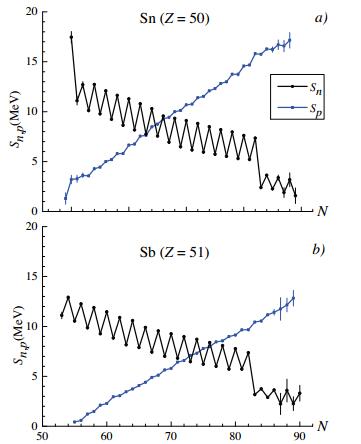
Figure 3.(color online) Neutron and proton separation energiesSnandSpin Sn (a) and Sb (b) isotopes. Nuclear mass data are from [10].
The dependence ofSn(N) has a zigzag shape, which is related to neutron pairing. The dependence ofSp(N) shows even-odd jumps as well despite the fact thatZis constant, due to the additional interaction of a proton with an odd neutron. The distance between parallel lines drawn through isotopes with even and oddZcorresponds to thenp-interaction [53,54].
The dependenceSn(Z) in a chain of isotones is shown schematically inFig. 4. The different behaviour ofSn(Z) for even and odd number of neutrons is of importance. In the case of evenN, the largest values ofSnalso correspond to even values ofZ; for isotones with oddN, the maxima correspond to odd values ofZ. These features ofSn(Z) andSp(Z) were explained in [54] in the framework of the Shell Model. According to the diagram inFig. 4, the expression for Δnpshould include a term depending on the parity ofA:
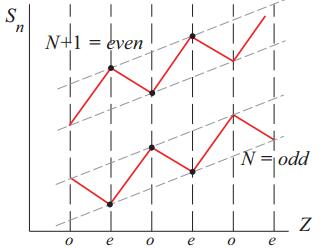
Figure 4.(color online) Schemes used to determine the properties of the pairing interaction using nucleon separation energies.a) like-nucleon correlation (Sn(N) forZ= Const),b) neutron-proton correlation (Sn(N) forN= Const)
$ \begin{eqnarray}\begin{array}{ll}{\Delta }_{np}(N, Z)&={(-1)}^{A}[{S}_{n}(N, Z)-{S}_{n}(N, Z-1)]\\ &={(-1)}^{A}[{S}_{p}(N, Z)-{S}_{p}(N-1, Z)].\end{array}\end{eqnarray} $
(11) However, the experimental data forSp(Z), given inFig. 3, show that introducing a dependence on parity ofAis not so obvious, since the relations
${S}_{p}^{oo}(N, Z)\gt {S}_{p}^{eo}(N+1, Z)$ and${S}_{p}^{ee}(N+1, Z)\gt {S}_{p}^{oe}(N+1, Z+1)$ are not always satisfied. In fact, these inequalities appear not to be valid in most cases. Therefore, when constructing the empirical dependence of Δnp, a term depending on the parity ofAis not included in [55,56]. Since the study of empirical values ofnp-pairing is based on the chains of nuclei with evenA, the question of the dependence onA-parity is not so important. Furthermore, the value of Δnpin odd-Anuclei is close to zero. Nevertheless, we choose to keep the (−1)A‘phase' for constructing the mass relation.As in the case of relations for identical nucleon pairing [19], it seems reasonable to average the values of Δnpfor two or more neighbouring nuclei, which leads to formulas [14]:
$ \begin{eqnarray}\begin{array}{lll}{\Delta }_{np}^{(6, n)}(N, Z)&=&\frac{1}{2}[{\Delta }_{np}(N+1, Z)+{\Delta }_{np}(N, Z)]\\ &=&\frac{{(-1)}^{A}}{2}[-{S}_{n}(N+1, Z)-{S}_{n}(N, Z-1)\\ &&+{S}_{n}(N, Z)+{S}_{n}(N+1, Z-1)].\end{array}\end{eqnarray} $
(12) Similar considerations for the proton separation energySpin isotonesZ= Const leads to the formula:
$ \begin{eqnarray}\begin{array}{lll}{\Delta }_{np}^{(6, p)}(N, Z)&=&\frac{1}{2}[{\Delta }_{np}(N, Z+1)+{\Delta }_{np}(N, Z)]\\ &=&\frac{{(-1)}^{A}}{2}[-{S}_{p}(N, Z+1)-{S}_{p}(N-1, Z)\\ &&+{S}_{p}(N, Z)+{S}_{p}(N-1, Z+1)].\end{array}\end{eqnarray} $
(13) Diagrams for the indicators (12) and (13) are shown inFig. 1(d)and(e). As can be seen, formula (12) averages the differences of neutron separation energies for even and oddAby using two chains of isotones:NandN+1. The formula that is most symmetric is the one that averages the neutron separation energy differences both in the neighbouring isotonic chains and in the neighbouring nuclei in each chainZandZ+1 (seeFig. 1(f)). This diagram shows that averaging in accordance with formulas (12) and (13) leads to the same result. Indeed, it is evident fromFig. 1(d)and(e)that the difference in these values leads to the well-known Garvey-Kelson mass relations (4).
The indicator Δnp(A) for a chain of nuclei withN=Zconsisting of even-even and odd-odd isotopes, and for a neighbouring chain of odd nuclei withN=Z+ 1, are shown inFig. 5. While the values of ΔnpforN=Zare large and are, in general, in accordance with the analytical relation 24A−1/2, the corresponding values for odd nuclei (N=Z+1 chain) are smaller and tail to zero, having even negative values for largeA. Accordingly, for the chain withN=Z, the indicator
${\Delta }_{np}^{(6, n)}(A)$ (12), which is the average between these two chains, is substantially below Δnp. This example illustrates best the contribution of the symmetry energy forN=Znuclei, although this trend also holds for nuclei with neutron excess.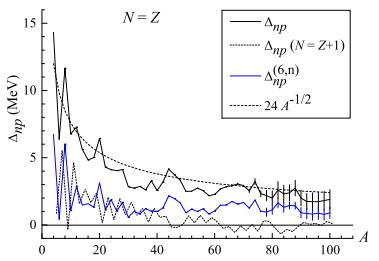
Figure 5.(color online) Indicators Δnp(black line) and
${\Delta }_{np}^{(6, n)}$ (blue line) in nuclei withN=Z. Dotted line shows Δnp(A) in nucleiN=Z+1; dashed line corresponds to 24A−1/2.Indicator
${\Delta }_{np}^{(6, n)}(A)$ (12) was used for estimating thenp-pairing term in several papers [14,18,20]. This indicator includes a difference between nuclei having differentA-parity, and it therefore reflects the complexity ofnp-correlations, and not only thenp-pairing in odd-odd nuclei. Thus, this relation can be interpreted differently, for example as an indication ofα-clustering in even-even nuclei [57]. -
The indicators fornp-pairing Δnp(2) and
${\Delta }_{np}^{(7)}$ (3) are obtained using the masses of neighbouring nuclei for both even and oddA, as well asNandZ. As the corresponding estimates of like-nucleon pairing are based on isotone and isotope chains, a significant difference is seen between these estimates and indicators (2) and (3).Variants ofnp-pairing indicators constructed by analogy with the formulas for neutron OES and proton OES use the binding energies of even or oddAnuclei for the chain withN-Z= Const. Indeed, for a chain of even-Anuclei, one notes the splitting of binding energies into two groups, for even-even and odd-odd nuclei. Since the mass numberAincreases quickly for this sequence, the splitting is small compared to the general increase of the binding energy. As in the case of like-nucleons, this effect is more pronounced for the difference in binding energies of neighbouring isotopes [19]. In the case of theN=Zchain, this corresponds to the deuteron separation energy, corrected for its binding energy:
$ \begin{eqnarray*}{S}_{d}(N, Z)=B(N, Z)-B(N-1, Z-1)-2.22\, {\rm{MeV}}.\end{eqnarray*} $
TheA-dependence of the deuteron separation energySdin nuclei withN=Zis shown inFig. 6. Similar toSn(Z) andSp(N), it shows a zigzag shape with an overall tendency of gradual decrease and stabilization of the even-even - odd-odd splitting for heavier isotopes. The energy ofnp-pairing in odd-odd nucleus (N,Z) based on this dependence corresponds to half of the difference of deuteron separation energies for even-even and odd-odd nuclei:
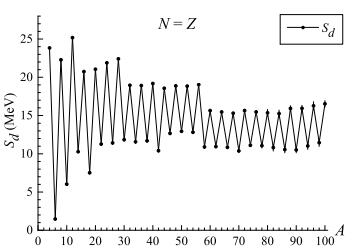
Figure 6.Deuteron separation energySd(A) in nuclei withN=Z. Nuclear mass data are from [10].
$ \begin{eqnarray}\begin{array}{lll}{\Delta }_{np}^{(3)}(N, Z)&=&\frac{1}{2}({S}_{d}(N+1, Z+1)-{S}_{d}(N, Z))\\ &=&\frac{1}{2}(B(N+1, Z+1)-2B(N, Z)\\ &&+B(N-1, Z-1)).\end{array}\end{eqnarray} $
(14) This relation was used in [26,58] for estimating the isovectornp-interaction. Indeed, one can see that in the case of evenA, the deuteron separation energy is not larger than the distance between the even-even and odd-odd mass surfaces, corrected for the deuteron binding energyBd. The averaging indicator
${\Delta }_{np}^{(3)}$ cancelsBdand corresponds to$ \begin{eqnarray*}B{E}_{ee}-B{E}_{oo}\approx {\Delta }_{p}+{\Delta }_{n}\approx 2\Delta .\end{eqnarray*} $
Charge independence of nuclear forces implies that isovectornp-pairing in odd-odd (N=Z) nuclei must be the same as neutron pairing in the neighbouring (N+1,Z−1) isotope and proton pairing in the (N−1,Z+1) isotope. Therefore, the indicator
${\Delta }_{np}^{(3)}$ in the chain ofN=Zisotopes can be used to studynp-correlations. It must be different for isotopes withN−Z≥2; nevertheless, it makes sense to examine the behaviour of indicators constructed by analogy with mass relations for like-nucleon pairing in isotopes chains withN−Z= Const ≥ 2.Relation (14) is analogous to the formula for OES for neutron pairing [12]:
$ \begin{eqnarray}\begin{array}{lll}{\Delta }_{n}^{(3)}(N, Z)&=&\frac{{(-1)}^{N+1}}{2}({S}_{n}(N+1, Z)-{S}_{n}(N, Z))\\ &=&\frac{{(-1)}^{N+1}}{2}(B(N+1, Z)-2B(N, Z)\\ &&+B(N-1, Z)).\end{array}\end{eqnarray} $
(15) By analogy with the averaged estimates of the OES effect, one can introduce an indicator based on binding energies of four nuclei [59]:
$ \begin{eqnarray}\begin{array}{lll}{\Delta }_{np}^{(4)}(N, Z)&=&\frac{1}{2}({\Delta }_{np}^{(3)}(N, Z)+{\Delta }_{np}^{(3)}(N-1, Z-1))\\ &=&\frac{{(-1)}^{N+1}}{4}({S}_{d}(N+1, Z+1)-2{S}_{d}(N, Z)\\ &&+{S}_{d}(N-1, Z-1)).\end{array}\end{eqnarray} $
(16) The diagrams of the coefficients for
${\Delta }_{np}^{(3)}$ and${\Delta }_{np}^{(4)}$ are given inFig. 1(g)and(h), respectively. The (−1)N+1multiplier is used only for chains of even-Anuclei. For these chains, the OES effect appears to be prominent, as the deuteron separation energy in even-even nuclei is consistently greater than in odd-odd nuclei. No such relation exists for odd-A nuclei, and the (−1)N+1factor is omitted for the corresponding chains.The indicators
${\Delta }_{np}^{(3)}$ and${\Delta }_{np}^{(4)}$ for nuclei withN=Zare shown inFig. 7(a). Since the deuteron separation energySd(A) does not have a common slope,${\Delta }_{np}^{(3)}(N, Z)$ and${\Delta }_{np}^{(4)}(N, Z)$ practically coincide. The dependence is smooth, with jumps in the regions of double magic numbers 16, 40, 56. The general shape of the dependence is in accordance with the approximation 2Δ = 24/A1/2given in [12]. In the region of light nuclei, the majority of${\Delta }_{np}^{(3)}$ and${\Delta }_{np}^{(4)}$ values are above, and forA>40 - below this approximation. Further down inFig. 7,${\Delta }_{np}^{(3)}$ and${\Delta }_{np}^{(4)}$ are shown for chains of odd-Anuclei withN=Z+1 (b), and even-Anuclei withN=Z+2 (c). FromFig. 7(b), it is clear that for most nuclei with oddAboth indicators have practically zero values. All plots show similar behaviour, except that in the case ofN=Z+2,${\Delta }_{np}^{(3)}$ and${\Delta }_{np}^{(4)}$ are smaller due to the absence of the Wigner term.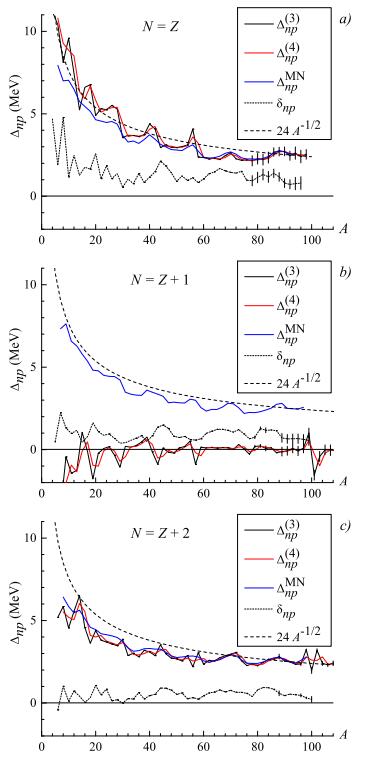
Figure 7.(color online) Indicators ofnp-correlations in the chains a)N=Z, b)N=Z+1, c)N=Z+2:
${\Delta }_{np}^{(3)}(A)$ (red line),${\Delta }_{np}^{(4)}(A)$ (green line),${\Delta }_{np}^{(13)}(A)$ (blue line),δnp(A) (dashed black line). The thin dotted line corresponds to 24/A1/2. Nuclear mass data are from [10].As we will see later,
${\Delta }_{np}^{(3)}$ and${\Delta }_{np}^{(4)}$ have a complex structure and are indirectly related tonp-correlations. That is why there are different interpretations in literature. For example, in [14] the indicator${\Delta }_{np}^{(4)}$ was proposed as an estimator of four-nucleon correlations. -
The mass surface splitting is primarily due to the pairing of identical nucleons, but the estimate of the fluctuation between experimental masses of even-even and odd-odd nuclei is somewhat less than the sum of OES effects for protons Δpand neutrons Δn. This discrepancy is generally attributed to the presence of residual neutron and proton interactions [12], and in order to calculate the splitting between the mass surfaces for even-even and odd-odd nuclei one uses the relation [60-62]:
$ \begin{eqnarray}{E}_{ee}-{E}_{oo}={\Delta }_{n}+{\Delta }_{p}-\delta .\end{eqnarray} $
(17) The correctionδ, arising from the residual attractive interaction of the unpaired proton and unpaired neutron, is interpreted as annpinteraction and approximated byδ=20/AMeV [12].
Madland and Nix [61] obtained formulas for Δn, Δpandδas finite differences on the basis of Taylor expansion to fourth-order. Thus, if five neighbouring isotopes or isotones are used to calculate the OES effect for neutrons Δnand protons Δp, then data for a substantially larger number of neighbouring nuclei are required to calculate thenp-interaction indicators:
$ \begin{eqnarray}{\Delta }_{np}^{MN}(N, Z)={\Delta }_{n}+{\Delta }_{p}-{\delta }_{np}, \end{eqnarray} $
(18) whereδnp(N,Z) is the correction fornp-interactions:
$ \begin{eqnarray}\begin{array}{ll}{\delta }_{np}(N, Z)&=\frac{{(-1)}^{A}}{4}(2[B(N+1, Z)+B(N-1, Z)+B(N, Z+1)+B(N, Z-1)]-4B(N, Z)\\ &-[B(N+1, Z+1)+B(N-1, Z+1)+B(N-1, Z-1)+B(N+1, Z-1)]).\end{array}\end{eqnarray} $
(19) Proton and neutron OES in this case depend on the parity of the corresponding nucleons:
$ \begin{eqnarray}{\Delta }_{n}=\left\{\begin{array}{ll}{\Delta }_{n}^{(5)}(N, Z),&\, {\rm{even}}\, N\\ {\Delta }_{n}^{(5)}(N, Z)+{\delta }_{np},&\, {\rm{odd}}\, N\end{array}\right.\end{eqnarray} $
(20) $ \begin{eqnarray}{\Delta }_{p}=\left\{\begin{array}{ll}{\Delta }_{p}^{(5)}(N, Z),&\, {\rm{even}}\, Z\\ {\Delta }_{p}^{(5)}(N, Z)+{\delta }_{np},&\, {\rm{odd}}\, Z\end{array}\right.\end{eqnarray} $
(21) $ \begin{eqnarray}\begin{array}{ll}{\Delta }_{n}^{(5)}(N, Z)=&\frac{{(-1)}^{N}}{8}[{S}_{n}(N+2, Z)-3{S}_{n}(N+1, Z)\\ &+3{S}_{n}(N, Z)-{S}_{n}(N-1, Z)], \end{array}\end{eqnarray} $
(22a) $\begin{array}{c}{\Delta }_{p}^{(5)}(N, Z)=\frac{{(-1)}^{Z}}{8}[{S}_{p}(N, Z+2)-3{S}_{p}(N, Z+1)\\ \quad \quad +3{S}_{p}(N, Z)-{S}_{p}(N, Z-1)].\end{array}$
(22b) Diagrams for the indicators
${\Delta }_{np}^{MN}$ (18) andδnp(19) are shown inFig. 1(i)and(f), from where the relationship betweenδnpand previously introduced indicators Δnp,${\Delta }_{np}^{(6, n)}$ and${\Delta }_{np}^{(6, p)}$ is clear. In fact, as in the case of identical nucleons, the relations from [61] are an additional averaging of thenp-interaction energy Δnpover the mass surface.As mentioned above, the OES indicator
${\Delta }_{np}^{MN}$ (18) is indirectly related to thenp-correlation, but we include it as a well-studied reference point. According to the diagram inFig. 1(i), one can see that${\Delta }_{np}^{MN}$ for even-Anuclei is also an average, but of the indicator${\Delta }_{np}^{(3)}$ (14):$ \begin{eqnarray}\begin{array}{ll}{\Delta }_{np}^{MN}(N, Z)=&\frac{1}{4}(2{\Delta }_{np}^{(3)}(N, Z)-{\Delta }_{np}^{(3)}(N+1, Z-1)\\ &-{\Delta }_{np}^{(3)}(N-1, Z+1)), \end{array}\end{eqnarray} $
(23) It is interesting to note the similarity between
${\Delta }_{np}^{MN}$ (18) and the termd(A) in the Wigner energy (eq. 7). The latter can also be expressed as a combination of${\Delta }_{np}^{(3)}$ terms:$ \begin{eqnarray}\begin{array}{ll}d(A)=&\frac{1}{2}({\Delta }_{np}^{(3)}(N, Z)+{\Delta }_{np}^{(3)}(N+2, Z-2)\\ &-{\Delta }_{np}^{(3)}(N, Z-2)-{\Delta }_{np}^{(3)}(N+2, Z)).\end{array}\end{eqnarray} $
(24) The values
${\Delta }_{np}^{MN}(A)$ obtained from eq. (18) for nuclei withN=Zare shown inFig. 7(a)and compared with Δnp(A). The dependence${\Delta }_{np}^{MN}(A)$ is smoother; in the regionA>40 the indicators coincide to a high degree.Table 1shows the results of fitting the various Δnp(A) indicators presented above with the power functionC·A−b, for the chain of nucleiN=Z. In general, the results can be divided into two large groups. Indicators
${\Delta }_{np}^{MN}$ ,${\Delta }_{np}^{(3)}$ and${\Delta }_{np}^{(4)}$ , appropriate for assessment of mass splitting, and indicators Δnpand${\Delta }_{np}^{(7)}$ , based on the definition ofnp-pairing in odd-odd nuclei, all correspond to the approximation 2Δ = 24/A1/2in [12], and they can be approximated with sufficient accuracy by the power functionsA1/2orA2/3used to describe the pairing energy of nucleons in modern macroscopic models. The neutron OES effect, when fitted as${\Delta }_{n}^{(4)}={C}_{n}\cdot {A}^{-1/2}$ using the current data set results in a coefficientCnslightly less than 12 MeV,Cn= 10.77±0.06 MeV [63]. This result is in good agreement with the fitting parameters for${\Delta }_{np}^{MN}(A)$ . Such an outcome can be explained by the fact that smooth formulas were used for approximating both Δn(A) and Δnp(A).N=Z N−Z=2 C/MeV b C/MeV b Δnp(A) 29.4±1.8 0.60±0.02 5.8±0.8 0.37±0.04 ${\Delta }_{np}^{(7)}(A)$ 23.3±1.6 0.53±0.03 6.0±0.6 0.39±0.03 ${\Delta }_{np}^{(6n)}(A)$ 10.3±1.4 0.56±0.05 1.0±0.3 0.14±0.08 ${\Delta }_{np}^{(6p)}(A)$ 9.3±1.3 0.52±0.04 0.0±0.1 -0.7±0.3 ${\delta }_{np}^{}(A)$ 6.9±1.1 0.45±0.05 0.2±0.1 0.2±0.1 ${\Delta }_{np}^{(3)}(A)$ 25.9±1.3 0.53±0.02 10.8±0.8 0.33±0.02 ${\Delta }_{np}^{(4)}(A)$ 32.7±2.1 0.59±0.02 12.2±0.8 0.36±0.02 ${\Delta }_{np}^{MN}(A)$ 19.9±1.6 0.48±0.02 15.2±0.6 0.41±0.01 Table 1.Parameters of the fits Δnp(A)=C·A−bin nuclei withN=ZandN−Z=2.
Significantly smaller values of the fitting parameterCare obtained for
${\Delta }_{np}^{(6n)}, {\Delta }_{np}^{(6p)}$ andδnp. The small values and their significant fluctuations indicate that the approximations are unreliable. It should be noted, however, that the parameters of the approximations for these indicators are in good agreement with each other.
2.1. Mass relations “by definition” and theδVnpindicator
2.2. Wigner term
2.3.np-correlation fromSnandSp
2.4. Mass relations based for deuteron separation energy
2.5. Mass surface OES
-
The first step in interpreting the mass relations obtained can be made within the framework of the Shell Model [55]. Consider a nucleus withnneutrons in the statej1andpprotons in the statej2above the closed core (N0,Z0). The binding energy of such a configuration can be represented as a sum:
$ \begin{eqnarray}\begin{array}{ll}B({N}_{0}+n, {Z}_{0}+p)=&B({N}_{0}, {Z}_{0})+n{\varepsilon }_{n}+p{\varepsilon }_{p}\\ &+W({j}_{1}^{n})+W({j}_{2}^{p})+I({j}_{1}^{n}, {j}_{2}^{p}), \end{array}\end{eqnarray} $
(25) whereεnandεpdenote single-particle central-field energies of thej1neutrons andj2protons, respectively. TermsW(j) correspond to the interaction energy of nucleons in a given shell, whileI(j1,j2) denotes the interaction energy between nucleons located on different shells. The contribution of the interaction ofnidentical nucleons in the statejcan be written as the sum of two terms:
$ \begin{eqnarray}W({j}^{n})=\frac{1}{2}\left(n-\frac{1-{(-1)}^{n}}{2}\right)\pi +\frac{n(n-1)}{2}d, \end{eqnarray} $
(26) the first of which is due to the coupling of identical nucleons with “pairing energy”π. The second term describes the additional interaction of two nucleons with strengthd, which is independent of the relative orientation of their spins, and is of repulsive nature. The relationship of these quantities is clearly seen in the dependence ofSn(N) forZ= Const (Fig. 3). The pairing energyπis responsible for the zigzag behaviour of the curve and is determined by the difference betweenSn(N) in neighbouring nuclei with even and oddN. The value ofddefines the slope of the curve and can be estimated from the differenceSn(N+1)−Sn(N−1).Fig. 4shows the scheme that allows to estimate the values ofπanddusingSn(N) in isotones. The mass difference relations for identical nucleons were considered in detail in our previous paper [19].
The interaction ofnneutrons in statej1andpprotons in statej2can be written as the sum of two terms [64]:
$ \begin{eqnarray}I({j}_{1}^{n}, {j}_{2}^{p})=np{I}^{0}+\frac{(1-{(-1)}^{n})(1-{(-1)}^{p})}{4}{I}^{^{\prime} }, \end{eqnarray} $
(27) where the contributionI0does not depend on the nucleon spin orientation and is determined by the scalar interaction. The contributionI′ depends on the value of the total spinJ, represents the “pairing properties” of the interaction and, accordingly, is present in odd-odd nuclei only.
Therefore, relation (25) can be rewritten in the form [55]:
$ \begin{eqnarray}\begin{array}{ll}B({N}_{0}+n, {Z}_{0}+p)=&B({N}_{0}, {Z}_{0})+n{\varepsilon }_{n}+p{\varepsilon }_{p}+\frac{n}{2}{\pi }_{n}+\frac{p}{2}{\pi }_{p}\\ &+\frac{n(n-1)}{2}{d}_{n}+\frac{p(p-1)}{2}{d}_{p}+np{I}^{0}-\delta, \end{array}\end{eqnarray} $
(28) where the parity termδis given by
$ \begin{eqnarray}\delta =\left\{\begin{array}{ll}0,&ee, \\ \frac{1}{2}{\pi }_{p},&eo, \\ \frac{1}{2}{\pi }_{n},&oe, \\ \frac{1}{2}{\pi }_{n}+\frac{1}{2}{\pi }_{p}-{I}^{^{\prime} },&oo.\end{array}\right.\end{eqnarray} $
(29) This relation is simplistic but allows to identify some regularities in the behaviour of the indicators based on mass differences.
The neutron separation energy in this representation depends on the parity ofNandZ:
$ \begin{eqnarray}{S}_{n}(N, Z)=\left\{\begin{array}{ll}{\varepsilon }_{n}+(n-1){d}_{n}+p{I}^{0}+{\pi }_{n},&ee\\ {\varepsilon }_{n}+(n-1){d}_{n}+p{I}^{0},&oe\\ {\varepsilon }_{n}+(n-1){d}_{n}+p{I}^{0}+{\pi }_{n}-{I}^{^{\prime} },&eo\\ {\varepsilon }_{n}+(n-1){d}_{n}+p{I}^{0}+{I}^{^{\prime} },&oo\end{array}\right.\end{eqnarray} $
(30) Hence, the following relations hold for pairing of neutrons in an even-even nucleus:
$ \begin{eqnarray}{\Delta }_{nn}={\pi }_{n}+{d}_{n}, \end{eqnarray} $
(31) $ \begin{eqnarray}{\Delta }_{nn}^{(3)}={\pi }_{n}-{d}_{n}, \end{eqnarray} $
(32) $ \begin{eqnarray}{\Delta }_{nn}^{(5)}=2{\Delta }_{n}^{(5)}={\pi }_{n}.\end{eqnarray} $
(33) In this model, asd< 0, Δnnfor evenNis always smaller than for oddN. Furthermore,
${\Delta }_{nn}^{(3)}$ has an inverse relation, and the averaging indicator${\Delta }_{nn}^{(5)}$ depends only on the neutron pairing energyπn. The value ofdcan also be extracted from the mass relations as the difference$({\Delta }_{nn}-{\Delta }_{nn}^{(3)})/2$ . -
Let us consider the structure of the previously introduced mass relations fornp-correlations. The values of the indicators Δnp(2) and
${\Delta }_{np}^{(7)}$ (3) significantly differ for even and oddA:$ \begin{eqnarray}{\Delta }_{np}={\Delta }_{np}^{(7)}={I}^{^{\prime} }+{I}^{0}\, (ee, oo), \end{eqnarray} $
(34) $ \begin{eqnarray}{\Delta }_{np}={\Delta }_{np}^{(7)}={I}^{^{\prime} }-{I}^{0}(oe, eo).\end{eqnarray} $
(35) Good agreement of these relations was shown above on the example of evenAnuclei (seeFig. 2). It should be noted that the averaging in the relation
${\Delta }_{np}^{(7)}$ does not allow to separate contributions ofI0andI′.The contribution ofI′ can be determined, by analogy with like-nucleon pairing, from the indicators
${\Delta }_{np}^{(6, n)}$ (12) and${\Delta }_{np}^{(6, p)}$ (13):$ \begin{eqnarray*}{\Delta }_{np}^{(6, n)}={\Delta }_{np}^{(6, p)}={I}^{^{\prime} }\end{eqnarray*} $
and consequently by the indicator
${\delta }_{np}(N, Z)=({\Delta }_{np}^{(6, p)}(N, Z)+{\Delta }_{np}^{(6, p)}(N+1, Z))/2={I}^{^{\prime} }$ (see eq. (19)). Comparison of the diagrams for the indicators Δnpand${\Delta }_{np}^{(6, p)}$ (seeFig. 8, first row) leads to the expression for the parameterI0in even-Anuclei: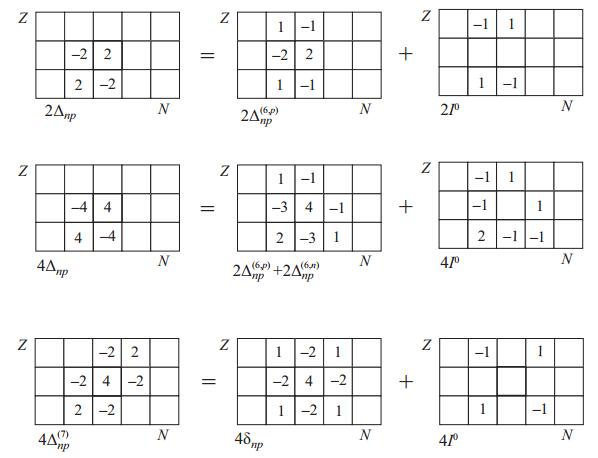
Figure 8.Diagrams for estimating thenp-pairing energy Δnp,I0andI′. See text for details.
$ \begin{eqnarray}\begin{array}{ll}{I}^{0}(N, Z)=&\frac{1}{2}[B(N, Z+1)-B(N-1, Z+1)\\ &+B(N-1, Z-1)-B(N, Z-1)].\end{array}\end{eqnarray} $
(36) One can obtain a similar formula for
${\Delta }_{np}^{(6, n)}$ . As shown earlier, the results for${\Delta }_{np}^{(6, n)}$ (12) and${\Delta }_{np}^{(6, p)}$ (13) differ slightly and it is useful to average them.Diagrams for this case are shown in the second row ofFig. 8, and the results of calculations are presented inFig. 9by solid lines. The values ofI0lie aboveI′, and for nuclei withN=Zagree well with the dependence 12/A1/2, which was proposed to describe the pairing effect. The values ofI′ fluctuate much more. With increasingA, the values ofI0andI′ converge, but the ratio between them can vary. Dashed lines showI0andI′ calculated using the averaged formula forI′=δnp. The diagrams in this case are symmetrical (see the third row ofFig. 8). The sumI0+I′ is related to the indicator
${\Delta }_{np}^{(7)}$ , and the expression forI0is of the form: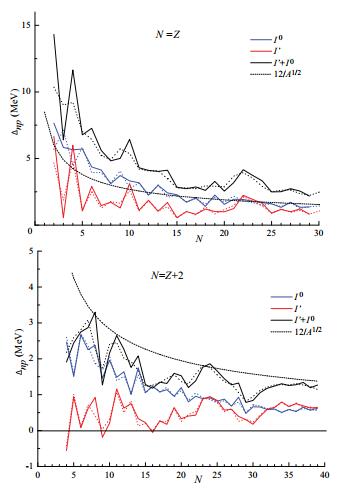
Figure 9.(color online) Comparison of Δnp,I0,I′ in chains of nuclei withN=Z(a) andN−Z= 2 (b). Solid lines show the results for averaged parameters from the second row inFig. 8(
${I}^{^{\prime} }=({\Delta }_{np}^{6, p}+{\Delta }_{np}^{6, n})/2$ ); dashed lines correspond to the third row (I′=δnp).$ \begin{eqnarray}\begin{array}{ll}{I}^{0}(N, Z)=&\frac{1}{4}[B(N+1, Z+1)-B(N-1, Z+1)\\ &+B(N-1, Z-1)-B(N+1, Z-1)].\end{array}\end{eqnarray} $
(37) This formula coincides with the expression for the empiricalnp-interaction of the last neutron with the last proton in even-even nucleiδVnpfrom [21,23,41]. The important point here is that in this case the binding energies of odd-odd nuclei are used in the calculations, in contrast to relation (5), where
$\delta {V}_{np}^{ee}$ is based onB(N,Z) in even-even isotopes. This difference does not significantly change the numerical results in general, but should be taken into account in more accurate models.Table 2gives the coefficientsCwhen the parametersπanddfor identical nucleon interaction are approximated by the functionC·A−b. The parameters were fitted without taking into account the magic and self-adjoint nuclei, in accordance with the selection rules from [13]. The fixed exponentsbwere chosen to be close to the fits with two free parametersCandb. For the parametersπnandπp, the fitted values ofbare 0.30±0.01 and 0.32±0.01, respectively, which is close to 1/3. For the parametersdnanddp, the chosen value ofbis unity, which agrees well with the fit coefficientbfor neutrons (0.93±0.03); for protons, the deviation of the fit coefficientbfrom unity is more significant due to the effect of Coulomb interaction (0.56±0.01).
neutrons protons π(A)=C/A1/3 10.22±0.06 11.48±0.06 d(A)=C/A −23.0±0.3 −56.7±0.6 Table 2.CoefficientsC(MeV) for fittingπanddfor like-nucleons with the power functionC·A−b
The values of the coefficientCwhen the parametersI0andI′ are approximated by the power functionC·A−bare given inTable 3for various values ofb. The fixed values ofballow to compareI0andI′ to each other, and toπandd. The fit ofI0andI′ by a power function with a free exponent gives the values ofbequal to 0.83±0.01 and 0.67±0.02, respectively. Thus, the best approximation forI0isC/A, whereasC/A2/3describesI′ well. For allb, the coefficientsCforI0andI′ are similar, butCforI0is always larger.
I0 I′ C/A 41.9±0.3 30.7±0.4 C/A2/3 9.43±0.06 7.04±0.08 C/A1/3 1.93±0.02 1.46±0.02 Table 3.CoefficientsC(MeV) for fittingI0andI′ with the power functionC·A−bfor various fixedb
-
The splitting of the mass surface
${\Delta }_{np}^{MN}(N, Z)$ , given by formula (18), does not depend on the parity ofNandZin the Shell Model with parametrization (25), and has the form:$ \begin{eqnarray}{\Delta }_{np}^{MN}(N, Z)=\frac{{\pi }_{n}}{2}+\frac{{\pi }_{p}}{2}-{I}^{^{\prime} }, \end{eqnarray} $
(38) which corresponds to the definition of the indicator. However, it is important to note that this relation is valid only for nuclei with evenA; for odd-Anuclei the meaning of this indicator is not obvious. More significant are the indicators
${\Delta }_{np}^{(3)}$ and${\Delta }_{np}^{(4)}$ . Indicator${\Delta }_{np}^{(3)}(N, Z)$ depends on the parity ofNandZ:$ \begin{eqnarray}{\Delta }_{np}^{(3)}(N, Z)=\frac{1}{2}\left\{\begin{array}{ll}(({\pi }_{n}-{d}_{n})+({\pi }_{p}-{d}_{p}))-2({I}^{^{\prime} }+{I}^{0}),&ee\\ (-({\pi }_{n}-{d}_{n})+({\pi }_{p}+{d}_{p}))+2{I}^{0},&oe\\ (({\pi }_{n}+{d}_{n})-({\pi }_{p}-{d}_{p}))+2{I}^{0},&eo\\ (({\pi }_{n}+{d}_{n})+({\pi }_{p}+{d}_{p}))-2({I}^{^{\prime} }-{I}^{0}),&oo\end{array}\right.\end{eqnarray} $
(39) The expression for even-even nuclei corresponds to the splitting of the mass surface between even-even and odd-odd nuclei
$ \begin{eqnarray*}{\Delta }_{np}^{(3)}(ee)=\frac{1}{2}({\Delta }_{nn}^{(3)}(ee)+{\Delta }_{pp}^{(3)}(ee))-{\Delta }_{np}(ee), \end{eqnarray*} $
The relation for nuclei with oddAcontains the energy difference of identical nucleon pairing, and includes a small splitting of the mass surface between even-odd and odd-even nuclei.
The relations for the indicator
${\Delta }_{np}^{(4)}$ depend on the parity ofA:$ \begin{eqnarray}{\Delta }_{np}^{(4)}(N, Z)=\frac{1}{2}\left\{\begin{array}{ll}({\pi }_{n}+{\pi }_{p})-2{I}^{^{\prime} },&ee, oo\\ ({d}_{n}+{d}_{p})+2{I}^{0},&oe, eo\end{array}\right.\end{eqnarray} $
(40) This expression for evenAagrees with the expression for
${\Delta }_{np}^{MN}$ . The degree of accordance can be seen inFig. 7on the example of the chain ofN=Znuclei. The figure shows the dependence of indicators${\Delta }_{np}^{MN}, {\Delta }_{np}^{(3)}$ and${\Delta }_{np}^{(4)}$ on the mass number, and it is clear that while${\Delta }_{np}^{MN}$ and${\Delta }_{np}^{(4)}$ agree well only in the regionA>40, indicators${\Delta }_{np}^{(3)}$ and${\Delta }_{np}^{(4)}$ agree to good accuracy for allNandZ, except for the magic numbers. From the approximate equality${\Delta }_{np}^{(3)}\approx {\Delta }_{np}^{(4)}$ for odd-odd nuclei, it follows:$ \begin{eqnarray}\begin{array}{ll}\frac{1}{2}(({\pi }_{n}+{d}_{n})+({\pi }_{p}+{d}_{p}))&-({I}^{^{\prime} }-{I}^{0})\approx \frac{1}{2}({\pi }_{n}+{\pi }_{p})-{I}^{^{\prime} }, \\ &\frac{1}{2}({d}_{n}+{d}_{p})+{I}^{0}\approx 0.\end{array}\end{eqnarray} $
(41) The last relation links the values of the parametersdandI0, and also shows that for oddA,
${\Delta }_{np}^{(3)}$ and${\Delta }_{np}^{(4)}$ are close to zero. Indeed, the estimates ofπ,dandImade in [55] on the array of stable nuclei, show thatdnis about −0.1 MeV,dpis about −0.5 MeV, andI0has a value of about 0.3 MeV. The fact that the values of${\Delta }_{np}^{(3)}$ and${\Delta }_{np}^{(4)}$ are close to zero for oddApoints to the equality of the pairing forces of identical nucleons:$ \begin{eqnarray}\begin{array}{ll}\frac{1}{2}(-({\pi }_{n}-{d}_{n})+({\pi }_{p}+{d}_{p}))+&{I}^{0}\approx \frac{1}{2}({d}_{n}+{d}_{p})+{I}^{0}\approx 0, \\ &{\pi }_{p}\approx {\pi }_{n}, \end{array}\end{eqnarray} $
(42) which follows from the charge independence of nuclear forces. The degree of agreement of these relations is clearly seen in the values of the coefficientsCforπ,dandIinTables 2and3.
3.1. Neutron - proton interaction
3.2. “Deuteron-type” relations and mass staggering
-
Mass relations based on even-odd staggering of the mass surface are widely used to estimate the identical nucleon pairing in atomic nuclei. By analogy, a significant number of mass indicators are constructed fornp-correlations in order to estimate the value ofnp-pairing. However, the difficulty of extracting experimental information for odd-odd nuclei significantly limits the possibilities of analysing the values obtained.
In this paper, various indicators Δnpare considered for both odd-odd and even-even nuclei. The estimates of thenp-pair separation and the relations constructed by analogy with the estimates for like-nucleon pairing, can both serve as basis for construction of different mass relations. It turns out that almost all formulas are related to each other. They are based on the standard expression for the neutron-proton correlation in an odd-odd nucleus:
$ \begin{eqnarray*}\begin{array}{ll}{\Delta }_{np}=&B(N, Z)+B(N-1, Z-1)\\ &-B(N-1, Z)-B(N, Z-1), \end{array}\end{eqnarray*} $
and are either an average or a difference of their respective values for the neighbouring nuclei. Thus, the widely discussed quantityδVnp, which coincides with the definition of Δnpfor odd-odd nuclei, is an average of Δnpover four isotopes when applied to even-even nuclei. The correction for thenpinteraction,δnp, commonly mentioned in discussions of the mass surface splitting, is also an average of Δnpover four neighbouring nuclei, performed, however, by taking into account the zigzag features of the neutron separation energy in isotopes (or proton separation energy in isotones).
This approach is similar to the method used to obtain an estimate of like-nucleon pairing energy, but it can lead to different results. In general, the zigzag relation depends on two parameters,πandd, which determine the amplitude of the oscillations and the general slope of the dependence. While for identical nucleonsπandddiffer considerably, the parametersSn(Z) in isotones andSp(N) in isotopes used to construct the mass relations are close in magnitude. Furthermore, the relationship between various nuclear parameters can change within an isotope chain. Such changes inevitably affect the results of calculations using formulas analogous to those for like-nucleon pairing, and lead to appearance of alternating quantities.
To clarify the structure of various indicators Δnp, parametrization of the binding energy of the atomic nucleus based on the Shell Model was used. This approach effectively takes into account both the residual interaction of identical nucleons in a single state, and the interaction of nucleons on different subshells, such as between external neutrons and protons. Such a parametrization makes it possible to show more clearly the relationship of different mass formulas, and to elucidate their physical meaning. In the context of this parametrization, the pair interaction of identical nucleons is described by the sum of two terms
$ \begin{eqnarray*}{\Delta }_{nn(pp)}={\pi }_{n(p)}+{d}_{n(p)}.\end{eqnarray*} $
The first term is responsible for pairing of identical nucleons with the “pairing energy”π, while the second describes the additional repulsive interaction of a nucleon pair with strengthd, independent of the relative orientation of the nucleon spins. However, taking into account the typical values ofπandd, using only parameterπto describe the pairing forces does not greatly affect the result. In this approach, thenpinteraction in odd-odd nuclei should include both contributions
$ \begin{eqnarray*}{\Delta }_{np}={I}^{0}+{I}^{^{\prime} }.\end{eqnarray*} $
As the values ofI0andI′ are similar, taking into account only one of these parameters changes the result by a factor of two. This is best seen from the comparison of the indicator Δnpwith the averaged quantities
${\Delta }_{np}^{(6, n)}$ ,${\Delta }_{np}^{(6, p)}$ andδnp, which are all about Δnp/2.Approximation ofI0andI′ by a power functionC/Ab, with various constant values ofb, demonstrates a clear relationship of various parameters in the whole modern range of atomic nuclei. The coefficientsC, whendn,dpandI0are approximated byC/A, are of the same order of magnitude, and are related asdn+dp≈−2I0. In turn, the pairing parameters of identical nucleonsπnandπpare well described byC/A1/3, with the coefficientsChaving similar values slightly above 10 MeV. The coefficientCin the approximation ofI′ byC/A1/3is almost an order of magnitude smaller, 1.38±0.02 MeV, which clearly illustrates the relationship of the pairing effects of identical nucleons and thenp-interaction.
The authors would like to thank Dr. D. Lanskoy and L. Imasheva for fruitful discussions and technical support.


 DownLoad: