


2026 Vol. 50, No. 11
Display Method:|

2026, 50(11): 111001.
doi:10.1088/1674-1137/ae904f


Abstract:
The correlation between the nuclear bubble structure and the EMC effect is investigated within the framework of T. D. Lee's soliton bag model and the doubleQ2-rescaling model. For27Al, we artificially reduce its central density via a three-parameter Fermi distribution of nucleon density while conserving the mass number. It is found that as the central density decreases, nucleons are redistributed from the interior to the surface, leading to a systematic reduction in the average nucleon swelling factor, rescaling parameters and the EMC slope. However, this single-parameter modification fails to simultaneously reproduce both the magnitude and the slope of the experimental EMC ratio within the same parameter set, suggesting that additional nuclear medium effects must be considered. For the density distributions of the candidate bubble nucleus48Si, we calculate them by the Skyrme-Hartree-Fock-Bogoliubov (SHFB) theory with the SLy4, SKM*and LNS interactions, while the density profiles given by the PKA1 interaction are taken from the relativistic Hartree-Fock-Bogoliubov (RHFB) calculation (Phys. Lett. B788, 192 (2019)). Among the PKA1, SLy4 and SKM*interactions, a stronger bubble structure correlates with a larger nucleon swelling factor and a stronger EMC effect. The LNS interaction, however, presents an exception: despite having a weaker bubble, it yields the largest EMC effect, owing to its systematically higher overall nuclear density. This demonstrates that the EMC effect in bubble nuclei depends on both the bubble strength and the global density scale set by the effective interaction.
The correlation between the nuclear bubble structure and the EMC effect is investigated within the framework of T. D. Lee's soliton bag model and the doubleQ2-rescaling model. For27Al, we artificially reduce its central density via a three-parameter Fermi distribution of nucleon density while conserving the mass number. It is found that as the central density decreases, nucleons are redistributed from the interior to the surface, leading to a systematic reduction in the average nucleon swelling factor, rescaling parameters and the EMC slope. However, this single-parameter modification fails to simultaneously reproduce both the magnitude and the slope of the experimental EMC ratio within the same parameter set, suggesting that additional nuclear medium effects must be considered. For the density distributions of the candidate bubble nucleus48Si, we calculate them by the Skyrme-Hartree-Fock-Bogoliubov (SHFB) theory with the SLy4, SKM*and LNS interactions, while the density profiles given by the PKA1 interaction are taken from the relativistic Hartree-Fock-Bogoliubov (RHFB) calculation (Phys. Lett. B788, 192 (2019)). Among the PKA1, SLy4 and SKM*interactions, a stronger bubble structure correlates with a larger nucleon swelling factor and a stronger EMC effect. The LNS interaction, however, presents an exception: despite having a weaker bubble, it yields the largest EMC effect, owing to its systematically higher overall nuclear density. This demonstrates that the EMC effect in bubble nuclei depends on both the bubble strength and the global density scale set by the effective interaction.


2026, 50(11): 111002.
doi:10.1088/1674-1137/ae9ea7
Abstract:
Long-lived particles that decay inside the tracker are searched for via the spatial displacement of their decay vertices. However, the same decays also arrive late, providing a handle made available by a precision timing layer at the HL-LHC that displaced-vertex searches do not exploit. We study the exotic decay of a Higgs boson produced through vector-boson fusion (VBF),
\begin{document}$ pp\to hjj $\end{document}
with
\begin{document}$ h\to ss $\end{document}
, in which the long-lived scalar decays as
\begin{document}$ s\to b\bar b $\end{document}
, and use the VBF tag jets to identify the hard-scatter vertex. Its prompt central tracks, timed by a CMS-MTD-like barrel layer that also times the central tracks of the displaced vertex, define a per-event start time, turning each displaced vertex into a four-dimensional object. Because a fast simulation cannot determine the absolute normalization of the heavy-flavour and instrumental displaced-vertex backgrounds, we take as the primary result a normalization-free figure of merit: the ratio of the timing-enhanced sensitivity to the spatial-only sensitivity. Adding the timing layer improves this ratio by a factor of
\begin{document}$ \simeq2.8 $\end{document}
at a nominal working point and by up to an order of magnitude for a tighter delayed-vertex requirement, because the heavy-flavour background that survives the spatial selection is prompt in collision time. The improvement increases with decay length, extending sensitivity into the long-lifetime regime in which purely spatial searches lose tracker acceptance. The gain is essentially mass-independent at a decay length of
\begin{document}$ c\tau\simeq100 \,{\rm{mm}} $\end{document}
, where the trend with scalar mass reverses: lighter scalars benefit more at short lifetimes because of their larger boost, whereas heavier scalars benefit more at long lifetimes as the lighter states leak out of the tracker.
Long-lived particles that decay inside the tracker are searched for via the spatial displacement of their decay vertices. However, the same decays also arrive late, providing a handle made available by a precision timing layer at the HL-LHC that displaced-vertex searches do not exploit. We study the exotic decay of a Higgs boson produced through vector-boson fusion (VBF),


2026, 50(11): 113001.
doi:10.1088/1674-1137/ae457d
Abstract:
Geoneutrinos—antineutrinos emitted during the decay of long-lived radioactive elements inside the Earth—serve as a unique tool for studying our planet's composition and heat budget. The Jiangmen Underground Neutrino Observatory (JUNO) experiment in China, which has recently completed construction, is expected to collect a sample comparable in size to the entire existing world geoneutrino dataset in less than a year. This paper presents an updated estimation of JUNO's sensitivity to geoneutrinos using the best knowledge available to date about the experimental site, the surrounding nuclear reactors, the detector response uncertainties, and the knowledge of the reactor antineutrino flux. To facilitate comparison with present and future geological models, our results cover a wide range of predicted signal strengths. Despite the significant background from reactor antineutrinos, the primary channel JUNO will use to determine the neutrino mass ordering, the experiment will measure the total geoneutrino flux with a precision comparable to that of existing experiments within its first few years, ultimately achieving a world-leading precision of about 8% over ten years. JUNO's large statistics will also allow separation of the Uranium-238 and Thorium-232 contributions with unprecedented precision, providing crucial constraints on models of Earth’s formation and composition. Observation of the mantle signal above the lithospheric flux will be possible but challenging. For models with the highest predicted mantle concentrations of heat-producing elements, a ~
\begin{document}$3\sigma$\end{document}
detection over six years requires knowledge of the lithospheric flux to within 15%. Together with complementary measurements from other locations, JUNO’s geoneutrino results will offer cutting-edge, high-precision insights into the Earth’s interior, of fundamental importance to both the geoscience and neutrino physics communities.
Geoneutrinos—antineutrinos emitted during the decay of long-lived radioactive elements inside the Earth—serve as a unique tool for studying our planet's composition and heat budget. The Jiangmen Underground Neutrino Observatory (JUNO) experiment in China, which has recently completed construction, is expected to collect a sample comparable in size to the entire existing world geoneutrino dataset in less than a year. This paper presents an updated estimation of JUNO's sensitivity to geoneutrinos using the best knowledge available to date about the experimental site, the surrounding nuclear reactors, the detector response uncertainties, and the knowledge of the reactor antineutrino flux. To facilitate comparison with present and future geological models, our results cover a wide range of predicted signal strengths. Despite the significant background from reactor antineutrinos, the primary channel JUNO will use to determine the neutrino mass ordering, the experiment will measure the total geoneutrino flux with a precision comparable to that of existing experiments within its first few years, ultimately achieving a world-leading precision of about 8% over ten years. JUNO's large statistics will also allow separation of the Uranium-238 and Thorium-232 contributions with unprecedented precision, providing crucial constraints on models of Earth’s formation and composition. Observation of the mantle signal above the lithospheric flux will be possible but challenging. For models with the highest predicted mantle concentrations of heat-producing elements, a ~


2026, 50(11): 113002.
doi:10.1088/1674-1137/ae99cc
Abstract:
The Standard Model of particle physics, although remarkably successful, leaves several major questions unanswered, continuing to motivate searches for new phenomena. Multiboson interactions involving the Higgs boson are of particular interest as probes of the electroweak Lagrangian, where potential new physics may reside. In this work, we present a study of the associated production of aWboson, a Higgs boson, and a photon in proton-proton collisions at the Large Hadron Collider (LHC). Monte Carlo simulations are performed to model both the signal and background processes, and detector effects are included according to CMS specifications. Boosted decision trees are employed to optimize the event selection and enhance signal–background discrimination. We estimate that, with an integrated luminosity of 440 fb−1, the expected significance for the
\begin{document}$WH\gamma$\end{document}
process is 0.63σ, increasing to a projected 1.64σat the High-Luminosity LHC (HL-LHC).
The Standard Model of particle physics, although remarkably successful, leaves several major questions unanswered, continuing to motivate searches for new phenomena. Multiboson interactions involving the Higgs boson are of particular interest as probes of the electroweak Lagrangian, where potential new physics may reside. In this work, we present a study of the associated production of aWboson, a Higgs boson, and a photon in proton-proton collisions at the Large Hadron Collider (LHC). Monte Carlo simulations are performed to model both the signal and background processes, and detector effects are included according to CMS specifications. Boosted decision trees are employed to optimize the event selection and enhance signal–background discrimination. We estimate that, with an integrated luminosity of 440 fb−1, the expected significance for the


2026, 50(11): 113003.
doi:10.1088/1674-1137/ae9929
Abstract:
A sensitivity study of the search for heavy sterile neutrinos (
\begin{document}$ \nu_H $\end{document}
) in the MeV mass range using solar neutrino experiments is presented.
\begin{document}$ \nu_H $\end{document}
, with masses ranging from a few MeV up to approximately 15 MeV, can be produced in the Sun through8B decay and subsequently decays into
\begin{document}$ \nu_e e^+ e^- $\end{document}
. Its flux and lifetime strongly depend on the mixing parameter
\begin{document}$ |U_{eH}|^2 $\end{document}
and mass
\begin{document}$ m_{\nu_H} $\end{document}
. The
\begin{document}$ \nu_H $\end{document}
signal can be detected via its decay products, either the
\begin{document}$ e^+e^- $\end{document}
pair or
\begin{document}$ \nu_e $\end{document}
, depending on whether
\begin{document}$ \nu_H $\end{document}
decays inside or outside the detector. Expected signal yields for both detection methods (detecting
\begin{document}$ e^+e^- $\end{document}
or
\begin{document}$ \nu_e $\end{document}
signal) are presented across the full
\begin{document}$ |U_{eH}|^2 $\end{document}
and
\begin{document}$ m_{\nu_H} $\end{document}
parameter spaces. These two methods are found to be complementary in different regions of the
\begin{document}$ |U_{eH}|^2 $\end{document}
and
\begin{document}$ m_{\nu_H} $\end{document}
phase spaces. By combining both approaches, we anticipate observing at least a handful of signal events across most of the parameter space of
\begin{document}$ 10^{-6} \lt |U_{eH}|^2 \lt 1 $\end{document}
and 2 MeV
\begin{document}$ \lt m_{\nu_H} \lt $\end{document}
15 MeV, assuming a 500-ton solar neutrino experiment operating for one year. Key variables, such as the energy spectra of
\begin{document}$ \nu_e $\end{document}
or
\begin{document}$ e^+e^- $\end{document}
and
\begin{document}$ \nu_e $\end{document}
solar angle, are also discussed to help distinguish the signal from major backgrounds, such as solar neutrino events.
A sensitivity study of the search for heavy sterile neutrinos (


2026, 50(11): 113101.
doi:10.1088/1674-1137/ae9279
Abstract:
We investigate the feasibility of probing interactions between ultralight scalar dark matter and atomic nuclei using stationary Mössbauer spectroscopy. The exceptional energy resolution of the Mössbauer resonance enables searches for minute nuclear energy shifts induced by the local dark matter field. The dark matter mass range considered in this work is
\begin{document}$10^{-18}$\end{document}
–
\begin{document}$10^{-8}\;\mathrm{eV}$\end{document}
. We present projected constraints for two candidate Mössbauer isotopes,
\begin{document}$^{109}\mathrm{Ag}$\end{document}
and
\begin{document}$^{45}\mathrm{Sc}$\end{document}
, with
\begin{document}$^{109}\mathrm{Ag}$\end{document}
providing the strongest sensitivity. For
\begin{document}$^{109}\mathrm{Ag}$\end{document}
, projected sensitivities of approximately
\begin{document}$10^{-19}$\end{document}
,
\begin{document}$10^{-22}$\end{document}
, and
\begin{document}$10^{-21}\; \mathrm{GeV^{-1}}$\end{document}
can be achieved for the scalar DM–photon, DM–gluon, and DM–quark couplings
\begin{document}$f_{\gamma}^{-1}$\end{document}
,
\begin{document}$f_{g}^{-1}$\end{document}
, and
\begin{document}$f_{\hat{m}}^{-1}$\end{document}
, respectively. In the low-mass region, the projected sensitivity to the scalar DM–photon coupling approaches current constraints from equivalence-principle (EP) tests. These results demonstrate that Mössbauer-based techniques provide a promising and competitive approach to probing ultralight dark matter interactions with Standard Model particles.
We investigate the feasibility of probing interactions between ultralight scalar dark matter and atomic nuclei using stationary Mössbauer spectroscopy. The exceptional energy resolution of the Mössbauer resonance enables searches for minute nuclear energy shifts induced by the local dark matter field. The dark matter mass range considered in this work is


2026, 50(11): 113102.
doi:10.1088/1674-1137/ae8cf3
Abstract:
Confinement and dynamical chiral symmetry breaking are two emergent non-perturbative phenomena of quantum chromodynamics (QCD) that are responsible for the nature of hadron spectra. While it is well known that the chiral condensate
\begin{document}$ -\langle\bar{\psi} \psi \rangle $\end{document}
is an order parameter for the chiral transition, the Polyakov loop is the associated approximate order parameter for the confinement–deconfinement transition in the pure gauge sector with center symmetry. Nevertheless, this quantity cannot be derived from functional methods, and other quantities have therefore been proposed as order parameters for this transition. In the current investigation, we review and compare several proposed parameters that have been used to describe the confinement/deconfinement transition in QCD and related quantum field theories in the framework of Schwinger–Dyson equations.
Confinement and dynamical chiral symmetry breaking are two emergent non-perturbative phenomena of quantum chromodynamics (QCD) that are responsible for the nature of hadron spectra. While it is well known that the chiral condensate


2026, 50(11): 113103.
doi:10.1088/1674-1137/ae91ce
Abstract:
In recent years, long-lived particles (LLPs) have attracted increasing attention in searches for physics beyond the Standard Model (SM). In this paper, we investigate the discovery prospects for light, long-lived ALPs predicted by the photophobic ALP scenario through displaced-vertex signals at the CEPC, with a center-of-mass energy of
\begin{document}$ \sqrt{s}=91.2 $\end{document}
GeV and an integrated luminosity of
\begin{document}$ {\cal{L}}= $\end{document}
100 ab−1. After comparing several possible single-production processes for the photophobic ALP, we focus on the dominant process
\begin{document}$ e^+ e^- \to Z \to a \gamma $\end{document}
, in which the ALPasubsequently decays into a pair of charged leptons at a displaced vertex. Dedicated Monte Carlo simulations are performed for the
\begin{document}$ \mu^+ \mu^- \gamma $\end{document}
and
\begin{document}$ \tau_h^+ \tau_h^- \not{E}_T \gamma $\end{document}
signals. For the
\begin{document}$ \mu^+\mu^-\gamma $\end{document}
signal, the CEPC is sensitive to the parameter region
\begin{document}$ g_{aWW} \in [1.27\times10^{-3},6.80\times10^{-1}]\; {\rm{TeV}}^{-1} $\end{document}
for
\begin{document}$ m_a \in [1,4]\; {\rm{GeV}} $\end{document}
. For the
\begin{document}$ \tau_h^+\tau_h^-\not{E}_T\gamma $\end{document}
signal, the accessible region is
\begin{document}$ g_{aWW} \in [7.00\times10^{-4},9.40\times10^{-3}]\; {\rm{TeV}}^{-1} $\end{document}
for
\begin{document}$ m_a \in [4,9]\; {\rm{GeV}} $\end{document}
. These results demonstrate the substantial potential of the CEPC to explore light, long-lived ALPs through displaced-vertex signals, providing complementary coverage to existing searches at LEP and the LHC, as well as to the projected reach of the HL-LHC.
In recent years, long-lived particles (LLPs) have attracted increasing attention in searches for physics beyond the Standard Model (SM). In this paper, we investigate the discovery prospects for light, long-lived ALPs predicted by the photophobic ALP scenario through displaced-vertex signals at the CEPC, with a center-of-mass energy of


2026, 50(11): 113104.
doi:10.1088/1674-1137/ae8f26
Abstract:
We refine the hadronization sector of a pp PYTHIA 8 tune for
\begin{document}$ e^+e^-\to q\bar q $\end{document}
production using selected BELLE and BABAR measurements near the
\begin{document}$ \Upsilon(4S) $\end{document}
region. The study is performed with PYTHIA 8.316 and Rivet 4.1.1 and is restricted to the parameters used in this
\begin{document}$ e^+e^- $\end{document}
setup. Starting from the five-parameter hadronization subset of the pp tune, we perform a staged extension guided by the remaining discrepancies with the BELLE and BABAR data. The final comparison uses a fixed common set of 20,803 bins and samples of 1,000,000 generated events per analysis and tune point. On this basis, the selected refined tune yields a bin-weighted score of 73.42, compared with 76.49 for the Skands
\begin{document}$ e^+e^- $\end{document}
reference and 79.22 for Monash 2013
\begin{document}$ e^+e^- $\end{document}
. It remains the best-scoring tune for the BELLE charged-hadron, baryon, and single- and dihadron measurements, whereas Skands still performs better for the BABAR charged-hadron sample and the BELLE meson sample. The bin-weighted ordering is driven primarily by the BELLE 2020 sample. The refined tune provides a small but stable improvement for the selected BELLE and BABAR measurements, although clear differences among the individual datasets remain.
We refine the hadronization sector of a pp PYTHIA 8 tune for


2026, 50(11): 113105.
doi:10.1088/1674-1137/ae9925
Abstract:
We demonstrate that mass inequalities for hadrons containing one or more heavy quarks arise primarily from the concavity of binding energies in the quark model, reflecting short-range Coulombic interactions and long-range confinement. Empirical two-body bindings
\begin{document}$ B_{i\bar{j}} $\end{document}
are extracted from spin-averaged meson masses, ensuring model independence and direct use of experimental data. Fitting these quantities as functions of the reduced mass
\begin{document}$ \mu_{ij} $\end{document}
reveals a critical confinement scale of 1.34 fm, at which the bindings become positive. The concavity of
\begin{document}$ B(1/\mu) $\end{document}
motivates Jensen-like relations under flavor permutation, reproducing relations such as
\begin{document}$ m_{x\bar{y}} \gt \dfrac{1}{2}(m_{x\bar{x}} + m_{y\bar{y}}) $\end{document}
and the baryon analog
\begin{document}$ m_{xyz} \gt \dfrac{1}{3}(m_{xxx} + m_{yyy} + m_{zzz}) $\end{document}
. Hadron mass decomposition validates
\begin{document}$ \Delta M_{ \rm{EXP}} \approx \Delta B + \Delta C $\end{document}
with
\begin{document}$ \sigma \sim 2.07 $\end{document}
MeV for mesons and baryons. Using this decomposition, we obtain approximate mass estimates for unobserved heavy baryons (e.g.,
\begin{document}$ M(\Omega_{b}^{\ast})\approx 6076.6\, $\end{document}
MeV,
\begin{document}$ M(\Xi_{cc}^{\ast})\approx 3703.6\, $\end{document}
MeV, and
\begin{document}$ M(\Omega_{cc}^{\ast})\approx 3802.4\, $\end{document}
MeV) and identify favored quark-exchange scattering channels. The present analysis is phenomenological and does not constitute a rigorous three-body derivation.
We demonstrate that mass inequalities for hadrons containing one or more heavy quarks arise primarily from the concavity of binding energies in the quark model, reflecting short-range Coulombic interactions and long-range confinement. Empirical two-body bindings

2026, 50(11): 113106.
doi:10.1088/1674-1137/ae8cee
Abstract:
We study the isospin-violating
\begin{document}$J/\psi \to \Lambda\bar \Sigma^0 \eta $\end{document}
reaction, recently measured by the BESIII collaboration, by considering the dominant terms involving
\begin{document}$\bar \Sigma^0$\end{document}
and pairs of pseudoscalar-baryon particles that together form anSU(3) singlet and can therefore couple to the
\begin{document}$J/\psi$\end{document}
. We then allow these pairs to undergo final-state interaction to produce the final
\begin{document}$\eta \Lambda$\end{document}
. We find that the relevant original channels are
\begin{document}$\bar K N$\end{document}
and
\begin{document}$K \Xi$\end{document}
, and that the incomplete cancellation of terms involving charged and neutral particles, owing to their different masses, is responsible for the reaction. With this mechanism, we find good agreement with the three experimental mass distributions.
We study the isospin-violating


2026, 50(11): 113107.
doi:10.1088/1674-1137/ae97e9
Abstract:
We investigate the magnetic dipole moments of doubly-bottom pentaquark states with spin-parities
\begin{document}$J^P= {1}/{2}^-$\end{document}
and
\begin{document}$ {3}/{2}^-$\end{document}
, interpreted as hadronic molecules in the
\begin{document}$B\Sigma_b$\end{document}
,
\begin{document}$B\Sigma_b^{*}$\end{document}
, and
\begin{document}$B^{*}\Sigma_b$\end{document}
configurations. The analysis is conducted within the framework of QCD light-cone sum rules employing photon distribution amplitudes. Our results demonstrate a strong sensitivity of the magnetic dipole moments to the internal spin structure and quark composition of the states. Specifically, the light-quark sector provides the dominant contribution in the
\begin{document}$B\Sigma_b$\end{document}
configuration, whereas the magnetic moment of
\begin{document}$B\Sigma_b^{*}$\end{document}
is largely governed by the heavy bottom quark. For the
\begin{document}$B^{*}\Sigma_b$\end{document}
molecular state, both light and heavy sectors contribute constructively, leading to a significantly enhanced magnetic dipole moment. These findings indicate that magnetic dipole moments serve as a sensitive probe of the internal structure of molecular-type doubly-bottom pentaquarks and provide testable predictions for future experimental studies.
We investigate the magnetic dipole moments of doubly-bottom pentaquark states with spin-parities


2026, 50(11): 113108.
doi:10.1088/1674-1137/ae8cf6
Abstract:
For the two-loop next-to-leading-order electroweak (NLO EW) corrections to
\begin{document}$ gg \rightarrow ZH $\end{document}
, the light-fermion contributions can be classified into eight distinct topologies. Using the canonical differential-equations method, we perform an analytic computation of the master integrals (MIs) associated with the four planar topologies. Canonical bases are constructed using the Magnus-expansion method, and the resulting alphabets consist of algebraic symbol letters involving nontrivial radicals. We develop a systematic framework for identifying the radical structures of the canonical MIs, enabling their organization into suitable subsystems and, whenever possible, their representation in terms of Goncharov polylogarithms (GPLs) up to
\begin{document}$ {\cal{O}}(\epsilon^4) $\end{document}
. Only a few MIs at
\begin{document}$ {\cal{O}}(\epsilon^3) $\end{document}
and
\begin{document}$ {\cal{O}}(\epsilon^4) $\end{document}
are instead represented as one-fold integrals over GPLs, due to the presence of nested square roots that obstruct the simultaneous rationalization of all radicals.
For the two-loop next-to-leading-order electroweak (NLO EW) corrections to


2026, 50(11): 113109.
doi:10.1088/1674-1137/ae97eb
Abstract:
We study the search prospects for long-lived heavy neutral leptons (HNLs) pair-produced in decays of axionlike particles (ALPs) at the proposed Super Tau–Charm Facility (STCF), focusing on a center-of-mass energy of
\begin{document}$ \sqrt{s}=3.773 $\end{document}
GeV. The ALPs are assumed to originate from
\begin{document}$ D^\pm $\end{document}
-meson decays in association with a charged pion. We perform both truth-level and detector-level Monte Carlo simulations and determine the expected sensitivity to the mixing parameter between the HNL and the electron neutrino,
\begin{document}$ |V_{eN}|^2 $\end{document}
, using a displaced-vertex search at STCF. We find that STCF can probe values of
\begin{document}$ |V_{eN}|^2 $\end{document}
approximately one to two orders of magnitude beyond existing bounds. We also perform an approximate reinterpretation of a search for HNLs at the CHARM experiment, which is subject to model-dependent assumptions about the production and kinematic distributions, and find that beam-dump experiments may provide strong complementary constraints.
We study the search prospects for long-lived heavy neutral leptons (HNLs) pair-produced in decays of axionlike particles (ALPs) at the proposed Super Tau–Charm Facility (STCF), focusing on a center-of-mass energy of


2026, 50(11): 113110.
doi:10.1088/1674-1137/ae9c1d
Abstract:
In the framework of the Chiral quark model (ChQM), we investigate fully charmed and fully bottom tetraquarks with
\begin{document}$J^{PC}=2^{++}$\end{document}
by considering two structures:
\begin{document}$Q\bar{Q}-Q\bar{Q}$\end{document}
and
\begin{document}$QQ-\bar{Q}\bar{Q}$\end{document}
. The bound-state calculation shows that there are no bound states in either the
\begin{document}$cc\bar{c}\bar{c}$\end{document}
or
\begin{document}$bb\bar{b}\bar{b}$\end{document}
systems. However, using the real-scaling method, we obtain several resonant states. For the
\begin{document}$cc\bar{c}\bar{c}$\end{document}
system, when the channel coupling includes only threeS-wave channels, two resonant states are obtained: one with a mass of approximately
\begin{document}$7002$\end{document}
MeV and a decay width of about
\begin{document}$54$\end{document}
MeV, and another with a mass of approximately
\begin{document}$7227$\end{document}
MeV and a decay width of about
\begin{document}$66$\end{document}
MeV. The former can be regarded as a candidate for the
\begin{document}$X(6900)$\end{document}
, whereas the latter can be considered a candidate for the
\begin{document}$X(7200)$\end{document}
. After adding the
\begin{document}$\chi_{c0}\chi_{c2}$\end{document}
,
\begin{document}$\chi_{c1}\chi_{c1}$\end{document}
,
\begin{document}$\chi_{c1}\chi_{c2}$\end{document}
, and
\begin{document}$\chi_{c2}\chi_{c2}$\end{document}
channels, both resonant states remain. For the
\begin{document}$bb\bar{b}\bar{b}$\end{document}
system, only one resonant state is obtained, regardless of whether the four excited-meson channels are included. The mass and width of this resonant state are approximately
\begin{document}$19743$\end{document}
MeV and
\begin{document}$67$\end{document}
MeV, respectively. We suggest that future experiments search for this possible resonant state in the invariant mass spectrum of
\begin{document}$\Upsilon \Upsilon$\end{document}
or
\begin{document}$\Upsilon \Upsilon(2S)$\end{document}
.
In the framework of the Chiral quark model (ChQM), we investigate fully charmed and fully bottom tetraquarks with


2026, 50(11): 113111.
doi:10.1088/1674-1137/ae9e9a
Abstract:
This paper investigates the rare decays of theZboson intoS-wave quarkonia within the Bethe-Salpeter formalism. Both doubleS-wave quarkonium production and radiative decays into a singleS-wave quarkonium are analyzed. For double-quarkonium production,i.e.,
\begin{document}$ Z\to VV $\end{document}
and
\begin{document}$ Z\to VP $\end{document}
(whereVandPdenote vector and pseudoscalar quarkonia, respectively), we consider the leading-order contributions from both QCD and electromagnetic transition via virtual photon (QED) amplitudes. The heavy-quark limit is adopted to simplify the calculations. In addition, we introduce another possible leading-order channel forZ-boson decays into doubleS-wave quarkonia, in which theZboson decays into bottomonium plus charmonium via a QED amplitude. Such processes may include
\begin{document}$ Z\to J/\psi+\Upsilon(1S) $\end{document}
,
\begin{document}$ Z\to\eta_{b}+J/\psi $\end{document}
, and
\begin{document}$ Z\to\eta_{c}+\Upsilon(1S) $\end{document}
. Moreover, we study radiativeZ-boson decays toS-wave quarkonium, namely
\begin{document}$ Z\to X(Q\bar{Q})\gamma $\end{document}
, where
\begin{document}$ X(Q\bar{Q})=J/\psi $\end{document}
,
\begin{document}$\Upsilon $\end{document}
,
\begin{document}$ \eta_{c} $\end{document}
, and
\begin{document}$ \eta_{b} $\end{document}
. Interestingly, for double-charmonium and radiative charmonium production, our results are larger than the NRQCD predictions, whereas for bottomonium they are comparatively smaller. This indicates that charmonium is a relativistic system, while bottomonium is a non-relativistic system.
This paper investigates the rare decays of theZboson intoS-wave quarkonia within the Bethe-Salpeter formalism. Both doubleS-wave quarkonium production and radiative decays into a singleS-wave quarkonium are analyzed. For double-quarkonium production,i.e.,


2026, 50(11): 114101.
doi:10.1088/1674-1137/ae9050
Abstract:
Heavy-ion charge-exchange (CE) reactions provide a sensitive probe of isospin dynamics in nuclear collisions. We investigate the reaction
\begin{document}$^{12}\mathrm{C}(^{12}\mathrm{C},\,^{12}{\rm N}\,{\pi}^{+})\,^{12}\mathrm{Be}$\end{document}
at 400−600AMeV using the ultra-relativistic quantum molecular dynamics model coupled with a phase-space coalescence approach. This reaction constitutes a nontrivial CE channel accompanied by single
\begin{document}${\pi}^+$\end{document}
production in heavy-ion collisions, thereby extending previous studies from lepton-induced to hadronic systems. The
\begin{document}$^{12}{\rm N}$\end{document}
fragment is formed via nucleon and meson exchange, while
\begin{document}${\pi}^+$\end{document}
production is primarily governed by∆resonance excitation and decay; this dual mechanism enables the simultaneous investigation of CE processes and∆-induced pion production within the same reaction system. We calculate the reaction cross section and analyze the four-momentum distributions of
\begin{document}$^{12}{\rm N}$\end{document}
and
\begin{document}${\pi}^+$\end{document}
. Characteristic phase-space features reflect these distinct production mechanisms and offer guidance for future experimental design. Furthermore, this reaction could serve as a pathway for rare-isotope production.
Heavy-ion charge-exchange (CE) reactions provide a sensitive probe of isospin dynamics in nuclear collisions. We investigate the reaction


2026, 50(11): 114102.
doi:10.1088/1674-1137/ae836e
Abstract:
A theoretical study of the7Be(p,γ)8B reaction in the "astrophysical" energy range with the use ofab initiomethods is presented. The used approaches are No-Core Shell Model and Cluster Channels Orthogonal Functions Method. The scheme also contains elements of R-matrix theory and procedures for extrapolating various data obtained inab initiocomputations. The developed approach as a whole allows one not only to calculate the astrophysicalS-factor and all nuclear characteristics that determine its value, but also to evaluate the reliability of the obtained results and to identify the dominant reaction mechanisms against a background of insignificant ones. The high accuracy of the obtained results and has been demonstrated.
A theoretical study of the7Be(p,γ)8B reaction in the "astrophysical" energy range with the use ofab initiomethods is presented. The used approaches are No-Core Shell Model and Cluster Channels Orthogonal Functions Method. The scheme also contains elements of R-matrix theory and procedures for extrapolating various data obtained inab initiocomputations. The developed approach as a whole allows one not only to calculate the astrophysicalS-factor and all nuclear characteristics that determine its value, but also to evaluate the reliability of the obtained results and to identify the dominant reaction mechanisms against a background of insignificant ones. The high accuracy of the obtained results and has been demonstrated.


2026, 50(11): 114103.
doi:10.1088/1674-1137/ae904e
Abstract:
We present a systematic investigation ofα-decay half-lives for nuclei with
\begin{document}$ 52 \leq Z \leq 122 $\end{document}
within a microscopic double-folding framework. Theα–nucleus potentials are constructed from the Michigan three-range Yukawa (M3Y) nucleon–nucleon interaction and its density-dependent variants (DDM3Y, CDM3Y, and BDM3Y), explicitly incorporating both direct and exchange terms. Special emphasis is placed on the role of finite-range exchange effects, which provide a more realistic description than the conventional zero-range approximation and lead to noticeable modifications in the Coulomb barrier region. Barrier penetrabilities are calculated using the WKB approximation with the Bohr–Sommerfeld quantization condition. The results demonstrate that nuclear deformation generally enhances the tunneling probability, resulting in shorterα-decay half-lives. Furthermore, the calculations indicate that increasing the nuclear incompressibility parameterKwithin the CDM3Y family tends to shorten the predicted half-lives by slightly enhancing the barrier penetrability. The calculated isotopic trends reflect the characteristic behavior near the neutron shell closures at
\begin{document}$ N=82 $\end{document}
, 126, and 184, highlighting the interplay between nuclear structure effects and decay dynamics. Overall, the results provide a systematic assessment of the sensitivity ofα-decay half-lives to finite-range exchange, density dependence, deformation, and nuclear incompressibility within this microscopic double-folding approach.
We present a systematic investigation ofα-decay half-lives for nuclei with


2026, 50(11): 114104.
doi:10.1088/1674-1137/ae927a
Abstract:
A systematic evaluation of the isospin diffusion coefficients of symmetric andβ-stable nuclear matter in the low-temperature limit is presented within the Abrikosov–Khalatnikov framework. Key microscopic inputs, including the susceptibility, effective mass, and in-medium differential cross sections, are obtained self-consistently within the Brueckner–Hartree–Fock approach using the realistic Av18 potential, with and without a microscopic three-body force. The inclusion of three-body forces suppresses the effective in-medium cross sections and consequently enhances the diffusion coefficient. Compared with the exact Abrikosov–Khalatnikov results, the neutron–proton total cross-section approximation, which retains only the neutron–proton contribution, provides a comparatively robust description, highlighting the dominant role of the neutron–proton channel. Furthermore, the dependence of the diffusion coefficient on the isospin asymmetryβdeviates significantly from the quadratic form
\begin{document}$ (1-\beta^2) $\end{document}
and exhibits a symmetric double-peaked structure. This behavior arises primarily from theβdependence of mixing effects associated with the effective mass, in-medium scattering, and Fermi-momentum splitting, in addition to the contribution from the susceptibility. These results provide useful microscopic input for transport simulations and constraints on the nuclear symmetry energy.
A systematic evaluation of the isospin diffusion coefficients of symmetric andβ-stable nuclear matter in the low-temperature limit is presented within the Abrikosov–Khalatnikov framework. Key microscopic inputs, including the susceptibility, effective mass, and in-medium differential cross sections, are obtained self-consistently within the Brueckner–Hartree–Fock approach using the realistic Av18 potential, with and without a microscopic three-body force. The inclusion of three-body forces suppresses the effective in-medium cross sections and consequently enhances the diffusion coefficient. Compared with the exact Abrikosov–Khalatnikov results, the neutron–proton total cross-section approximation, which retains only the neutron–proton contribution, provides a comparatively robust description, highlighting the dominant role of the neutron–proton channel. Furthermore, the dependence of the diffusion coefficient on the isospin asymmetryβdeviates significantly from the quadratic form


2026, 50(11): 114105.
doi:10.1088/1674-1137/ae9924
Abstract:
We investigate transverse momentum broadening (TMB) in particle production in upcoming electron--ion collision experiments, an important manifestation of jet transport in cold nuclear matter. By incorporating the effects of parton multiple scattering in the nuclear medium within the high-twist expansion framework of perturbative QCD, we calculate the TMB of single-hadron production in semi-inclusive measurements, as well as the nuclear enhancement of the transverse momentum imbalance in di-hadron and heavy-meson pair production. A central input to our calculations is the effective jet transport coefficient
\begin{document}$\hat{q} = \hat{q}(x,Q^2)$\end{document}
, which depends on the parton momentum fractionxand the probing scale
\begin{document}$Q^2$\end{document}
. This quantity is obtained from an improved global analysis of existing data, with uncertainties quantified using the Hessian method. Our predictions show clear kinematic and color-state dependence of the nuclear-induced broadening and imbalance. These results demonstrate that future measurements of TMB will provide valuable insights into the kinematic dependence of jet transport properties, thereby substantially advancing jet tomography of cold nuclear matter.
We investigate transverse momentum broadening (TMB) in particle production in upcoming electron--ion collision experiments, an important manifestation of jet transport in cold nuclear matter. By incorporating the effects of parton multiple scattering in the nuclear medium within the high-twist expansion framework of perturbative QCD, we calculate the TMB of single-hadron production in semi-inclusive measurements, as well as the nuclear enhancement of the transverse momentum imbalance in di-hadron and heavy-meson pair production. A central input to our calculations is the effective jet transport coefficient


2026, 50(11): 114106.
doi:10.1088/1674-1137/ae92f5
Abstract:
The temperature dependence of neutron star structure significantly alters the equation of state, thereby affecting observable properties such as the moment of inertia and gravitational redshift. Using relativistic mean-field (RMF) theory with hyperonic degrees of freedom underSU(3) flavor andSU(6) spin-flavor symmetries, we investigate thermal effects on the structural properties of protoneutron stars (PNSs) and cold neutron stars (CNSs). Focusing on PSR J1012+5307, we analyze the pronounced structural transformations that occur during the transition from a PNS to a CNS. For a 1.94
\begin{document}$M_{\odot}$\end{document}
hyperonic star underSU(3) flavor symmetry, decreasing the temperature from
\begin{document}$T = 30$\end{document}
MeV to 0 MeV induces a radius contraction of approximately 50%, accompanied by a decrease in the moment of inertia of nearly 26% and a substantial increase in gravitational redshift of approximately 154%. Furthermore, we examine variations in the moment of inertia and gravitational redshift arising from the mass uncertainties of PSR J1012+5307. TakingSU(3) flavor symmetry at
\begin{document}$T=20$\end{document}
MeV as an example, increasing the mass across the range 1.72−
\begin{document}$1.94 \,\, M_{\odot} $\end{document}
leads to a radius contraction of 2.749 km, an ~8% increase in the moment of inertia, and a substantial ~40% increase in the gravitational redshift. We find that, in the cold regime and at fixed mass, the radius, moment of inertia, and gravitational redshift of hyperonic matter underSU(3) flavor symmetry differ only marginally from those of purely nucleonic matter. This makes it difficult to observationally confirm the presence of hyperons in the core of PSR J1012+5307. Moreover, future observations that can precisely constrain pulsar masses, ideally through long-term monitoring from birth, may help determine more conclusively whether hyperons or other exotic matter reside in individual pulsars.
The temperature dependence of neutron star structure significantly alters the equation of state, thereby affecting observable properties such as the moment of inertia and gravitational redshift. Using relativistic mean-field (RMF) theory with hyperonic degrees of freedom underSU(3) flavor andSU(6) spin-flavor symmetries, we investigate thermal effects on the structural properties of protoneutron stars (PNSs) and cold neutron stars (CNSs). Focusing on PSR J1012+5307, we analyze the pronounced structural transformations that occur during the transition from a PNS to a CNS. For a 1.94


2026, 50(11): 114107.
doi:10.1088/1674-1137/ae9917
Abstract:
The charge radii of calcium isotopes are investigated within the framework of relativistic configuration-interaction density functional (ReCD) theory. The ReCD theory microscopically incorporates beyond-mean-field correlations through rotational symmetry restoration and configuration mixing among quasiparticle excited states, treating both even-even and odd-Aisotopes on the same footing. It is found that beyond-mean-field correlations significantly soften the potential energy surfaces of calcium isotopes and shift the energy minima from nearly spherical mean-field solutions to deformed shapes. The quadrupole deformation parameters predicted by the ReCD theory show much better agreement with the available experimental data than the mean-field results, supporting the reliability of the calculated potential energy surfaces and highlighting the crucial role of beyond-mean-field correlations. Due to the sensitive dependence of charge radii on nuclear deformation, the charge radii obtained within the ReCD framework are generally larger than the mean-field predictions. The nearly identical charge radii of
\begin{document}$ ^{40}\mathrm{Ca} $\end{document}
and
\begin{document}$ ^{48}\mathrm{Ca} $\end{document}
, as well as the unexpectedly large charge radius of
\begin{document}$ ^{52}\mathrm{Ca} $\end{document}
, are well reproduced. Compared with the mean-field calculations, the description of the odd-even staggering is improved, particularly for the enhanced charge radii of
\begin{document}$ ^{42}\mathrm{Ca} $\end{document}
and
\begin{document}$ ^{44}\mathrm{Ca} $\end{document}
. It is also noteworthy that secondary local minima appear in the ReCD-based potential energy surfaces of the odd-Acalcium isotopes
\begin{document}$ ^{41,43,47}\mathrm{Ca} $\end{document}
. The present results suggest that shape mixing between different local minima, which is not fully included in the current calculation, may further improve the description of the pronounced odd-even staggering observed in calcium isotopes.
The charge radii of calcium isotopes are investigated within the framework of relativistic configuration-interaction density functional (ReCD) theory. The ReCD theory microscopically incorporates beyond-mean-field correlations through rotational symmetry restoration and configuration mixing among quasiparticle excited states, treating both even-even and odd-Aisotopes on the same footing. It is found that beyond-mean-field correlations significantly soften the potential energy surfaces of calcium isotopes and shift the energy minima from nearly spherical mean-field solutions to deformed shapes. The quadrupole deformation parameters predicted by the ReCD theory show much better agreement with the available experimental data than the mean-field results, supporting the reliability of the calculated potential energy surfaces and highlighting the crucial role of beyond-mean-field correlations. Due to the sensitive dependence of charge radii on nuclear deformation, the charge radii obtained within the ReCD framework are generally larger than the mean-field predictions. The nearly identical charge radii of


2026, 50(11): 114108.
doi:10.1088/1674-1137/aea10b
Abstract:
Signature splitting in the
\begin{document}$ \nu h_{11/2} $\end{document}
rotational bands of the odd-Nneutron-deficient isotopes117–127Ba is investigated systematically. Band crossings and shape evolution are studied using pairing- and deformation-self-consistent Woods-Saxon-Strutinsky calculations within the total-Routhian-surface (TRS) method in the
\begin{document}$ (\beta_2,\gamma,\beta_4) $\end{document}
deformation space. Calculated alignments and deformation-dependent Routhians indicate that proton-pair alignment is favored in117–123Ba, whereas proton and neutron alignments compete in125,127Ba. The signature splitting of the lowest
\begin{document}$ h_{11/2} $\end{document}
quasineutron Routhians is examined as a function of
\begin{document}$ \beta_2 $\end{document}
andγ, both below and above the first band crossing. The observed reduction and occasional inversion of the splitting are interpreted qualitatively in terms of competingγ-driving tendencies of the strongly coupled odd neutron and the aligned proton pair. For the heavier isotopes, the calculations associate large splitting with an aligned, oblate
\begin{document}$ \nu h_{11/2} $\end{document}
configuration; this association may help explain why only one member of a partner pair has been identified experimentally at high spin.
Signature splitting in the


2026, 50(11): 114109.
doi:10.1088/1674-1137/ae9f34
Abstract:
αdecay plays a key role in the natural radioactivity of heavy and superheavy nuclei. In the present work, we systematically calculate theα-decay half-lives of 177 even-even nuclei by applying the transition matrix method within the cluster-formation model (CFM). Specifically, we employ both the phenomenological cosh potential and the microscopic double-folding potential based on the density-dependent M3Y (DDM3Y) interaction to describe theα-daughter interaction. The quadrupole and hexadecapole deformation effects of the daughter nuclei are taken into account through orientation averaging. The calculated results are in good agreement with the experimental data, with root-mean-square (RMS) deviations of 0.375 and 0.370 for the spherical and deformed cosh calculations, respectively, and 0.380 and 0.362 for the spherical and deformed DDM3Y calculations, respectively. Furthermore, we extend this method to predict theα-decay half-lives of 61 even-even nuclei withZ= 120 and 122. For comparison, the universal decay law (UDL) proposed by Qiet al.[Phys. Rev. Lett.103, 072501 (2009)] is also used. These predicted results are consistent with one another.
αdecay plays a key role in the natural radioactivity of heavy and superheavy nuclei. In the present work, we systematically calculate theα-decay half-lives of 177 even-even nuclei by applying the transition matrix method within the cluster-formation model (CFM). Specifically, we employ both the phenomenological cosh potential and the microscopic double-folding potential based on the density-dependent M3Y (DDM3Y) interaction to describe theα-daughter interaction. The quadrupole and hexadecapole deformation effects of the daughter nuclei are taken into account through orientation averaging. The calculated results are in good agreement with the experimental data, with root-mean-square (RMS) deviations of 0.375 and 0.370 for the spherical and deformed cosh calculations, respectively, and 0.380 and 0.362 for the spherical and deformed DDM3Y calculations, respectively. Furthermore, we extend this method to predict theα-decay half-lives of 61 even-even nuclei withZ= 120 and 122. For comparison, the universal decay law (UDL) proposed by Qiet al.[Phys. Rev. Lett.103, 072501 (2009)] is also used. These predicted results are consistent with one another.


2026, 50(11): 114110.
doi:10.1088/1674-1137/ae9922
Abstract:
We report a systematic generator-level study of identified-hadron production in minimum-bias Au+Au collisions at
\begin{document}$\sqrt{s_{NN}}=6$\end{document}
, 7, and 8 GeV using EPOS-LHC, EPOS-4, and SMASH. These frameworks represent different microscopic approaches, ranging from string/core-corona and hydrodynamic descriptions to purely hadronic transport. We compare rapidity distributions, transverse-momentum spectra, two-dimensional
\begin{document}$p_T-y$\end{document}
density maps, particle-yield ratios, and number-of-constituent-quark-scaled elliptic flow. Charged and neutral pions provide a relatively model-insensitive baseline dominated by bulk production and resonance feed-down, whereas
\begin{document}$K^\pm$\end{document}
, protons, and
\begin{document}$\Lambda$\end{document}
baryons exhibit stronger model dependence. The
\begin{document}$p_T-y$\end{document}
maps identify the longitudinal and transverse phase-space regions in which the model predictions diverge, although conclusions for rare strange particles are limited to statistically populated regions. Elliptic flow is presented as
\begin{document}$v_2/n_q$\end{document}
versus transverse kinetic energy per constituent quark,
\begin{document}$(m_T-m_0)/n_q$\end{document}
. All three models exhibit an approximately common trend at low and intermediate transverse kinetic energy, with the closest visual grouping in EPOS-LHC; deviations and statistical uncertainties increase at larger
\begin{document}$(m_T-m_0)/n_q$\end{document}
. Because each sample contains 50,000 events, no quantitative conclusions are drawn from sparsely populated forward-rapidity or high-
\begin{document}$p_T$\end{document}
regions. The results provide exploratory model baselines and identify strange-particle spectra,
\begin{document}$K^-/K^+$\end{document}
,
\begin{document}$\Lambda/\pi^+$\end{document}
, double-differential
\begin{document}$p_T-y$\end{document}
measurements, and identified-particle elliptic flow as priority observables in the NICA energy range.
We report a systematic generator-level study of identified-hadron production in minimum-bias Au+Au collisions at


2026, 50(11): 114111.
doi:10.1088/1674-1137/ae9f35
Abstract:
Partial level schemes of
\begin{document}$ ^{107,109,111} {\rm{Pd}}$\end{document}
have been reported in the literature, and antimagnetic rotational bands were recently predicted within the cranked shell model for the negative-parity bands of
\begin{document}$ ^{107} {\rm{Pd}}$\end{document}
and
\begin{document}$ ^{109} {\rm{Pd}}$\end{document}
, although lifetime data and semiclassical particle-rotor model studies are still unavailable. Electric quadrupole (
\begin{document}$ E2 $\end{document}
) transitions have also been observed in the negative-parity band of
\begin{document}$ ^{111} {\rm{Pd}}$\end{document}
, for which the rotational structure has not yet been theoretically investigated within the semiclassical particle-rotor framework. Over the past decade, the semiclassical particle-rotor model has been extensively applied to antimagnetic rotational bands in various nuclei, successfully explaining the generation of angular momentum through the shears mechanism and reproducing the observed systematics of excitation energies and
\begin{document}$ B(E2) $\end{document}
transition rates. In the present work, the negative-parity bands of
\begin{document}$ ^{107,109,111} {\rm{Pd}}$\end{document}
are investigated within the semiclassical particle-rotor model, where angular momentum is generated through the closing of proton-hole shears toward the neutron-particle angular momentum vector involving high-jorbitals. The calculated
\begin{document}$ B(E2) $\end{document}
values decrease with increasing spin, while the ratio
\begin{document}$ \Im^{(2)}/B(E2) $\end{document}
increases for the negative-parity bands of
\begin{document}$ ^{107,109,111} {\rm{Pd}}$\end{document}
, consistent with the characteristic signatures of antimagnetic rotation.
Partial level schemes of


2026, 50(11): 114112.
doi:10.1088/1674-1137/aea283
Abstract:
Phenomenological vibrational prescriptions are widely used in microscopic combinatorial nuclear level-density (NLD) calculations, but they introduce empirical phonon-energy systematics that are not generated by the underlying nuclear-structure model. This empirical input limits the predictive consistency of the model, especially for nuclei for which low-lying collective spectra are unavailable. To reduce this empirical component, we construct self-consistent phonon inputs for vibrationally corrected combinatorial NLDs by calculating the first 2+, 3-, and 4+phonon states with the relativistic quasiparticle random-phase approximation (RQRPA) built on the relativistic Hartree–Bogoliubov ground state. The corresponding RQRPA excitation energies are used in place of the phenomenological phonon energies, while the intrinsic combinatorial density and the established combinatorial vibrational prescription are kept unchanged. The method is benchmarked in selected even-even Sn isotopes against the phenomenological prescription and Oslo-normalized level densities. The RQRPA-based calculation approximately preserves the average vibrational enhancement of the phenomenological prescription and achieves agreement with the Oslo-normalized data comparable to that of the phenomenological calculation. These results demonstrate, for the selected semi-magic Sn isotopes, that self-consistent microscopic phonon energies can serve as collective inputs for vibrationally corrected combinatorial NLDs without using experimental low-lying spectra as model inputs.
Phenomenological vibrational prescriptions are widely used in microscopic combinatorial nuclear level-density (NLD) calculations, but they introduce empirical phonon-energy systematics that are not generated by the underlying nuclear-structure model. This empirical input limits the predictive consistency of the model, especially for nuclei for which low-lying collective spectra are unavailable. To reduce this empirical component, we construct self-consistent phonon inputs for vibrationally corrected combinatorial NLDs by calculating the first 2+, 3-, and 4+phonon states with the relativistic quasiparticle random-phase approximation (RQRPA) built on the relativistic Hartree–Bogoliubov ground state. The corresponding RQRPA excitation energies are used in place of the phenomenological phonon energies, while the intrinsic combinatorial density and the established combinatorial vibrational prescription are kept unchanged. The method is benchmarked in selected even-even Sn isotopes against the phenomenological prescription and Oslo-normalized level densities. The RQRPA-based calculation approximately preserves the average vibrational enhancement of the phenomenological prescription and achieves agreement with the Oslo-normalized data comparable to that of the phenomenological calculation. These results demonstrate, for the selected semi-magic Sn isotopes, that self-consistent microscopic phonon energies can serve as collective inputs for vibrationally corrected combinatorial NLDs without using experimental low-lying spectra as model inputs.


2026, 50(11): 114113.
doi:10.1088/1674-1137/ae9ea6
Abstract:
The small observed radius of the neutron star XTE J1814-338 (with a mass of
\begin{document}$1.21_{-0.05}^{+0.05} M_{\odot}$\end{document}
and a radius of
\begin{document}$7_{-0.4}^{+0.4} \text{km}$\end{document}
) poses a significant challenge to the conventional neutron star model composed of normal nuclear matter. The dark matter-admixed neutron star (DANS) model offers a possible solution to this challenge. By employing a self-interacting fermionic dark matter model, we investigate the effects of dark matter parameters, including the particle mass, self-interaction strength, and dark matter mass fraction, on the properties of DANSs. Our results indicate that the joint constraints from the observations of XTE J1814-338 and the astrophysical limits on the dark matter self-interaction cross section derived from observations of different colliding galaxy clusters can effectively constrain the dark matter particle mass. Specifically, to simultaneously satisfy the small radius of XTE J1814-338 and the self-interaction limit, the particle mass of self-interacting fermionic dark matter is constrained to the range from sub-GeV to a few GeV.
The small observed radius of the neutron star XTE J1814-338 (with a mass of


2026, 50(11): 115101.
doi:10.1088/1674-1137/ae8cf0
Abstract:
In this paper, we investigate the photon regions, shadow, and observational constraints of a Kerr-Newman-like black hole in Bumblebee gravity within a plasma medium. Using a specific non-homogeneous power-law plasma model to ensure the separability of the Hamilton-Jacobi equation, we derive the null geodesic equations, analyze the photon regions, and construct the black hole shadow. Furthermore, we introduce two sets of shadow observables to systematically analyze the distinct effects of each physical parameter (spina, charge
\begin{document}$ Q_0 $\end{document}
, Lorentz-violating parameterℓ, and plasma parameterk) on the shadow geometry. Specifically, we find thataandℓmainly enhance the distortion of the shadow, whereas
\begin{document}$ Q_0 $\end{document}
andkprimarily lead to radial shrinkage. In addition, a brief evaluation of the energy emission rate shows that increasing these parameters generally suppresses the emission peak. Finally, by modeling M87* as a charged, rotating black hole in Bumblebee gravity surrounded by plasma, we constrain the physical parameters using observations from the Event Horizon Telescope (EHT). For a fixed viewing angle of
\begin{document}$ 17^\circ $\end{document}
, the angular diameter
\begin{document}$ \theta_d = 42 \pm 3 \, \mu\mathrm{as} $\end{document}
narrows the viable parameter space, while the circularity deviation
\begin{document}$ \Delta C \lesssim 0.1 $\end{document}
and axis ratio
\begin{document}$ 1 \lt D_x \lesssim 4/3 $\end{document}
satisfy the EHT limits. This suggests that the charged, rotating black hole in Bumblebee gravity surrounded by plasma may be a candidate for real astrophysical black holes.
In this paper, we investigate the photon regions, shadow, and observational constraints of a Kerr-Newman-like black hole in Bumblebee gravity within a plasma medium. Using a specific non-homogeneous power-law plasma model to ensure the separability of the Hamilton-Jacobi equation, we derive the null geodesic equations, analyze the photon regions, and construct the black hole shadow. Furthermore, we introduce two sets of shadow observables to systematically analyze the distinct effects of each physical parameter (spina, charge


2026, 50(11): 115102.
doi:10.1088/1674-1137/ae8db3
Abstract:
Timelike orbits constitute a crucial probe for exploring the intrinsic properties of curved spacetimes, and the accompanying gravitational radiation signals provide a direct window into strong field gravity. In this paper, we develop a versatile computational framework based on Mathematica and the OpenMP parallel architecture to simulate the rational orbits of timelike particles and their gravitational radiation in static spherically symmetric spacetimes. Specifically, with only the user defined covariant metric as input, this numerical tool can efficiently calculate rational orbits for various configurations, as well as the corresponding gravitational wave polarization states and characteristic strains. The package presented here provides an efficient and comprehensive tool for investigating the properties of curved spacetimes and their potential observational signatures. To demonstrate the reliability and capability of our code, we apply it to the Schwarzschild spacetime as a test case, illustrating its functionality in several key aspects, including the effective potential, stable orbital regions, rational and irrational orbits, and gravitational wave signals. Furthermore, we show that the gravitational waves emitted by an extreme-mass-ratio inspiral system composed of an intermediate mass black hole and the Galactic Center supermassive black hole could be detected by future space detectors.
Timelike orbits constitute a crucial probe for exploring the intrinsic properties of curved spacetimes, and the accompanying gravitational radiation signals provide a direct window into strong field gravity. In this paper, we develop a versatile computational framework based on Mathematica and the OpenMP parallel architecture to simulate the rational orbits of timelike particles and their gravitational radiation in static spherically symmetric spacetimes. Specifically, with only the user defined covariant metric as input, this numerical tool can efficiently calculate rational orbits for various configurations, as well as the corresponding gravitational wave polarization states and characteristic strains. The package presented here provides an efficient and comprehensive tool for investigating the properties of curved spacetimes and their potential observational signatures. To demonstrate the reliability and capability of our code, we apply it to the Schwarzschild spacetime as a test case, illustrating its functionality in several key aspects, including the effective potential, stable orbital regions, rational and irrational orbits, and gravitational wave signals. Furthermore, we show that the gravitational waves emitted by an extreme-mass-ratio inspiral system composed of an intermediate mass black hole and the Galactic Center supermassive black hole could be detected by future space detectors.


2026, 50(11): 115103.
doi:10.1088/1674-1137/ae97ea
Abstract:
In this paper, we study a self-dual black hole (BH) in loop quantum gravity (LQG) by analyzing both timelike and null geodesics. Using observational data from Mercury’s perihelion shift and the orbit of the S2 star around Sagittarius A*(Sgr A*), we derive constraints on the polymeric functionP. We also investigate photon trajectories near the self-dual BH under various scenarios to assess their observational relevance. Finally, we examine the properties of accretion disks around the self-dual BH in LQG, including their direct and secondary images. We further study the redshift and observed energy-flux distribution across the accretion disk, as measured by distant observers at different inclination angles. Our findings provide new insights into the physical nature and accretion properties of self-dual BHs in LQG and their possible observational consequences.
In this paper, we study a self-dual black hole (BH) in loop quantum gravity (LQG) by analyzing both timelike and null geodesics. Using observational data from Mercury’s perihelion shift and the orbit of the S2 star around Sagittarius A*(Sgr A*), we derive constraints on the polymeric functionP. We also investigate photon trajectories near the self-dual BH under various scenarios to assess their observational relevance. Finally, we examine the properties of accretion disks around the self-dual BH in LQG, including their direct and secondary images. We further study the redshift and observed energy-flux distribution across the accretion disk, as measured by distant observers at different inclination angles. Our findings provide new insights into the physical nature and accretion properties of self-dual BHs in LQG and their possible observational consequences.


2026, 50(11): 115104.
doi:10.1088/1674-1137/ae9926
Abstract:
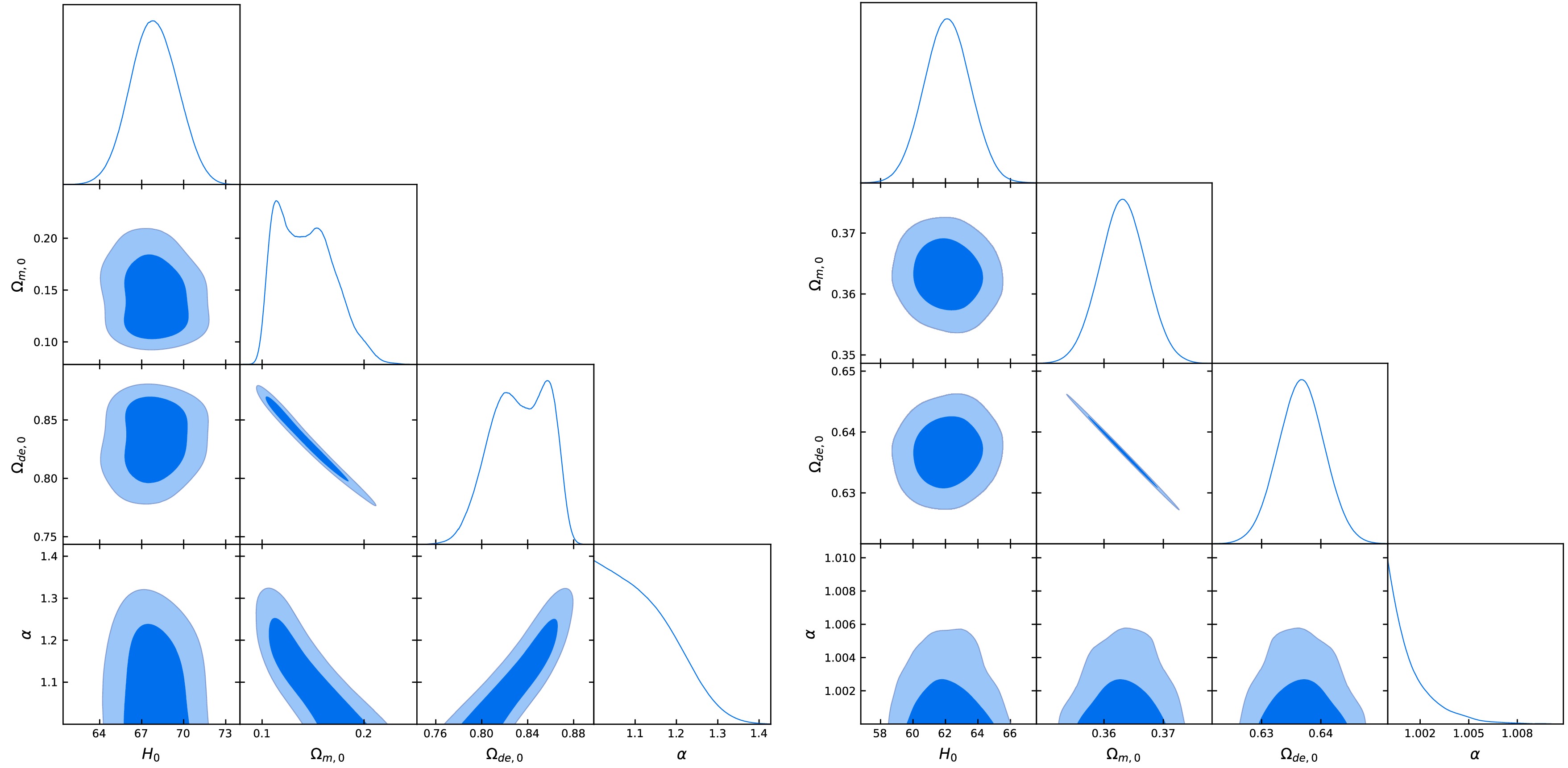
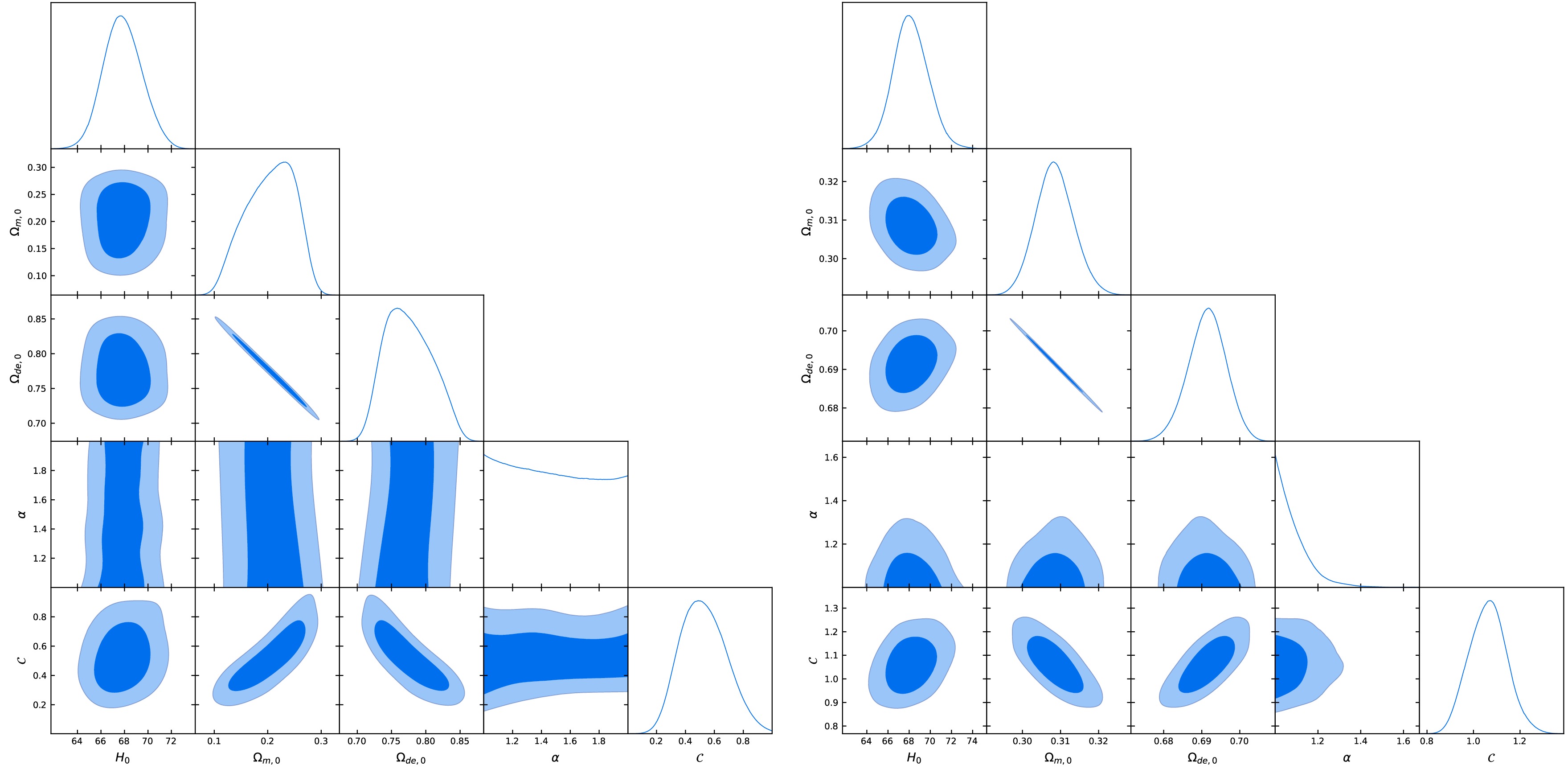
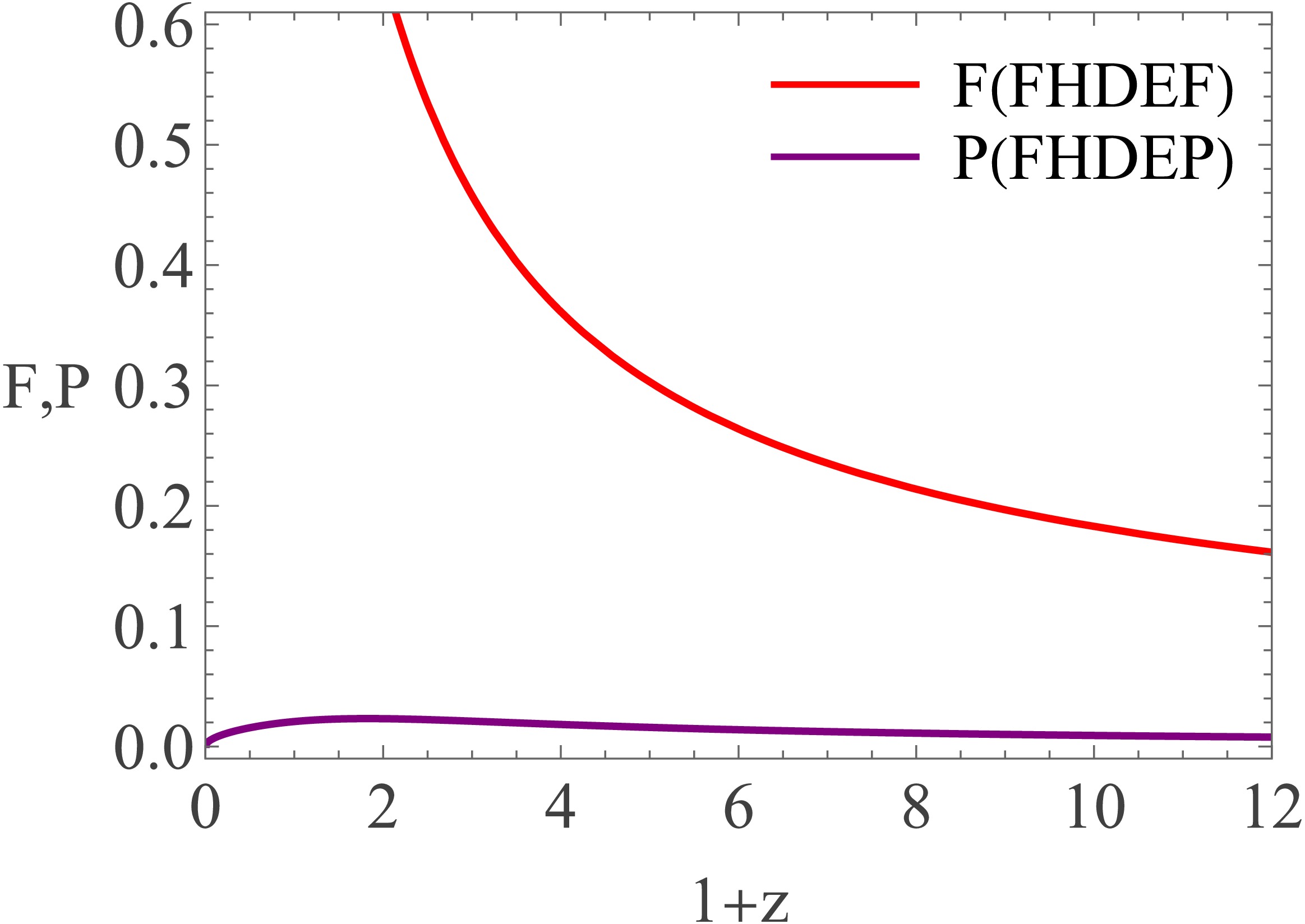
Based on the fractional entropy from fractional quantum mechanics, fractional holographic dark energy (FHDE) has been proposed with the Hubble horizon as the IR cutoff (FHDEH). We extend this framework by adopting the future event horizon and the particle horizon as the IR cutoff and proposing the FHDEF and FHDEP models. Using the SN+OHD+DESI DR2 dataset to constrain these models, we find that all three models provide a marginally lower
\begin{document}$\chi^{2}_{\min}$\end{document}
compared to ΛCDM but without significant preference according to AIC and BIC. When CMB distance priors are included, the FHDEH and FHDEP models are strongly ruled out. We further analyze the cosmological evolution for these models, and find that only the FHDEF model predicts nearly identical evolutions of
\begin{document}$ \Omega_{m} $\end{document}
and
\begin{document}$ \Omega_{\rm de} $\end{document}
to those of the ΛCDM model across cosmic history, but its deceleration parameterqdeviates from the ΛCDM model in the future, indicating richer late time dynamics beyond the standard ΛCDM cosmology.
Based on the fractional entropy from fractional quantum mechanics, fractional holographic dark energy (FHDE) has been proposed with the Hubble horizon as the IR cutoff (FHDEH). We extend this framework by adopting the future event horizon and the particle horizon as the IR cutoff and proposing the FHDEF and FHDEP models. Using the SN+OHD+DESI DR2 dataset to constrain these models, we find that all three models provide a marginally lower




2026, 50(11): 115105.
doi:10.1088/1674-1137/ae8cf4
Abstract:
We investigate the equilibrium structure of electrically charged quark stars within the framework of energy-momentum-squared gravity (EMSG), adopting a unified interacting quark-matter equation of state that incorporates perturbative quantum chromodynamics (QCD) corrections, color superconductivity, and finite strange-quark mass effects. By solving the modified Tolman-Oppenheimer-Volkoff (TOV) equations across a broad range of EMSG coupling strengths and interaction parameters, we show that including electric charge substantially increases both the maximum mass and the radius relative to neutral configurations. For strong negative couplings and pronounced interaction strengths, the resulting stellar models reach masses close to
\begin{document}$3\,M_{\odot}$\end{document}
, with compactness ratios of order
\begin{document}$0.34$\end{document}
, placing them within the mass range inferred for the secondary component of GW190814, whose nature remains observationally undetermined. The presence of charge reduces the central density at maximum mass by approximately
\begin{document}$10\%$\end{document}
–
\begin{document}$15\%$\end{document}
while satisfying causality requirements. Furthermore, comparisons with observational constraints from PSR J1614
\begin{document}$-$\end{document}
2230, J0348
\begin{document}$+$\end{document}
0432, J0740
\begin{document}$+$\end{document}
6620, J0952
\begin{document}$-$\end{document}
0607, and recent NICER radius measurements indicate that charged EMSG configurations remain consistent with current astrophysical bounds across a wide parameter space. These results demonstrate that moderate electric charge, combined with nonlinear matter-geometry coupling, can support quark stars that are significantly more massive than those predicted by general relativity, underscoring the potential observational relevance of charged compact objects in modified gravity and multimessenger astrophysics.
We investigate the equilibrium structure of electrically charged quark stars within the framework of energy-momentum-squared gravity (EMSG), adopting a unified interacting quark-matter equation of state that incorporates perturbative quantum chromodynamics (QCD) corrections, color superconductivity, and finite strange-quark mass effects. By solving the modified Tolman-Oppenheimer-Volkoff (TOV) equations across a broad range of EMSG coupling strengths and interaction parameters, we show that including electric charge substantially increases both the maximum mass and the radius relative to neutral configurations. For strong negative couplings and pronounced interaction strengths, the resulting stellar models reach masses close to


2026, 50(11): 115106.
doi:10.1088/1674-1137/ae8cf1
Abstract:
We investigate the spectral dynamics of a rotating black hole embedded in a Dehnen
\begin{document}$(1,4,\gamma)$\end{document}
dark matter halo, in which quasibound states and superradiant scattering jointly characterize the physical response of the system. Starting from an exact Schwarzschild–Dehnen solution, we construct its rotating counterpart via the Newman–Janis algorithm, thereby obtaining a consistent axisymmetric geometry that incorporates the influence of a structured halo. Through its inner slope parameterγ, the Dehnen profile introduces a controlled deformation of both the near-horizon and asymptotic regions of the spacetime. Using the analytical asymptotic matching method, we derive the quasibound-state spectrum and show that the real part of the frequency retains a hydrogen-like structure but is systematically shifted by the leading-order halo correction proportional to
\begin{document}$\rho_0 r_0^3/(3-\gamma)$\end{document}
. In particular, denser, more extended, and cuspier halos strengthen the binding of the quasibound states, lower the critical mass required for the onset of instability, and typically suppress the growth rate of the black hole bomb. In the scattering sector, we obtain an analytic expression for the superradiant amplification factor and find that the same halo properties that strengthen the binding effects also tend to narrow the superradiant window. These results demonstrate that quasibound states and superradiant scattering are complementary manifestations of a unified spectral structure, with the Dehnen halo acting as an environmental tuner that directly imprints its properties onto both the resonance spectrum and the energy-extraction channels of the rotating black hole.
We investigate the spectral dynamics of a rotating black hole embedded in a Dehnen


2026, 50(11): 115107.
doi:10.1088/1674-1137/ae86dd
Abstract:
In terms of the stability of two-fluid star models, we rigorously prove the equivalence between the emergence of a zero-frequency radial oscillation mode and the static critical-curve criterion for mixed stars, after briefly reviewing the hybrid star case. This establishes a sufficient-condition relation between two independently developed stability criteria. Although this connection has often been implicitly assumed in previous studies on mixed stars, it has rarely been demonstrated explicitly. Our derivation can be extended to general multi-fluid systems. As an example, we consider dark matter-admixed neutron star models and show that their stability boundary differs from that of single-fluid stars. In this case, stable configurations form a surface in the three-dimensional parameter space spanned by the central pressure, mass, and radius, giving rise to a class of stable mixed stars. This class includes ''twin stars'' with identical masses and radii but distinct internal compositions and structures. These results provide a useful framework for interpreting compact star observations and constraining dark matter properties through astrophysical measurements.
In terms of the stability of two-fluid star models, we rigorously prove the equivalence between the emergence of a zero-frequency radial oscillation mode and the static critical-curve criterion for mixed stars, after briefly reviewing the hybrid star case. This establishes a sufficient-condition relation between two independently developed stability criteria. Although this connection has often been implicitly assumed in previous studies on mixed stars, it has rarely been demonstrated explicitly. Our derivation can be extended to general multi-fluid systems. As an example, we consider dark matter-admixed neutron star models and show that their stability boundary differs from that of single-fluid stars. In this case, stable configurations form a surface in the three-dimensional parameter space spanned by the central pressure, mass, and radius, giving rise to a class of stable mixed stars. This class includes ''twin stars'' with identical masses and radii but distinct internal compositions and structures. These results provide a useful framework for interpreting compact star observations and constraining dark matter properties through astrophysical measurements.


2026, 50(11): 115108.
doi:10.1088/1674-1137/ae9264
Abstract:
This study investigates the polarization modes of gravitational waves within the most general symmetric teleparallel gravity theory that allows for second-order field equations. We consider scenarios where test particles either carry or do not carry a hypermomentum charge. Our findings reveal the existence of tensor, vector, and scalar modes of gravitational waves. First, the theory supports the + and × tensor modes propagating at the speed of light. Second, in the case where particles do not carry hypermomentum, vector modes propagating at the speed of light exist only within a very specific parameter space. However, when particles do carry hypermomentum, there are two shear modes that propagate at the speed of light, while the vector-xand vector-ymodes emerge only under very specific conditions. Third, in the presence of hypermomentum, there is always a longitudinal mode propagating at the speed of light. The universal existence of the shear modes and the longitudinal mode in the presence of hypermomentum is a key feature of symmetric teleparallel gravity, distinguishing it from the Riemannian framework through gravitational wave polarization detection. We also analyze the polarization modes in two widely studied special theories:f(Q) theory and quadratic non-metricity theory.
This study investigates the polarization modes of gravitational waves within the most general symmetric teleparallel gravity theory that allows for second-order field equations. We consider scenarios where test particles either carry or do not carry a hypermomentum charge. Our findings reveal the existence of tensor, vector, and scalar modes of gravitational waves. First, the theory supports the + and × tensor modes propagating at the speed of light. Second, in the case where particles do not carry hypermomentum, vector modes propagating at the speed of light exist only within a very specific parameter space. However, when particles do carry hypermomentum, there are two shear modes that propagate at the speed of light, while the vector-xand vector-ymodes emerge only under very specific conditions. Third, in the presence of hypermomentum, there is always a longitudinal mode propagating at the speed of light. The universal existence of the shear modes and the longitudinal mode in the presence of hypermomentum is a key feature of symmetric teleparallel gravity, distinguishing it from the Riemannian framework through gravitational wave polarization detection. We also analyze the polarization modes in two widely studied special theories:f(Q) theory and quadratic non-metricity theory.


2026, 50(11): 115109.
doi:10.1088/1674-1137/ae8ced
Abstract:
We investigate the dynamics of test particles in a Hayward–AdS black hole with string fluid, with particular emphasis on how the relevant parameters influence particle motion. The stability of circular orbits is studied using the effective potential method, which yields analytic expressions for the particle energy and angular momentum in terms of the black hole parameters. The effects of these parameters on the innermost stable circular orbit and the effective force are also examined. In addition, we calculate the pericenter precession frequency and investigate the small oscillatory motion of a particle around a stable orbit, examining how the corresponding frequency is modified by the black hole parameters. We further compare particle dynamics in the Hayward–AdS spacetime with string fluid to those in the Hayward–AdS, the Hayward Reissner Nordstrom, and the conventional Hayward black holes. Lastly, we examine the influence of the string fluid and the Hayward parameter on the quasinormal spectrum and the time-domain dynamics of electromagnetic perturbations, and find that these two terms have reciprocal effects on the quasinormal scale.
We investigate the dynamics of test particles in a Hayward–AdS black hole with string fluid, with particular emphasis on how the relevant parameters influence particle motion. The stability of circular orbits is studied using the effective potential method, which yields analytic expressions for the particle energy and angular momentum in terms of the black hole parameters. The effects of these parameters on the innermost stable circular orbit and the effective force are also examined. In addition, we calculate the pericenter precession frequency and investigate the small oscillatory motion of a particle around a stable orbit, examining how the corresponding frequency is modified by the black hole parameters. We further compare particle dynamics in the Hayward–AdS spacetime with string fluid to those in the Hayward–AdS, the Hayward Reissner Nordstrom, and the conventional Hayward black holes. Lastly, we examine the influence of the string fluid and the Hayward parameter on the quasinormal spectrum and the time-domain dynamics of electromagnetic perturbations, and find that these two terms have reciprocal effects on the quasinormal scale.


2026, 50(11): 115110.
doi:10.1088/1674-1137/ae9916
Abstract:
Starting from the first law of black hole thermodynamics, we establish an explicit correspondence between the corrected entropy and the metric function under the condition of fixed black hole energy and horizon location. Using the corrected metric, we then compute the photon sphere radius and shadow size, demonstrating that different entropy corrections produce characteristic optical shifts. By comparing these results with Event Horizon Telescope observations of Sgr A*, we constrain the parameter range associated with the corrected entropy. This analysis provides a feasible approach for testing generalized entropy frameworks and probing deviations from the Bekenstein--Hawking area law.
Starting from the first law of black hole thermodynamics, we establish an explicit correspondence between the corrected entropy and the metric function under the condition of fixed black hole energy and horizon location. Using the corrected metric, we then compute the photon sphere radius and shadow size, demonstrating that different entropy corrections produce characteristic optical shifts. By comparing these results with Event Horizon Telescope observations of Sgr A*, we constrain the parameter range associated with the corrected entropy. This analysis provides a feasible approach for testing generalized entropy frameworks and probing deviations from the Bekenstein--Hawking area law.


2026, 50(11): 115111.
doi:10.1088/1674-1137/ae9278
Abstract:
Black hole thermodynamics and topology have emerged as a robust foundation for a coordinate-independent understanding of phase transitions. Using both Duan’s topological current theory and a novel complex residue method, we conduct a topological study of the Kerr-Sen AdS black hole arising in heterotic string theory. Specifically, we identify the zero points corresponding to on-shell black hole states and calculate their winding numbers to determine the global topological charge by constructing the generalized off-shell free energy and examining the corresponding vector field in a parametric space. Our analysis reveals that the Kerr-Sen AdS black hole exhibits three distinct thermodynamic phases—small, intermediate, and large black hole branches—characterized by critical points with winding numbers
\begin{document}$ +1 $\end{document}
,
\begin{document}$ -1 $\end{document}
, and
\begin{document}$ +1 $\end{document}
, respectively, culminating in a total topological charge
\begin{document}$ W = +1 $\end{document}
. Significantly, this topological number remains invariant under variations of the dilaton charge parameter, indicating that the dilaton field does not alter the fundamental topological class established for Kerr-AdS and RN-AdS black holes. However, the rotation parameter proves crucial in determining the phase structure and the emergence of multiple critical points. We systematically examine three limiting configurations: the full Kerr-Sen AdS spacetime, the GMGHS AdS limit (
\begin{document}$ a = 0 $\end{document}
), and the asymptotically flat Kerr-Sen case (
\begin{document}$ \Lambda = 0 $\end{document}
). The GMGHS AdS black hole yields a vanishing total topological charge, with winding numbers
\begin{document}$ +1 $\end{document}
and
\begin{document}$ -1 $\end{document}
canceling each other, while the Kerr-Sen black hole (
\begin{document}$ \Lambda = 0 $\end{document}
) similarly exhibits
\begin{document}$ W = 0 $\end{document}
despite possessing two distinct phase branches. Furthermore, we propose a novel approach by analytically continuing the thermodynamic characterization to the complex plane. The resulting complex function, derived from the off-shell Gibbs free energy, possesses isolated singular points whose residues directly encode the winding numbers. Our results indicate that topology offers profound insights into black hole phase transitions, with potential implications for understanding holographic dualities.
Black hole thermodynamics and topology have emerged as a robust foundation for a coordinate-independent understanding of phase transitions. Using both Duan’s topological current theory and a novel complex residue method, we conduct a topological study of the Kerr-Sen AdS black hole arising in heterotic string theory. Specifically, we identify the zero points corresponding to on-shell black hole states and calculate their winding numbers to determine the global topological charge by constructing the generalized off-shell free energy and examining the corresponding vector field in a parametric space. Our analysis reveals that the Kerr-Sen AdS black hole exhibits three distinct thermodynamic phases—small, intermediate, and large black hole branches—characterized by critical points with winding numbers


2026, 50(11): 115112.
doi:10.1088/1674-1137/ae8cef
Abstract:
The main objective of this manuscript is to explore the viable cosmological bounce solutions in the background of
\begin{document}$f(Q,L_{m},T)$\end{document}
gravity, whereQdenotes the non-metricity scalar describing the curvature of spacetime,
\begin{document}$L_m$\end{document}
represents the matter-Lagrangian density, andTis the trace of the energy-momentum tensor. For this purpose, we consider an isotropic and homogeneous universe with bulk viscous fluid to examine the implications of this framework on the dynamics of the early universe. The central focus of this work is to uncover the role of bulk viscosity on the cosmic evolution, especially in non-singular bounces. Furthermore, we investigate the behavior of various cosmological parameters to identify the viable bounce solutions. We find that the positive energy density, negative pressure profile and violation of energy conditions (ECs) support the realization of a cosmological bounce. These results emphasize the importance of bulk viscosity in shaping the cosmic dynamics. We demonstrate that system's entropy evolution satisfies the second law of thermodynamics, confirming its thermodynamic consistency over time. Moreover, the examination of cosmographic parameters and adiabatic sound speed demonstrates the model's kinematic feasibility and stability. Our findings imply that
\begin{document}$f(Q,L_{m},T)$\end{document}
gravity stands as a consistent and alternative theory for standard cosmology, providing a significant theoretical framework to study the gravitational interactions. This modified gravitational theory (MGT) successfully accommodates important aspect of cosmic evolutions and offers a new perspective on geometric and coupling effects that may govern the dynamics of the universe beyond the predictions of general relativity.
The main objective of this manuscript is to explore the viable cosmological bounce solutions in the background of


2026, 50(11): 115113.
doi:10.1088/1674-1137/ae9921
Abstract:
Precise measurements of high-energy cosmic-ray electrons and positrons have revealed spectral features that are difficult to reproduce with a single smooth power-law background. The rising positron fraction measured by PAMELA and AMS-02, together with the all-electron excess reported by ATIC and the high-precision all-electron spectrum measured by DAMPE, has motivated interpretations ranging from nearby astrophysical accelerators to dark-matter annihilation or decay. In this work, we revisit the conventional diffuse electron background and the possible contribution from nearby pulsars within a common propagation framework. The diffuse component is modeled using GALPROP configurations calibrated against cosmic-ray nuclei and diffuse gamma-ray observations. We then use the Green-function solution for nearby discrete sources with radiative losses to study pulsar contributions with both burst-like and continuous injection histories, including the effect of stochastic inverse-Compton cooling on the propagated spectra. We also use the highest-energy DAMPE data points as an illustrative case to compare possible local-source contributions from pulsars and supernova-remnant-like burst sources. The spectral shape of such features provides a useful diagnostic for distinguishing physically plausible nearby-source features from more exotic interpretations.
Precise measurements of high-energy cosmic-ray electrons and positrons have revealed spectral features that are difficult to reproduce with a single smooth power-law background. The rising positron fraction measured by PAMELA and AMS-02, together with the all-electron excess reported by ATIC and the high-precision all-electron spectrum measured by DAMPE, has motivated interpretations ranging from nearby astrophysical accelerators to dark-matter annihilation or decay. In this work, we revisit the conventional diffuse electron background and the possible contribution from nearby pulsars within a common propagation framework. The diffuse component is modeled using GALPROP configurations calibrated against cosmic-ray nuclei and diffuse gamma-ray observations. We then use the Green-function solution for nearby discrete sources with radiative losses to study pulsar contributions with both burst-like and continuous injection histories, including the effect of stochastic inverse-Compton cooling on the propagated spectra. We also use the highest-energy DAMPE data points as an illustrative case to compare possible local-source contributions from pulsars and supernova-remnant-like burst sources. The spectral shape of such features provides a useful diagnostic for distinguishing physically plausible nearby-source features from more exotic interpretations.


2026, 50(11): 115114.
doi:10.1088/1674-1137/ae973b
Abstract:
This work examines the observational signatures of rotating black holes with tidal charge in the Randall–Sundrum braneworld scenario. By combining an elliptic-integral-based analytical treatment with numerical ray tracing, we characterize photon motion around braneworld black holes in detail. At small observer inclinations, secondary images remain embedded within the primary emission rings. As the inclination increases, the primary and secondary images gradually separate, producing a strongly asymmetric image morphology. We show that the image asymmetry and deformation of the inner shadow are jointly governed by the black hole spin, tidal charge, and observer inclination. To analyze frequency shifts across the accretion disk, we extend the emitting region from the ISCO to the event horizon by including the plunging flow. The results indicate that the observer inclination is the dominant factor controlling the frequency-shift distribution. In addition, we reconstruct braneworld black hole images using a fisheye-lens ray-tracing model. The optical morphology and brightness distribution exhibit a clear dependence on the observing frequency, particularly when comparing 230 GHz with 86 GHz. We also compare the brightness distributions of prograde and retrograde disks and find that both the total intensity and peak intensity at 86 GHz are higher than those at 230 GHz. For negative tidal-charge values, we further investigate the corresponding frequency-shift behavior and 230 GHz intensity profiles, which may provide useful theoretical guidance for future studies of extra-dimensional gravity models.
This work examines the observational signatures of rotating black holes with tidal charge in the Randall–Sundrum braneworld scenario. By combining an elliptic-integral-based analytical treatment with numerical ray tracing, we characterize photon motion around braneworld black holes in detail. At small observer inclinations, secondary images remain embedded within the primary emission rings. As the inclination increases, the primary and secondary images gradually separate, producing a strongly asymmetric image morphology. We show that the image asymmetry and deformation of the inner shadow are jointly governed by the black hole spin, tidal charge, and observer inclination. To analyze frequency shifts across the accretion disk, we extend the emitting region from the ISCO to the event horizon by including the plunging flow. The results indicate that the observer inclination is the dominant factor controlling the frequency-shift distribution. In addition, we reconstruct braneworld black hole images using a fisheye-lens ray-tracing model. The optical morphology and brightness distribution exhibit a clear dependence on the observing frequency, particularly when comparing 230 GHz with 86 GHz. We also compare the brightness distributions of prograde and retrograde disks and find that both the total intensity and peak intensity at 86 GHz are higher than those at 230 GHz. For negative tidal-charge values, we further investigate the corresponding frequency-shift behavior and 230 GHz intensity profiles, which may provide useful theoretical guidance for future studies of extra-dimensional gravity models.


2026, 50(11): 115115.
doi:10.1088/1674-1137/ae9b89
Abstract:
In this work, we investigate the Lyapunov exponents that characterize the chaotic dynamics of neutral spinning particles around a Kerr black hole and perform a stringent test of the chaos bound in this framework. We carry out a systematic analysis of the dependence of these exponents on the black hole angular momentum, the particle spin, and its total angular momentum. For a non-extremal Kerr black hole with rotational parameter
\begin{document}$a=\pm 0.90$\end{document}
, no violation of the chaos bound is observed when the black hole rotation is aligned with thez-axis. In the anti-aligned configuration, violations occur only when the particle spin magnitude or total angular momentum exceeds a critical threshold. In the extremal case, which corresponds to a zero-temperature thermal state, the surface gravity vanishes. Within the parameter ranges for which unstable equilibrium orbits exist, the exponents are found to be positive. These results provide clear evidence of violation of the bound by a spinning particle in Kerr spacetime.
In this work, we investigate the Lyapunov exponents that characterize the chaotic dynamics of neutral spinning particles around a Kerr black hole and perform a stringent test of the chaos bound in this framework. We carry out a systematic analysis of the dependence of these exponents on the black hole angular momentum, the particle spin, and its total angular momentum. For a non-extremal Kerr black hole with rotational parameter


2026, 50(11): 115116.
doi:10.1088/1674-1137/ae8ce5
Abstract:
This paper investigates constraints on the parameters of
\begin{document}$ f(R) $\end{document}
modified gravity through high-precision, space-based gravity gradiometer measurements of the planetary gravitomagnetic Lense-Thirring effect. As a generalization of general relativity,
\begin{document}$ f(R) $\end{document}
gravity introduces an additional scalar degree of freedom. In the weak-field limit, it can effectively behave as a scalar-tensor theory and thus may alter gravitomagnetic effects. We derive the metric solution within the parametrized post-Newtonian (PPN) framework and obtain the gravitomagnetic potential containing the
\begin{document}$ f(R) $\end{document}
parameter
\begin{document}$ \eta \equiv G_{{\rm{eff}}}/G $\end{document}
. We propose a differential measurement scheme using two freely falling test masses in a near-Earth orbit to detect the transverse tidal signal induced by the gravitomagnetic field. Solving the geodesic deviation equation at first post-Newtonian order yields a signal proportional toη. For a satellite at an altitude of 1500 km with a gradiometer sensitivity of
\begin{document}$ 10^{-2} {{s}}^{-2}/\sqrt{{\rm{Hz}}} $\end{document}
at 0.1 mHz, one year of data can constrain
\begin{document}$ |\eta - 1| \lesssim 0.0025 $\end{document}
, corresponding to an upper bound on the quadratic coupling parameter
\begin{document}$ \alpha/a^2 \lesssim 1.1\times 10^{-3} $\end{document}
, whereais the radius of the satellite orbit. This work establishes a measurement framework for gravitomagnetic effects in
\begin{document}$ f(R) $\end{document}
gravity and provides a new approach for testing modified gravity with future space-based gradiometer missions.
This paper investigates constraints on the parameters of


2026, 50(11): 115117.
doi:10.1088/1674-1137/ae9c23
Abstract:
We analyze the causal structure of horizonless compact objects through the light-cone geometry and conformal compactification of the Joshi-Malafarina-Narayan (JMN-1) and Janis-Newman-Winicour (JNW) spacetimes. Penrose diagrams reveal that JMN-1 undergoes a transition from timelike
\begin{document}$ (0
to null
\begin{document}$ (2/3
singularities, whereas JNW remains timelike throughout, in contrast to the spacelike singularity of the Schwarzschild spacetime. We show that photon spheres exist in Schwarzschild and JNW spacetimes, but arise in JMN-1 only when the singularity is null. For the class of spacetimes considered here, this result reveals a correspondence between the causal character of the singularity and null-geodesic trapping. We further demonstrate that radial timelike geodesics develop turning points in certain parameter regimes in both JMN-1 and JNW spacetimes, indicating the emergence of such turning points in the strong-field region. These features lead to distinct shadow signatures that may be testable by very-long-baseline interferometric observations such as those of the Event Horizon Telescope.
We analyze the causal structure of horizonless compact objects through the light-cone geometry and conformal compactification of the Joshi-Malafarina-Narayan (JMN-1) and Janis-Newman-Winicour (JNW) spacetimes. Penrose diagrams reveal that JMN-1 undergoes a transition from timelike


2026, 50(11): 115118.
doi:10.1088/1674-1137/ae9fbe
Abstract:
This work examines how a Schwarzschild black hole embedded within a King dark matter halo and immersed in a dispersive, cold plasma leaves observable imprints on photon trajectories. For the King profile
\begin{document}$ (\mu,\nu,\alpha)=(3,2,0) $\end{document}
we obtain a closed-form analytic metric that recovers the Schwarzschild solution once the dark matter contribution vanishes. Applying the Hamilton–Jacobi method to photon propagation in a plasma, we evaluate the photon-sphere radius and the black-hole shadow for both homogeneous and spatially varying plasma configurations. We find that plasma pushes the photon sphere to larger radii while simultaneously shrinking the shadow's apparent size relative to the vacuum case. Comparing these predictions with Event Horizon Telescope shadow measurements of M87* and Sgr A* yields only weak upper limits on the halo's central density and core radius, showing that physically realistic King halos remain consistent with the observed shadows. We further obtain analytic and semi-analytic deflection-angle and magnification formulas in the weak-lensing regime for three plasma configurations: uniform, singular isothermal sphere (SIS), and non-singular isothermal sphere (NSIS). Of these, the homogeneous plasma yields the largest enhancement of both the deflection angle and the magnification relative to vacuum, whereas the SIS profile, despite likewise enhancing the deflection, produces the smallest such enhancement of the models studied. These findings indicate that plasma contributions cannot be neglected when weak gravitational lensing is employed to constrain dark matter concentrations around supermassive black holes.
This work examines how a Schwarzschild black hole embedded within a King dark matter halo and immersed in a dispersive, cold plasma leaves observable imprints on photon trajectories. For the King profile


IF: 3.0
Monthly issued, founded in 1977
Sponsored by:
ISSN1674-1137 CN11-5641/O4
Original research articles, Ietters and reviews Covering theory and experiments in the fieids of
- Particle physics
- Nuclear physics
- Particle and nuclear astrophysics
- Cosmology
Author benefits
- A SCOAP3 participating journal - free Open Access publication for qualifying articles
- Average 24 days to first decision
- Fast-track publication for selected articles
- Subscriptions at over 3000 institutions worldwide
- Free English editing on all accepted articles
News
- Chinese Physics C Best Paper Awards 2026 Announced
- Editorial Office Closed
- CPC Announces 2025 Outstanding Reviewers
- Chinese Physics C Outstanding Reviewer Award 2023
- Impact factor of Chinese Physics C is 3.6 in 2022
Cover Story
- Cover Story (Issue 10, 2026): An autonomous AI physicist Determines three-dimensional Proton Structure
- Cover Story (Issue 9, 2026): Charge Separation Measurements in Au+Au collisions at \sqrt{S_{NN}} = 7.7-200 GeV in Search of the Chiral Magnetic Effect
- Cover Story (Issue 5, 2026): Determination of Fragmentation Functions from Charge Asymmetries in Hadron Production
- Cover Story (Issue 4, 2026): Initial performance results of the JUNO detector
- Cover Story (Issue 3, 2026): Comprehensive investigation on baryon number violating nucleon decays involving an axion-like particle
Advertising


