The 3rd Workshop on Grand Unified Theories: Phenomenology and Cosmology (GUTPC 2026)

Asia/Shanghai
Description

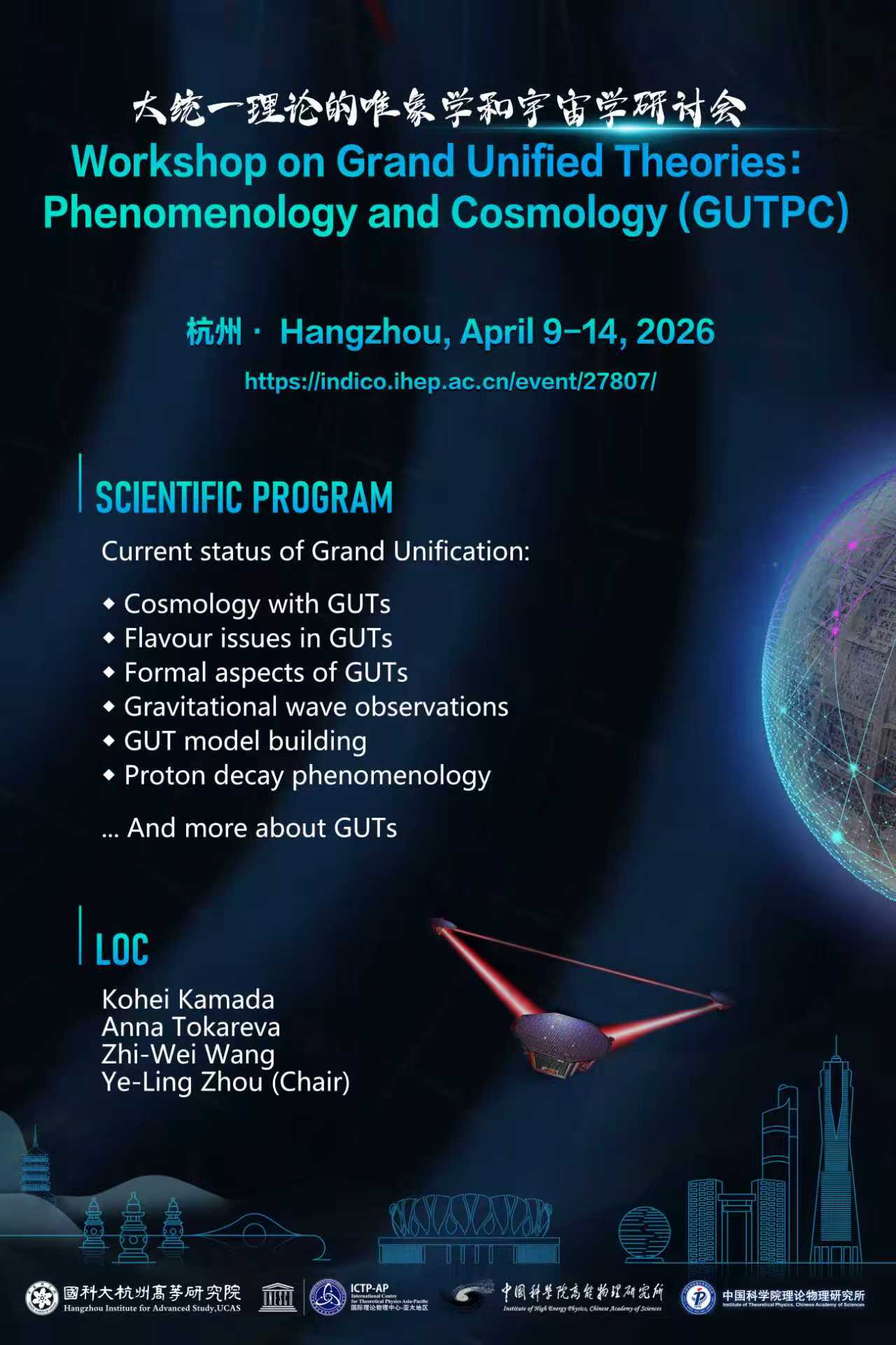
The Workshop on Grand Unified Theory, Phenomenology and Cosmology (GUTPC) will be hosted in Hangzhou Institute for Advanced Study (HIAS), University of Chinese Academy of Sciences (UCAS), on April 9-14, 2026, including registration day and leaving day.

The aim of the workshop is to discuss recent progresses in Grand Unified Theories (GUT), which unifies all fundamental particle forces. Inspired by undergoing and upcoming gravitational wave observatories and precision measurements in neutrino experiments, we will focus on particle phenomenology and cosmology related to GUT.

Registration fee: 1500 CNY for staffs, 1000 CNY for students

Registration and abstract submission deadline: April 1st, 2026

Time: April 9-14, 2026 (arrival on 9, departure on 14)

Address: Conference Hall on Floor 2A, B3, Yunyi Campus of HIAS, UCAS

国科大杭州高等研究院云艺园区 3号楼 2楼报告厅

Contact:
Ms. Jing Wang (SLXY@ucas.ac.cn)
Ms. Shutong Liu (liushutong@ucas.ac.cn)
Participants
  • Aldo Deandrea
  • Alexey Koshelev
  • Andrew Cheek
  • Anna Tokareva
  • Borut Bajc
  • Bowen Fu
  • Chang Hu
  • Chao-Qiang Geng
  • Chen Sun
  • Chun (纯) Liu (刘)
  • Danny Marfatia
  • Deshan Yang
  • Eung Jin Chun
  • Fei Wang
  • Fotis Koutroulis
  • Francesco Sannino
  • Frank Deppisch
  • Haijun Wang
  • Hajime Otsuka
  • Jessica Turner
  • Jia-Jun Wu
  • Jingya ZHU
  • Kohei Kamada
  • Lingfeng Li
  • Liu yutong
  • Long-Bin Chen
  • Mohammed Omer Khojali
  • Natsumi Nagata
  • Oleg Lebedev
  • Pavel Petrov
  • Peter Athron
  • Qing Chen
  • Roman Pasechnik
  • Runqi Kang
  • Saurabh Kumar Shukla
  • Sebastian Garcia-Saenz
  • Shao-Jiang Wang
  • Shihwen Hor
  • Shun Zhou
  • Shuntaro Aoki
  • Sin Kyu Kang
  • Takumi Kuwahara
  • Tao Zhu
  • Tianjun Li
  • Wei Chao
  • Wei(刘威) Liu
  • Wen-Hao Jiang
  • Wenyuan Ai
  • Xiao-Dong Ma
  • Xiao-Gang He
  • Xingyu Wang
  • Xiyuan Gao
  • Xubin Hu
  • Ye-Ling Zhou
  • Yi Yang
  • Yi-Lei Tang
  • Yifan Hu
  • YIFU CAI
  • Yoshiki Uchida
  • Yucheng Wang
  • Yufeng Li
  • Yuichiro Nakai
  • Zhen-hua Zhao
  • Zhi-zhong Xing
  • ZHIWEI 志伟 WANG 王
  • Zhiyong WANG
  • Zi-Qiang Chen
  • 君豪 刘
  • 海静 周
  • 贇 蒋
  • 赛雅 张
    • Registration
    • Registration
    • Plenary
      Convener: Zhi-zhong XING(IHEP, Beijing)
      • 1
        GUT Seesaw Parameters from low energy physics inputs

        TBA

        Speaker: Prof.Xiao-Gang He(TDLI)
      • 2
        Probing High-scale Physics with Neutrinoless Double Beta Decay

        TBA

        Speaker: Prof.Frank Deppisch(UCL)
    • Registration
    • break
    • Plenary
      Convener: Prof.Deshan Yang(UCAS)
      • 3
        Modulus Stabilization of modular flavor models in Jordan frame supergravity

        We propose to discuss the modular flavor model and the stabilization of single modulus field in the Jordan frame supergravity with non-minimal scalar-curvature coupling. Modular invariance and positivity of the scale factor constrain stringently the form of the frame function, consequently the Kahler potential. We discuss some general properties of scalar potentials after the scale transformation from the Jordan frame to the Einstein frame. We find that the shape of the resulting scalar potential in the Einstein frame is quite different from that of ordinary single modulus stabilization mechanism. The scalar potential could be stationary at the fixed point, leading to a runaway type vacuum. We also discuss numerically the modulus stabilization for some simplified scenarios.

        Speaker: Fei Wang(Department of Physics, ZhengZhou University)
      • 4
        Inflation and Cosmological Collider Signals in Modular Theories

        Modular symmetry arises in various extensions of the Standard Model and plays an important role in particle phenomenology. In this talk, I explore its cosmological implications from the perspectives of inflation and cosmological collider physics. Modular inflation models lead to multi-field dynamics and characteristic primordial signatures, while modular extensions generically predict heavy states that can be probed through cosmological collider signals in non-Gaussianities. This provides a novel way to test modular symmetry in the early Universe.

        Speaker: DrShuntaro Aoki
      • 5
        Lepton Flavor Structure near a Modular Fixed Point

        Modular symmetry is a promising framework for flavor physics, where Yukawa couplings are described by modular forms. After a brief introduction to the basic idea, this presentation focuses on the behavior of modular forms near a fixed point and discusses how their general properties can shed light on lepton flavor structure

        Speaker: Xing-Yu Wang(Sichuan University)
    • Lunch
    • Plenary
      Convener: Shun Zhou(高能所)
      • 6
        Prominence: a discriminator of gravitational wave signals

        The concept of prominence is familiar to signal engineers, topographers and mountaineers. I will introduce prominence as a discriminator of gravitational wave signals.

        Speaker: Prof.Danny Marfatia(Hawaii University)
      • 7
        High-frequency gravitational waves from first-order phase transitions

        First-order phase transitions in the early Universe are a well-motivated source of gravitational waves. In this talk, I will discuss a previously overlooked gravitational wave production mechanism: gravitational transition radiation, arising from graviton emission by particles whose mass changes as they pass through expanding bubble walls. The resulting spectrum features a distinctive shape with a peak frequency redshifting to 10 GHz, corresponding to the current temperature of the Universe. This mechanism is generic and is expected to operate similarly for domain walls and other relativistic interfaces.

        Speaker: Wenyuan Ai(Tsung-Dao Lee Institute, Shanghai Jiao Tong University)
      • 8
        Probing quark-lepton correlation in GUTs with high-precision neutrino measurements

        GUTs unify quarks and leptons into same representations and predict correlations between their masses and mixing. We perform numerical scans in SO(10) GUTs to explore the flavor space with new data of JUNO taken into account. The quark-lepton correlation shows the preference of normal ordering for light neutrino masses, predicts favored region of the CP-violating phase in neutrino oscillations, and classifies GUT models based on their testability in neutrinoless double beta decay experiments. The quark-lepton correlation predicts mass spectrum of right-handed neutrinos, pointing to the energy scale of baryon and lepton number violation and providing sources for baryogenesis. We emphasize that, as high precision measurements of neutrino physics are coming, the quark-lepton correlation will provide increasingly important role in the testability of GUTs, complementary to proton decay measurements.

        Speaker: Zi-Qiang Chen(HIAS-UCAS)
    • break
    • Plenary
      Convener: Kohei Kamada(HIAS, UCAS)
      • 9
        Proton Decay Patterns as Probes of Grand Unified Theories.

        TBA

        Speaker: Prof.Natsumi Nagata(Tokyo University)
      • 10
        BNV nucleon decays in the landscape of effective field theory

        In the talk, I will summarize our recent works on the study of baryon-number-violating nucleon decay modes, either with or without a new light particle in the final state. In light of the current and upcoming neutrino expriments, a solid theoretical description of all possible kinematically allowed decay modes is urgent. We work within the low energy effective field theory (LEFT) plus chiral perturbation theory (ChPT) framework, and construct the relevant LEFT operators and their corresponding hadronic chiral counterparts. Within the chial framework, we formulate the general expressions of the nucleon decay widths and analyze their characteristic experimnetal signatures, which facilitate experimental searches for those nucleon decays.

        Speaker: DrXiao-Dong Ma(SCNU)
      • 11
        Planck-Scale Effects on Nucleon Decay in Minimal Supersymmetric SU(5)

        We examine the impact on the phenomenology of the minimal supersymmetric SU(5) Grand Unified Theory (GUT) of dimension-5 operators with coefficients suppressed by the Planck mass scale, with particular emphasis on predictions for nucleon decay. We incorporate dimension-5 operators in both the Higgs sector and the Yukawa interactions in the theory, and take account of the constraints from gauge coupling measurements, the mass of the Higgs boson, fermion masses and the cold dark matter density. We consider two scenarios for soft supersymmetry breaking: the constrained minimal supersymmetric extension of the Standard Model (CMSSM) and the Non-Universal Higgs Model (NUHM). We present predictions for the nucleon decay modes p → π0e+, π0μ+, K+ ¯ν, π+ ¯ν, K0e+, K0μ+ and n → π0 ¯ν, π−e+, K0 ¯ν, which we compare with both the present experimental sensitivities and those projected for the JUNO and Hyper-Kamiokande experiments. We find that these experiments may have interesting possibilities for discovering several of these decay modes.

        Speaker: Shihwen Hor
    • Reception: Yuanye Restaurant
    • Plenary
      Convener: Prof.Chao-Qiang Geng(HIAS)
      • 12
        Tracking down the route of GUT breaking

        TBA

        Speaker: Prof.Eung Jin Chun(KIAS)
      • 13
        The Dual Standard Model

        TBA

        Speaker: Prof.Francesco Sannino(Southern Denmark University)
    • Photo session
    • Fei_Wang.pdf
  • 4
    Inflation and Cosmological Collider Signals in Modular Theories

    Modular symmetry arises in various extensions of the Standard Model and plays an important role in particle phenomenology. In this talk, I explore its cosmological implications from the perspectives of inflation and cosmological collider physics. Modular inflation models lead to multi-field dynamics and characteristic primordial signatures, while modular extensions generically predict heavy states that can be probed through cosmological collider signals in non-Gaussianities. This provides a novel way to test modular symmetry in the early Universe.

    Speaker: Dr Shuntaro Aoki
  • 5
    Lepton Flavor Structure near a Modular Fixed Point

    Modular symmetry is a promising framework for flavor physics, where Yukawa couplings are described by modular forms. After a brief introduction to the basic idea, this presentation focuses on the behavior of modular forms near a fixed point and discusses how their general properties can shed light on lepton flavor structure

    Speaker: Xing-Yu Wang (Sichuan University)
  • Lunch
  • Plenary
    Convener: Shun Zhou (高能所)
  • break
  • Plenary
    Convener: Kohei Kamada (HIAS, UCAS)
  • Reception: Yuanye Restaurant
  • Saturday, 11 April
  • Sunday, 12 April
  • Monday, 13 April
  • Baidu
    map