
The BESIII collaboration recently reported the first search for four-body Ds+decays to final states including an e+e-pair, based on 7.33 fb-1data collected in the energy range √s=4.128-4.226 GeV. The results have been published recently in Physics Review Letters on September 17, 2024 [Phys. Rev. Lett. 133, 121801 (2024)].
The rare decays via c→ue+e-processes are flavor-changing neutral-current (FCNC) transitions which are sensitive to new physics. However, FCNC transitions in charm decays are often overshadowed by long-distance (LD) effects mediated by vector mesons. Precise measurements of these LD effects in rare charm decays are essential for exploring FCNC contributions and testing lepton flavor universality (LFU). The latter is particularly interesting by offering an analogy in the up-quark sector, in response to recent LHCb RKand RK*measurements. Until now, experimental results for four-body decays of charged charm mesons into final states with an e+e-pair have been limited, due to the presence of a final-state neutral hadron (π0or KS0), which is challenging for hadron collider experiments. Therefore, the BESIII experiment is especially advantageous here due to relatively low background level with near-threshold charm production, and superb detector performance in measuring electrons and neutral hadrons such as π0and KS0.
In this work, based on about six million Ds*±Ds∓pairs collected with the BESIII detector at the BEPCII storage ring, we search for the rare decays Ds+→h+(h0)e+e-, where h represents a kaon or pion. By requiring the e+e-invariant mass to be consistent with a ϕ(1020), 0.98
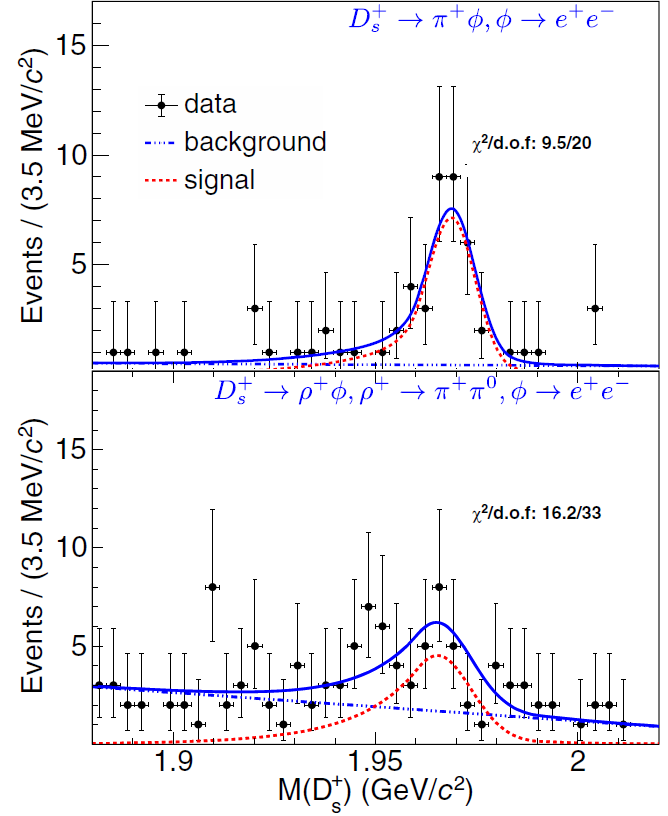
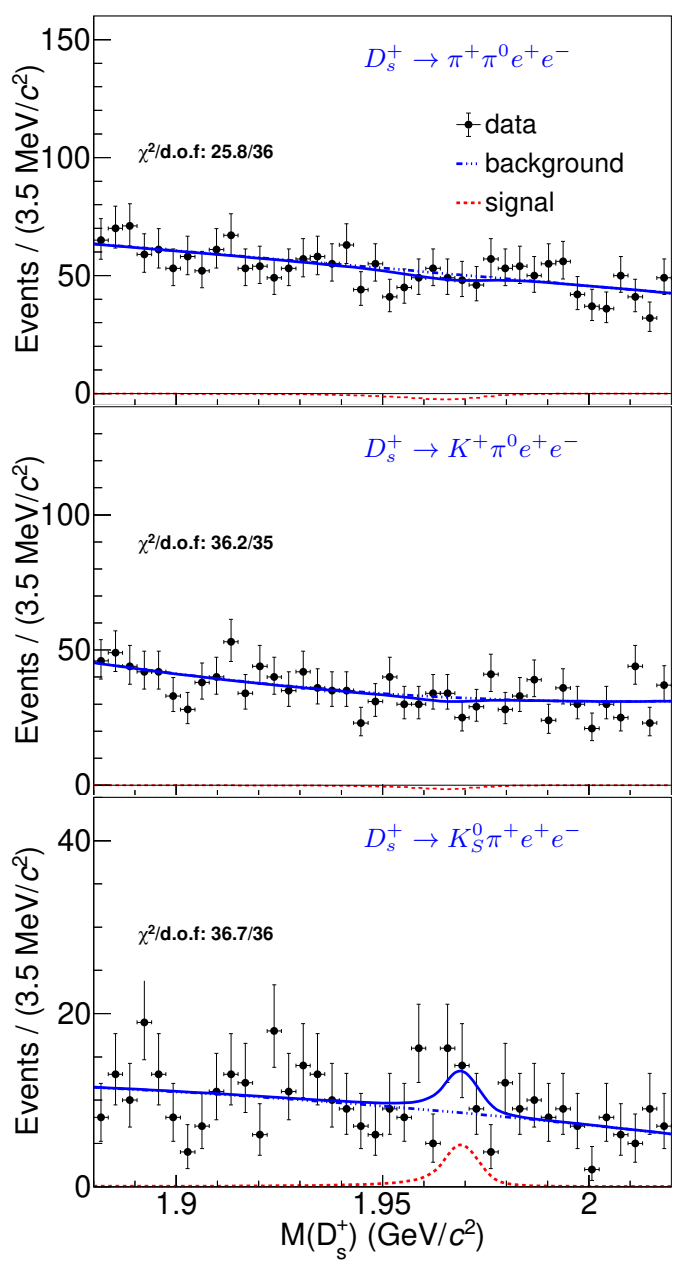
FIG.1. Left: Fits to the M(Ds+) distributions in the ϕ region: 0.98
Further reading:
PRL publication link:https://link.aps.org/doi/10.1103/PhysRevLett.133.121801
arXiv link:https://arxiv.org/abs/2404.05973