BESIII collaboration has reported the first hadronic form factor measurement of the semileptonic decay D
s
+→f
0(980)e
+ν
ewith f
0(980)→π
+π
-and the first search of the decay D
s
+→f
0(500)e
+ν
ewith f
0(500)→π
+π
-. These results have been published in Physical Review Letters on 05 April 2024. [Phys. Rev. Lett. 132,141901(2024)].
The light scalar mesons f
0(500), f
0(980), and a
0(980) play a crucial role in the dynamics of the spontaneous breaking of QCD chiral symmetry and in the origin of pseudoscalar meson masses, and consequently can be used to probe the confinement of quarks. Furthermore, our understanding of the nature of light hadrons is still poor since QCD is nonperturbative in the low-energy region. Investigating the structure of the light scalar mesons provides key input to these issues. In spite of the striking success of the constituent quark model, the nontrivial quark structure of these mesons has remained controversial for many years. Since the leptons and hadrons in the final state interact only weakly with each other, semileptonic decays of charm mesons provide a unique and clean platform to probe the constituent qqbar components in the wave functions of light scalar states. Additionally, the dynamics of the semileptonic charmed meson decays can be studied by measuring the hadronic form factor that describes the strong interaction between the final-state quarks, including all the nonperturbative effects.
Using e
+e
-annihilation data corresponding to an integrated luminosity of 7.33 fb
-1collected at center-of-mass energies between 4.128 and 4.226 GeV, we measure the branching fraction of the decay D
s
+→f
0(980)e
+ν
ewith f
0(980)→π
+π
-to be (1.72±0.13±0.10)×10
-3, which is best accurate up to date. In the qqbar mixture picture, this implies that the ssbar component dominates for the f
0(980). The decay D
s
+→f
0(500)e
+ν
ewith f
0(500)→π
+π
-is searched for the first time but no signal is found. The upper limit on the branching fraction of D
s
+→f
0(500)e
+ν
e, f
0(500)→π
+π
-decay is set to be 3.3×10
-4at 90% confidence level. These branching fractions measurements, especially the one involving f
0(500), favor the predictions of models assuming f
0(980) and f
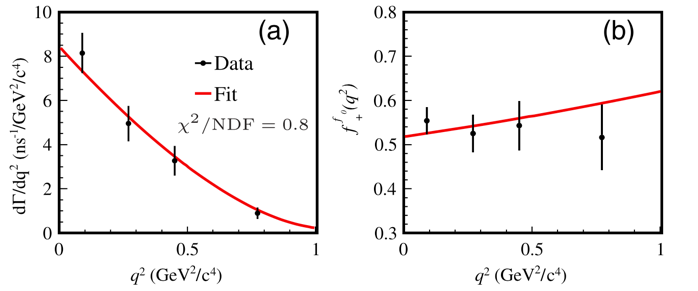
0(500) as tetraquark composition over those based on the qqbar mixture picture. Furthermore, the product of the form factor f
+
f0(0) and the
c →sCabibbo-Kobayashi-Maskawa matrix element |V
cs| is determined for the first time to be f
+
f0(0)|V
cs|=0.504±0.017±0.035 by analyzing the dynamics of the decay D
s
+→f
0(980)e
+ν
e, f
0(980)→π
+π
-with the simple pole parametrization of the hadronic form factor and the Flatte formula describing the f
0(980) in the differential decay rate. These results are important to understand the nature of the light scalar states f
0(980)and f
0(500), and the nonperturbative dynamics of charm meson decays.